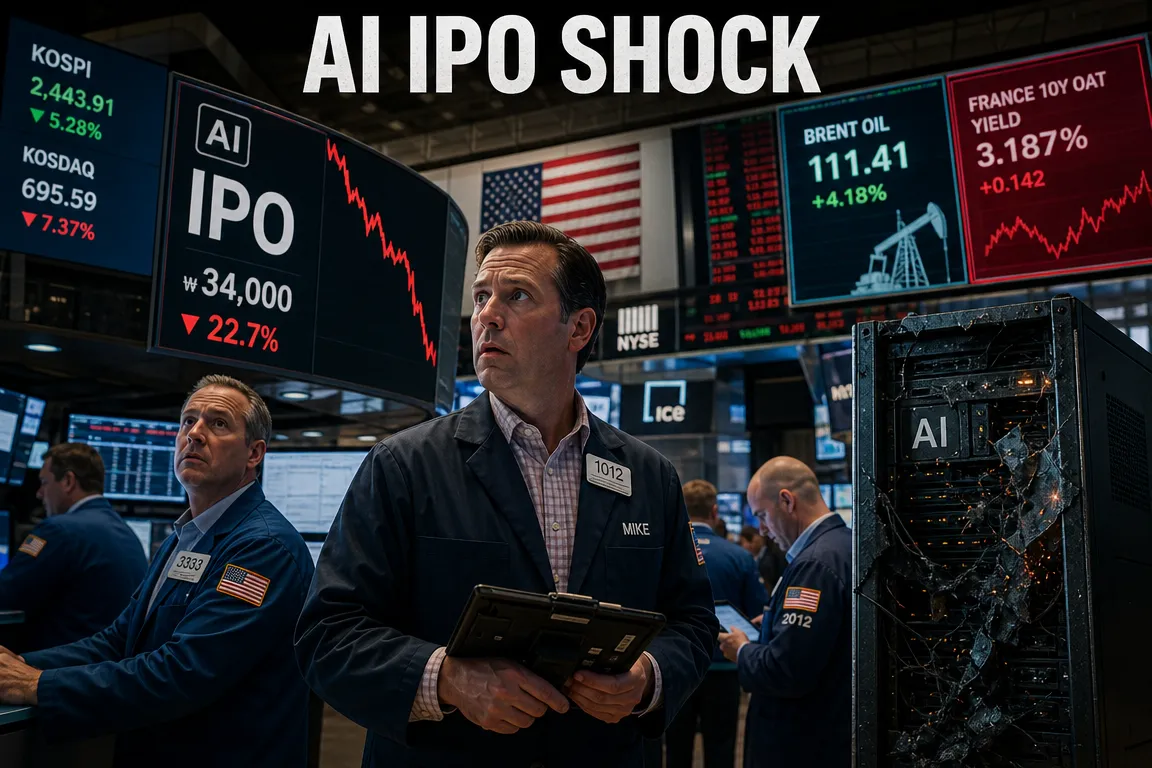
● AI IPO Shock, Oil Spike, France Bond Panic
How Korea’s AI IPO Shock Roiled Wall Street: Ellis Slides 32%, Oil Tops $110, and French Bond Stress Hits the Radar
Today’s market story is not simply that “technology stocks fell.”
The 32% first-day plunge in Ellis, an AI infrastructure company listed on Korea’s Kosdaq, directly weakened Wall Street’s AI risk appetite, and the pressure spread to Nvidia, Micron, and SK Hynix ADRs across the global semiconductor value chain.
At the same time, claims of an attack on tankers in the Gulf pushed international oil prices above $110 per barrel, reviving inflation concerns, while French bond yields approached a 24-year high and renewed fears over European fiscal stability.
What looks like a routine correction in U.S. equities is better understood as a combined warning sign involving AI exuberance, debt risk, energy prices, global bond yields, and political risk.
1. New York market overview: the technology rebound ended after one day
On October 20, U.S. equities failed to extend the previous day’s rebound in technology shares and turned lower again.
The S&P 500 opened slightly below flat, while the Nasdaq 100 fell by as much as around 1%, highlighting a correction centered on technology stocks.
The Dow Jones held up relatively well, and the Russell 2000 showed some gains, indicating a rotation out of large-cap technology and into defensive names and select small caps.
The prior day, U.S. equities had rebounded as dip buying returned to semiconductors and AI-related stocks that had fallen sharply the previous week.
That tone did not carry into Asian trading.
Korea’s KOSPI dropped 3.7%, Samsung Electronics fell about 3%, and SK Hynix declined more than 4%.
In particular, Ellis, the AI infrastructure company listed on the Kosdaq, fell 32% on its first trading day, reinforcing investor caution globally.
Wall Street’s concern was straightforward.
The decline was seen not as an isolated listing event, but as a sign of fatigue in the global AI investment cycle.
AI investment, semiconductors, data centers, high funding costs, and IPO valuations are increasingly being viewed as one interconnected trade, and the pressure is now affecting U.S. technology sentiment as well.
2. Ellis falls 32% on debut: why Wall Street watched a Korean IPO
The most important issue in this briefing is Ellis’s sharp decline on its Kosdaq debut.
Ellis is an AI infrastructure and data center-related company that drew strong market attention.
The IPO price was KRW 95,000, but the stock closed at KRW 61,500 on its first day, down about 32%.
Bloomberg data indicate that this was the worst first-day performance among Korean IPOs with a deal size above $100 million.
Pre-listing sentiment had been strong.
The subscription competition ratio was around 389 to 1, and deposits exceeded KRW 10 trillion.
Yet once trading began, selling pressure overwhelmed demand.
The issue was not that the business was fundamentally weak.
First-half revenue rose 200% year over year, and operating profit reached KRW 10.3 billion.
Even so, investors turned away because of valuation concerns.
Based on the offer price, the company’s market capitalization exceeded KRW 1 trillion, implying an enterprise value of roughly 15 times sales.
The market is no longer willing to justify elevated valuations on growth alone.
AI infrastructure companies require heavy upfront spending on data centers, GPUs, power, cooling, and networking.
Investors are now focusing more strictly on cash flow, cost of capital, payback timing, and debt burden than on revenue growth alone.
3. The real issue: for AI infrastructure, the problem is not demand but payback period
Many reports describe Ellis’s plunge as evidence of a cooling AI trend.
The more important point is that AI demand itself has not disappeared; rather, the market is increasingly questioning how long it will take to recover the capital invested in AI infrastructure.
The AI industry is not weakening because of lack of demand.
Chinese large-cap technology firms are still placing massive orders for Nvidia GPUs, and cloud and data center operators continue to evaluate capital spending to meet rising AI inference demand.
The real issue is the revenue model.
Companies spend heavily first on GPUs and data centers, and only later recover that investment if customer usage rises sufficiently.
In a high-rate environment, the longer that payback period becomes, the more the valuation is compressed.
In other words, the key variable in the AI investment cycle is not whether AI is promising, but whether AI infrastructure can generate returns above its cost of capital.
From that perspective, Ellis’s selloff can be seen not as a failed Korean IPO, but as an early sign of a broader repricing in global AI infrastructure valuations.
That is why Wall Street paid attention to the Korean debut.
4. Semiconductor weakness spread: Nvidia, Micron, and SK Hynix ADRs all came under pressure
The Ellis shock quickly affected U.S. semiconductor stocks.
Nvidia fell more than 1% early in the session, while AMD and Micron also traded lower.
SK Hynix ADRs at one point dropped more than 3%, reflecting weaker sentiment toward Korean memory semiconductors.
Micron was especially notable.
It had rebounded about 3% the previous day, but quickly turned lower again.
Measured since October 7, the stock has fallen nearly 20%.
Micron is facing three overlapping pressures.
First, the sharp declines in SK Hynix and other Korean chip names weakened memory sentiment.
Second, Ellis’s poor IPO performance raised concerns about AI infrastructure demand.
Third, a labor union at its Taoyuan facility in Taiwan threatened a strike over bonus payments.
The Taoyuan facility is one of Micron’s major memory production sites.
A possible supply disruption could be relatively favorable for Samsung Electronics and SK Hynix on the supply side.
However, the market is currently more focused on overheating in the broader AI investment cycle and weaker profitability than on individual production issues.
As a result, the entire semiconductor sector is under pressure.
5. SoftBank CDS at 432 bps: a warning sign for leveraged AI investment
SoftBank’s credit risk also emerged as a key warning signal.
As of October 20, SoftBank’s 5-year CDS spread rose to 432 bps.
That is the highest level since November 2022, and it increased by 30 bps in just one week.
A CDS is a derivative used to insure against default risk.
A wider CDS spread means the market is assigning higher credit risk or default risk to the company.
SoftBank’s CDS is the highest among major Japanese corporates and is more than 130 bps above Nissan, which ranks second.
SoftBank’s share price has also fallen about 50% from its June peak.
The main reason is aggressive fundraising to expand AI investment.
SoftBank is a major investor in OpenAI and is deploying capital across AI infrastructure and related companies.
The company also recently announced a roughly $11 billion junk bond issuance.
The coupon is 9.75%, close to 10%.
Borrowing at that level implies that future investment returns must be very high to justify the financing cost.
The market’s concern is not simply that SoftBank is investing in AI.
The issue is that the investment is being financed with debt, while the timing of cash-flow generation remains uncertain.
With credit risk now surfacing at CoreWeave and SoftBank, leverage in AI is no longer a side issue; it is now a central market variable.
6. Chinese big tech orders $35 billion of Nvidia GPUs: AI demand remains intact
While concerns over AI investment rose, a strong demand signal also emerged.
ByteDance, Alibaba, and Tencent reportedly ordered more than 3 million Nvidia RTX Pro 5500 graphics cards.
The order value is about $35 billion, or more than KRW 50 trillion.
The RTX Pro 5500 complies with U.S. export restrictions on sales to China.
Chinese companies plan to use the GPUs mainly for AI inference workloads.
This reflects the rapid growth in inference demand, rather than training alone.
However, actual delivery remains uncertain.
Total orders from Chinese companies are said to exceed 6 million units, while Nvidia’s global production capacity next year is estimated at up to 3 million units.
Some customers may receive only 5% to 10% of their requested volume.
This distinction matters.
Financial-market concerns about AI investment and actual AI compute demand are both real.
In other words, AI is not disappearing; rather, the market is entering a phase in which demand remains strong, but the financing structures used to expand capacity are becoming riskier.
Investors need to distinguish between the two.
7. HSBC’s counterargument: the AI debt issue is not comparable to 2008
HSBC recently argued that concerns over an AI-driven debt crisis are overstated.
Its view is that the current situation differs materially from the 2008 global financial crisis in terms of leverage structure.
U.S. nonfinancial corporate debt currently stands at about 140% of GDP.
In 2008, it was 171%, meaning current leverage is more than 30 percentage points lower than during the financial crisis.
Household debt has also fallen to about 66% of GDP from 97% in 2008.
Bank capitalization has also improved significantly since then.
HSBC’s real concern is not the total debt level, but AI investment profitability.
A limited number of AI firms and data center companies are absorbing large amounts of capital, while cross-investment and funding relationships are creating a complex circular structure.
The upcoming earnings season will therefore be critical.
It will show whether AI spending is translating into revenue and profit, whether data center expansion is generating cash flow, and whether big-tech capital expenditures are justified by the numbers.
8. Crude oil tops $110: claims of tanker attacks in the Gulf revive inflation fears
Oil prices were another major market driver.
Brent crude rose above $111 per barrel intraday, its highest level in five months.
WTI also climbed to around $99, nearing the $100 threshold.
Oil prices are up roughly 13% so far this month.
The immediate catalyst was a statement from Iran’s Revolutionary Guard.
Iran claimed that two tankers struck mines it had placed south of the Strait of Hormuz, causing fires and halting operations.
The UK Maritime Trade Operations agency also confirmed an incident involving a vessel linked to military activity east of Oman.
The Strait of Hormuz is a critical route for global oil shipments.
When mine threats rise in the area, tanker freight and insurance costs increase even if physical supply does not immediately decline.
Those costs are ultimately reflected in global oil prices.
Higher oil prices add to inflation pressure.
If inflation rises again, expectations for Federal Reserve rate cuts weaken, and in some cases rate hike concerns may reappear.
That is negative for growth stocks and technology valuations.
9. U.S. gasoline and diesel prices: freight and farm costs are under pressure
According to AAA, the national average U.S. gasoline price was around $4.28 per gallon.
That was slightly below the previous week and also lower than a month ago, but still about 41% higher than a year earlier.
Diesel is the more important issue.
The national average diesel price was around $6.32 per gallon, more than 70% above the prior year.
Because trucking plays a central role in U.S. logistics, higher diesel prices feed directly into freight costs.
As freight costs rise, corporate input costs increase and eventually put upward pressure on consumer prices.
Farmers are also being hit directly.
Tractors and harvest equipment are largely diesel-powered.
A sharp rise in diesel prices significantly increases harvest-season costs.
10. Trump’s $8 billion farm support plan: energy prices and politics intersect
President Trump announced an $8 billion support package for U.S. farmers.
That is roughly KRW 11 trillion.
The stated purpose is to ease fuel-cost pressure during the harvest season.
The U.S. Department of Agriculture plans to introduce a new harvest fuel support program.
Payments will be calculated based on acreage, crop-specific production costs, and output levels.
Specific payment rates are expected to be released in November.
The political significance is also clear.
The announcement came roughly two weeks before the U.S. midterm elections and was unveiled at a Republican campaign event in Kansas.
With fuel prices rising, the measure is intended to ease inflation pressure while appealing to rural voters.
11. U.S. economic data: housing and employment are both slowing
Pre-market U.S. data pointed to a slowing economy.
Housing starts came in at 1.221 million, below the forecast of 1.30 million.
They also declined 5.2% from the previous month.
Building permits were 1.40 million, slightly above the 1.39 million forecast.
However, both starts and permits declined in the single-family segment.
Weakness in the single-family housing market suggests that high rates continue to weigh on both construction and demand.
Employment also weakened.
The 4-week average of weekly private payroll growth from ADP fell to 18,500 from 26,000 previously.
The combination of slowing housing and weaker employment suggests the U.S. economy is increasingly feeling the effects of high interest rates.
12. Corporate earnings: GE Aerospace and 3M beat estimates, while GM faces guidance pressure
GE Aerospace reported better-than-expected third-quarter results.
Adjusted earnings per share were $1.25, above consensus, and rose 36% year over year.
New orders reached $19 billion, up 49% from the prior year.
Airlines are keeping older aircraft in service longer, which has increased demand for engine maintenance and parts replacement.
The company also raised its full-year guidance.
However, if oil prices remain elevated, airline costs could rise and create a headwind for growth next year.
3M also reported third-quarter earnings above expectations.
Net income rose sharply from $834 million last year to $1.37 billion.
Revenue growth was modest, but profitability improved through cost reductions and productivity gains.
GM’s results were not weak, and the company announced a $20 billion share buyback.
Still, the stock fell.
The reason was the outlook.
Higher energy prices, logistics costs, and semiconductor costs are raising pressure on margins, and the market is discounting weaker future earnings power.
In the current environment, a strong reported quarter alone is no longer enough to lift a stock.
If forward guidance disappoints, shares can fall even after solid earnings.
13. After-market earnings to watch: Netflix, SpaceX, and airlines
After the close, earnings from major companies including Netflix and SpaceX are scheduled.
For Netflix, the key issues are advertising revenue growth and subscriber momentum.
For SpaceX, the focus is on Starlink growth and investment scale.
Earnings from United Airlines and Alaska Airlines will also be closely watched.
With crude prices rising sharply, the key question is how much fuel costs are affecting margins and guidance.
Other reports from Capital One, Chubb, and Pegasystems are also due.
This earnings season is testing not only AI profitability, but also the impact of high oil prices and high rates on corporate results.
14. French bond yields approach a 24-year high: European fiscal stress returns
France’s bond market is also under pressure.
France has seen continued unrest and protests, and some areas have introduced curfews after 11 p.m.
Demonstrators have called for additional rallies, keeping social tensions elevated.
French 10-year bond yields rose to as high as 4.96%, near the highest level since 2002.
By contrast, German yields fell.
Germany is viewed as a safe haven within Europe, so capital tends to move into German bonds when stress rises.
As a result, the spread between French and German 10-year yields widened to 152 bps.
That indicates investors are demanding a larger risk premium to hold French debt.
France’s core problem is its fiscal deficit.
The deficit is expected to reach 5.4% of GDP this year.
National debt could exceed 120% of GDP next year.
The government has announced plans to cut spending by EUR 54 billion next year, but rising public resistance makes fiscal tightening difficult.
A Moody’s review of France’s sovereign rating is also scheduled for Friday.
The government needs to reduce the deficit to protect its credit rating, but tighter austerity could intensify social backlash, creating a policy dilemma.
15. U.S., Japan, and German bond markets: safe-haven demand and bargain buying
U.S. Treasury yields fell across the curve.
The 10-year yield moved down to around 5.10%, while the 30-year yield was around 5.42%.
The move reflected bargain buying after a period in which yields had risen too far, too fast.
In Japan, demand at a 20-year government bond auction was the strongest on record.
The bid-to-cover ratio reached 5.84, the highest ever.
After the auction, the 20-year JGB yield fell from 3.77% to 3.73%.
The possibility of further rate hikes by the Bank of Japan remains on the table.
Even so, investor demand for longer-dated bonds is strong once yields reach sufficiently attractive levels.
That is a supportive signal for the broader global bond market.
German bond yields also declined.
As French fiscal stress increased, safe-haven demand shifted into German bonds.
Within Europe as well, sovereign credit risk is again being reflected in market pricing.
16. Sector performance: semiconductors weaker, healthcare and defensives stronger
By sector, semiconductors and large-cap technology were weak.
Nvidia, AMD, Micron, and Broadcom were broadly softer, while Meta, Apple, and Alphabet also declined.
SpaceX also traded lower ahead of its earnings release.
By contrast, healthcare and consumer staples were relatively strong.
Eli Lilly, Johnson & Johnson, and AbbVie rose, while defensive names such as Walmart held up well.
This is a classic rotation into defensive sectors as money leaves technology.
Financial stocks were also fairly resilient.
Major banks such as JPMorgan showed some gains.
The market appears to be factoring in the potential benefit of a higher-rate environment for net interest margins.
17. Five key points investors should monitor now
First, investors should track AI infrastructure companies’ stock performance together with credit risk.
It is no longer enough to look only at share prices; CDS levels, corporate bond yields, and junk bond terms also matter.
The AI cycle is now being priced not only by equities, but by credit markets as well.
Second, Nvidia order flow should be separated from data center profitability.
GPU demand remains strong, but whether companies that buy GPUs and operate data centers can earn adequate returns is a separate question.
Third, it is important to see whether oil stays above $100 per barrel.
If oil remains elevated, inflation, Fed policy, corporate margins, and consumer sentiment could all come under pressure.
Fourth, the spread between French and German bond yields should be monitored.
It is a key indicator of whether French fiscal stress is spreading across European financial markets.
Fifth, earnings guidance matters more than ever this season.
The market is more sensitive to forward profit outlooks than to historical results.
Even strong earnings can lead to share-price declines if costs rise and margins weaken.
18. Market summary in one sentence
Today’s market can be summarized as follows: AI demand remains strong, but companies financing AI infrastructure with debt are now facing intense scrutiny over returns and balance-sheet risk.
Ellis’s IPO shock in Korea was the first numerical sign of that scrutiny, and Wall Street interpreted it as a warning about global AI overvaluation.
With oil prices surging, French fiscal stress resurfacing, and U.S. housing and employment data softening, investors are assigning a higher discount rate to growth assets.
< Summary >
Korean AI infrastructure company Ellis fell 32% on its first trading day, shaking Wall Street’s AI sentiment.
Semiconductor stocks including Nvidia, Micron, and SK Hynix ADRs weakened, while SoftBank’s CDS rose to 432 bps, highlighting AI-related leverage risk.
At the same time, Chinese big tech reportedly placed $35 billion of orders for Nvidia GPUs, showing that AI demand remains strong.
Claims of an attack on tankers in the Gulf pushed Brent crude above $111 per barrel, reviving inflation and Fed-rate concerns.
French bond yields approached a 24-year high, increasing concern over European fiscal stability.
The key market issue now is not AI growth alone, but AI profitability, debt burden, and funding cost.
[Related Articles…]
- AI Infrastructure Debt Risk and the Semiconductor Cycle
- Oil Price Surge and Its Impact on U.S. Equities and Inflation
*Source: [ Maeil Business Newspaper ]
– 한국 AI 쇼크에 월가도 긴장 엘리스 32% 폭락|이란 유조선 공격에 유가 110달러 돌파|프랑스 국채금리 24년래 최고|소프트뱅크 AI 빚투 경고등|홍혜진의 뉴욕브리핑