● Musk-ignites-AI-frenzy, Samsung-and-SK-Hynix-surge
Elon Musk: “AI demand is still strong”
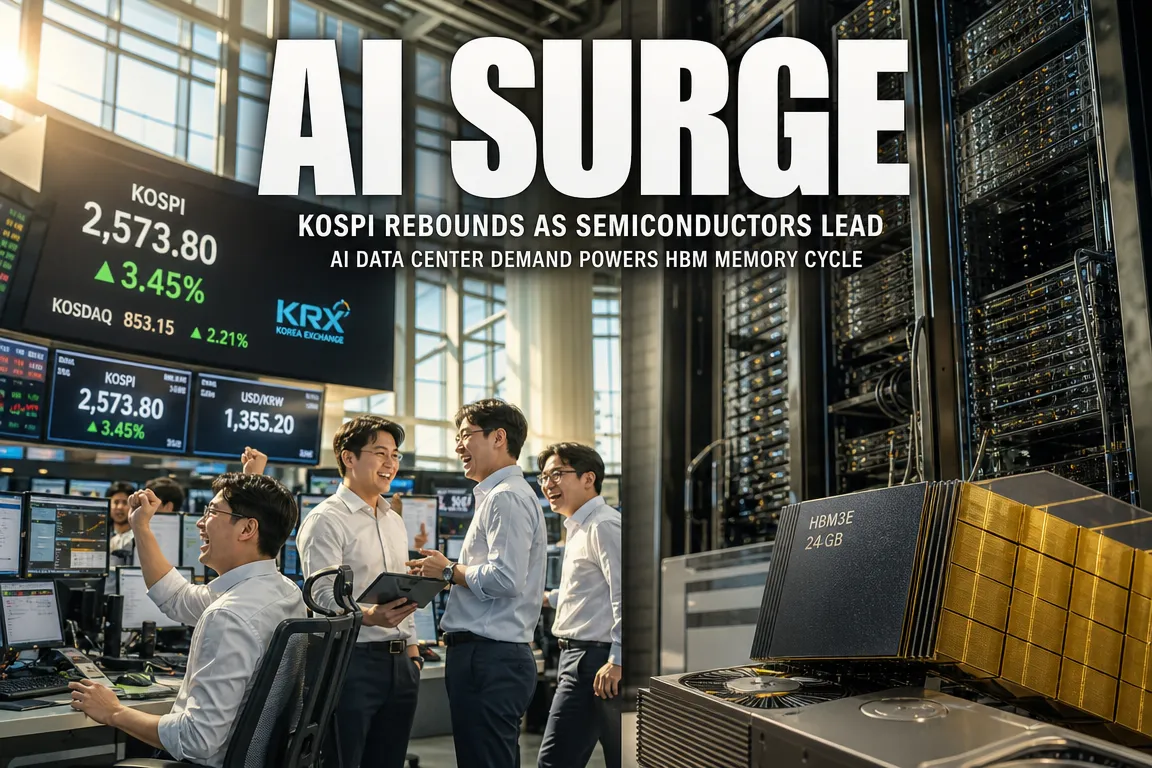
KOSPI sidecar activation and the real significance of Samsung Electronics and SK hynix’s rebound
The key issue here is not simply that Samsung Electronics and SK hynix rose.
The important point is that Elon Musk’s comments on data center demand, the shortage of GPUs, TPUs, and AI semiconductors, and the race among major technology companies to secure computing power are once again stimulating the memory semiconductor cycle.
In particular, the KOSPI’s sharp early-session rally triggered a sidecar activation, with expectations for expanded AI infrastructure investment at the center of the move.
The market is now looking beyond the broad narrative that “AI is positive” and focusing on which companies can generate earnings and which names may be re-rated.
In short, this move raises the question of whether Samsung Electronics and SK hynix can once again be viewed as core beneficiaries of the global AI investment cycle.
1. Sharp early-session KOSPI gains and sidecar activation
The KOSPI posted a strong early-session advance, which triggered a sidecar.
A sidecar is a mechanism that temporarily restricts program trading when futures prices move sharply.
In simple terms, it is a safeguard that allows the market to pause when it moves too quickly in one direction.
This sidecar activation signaled short-term overheating, but it also showed how quickly investors reacted to AI semiconductors and large-cap semiconductor names.
Samsung Electronics and SK hynix led the advance and lifted overall market sentiment.
However, gains narrowed later in the day.
This was due to selling by investors who had been trapped in prior positions and used the rebound as an opportunity to exit or lock in gains.
In other words, the market direction was positive, but short-term supply and demand conditions remained unsettled.
2. Why results from SpaceX and Super Micro reinforced market expectations
Overnight results from SpaceX and Super Micro came in above expectations.
Both revenue and operating profit exceeded market estimates, reinforcing the earnings momentum of AI infrastructure-related companies.
Super Micro, in particular, is viewed as a direct indicator of AI server and data center infrastructure investment trends.
Strong demand for AI servers does not benefit only server manufacturers.
It also implies higher demand for GPUs, TPUs, high-performance memory, storage devices, power equipment, and cooling systems used in those servers.
This is why Samsung Electronics and SK hynix are drawing renewed attention.
As AI server deployment increases, demand for high-bandwidth memory, high-performance DRAM, and enterprise SSDs is also likely to rise.
3. The core of Elon Musk’s remarks: AI demand is still outpacing supply
Elon Musk emphasized that data center demand is enormous.
He said that GPUs, TPUs, and AI semiconductors are difficult to obtain.
He also indicated that even major technology companies are seeking access to computing power.
This is highly significant.
In the AI industry, the bottleneck is not a lack of demand.
The more relevant issue is that servers, semiconductors, data centers, and power infrastructure are insufficient to absorb that demand.
AI competition is therefore shifting from model performance to computing power 확보.
This trend has direct implications not only for AI semiconductors but also for the memory semiconductor cycle.
4. Why Samsung Electronics and SK hynix moved together
The most notable feature of the market reaction was that Samsung Electronics and SK hynix advanced together.
Strong AI demand is not only positive for GPU makers such as Nvidia.
AI servers require not only GPUs but also large-capacity memory and high-speed storage devices.
In particular, HBM has emerged as a key component that determines AI accelerator performance.
SK hynix has demonstrated strong competitiveness in the HBM market, while Samsung Electronics is benefiting from expectations of improved HBM competitiveness and a recovery in the broader memory cycle.
In other words, the market interpreted the move as follows: if AI investment continues, memory demand will inevitably improve as well.
For Samsung Electronics, there is potential for re-rating across the AI semiconductor value chain, including HBM, DRAM, NAND, foundry, and packaging.
For SK hynix, the expected earnings improvement is more directly tied to HBM.
5. Why the rally faded later in the day
The AI semiconductor rally was strong early in the session, but momentum slowed later in the day.
The main reason was selling by investors already holding positions.
Semiconductor shares have been highly volatile, repeatedly moving between optimism and disappointment.
As prices rose quickly, some investors sold to reduce losses or secure profits.
In the short term, this selling can limit further gains.
However, the key point is that AI demand and earnings improvement expectations have returned to the center of the market.
Once supply and demand stabilize, direction will likely be determined by the next earnings round.
6. Key indicators to watch in the current earnings season
The earnings season is now beginning in earnest.
For Samsung Electronics and SK hynix to be re-rated, the market needs confirmation through actual numbers.
The first item to watch is the pace of memory price recovery.
The trajectory of DRAM and NAND prices will determine the broader earnings trend.
The second is HBM supply expansion and profitability.
Even if AI server demand remains strong, it is important to assess how much high-value product can be supplied and what margin profile can be achieved.
The third is capital expenditure plans among data center customers.
If major technology companies continue to increase AI infrastructure investment, the semiconductor upcycle could extend further.
The fourth is inventory levels.
Memory cycles typically improve rapidly when inventories fall and prices rise.
The final factor is valuation.
As noted in the source material, Samsung Electronics and SK hynix may not appear excessively expensive on a purely numerical basis.
If earnings improvement is confirmed, the market may place greater weight on future earnings than on current prices.
7. The most important point that is often missed in other coverage
The most important point in this issue is not simply that AI semiconductors are in short supply.
The real issue is that computing power is increasingly functioning like a tradable strategic asset.
As Elon Musk noted, the fact that even major technology companies are seeking to borrow computing power shows that the bottleneck in AI has changed fundamentally.
In the past, companies with strong software and algorithms had the advantage.
Today, companies with GPU clusters, data centers, power infrastructure, cooling systems, and memory supply chains needed to train and deploy AI models are becoming more competitive.
This shift is highly significant for memory companies such as Samsung Electronics and SK hynix.
As AI service competition intensifies, major technology companies will need to build more servers.
More servers mean higher demand for high-performance memory.
Although AI competition appears to be centered on chatbot performance and model quality, the actual flow of capital may be more concentrated in data centers and the semiconductor supply chain.
This is the core of the KOSPI rebound and the re-rating of semiconductor stocks.
8. Potential re-rating for Samsung Electronics
Samsung Electronics has recently been viewed as lagging SK hynix in the AI semiconductor space.
In particular, HBM competitiveness and customer qualification have been important drivers of its share price.
However, if AI data center demand continues to expand, Samsung Electronics still has room to benefit.
Samsung Electronics has memory production scale, DRAM technology, NAND capability, foundry operations, and advanced packaging capacity.
As the AI semiconductor ecosystem expands, integrated semiconductor capability may matter more than a single product line.
Accordingly, Samsung Electronics could see a stronger re-rating once HBM competitiveness improves and a broader recovery in memory prices becomes visible.
9. Why SK hynix continues to attract attention
SK hynix has established a clear position in the HBM market.
AI accelerators require high-performance memory, and SK hynix has built market credibility through supply relationships with major global customers.
If AI server investment continues to expand, the earnings improvement case for SK hynix remains relatively direct.
That said, much of this optimism is already reflected in the share price, so future supply capability and margin sustainability will be important.
Even if HBM demand remains strong, competition is intensifying and supply is increasing, so margin trends must continue to be monitored.
For SK hynix, the question is not whether it is a strong company, but whether it can continue to exceed already elevated expectations.
10. Market signals investors should monitor now
-
First, whether the KOSPI rally continues to be led by semiconductors.
-
Second, whether gains in Samsung Electronics and SK hynix are driven by improved earnings expectations rather than short-term positioning.
-
Third, whether major technology companies maintain their data center investment plans.
-
Fourth, whether AI semiconductor supply shortages translate into higher memory prices.
-
Fifth, during earnings season, whether operating margin improvement matters more than revenue growth.
This move could end as a short-term thematic rebound, or it could mark the beginning of a broader semiconductor re-rating.
The difference will depend on earnings and guidance.
The market already recognizes that AI demand remains strong.
The key question now is how quickly that demand translates into earnings for Samsung Electronics and SK hynix.
11. Market perspective: this is a time for confirmation, not just expectations
The market is currently pricing in both the AI growth narrative and expectations for a semiconductor earnings recovery.
However, as share prices rise quickly, investors demand more concrete numbers.
For Samsung Electronics and SK hynix to be re-rated, four conditions must align: earnings improvement, memory price recovery, HBM supply expansion, and continued data center investment.
Elon Musk’s comments provided evidence that data center and computing demand remain strong.
What remains is whether Korean semiconductor companies can convert that demand into profits.
This is why the current earnings season may be a critical event for determining whether the country’s major semiconductor names deserve a broader re-rating.
< Summary >
The KOSPI rose sharply in early trading, triggering a sidecar, with Samsung Electronics and SK hynix leading the move.
Strong results from SpaceX and Super Micro were interpreted as evidence that AI infrastructure demand remains robust.
Elon Musk said data center demand is massive and that GPUs, TPUs, and AI semiconductors remain in short supply.
His remarks reinforced expectations that AI server expansion could translate into demand for HBM, DRAM, and SSDs.
However, gains moderated later in the day due to profit-taking and selling by investors seeking to exit positions.
Going forward, the key variables are memory prices, HBM profitability, and the sustainability of data center investment during earnings season.
The most important point is that AI competition is shifting from model performance to computing power and data center capacity.
This structural change is the main backdrop for the medium- to long-term re-rating potential of Samsung Electronics and SK hynix.
[Related Articles…]
- AI Semiconductor Demand and the Data Center Investment Cycle
- Samsung Electronics and the Global Memory Semiconductor Outlook
*Source: [ 내일은 투자왕 – 김단테 ]
– 일론머스크 “AI 수요 뜨겁다” #일론머스크 #삼성전자 #코스피
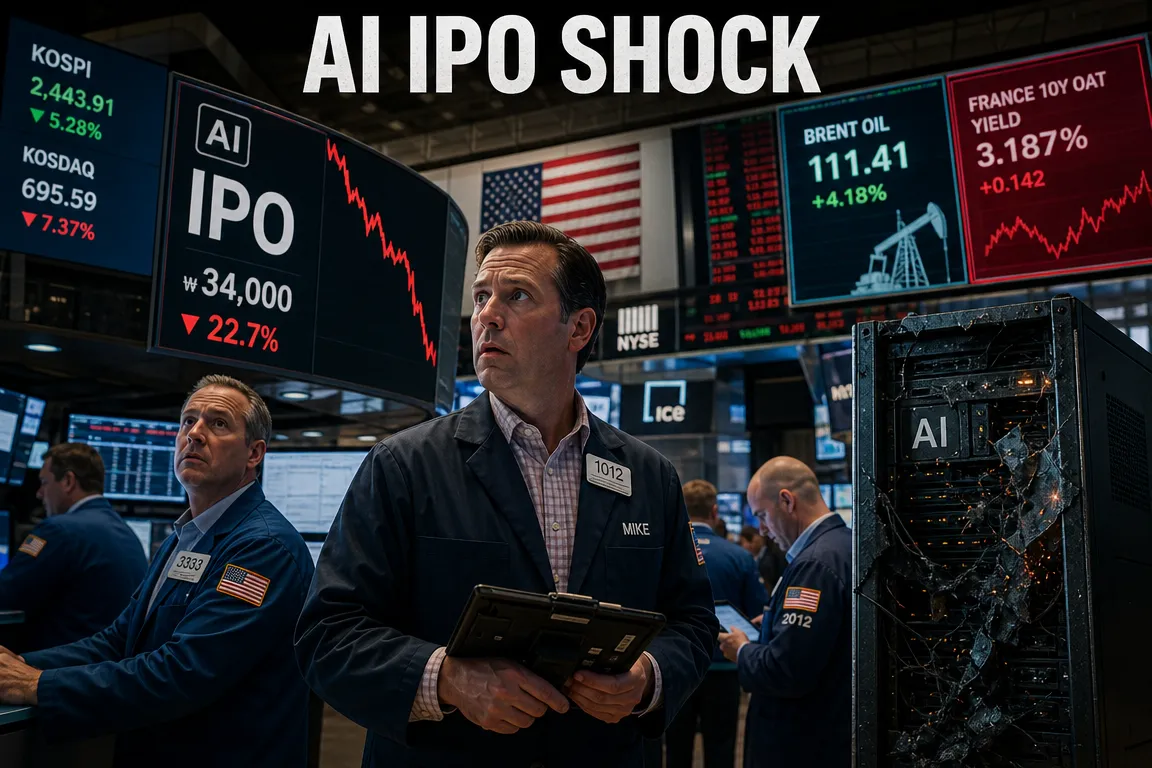
● AI Shock to 2027 – CoreWeave, Rates, Korea Selloff
When Will AI Adjustment End: 2027 Economic Outlook, Treasury Yields, AI Data Centers, and KOSPI Leadership Rotation
The key issue in this discussion is not simply whether AI stocks are expensive or cheap.
The market is now in a phase where it does not fully trust even strong earnings from Samsung Electronics or SK Hynix, because the concern is no longer 2026 results but the sustainability of AI demand in 2027 and 2028.
In particular, CoreWeave, GPU leasing rates, AI data center investment, Treasury yields, inflation, KOSPI correction, and the next market leader after Nvidia should be viewed as one connected cycle.
The central question is this.
The market is now asking not how much money has been made, but whether this cycle can continue in 2027.
This article summarizes whether the current AI correction is a bubble collapse or an early signal of leadership rotation ahead of 2027.
1. Why the Market Is Not Believing Strong Earnings
The most unusual feature in AI and semiconductor stocks today is that prices are not responding immediately even when earnings are strong.
Even if Samsung Electronics or SK Hynix deliver record earnings, the market is first asking whether such performance can continue in 2027.
-
Memory semiconductor prices remain strong.
-
Spot DRAM prices are at historically elevated levels.
-
GPU leasing rates remain near cyclical highs.
-
Cloud providers such as AWS and Nebius are raising data center contract pricing.
-
AI data center infrastructure pricing has not clearly weakened.
On current numbers alone, AI infrastructure remains strong.
The issue is that equity prices have already discounted much of the market’s expectations through 2028.
The market is now discounting not 2026 first-half earnings, but whether AI demand can continue to expand in the second half of 2027 and into 2028.
That is why investors are increasingly questioning whether earnings releases still matter.
Current profitability is largely reflected in share prices; what matters now is the durability of those profits.
2. The CoreWeave Issue Is Credit Risk, Not Just GPU Pricing
CoreWeave matters because it reflects the financing structure of the AI infrastructure industry, not just the situation of a single company.
CoreWeave entered into long-term fixed-price GPU leasing contracts, while GPU rental rates later rose sharply, creating structural pressure.
In simple terms, the structure works as follows.
-
GPU prices and leasing rates have continued to rise.
-
Some contracts remain locked in at earlier pricing levels.
-
Providers may have to supply capacity at lower contracted prices even as market rates rise.
-
Renegotiation can involve penalties, legal disputes, and creditor negotiations.
The key point is that this is less a market risk than a credit risk.
Market risk is often resolved once investors accept losses.
Credit risk is more complex because it raises questions about who ultimately bears the cost.
Contract renegotiation, creditor conflicts, legal disputes, and data center distress could all emerge together.
For that reason, even if the AI correction ends, the transition may remain volatile.
That said, it would be excessive to interpret this as an outright collapse of the AI industry.
GPU leasing rates and data center contract pricing remain firm.
A more realistic interpretation is that excessive pricing and leverage are being corrected.
3. The KOSPI Correction Is About Future Confidence, Not Just Weak Earnings
The current KOSPI correction is driven more by expectations moving too far ahead than by deteriorating corporate fundamentals.
Semiconductors, AI infrastructure, power equipment, and data center-related names have already priced in a significant portion of future value.
In such a setting, even strong earnings may not trigger immediate gains.
The market is already treating strong results as a base case.
Investors are mainly seeking confirmation on the following.
-
Whether AI data center demand will remain intact in 2027.
-
Whether GPU leasing rates can stay elevated.
-
Whether big tech capital expenditures can continue despite higher rates.
-
Whether semiconductor margins can hold beyond 2026.
-
Whether a new AI market leader will emerge after Nvidia.
In the end, the direction of the KOSPI is not determined by Samsung Electronics alone.
It depends on Treasury yields, U.S. big tech investment, AI data center demand, memory pricing, and global liquidity conditions.
4. The Most Important Variable in the 2027 Outlook Is Treasury Yields
The key variable repeatedly raised in this discussion is Treasury yields.
For the AI investment cycle to continue, large technology firms and data center operators must keep spending.
However, higher Treasury yields raise financing costs for corporate investment.
When U.S. 10-year Treasury yields remain elevated, the following pressures emerge.
-
Corporate bond yields rise.
-
Data center investment costs increase.
-
Concerns grow that AI capital expenditures may slow.
-
Valuations for long-duration growth assets decline.
-
Risk assets such as the KOSPI face greater correction pressure.
For this reason, rates are effectively the key driver for AI equities.
When rates fall, stress tends to ease across the market.
When rates remain high, investors may continue to question valuations even with strong earnings.
5. Why Rate Cuts May Become More Likely in 2027
One view is that inflationary pressure could ease materially from 2027.
The main reason is the base effect in crude oil prices.
For example, if oil rises from 50 dollars in 2025 to 100 dollars in 2026, the year-over-year increase is 100%.
If oil remains at 100 dollars in 2027, the year-over-year increase becomes 0%.
Even if prices rise to 120 or 130 dollars, the year-over-year pace may still be lower than in 2026.
Inflation is driven not only by price levels but also by year-over-year change rates.
As a result, CPI and PCE inflation could mathematically slow from February or March 2027 onward.
If that scenario materializes, market conditions could shift as follows.
-
Rate hike concerns may persist through 2026.
-
Inflation may begin to moderate in 2027.
-
Concerns over further tightening may fade.
-
Rate-cut expectations may increase.
-
Liquidity may return to risk assets.
In that case, the AI correction would likely be a mid-cycle pause rather than a long-term downturn.
For countries such as Korea, which are closely linked to semiconductors, power infrastructure, and AI data center supply chains, a more supportive monetary and fiscal backdrop could be beneficial.
6. Lower Rates Are Not Always a Positive Signal
The opposite view is also important.
Lower rates are not automatically positive for AI equities.
Rates consist of two main components.
-
Real rates.
-
Inflation expectations.
Recent rate increases have been driven more by real rates than by inflation expectations.
If rates stabilize because inflation expectations decline, that would be constructive.
However, if rates fall because AI capital expenditure demand weakens, the implication is different.
In other words, the reason for lower rates matters.
-
If rates fall because inflation stabilizes, that is positive.
-
If rates fall because AI investment demand weakens, that is negative.
The most favorable outcome would be for Treasury yields to avoid a sharp further rise and instead stabilize near current levels.
A structure in which real rates remain relatively high but inflation expectations cool would be the most constructive setup.
In that case, AI capital expenditures could continue while inflation pressure eases.
7. AI Capital Expenditure and U.S. Midterm Politics
AI data center investment is no longer only a corporate issue; it has become a political issue.
Capital expenditures now play a meaningful role in U.S. growth, employment, power infrastructure, and semiconductor supply chains.
Before the midterm elections, policymakers are likely to support AI CapEx more aggressively.
This helps support growth and preserve confidence in the economy.
After the midterms, the environment may change.
-
The balance of power in Congress may shift.
-
Because budget authority rests with Congress, policy momentum may weaken.
-
Calls to slow AI investment may strengthen.
-
At the same time, reduced election uncertainty may support the market.
The market is already discounting some of the post-election policy uncertainty.
As a result, once the election is over, the removal of that uncertainty could create new opportunities.
8. Has the AI Bubble Ended, or Is the Final Stage Still Ahead?
The AI cycle can be viewed as having begun in the second half of 2022.
Since the cycle has already lasted more than three years, it is no longer appropriate to treat it as an early-stage trend.
However, it is still difficult to conclude that the bubble has ended.
The comparison with the dot-com era is useful.
-
Cisco played a role similar to Nvidia in the early phase of the dot-com cycle.
-
Cisco remained strong throughout much of the cycle.
-
Mid-cycle names such as Amazon rose on future narratives rather than current earnings.
-
Late-stage names such as Qualcomm surged on pure story-driven momentum.
If this framework is applied to AI, the following sequence is possible.
-
Phase 1 is Nvidia.
-
Phase 2 is AI model companies such as OpenAI and Anthropic.
-
Phase 3 may involve physical AI, robotics, space, Tesla, and SpaceX.
One important factor is that the valuation gains of OpenAI and Anthropic may already have played out in the private market, potentially completing the equivalent of an Amazon-style second phase outside public equities.
The rapid rise in Anthropic’s valuation suggests that the narrative rally may already have been reflected in private markets rather than public ones.
If that is the case, the next rally may be shorter and more volatile.
9. The Next Market Leader May Be Physical AI, Not Nvidia
This does not mean Nvidia has run its course.
As Cisco remained central during the dot-com era, Nvidia may remain a core AI infrastructure beneficiary.
However, market attention may eventually shift from who makes the GPUs to how AI changes the physical world.
The areas to watch are as follows.
-
Physical AI.
-
Humanoid robots.
-
Autonomous driving.
-
Space industry.
-
Power infrastructure.
-
AI data center cooling and energy efficiency.
Tesla and SpaceX are relevant because AI can generate its strongest narrative when it extends beyond software into the physical economy.
Once AI expands into automobiles, robots, satellites, manufacturing, and logistics, the market may begin pricing a new growth phase.
10. The Key Point Often Missed in Other Coverage: The Market Is Now Watching Contract Structures, Not Just Earnings
The most important but least discussed issue is that the main risk in the AI industry is shifting from earnings to contract structure.
Most headlines focus on Nvidia earnings, Samsung profit, the KOSPI level, or the size of AI stock corrections.
What matters more is how AI data center companies funded themselves, how GPUs were contracted, and what terms were signed with customers.
The AI industry now requires close attention to three factors.
-
Whether GPU leasing contracts are fixed-price or variable-price.
-
How much leverage data center operators have used.
-
Whether major cloud customers continue to renew contracts as AI monetization develops.
This matters because if the AI bubble breaks, the process may begin with credit stress before any broad price collapse.
Conversely, if these contract issues remain manageable, the market could stabilize more quickly than expected.
In short, the key checkpoint for AI stocks is no longer simply whether the latest quarter was strong.
It is whether contract pricing holds, leverage remains sustainable, and customers continue to renew.
11. What Investors Should Monitor Now
To determine whether the AI correction is ending, the following indicators should be monitored together.
-
Whether U.S. 10-year Treasury yields stabilize rather than rise further.
-
Whether GPU leasing rates remain at elevated levels.
-
Whether DRAM and HBM prices hold up.
-
Whether AWS, Microsoft, Google, and Meta reduce AI CapEx guidance.
-
Whether debt and contract risk among neo-cloud firms such as CoreWeave spreads further.
-
Whether KOSPI leadership broadens from semiconductors to power equipment, cooling, data centers, and robotics.
-
Whether CPI and PCE inflation slow as expected in early 2027.
The most important variables are rates and capital expenditure.
AI is built on substantial capital spending.
If funding costs decline and big tech investment remains firm, the correction may prove to be an opportunity.
If rates stay high and CapEx guidance weakens, AI valuations may face additional pressure.
12. Conclusion: The Setup May Change from 2027
The current AI correction cannot yet be described as complete.
CoreWeave-related credit risk could become more complicated, and KOSPI and AI stocks have already discounted a large amount of future growth.
However, the structure may change from 2027 onward.
If inflation rates ease, rate-cut expectations rise, and fiscal policy becomes more supportive, liquidity conditions may improve again.
At the same time, lower rates are not automatically positive.
It is important to distinguish between rates falling because AI demand weakens and rates stabilizing because inflation pressure declines.
The market’s central question is straightforward.
Will AI data center investment continue in 2027?
If the answer is yes, the current correction may be a mid-cycle pause in a broader AI supercycle.
If the answer is no, the expectations already priced in through 2028 may need to be reversed.
< Summary >
The key issue in the AI correction is not current earnings but demand sustainability beyond 2027.
GPU leasing rates, DRAM prices, and AI data center contract pricing remain firm.
CoreWeave is primarily a credit and contract structure issue rather than a simple pricing issue.
Treasury yields are the key variable shaping AI equities and the KOSPI.
Inflation may ease from early 2027 due to favorable base effects, supporting rate-cut expectations.
However, lower rates would be negative if they reflect weaker AI capital spending.
The next market leader after Nvidia may shift toward OpenAI, Anthropic, physical AI, Tesla, SpaceX, robotics, and space-related industries.
Investors should focus more on contract pricing, leverage, CapEx guidance, and rate direction than on headline earnings alone.
[Related Articles…]
- 2027 Economic Outlook and Global Liquidity Shift
- AI Data Center Investment and Next-Generation Market Leaders
*Source: [ 경제 읽어주는 남자(김광석TV) ]
– AI 조정 곧 끝날까…2027년부터 판이 바뀔 수 있다 | 경읽남과 토론합시다 | 3자토론 이효석x김단테x김광석 [2편]