● Musk-Fueled AI Frenzy, Bonds, and Inflation Shock
SpaceX-Tesla merger talks rattle Wall Street: AI data centers, semiconductors, and rate risks in one view
The key takeaway from today’s U.S. market action was not simply that technology stocks rebounded.
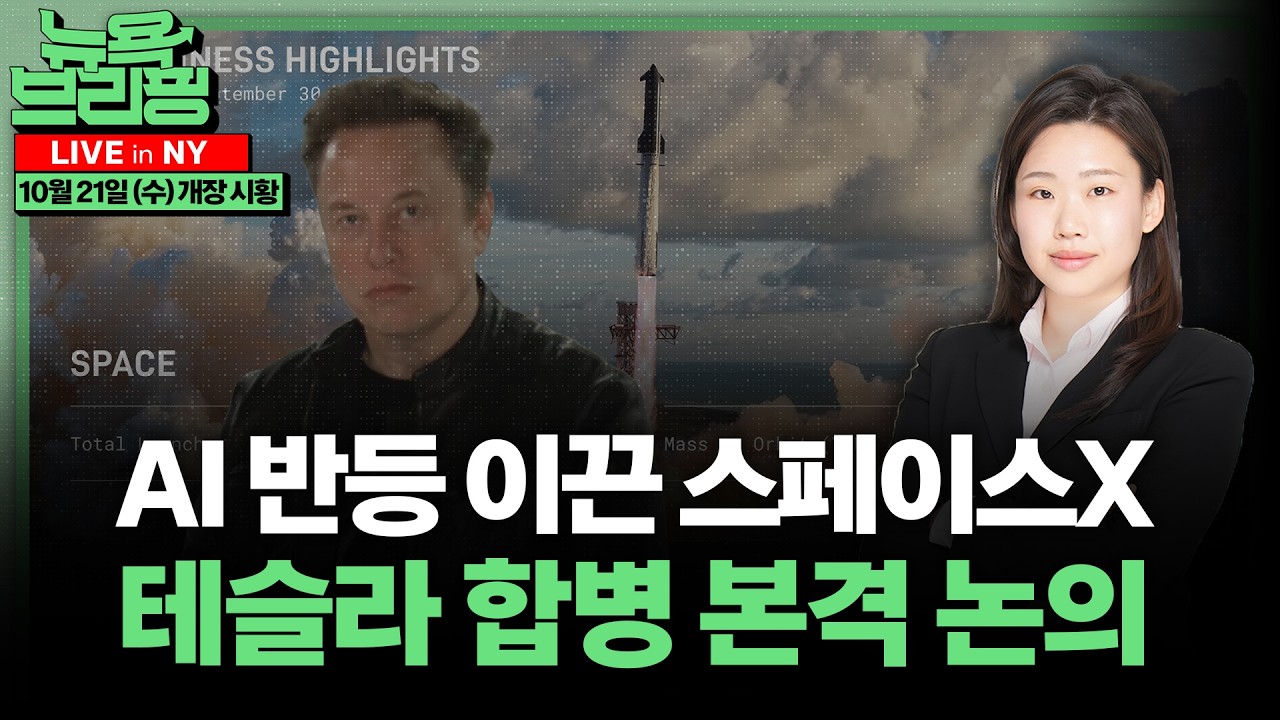
SpaceX’s earnings surprise and merger discussions with Tesla improved sentiment on Wall Street, while Super Micro’s outlook for AI servers supported the semiconductor rebound.
At the same time, Anthropic’s large losses, NextDC’s 42% plunge in Australia, French 10-year yields above 5%, and a reacceleration in U.K. inflation highlighted the tension between AI growth expectations and higher-rate, higher-energy-cost conditions.
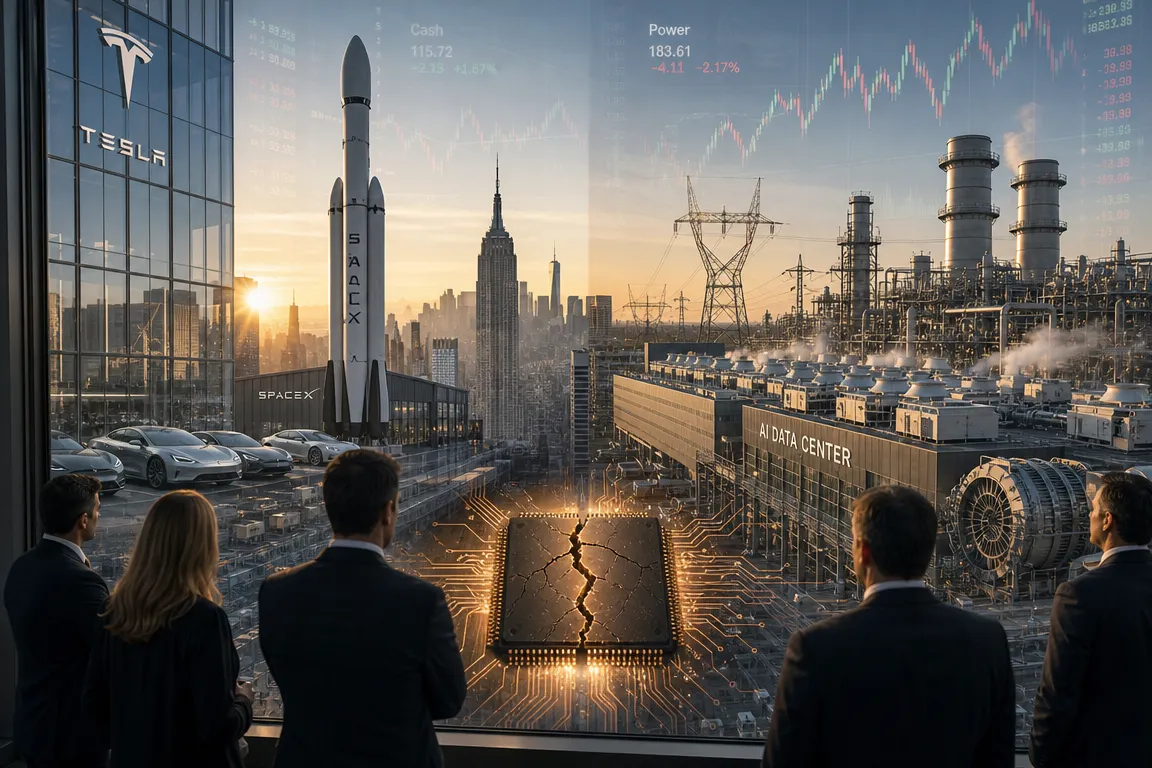
The most important structural issue is that the bottleneck in AI has shifted beyond GPUs to power, cooling, gas turbine components, local permitting, and balance-sheet capacity.
1. New York market action: semiconductors and Musk-related names led the rebound
The market tone in early trading on October 21 was broadly risk-on.
The S&P 500 rose about 0.2% to 0.35%, while Nasdaq 100 futures gained around 0.6%, led by technology stocks.
The Dow Jones also advanced 0.2% to 0.47%, and the Russell 2000 rose 0.4% to 0.57%, as dip buyers returned to small-cap names.
European equities also staged a rebound.
Euro Stoxx 50 futures and the DAX each rose more than 1%, reflecting improved global risk sentiment.
The VIX, often viewed as a gauge of market fear, eased to the low 18s, indicating a partial reduction in near-term volatility.
-
U.S. stocks were led by AI semiconductors and aerospace-related names.
-
NVIDIA, TSMC, Broadcom, Micron, AMD, and Intel all rose.
-
Semiconductor equipment names such as ASML also posted gains.
-
Hardware companies linked to AI server demand, including Dell and HP, attracted buying interest.
-
By contrast, Apple, Microsoft, Alphabet, and Meta were weaker, underscoring clear sector rotation.
The market’s focus was clear.
Signals that AI demand remains intact lifted semiconductors and server-related stocks, while expectations around a possible SpaceX-Tesla combination boosted Musk-related names.
2. Korea market rebound: a sharp reversal after the prior day’s selloff
Korean equities also rebounded strongly after the previous session’s sharp decline.
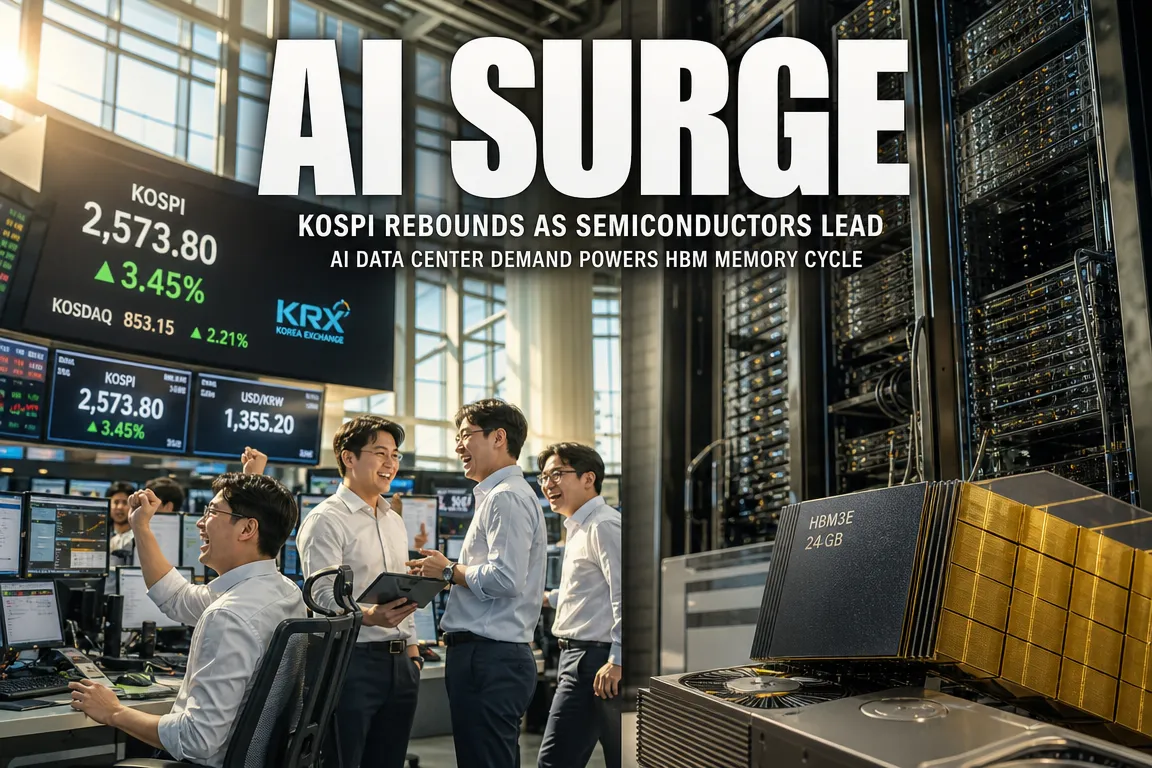
The KOSPI, after falling more than 3.7% the day before, rose about 3.29% and recovered much of the lost ground.
Intraday gains were strong enough to trigger a buying-side circuit breaker.
Samsung Electronics and SK hynix each rebounded more than 5%, helping restore sentiment in the domestic semiconductor sector.
Meanwhile, Alice, an AI cloud company that had fallen 32% on its listing debut the previous day, rebounded 30%.
Still, it remained below its offering price, suggesting that caution toward newly listed AI names remains high.
The rebound in Korean equities was supported by Super Micro’s stronger-than-expected outlook.
The market interpreted this as a sign that AI server demand remains solid, supporting expectations across Samsung Electronics, SK hynix, and semiconductor equipment names.
3. SpaceX earnings surprise: the main catalyst behind the Wall Street rebound
The biggest event in today’s market update was SpaceX’s third-quarter earnings release.
SpaceX reported results that beat expectations and outlined an aggressive capital spending plan.
It projected fourth-quarter capex of $35 billion to $40 billion, signaling large-scale investment in AI data centers, space infrastructure, and semiconductor production.
Spending more than twice quarterly revenue on capex amounts to more than a growth strategy; it is a statement of intent to control both AI and space infrastructure.
-
The company emphasized rapid growth in AI computing.
-
It provided more specific plans to expand data center investment.
-
It also discussed in-house semiconductor production.
-
Starlink expansion plans were also disclosed.
-
Merger discussions with Tesla were formally acknowledged.
SpaceX shares rose more than 8% at the open and later extended gains to above 11%, making the company the day’s standout performer.
Tesla also advanced by about 3% on merger expectations.
4. Formalized SpaceX-Tesla merger talks: expectations and risks are both rising
Elon Musk formally raised the possibility of a SpaceX-Tesla merger during the conference call.
What had long been a market rumor has now entered an official review process through a special committee.
Musk described a merger as a good idea.
He also said he would not personally take part in negotiations because he is an interested party in both companies.
The two companies are reviewing the possibility through independent-director special committees.
The main rationale for a merger is AI synergy.
Tesla has data from autonomous driving, robotics, and EVs.
SpaceX has AI software, data centers, in-house semiconductor production, Starlink satellite communications, and space infrastructure, including Grok-related assets.
A combination could create a vertically integrated platform spanning AI software, robotics, semiconductors, communications, and space infrastructure.
For Tesla shareholders, however, the risks are also significant.
SpaceX’s large-scale AI infrastructure spending could be effectively transferred to Tesla shareholders.
In addition, Tesla requires approval from more than half of all outstanding shares, not just a majority of votes cast.
That is a high hurdle given non-voting shareholders.
Bloomberg estimated that the combined enterprise value could reach about $3.5 trillion.
If completed, the transaction could rank among the largest corporate combinations in history.
5. The key hidden point: AI competition is shifting from GPU access to power access
The most important point, which is less emphasized in other coverage, is power infrastructure.
SpaceX said it plans to expand AI computing capacity to 13 GW by the end of next year.
Moving from 3 GW at year-end to 13 GW by the end of next year would be an exceptionally aggressive target.
The issue is that buying more GPUs alone does not make an AI data center operational.
Power, cooling, substations, gas turbines, and critical component procurement must all align.
Musk stressed that power and cooling are as important as semiconductors in AI data center expansion.
He also noted that key gas turbine components such as blades and vanes could require an additional 12 to 18 months to secure.
SpaceX is reportedly considering in-house production of these parts using its rocket engine manufacturing expertise.
If successful, this could allow the company to build out power infrastructure more than a year ahead of competitors.
This is a sign that the main bottleneck in AI is changing.
So far, the market has focused mainly on NVIDIA GPU procurement.
Going forward, the pace at which a company can secure power, build cooling infrastructure, and clear local approvals may determine profitability.
6. SpaceX semiconductor production plans: reducing dependence on NVIDIA and TSMC
SpaceX also discussed plans to produce semiconductors in-house.
Musk said the company expects to run its first test chips at its Austin research facility in Texas in May or June next year, with mass production targeted for the third or fourth quarter of 2028.
Given typical timelines for advanced chip fabs, equipment installation, and yield stabilization, this is an aggressive schedule.
He also said ASML and other equipment suppliers are helping compress delivery timelines.
However, he did not give a clear answer on whether EUV tools have actually been ordered.
Longer term, Musk also referred to a potential annual 1 TW semiconductor output target.
That would imply an effort to move beyond the current division of labor in which NVIDIA designs and TSMC manufactures, and toward in-house production capabilities.
For Korean investors, the key issue is the potential impact on Samsung Electronics, SK hynix, semiconductor equipment suppliers, and memory-related supply chains.
This is not yet a replacement for NVIDIA or TSMC.
Test chips, production timing, yield, and scale remain unproven.
However, the broader trend of major tech and space companies moving into chip manufacturing is an important signal for future supply-chain reconfiguration.
7. AI computing rental business: SpaceX prefers short-term contracts over long-term ones
SpaceX is considering using about half of its AI computing capacity for internal AI projects, while leasing the remainder to external customers.
The split may change depending on conditions, including a 60/40 ratio, but the strategy is clearly to combine in-house development with external leasing.
Musk said he prefers shorter contracts over long-term ones.
The reason is his expectation that AI computing lease rates will continue to rise.
Shorter contracts would allow pricing to adjust more quickly to higher rates.
One notable point is the different pricing dynamic in AI computing versus traditional semiconductors.
Normally, older chips lose value when new products are introduced.
But Musk said even older GPUs such as NVIDIA’s H100 are being leased at higher prices than initially.
The implication is that as AI models evolve, the economic value of computing capacity is increasing further.
SpaceX said new computing assets could achieve payback periods of as little as six months next year.
If realized, that would significantly ease concerns about the profitability of AI data center operations.
That said, lease rates could decline once competing data centers come online, so sustainability remains to be seen.
8. Starlink expansion: moving from satellite internet into mobile communications
Starlink continues to expand.
As of the end of the third quarter, consumer subscribers reached 13.6 million, up 1.6 million over three months.
Average monthly revenue per user rose 5% quarter over quarter to $69.
SpaceX is not positioning Starlink as only a satellite internet provider.
It plans to secure major communications capacity using S-band spectrum and to address in-building coverage with 800 MHz low-band spectrum.
The company also plans to combine satellite and terrestrial networks by adding small devices to homes, enterprises, and existing towers equipped with Starlink.
Musk said the communications business, including Starlink, could ultimately reach annual revenue in the hundreds of billions of dollars.
Given that the current quarterly communications revenue is about $5.2 billion, that is a highly aggressive outlook.
Expansion is also continuing in aviation.
SpaceX said it has secured Starlink service for 12,000 aircraft.
Korean carriers Korean Air and Asiana were also cited as among the first airlines to operate aircraft equipped with Starlink this quarter.
9. Super Micro: AI server demand has not yet slowed
Super Micro issued revenue guidance and margin expectations that exceeded market forecasts by a wide margin.
Its revenue outlook was about 25% above consensus, signaling that AI server demand remains firm.
Super Micro produces AI servers equipped with NVIDIA GPUs.
The stronger outlook is positive for NVIDIA, Dell, HP, Micron, SK hynix, Samsung Electronics, and the broader AI infrastructure supply chain.
Until recently, the market had been concerned about excessive AI data center investment, leverage, and weakening profitability.
Super Micro’s guidance at least confirms that server orders remain healthy.
That is why the semiconductor sector rebounded strongly today.
If AI server orders hold up, demand could continue across HBM, DRAM, NAND, server CPUs, power semiconductors, and cooling equipment.
10. Anthropic IPO risk: the real meaning of the $80.7 billion net loss
Anthropic reported a net loss of more than $80.7 billion in the first half of the year.
The figure was disclosed in preliminary IPO filings ahead of a listing expected next month.
However, the loss should not be interpreted entirely as an operating loss.
About $72 billion reflected non-cash accounting losses from the revaluation of convertible notes.
As the company’s valuation rose, the value of the convertible debt also increased, and that was booked as a higher liability.
In other words, the $80.7 billion net loss is striking, but much of it does not reflect cash outflow.
Still, the real burden is substantial.
Anthropic spent $9 billion on computing and infrastructure in the first half of the year.
That is nearly four times the $2.3 billion spent a year earlier.
Over the next 10 years, the company has committed at least $518 billion to cloud and computing infrastructure.
Including additional negotiated amounts, the total could reach as much as $750 billion.
That exceeds KRW 1,000 trillion.
Revenue is also growing quickly.
Third-quarter revenue reached $16.8 billion, up 45% from the prior quarter.
However, growth was even faster in the previous quarter, so there are concerns about deceleration.
The Anthropic IPO is likely to become a test case for AI sector sentiment.
The market is increasingly asking not just whether revenue is growing, but whether the company can sustain its cost structure.
11. NextDC’s 42% plunge: the real weakness in AI data centers has surfaced
NextDC, an Australian AI data center operator, plunged 42% in a single day.
About A$3 billion in market value was wiped out, marking the worst trading day since 2010.
The direct cause was a delay in power supply at the M3 data center in Melbourne.
Due to local opposition and delays in power expansion work, additional electricity supply has been pushed back to 2028.
The company had contracts in place with customers, but insufficient power prevented the facility from operating as intended.
As a result, about A$140 million in revenue was deferred.
The company cut its 2027 revenue outlook by more than 20% and suspended new data center development and land acquisition.
This is an important warning for AI infrastructure investment.
Strong AI demand does not mean every data center operator will be profitable.
When power access is delayed, revenue recognition is deferred and payback periods extend.
In a high-rate environment, that delay can be highly damaging to valuation.
12. Netflix falls sharply: advertising growth slowdown matters more than earnings
Netflix posted solid revenue and net income for the third quarter, but the stock fell sharply after the company delivered a weaker-than-expected outlook for advertising.
It lowered its annual ad revenue target from $3.0 billion to $2.7 billion.
Fourth-quarter earnings guidance also fell short of market expectations.
Netflix has been building advertising-supported lower-priced plans as a new growth driver.
With limited room to raise subscription prices, advertising revenue has become increasingly important.
The company’s own downward revision to ad revenue expectations raised questions about the growth model.
Competition for viewing time from YouTube, TikTok, and other short-form video platforms is also a headwind.
Following the results, at least 14 Wall Street firms cut their price targets on Netflix.
The stock is already down about 26% this year and was weak again in early trading.
13. French 10-year yields break 5%: memories of the European debt crisis return
French 10-year government bond yields rose above 5% for the first time in 24 years.
They reached 5.002% intraday, while the spread over German Bunds widened to 1.57 percentage points.
That is close to levels seen during the 2011 European debt crisis.
France’s government debt stands at roughly 119% of GDP.
The fiscal deficit remains elevated at above 5%.
The government is pushing austerity measures to reduce the deficit, but parliamentary approval remains uncertain.
At the same time, protests have escalated over the cost of living, weaker public services, and political instability.
Hundreds of thousands reportedly joined weekend demonstrations, with more protests planned.
French bank stocks have fallen about 17% recently, reflecting market concerns.
As global bond yields rise on higher energy costs and inflation pressure, France is under additional strain from fiscal and political instability.
14. Carrefour earnings hit: French instability is spilling into the real economy
French retailer Carrefour said nationwide riots and looting could reduce operating profit by as much as EUR 200 million.
About 50 stores suffered looting and damage, and many others were closed under curfew restrictions.
Carrefour operates about 6,000 stores in France.
The impact has been broad enough for the company to lower its full-year earnings outlook.
It also reduced planned capital expenditures in France from EUR 1.7 billion to EUR 1.6 billion.
The stock fell as much as 15% intraday.
The key point is that higher French yields and political instability are now affecting not only financial markets, but also corporate operations and investment plans.
15. U.K. inflation at an 11-month high: pressure for tighter policy has returned
U.K. consumer price inflation for September was reported at 3.5%.
That was the highest level in 11 months.
It exceeded both the market estimate of 3.4% and the Bank of England’s forecast of 3.0%.
The main driver was higher energy prices.
Rising crude oil and natural gas prices lifted U.K. inflation.
Although the U.K. was once a North Sea oil producer, output has fallen by more than 70% since peaking in 1999.
The country is now effectively a net importer of oil and natural gas.
Services inflation also rose 3.7%.
That suggests price pressure is broadening across the economy even after excluding energy effects.
U.K. government debt has exceeded GBP 3 trillion for the first time.
Because the country has a large share of inflation-linked bonds, higher inflation also raises the government’s interest burden.
Market expectations now point to a possible rate increase from 3.75% to 4.0% at the Bank of England’s next decision on November 5.
16. Samsung Electronics and SK hynix upgrade China fabs: defending NAND competitiveness
Reports indicate that Samsung Electronics and SK hynix are upgrading their China fabs into more advanced NAND production bases.
Samsung is moving toward 286-layer V9 NAND production at its Xi’an plant.
The Xi’an facility accounts for about 40% of Samsung’s total NAND output.
SK hynix is upgrading its Dalian plant from 192-layer NAND to more than 240 layers.
Increasing layer counts allows more data to be stored in the same area and improves production efficiency.
As AI data centers expand and demand for high-capacity storage rises, the two companies are improving manufacturing efficiency to meet demand.
The move also appears aimed at countering the rapid growth of China’s YMTC.
The key variable is U.S. export controls.
Bringing U.S.-made semiconductor equipment into China requires approval.
Technology upgrades may also face restrictions.
The news helped lift Samsung Electronics and SK hynix by about 6% in the Korean market.
17. U.S. releases heating oil from reserves: response to higher energy prices and diesel tightness
The U.S. government plans to lend about 315,000 barrels of the 1 million barrels of heating oil stored in the Northeast to private companies.
The move comes as diesel prices rise above $6.50 per gallon and winter heating costs increase.
Heating oil and diesel are part of the same product family.
The U.S. Northeast, including New York and New England, has strong household heating oil demand.
With diesel already in tight supply, heating oil demand could push prices even higher.
Using emergency reserves is not routine.
It is typically reserved for events such as Hurricane Sandy.
The current release is not large enough to move the global oil market materially, but it is intended to ease short-term price pressure in the U.S. Northeast.
18. Key after-hours earnings releases: Meta, Tesla, and Lam Research matter most
Several important companies are scheduled to report after the U.S. close.
For Meta, the key issues are the scale of AI infrastructure spending and the pace of advertising revenue growth.
The market will focus on how much data center investment has increased and whether the advertising business remains resilient in a weaker macro backdrop.
For Tesla, the main focus will be EV profitability and the outlook for autonomous driving.
Investors will also watch for further comments on the possible SpaceX merger.
Any remarks that could ease shareholder concerns will matter.
In semiconductors, Lam Research and Texas Instruments will be important.
Lam Research provides a useful read-through on memory-related capex trends.
Investors in Samsung Electronics and SK hynix should pay close attention to Lam Research orders and guidance.
IBM and SAP will also be watched as indicators of enterprise software demand and AI spending trends.
19. Key takeaways for investors
First, AI demand remains strong.
Super Micro’s outlook, SpaceX’s computing rental demand, and the rebound in semiconductor stocks indicate that AI server demand has not yet weakened.
Second, AI companies’ cost burdens are rising.
Anthropic’s infrastructure commitments and NextDC’s power-related delays show that AI growth comes with substantial capex and execution risk.
Third, the AI bottleneck is shifting from GPUs to power.
Companies that can secure power and cooling faster may command higher valuations than those that simply build more data centers.
Fourth, Europe’s risks should not be underestimated.
French 10-year yields above 5% and the reacceleration in U.K. inflation could renew global rate pressures.
Fifth, a Tesla-SpaceX merger would be both a short-term catalyst and a long-term risk.
AI, space, and robotics synergies are attractive, but the funding burden and merger terms could be sensitive for Tesla shareholders.
< Summary >
U.S. equities rebounded on SpaceX’s earnings surprise, merger discussions with Tesla, and Super Micro’s strong AI server outlook.
Semiconductor stocks rose on signs that AI demand remains resilient.
However, Anthropic’s large losses and NextDC’s power-delay collapse highlighted the cost and execution risks embedded in AI infrastructure investment.
French 10-year yields above 5% and higher U.K. inflation are adding to global rate and inflation pressure.
The central theme is that AI competition is expanding beyond GPU procurement into power, cooling, semiconductor vertical integration, and capital access.
[Related Articles…]
-
AI Data Center Power Bottlenecks and Global Infrastructure Investment Strategy
-
Semiconductor Supercycle and Investment Takeaways for Samsung Electronics and SK hynix
*Source: [ Maeil Business Newspaper ]
– 스페이스X발 월가 반등·테슬라 합병|IPO 앞둔 앤트로픽 800억달러 손실|호주 데이터센터주 42% 폭락|삼성·SK 中공장 첨단화|프랑스 금리·영국 물가 비상|홍혜진의 뉴욕브리핑