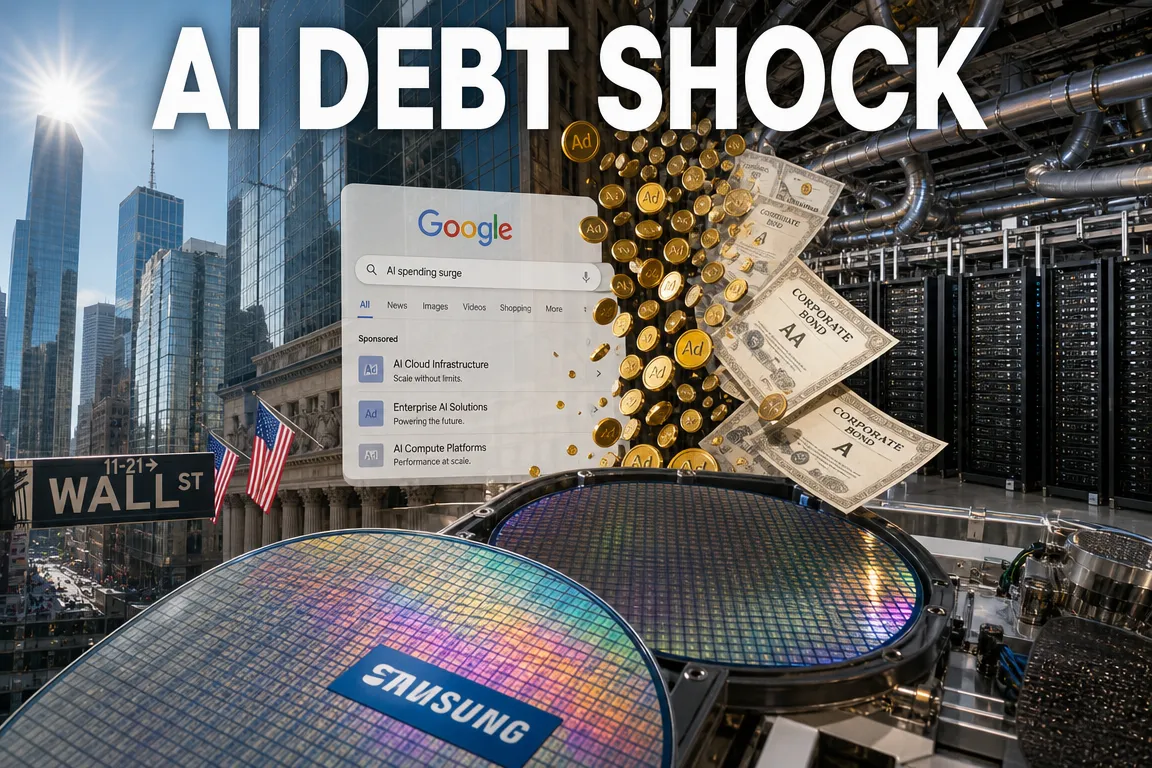
● Google Shock, AI Reckoning, Big Tech Debt
Google’s End or Reinvention in the AI Era: Why Alphabet’s Search Risk and Big Tech Debt Must Be Assessed Together
The central issue is not Alphabet’s one-day share-price decline.
The key question is whether generative AI services such as ChatGPT are drawing users away from traditional search and shifting advertising budgets beyond Google.
As Microsoft and other major technology companies increase data-center investment and financing, investors are shifting their focus from AI growth to whether AI can generate sufficient cash returns on invested capital.
Google retains significant strategic assets beyond search advertising, including Google Cloud, TPUs, Gemini, and YouTube.
Alphabet’s long-term outlook depends on whether growth in AI, cloud, and YouTube can outpace the deterioration of its search business.
1. Initial Verification: Several Figures Require Cross-Checking Against Current Disclosures
The source states that Alphabet shares fell by more than 11%, erasing approximately $500 billion in market capitalization, while Microsoft issued about $25 billion in corporate bonds.
It also cites $40 billion in financing by SpaceX, $95 billion in equity and debt financing by Meta, and total Big Tech corporate borrowing of $387 billion.
Because the recording date and calculation methods are unclear, these figures should not be treated as confirmed current data without verification.
Gemini 1.5 Flash was introduced in 2024. Any assessment of Google’s current AI competitiveness should incorporate subsequent Gemini models and operating metrics.
The claim that Google Cloud growth exceeded 100% also requires clarification as to whether it refers to total cloud revenue, a specific AI product, or usage volume.
The analysis below therefore focuses on structural industry changes rather than short-term share-price movements or unverified figures.
2. Why the Nasdaq Became More Cautious: Cash Returns Matter More Than AI Investment Volume
The first market concern highlighted in the source is Microsoft’s large corporate bond issuance.
Large-scale financing by cash-rich technology companies indicates the substantial cost of AI data centers, semiconductors, power infrastructure, servers, and networks.
Debt issuance is not inherently negative.
If investment returns exceed financing costs, leverage can increase shareholder value.
The principal risk is that AI infrastructure spending may grow faster than AI revenue and free cash flow.
- Data-center development requires land, cooling systems, power procurement, and grid connections.
- AI accelerators and high-bandwidth memory require significant upfront capital.
- Inference workloads create recurring power and operating costs.
- Shorter technology replacement cycles may accelerate depreciation expenses.
- Greater competition and lower AI service prices could extend investment payback periods.
The principal market risk is not limited to a slowdown in AI adoption.
AI usage could continue to expand while profitability declines because of price competition.
Investors should therefore assess revenue growth together with capital expenditure, depreciation, interest expense, and free cash flow.
3. AI Obligations Beyond the Balance Sheet: Off-Balance-Sheet Contracts Also Matter
Reported corporate bonds alone may understate the economic burden of Big Tech’s AI investment.
Technology companies may contract with external developers to build data centers and then lease the facilities under long-term agreements.
Depending on contract terms and accounting standards, these arrangements may be reported differently from conventional financial debt.
Economically, however, they represent future payment obligations with debt-like characteristics.
Relevant items include:
- Long-term data-center leases.
- Minimum cloud-capacity and electricity purchase commitments.
- Long-term AI semiconductor and server supply agreements.
- Infrastructure investment through project financing and joint ventures.
- Non-cancellable capital expenditure commitments.
This issue receives less attention than reported debt but may be equally important.
A comprehensive assessment of AI investment obligations should include future data-center lease payments and purchase commitments.
As the AI investment cycle extends, these obligations could affect valuation more significantly than reported borrowings.
4. Alphabet’s Core Risk: Search Economics Matter More Than Search Revenue Mix
The source cites analysis indicating that search now accounts for less than 50% of Google’s total revenue.
A lower share may reflect positive diversification through faster growth in non-search businesses.
However, investors are primarily concerned that search advertising, Alphabet’s main cash-generating business, may be weakening structurally.
Google Search is not merely a major revenue source.
It captures user intent and connects that intent with advertisers at high margins, making it central to Alphabet’s economics.
Even if Google Cloud and Gemini grow rapidly, consolidated operating margins could decline if these businesses remain less profitable than search advertising.
Investors should therefore focus on three issues:
- Whether conventional search-query volume is declining.
- How advertising prices and click-through rates per search are changing.
- Whether AI search can generate revenue comparable to conventional search.
5. How ChatGPT Threatens Google’s Search Model
ChatGPT and Claude are not identical to Google’s search engine.
However, they compete directly to become the first destination for users seeking information or completing tasks.
Users previously reviewed multiple search results when planning travel, comparing products, researching work-related topics, or locating service providers.
AI systems can now summarize information and produce customized responses in a single interaction.
This shift is unfavorable to Google because user questions may bypass the search-results page.
If users obtain sufficient answers directly from AI, both advertising exposure and outbound clicks may decline.
A modest reduction in total search volume could have a disproportionate revenue impact if high-value, purchase-oriented queries migrate to AI assistants.
Conversely, Google could convert this threat into a new revenue stream by integrating advertising and commerce effectively into AI responses.
The decisive issue is therefore not AI search volume but AI search monetization.
6. Google’s Undisclosed Metrics May Be More Important
According to the source, Google management stated that search-volume growth was among the strongest levels recorded over the previous five years.
However, total search activity may include both conventional link-based queries and AI-enabled search features.
Total search volume could therefore rise even while higher-margin conventional searches decline.
Investors need more detailed operating metrics, including:
- The usage mix between conventional and AI search.
- Inference cost per AI response.
- Advertising exposure and click-through rates in AI search.
- Revenue per AI search user.
- The rate at which AI features substitute for conventional search.
Limited disclosure does not necessarily indicate business deterioration.
Google may be protecting competitively sensitive information.
Nevertheless, limited visibility can increase the risk premium applied by investors and contribute to greater share-price volatility.
7. Advertiser Concerns: Could Google Raise Prices as Search Volume Declines?
The source cites an advertiser that has spent more than $500,000 per month on Google Ads.
The advertiser alleges that Google is modifying its systems to increase advertiser spending as search volume weakens.
The specific concerns include:
- Changes to advertising auctions that may support higher prices.
- Advertising placements against search terms not explicitly selected by advertisers.
- Reduced budget control because of automated broad-match and campaign settings.
- Daily spending that may exceed the stated daily budget on certain dates.
Daily spending above the stated amount can also result from Google Ads’ established monthly billing-limit system.
It should not automatically be interpreted as a new revenue-protection policy.
The relevant question is whether advertiser returns are deteriorating.
Cost per click should not be assessed in isolation.
Return on advertising spending, customer-acquisition cost, conversion rates, and customer lifetime value are more informative measures.
Advertisers may remain on Google if higher prices are accompanied by stronger conversion rates.
If automation increases spending without corresponding revenue gains, budgets could shift rapidly to other channels.
8. What the Rollins Case Indicates About Structural Change in Search Advertising
The source presents U.S. pest-control company Rollins as a representative example.
Because consumers have difficulty assessing service quality in advance, brand recognition and marketing are particularly important in the pest-control industry.
High placement for searches such as “pest-control company near me” has historically been important for customer acquisition.
If consumers instead ask AI assistants to recommend local providers, the customer-acquisition channel changes.
The source links lower new inquiries and a decline in Rollins shares to this shift.
However, a company’s share-price performance should not be attributed solely to AI-driven search migration.
Earnings guidance, valuation, costs, competition, acquisitions, and macroeconomic conditions must also be considered.
The broader implication remains relevant.
If AI responses replace Google search results as the primary gateway for local services, marketing budgets may follow.
Investors should therefore monitor not only consumer engagement but also the reallocation of advertising spending.
9. From SEO to GEO and AEO: The Next Phase of Digital Marketing
The source describes a transition from search engine optimization to a new optimization framework.
The commonly used terms are generative engine optimization, or GEO, and answer engine optimization, or AEO.
The objective is no longer limited to first-page search placement. Companies must also become credible sources that AI systems cite when generating answers.
Companies preparing for GEO and AEO should:
- Provide product prices and service areas through structured data.
- Maintain consistent brand names, addresses, contact details, and service information across platforms.
- Clearly identify authors, professional credentials, and source materials.
- Expand question-and-answer content.
- Manage customer reviews and independent assessments systematically.
- Provide comparison tables, statistics, and primary data in formats that AI systems can process.
- Secure references from media outlets and other authoritative external sources.
A well-designed corporate website alone may no longer be sufficient.
AI systems may place greater weight on information corroborated across multiple independent sources than on promotional claims published by a company.
Brand competitiveness may increasingly depend on how frequently and accurately a company appears in AI-generated answers.
10. Google’s First Strategic Response: Google Cloud
Even if search faces pressure, Google Cloud could provide an important source of diversification.
Enterprise adoption of generative AI requires data storage, security, computing capacity, development tools, and operating platforms in addition to models.
Google can integrate cloud infrastructure, Vertex AI, Gemini, and data-analytics services within one ecosystem.
Total Google Cloud growth should be distinguished from usage growth in specific AI products.
Even rapid cloud revenue growth may produce limited profit expansion if data-center depreciation and inference costs rise faster.
Investors should therefore evaluate operating margins, backlog, long-term contracts, and the proportion of workloads related to AI.
11. Google’s Second Strategic Response: TPUs and Vertical Integration
Google’s proprietary Tensor Processing Unit is one of its strongest differentiating assets.
Google has developed and deployed TPUs for years, optimizing AI training and inference across its data centers.
Its ability to integrate chips, networks, cloud infrastructure, models, and consumer services may provide an advantage over companies dependent entirely on third-party semiconductors.
This structure resembles the cost advantage achieved by electric-vehicle manufacturers that vertically integrate batteries and critical components.
As performance differences among AI models narrow, competition may shift from intelligence benchmarks toward price, response speed, and reliability.
Companies with lower cost per token would then have a stronger competitive position.
Google’s vertically integrated model operates as follows:
- Proprietary TPUs reduce training and inference costs.
- Google Cloud sells computing capacity to external customers.
- Gemini is deployed across Search, Workspace, Android, and YouTube.
- Large-scale user feedback supports model improvement.
- Improved models strengthen cloud and advertising competitiveness.
However, describing TPUs as a leading alternative to Nvidia GPUs is not equivalent to establishing that they rank second in external semiconductor sales.
Because TPUs are primarily offered through Google’s cloud ecosystem, external sales volumes and market share should be assessed cautiously using available disclosures.
12. Google’s Third Strategic Response: The Gemini Ecosystem
Google’s AI competitiveness cannot be assessed through a single benchmark score.
Users evaluate accuracy, response speed, hallucination rates, multimodal capabilities, coding performance, context capacity, and price.
Enterprise customers also consider security, data protection, management tools, and integration with existing systems.
Google’s distribution reach is a major advantage.
Deploying Gemini across Search, Gmail, Docs, YouTube, Android, Chrome, and Google Cloud allows Google to acquire users with relatively low incremental customer-acquisition costs.
However, if Gemini substitutes for conventional search advertising, Alphabet may replace a high-margin business with a lower-margin product.
Gemini’s success should therefore be evaluated through:
- Growth in paid subscribers and enterprise customers.
- Higher average revenue per Google Workspace customer.
- Cloud AI revenue and profitability.
- Advertising monetization of AI-enabled search.
- The rate of decline in inference cost per token.
13. Google’s Fourth Strategic Response: YouTube and the Television Market
YouTube is no longer primarily a mobile video platform.
As smart-TV adoption increases, YouTube is becoming a major living-room platform competing with both traditional broadcasting and streaming services.
The source identifies YouTube’s growing influence in U.S. television viewing as an important strategic asset for Google.
YouTube benefits from a differentiated content-cost structure.
Streaming companies such as Netflix must invest heavily in proprietary content, while YouTube receives a continuous supply of content from creators worldwide.
Google monetizes this content through recommendations and advertising while expanding premium subscriptions and YouTube TV.
Television advertising is also better positioned than mobile advertising to attract brand-marketing budgets.
The extent to which television advertising and subscription revenue can offset slower search-advertising growth is therefore an important consideration for Alphabet investors.
14. Key Issues Often Overlooked in Other Coverage
Google’s primary risk is not lower search volume but the loss of ownership over queries that reveal user intent.
If users disclose what they want to buy, where they plan to visit, or which services they need to AI assistants before using Google, advertising-market value could shift accordingly.
The second issue is that advertising budgets may move faster than search traffic.
Even without a sharp decline in users, diversification toward AI recommendations, social media, retail media, and influencer channels could reduce Google’s pricing power.
The third issue is that Google is not necessarily structurally disadvantaged in AI.
Google is one of the few companies with proprietary semiconductors, cloud infrastructure, AI models, a search platform, a mobile operating system, and a global content platform.
The fourth issue is that Google’s cost advantage could become more important as model performance converges.
Current competition emphasizes model quality, but long-term profitability may depend on delivering comparable performance at lower cost.
Finally, AI competition is both a technology contest and a financing contest.
Continued data-center expansion requires cash, debt, long-term leases, and power-purchase agreements.
The eventual winners may be the companies that can sustain prolonged investment while preserving stable cash flow, rather than those that merely develop the highest-performing models.
15. Key Checklist for Alphabet Investors
- Compare Google Search revenue with market expectations.
- Identify indications that distinguish conventional search growth from AI search growth.
- Evaluate paid-click volume and cost-per-click trends together.
- Monitor advertiser customer-acquisition costs and returns on advertising spending.
- Prioritize Google Cloud operating income and backlog over revenue growth alone.
- Compare Alphabet’s capital expenditure growth with depreciation growth.
- Assess whether external TPU customers and Google Cloud AI usage are expanding.
- Determine whether Gemini is generating revenue beyond free-user growth.
- Monitor YouTube’s television-viewing share, advertising revenue, and subscription revenue.
- Review long-term lease and purchase commitments in addition to reported debt.
16. Conclusion: A Business-Model Transition Rather Than the End of Google
Google is unlikely to disappear in the foreseeable future.
However, the shift from search boxes to AI conversations is unlikely to be temporary.
The key issue is not whether Google can follow this transition.
The critical question is whether it can migrate to AI search while preserving the profitability of conventional search advertising.
If search weakens gradually while Google Cloud, Gemini, TPUs, and YouTube expand rapidly, Alphabet could remain a leading platform company in the AI era.
If search-advertising profitability falls rapidly while AI investment and depreciation continue to increase, valuation could remain under pressure despite revenue growth.
Alphabet is therefore better understood as undergoing a replacement of its core cash-generation engine rather than facing an imminent end.
< Summary >
- Expanding AI data-center investment is increasing market scrutiny of Big Tech debt and long-term contractual obligations.
- Google’s primary risk is not merely the loss of search volume, but the migration of purchase-intent queries and advertising budgets to AI platforms.
- Reported search growth may include AI-enabled activity, making conventional search trends difficult to assess independently.
- Corporate marketing is expanding from SEO toward GEO and AEO.
- Google Cloud, TPUs, Gemini, and YouTube are Alphabet’s principal strategic responses.
- Alphabet’s outlook depends on whether revenue and profit growth from new AI businesses can outpace the decline in search economics.
- Share-price, financing, and growth figures cited in the source require verification against current disclosures because their dates and calculation methods are unclear.
[Related Articles…]
*Source: [ 내일은 투자왕 – 김단테 ]
– 구글의 종말
● Samsung Shock, Fed Fear, PCE Spike
The Real Drivers Behind Samsung Electronics’ Post-Earnings Sell-Off and the Outlook for U.S. PCE Inflation, GDP, and Federal Reserve Policy
Samsung Electronics’ share price fell sharply despite record-level results, not because its earnings were weak.
The market had already priced in strong results. Investors were focused on earnings growth, shareholder returns, competition from Chinese semiconductor manufacturers, and the company’s ability to defend its market share.
At the same time, the possibility of renewed U.S. PCE inflation and stronger-than-expected U.S. GDP growth increased concerns about Federal Reserve tightening and upward pressure on U.S. Treasury yields.
This report assesses the outlook for Samsung Electronics from the perspective of growth and capital allocation, while examining how U.S. PCE inflation and Federal Reserve policy could affect the South Korean equity market.
Key issues include slowing earnings growth, the economic cost of unpredictable disclosure timing, the tension between AI investment and cash flow, and CXMT’s low-cost memory strategy.
Key Developments at a Glance
- Samsung Electronics’ earnings: The source described record-level results that exceeded market expectations.
- Reasons for the share-price decline: Slowing earnings growth and the postponement of detailed shareholder-return measures appeared more important than absolute earnings.
- Semiconductor competition: CXMT’s expansion in commodity DRAM and changes in HBM and foundry market shares were identified as long-term risks.
- U.S. PCE inflation: The reported figures were broadly in line with expectations, but the inflation trend appeared to be turning upward again.
- U.S. GDP: Stronger-than-expected growth reduced recession concerns while increasing the risk of tighter Federal Reserve policy.
- AI investment: Expanding data-center investment supports AI semiconductor demand but may weaken corporate free cash flow.
Important Caveats Regarding the Source Data
The source includes figures such as KRW 195 trillion in revenue and KRW 107 trillion in operating profit, which are inconsistent with Samsung Electronics’ typical quarterly results.
Units may have been mixed, or decimal points and currency denominations may have been incorrectly transcribed.
Dividend figures also appear to combine per-share dividends with aggregate distributions, making the unverified data unsuitable for investment decisions.
U.S. PCE inflation, GDP figures, and FedWatch probabilities also vary according to the release date and market pricing.
The following analysis therefore focuses on market structure and the source’s core reasoning. Investors should verify current data through Samsung Electronics’ regulatory filings, the U.S. Bureau of Economic Analysis, and CME FedWatch.
Why Samsung Electronics Fell Despite Record-Level Earnings
1. Share Prices Respond to Earnings Growth, Not Only Absolute Earnings
Higher earnings do not necessarily lead to sustained share-price appreciation.
Equity markets generally price the expected pace of growth in future quarters and years rather than current earnings alone.
Even if operating profit rises substantially, a lower growth rate than in the previous quarter may be interpreted as weakening momentum.
The central issue was that record-level earnings may have coincided with a perceived peak in earnings growth.
This does not necessarily indicate deterioration in the company itself.
Even a high-quality company may experience valuation compression if its growth rate falls short of expectations.
If the share price already reflects aggressive growth assumptions, even modest deceleration can trigger significant selling pressure.
2. A Buy-the-Rumor, Sell-the-News Dynamic Emerged
The semiconductor recovery, higher memory prices, and rising AI semiconductor demand were widely recognized before the earnings release.
Investors may therefore have accumulated shares in anticipation of strong results.
If reported earnings remain within the expected range, the announcement may provide limited incremental upside.
Profit-taking by short-term investors can then cause the share price to decline despite favorable results.
The relevant question is not whether earnings were strong, but whether they exceeded market expectations by a sufficient margin.
3. Delayed Shareholder-Return Plans Increased Disappointment
The market expected specific measures covering dividends and share repurchases.
According to the source, details regarding funding methods, repurchase size, and execution timing were deferred to a later announcement.
Available cash alone does not create shareholder value.
The market requires clarity on the timing, scale, and structure of capital returns.
Earnings met expectations, but the capital-allocation framework did not, contributing to the negative market reaction.
4. Dependence on a Single Business Segment Remains a Risk
The Device Solutions division, which includes semiconductors, has been the primary driver of Samsung Electronics’ earnings recovery.
By contrast, smartphones, home appliances, and certain other businesses have not delivered comparable improvements in profitability.
When one division accounts for most earnings growth, declining memory prices or increased supply can rapidly amplify earnings volatility.
The market is therefore assessing not only current profit levels but also portfolio balance and earnings sustainability.
Why Disclosure Timing Affects Share Prices and Corporate Value
The source criticized Samsung Electronics and SK Hynix for releasing results later than the market had expected.
This issue extends beyond scheduling inconvenience.
If a company does not clearly announce its earnings-release time, domestic and international investors, analysts, media organizations, and institutions must remain on standby under uncertainty.
This reduces information efficiency and may create unnecessary concerns about unequal access to material information.
Global investor-relations standards generally specify the earnings date, release time, conference-call schedule, and sequence of information disclosure.
Predictable disclosure is not merely an administrative matter; it is part of the governance framework required to reduce the Korea discount.
Why China’s CXMT Matters to Samsung Electronics and SK Hynix
1. China’s Expansion Does Not Begin With the Most Advanced Products
CXMT has not necessarily matched South Korean manufacturers in advanced HBM or top-tier DRAM.
However, the semiconductor market is not limited to leading-edge products.
Commodity DRAM used in PCs, smartphones, appliances, and industrial equipment represents a substantial market.
CXMT can increase shipments of products with lower technological barriers and capture Chinese demand through competitive pricing.
Establishing a position in commodity products can provide manufacturing experience, cash flow, and customer relationships before expansion into higher-value segments.
This resembles strategies previously used by Chinese companies in displays, batteries, solar equipment, and steel.
2. Market Share Can Decline During an Industry Upcycle
Higher memory prices can increase revenue and earnings at both Samsung Electronics and SK Hynix.
However, if Chinese manufacturers expand output more rapidly, the South Korean companies’ market shares can decline during the same period.
Strong earnings and weakening competitive positioning can therefore occur simultaneously.
Investors should monitor shipment volume, average selling prices, market share, and capital expenditure in addition to operating profit.
3. HBM and Foundry Operations Require Separate Assessment
HBM is one of the most important growth segments in the AI semiconductor market.
However, customer qualification, production yields, packaging technology, and delivery schedules are critical, making capacity alone an insufficient measure of competitiveness.
In foundry services, TSMC’s market share and yield advantages remain major competitive constraints.
Even if Samsung Electronics reports strong overall semiconductor earnings, insufficient progress in HBM customer expansion and foundry yields may justify a structural valuation discount.
Future share-price performance is likely to depend on HBM supply growth and narrowing foundry losses, in addition to memory pricing.
Why U.S. PCE Inflation Provided Both Relief and Concern
The source indicated that September U.S. PCE inflation was broadly consistent with market expectations.
The absence of an upside surprise provided near-term relief.
However, the absolute inflation rate and recent trend did not necessarily support an immediate shift toward Federal Reserve rate cuts.
Headline PCE Versus Core PCE
Headline PCE measures overall personal consumption expenditure inflation, including food and energy.
It is sensitive to changes in oil and food prices and therefore exhibits greater short-term volatility.
Core PCE excludes food and energy to provide a clearer measure of underlying inflation.
The Federal Reserve closely monitors core inflation, services inflation, and wage growth when setting monetary policy.
Even if headline inflation moderates, persistent core services inflation can delay rate cuts.
Why In-Line PCE Inflation May Not Be Sufficiently Reassuring
- Inflation may remain above the Federal Reserve’s long-term 2% target.
- Higher producer prices may pass through to consumer prices with a time lag.
- Rising oil prices can increase transportation costs, production expenses, and inflation expectations.
- Strong economic growth and employment can preserve corporate pricing power.
- Tariffs and supply-chain restructuring may create additional goods-price pressure.
Why Stronger U.S. GDP Is Not Unambiguously Positive for Equities
The source reported that third-quarter U.S. GDP growth exceeded market expectations.
Strong growth supports corporate revenue and employment while reducing recession risk.
However, it also reduces the Federal Reserve’s need to lower interest rates to support the economy.
If growth remains strong while inflation is elevated, the Federal Reserve may maintain restrictive rates for longer or consider additional tightening.
Consequently, positive economic data can raise Treasury yields and weigh on growth stocks.
In the current market environment, the effect of strong economic data on interest rates may be more important than its direct effect on earnings.
Transmission Through U.S. Treasury Yields and the Dollar
If PCE inflation and GDP are both strong, markets may reprice the expected Federal Reserve policy path upward.
Short-term Treasury yields typically respond first. Ten-year yields may also rise if inflation and fiscal concerns intensify.
Higher U.S. Treasury yields can increase investor preference for dollar-denominated assets over risk assets.
This may result in dollar strength, won depreciation, and foreign selling pressure in the South Korean equity market.
AI semiconductor and growth stocks are particularly sensitive to higher discount rates because their valuations depend heavily on future earnings.
South Korean semiconductor exports may remain strong even as higher exchange rates and U.S. Treasury yields constrain foreign fund flows.
Key Indicators for the Federal Reserve’s Next Decision
The source stated that FedWatch pricing reflected a meaningful probability of a rate increase at the time.
However, FedWatch probabilities change continuously with interest-rate futures pricing and should not be treated as fixed forecasts.
The following indicators should be evaluated together when assessing the Federal Reserve’s next policy move:
- Core PCE: Whether services inflation and underlying inflation are moderating.
- Consumer Price Index: Whether housing and services inflation continue to decelerate.
- Producer Price Index: The potential for higher corporate costs to pass through to consumer prices.
- Employment report: Payroll growth, unemployment, and hourly wage growth.
- Oil prices: Whether energy costs are renewing inflation expectations.
- GDP and consumption: Whether the U.S. economy remains resilient under restrictive interest rates.
The Hidden Risk in AI Data-Center Investment: Free Cash Flow
Amazon, Alphabet, Meta, Microsoft, and other global technology companies are investing substantial amounts in AI data centers.
Higher data-center investment supports demand for GPUs, HBM, server DRAM, NAND flash, and networking equipment.
This is a significant demand driver for South Korean AI semiconductor companies.
However, if capital expenditure grows faster than operating cash flow, free cash flow will decline.
Weakening free cash flow may lead companies to reduce share repurchases, increase bond issuance, or moderate future data-center investment.
Investors assessing Amazon, Intel, and related companies should examine the following factors in addition to revenue growth:
- AI and cloud revenue growth
- Data-center capital expenditure
- The gap between operating cash flow and free cash flow
- The pace of monetization relative to AI investment
- Upward or downward revisions to capital-expenditure guidance
If cash generation fails to keep pace with AI investment, the market may view the spending as deteriorating capital efficiency rather than productive growth investment.
Underappreciated Investment Implications
1. The Samsung Electronics Sell-Off Reflected Expectations Rather Than Current Earnings
The central issue was not an earnings deterioration but a higher market threshold.
Even record earnings may not support the share price if growth slows and shareholder-return policies remain unclear.
2. Earnings-Release Timing Is a Corporate-Governance Issue
Precise disclosure schedules reduce investor time costs and information asymmetry.
To strengthen global investor confidence, companies should standardize release times and disclosure procedures.
3. China’s Semiconductor Threat Is Likely to Emerge First in Commodity Markets
CXMT’s inability to produce the highest-performance products should not lead investors to underestimate its competitive impact.
Low-cost expansion in commodity products could increase South Korean manufacturers’ dependence on premium products and weaken industry pricing power.
4. Concentrated AI Investment May Restrict Capital Availability Elsewhere
As global capital concentrates in AI, semiconductors, and data centers, traditional manufacturers, domestic businesses, and smaller companies may face relatively higher financing costs.
AI growth presents significant opportunities but may also increase investment and credit imbalances across the broader economy.
5. A Strong U.S. Economy Is a Double-Edged Factor for South Korean Equities
Strong U.S. growth supports demand for South Korean exports.
However, rising U.S. Treasury yields and a stronger dollar may trigger foreign capital outflows from the South Korean market.
Export strength and tighter financial conditions may therefore affect the market simultaneously.
Checklist for Samsung Electronics and the South Korean Equity Market
- Determine whether quarterly revenue and operating-profit growth reaccelerate.
- Review specific dividend and share-repurchase plans.
- Monitor HBM customer qualification and actual shipment growth.
- Assess foundry utilization, yields, and the pace of loss reduction.
- Track capacity expansion by CXMT and other Chinese memory manufacturers.
- Determine whether AI capital expenditure by Amazon, Alphabet, and other technology companies remains sustainable.
- Assess how U.S. PCE inflation, employment, and oil prices affect the Federal Reserve’s policy path.
- Monitor the effect of the U.S. 10-year Treasury yield and the won-dollar exchange rate on foreign fund flows.
Final Investment Assessment
Interpreting the post-earnings decline as evidence of a collapse in Samsung Electronics’ competitiveness would be excessive.
Conversely, record earnings alone do not guarantee share-price appreciation.
The market is focused on future earnings growth, market share, shareholder returns, and the sustainability of AI investment.
In the near term, U.S. PCE inflation, Treasury yields, and the dollar may increase share-price volatility.
Over the medium to long term, Samsung Electronics’ HBM competitiveness, foundry improvement, shareholder-return policy, and response to Chinese competition will be more important valuation factors.
The sell-off can therefore be characterized as a collision between elevated expectations and slowing earnings growth rather than an outright earnings deterioration.
This report is based on a structural interpretation of the supplied source and does not constitute investment advice or a recommendation to buy or sell any security.
< Summary >
Samsung Electronics reported strong results, but slowing earnings growth and delayed shareholder-return measures contributed to a sharp share-price decline.
CXMT’s expansion in commodity memory and Samsung Electronics’ competitiveness in HBM and foundry services remain key medium- to long-term variables.
U.S. PCE inflation was broadly in line with expectations, but renewed inflation pressure and strong GDP growth preserved the risk of restrictive Federal Reserve policy.
Higher U.S. Treasury yields and a stronger dollar could constrain foreign fund flows even if South Korean semiconductor earnings remain robust.
AI data-center investment supports semiconductor demand, but investors should also monitor the effect of capital expenditure on big technology companies’ free cash flow.
[Related Articles…]
*Source: [ 경제 읽어주는 남자(김광석TV) ]
– [생방송] ‘삼성전자 쇼크’의 진짜 이유 / 미국 PCE 심층분석 [즉시분석]