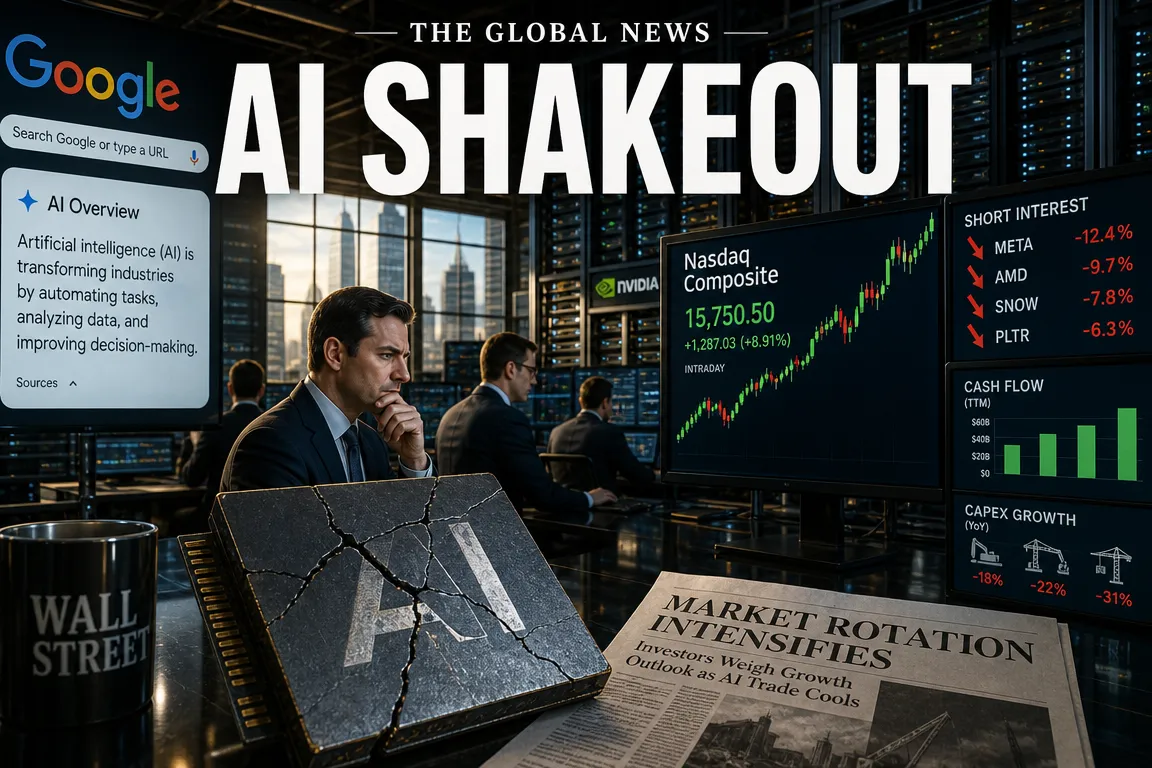
● AI Stocks, Bubble, Crash, Rebound
Do AI Stocks Still Have Upside? Big Tech Cash Flow, Risks to Google Search, and Nasdaq Rebound Signals
The central issue in the recent AI stock correction is not simply the scale of the decline.
Investors must assess whether Big Tech’s AI spending is generating cash, whether Google’s AI-powered search can protect its advertising business, and whether forced hedge fund selling and elevated technology-sector short interest indicate a near-term market bottom.
Key considerations include weakening Big Tech free cash flow, monetization challenges for Google AI Overviews, declining search referrals to Reddit, funding risks at OpenAI and Anthropic, and positioning indicators relevant to a potential Nasdaq rebound.
AI demand has not disappeared, but the market’s valuation framework for AI companies has changed materially.
Investors are shifting their focus from user growth to the timing and scale of AI-generated earnings and cash flow.
1. Cash Flow Is the Central Issue in the AI Stock Correction
The source material cites an approximately 2.8% one-day decline in the Nasdaq.
However, the more significant concern was the deterioration in aggregate free cash flow among major Big Tech companies.
Free cash flow represents operating cash flow after capital expenditures.
It measures the cash remaining after a company funds operations and investment requirements.
- AI data center construction costs are rising rapidly.
- Spending on high-performance GPUs and servers is increasing.
- Investment is required in power infrastructure, cooling systems, and networking equipment.
- Model training and inference generate substantial recurring costs.
When these investments occur simultaneously, free cash flow can decline materially even if revenue and operating income continue to increase.
A decline in free cash flow does not, by itself, indicate that an AI strategy has failed.
However, if AI revenue and earnings do not grow fast enough relative to investment, the market may apply lower valuation multiples.
The message from the latest Big Tech earnings cycle was clear.
Investors want evidence that AI can generate revenue and cash, not only improvements in model performance and user metrics.
2. How to Interpret Weakening Big Tech Free Cash Flow
Lower free cash flow does not necessarily indicate deterioration in the core business.
If operating cash flow remains stable while data center spending accelerates, the decline may reflect investment in future capacity rather than structural operating weakness.
If operating cash flow also slows while AI capital expenditures continue to increase, a more conservative assessment is warranted.
Investors should monitor four metrics in future Big Tech earnings reports.
- Operating cash flow: Whether core operations continue to generate stable cash inflows.
- Capital expenditures: The rate at which AI data center investment is increasing.
- AI-related revenue: AI’s contribution to cloud and software revenue.
- Return on investment: Whether incremental AI revenue and earnings justify the required investment.
The success of AI investment will not be determined by technical capability alone.
Operating efficiency, pricing power, margins, and the speed of capital recovery are becoming increasingly important.
3. Google’s Results Highlight the AI Search Paradox
The source attributes Google’s sharp share-price decline around its earnings announcement partly to concerns about AI search monetization.
Strong search activity and engagement may not satisfy investors if incremental AI usage does not generate revenue comparable to conventional search advertising.
Under the traditional Google Search model, users reviewed results and clicked advertisements or external links.
Google generated search advertising revenue, while external websites received referral traffic.
AI Overviews and AI Mode instead summarize information from multiple websites and provide answers directly on the search page.
Users can obtain information without visiting external websites and can continue asking follow-up questions through Gemini.
This may increase engagement within Google’s ecosystem, but it may not immediately generate the same revenue per query as conventional search advertising.
Google’s challenge is a transition in its business model rather than a failure of the underlying technology.
Excessive advertising within AI responses could weaken the user experience and reduce trust in the answers.
Conversely, limited advertising could increase AI usage while reducing revenue per search.
Google’s principal challenge is integrating AI search with paid subscriptions, commerce, recommendation-based advertising, and enterprise Gemini services.
4. The Impact of AI Overviews on Reddit and the Content Industry
The source cites a claim that Reddit is losing approximately 1 million search-referred users per week on average.
This figure should be verified against Reddit’s official earnings materials and regulatory disclosures before being used in an investment decision.
Many users have historically added “Reddit” to Google queries to find first-hand experiences and opinions.
Prominent placement of Reddit posts in Google results generated direct visits, traffic, and advertising revenue for Reddit.
If Google AI summarizes content from Reddit and other websites directly on the search page, users have less reason to visit the original source.
This is commonly described as zero-click search.
Users receive answers, while the original information providers may receive neither traffic nor advertising revenue.
The impact extends beyond Reddit.
- Publishers and blogs dependent on search traffic may be affected.
- Product comparison and review websites may experience lower traffic.
- Travel, financial, and healthcare information platforms may lose search referrals.
- Small businesses dependent on Google rankings may need to revise their marketing strategies.
As the web shifts away from a search engine optimization model, inclusion as a credible source in AI-generated answers may become increasingly important.
Content companies may need proprietary data, first-hand expertise, differentiated analysis, and stronger brand credibility.
5. A Critical Structural Shift: Control of Search Traffic Is Changing
The most important development is not the design of the search interface.
The underlying issue is who controls internet traffic and captures the economic value created by content.
Historically, Google served as a gateway directing users to external websites.
In the AI search model, Google is becoming the destination by synthesizing external information and delivering the final answer.
If this structure expands, content creators may receive neither traffic nor advertising revenue even when their information is used in AI-generated responses.
Google, meanwhile, may retain users within its ecosystem and collect more behavioral data.
Disputes over content fees, data licensing, source attribution, and revenue sharing are therefore likely to intensify.
Investors should evaluate search advertising pricing, revenue per query, external click-through rates, and content acquisition costs alongside AI search usage.
6. OpenAI Funding Claims Require Verification
The source presents OpenAI’s reported inability to meet its targeted valuation and fundraising objectives as a negative development.
The figures cited include a $30 billion fundraising target, $1.1 billion in investment commitments, and a valuation reduction from $1.4 trillion to $1.25 trillion.
These figures contain a clear mathematical inconsistency.
$1.1 billion represents approximately 3.7% of $30 billion, not roughly one-third as stated in the source.
The intended figure may have been $11 billion, or the valuation units may have been translated incorrectly.
The figures should not be treated as confirmed without verification through official announcements and credible financial reporting.
Nevertheless, the broader issue remains relevant.
Generative AI companies require substantial capital for model training and inference. Deteriorating financing conditions could directly affect growth rates and valuations.
If computing costs rise faster than revenue, dependence on external funding may remain high.
7. Why Anthropic’s Credit Risk Matters
The source suggests that Anthropic could receive a speculative-grade rating while preparing for an initial public offering.
The financing structure, rated entity, and any official credit rating require independent verification.
A speculative-grade rating would increase borrowing costs in bond and loan markets.
Higher financing costs could reduce the capital available for research and development, computing services, and recruitment.
Investment-grade status is therefore not merely a reputational issue. It affects the cost and availability of long-term financing.
Evaluating AI companies requires analysis of cash reserves, annual cash burn, cloud contract terms, and funding costs in addition to model performance.
8. Why Bill Ackman Does Not View AI as a Bubble
The source presents Bill Ackman’s view that demand for AI computing is substantial and commercially grounded.
Although shares of Microsoft, Meta, and Amazon declined after the companies announced capital expenditure plans above market expectations, he reportedly viewed those declines as buying opportunities.
Higher interest rates generally increase borrowing costs and discourage capital investment.
However, Big Tech companies may be unable to reduce AI investment materially because falling behind could weaken the competitiveness of their core businesses.
If AI generates sufficient profits across cloud computing, advertising, e-commerce, and enterprise software, current capital expenditures may be justified over the long term.
If AI revenue falls short, depreciation and financing costs could pressure earnings.
The assertion that AI demand is real should therefore be distinguished from the claim that all AI stocks are attractively valued.
An industry can expand while investors who pay excessive valuations still earn weak returns.
9. Is Forced Hedge Fund Selling a Near-Term Rebound Signal?
The source cites a post referencing Morgan Stanley data indicating that hedge funds sharply reduced long equity exposure.
Large-scale hedge fund selling does not necessarily reflect a deterioration in the fundamental outlook.
Loss limits, higher volatility, investor redemptions, and internal risk controls can force funds to sell positions they would otherwise retain.
When forced liquidation becomes extreme, much of the required selling may already have occurred.
Historical observations suggest that one-month, three-month, and six-month equity returns have sometimes improved following severe position reductions.
Historical performance does not guarantee a rebound.
If a recession, downward earnings revisions, or a credit crisis occurs simultaneously, markets may continue to decline after positioning has been reduced.
This indicator is more appropriately viewed as evidence of potential short-term overselling than as confirmation of a market bottom.
10. What the Increase in QQQ Short Interest Indicates
The source also states that short interest in the Nasdaq-100-tracking QQQ reached its highest level since March 2023.
Short interest reportedly increased substantially in QQQ but not to the same extent in the S&P 500-tracking SPY.
This suggests that bearish positioning was concentrated in technology and AI-related stocks rather than the broader US equity market.
When short positioning becomes excessive, even a modest positive catalyst can trigger short covering.
Short covering occurs when investors betting on lower prices repurchase shares to limit losses.
If such purchases become widespread, they can produce a rapid Nasdaq rebound or short squeeze.
High short interest alone does not confirm a market bottom.
If the bearish thesis is correct, prices may decline further.
Investors should assess short interest alongside earnings expectations, Treasury yields, credit spreads, and market volatility.
11. Factors That Could Increase the Probability of a Near-Term Rebound
- Position liquidation: A significant portion of forced hedge fund selling may already have occurred.
- Concentrated technology short positions: Positive catalysts could trigger QQQ-focused short covering.
- AI computing demand: Underlying cloud and data center demand may remain resilient.
- Big Tech financial capacity: Major platform companies retain strong core businesses and sufficient resources to continue investing.
- Lower geopolitical tensions: Progress in Middle East negotiations could support oil-price stability and risk-asset sentiment.
12. Risk Factors That Could Drive Further Declines
- Delayed AI monetization: Revenue and cash recovery may lag investment.
- High interest rates: Funding costs and discount rates for growth stocks may remain elevated.
- Rising depreciation: Large data center investments will increasingly be recognized as accounting expenses.
- Search advertising cannibalization: AI search may displace higher-margin conventional search advertising.
- Funding pressure on private AI companies: Difficult financing conditions could force companies to reduce expansion plans.
- Geopolitical conflict: Renewed military tensions in the Middle East could increase oil prices and market volatility.
13. Iran-Related Negotiations Should Be Treated as a Secondary Variable
The source identifies the possibility of Qatar-mediated negotiations involving Iran as a potentially positive development.
However, it remains unclear whether the discussions would involve direct US-Iran negotiations or mediation between Qatar and Iran.
Geopolitical negotiations can change rapidly in timing, participation, and scope.
Investors should assess oil prices, shipping rates, defense stocks, and safe-haven assets rather than relying solely on negotiation headlines.
Lower tensions could reduce oil prices and inflation concerns, supporting growth stocks.
Escalating military conflict could raise energy prices and Treasury yields, placing additional pressure on technology-sector valuations.
14. Checklist for AI Equity Investors
First, determine whether AI revenue is growing faster than total company revenue.
Investors should consider actual revenue scale and paying customer growth, not only percentage growth in AI products.
Second, compare capital expenditure growth with free cash flow.
If investment continues to increase while cash generation weakens, valuation compression becomes more likely.
Third, monitor cannibalization in search and advertising.
The extent to which AI search replaces conventional search advertising revenue will be a critical metric for Google.
Fourth, assess AI infrastructure utilization.
The efficiency and utilization of data center capacity matter more than construction volume alone.
Fifth, evaluate the financing terms of private AI companies.
Investors should examine preferred share terms, conversion rights, minimum return provisions, and cloud service commitments, not only headline valuations.
Sixth, separate positioning indicators from fundamental performance.
Short covering and forced liquidation can drive near-term rebounds, but long-term equity performance ultimately depends on earnings and cash flow.
15. Why AI Stocks May Still Have Long-Term Potential
The investment case for AI stocks does not rest on the magnitude of recent price declines.
The central factor is continued growth in demand for AI computing across cloud services, advertising, software, semiconductors, and data centers.
The current correction may represent a normalization of expectations and valuations rather than the end of the AI investment cycle.
However, not every AI company will succeed.
Companies capable of funding substantial investment while generating high margins and recurring revenue are more likely to remain competitive over the long term.
The market is likely to place greater emphasis on cash generation, paid conversion rates, and returns on invested capital rather than technical demonstrations, user growth, or revenue expansion alone.
In the near term, forced hedge fund selling and elevated QQQ short interest could provide support for a rebound.
Over the long term, the decisive issue is whether AI can generate cash flows that exceed the capital required to build and operate the supporting infrastructure.
< Summary >
The AI equity correction reflects concerns about delayed cash recovery relative to large-scale investment rather than the disappearance of AI demand.
Google is expanding AI search usage but must convert that activity into revenue comparable to its conventional search advertising business.
Reddit and other content companies may face declining referrals as zero-click AI search expands.
Funding claims involving OpenAI and Anthropic require verification, and some figures cited in the source are mathematically inconsistent.
Forced hedge fund selling and increased QQQ short interest indicate potential overselling and create conditions for short covering.
Long-term AI demand may remain intact, but investors are likely to prioritize free cash flow and returns on invested capital over technical capability alone.
[Related Articles…]
*Source: [ 내일은 투자왕 – 김단테 ]
– AI 주식 아직 희망이 있다?