● Taiwan Shock, Korea Risk, US Shift
Potential Expansion of U.S. Forces Korea’s Off-Peninsula Role: Implications of a Taiwan Contingency for South Korea’s Economy and Security
The central issue is not evidence of an imminent North Korean attack, but the potential expansion of U.S. Forces Korea’s mission toward China and Taiwan, changes in the conditions for transferring wartime operational control, and the possibility that crises on the Korean Peninsula and in the Taiwan Strait could become operationally linked.
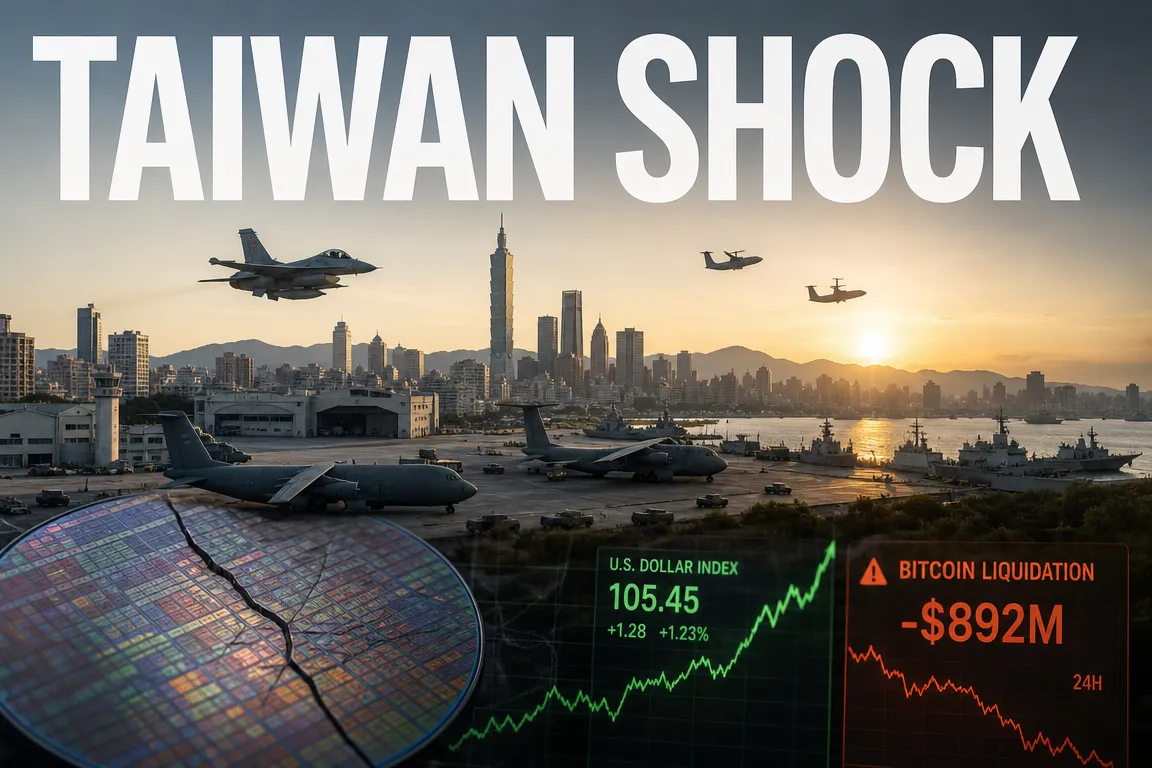
Key risks include a compound crisis in which North Korea launches military provocations during a Taiwan contingency, along with potential shocks to semiconductor supply chains, exchange rates, energy prices, and South Korean equities.
Terms such as “surprise-attack warning” and “war readiness” in a video title should not be interpreted as evidence that war is imminent.
The available source is an excerpt from an expert interview. The video was recorded on October 29, but the year and full context cannot be verified from the provided material.
1. Core Issue: U.S. Forces Korea Is No Longer Focused Exclusively on North Korea
The source’s principal argument is that the strategic role of U.S. Forces Korea may no longer remain limited to defending the Korean Peninsula.
As China becomes the primary focus of U.S. military competition, U.S. forces deployed across the Indo-Pacific are increasingly likely to operate as an integrated regional network.
U.S. Forces Korea officially remains responsible for supporting the defense of the Korean Peninsula and maintaining the combined defense posture.
However, a major conflict in the Taiwan Strait or East China Sea could affect U.S. bases, logistics facilities, and intelligence assets located in South Korea.
- Osan Air Base: A major hub for air operations, intelligence, and command functions.
- Camp Humphreys in Pyeongtaek: A core facility supporting command, logistics, and force operations.
- Kunsan Air Base: Strategically important for operations over the Yellow Sea and Northeast Asia.
- Busan and Jinhae: Potentially important for maritime transportation and logistical support.
A clear distinction is necessary.
The assessment that U.S. Forces Korea could prepare for regional contingencies does not mean that it would automatically enter a Taiwan conflict without consultation with the South Korean government.
Troop and equipment movements, the scope of base access, and the level of South Korean military support would depend on bilateral consultations, alliance procedures, domestic law, and international law.
2. Interpreting the Statement That China Has Become the Primary Adversary
The source uses strong language to describe the shift in U.S. strategic priorities toward China.
This should not be interpreted as meaning that the South Korean government has officially designated China as its primary enemy.
A more accurate interpretation is that U.S. defense strategy identifies China as its most consequential long-term competitor and military challenge.
The United States treats China’s military expansion, pressure on Taiwan, activities in the South China Sea, and competition in advanced technologies as interconnected security issues.
It is therefore strengthening cooperation with allies including Japan, South Korea, Australia, and the Philippines while adjusting its Indo-Pacific force posture.
For South Korea, the central policy challenge is determining the appropriate scope of its role and obligations between the alliance’s traditional focus on deterring North Korea and the broader U.S. strategy toward China.
3. Risk of Simultaneous North Korean Action During a Taiwan Contingency
The most severe scenario presented is a simultaneous crisis involving a Chinese attack on Taiwan or conflict in the Taiwan Strait and North Korean military provocations.
If U.S. attention and capabilities were concentrated on the Taiwan Strait, North Korea could perceive an opportunity to exploit pressure on the South Korea-U.S. combined defense posture.
This does not mean North Korea would necessarily initiate a full-scale war.
More plausible options could include missile launches, localized provocations near the Northern Limit Line, drone incursions, GPS interference, cyberattacks, and intensified nuclear threats.
Such actions could disperse South Korean and U.S. response capabilities at a lower cost than full-scale conflict.
There is no publicly confirmed evidence that China and North Korea have agreed in advance to conduct simultaneous military operations.
The scenario should therefore be treated as a high-impact contingency requiring preparation, not as a confirmed plan.
4. Potential Stages of Escalation on the Korean Peninsula
Stage 1 would involve heightened military tension and intensified information warfare.
North Korean missile launches and threatening statements, Chinese military exercises around Taiwan, and U.S. strategic-asset deployments could occur in rapid succession.
False reports, manipulated videos, and disinformation intended to destabilize financial markets could spread rapidly.
Stage 2 would involve increased gray-zone activity.
Cyberattacks, communications disruption, satellite-navigation interference, and maritime confrontations could increase without clearly crossing the threshold into war.
Stage 3 would involve a higher military readiness posture.
South Korea and the United States could expand surveillance operations, strengthen air and maritime patrols, and increase selected exercises or troop movements.
Such measures would not, by themselves, indicate that war had begun.
Stage 4 would involve simultaneous regional crises.
If combat began in the Taiwan Strait while North Korea initiated military action, the alliance would need to manage both the defense of the Korean Peninsula and support for U.S. regional operations.
The speed of South Korean decision-making and the extent of prior bilateral agreements would become critical.
5. Why the Transfer of Wartime Operational Control Is Becoming More Complex
The transfer of wartime operational control is conditions-based rather than automatically implemented on a predetermined date.
Key criteria include South Korea’s core military capabilities, its ability to respond to North Korean nuclear and missile threats, and the existence of a stable security environment.
The complication is that the relevant security environment may be expanding beyond North Korea to include China and a potential Taiwan Strait crisis.
A policy debate could emerge over whether South Korea must only be capable of deterring North Korean conventional, nuclear, and missile threats or must also prepare for regional conflicts that could extend to the peninsula.
The transfer of wartime operational control would not automatically result in the withdrawal of U.S. forces or the termination of the alliance.
The central issue is the command structure under which South Korean and U.S. combined forces would operate during wartime.
More important than a binary debate over transfer or retention is the development of detailed post-transfer command arrangements, extended-deterrence mechanisms, intelligence-sharing systems, and nuclear-crisis procedures.
6. DMZ Militarization and the United Nations Command
The source discusses possible militarization of the Demilitarized Zone and the approval authority of the United Nations Command.
The DMZ is a special military area established under the 1953 Armistice Agreement.
It is not administered in the same manner as a conventional national defense area in which the South Korean government or military may freely deploy facilities and weapons.
The movement of personnel and equipment and the installation of facilities within the Military Demarcation Line and DMZ may be subject to the Armistice Agreement and the United Nations Command’s administrative authority.
However, it would also be inaccurate to conclude that South Korea cannot take any action without unilateral authorization from the United Nations Command.
Actual measures would depend on South Korea-U.S. consultations, interpretations of the Armistice Agreement, operational requirements, and field safety.
This issue is distinct from wartime operational control.
Wartime operational control concerns the command of combined forces, while the United Nations Command has separate legal and military responsibilities related to maintaining the armistice.
7. Economic Impact: Vulnerabilities Under Simultaneous Taiwan and Korean Peninsula Crises
The issue has substantial economic as well as security implications.
The Taiwan Strait is central to advanced semiconductor production and Asian maritime trade. A conflict could materially weaken the global economic outlook.
The first channel would be the won-dollar exchange rate and foreign capital flows.
Higher geopolitical risk typically drives investors toward safe-haven assets such as the U.S. dollar and U.S. Treasury securities.
The South Korean won is sensitive to external uncertainty and could experience significant volatility.
Simultaneous foreign selling of South Korean and Taiwanese equities could rapidly weaken the near-term outlook for South Korea’s stock market.
The second channel would be semiconductor supply chains.
Taiwan is the center of advanced foundry production, while South Korea is a major supplier of memory chips and advanced manufacturing capacity.
A disruption in Taiwanese production could redirect some demand toward South Korean semiconductor companies. However, disruptions to equipment, materials, chip design, packaging, and logistics would limit any straightforward substitution benefit.
Simultaneous shortages of GPUs, high-bandwidth memory, and advanced packaging capacity could also delay global data-center investment.
The third channel would be maritime logistics and energy prices.
Instability in and around the Taiwan Strait could require vessels to reroute and could raise shipping and war-risk insurance costs.
South Korea’s dependence on imported crude oil and liquefied natural gas makes it particularly exposed to higher transportation and energy costs.
The fourth channel would be corporate investment and consumer sentiment.
Prolonged security uncertainty could delay capital expenditure, hiring, and household consumption.
A weaker currency could also raise import prices, increasing the risk of slower growth combined with persistent inflation.
8. Overlooked Linkages to the AI Industry
Although semiconductors would receive the greatest attention during a Taiwan contingency, the broader infrastructure required to operate AI services would also be exposed.
Advanced AI accelerators depend on an international production network connecting Taiwanese foundries, South Korean memory suppliers, U.S. design companies, and Japanese and European equipment and materials producers.
A conflict in one region could disrupt GPU supply, server deployment, cloud-capacity expansion, and AI model-training schedules.
Cyberattacks and generative-AI-enabled disinformation represent additional risks.
During a military crisis, deepfakes, fabricated government announcements, and false evacuation orders could intensify social disruption and financial-market volatility.
Companies should prepare not only through AI development, but also through geographically distributed data centers, multi-cloud redundancy, backup power, and cyber-recovery systems.
9. Key Issues Receiving Limited Attention
First, the main issue is mission flexibility rather than the withdrawal of U.S. Forces Korea.
Even if U.S. forces remain stationed in South Korea, the priorities assigned to selected forces and intelligence assets could change in response to regional conditions.
Investors and policymakers should monitor not only troop numbers but also force composition, deployment locations, and assigned missions.
Second, the Taiwan Strait and Korean Peninsula already constitute an integrated economic risk zone.
Although they may remain separate military theaters, financial markets and supply chains are unlikely to treat them independently.
A Taiwan crisis would immediately affect South Korea’s currency, exports, and semiconductor production, while higher tensions on the Korean Peninsula could raise risk premiums across Asian assets.
Third, the use of bases in South Korea could become a more immediate issue than direct South Korean military participation.
Even without direct combat involvement by South Korean forces, the use of U.S. bases for intelligence, maintenance, transportation, or refueling could expose South Korea to diplomatic and economic friction with China.
Fourth, wartime operational control is an issue of information and technology as well as command authority.
Without sufficient independent capabilities in surveillance, reconnaissance, missile detection, command and control, space, and cyber operations, a formal transfer would not necessarily provide full operational autonomy.
Fifth, the economic cost of a prolonged crisis could emerge before an actual war.
Military exercises, sanctions, export controls, higher insurance premiums, and corporate supply-chain restructuring could generate substantial costs even without armed conflict.
10. Risk Indicators for Investors and Companies
- Official statements on the mission of U.S. Forces Korea: Priority should be given to documents issued by the U.S. Department of Defense and South Korean and U.S. defense authorities.
- Changes in military exercises around Taiwan: Relevant indicators include exercise duration, live-fire activity, blockade simulations, and the scale of naval and air deployments.
- North Korean provocation patterns: Launch locations, missile types, and conventional-force movements are more informative than launch frequency alone.
- Won-dollar exchange rate and foreign-investor flows: These indicators show how rapidly geopolitical risk is being priced into financial markets.
- Shipping rates and war-risk insurance premiums: These provide evidence of whether logistical risk is materially increasing.
- Semiconductor delivery times and inventories: These indicate whether geopolitical tension is spreading into physical supply chains.
- Cybersecurity alerts: Attacks on telecommunications, finance, and energy infrastructure could precede visible military escalation.
11. How to Assess Sensationalized War Reporting
First, conditional expert scenarios should be distinguished from government-confirmed intelligence.
The assessment that North Korea could act during an attack on Taiwan describes a possibility, not a confirmed outcome.
Second, military exercises should not automatically be interpreted as preparations for an actual attack.
Additional indicators would include logistics stockpiling, conversion of medical systems to wartime use, large-scale mobilization, and restrictions on civilian aviation or shipping.
Third, the recording date, publication date, and full context of video statements should be verified.
The source states that the video was recorded on October 29, but does not identify the year and ends before the full discussion is presented. It therefore cannot be assumed to reflect the latest official conditions.
Fourth, investment decisions should be based on official disclosures and market indicators rather than video headlines.
Panic selling or indiscriminate purchases of defense stocks could generate substantial losses.
< Summary >
The role of U.S. Forces Korea could evolve beyond deterring North Korea and become more closely connected to U.S. Indo-Pacific strategy toward China and the Taiwan Strait.
The possibility of North Korean provocations during a Taiwan contingency is a compound-risk scenario requiring preparation, but it is not evidence of a confirmed war plan or imminent attack.
The central issues in transferring wartime operational control are the combined command structure, intelligence capabilities, extended deterrence, and nuclear-crisis response.
Simultaneous tensions in the Taiwan Strait and on the Korean Peninsula could affect exchange rates, energy prices, semiconductor supply chains, AI data-center investment, and South Korean equities.
Assessment should prioritize official statements, military indicators, financial-market data, and supply-chain metrics rather than unsupported conclusions.
[Related Articles…]
*Source: [ 달란트투자 ]
– “남북 전쟁 준비 태세” 주한미군 기습 경고 한반도 분위기 심상치 않다 | 조한범 박사 2부
● Tech Shock, Crypto Chaos, Dollar Surge
SOXL, Palantir, Bitcoin, Google, Meta, Microsoft, and IREN Outlook: Investment Criteria to Monitor Now
The key issue is not predicting the exact market bottom.
The priority is to integrate the Nasdaq trend, critical price levels for individual securities, and the structural risks of leveraged ETFs into a unified investment framework.
This analysis addresses the risks of buying SOXL during a decline, why Palantir may fall despite strong earnings, the potential liquidation cycle following a breakdown in Bitcoin’s technical pattern, and the possibility of a new trading range for USD/KRW.
For AI-related companies such as Google, Meta, Microsoft, and IREN, the focus should be on market-index confirmation rather than isolated price targets.
The source did not specify the recording date or futures contract year, and some names, prices, and units appear to contain transcription errors.
The price levels below should therefore be treated as historical technical reference points from the source, not current market prices.
Investors should verify all information against current exchange data and corporate disclosures.
1. Core Market Conclusions
- The first rebound after a sharp decline may be a dead-cat bounce rather than the start of a new uptrend.
- If the Nasdaq fails to recover key resistance, rebounds in individual stocks may remain limited.
- Leveraged ETFs such as SOXL are unsuitable for long-term bottom-fishing during a downtrend.
- Earnings results and subsequent share-price direction do not necessarily align.
- For USD/KRW, the medium- to long-term trading range and underlying dollar demand matter more than a daily move of KRW 10–15.
- Weakness in AI semiconductors could extend beyond a technology-sector correction and increase concerns about an economic slowdown.
The central principle is straightforward.
A price increase alone does not confirm a trend reversal; the market must recover predetermined technical thresholds.
Sharp declines are often followed by volatile consolidation, with repeated advances and reversals.
Interpreting a one- or two-day rebound as a new bull market can lead to buying near a short-term peak.
2. Nasdaq Outlook: Recovery Above 29,000 Matters More Than the Initial Rebound
The source identified 29,000 as the most important short-term threshold for its Nasdaq-related indicator.
This figure may not correspond to the commonly referenced Nasdaq Composite or Nasdaq-100 spot index.
It may refer to a specific futures contract, CFD, or platform-based index, so investors using different charts should not apply the number directly.
- Initial observation area: Approximately 28,200
- Trend-recovery condition: A sustained move above 29,000
- Risk signal: Repeated short-term rebounds without improving volume or trend structure
Rebounds below 29,000 should initially be treated as potential countertrend rallies.
If the market recovers this level and converts it into support, downside scenarios for technology and AI-related stocks may need to be revised.
Broad market direction should be assessed before individual stock charts.
3. How to Monitor S&P 500 E-mini Futures on Yahoo Finance, TradingView, and MarketWatch
S&P 500 E-mini futures can provide useful information on market sentiment before the U.S. regular trading session.
TD-affiliated platforms generally use /ES for S&P 500 E-mini futures and /NQ for Nasdaq-100 E-mini futures.
Yahoo Finance typically lists these contracts as ES=F and NQ=F, respectively.
TradingView, MarketWatch, and Robinhood may also display futures or related indices, although access depends on account status and exchange-data subscriptions.
Claims of completely delay-free pricing should be treated cautiously.
CME futures data may be real-time or delayed depending on the platform’s data agreement.
Displayed prices may differ from an execution platform by several seconds or minutes.
The source also referred to a December contract without specifying the contract year.
Because futures expire, investors must verify the active contract month, contract code, and current volume leader.
Near expiration, liquidity shifts to the next contract during rollover, potentially distorting simple price comparisons.
4. USD/KRW Outlook: Could 1,300 Become a New Normal?
The source viewed the KRW 1,300–1,350 range as potentially significant for medium- to long-term dollar conversion.
The underlying argument is that global inflation and geopolitical uncertainty may prevent a rapid return to the historical KRW 1,100–1,200 range.
- Around KRW 1,300: Potential area for renewed dollar demand
- Around KRW 1,350: Upper range where near-term exchange-rate pressure may increase
- Below KRW 1,300: Potential staged-conversion opportunity for long-term dollar buyers
However, KRW 1,300 should not be treated as a permanent new normal.
USD/KRW is influenced by U.S.–Korean interest-rate differentials, trade balances, foreign capital flows, oil prices, China’s economy, and global risk appetite.
Federal Reserve rate cuts and stronger Korean exports could support the won.
Financial instability or geopolitical shocks could renew dollar strength.
Investors requiring U.S. dollars may benefit from staged conversion rather than attempting to identify an exact exchange-rate bottom.
U.S. equity investors should evaluate both investment returns and foreign-exchange gains or losses.
5. Is the Dollar a Safer Haven Than Gold?
The source suggested that investors may prioritize liquid U.S. dollars over gold during severe market stress.
During liquidity shocks, investors may sell gold or bonds to secure dollar cash.
This does not mean that gold is no longer a safe-haven asset.
The dollar tends to perform well during liquidity crises and short-term risk aversion.
Gold may strengthen when real interest rates decline, confidence in currencies weakens, central-bank purchases rise, or geopolitical risks persist.
For U.S. Treasuries, stability at maturity should be distinguished from interim market-price volatility.
The dollar, gold, and U.S. Treasuries can all function as safe havens, but their performance depends on different macroeconomic conditions.
6. FOMC and Stagflation: The Issue Beyond a Rate Hold
The source characterized the relevant FOMC decision to hold rates amid elevated inflation and limited data as relatively cautious.
However, monetary policy is not determined by consumer inflation alone.
The Federal Reserve also considers employment, wages, service inflation, inflation expectations, financial conditions, and credit-market risks.
A more significant market risk is stagflation.
Stagflation combines slowing economic growth with persistently high inflation.
Under these conditions, the Federal Reserve has limited flexibility to cut rates to support growth or raise them to control inflation.
Simultaneous weakness in AI and cyclical semiconductors may indicate more than valuation compression; it may also signal slowing economic activity.
Semiconductor orders and capital expenditure often reflect expected future corporate demand.
7. Google Outlook: Historical Reference Levels at $280 and $270
The source identified approximately $280 for Alphabet as a potential short-term support and rebound area.
The $270 level was presented as a critical threshold for determining whether the intermediate trend had materially weakened.
- $280: Short-term support and rebound-confirmation area
- $270: Critical level for assessing medium-term trend deterioration
- Key factors: Nasdaq direction, advertising revenue, cloud growth, and AI investment costs
Alphabet should be evaluated across search advertising, YouTube, cloud computing, and generative AI.
Even if AI investment supports revenue growth, higher data-center depreciation and capital expenditure may pressure near-term profitability.
A price level alone is insufficient; Nasdaq direction and earnings expectations should also confirm the investment case.
8. Meta Outlook: Why $600 Matters
The source indicated that Meta failed to extend gains near a previous high and subsequently entered a correction.
From a technical perspective, approximately $600 was identified as an important supply zone and psychological threshold.
- Holding $600: May preserve the medium- to long-term bullish structure
- Breaking below $600: Could require assessment of lower support levels
- Key factors: Advertising growth, AI recommendation efficiency, capital expenditure, and Reality Labs losses
Meta uses AI to improve advertising conversion and content recommendations.
However, higher AI infrastructure spending could make the stock more sensitive to operating-margin guidance than to revenue growth alone.
9. Microsoft Outlook: Failure at $570 and Support at $520
The source stated that Microsoft advanced toward $570 after earnings but failed to establish a sustained breakout.
It identified $520 as the next critical support level.
- Sustained move above $570: Potential resumption of the uptrend
- Holding $520: Maintains the correction within an intermediate range
- Break below $520: Could extend the source’s downside scenario toward $470
Azure growth and Copilot monetization remain central to Microsoft’s outlook.
Investors also assess data-center capital expenditure and power-supply costs alongside AI-related revenue growth.
Strong earnings can still trigger profit-taking if expectations are already fully reflected in the share price.
10. IREN Outlook: A Potential $21–$28 Trading Range
The company identified in the source appears to be IREN, an operator of data centers and Bitcoin-mining infrastructure.
After support at $38 failed, the source projected a possible correction toward $22–$20.
- Lower boundary: $20–$21
- Upper boundary: Approximately $28
- Expected structure: An earnings-driven trading range with repeated advances and declines
A move from $23 to $26 may remain a range-bound rebound if the stock cannot exceed $28.
A credible trend reversal would require a volume-supported breakout above the upper boundary followed by confirmation that the level has become support.
IREN is affected by Bitcoin prices, electricity costs, mining difficulty, equipment efficiency, AI data-center contracts, and financing terms.
An investment case based only on AI data-center expectations may overlook mining volatility and capital requirements for new facilities.
11. SOXL Outlook: Why Leveraged ETFs Are Risky in a Downtrend
SOXL is a leveraged ETF designed to deliver three times the daily return of a U.S. semiconductor index.
The source emphasized that SOXL may be inappropriate when the underlying semiconductor index is in a downtrend.
SOXL does not guarantee three times the index’s cumulative long-term return.
Because it resets daily, prolonged volatility and range-bound trading can produce persistent value erosion.
For example, if the underlying index falls 10% and then rises 11.1% the following day, it returns approximately to its starting level.
A three-times leveraged product would fall about 30% and then rise about 33.3%, leaving it below its original value.
This effect is known as volatility drag.
- Historical range cited by the source: A decline from below $100 into the $70s
- Additional downside scenario: $50 or lower if semiconductor sentiment deteriorates
- Conditions to confirm before entry: Semiconductor-index reversal, Nasdaq support, and recovering volume
SOXL should not be considered inexpensive solely because its price has declined significantly.
It is a high-risk instrument best considered selectively when both the underlying trend and broader volatility conditions improve.
12. SOXX Outlook: Risks of Relying Solely on the 200-Day Moving Average
The source identified $500 for SOXX as a critical level for recovering investor confidence.
Below $500, it interpreted the semiconductor sector’s intermediate trend as weak.
The 200-day moving average should not automatically be treated as a strong buying level.
A moving average is only a technical reference point.
Its support value may be limited without confirmation from historical volume zones or improving corporate fundamentals.
The source also mentioned “260,” but it is unclear whether this referred to SOXX or another semiconductor-related index.
The figure should be verified against the original chart before use.
13. SK Hynix: Price and Unit Errors Require Verification
The source recorded SK Hynix prices of KRW 2.6 million and KRW 1.2 million.
These figures are likely transcription or speech-recognition errors.
The intended levels may have been KRW 260,000 and KRW 120,000, or different values entirely, and should not be used without verification.
References to “SKHY” or price levels of $124 and $150 also require accurate instrument identification.
SK Hynix common shares trade on the Korea Exchange under code 000660.
The source may have confused an ADR, an over-the-counter security, a derivative, or another semiconductor company.
Relevant investment factors include HBM shipments, average selling prices, DRAM and NAND conditions, capital expenditure, and customer concentration.
Even with strong AI-related semiconductor demand, the stock may decline after favorable earnings if market expectations are excessive.
14. Palantir Outlook: Expectations and Valuation Matter More Than Headline Earnings
The source expected potentially solid Palantir results but remained uncertain about the subsequent share-price direction.
This distinction is critical for growth-stock analysis.
A stock may fall despite strong results if earnings fail to exceed expectations or management provides conservative guidance.
- Upper level cited by the source: Approximately $213
- Potential lower range after a failed breakout: Approximately $160
- Key factors: U.S. government contracts, commercial revenue growth, operating margin, and stock-based compensation
Palantir may command a high valuation because of expectations for its AI platform.
Under such conditions, the market may prioritize sustained growth acceleration over absolute revenue growth.
Investors should review the earnings call and forward guidance rather than reacting only to the initial post-earnings price move.
15. Bitcoin Outlook: Why $76,000 and $60,000 Matter
The source identified $76,000–$77,000 as Bitcoin’s first major support area.
Failure to rebound from this range could support a bearish head-and-shoulders scenario.
- Initial support: $76,000–$77,000
- Second critical support: Approximately $60,000
- Extreme downside range if the bearish pattern completes: Approximately $40,000
If a previously formed cup-and-handle pattern fails to break upward, investors positioned for the pattern may exit rapidly.
Stop-loss orders and leveraged liquidations could then produce greater volatility in derivatives than in the spot market.
Technical patterns alone cannot provide a definitive Bitcoin forecast.
Spot ETF flows, global liquidity, the U.S. Dollar Index, stablecoin supply, miner selling, and derivatives open interest should also be monitored.
The source referred to an exchange and a hacking incident without identifying the event or date.
Unverified exchange-related reports should not be treated as the sole cause of a price decline.
16. Practical Framework for Combining Index and Stock Analysis
The most actionable approach is to connect broad Nasdaq conditions with individual stock levels.
Assume a stock trades at $110 with expected support at $100.
If the stock falls to $105 while the Nasdaq reaches major support and rebounds strongly, the stock may recover without reaching $100.
If the Nasdaq breaks support and continues lower, the probability of the stock reaching $100 increases.
- Assess the S&P 500 and Nasdaq trends first.
- Define support and resistance levels for the market indices.
- Review each company’s earnings schedule and critical price levels.
- Compare whether the index rebounds first and whether the stock shows relative strength or weakness.
- Consider staged entry only when both the index and the stock meet predefined conditions.
A price target is not a guaranteed forecast; it is a scenario that depends on specific conditions.
If the index environment changes, stock targets and risk limits should be revised accordingly.
17. Critical Issues Often Overlooked in Financial News and Online Commentary
First, consolidation is not a quiet market; it is a market of repeated advances and declines.
A stock can gain 10–20% within a range without confirming a trend reversal if it fails to break the upper boundary.
Second, strong earnings do not guarantee a higher share price.
Stocks respond more to the difference between expectations and forward guidance than to historical results alone.
Third, leveraged ETFs may be poorly suited to bottom-fishing strategies.
During a downtrend or high-volatility consolidation, SOXL may recover more slowly than expected even if the underlying index returns to a previous level.
Fourth, chart levels vary by instrument and platform.
Spot indices, futures, CFDs, and ETFs can display materially different values even when they reference the Nasdaq.
Fifth, the dollar and gold can strengthen simultaneously.
Safe-haven assets should be assessed according to the type of crisis and the direction of real interest rates, rather than ranked uniformly.
Sixth, the central risk for AI companies is the speed of return on invested capital.
Even if Google, Meta, and Microsoft increase AI-related revenue, future valuations may depend on how quickly they recover investments in data centers, semiconductors, and power infrastructure.
18. Investor Checklist
- Confirm whether the Nasdaq has recovered the key resistance level cited by the source.
- Assess whether the semiconductor index and SOXX are outperforming the broader market.
- Evaluate SOXL as a short-term post-reversal instrument rather than a simple bottom-fishing vehicle.
- Remember that Google at $280 and $270, Meta at $600, and Microsoft at $570 and $520 were historical reference levels.
- Monitor whether IREN breaks the $21–$28 range and assess the move alongside Bitcoin prices.
- For Palantir, prioritize guidance and valuation changes over headline earnings.
- At Bitcoin’s $76,000 and $60,000 levels, monitor spot ETF flows as well as price action.
- Use staged currency conversion rather than reacting to short-term USD/KRW volatility.
- Verify futures contract month, contract year, and real-time data status.
- Validate all price levels against current charts and the latest corporate disclosures.
< Summary >
A rebound following a sharp decline should not automatically be interpreted as the start of a new uptrend.
If the Nasdaq cannot recover key resistance, rebounds in Google, Meta, Microsoft, Palantir, and IREN may remain constrained.
SOXL’s daily three-times leverage structure can magnify losses during declining and range-bound markets.
For Bitcoin, the source identified $76,000 and $60,000 as key levels, but ETF flows and leveraged liquidations should also be evaluated.
The KRW 1,300–1,350 USD/KRW range may have medium-term significance, but it should not be assumed to represent a permanent new normal.
The central principle is to treat individual price targets as conditional scenarios linked to the Nasdaq, earnings, and trading volume rather than as deterministic forecasts.
Investment Risk Notice: This material is a reconstruction of market commentary and does not constitute individualized investment advice.
Leveraged ETFs, futures, and digital assets carry substantial risk of principal loss. Investors should assess their financial circumstances and risk tolerance before investing.
[Related Articles…]
*Source: [ 미국주식은 훌륭하다-미국주식대장 ]
– 이걸 모르면 평생 후회할 수도 있습니다. SOXL SKHY 팔란티어 비트코인 구글 메타 마이크로소프트 아이렌