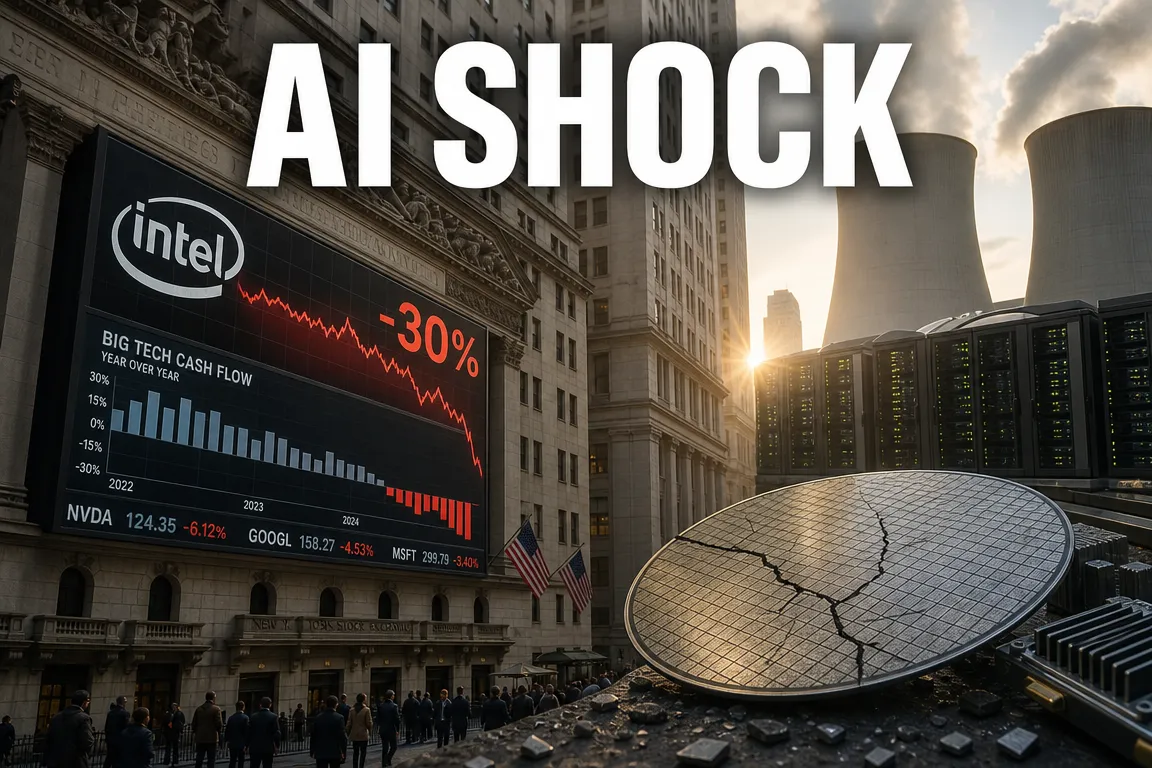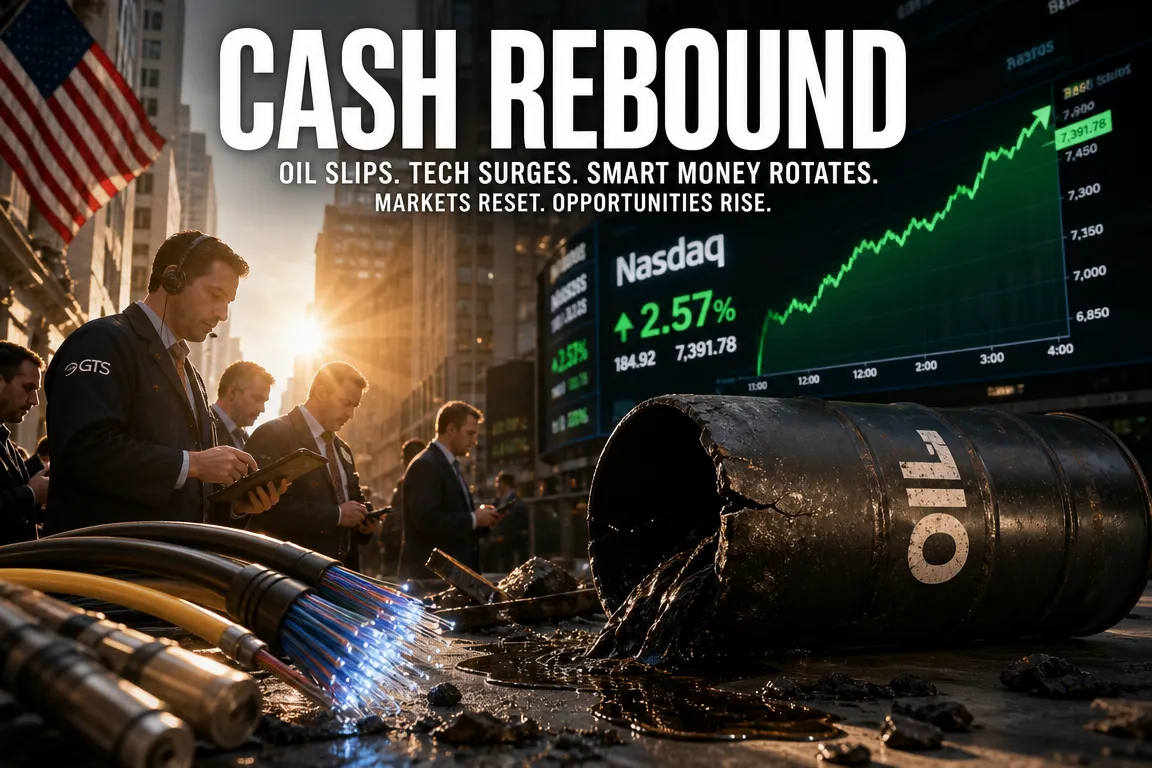
● Oil Crash, Tech Rebound, AI Shakeup
Wall Street Rebounds as Oil Prices Plunge: Technology Bargain Buying, Midterm Election Beneficiaries, AI Optical Networking, and OpenAI Financing
The key market development extends beyond the decline in crude oil prices and the rebound in the Nasdaq.
Lower oil prices reduced U.S. Treasury yields and supported technology stocks, although Middle East oil supplies have not normalized.
Wall Street has resumed selective technology buying while applying greater scrutiny to AI investment returns, data-center financing, and OpenAI’s funding capacity.
The U.S. midterm election could also affect the outlook for clean energy, homebuilding, AI infrastructure, defense, financial services, and cryptocurrency.
A particularly important structural shift is the movement of the AI industry’s competitive bottleneck from GPU performance toward optical communications and network connectivity.
The figures and events below are based on the original broadcast dated November 2, 2026.
The source presented inconsistent oil-price declines, market estimates, currency conversions, and schedules. Investors should verify all information against exchange filings and official corporate announcements.
1. Oil Price Decline Supports a Wall Street Rebound
U.S. equity futures advanced at the beginning of November.
- S&P 500 futures rose approximately 0.46%.
- Nasdaq 100 futures gained approximately 0.72%.
- Dow futures increased approximately 0.60%.
- Russell 2000 futures advanced approximately 0.68%.
The principal catalyst was a sharp decline in crude oil prices.
WTI fell to approximately $97 per barrel, while Brent declined to about $106. Intraday losses were reported at roughly 6%.
The headline indicated a decline of approximately 4%, while the body cited losses of 5.9% to 6.7%. The discrepancy may reflect different observation times or futures contract rollover effects.
Lower oil prices reduce transportation, raw-material, and household fuel costs. They can also moderate long-term inflation expectations, lowering Treasury yields and supporting rate-sensitive technology and growth stocks.
2. Iran Negotiation Expectations and Futures Rollover Drove the Decline
The immediate catalyst was the possibility of diplomatic negotiations between the United States and Iran.
Talks involving Iranian and Qatari officials raised expectations that disruptions in the Strait of Hormuz could ease. Reports that Washington might allow additional time for diplomacy before taking further military action also reduced the geopolitical risk premium.
Iran reportedly indicated that the Strait of Hormuz could reopen within two days if the United States accepted specified conditions.
Those conditions reportedly included lifting port restrictions, easing sanctions on Iranian oil exports, and establishing ceasefires that included Lebanon. U.S. acceptance remains uncertain.
Crude futures rollover activity at the beginning of November also amplified volatility. Concentrated selling during high-volume periods, combined with diplomatic expectations, accelerated the decline.
3. Lower Oil Prices Do Not Mean the Supply Crisis Is Over
The decline should not be interpreted as evidence that oil supplies have normalized.
Physical production and transportation volumes did not increase immediately. The move primarily reflected a reduction in the geopolitical risk premium.
Global oil inventories reportedly declined substantially following disruptions in the Strait of Hormuz, while diesel inventories in some regions fell to their lowest levels in 35 years.
Transportation and logistics costs were estimated to have risen from approximately 5% of the oil price before the conflict to nearly 30%.
Diesel and heating-fuel shortages ahead of winter could cause oil prices to rebound rapidly.
Goldman Sachs reportedly raised its December Brent forecast from $90 to $105 per barrel.
Its 2027 average Brent forecast was also increased from $81 to $88 per barrel.
Under a severe scenario involving prolonged Middle East production disruptions, Brent could reach $140 per barrel.
Morgan Stanley and ING were also reported to have raised Brent forecasts to approximately $105.
The market is therefore pricing both near-term diplomatic progress and the possibility of a longer-term structural supply deficit.
4. Why Wall Street Shifted Back Toward Technology Stocks
The Nasdaq 100 had fallen approximately 3.5% in the previous session, its worst daily performance since June 2025.
Its market capitalization reportedly declined by more than $2.5 trillion over the preceding month.
Following the selloff, several Wall Street firms concluded that U.S. technology stocks had become oversold.
Deutsche Bank upgraded U.S. technology stocks from “Neutral” to “Overweight.”
The firm had downgraded the sector from “Overweight” to “Neutral” only three weeks earlier.
During that period, U.S. large-cap technology and growth stocks declined approximately 11%, while non-technology S&P 500 stocks gained about 6%.
Deutsche Bank concluded that relative technology-sector performance had reached the lower end of its long-term trend.
Historical periods with similar relative valuations were followed by average gains of approximately 32%, although past performance does not guarantee future returns.
The current correction reflects more than weak sentiment. Investors remain concerned about whether AI capital expenditure can generate adequate earnings and cash flow.
5. Semiconductors Rebounded, but AI Stocks Diverged
Nvidia, AMD, Micron, and Broadcom initially advanced.
Semiconductor-equipment companies, including Lam Research and Applied Materials, also rebounded.
Intel underperformed because of weak earnings guidance. The stock initially rose before reversing to a decline of approximately 2%.
Among major technology companies, Alphabet and Amazon were relatively strong, while Microsoft posted a modest gain.
Apple and Meta traded lower during parts of the session. Oracle and Marvell also declined.
The divergence indicates that investors are no longer treating all AI-related companies as a uniform group.
For companies dependent on external financing or unusually high data-center expenditure, funding costs and investment payback periods are becoming as important as revenue growth.
6. Apple’s Results Provide a Test of Capital-Efficient AI Investment
Apple has invested less aggressively in large-scale AI data centers than Microsoft, Alphabet, Amazon, and Meta.
Its results therefore provide a benchmark for determining whether a company can maintain stable profitability without exceptionally high AI infrastructure spending.
Wall Street estimates cited in the source called for revenue of approximately $113 billion and net income of about $29 billion.
Key metrics include iPhone sales growth, services revenue, regional demand including China, and holiday-season guidance.
Stable results could encourage the market to place greater emphasis on cash flow and capital efficiency rather than the absolute level of AI spending.
7. Optical Communications Are Becoming AI’s Next Competitive Frontier
A critical industry shift is the movement of the AI bottleneck from computing capacity toward data transmission.
Installing tens of thousands of GPUs does not ensure optimal performance if data cannot move efficiently between processors.
Optical communications address this problem by using light rather than electrical signals to transmit data.
The technology can increase transmission speed while reducing power consumption and heat generation, making it increasingly important for large AI clusters.
Marvell was reportedly considering the acquisition of optical-components producer Lumentum for approximately $15 billion.
The original conversion of $15 billion into KRW 166 trillion appears incorrect. Depending on the exchange rate, the value would be in the low-KRW 20 trillion range.
Lumentum produces high-performance lasers and optical components.
An acquisition could allow Marvell to supply both custom AI semiconductors and the optical interconnect technology linking those chips.
The strategy would position Marvell to compete more directly with Broadcom in custom AI processors and data-center networking.
The AI semiconductor interconnect market was projected to grow approximately 65% annually and reach $65 billion by 2030.
Nvidia was also reported to have invested in both Marvell and Lumentum, indicating that it considers networking and optical connectivity essential components of AI infrastructure.
8. Why Marvell Shares Fell Sharply
Long-term growth in optical communications does not make every acquisition immediately beneficial to shareholders.
Marvell shares reportedly declined approximately 22% after the acquisition report.
The main concern was that the proposed purchase price could be excessive.
An all-stock transaction could dilute existing Marvell shareholders.
Lumentum shareholders could hold approximately 33% of the combined company after the transaction.
Current shortages of optical components support pricing and margins, but future supply growth could reduce profitability.
Marvell may be seeking strategically important technology, but the market is assessing whether the acquisition cost is justified.
9. OpenAI’s Reduced Financing Target Signals a More Selective Market
OpenAI reportedly reduced its financing target from $30 billion to $20 billion.
Its target valuation was also reported to have declined from $1.4 trillion to $1.25 trillion.
Some investors reportedly reduced prior commitments, leaving approximately $11 billion secured.
OpenAI’s potential IPO, target valuation, and financing plans require confirmation through official statements and regulatory filings.
The broader implication is more important than the individual figures.
AI revenue is increasing, but spending on GPUs, electricity, data centers, and networking is rising rapidly.
Investors are evaluating cash-burn rates, long-term contractual obligations, GPU depreciation, dependence on external financing, and operating cash flow.
The AI investment cycle is shifting from growth-based financing toward measurable returns on invested capital.
10. OpenAI, Anthropic, and Big Technology Companies Compete for Capital
Anthropic was also reported to be considering a U.S. listing and global fundraising initiative.
The company could seek approximately $3.5 billion from Japanese investors, with possible participation from Mizuho Securities and Goldman Sachs.
Investors in Australia, Canada, and Europe could also be offered participation.
Meta was reported to be considering up to $95 billion in financing through common and preferred equity, while Alphabet could raise approximately $85 billion.
Microsoft was reported to be pursuing U.S. dollar-denominated bond financing for the first time since 2017.
Simultaneous equity and debt issuance by multiple AI companies would intensify competition for available capital.
Companies with strong credit quality and stable cash flow can generally borrow at lower rates, while loss-making AI start-ups may need to offer higher yields or greater equity participation.
Long-term AI leadership may depend not only on technology but also on the ability to secure large amounts of capital at a low cost.
11. Why Short- and Long-Term Treasury Yields Moved in Opposite Directions
The U.S. two-year Treasury yield rose modestly to approximately 4.606%.
The 10-year yield declined to approximately 4.908%, while the 30-year yield fell to about 5.272%.
The combination of higher short-term yields and lower long-term yields produced a flatter yield curve.
Short-term yields are particularly sensitive to expectations for Federal Reserve policy.
Third-quarter U.S. annualized economic growth was reported at 3.4%, while September PCE inflation was cited at 3.6% year over year.
Strong growth and persistent inflation could keep the federal funds rate elevated for longer or increase the probability of further tightening.
Long-term yields declined as lower oil prices reduced long-term inflation expectations and investors considered the possibility of reduced long-duration Treasury issuance.
12. Why the U.S. Treasury’s Borrowing Plan Matters
The U.S. Treasury was scheduled to release its quarterly borrowing plan.
The market focused on whether issuance of 20-year and 30-year securities would be reduced, with a greater share of financing shifted toward Treasury bills.
Citigroup projected that issuance of 20-year and 30-year bonds could each decline by $3 billion per auction.
Lower long-term bond supply could raise bond prices and reduce long-term yields.
Because 30-year mortgage rates are influenced by long-term Treasury yields, the decision could also affect the housing market and household consumption.
JPMorgan, however, expected the Treasury to maintain existing issuance levels.
Investors should also monitor whether the Treasury maintains or expands its bond buyback program.
Lower issuance combined with larger buybacks could produce a disproportionate decline in 20-year and 30-year yields, resulting in a bull-flattening of the yield curve.
This flattening should not automatically be interpreted as a recession signal. Treasury supply policy and lower oil prices may be more important than deteriorating growth expectations.
13. Sector Implications of the U.S. Midterm Elections
Prediction-market data cited in the source assigned a 72% probability to Democrats winning both the Senate and House.
The probability of Democrats winning only the House while Republicans retained the Senate was 23%, while the probability of Republicans retaining both chambers was 6%.
Prediction-market probabilities reflect participant pricing rather than actual election results.
Clean Energy
Greater Democratic influence could support expanded solar tax credits and renewable-energy incentives.
First Solar, Sunrun, and NextEra Energy were identified as potential beneficiaries.
Homebuilding
Policies intended to expand housing supply and reduce home-price, mortgage, and rental pressures could benefit homebuilders, building-material suppliers, and selected housing-finance companies.
AI, Semiconductors, and Data Centers
Congressional scrutiny of AI safety, electricity consumption, and data privacy could increase.
More restrictive permitting and environmental standards for data centers could create headwinds for Micron, Applied Materials, Vertiv, and related companies.
However, AI investment is closely linked to national competitiveness and is unlikely to stop regardless of the election result.
Defense
A Democratic House could subject major defense-budget increases to greater scrutiny.
RTX and Northrop Grumman could be affected, although geopolitical tensions in the Middle East and the Russia-Ukraine conflict may sustain weapons demand.
Financial Services
The pace of banking deregulation could slow.
Capital requirements and operating conditions for JPMorgan, Citigroup, Goldman Sachs, and other major financial institutions could be affected.
Healthcare
Expanded healthcare assistance could support hospital and medical-service demand.
Stronger pressure to reduce drug prices and insurance premiums could negatively affect pharmaceutical and insurance margins.
Cryptocurrency
A Democratic Senate could delay legislation governing digital-asset market structure.
Presidential veto authority means that a change in congressional control would not immediately reverse existing policy.
14. Binance Hacking Claims and Cryptocurrency Market Effects
The source reported claims that approximately $6.3 billion in cryptocurrency had been stolen from Binance.
The assets were allegedly removed within approximately 20 minutes, and the TraderTraitor group, reportedly linked to North Korea, was identified as a possible perpetrator.
The alleged attack involved compromising an employee laptop, accessing internal systems, authorizing irregular withdrawals, and using malware to remove evidence.
A $6.3 billion loss would represent one of the largest financial cyberattacks on record.
Confirmation from Binance, the FBI, and blockchain analytics companies is therefore essential.
Binance reportedly experienced customer outflows of approximately $4.72 billion, equivalent to about 2.8% of platform assets.
Approximately $2.7 billion subsequently returned, partially reducing concerns about a broader run on the exchange.
Bitcoin reportedly fell below $70,000 during the weekend, reached the $66,000 range, and then rebounded to approximately $78,000.
U.S. spot Bitcoin ETFs reportedly recorded daily outflows of approximately $643 million.
If confirmed, the incident could lead institutional investors to reassess exchange custody and counterparty risk.
Individual investors may also consider cold wallets, withdrawal-address whitelists, and multi-factor authentication rather than holding all assets on an exchange.
15. French Fiscal Risk and Germany’s Energy Exposure
Fitch reportedly affirmed France’s sovereign rating at A+ while revising the outlook from “Stable” to “Negative.”
France’s government debt-to-GDP ratio was projected to increase from 115.7% to 124%.
Fiscal consolidation remains constrained by political fragmentation and potential public opposition ahead of the presidential election.
The French 10-year government bond yield reportedly exceeded 5.14%, its highest level since 2002.
Germany faces a different risk from insufficient natural-gas inventories.
German gas storage was reported at approximately 61% at the end of October, significantly below the 80% target.
Higher gas prices linked to the Middle East conflict reportedly prevented energy companies from building sufficient inventories during the summer.
A severe winter could raise energy costs for German manufacturers and increase the risk of a broader European slowdown.
16. Key Economic and Earnings Events
Monday
The ISM Manufacturing PMI and manufacturing prices index are scheduled for release.
The U.S. Treasury’s quarterly borrowing estimate could affect bond yields.
Apple and Palantir are the principal earnings reports.
Tuesday
The U.S. midterm elections and Job Openings and Labor Turnover Survey are scheduled.
AMD, Arista Networks, Super Micro Computer, and Coupang were listed among companies reporting earnings.
AMD’s results could help determine whether Intel’s weakness is company-specific or reflects broader semiconductor conditions.
Wednesday
Private employment data, services-sector indicators, and the Treasury’s quarterly refunding announcement will be important.
Uber, McDonald’s, Datadog, Novo Nordisk, Arm, Qualcomm, and AppLovin were listed among scheduled earnings reports.
Thursday
Initial jobless claims and nonfarm productivity data are scheduled.
Higher productivity can reduce inflationary pressure even when wages rise, potentially supporting a less restrictive Federal Reserve policy outlook.
Lumentum, Cloudflare, Airbnb, IonQ, MP Materials, and NuScale were listed among companies scheduled to report.
Friday
The October employment report and University of Michigan consumer sentiment index are scheduled.
The source cited a 4.2% unemployment-rate forecast and expected average hourly earnings growth of 0.3% month over month.
Stronger-than-expected employment and wage data could raise short-term Treasury yields and pressure technology valuations.
17. Key Issues That May Be Underappreciated
First, the nature of the oil-price decline is more important than the decline itself.
If prices fell because of diplomatic expectations and futures rollover activity rather than increased physical supply, unsuccessful negotiations could produce a rapid reversal.
Second, the technology rebound does not indicate that AI-sector risks have disappeared.
Oversold conditions coexist with persistent concerns about long-term investment returns.
Third, the AI infrastructure bottleneck is shifting from GPU availability toward electricity, networking, and optical connectivity.
Competitive performance will increasingly depend on the speed and energy efficiency of data transmission within AI data centers.
Fourth, AI competitiveness may ultimately depend on funding costs.
Companies able to secure long-duration capital at low rates may gain a structural advantage over businesses dependent on repeated external financing.
Fifth, lower long-term Treasury yields should not automatically be treated as a recession signal.
Oil prices, inflation expectations, and Treasury issuance policy are significant drivers of the current move.
Sixth, election beneficiaries cannot be identified solely from the final vote.
Presidential veto authority, the size of congressional majorities, budget negotiations, and regulatory enforcement capacity will also determine sector outcomes.
< Summary >
- Lower oil prices and declining long-term U.S. Treasury yields supported a rebound in U.S. equities and technology stocks.
- The oil-price decline primarily reflected U.S.-Iran negotiation expectations and futures rollover effects rather than confirmed supply normalization.
- Wall Street identified oversold conditions in technology stocks, but concerns about AI investment returns remain unresolved.
- The focus of AI competition is expanding from GPUs toward optical communications, networking, and power efficiency.
- Funding competition among OpenAI, Anthropic, and major technology companies indicates that capital markets are becoming more selective.
- The U.S. midterm elections could affect clean energy, homebuilding, AI infrastructure, defense, financial services, and cryptocurrency.
- The reported Binance loss requires verification because of its exceptional scale.
- Key near-term catalysts include the midterm elections, the Treasury’s borrowing plan, the employment report, and major AI-related earnings.
[Related Articles…]
- Oil Markets, Treasury Yields, and U.S. Equity Strategy
- AI Photonics and the Next Data-Center Infrastructure Cycle
*Source: [ Maeil Business Newspaper ]
– 유가 4% 급락에 뉴욕증시 반등 시동|월가 기술주 매수 전환?|중간선거 업종별 수혜주|광통신 선점 경쟁 왜|오픈AI 자금조달 축소|바이낸스 63억불 해킹 후폭풍