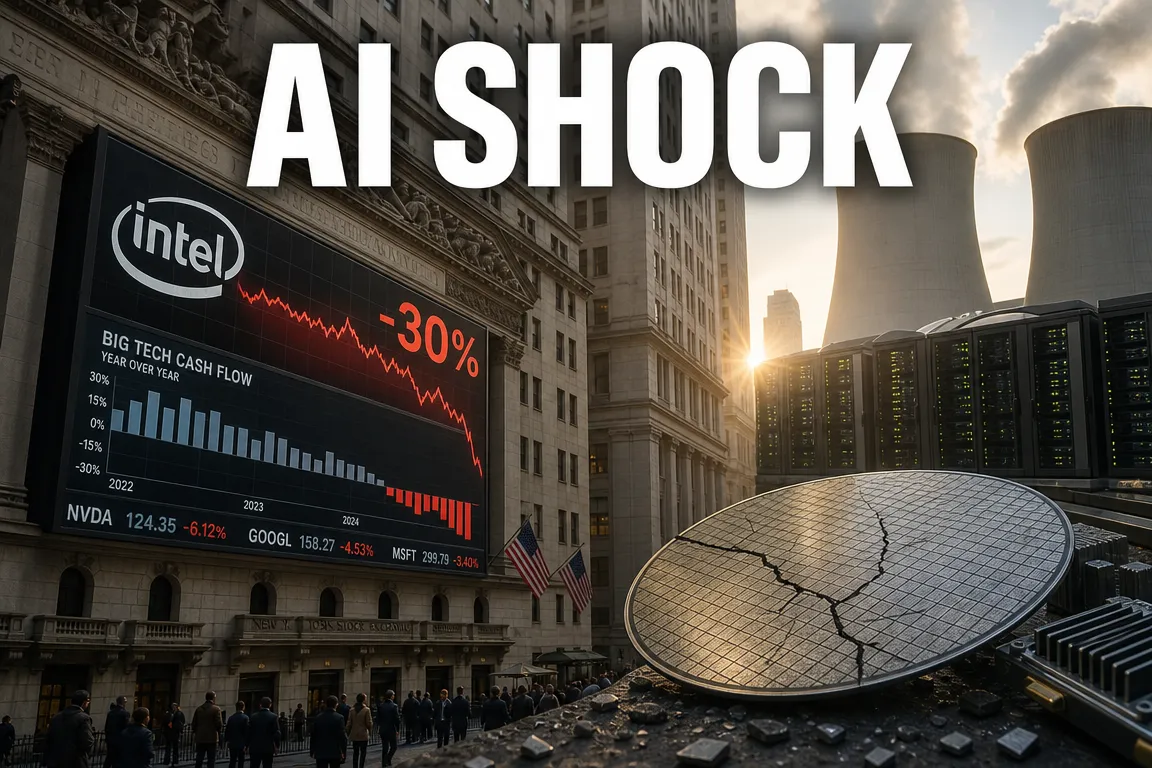
● Intel Shock AI Slowdown and Big Tech Cash Crunch
Intel’s 30% Share-Price Shock and the AI Peak Debate | Big Tech Cash Flow, U.S. Midterm Elections, and the AI Investment Cycle
Viewing Intel’s sharp decline solely as an earnings shock risks overlooking a broader market shift.
The key issue is not Intel alone, but the potential deterioration in Big Tech cash flow and a slowdown in AI data-center investment growth across Alphabet, Amazon, Meta, and other major technology companies.
Additional pressures include U.S. midterm-election uncertainty, higher financing costs for AI companies, reduced share repurchases, and capital rotation into non-AI sectors.
The market is not yet pricing in the end of the AI industry. It is entering a phase in which investors are assessing which companies can continue funding AI investment.
However, Intel’s reported decline, individual corporate financing plans, Anthropic’s potential IPO timetable, and credit-rating expectations require confirmation through official filings and current reporting.
1. The Most Important Change in the Current Market Correction
The recent U.S. equity-market correction differs from a conventional recession-driven decline affecting all sectors simultaneously.
While the Nasdaq and AI semiconductor stocks have weakened, selected non-AI sectors, including healthcare, pharmaceuticals, and consumer staples, have shown relative strength.
This suggests sector rotation rather than a broad withdrawal of capital from the market.
- AI infrastructure and semiconductor stocks face pressure from capital requirements and valuation adjustments.
- Big Tech is increasingly evaluated on free cash flow and financing capacity rather than revenue growth alone.
- Healthcare and non-AI growth companies are benefiting from earnings-based demand.
- Midterm-election uncertainty is increasing volatility in policy-sensitive stocks.
- Investors are focusing more on the rate of change in AI investment than on absolute spending.
Investors should therefore assess AI and non-AI sectors separately rather than relying only on broad market indices.
2. Alphabet’s Core Issue Is Cash Flow, Not Revenue
Investor attention surrounding Alphabet has shifted from Google Cloud growth and data-center usage to cash-flow generation.
AI data-center expansion requires substantial capital expenditure on servers, GPUs, networking equipment, power infrastructure, and cooling systems.
Even when revenue rises, free cash flow can decline if capital expenditure grows more rapidly.
The market’s concern is not that Alphabet’s AI growth potential has disappeared, but that elevated investment requirements may persist longer than expected.
If management signals continued high spending, investors are likely to focus on three risks:
- The timing of meaningful returns from AI investment remains uncertain.
- Capital expenditure may continue to pressure operating margins and free cash flow.
- Generative AI may erode the economics of the existing search and advertising business.
The third risk concerns business-model cannibalization.
Generative AI may improve the search experience while weakening the click-based structure and profitability of conventional search advertising.
AI is therefore both a growth engine and a potential disruptor of Alphabet’s core revenue model.
3. How Amazon Differs from Microsoft
Amazon continues to emphasize the long-term growth of cloud computing and data centers, but investors increasingly want clarity on when those investments will generate sustainable cash flow.
Even with resilient AWS demand, data centers and equipment must be financed before revenue is realized. Near-term investment outlays may therefore grow faster than cash generation.
Under these conditions, strong revenue growth may not support the share price if the free-cash-flow outlook deteriorates.
Microsoft, by contrast, retains relatively strong investor confidence in its ability to fund AI investment while preserving cash flow and shareholder returns.
Continued dividends and share repurchases would indicate that Microsoft can finance AI spending primarily through internal cash generation.
| Company | Primary Market Focus | Positive Factor | Key Risk |
|---|---|---|---|
| Alphabet | Free cash flow and search profitability | Cloud and AI service growth | Investment burden and search-advertising cannibalization |
| Amazon | Timing of returns on AWS investment | Expanding cloud demand | Higher data-center spending |
| Microsoft | Cash-flow resilience | Strong credit profile and recurring revenue | AI investment efficiency and financing costs |
| Meta | Balance between advertising revenue and AI investment | Highly profitable advertising platform | Large capital expenditure and lower shareholder returns |
The central question for Big Tech is no longer which company can develop AI most effectively, but which company can sustain the investment cycle longest.
4. Why Cash Flow Matters
Corporate cash flow can be compared with a household budget.
Income may rise, but cash balances still decline if debt payments and expenses increase more quickly.
Similarly, a company may generate operating cash flow while producing negative free cash flow because of heavy data-center and equipment spending.
Companies facing cash shortfalls may rely on bonds, bank loans, equity offerings, or convertible debt.
The risk is that external financing is more expensive in a high-interest-rate environment.
Higher borrowing costs increase interest expense and reduce future net income and earnings per share.
Interest-rate expectations and corporate credit spreads are therefore important leading indicators for the AI investment cycle.
5. Why Reduced Share Repurchases Are a Hidden Risk
Big Tech share repurchases have been a major source of structural demand in the U.S. equity market.
Repurchases reduce shares outstanding and can increase earnings per share even when total earnings remain unchanged.
If AI investment absorbs more cash, companies may reduce or suspend buybacks.
This would weaken both shareholder returns and a consistent source of market demand.
Issuing new shares to fund investment may also dilute existing shareholders.
If corporate value remains unchanged while the share count rises, value and earnings per share may decline.
Investors should assess the following indicators alongside capital expenditure:
- Whether quarterly share repurchases are declining.
- Whether stock-based compensation and equity issuance are increasing total shares outstanding.
- Whether net cash is falling or net debt is rising.
- Whether corporate bond yields are increasing.
- When management expects free cash flow to return to positive territory.
6. Interpreting Intel’s 30% Share-Price Shock
The reported explanation for Intel’s approximately 30% decline includes a weaker cash-flow outlook, supply disruptions, pressure in the PC market, higher investment, and political uncertainty.
The precise decline and any operational or supply-chain incidents should be verified through Intel’s official earnings materials and regulatory filings.
The key market concern is that Intel, previously viewed as a turnaround candidate, has again emphasized its substantial investment requirements.
Intel requires significant funding for advanced semiconductor processes, foundry capacity, packaging, and AI data-center products.
If the return to positive free cash flow is delayed, anticipated restructuring benefits and earnings recovery may also be postponed.
If Intel’s cash flow fails to improve despite strong AI data-center demand, investors may question:
- Whether AI investment is generating sufficient economic benefits for equipment and component suppliers.
- Whether production capacity and research costs are rising faster than revenue.
Intel’s challenge is not necessarily a lack of AI demand, but the time and cost required to convert demand into revenue and cash flow.
7. Has Intel Become a Policy-Sensitive Stock?
Intel is central to U.S. semiconductor supply-chain restructuring and domestic manufacturing policy.
Its business outlook may be affected by semiconductor subsidies, government investment, defense and public-sector contracts, and restrictions on exports to China.
If the midterm elections alter the pace of industrial policy or congressional appropriations, Intel’s share-price volatility could increase.
However, election outcomes should not be linked mechanically to a single stock’s direction.
A Republican advance would not guarantee an Intel rally, while a Democratic victory would not immediately end U.S. semiconductor support.
Domestic semiconductor production has bipartisan relevance because of national-security and supply-chain considerations.
Immediately after the election, headlines and position unwinding may influence prices more than actual policy changes.
8. An AI Investment Peak Means Slower Growth, Not Necessarily Lower Spending
The term AI peak is often misunderstood as an immediate decline in AI spending.
In equity markets, a peak frequently refers to the rate of investment growth reaching its high point rather than an absolute reduction in expenditure.
For example, if capital expenditure rises 50% one year, 30% the next year, and 15% the following year, total spending continues to increase while growth decelerates.
Because equity prices discount future rates of change, slower spending growth alone may compress valuations across AI infrastructure stocks.
A key issue is whether Big Tech companies are shifting from aggressive capital-expenditure upgrades toward unchanged guidance or delayed spending schedules.
If confirmed in official guidance, this could affect order growth for AI semiconductors, servers, optical networking, power equipment, and cooling systems.
9. A Framework for Assessing the AI Infrastructure Cycle
AI infrastructure equities are likely to be driven by the combination of investment growth and financing costs rather than spending levels alone.
Rising investment growth and falling financing costs represent the most supportive environment.
Conversely, slower investment growth and wider credit spreads may pressure both revenue expectations and valuation multiples.
| AI Investment Growth | Financing Costs | Expected Market Environment |
|---|---|---|
| Accelerating | Falling | Most favorable for AI infrastructure |
| Accelerating | Rising | Revenue growth with margin pressure |
| Decelerating | Falling | Greater differentiation favoring large, high-quality companies |
| Decelerating | Rising | Most unfavorable for highly valued and highly leveraged companies |
The market is primarily concerned about the fourth scenario.
AI investment may continue, but at a slower growth rate and with higher external financing costs.
10. Why Anthropic and OpenAI Financing Matters
The AI ecosystem depends not only on Big Tech companies such as Microsoft, Alphabet, and Amazon, but also on the financing capacity of model developers including OpenAI and Anthropic.
Generative AI companies require substantial computing resources for model training and inference, often through large purchases or long-term contracts.
If these companies cannot secure sufficient capital, order growth may slow across cloud computing, semiconductors, networking, and data centers.
Potential risks include a lower-than-expected credit rating for Anthropic and reduced financing targets for OpenAI.
IPO schedules, funding targets, and expected credit ratings may change with market conditions and should be confirmed through official disclosures.
The relevant issue is not a specific rating in isolation, but whether financing conditions across the AI sector are deteriorating.
11. Investment Grade Versus Speculative Grade
Investment-grade companies generally have broader access to long-term institutional capital from insurers, pension funds, and other regulated investors.
Speculative-grade issuers may face a smaller investor base and higher required yields.
Even a one-percentage-point increase in borrowing costs can materially raise interest expense for companies financing tens of billions of dollars.
Lower AI-company credit quality may also affect suppliers.
If customers cannot secure financing, contracts may be reduced, delayed, or exposed to payment risk.
AI credit risk can therefore spread across the cloud, semiconductor, data-center, and power-infrastructure supply chains.
12. The Most Important Underappreciated Risk
The primary risk is not slower AI revenue growth, but a shift in AI financing from internal equity and cash generation toward debt and new share issuance.
Companies financing investment internally can withstand delayed revenue realization more effectively.
Debt- and equity-financed investment introduces both interest expense and shareholder dilution.
Under these conditions, markets prioritize balance-sheet strength over technological leadership.
Cash reserves, net debt, bond yields, repurchase activity, and share-count growth become more important valuation variables than model performance alone.
The next phase of AI leadership may favor companies capable of maintaining cash flow while continuing long-term investment.
13. Why AI Can Weaken While Other Sectors Strengthen
If the global economic outlook does not indicate a sharp recession, capital leaving AI assets may rotate into other sectors rather than remain in cash.
Potential beneficiaries include healthcare, pharmaceuticals, financials, industrials, and consumer companies with improving earnings.
Under this rotation, the Nasdaq may underperform while the S&P 500 and Dow Jones Industrial Average remain comparatively resilient.
If an investor’s portfolio declines substantially while major indices remain stable, excessive concentration in AI semiconductors and data-center stocks may be the cause.
Investors holding non-AI assets may experience materially lower volatility.
14. Eli Lilly and Obesity Treatments as Evidence of Sector Rotation
In healthcare, obesity-treatment leaders such as Eli Lilly may attract capital as alternatives to AI-related investments.
Demand for Mounjaro and Zepbound could continue to expand, while future oral obesity treatments may broaden the market further.
Even under drug-pricing pressure, higher sales volumes may offset lower prices and support revenue and earnings growth.
Price and volume should therefore be assessed separately.
If prices fall 10% while volumes rise 50%, total revenue can still increase.
While AI sectors face greater investment burdens, healthcare companies may be evaluated more directly on product sales and cash generation.
15. Potential Market Effects of the Midterm Elections
Control of both the House of Representatives and the Senate is relevant in U.S. midterm elections.
The Senate has substantial influence over major appointments and legislation, making the balance of power important for policy execution.
Policy-sensitive sectors, including semiconductors, defense, space, cryptocurrency, healthcare, and government technology contractors, may experience increased volatility.
Prediction-market probabilities may not match final results, and unexpected outcomes can produce significant futures-market reactions.
The initial market response may not indicate the longer-term direction.
Stocks may fall on concerns that specific policies will be suspended, then recover as more realistic policy assessments emerge.
A more disciplined approach is to evaluate both the policy implications and subsequent market confirmation rather than chase immediate post-election moves.
16. Why Apple and Palantir Earnings Matter
Apple may be viewed as a relatively defensive Big Tech company if its direct AI data-center investment burden remains limited.
However, investors should continue monitoring memory and component costs, iPhone demand, services revenue, and operating margins.
Palantir reflects both government-contract exposure and AI software growth expectations, making backlog and valuation as important as reported earnings.
Companies with substantial government exposure may react strongly to post-election budget and contract reviews.
The two companies may help indicate whether investors prefer asset-light Big Tech platforms or AI software providers during the next market phase.
17. Technical Signals to Monitor
Memory, data-center, optical-networking, power-equipment, and server stocks may be at risk of breaking below long-term trend levels.
Technical analysis cannot replace fundamental cash-flow analysis, but it can provide information about positioning and changes in risk appetite.
If industry leaders fall below long-term moving averages on rising volume, investors should assess whether institutional holdings are being reduced.
If prices stabilize despite negative news and trading volume declines, a significant portion of the risk may already be reflected in valuations.
18. Three Leading Indicators of an AI Investment Peak
Three indicators should be assessed together when evaluating whether the AI investment cycle is approaching a peak.
1. IPO Valuations and Investor Demand
Strong demand for AI IPOs indicates continued market risk appetite.
Reduced offering sizes and lower target valuations may signal weaker private-market financing conditions.
2. Big Tech Capital-Expenditure Growth
Investors should monitor whether capital-expenditure growth is slowing even if absolute spending continues to rise.
Repeatedly unchanged or reduced guidance may indicate that order growth for AI infrastructure is approaching a peak.
3. Debt-Funded Investment Activity
Debt-funded data-center investment can initially accelerate industry growth.
However, wider credit spreads can rapidly weaken the economics of new projects.
Deterioration in one indicator alone does not confirm the end of the AI cycle.
If all three weaken simultaneously, more conservative risk management may be appropriate.
19. Can Seasonality and Year-End Liquidity Support a Rebound?
U.S. equities have historically experienced periods of higher volatility around March and October, but seasonality alone cannot identify a market bottom.
From November onward, resumed corporate buybacks, pension inflows, and year-end portfolio management can support equity markets.
Resolution of midterm-election uncertainty may also release sidelined capital and renew expectations for a year-end rally.
However, the current cycle includes structural concerns related to slowing AI investment growth and credit risk.
Even if a seasonal rebound occurs, performance may favor companies with stronger cash flow rather than lifting all AI-related stocks equally.
20. U.S. Trading Hours for Investors in Asia
U.S. daylight saving time ended on November 1, 2026.
Regular U.S. trading hours therefore run from 9:30 a.m. to 4:00 p.m. Eastern Time.
Pre-market and after-hours sessions also shift by one hour relative to markets that do not observe U.S. daylight saving time. This should be considered when monitoring earnings releases and election results.
21. Practical Risk Management
Both abandoning the entire AI sector and buying indiscriminately after a sharp decline carry significant risks.
Investors should first assess whether portfolios are excessively concentrated in specific AI infrastructure segments.
Revenue growth should be evaluated alongside free cash flow, net cash, share repurchases, and changes in shares outstanding.
Because futures and regular-session markets may respond differently after elections, investors may benefit from waiting for closing prices and volume confirmation.
New AI positions may be accumulated in stages around earnings releases, election outcomes, and financing events rather than through a single entry.
- Prioritize companies with positive cash flow.
- Favor companies with low net debt and strong credit ratings.
- Review contract risk for suppliers dependent on a small number of AI customers.
- Monitor suspended buybacks and new share issuance.
- Consider diversification into healthcare, financials, industrials, and other non-AI sectors.
- Avoid chasing immediate post-election price movements.
22. Final Assessment | AI Peak or Pre-Election Risk Reduction?
Current evidence is insufficient to confirm a structural peak in the AI industry.
Demand for AI services and data-center investment may continue to grow.
However, if investment growth slows while financing costs rise, the share-price momentum of AI infrastructure companies may weaken.
In the near term, position reductions and uncertainty ahead of the midterm elections may have amplified market declines.
Over the medium term, Big Tech free cash flow, AI-company financing conditions, and the resumption of share repurchases will help determine whether the cycle has genuinely peaked.
A post-election rebound may not be durable if credit conditions and cash flow fail to improve.
Conversely, if AI financing normalizes and Big Tech demonstrates adequate returns on investment, the correction may prove to be a valuation reset within a longer-term expansion.
< Summary >
Intel’s decline and Alphabet’s weakness appear more closely linked to cash-flow pressure and investment costs than to insufficient AI demand.
Investors are placing greater emphasis on free cash flow, financing costs, and share-repurchase capacity than on revenue growth alone.
An AI investment peak would more likely involve slower capital-expenditure growth than an outright decline in spending.
The midterm elections may increase short-term volatility but are unlikely to determine the AI industry’s long-term direction independently.
Financing conditions for companies such as Anthropic and OpenAI may directly affect semiconductor, cloud, and data-center supply chains.
The current environment appears more consistent with rotation from AI into healthcare and other non-AI sectors than with a broad market collapse.
Future analysis should combine absolute AI spending with free cash flow, credit spreads, share-count growth, and the rate of investment growth.
The long-term winners of the AI cycle may not be the companies that spend the most, but those capable of sustaining investment while preserving cash flow.
[Related Articles…]
- AI Investment Cycles and the Outlook for Big Tech Data Centers
- Intel, Semiconductor Policy, and the Future of U.S. Manufacturing
*Source: [ 소수몽키 ]
– 인텔 -30% 쇼크, AI 피크아웃일까 중간선거 코앞 리스크 관리일까
● China Semiconductor Surge
China Accelerates Its Semiconductor Push: Huawei, CXMT, and DeepSeek Challenge South Korea’s Chip Industry and U.S. AI Leadership
China is not positioned to immediately overtake the United States or South Korea in leading-edge technology.
The more significant development is China’s effort to integrate Huawei’s AI chips, ChangXin Memory Technologies’ DRAM, and generative AI models from DeepSeek and Kimi into a unified domestic supply chain.
This report examines how Huawei is adapting to U.S. semiconductor restrictions, why CXMT presents a growing risk to Samsung Electronics and SK hynix, and how Chinese AI models are expanding usage through lower pricing.
It also assesses China’s actual technology capabilities, potentially overstated claims, reports concerning Apple’s adoption of CXMT products, and the limitations of AI token-share statistics.
China’s primary competitive advantages are not immediate technological leadership but cost competitiveness, a large domestic market, and a state-supported independent ecosystem.
Key Developments
- Huawei is combining chip design, DUV multipatterning, and advanced packaging to improve AI semiconductor performance without EUV equipment.
- CXMT is expanding commodity DRAM capacity and increasing China’s memory semiconductor self-sufficiency.
- DeepSeek and Kimi are attracting developers and enterprises through lower usage fees and open-source strategies.
- Samsung Electronics and SK hynix retain leadership in HBM and advanced DRAM, but pricing pressure in commodity memory could intensify.
- The U.S. AI industry faces structural pressure from high model-development costs, data center investment requirements, and power constraints.
1. Huawei and the Paradox of U.S. Restrictions
The United States has progressively tightened export controls intended to prevent Huawei from obtaining advanced semiconductors and manufacturing equipment.
China cannot acquire extreme ultraviolet lithography systems from ASML, which are critical to leading-edge processes at 5 nanometers and below.
EUV systems print highly complex circuit patterns onto wafers and are widely considered essential to advanced foundry production.
Process nodes such as 2 nanometers and 3 nanometers refer to manufacturing technologies capable of producing extremely small semiconductor structures.
Smaller process geometries generally allow more transistors per unit of area while improving performance and power efficiency.
How Huawei Is Operating Without EUV
Huawei and Chinese foundries are using multipatterning, which applies existing deep ultraviolet lithography multiple times to create circuit features that cannot be produced through a single exposure.
This approach is technically viable but requires additional process steps, reduces yields, and increases manufacturing costs.
China’s ability to manufacture advanced chips without EUV does not indicate that it has achieved the same production economics as Taiwan Semiconductor Manufacturing Company or Samsung Electronics.
Huawei is compensating for manufacturing limitations through chip architecture and advanced packaging.
Chiplet architectures, 2.5D and 3D packaging, and designs that reduce data-transfer latency between memory and processors can improve performance without relying exclusively on process-node advances.
Concepts such as temporal compression and logic folding generally refer to circuit-layout and stacking techniques that reduce signal-travel time.
These technologies cannot fully replace EUV and leading-edge process nodes.
Comparable performance may require more chips, greater power consumption, and a larger physical footprint.
Huawei’s Core Advantage Is Domestic Demand
Huawei’s most important asset is not its process technology but access to China’s large domestic market.
Demand from Chinese telecommunications operators, cloud providers, public institutions, and local governments can support large production volumes despite initial performance and cost disadvantages.
If Chinese AI companies such as DeepSeek expand their use of Huawei’s Ascend accelerators, hardware and model development could reinforce each other.
Restricted access to Nvidia GPUs gives Chinese AI developers an incentive to optimize software for Huawei hardware.
U.S. export controls are slowing China’s technological progress while also accelerating cooperation among Chinese companies and strengthening a domestic ecosystem.
2. Why CXMT Presents a Risk to Samsung Electronics and SK hynix
ChangXin Memory Technologies, or CXMT, is China’s leading DRAM manufacturer.
Although it had limited global presence several years ago, the company has expanded rapidly through state support and manufacturing investment.
CXMT has focused on commodity DRAM products, including DDR4 and LPDDR memory for smartphones, personal computers, and servers.
It is expanding into DDR5 and higher-performance memory and is pursuing longer-term entry into the HBM market.
CXMT’s Reported 10% Market Share Requires Qualification
Claims that CXMT’s market share increased from near zero to 10% depend on whether the figure refers to global DRAM revenue, production capacity, or China’s domestic market.
Samsung Electronics, SK hynix, and Micron continue to account for most global DRAM revenue.
It is more appropriate to conclude that CXMT is rapidly expanding its production capacity and domestic Chinese market share than to state that it has definitively secured 10% of global DRAM revenue.
Reports of several-hundred-percent revenue growth must also be viewed in the context of a low initial base.
Nevertheless, CXMT’s expansion remains strategically significant.
Memory semiconductors benefit from scale, repeated production, yield improvements, and lower unit costs.
Stable domestic orders could allow CXMT to increase output and accumulate manufacturing expertise despite near-term losses.
Potential Market Impact of Low-Cost Chinese DRAM
The primary risk to Samsung Electronics and SK hynix is not an immediate Chinese breakthrough in HBM.
A more probable risk is that Chinese production creates oversupply and price pressure in commodity DRAM.
Greater use of CXMT products by Chinese smartphone and PC manufacturers could reduce South Korean memory exports to China.
If CXMT enters emerging markets and lower-priced electronics segments, its pricing strategy could place downward pressure on global DRAM prices.
Even if Samsung Electronics and SK hynix generate strong HBM earnings, weaker commodity-memory profitability could increase overall earnings volatility.
CXMT should therefore remain a key factor in semiconductor industry forecasts.
Has Apple Adopted CXMT Memory?
Claims that Apple could be compelled to adopt CXMT DRAM because of pricing or supply shortages require additional evidence.
The more widely documented case involved Apple’s consideration of NAND flash memory produced by Yangtze Memory Technologies rather than DRAM from CXMT.
Apple reportedly considered using YMTC NAND in iPhones sold in China in 2022 but abandoned the plan following U.S. political pressure and tighter export controls.
There is no broadly confirmed evidence that Apple has officially selected CXMT products.
However, rising memory prices or supply shortages could give global electronics companies an incentive to evaluate Chinese suppliers.
Commercial adoption would also depend on compliance with U.S. regulations, data-security requirements, and supply-chain risk standards.
3. How DeepSeek and Kimi Are Challenging U.S. AI Providers
China’s generative AI strategy differs from that of the United States.
OpenAI, Google, and Anthropic primarily target premium markets through leading model performance and extensive computing infrastructure.
Chinese models such as DeepSeek and Moonshot AI’s Kimi emphasize low token prices, open-source ecosystems, and computational efficiency.
U.S. companies may retain an absolute performance advantage, but users may perceive limited differences in translation, summarization, customer service, document creation, and coding assistance.
When performance differences are not operationally material, enterprises have an incentive to select lower-cost models.
China’s AI Strategy Prioritizes Low Cost Over Absolute Leadership
For enterprise AI deployment, token cost can be as important as model intelligence.
Minor differences in unit pricing can become substantial when services support millions of users.
Companies can use lower-cost Chinese or internally hosted open-source models for routine tasks while reserving premium U.S. models for advanced reasoning.
Under a multimodel strategy, Chinese AI providers can expand usage without offering the highest-performing model in every category.
If Chinese providers improve performance after gaining market share, the pricing power of U.S. AI companies could weaken.
Token Share Is Not Equivalent to Overall AI Market Share
Claims that Chinese AI models have overtaken U.S. providers in token share require careful interpretation.
Token usage on platforms such as OpenRouter reflects user activity within those platforms.
It does not fully represent OpenAI and Google’s direct services, Microsoft Azure, Amazon Web Services, or private enterprise AI systems.
Free or low-cost models can process more tokens for the same revenue, meaning high token share may coexist with relatively low revenue share.
Rapid growth in DeepSeek’s token usage does not establish leadership in global AI revenue.
Token volume, paid customers, API revenue, and enterprise adoption should be evaluated separately.
4. Low-Cost AI Could Disrupt the U.S. AI Investment Model
U.S. AI companies are making substantial capital investments to improve model performance.
Major expenditures include Nvidia GPUs, networking equipment, data centers, and power infrastructure.
Sustaining this investment requires rapid growth in AI service revenue and profitability.
Price competition from lower-cost Chinese models could reduce token prices and profit margins for U.S. providers.
Lower profitability could constrain funding for data centers and AI semiconductors.
Slower data center investment would affect not only Nvidia but also HBM suppliers such as Samsung Electronics and SK hynix.
The sustainability of the AI semiconductor cycle ultimately depends on the long-term economics of AI service providers.
5. Power Infrastructure Is a Structural Constraint on U.S. AI Leadership
AI data centers consume substantially more electricity than conventional data centers.
Operating hundreds of thousands of GPUs requires generation capacity, transmission networks, substations, and cooling systems.
The United States leads in AI technology and capital availability but faces grid-connection delays and limited power-generation capacity.
In some regions, new data centers may wait several years for grid access.
This constraint has increased interest in restarting nuclear facilities, developing small modular reactors, and expanding natural-gas generation.
China can coordinate power generation, transmission infrastructure, industrial zones, and data centers through centralized planning.
China also faces regional power imbalances and semiconductor-efficiency limitations, but its ability to accelerate infrastructure construction remains an advantage.
Future AI competitiveness may increasingly depend on power availability, electricity costs, and data center construction speed rather than model performance alone.
Underappreciated Strategic Factors
First, China is developing an integrated vertical ecosystem rather than relying on individual companies.
CXMT supplies memory, Huawei develops AI accelerators and servers, and DeepSeek and Kimi operate AI services on the resulting infrastructure.
Chinese cloud providers, telecommunications operators, and government agencies can support a closed domestic cycle of development, production, and procurement.
Second, market share can shift even when a technology gap remains.
In commodity markets, price and supply stability often matter more than maximum performance.
South Korean companies cannot protect their commodity DRAM positions through technological leadership alone.
Third, U.S. restrictions increase China’s costs but also accelerate investment in self-sufficiency.
Export controls make leading-edge semiconductor production more difficult.
They also encourage Chinese investment in domestic equipment, materials, memory, and AI accelerators.
Fourth, Chinese AI growth has mixed implications for South Korean semiconductor demand.
China’s AI expansion could create additional demand for AI semiconductors.
However, export opportunities for South Korean suppliers may remain limited if China satisfies demand through domestic memory and accelerator production.
Fifth, China does not need to overtake South Korea in HBM to create material pressure.
Lower commodity DRAM prices could weaken the profitability and cash flow needed by South Korean manufacturers to fund HBM investment.
The industry may therefore face simultaneous price competition in commodity products and technology competition in advanced products.
Strategic Priorities for South Korea’s Semiconductor Industry
Maintain leadership in HBM and advanced packaging.
AI accelerator performance depends on HBM bandwidth and packaging technologies as well as GPU architecture.
Samsung Electronics and SK hynix should strengthen their positions in next-generation HBM, high-capacity server DRAM, and low-power memory.
Reassess cost competitiveness in commodity memory.
Technological strength may not protect market share against sustained low-cost Chinese supply.
Process efficiency, manufacturing automation, and portfolio optimization will be necessary to withstand pricing pressure.
Expand beyond memory into system semiconductors and packaging.
Huawei is using design and packaging to compensate for manufacturing constraints.
South Korea should develop a broader ecosystem encompassing AI accelerators, foundry services, chiplets, and advanced back-end processing.
Reduce dependence on China without fully abandoning the market.
Supply chains should be diversified in response to U.S. restrictions, while China’s scale and growth potential should remain part of commercial planning.
Strategies should focus on product-specific controls, customer exposure, and alternative markets rather than broad political positioning.
Investor Checklist
- CXMT’s actual DRAM capacity, yields, and global revenue share
- CXMT’s DDR5 and HBM development schedule and use of Chinese manufacturing equipment
- Huawei Ascend accelerator production and adoption by Chinese cloud providers
- DeepSeek and Kimi API revenue and paid-customer growth, in addition to token usage
- AI data center capital expenditure and power procurement by U.S. technology companies
- HBM capacity expansion and commodity DRAM profitability at Samsung Electronics and SK hynix
- Changes in U.S. semiconductor export controls and political conditions affecting China
Outlook
China is unlikely to fully overtake Samsung Electronics and SK hynix in memory technology or displace U.S. AI leadership in the near term.
However, focusing exclusively on technological leadership could obscure more immediate market changes.
China is combining adequate performance, low prices, domestic scale, and state support rather than competing solely through top-tier products.
This strategy could allow Chinese companies to capture commodity semiconductor and AI service markets while technology gaps remain.
The principal risk for South Korea is not immediate technological displacement.
It is the gradual loss of commodity markets, Chinese customers, and pricing power while resources remain concentrated in premium products.
AI semiconductor competition will increasingly involve an integrated contest across process technology, memory, packaging, AI models, data centers, power infrastructure, and pricing.
< Summary >
Huawei is using DUV processing, chip design, and advanced packaging to build an AI semiconductor ecosystem under U.S. restrictions.
CXMT is expanding through commodity DRAM and China’s domestic market, creating pricing pressure for Samsung Electronics and SK hynix.
DeepSeek and Kimi are challenging premium U.S. AI providers through lower token pricing and open-source strategies.
Claims regarding CXMT’s global share, Apple adoption, and Chinese AI token share require careful assessment of definitions and sources.
China’s principal advantage is an integrated ecosystem connecting semiconductors, AI models, domestic demand, infrastructure, and state support.
South Korea must preserve its HBM advantage while strengthening commodity-memory cost competitiveness, system semiconductors, and advanced packaging.
[Related Articles…]
*Source: [ 경제 읽어주는 남자(김광석TV) ]
– 창신메모리와 화웨이, 중국 ‘독자적 반도체’ 생태계 구축. AI와 반도체 미국을 넘어설까? [경읽남 269화]