● Musk Election Bombshell, Tesla, Cybercab, Optimus, Stock Shock
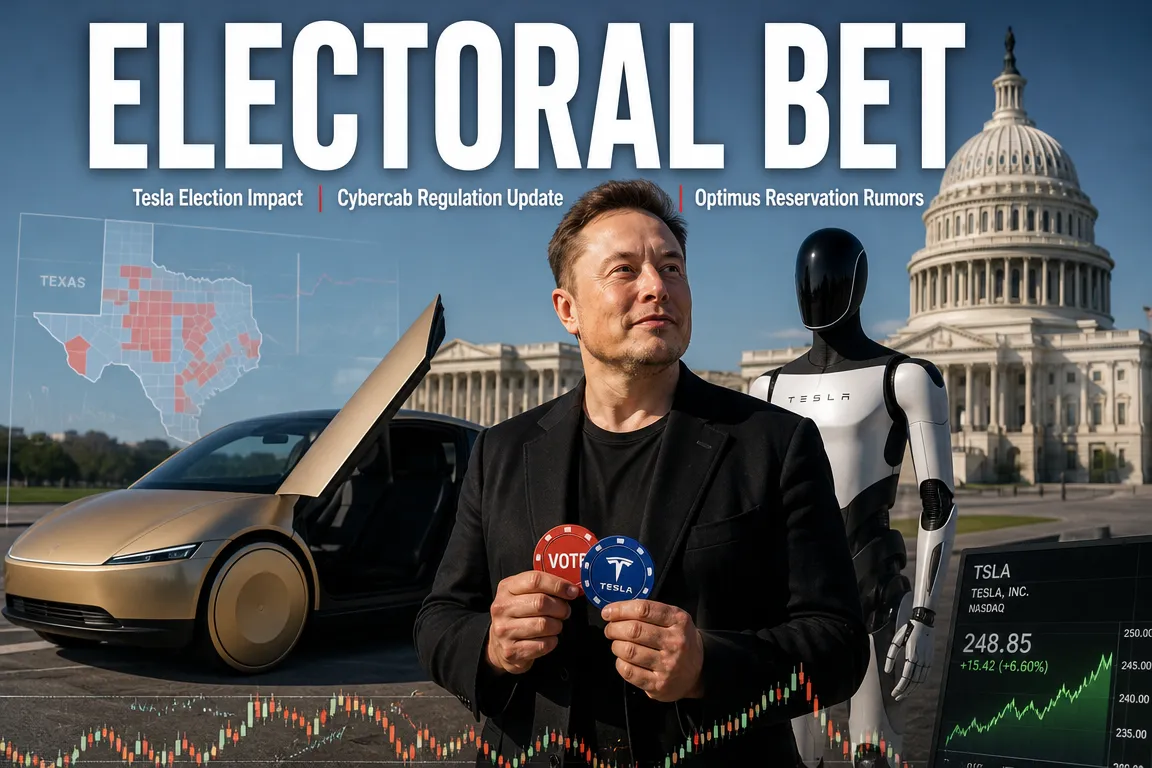
What If Musk Bet $445 Million on the U.S. Midterm Elections? Key Variables for Tesla Shareholders, From the Stock Price to Cybercab and Optimus
The central issue is not the election result itself.
The key question is how a shift in congressional control could affect Tesla’s electric-vehicle incentives, Cybercab regulation, congressional investigations involving Elon Musk, and SpaceX government contracts over the next two years.
Investors who purchased Tesla shares at approximately $399 should distinguish short-term election headlines from EV demand recovery, the pace of autonomous-driving regulation, and political brand risk.
The following analysis covers Musk’s political spending, Democratic polling advantages, the potential restoration of EV tax credits, Cybercab’s expansion into Dallas, Optimus reservation rumors, higher oil prices, and South Korean exports.
However, several claims, dates, and figures still require official verification.
Investors should distinguish confirmed policies from projections and unverified claims.
1. Musk’s $445 Million Election Bet: Is Tesla Paying?
According to the source material, Elon Musk has become the largest individual donor to Republican-aligned organizations in the U.S. midterm elections, contributing more than $445 million.
The amount is approximately KRW 590 billion and exceeds the roughly $290 million reportedly spent during the 2024 U.S. presidential election.
The final amount requires confirmation through official campaign-finance filings, but Musk’s political influence has clearly increased.
Tesla shareholders must distinguish Musk’s personal political spending from corporate expenses.
If the contributions were funded with Musk’s personal assets, they would not be recorded as an expense on Tesla’s income statement.
It would therefore be incorrect to assume that Tesla’s earnings decline by the amount Musk spent.
The potential costs to Tesla instead include brand polarization, key-person risk, changing relations with regulators, and weaker consumer sentiment.
2. The U.S. Midterm Election and the Seats That Matter
The 2026 U.S. midterm election will be held on Tuesday, November 3, local time.
Major battleground results should begin to emerge in South Korea on the morning of Wednesday, November 4.
All 435 House seats, regularly scheduled Senate seats, and applicable special-election seats are at stake.
Polling averages cited in the source show Democrats leading Republicans nationally by approximately 4∼9 percentage points.
Some election models assign Democrats an above-80% probability of winning the House, while the Senate remains considerably more competitive.
However, national party support does not translate directly into House seats.
House elections are decided across 435 individual districts, making district boundaries and battleground turnout more important than national polling alone.
Historically, the president’s party has often lost House seats in midterm elections.
Since the 1930s, governing parties have lost dozens of seats on average, while seat gains have been uncommon.
Living costs, gasoline prices, military conflicts, and energy-supply concerns could again weigh on the governing party.
3. Why a Democratic Polling Lead Does Not Guarantee Victory
According to the source, early voting reached 52.16 million participants, potentially a record for a midterm election.
Democratic voters generally favor early voting, while Republican voters are relatively more likely to vote in person on Election Day.
In previous elections, a significant portion of Republican voters cast ballots on Election Day.
Early-voting totals alone may therefore create a misleading electoral mirage.
One party may lead during the initial count before in-person or mail-in ballots reverse the result.
4. Why Tesla Shareholders Should Monitor Texas
Texas is home to Tesla’s headquarters, Gigafactory Texas, and major SpaceX operations.
The state’s Senate and House results could affect corporate regulation, aerospace funding, and energy policy.
The source identifies a potential contest between Democrat James Talarico and Republican Ken Paxton as a key race.
The final candidates and electoral structure should be verified through official election information.
A meaningful Democratic victory in Texas would carry implications beyond a single seat.
It could be interpreted as a political constraint on Musk in the state where Tesla and SpaceX maintain major operations.
Conversely, a Republican victory would strengthen the perceived influence of Musk’s political strategy.
5. Would Democratic Control of the House Benefit Tesla?
Democratic control could support EV policy while increasing pressure on Musk and Tesla’s corporate governance.
The primary potential benefit is the EV tax credit.
The source refers to proposals to restore the expired federal EV tax credit of up to $7,500 and expand incentives to as much as $15,000.
If the program does not exclude specific manufacturers, Tesla could be among the principal beneficiaries because of its significant U.S. EV market share.
Persistently high oil prices could also improve EV total-cost-of-ownership economics and support Tesla demand.
Congressional approval would not automatically result in implementation.
If the president vetoes legislation, a two-thirds majority in both the House and Senate is required to override the veto.
Even if Democrats secure a simple majority, restoring the EV tax credit may remain difficult if the administration opposes it.
Investors should not immediately incorporate restored incentives into Tesla’s sales forecasts following the election.
6. Investigation Risk Under Democratic Control
If Democrats gain a House majority, committee chairmanships and congressional investigative and subpoena powers would also shift.
Musk’s political contributions, government-efficiency activities, potential conflicts of interest, federal contracts, and intercompany transactions could face greater scrutiny.
Congress cannot directly prohibit Tesla product sales, but hearings and document requests could increase management distraction and legal costs.
SpaceX is particularly exposed because of its contracts with NASA, the Department of Defense, and other federal agencies.
Tesla could face additional implications from autonomous-driving safety reviews and Cybercab regulatory scrutiny by the National Highway Traffic Safety Administration.
However, regulatory agencies are part of the executive branch, so a change in congressional control would not immediately alter review standards.
Congress can exert longer-term pressure through budgets, hearings, and legislative amendments.
7. Tesla Scenarios by Election Outcome
| Election Outcome | Potential Benefits for Tesla | Potential Risks for Tesla |
|---|---|---|
| Democrats Win the House | Broader discussion of EV incentives and clean-energy policy | Potential investigations into Musk’s political spending and corporate governance |
| Republicans Retain Congress | Potentially more stable political relations between Musk and Washington | Lower probability of restoring EV tax credits |
| Divided Congress | Lower probability of abrupt regulatory changes | Prolonged gridlock on EV incentives and autonomous-driving legislation |
Neither party’s victory should be viewed as an unqualified positive or negative for Tesla.
Policy support and political investigations could move in opposite directions.
8. What Should Investors Who Bought Tesla at $399 Monitor?
Investors who purchased Tesla at $399 should focus on whether their investment thesis remains intact rather than on election-day price volatility.
Illustrative returns relative to a $399 purchase price are shown below.
| Assumed Tesla Share Price | Return Versus $399 |
|---|---|
| $350 | Approximately -12.3% |
| $399 | 0% |
| $450 | Approximately +12.8% |
| $500 | Approximately +25.3% |
The election result will not immediately change Tesla’s next-quarter deliveries or automotive gross margin.
More direct valuation drivers include vehicle pricing and sales, energy-segment growth, FSD adoption, and the Cybercab commercialization schedule.
Election-related policy expectations may increase short-term volatility, but long-term valuation will depend on cash flow and regulatory progress.
At elevated valuation multiples, positive developments may already be reflected in the share price.
Conversely, improving automotive and energy results could limit the impact of political setbacks.
The gap between 12-month earnings expectations and actual performance is more important than the $399 entry price itself.
9. Cybercab’s Dallas Expansion Is More Relevant to Earnings Than the Election
The source reports that Tesla is preparing Cybercab operations in Dallas following its initial activity in Austin.
Expansion into additional cities matters because it could indicate progress from a limited trial toward a repeatable robotaxi business model.
However, geographic expansion is not equivalent to approval for fully autonomous paid service.
A Cybercab without a steering wheel or pedals may require alternative treatment or exemptions under federal vehicle-safety standards.
The National Highway Traffic Safety Administration may request additional information regarding vehicle design, accident response, remote assistance, and passenger protection.
Absent publicly disclosed responses and approvals, investors should not assume the regulatory process is complete.
Key metrics include the number of vehicles in paid service, daily trips per vehicle, remote-intervention rates, accident rates, and operating costs per mile.
These indicators must improve before Cybercab can convert autonomous-driving expectations embedded in Tesla’s valuation into recurring revenue.
10. Optimus December Reservation Rumor and Musk’s Denial
A San Francisco-area publication claimed that Tesla would begin accepting Optimus reservations in early December.
The reported price was above $20,000, with most initial units allocated to businesses and a limited number offered to consumers.
However, Musk reportedly answered “no” when asked whether orders would open in December.
Demonstrations, reservations, and deliveries must be treated as separate milestones.
Tesla could unveil or demonstrate a third-generation Optimus model at an event.
Reservations and customer deliveries, however, require validated production stability, safety, battery endurance, and task-completion rates.
Tesla is likely to deploy Optimus in its own factories before selling it to external customers.
Factory environments offer standardized workflows and objects, simplifying training and safety management compared with residential settings.
Homes contain less predictable variables, including children, pets, stairs, and fragile objects.
Consumer sales of humanoid robots could therefore occur substantially later than factory deployment.
Optimus reservation speculation may attract attention to the AI sector but is unlikely to affect near-term earnings materially.
Investors should focus on actual production volumes and reductions in labor hours at Tesla factories rather than reservation counts.
11. How Higher Oil Prices and the Strait of Hormuz Could Affect Tesla Demand
The source states that Brent crude reached approximately $113 per barrel amid continued tensions involving the Strait of Hormuz.
Both the price and geopolitical conditions require confirmation using current market data.
Nevertheless, the mechanism through which higher oil prices affect EV demand remains relevant.
Higher gasoline prices increase the operating costs of internal-combustion vehicles and improve the relative total-cost-of-ownership economics of EVs.
If Tesla simultaneously expands lower-priced offerings or financing promotions, U.S. EV demand could recover faster than expected.
However, higher oil prices can also raise logistics and raw-material costs while reducing disposable income.
Higher oil prices should therefore not be treated as an unqualified benefit for Tesla.
12. South Korean Export Growth and AI Infrastructure Investment
The source reports strong growth in South Korean exports in October, including an approximately 496.6% year-over-year increase in computer products such as servers.
Semiconductor exports were reported to have increased by approximately 259.4%.
However, the stated export value of $15.2 billion may represent a preliminary figure for a limited reporting period rather than total monthly exports.
The expansion is being driven by AI data-center investment among global technology companies.
Demand is increasing for GPU servers, high-bandwidth memory, storage, power equipment, and cooling systems.
This trend supports South Korea’s semiconductor and server supply chains but could also increase electricity costs and producer prices.
If export growth in South Korea and Taiwan stimulates wages and capital expenditure, central banks may reduce interest rates more slowly.
This is an important but often overlooked variable in the global economic outlook.
AI investment can raise growth while simultaneously increasing inflation and interest-rate pressure.
13. Binance Hacking and Cryptocurrency Market Risk
The source claims that Binance gradually resumed withdrawals following a major cyberattack and covered approximately 90% of the lost cryptocurrency with its own funds.
It also states that the FBI attributed the attack to a North Korea-linked hacking organization.
These claims require verification through official Binance disclosures and FBI statements.
Investors should focus on actual reserves and the segregation of customer assets rather than reimbursement announcements alone.
Large fund transfers and reduced liquidity following the resumption of withdrawals could increase cryptocurrency price volatility.
Even if the exchange covers customer losses, regulatory, insurance, and cybersecurity expenses could rise.
14. Does SpaceX’s Valuation Directly Benefit Tesla Shareholders?
The source discusses SpaceX’s revenue growth, potential undervaluation, and positive projections from Cathie Wood and other investors.
It also proposes an integrated analysis of the space industry and cloud-based AI infrastructure.
This framework may have merit if Starlink expands beyond telecommunications into space-based data infrastructure.
However, the claim that Tesla owns approximately 18.99 million SpaceX shares should not be treated as fact unless confirmed in public financial statements.
SpaceX is privately held and therefore does not have an official Friday closing price comparable to publicly traded securities.
Private-company valuations are based on tender offers and private transactions rather than public-market closing prices.
A Tesla-SpaceX merger also remains speculative unless formally announced.
Potential technological cooperation and a legal merger are separate considerations.
If a merger were pursued, major issues would include conflicts of interest, valuation, minority-shareholder protection, and the transfer of government contracts.
15. The Most Important Considerations Often Overlooked
First, Musk’s political spending is not a direct Tesla expense, but it may increase the company’s discount rate.
As political controversy rises, investors may apply a higher risk premium to Tesla’s future cash flows.
Valuation multiples could contract even if operating performance remains unchanged.
Second, a Democratic victory could increase both EV incentive expectations and congressional investigation risk.
It would therefore be incomplete to classify either a Democratic or Republican victory as an unqualified positive for Tesla.
Third, Cybercab’s valuation impact depends more on permitted operating conditions than on the number of cities served.
Safety-driver requirements, remote-intervention frequency, and authorization for paid service will determine commercial value.
Fourth, Optimus reservations do not constitute revenue.
If reservation deposits are refundable, they primarily indicate customer interest and should not be treated as revenue before product delivery.
Fifth, higher oil prices and AI investment can stimulate both growth and inflation.
They may support EV demand and South Korean exports while also delaying interest-rate cuts and weakening consumer spending.
16. Key Events and Metrics for Tesla Investors
- Control of the House and results of competitive Senate races
- Texas Senate and House election results
- Formal provisions and the number of co-sponsors for EV tax-credit legislation
- Additional NHTSA inquiries and approval conditions related to Cybercab
- Paid robotaxi operations in Dallas and safety-driver requirements
- Potential unveiling of Optimus Generation 3 and the external customer-delivery schedule
- Tesla vehicle deliveries and automotive gross margin
- Changes in international oil prices and U.S. gasoline prices
- AI data-center investment and growth in South Korean semiconductor and server exports
< Summary >
If Musk’s political spending was funded with personal assets, it will not be recorded as a direct expense for Tesla.
However, political polarization and regulatory pressure could reduce Tesla’s valuation multiple.
Democratic control of Congress could support EV incentive proposals while increasing investigation risk for Musk and SpaceX.
Continued Republican control could stabilize political relations but reduce the probability of restoring EV tax credits.
Investors who purchased Tesla at $399 should prioritize vehicle sales, margins, FSD adoption, and Cybercab regulatory metrics over the election result.
Musk denied reports of December Optimus reservations, and investors should distinguish product demonstrations from customer deliveries.
Ultimately, the midterm election is more likely to determine the intensity of Washington’s scrutiny of Tesla over the next two years than to alter next-quarter earnings.
[Related Articles…]
*Source: [ 오늘의 테슬라 뉴스 ]
– 머스크가 역대 최대 4억 4,500만 달러를 건 선거 — 근데 여론조사는 반대편, $399 테슬라 주주는?
● KOSPI Shock, Intel Crash, Altman Visit, Oil Drop
Why the KOSPI Moved Differently from the U.S. Market: The Implications of Intel’s Shock, Sam Altman’s Korea Visit, and Lower Oil Prices
This report examines when Intel’s earnings shock was reflected in the Korean market, why Sam Altman’s meetings with Samsung Electronics and SK hynix mattered for memory semiconductors, and how lower oil prices supported the KOSPI.
However, the claim that Korea “avoided a Black Monday” should be distinguished from the actual market performance.
On August 5, 2024, the KOSPI plunged 8.77%, one of the largest declines in its history. Program-trading sidecars and market-wide circuit breakers were activated in both the KOSPI and KOSDAQ markets.
The key issue was therefore not that a Black Monday had been avoided.
The more relevant factors were the different timing effects of Intel’s earnings shock, U.S. recession concerns, yen carry-trade unwinding, and expectations for AI memory demand.
1. Market Timeline
- After the U.S. market close on August 1, 2024: Intel reported weak results and announced restructuring measures.
- Korean market on August 2, 2024: The KOSPI fell 3.65% as investors priced in Intel’s earnings shock and concerns about a U.S. economic slowdown.
- U.S. market on August 2, 2024: Intel shares plunged approximately 26%, while the Nasdaq Composite declined 2.43%.
- Korean market on August 5, 2024: The KOSPI fell 8.77% and the KOSDAQ dropped 11.30%, producing an actual Black Monday.
- Korean market on August 6, 2024: The KOSPI rebounded 3.30%, partially recovering from the panic-driven selloff.
The reported rise in the KOSPI should be interpreted as a technical rebound following a sharp decline, rather than evidence that the broader market collapse had been avoided.
In a volatile market, a one-day gain may reflect bargain buying and short-position covering after excessive losses in the previous session.
2. What It Means That Korea Priced In the Intel Shock First
Intel is a U.S. company, but its results were released after the close of regular U.S. trading. This allowed Asian markets, which opened next, to price in the news first.
During Friday’s Korean session, investors had to assess Intel’s weak earnings, workforce reductions, dividend suspension, and capital expenditure burden.
Samsung Electronics, SK hynix, Samsung Electro-Mechanics, and a broad range of semiconductor equipment and materials companies consequently faced selling pressure.
By the time Intel shares fell sharply in the U.S. market, part of the impact had already been incorporated into Korean equity prices.
However, prior pricing does not eliminate the possibility of further declines.
Over the weekend, weak U.S. employment data intensified recession concerns, while yen appreciation raised the risk of further yen carry-trade unwinding.
The subsequent Monday selloff was therefore not attributable solely to Intel. It reflected a combination of U.S. recession fears, concerns about the semiconductor cycle, foreign investor selling, and leveraged-position liquidation.
3. Intel’s Weakness Should Be Separated from the Memory Semiconductor Cycle
Intel’s earnings shock did not indicate deteriorating fundamentals across the entire semiconductor industry.
Market conditions differ substantially across CPUs, GPUs, foundry services, commodity memory, HBM, and package substrates.
Intel’s challenges reflected weakening competitiveness in PC and server CPUs, the financial burden of foundry investment, and an unfavorable cost structure.
By contrast, high-bandwidth memory, or HBM, is essential for AI accelerators supplied by companies such as Nvidia and remains a core strength of SK hynix.
Samsung Electronics has also pursued a strategy covering commodity DRAM and NAND, HBM, advanced packaging, and foundry services.
Intel’s share-price decline therefore did not necessarily imply an equivalent deterioration in the long-term demand outlook for Samsung Electronics or SK hynix.
Investors should assess each semiconductor company’s revenue mix and position within the AI supply chain separately.
4. Why Sam Altman Met Samsung Electronics and SK hynix
OpenAI CEO Sam Altman met executives from Samsung Electronics and SK hynix during his visit to Korea to discuss potential cooperation in AI semiconductors and memory supply chains.
The meetings highlighted that generative AI companies cannot scale through software and AI models alone.
Training and operating large AI models require GPUs and AI accelerators, as well as substantial volumes of HBM, server DRAM, NAND, and advanced packaging capacity.
For OpenAI, securing stable computing infrastructure and reducing dependence on individual GPU suppliers and cloud providers are strategically important.
For Samsung Electronics and SK hynix, continued AI data-center investment could expand opportunities for high-value memory sales and long-term supply agreements.
The meetings therefore represented a relevant signal for the medium- to long-term direction of the KOSPI and the broader AI industry.
5. Executive Meetings Should Not Be Treated as Confirmed Revenue
A meeting between Sam Altman and Korean semiconductor executives does not indicate that large orders have been finalized.
AI memory contracts require product qualification, yield validation, thermal management, power-efficiency testing, packaging compatibility, and customer approval before generating revenue.
HBM is more difficult to manufacture than conventional DRAM and often requires customer-specific specifications. Higher production capacity alone does not guarantee market share.
Rapid supply expansion could also increase pricing pressure over the medium term.
Investors should prioritize HBM shipment volumes, average selling prices, operating margins, customer qualifications, and capital expenditure plans over announcements of executive meetings.
6. Why Lower Oil Prices Supported the KOSPI
South Korea is a major importer of crude oil and natural gas.
Lower international oil prices can reduce the country’s import bill and lower transportation, electricity, and raw-material costs for businesses.
Reduced inflationary pressure may also improve the conditions for the Bank of Korea to lower interest rates.
Expectations of monetary easing can reduce corporate financing costs and increase the relative attractiveness of equities.
Lower oil prices can directly benefit industries with high energy-cost exposure, including airlines, transportation, chemicals, and consumer goods.
However, the cause of the oil-price decline remains critical.
A decline driven by ceasefire negotiations in the Middle East or improved supply stability can be constructive for financial markets.
By contrast, falling prices caused by collapsing global demand during a recession would not necessarily be positive for the KOSPI.
7. Why Samsung Electronics and SK hynix Attracted Attention
The primary bottleneck in the AI industry is not limited to GPU production.
GPUs perform calculations, while HBM rapidly transfers large volumes of data.
As AI models increase in scale, memory bandwidth and capacity become more important. HBM is therefore viewed as a core AI infrastructure resource rather than a standard component.
SK hynix has established a leading position in HBM, while Samsung Electronics combines large-scale manufacturing capacity with memory, foundry, and packaging operations.
If expectations for AI memory growth remain intact, both companies may recover more quickly from shocks affecting traditional semiconductor companies such as Intel.
However, Samsung Electronics and SK hynix remain exposed to U.S. technology-sector corrections, exchange-rate movements, foreign investor flows, and memory-price volatility.
8. Why Samsung Electro-Mechanics Underperformed
Samsung Electro-Mechanics operates a semiconductor package-substrate business, but its overall business structure extends beyond substrates.
Its principal businesses include multilayer ceramic capacitors, camera modules, and package substrates.
Weakness at Intel and in the PC market can raise concerns about demand for advanced semiconductor substrates, placing short-term pressure on Samsung Electro-Mechanics shares.
If smartphone and PC demand recovers more slowly than expected, improvements in the company’s MLCC and substrate businesses may also be delayed.
Conversely, increased investment in AI servers and data centers could support medium- to long-term demand for advanced substrates and automotive MLCCs.
The company’s performance should therefore be assessed using PC and smartphone demand, substrate utilization rates, MLCC pricing, and AI server investment rather than Intel’s results alone.
9. Key Factors Often Overlooked in Market Coverage
First, position liquidation was a more important driver of the market collapse than corporate earnings alone.
When recession concerns increase and foreign and institutional investors sell futures and cash equities simultaneously, the broader index can decline rapidly regardless of individual company fundamentals.
Second, AI investment does not benefit all semiconductor companies equally.
Companies with competitive HBM and advanced packaging capabilities may benefit, while those dependent on commodity products or facing delayed customer qualification may not achieve the expected earnings growth.
Third, investors should focus on the emergence of new risks rather than relying solely on whether existing risks have already been priced in.
Even if Intel’s results have been reflected in prices, deteriorating U.S. employment, rapid yen appreciation, or geopolitical risk can trigger additional declines.
Fourth, Sam Altman’s Korea visit was more indicative of competition for supply-chain control than of immediate orders.
If global AI companies, including OpenAI, pursue proprietary semiconductors and computing infrastructure, the negotiating leverage of memory, foundry, and packaging companies could change.
Fifth, oil prices should be evaluated alongside the value of the Korean won.
Even when oil prices decline, a sharp rise in the U.S. dollar against the won can offset a substantial portion of the reduction in local-currency energy import costs.
10. Key Indicators for Investors
- U.S. employment data: Nonfarm payrolls, the unemployment rate, and initial jobless claims provide signals regarding recession risk.
- U.S. equity performance: The direction of the Nasdaq and the Philadelphia Semiconductor Index can materially affect investor flows into Korean semiconductor stocks.
- USD/KRW exchange rate: Sharp won depreciation can intensify foreign capital outflows and increase imported inflation.
- International oil prices: Investors should distinguish between declines driven by improved supply conditions and those caused by collapsing demand.
- HBM shipments and customer qualifications: These are critical indicators of the competitive positions of Samsung Electronics and SK hynix in AI memory.
- Foreign investor futures positioning: During periods of repeated selloffs and rebounds, futures flows may signal index direction before cash-market activity.
- USD/JPY exchange rate: Rapid yen appreciation may indicate renewed yen carry-trade unwinding.
11. A Practical Perspective on the KOSPI and AI Semiconductor Market
Intel’s earnings shock was less a signal of an industry-wide semiconductor collapse than evidence of the widening gap between traditional CPU-centered businesses and the AI accelerator market.
Sam Altman’s engagement with Korean semiconductor companies demonstrated that AI competition is expanding beyond model performance into power supply, data centers, HBM, foundry capacity, and supply-chain control.
During periods of global economic uncertainty, fundamentally strong companies can still decline sharply because of liquidity shocks.
Conversely, a one-day rebound does not indicate that market risks have been fully resolved.
A balanced approach should consider the long-term outlook for AI data-center investment and high-value memory demand while monitoring U.S. economic indicators, exchange rates, and foreign investor flows in the short term.
< Summary >
Part of Intel’s earnings shock was reflected first in the Korean market because of differences in trading hours.
However, the KOSPI fell 8.77% on August 5, 2024, making the claim that Korea avoided a Black Monday factually inaccurate.
The selloff resulted from a combination of Intel’s weakness, U.S. recession concerns, yen carry-trade unwinding, and foreign investor selling.
Sam Altman’s meetings with Samsung Electronics and SK hynix underscored the strategic importance of HBM and memory supply chains in the AI industry.
Lower oil prices are generally constructive for South Korea as a major energy importer, but investors must distinguish between declines caused by supply stabilization and those resulting from recession-driven demand weakness.
Key indicators include HBM customer qualifications, U.S. employment data, the USD/KRW exchange rate, international oil prices, and foreign investor futures positioning.
[Related Articles…]
- AI-Era HBM Market Outlook for Samsung Electronics and SK hynix
- KOSPI Volatility Following U.S. Equity Market Shocks
*Source: [ 내일은 투자왕 – 김단테 ]
– 검은 월요일이 아닌 진짜 이유 #코스피 #인텔 #샘알트만