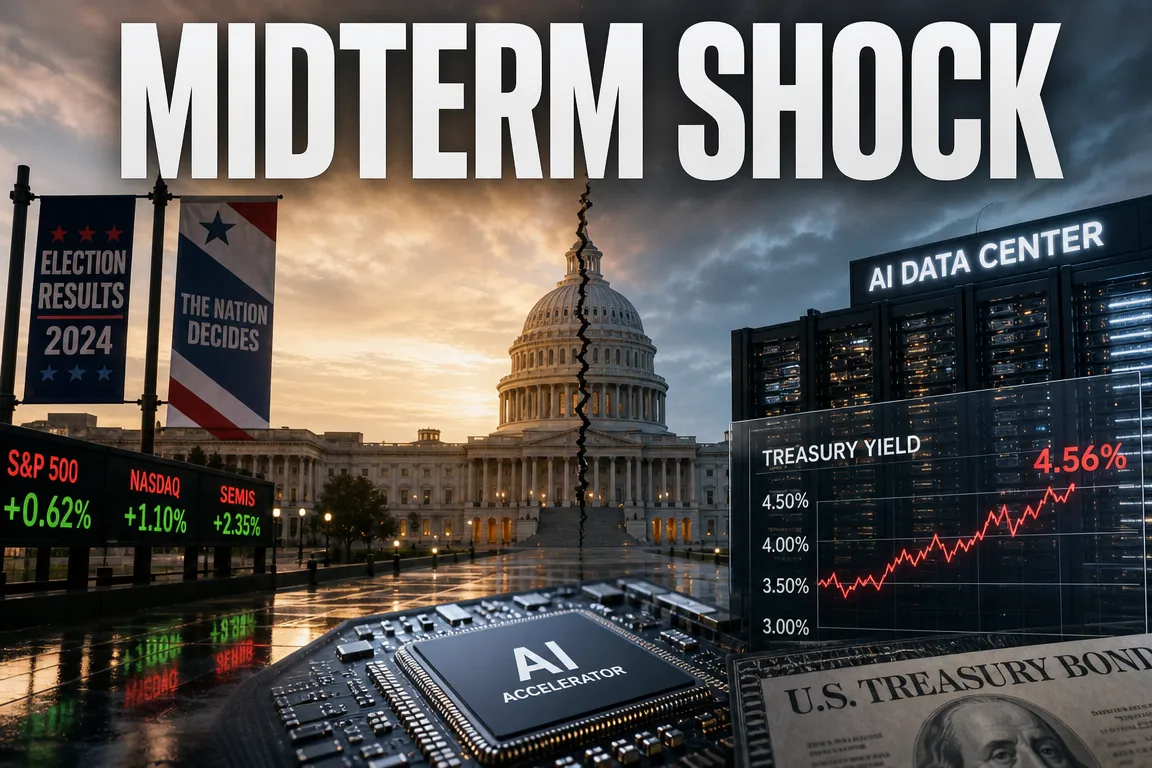
● Election Shock AI Stocks, Treasury Yield, Semiconductor Boom
Could the U.S. Midterm Elections Mark a Turning Point for Markets? AI Data Centers, Semiconductors, and Treasury Yield Scenarios
The key issue for investors in the U.S. midterm elections is not simply whether Republicans or Democrats prevail.
The outcome could simultaneously affect AI data center regulation, Big Tech capital expenditure, semiconductors, defense spending, renewable energy, healthcare, and U.S. Treasury yields.
If markets have already priced in a Democratic takeover of Congress, an unexpected result could generate the largest market reaction.
The following analysis presents four election scenarios and their potential implications for U.S. equities and the global economy.
Election probabilities, GDP contributions, and corporate free cash flow estimates can change in real time and vary by methodology. Investors should therefore focus on policy transmission channels and market scenarios rather than precise figures.
1. The Key Variable Is the Gap Between Expectations and Results
Financial markets price in polling data, prediction markets, policy platforms, and investor positioning before official results are announced.
The source analysis indicated that prediction markets favored Democratic control of both the Senate and the House.
However, prediction-market probabilities reflect participants’ capital and expectations rather than actual vote counts.
Polling errors, including the historical “shy Trump” effect, remain relevant. High early-voting turnout also does not automatically favor either party.
Assessing the electoral landscape requires analysis of voters’ location, age, party registration, and voting method.
Two factors are therefore critical:
- Which election outcome is already priced into markets
- How far the actual result deviates from expectations
If Democratic strength is fully priced in and Democrats win as expected, the market impact may be limited.
If Republicans retain both chambers, AI, semiconductors, defense, and nuclear-energy assets could undergo a significant repricing.
2. The First Post-Election Change Is Lower Political Uncertainty
Equity markets generally respond more negatively to uncertainty than to a clearly defined adverse outcome.
When polls and election probabilities fluctuate, institutional investors often reduce risk exposure and increase cash holdings.
Once the election concludes, part of the uncertainty premium may dissipate regardless of the winner.
Historically, U.S. equities have often experienced elevated volatility before midterm elections and recovered afterward. However, historical averages do not guarantee a similar outcome.
Post-election performance will also depend on Federal Reserve policy, corporate earnings, oil prices, Treasury yields, and recession risks.
The first signal to monitor is sector rotation rather than the headline index.
Even if major indices rise, leadership could shift between AI and semiconductors or renewable energy and healthcare, depending on the result.
3. Four Election Scenarios and Potential Market Responses
| Election Scenario | Policy Environment | Potentially Favored Sectors | Primary Risks |
|---|---|---|---|
| Democrats control both chambers | Stronger congressional oversight and increased potential for AI data center and electricity-cost regulation | Renewable energy, power infrastructure, healthcare | Slower AI investment, policy conflict, accelerated lame-duck dynamics |
| Republican Senate and Democratic House | Divided government, increased checks and negotiation | Oversold growth stocks, selected semiconductors, power grids, healthcare | Budget disputes and government shutdown risk |
| Democratic Senate and Republican House | Complex gridlock involving legislation and appointments | High-quality cash-generative companies with limited policy exposure | Prolonged legislative uncertainty |
| Republicans retain both chambers | Continued momentum for the administration’s policy agenda | AI, semiconductors, defense, nuclear power, conventional energy | Wider fiscal deficits and renewed Treasury yield increases |
4. If Democrats Control Both Chambers
Democratic control of Congress could significantly strengthen oversight of the executive branch.
Congress can influence budgets and spending approvals while using hearings and investigative authority to scrutinize cabinet officials and senior administration personnel.
This could slow the Trump administration’s policy agenda and accelerate lame-duck conditions.
In the AI sector, proposals requiring data center operators to bear a larger share of local electricity and grid costs could gain support.
Stricter cost-sharing requirements are distinct from a complete halt to data center construction. However, markets may price in slower capital expenditure before regulatory details are finalized.
Additional grid-connection, generation, and transmission costs could reduce expected returns on AI infrastructure projects.
Under this scenario, renewable energy, power infrastructure, energy efficiency, and healthcare could outperform AI, semiconductors, defense, and nuclear power on a relative basis.
The president would retain veto authority, meaning Democratic control would not automatically produce a comprehensive policy reversal.
5. If Republicans Retain the Senate and Democrats Win the House
The source analysis identified a Republican Senate and Democratic House as the most constructive scenario for capital markets.
Divided government would limit unilateral executive action while reducing the probability of an abrupt policy shift.
Financial markets generally favor policy predictability.
Congressional constraints on tax cuts, fiscal spending, and industrial subsidies could ease upward pressure on long-term Treasury yields.
However, partisan conflict could intensify around appropriations and the debt ceiling.
A government shutdown could temporarily disrupt public spending and delay the release of economic data.
Despite these risks, markets may view checks and balances more favorably than unconstrained policy expansion.
6. If Republicans Retain Both Chambers
Republican control of both chambers could generate a strong market surprise if it materially differs from prevailing expectations.
Policies supporting AI data center construction, nuclear deregulation, defense spending, and conventional energy development would likely continue.
The immediate effect could be positive for AI infrastructure and semiconductor demand.
Nuclear power, natural gas generation, transmission networks, cooling systems, and electrical equipment companies could benefit from rising data center electricity demand.
Defense companies could also reprice expectations for higher military expenditure.
However, continued fiscal expansion could increase Treasury issuance and push long-term yields higher.
Higher yields reduce the present value of future cash flows, creating a tension between favorable AI policy and a less supportive valuation environment for growth stocks.
7. Why AI Data Centers Have Become a Central Economic Issue
AI data centers are no longer solely a technology-sector issue.
Their construction requires semiconductors, servers, cooling systems, power grids, generation capacity, real estate, and telecommunications infrastructure.
Big Tech AI capital expenditure has therefore become a macroeconomic variable affecting U.S. growth and manufacturing investment.
When data centers are concentrated in specific regions, residents may face concerns over electricity prices, water consumption, noise, transmission construction, and environmental costs.
Voters may support strategic competition with China while opposing new data centers or power plants near their communities.
This local opposition can make data center regulation a significant electoral issue.
For elected officials, local electricity costs and environmental concerns may take priority over national AI competition.
The assumption that U.S. AI investment will rise indefinitely because of competition with China may therefore underestimate domestic political constraints.
8. Big Tech Earnings May Rise While Investable Cash Declines
A central issue is that Big Tech companies may report record earnings while experiencing weaker free cash flow.
Free cash flow represents operating cash remaining after capital expenditure and other required investments.
Amazon, Microsoft, Alphabet, Meta, and Oracle may generate higher revenue and operating income while free cash flow declines because of substantial spending on AI servers and data centers.
Lower free cash flow does not necessarily imply an immediate reduction in investment.
Companies can raise capital through corporate bonds, bank loans, or asset sales.
However, market scrutiny of investment returns increases when internally generated cash becomes less abundant.
The relevant question is shifting from how much companies invest in AI to how much revenue and cash flow those investments generate.
9. Capital Expenditure Could Decelerate After Third-Quarter Concentration
The source analysis suggested that AI-related capital expenditure made a substantial contribution to U.S. growth.
It also raised the possibility that some Big Tech companies accelerated planned investment into the third quarter.
If correct, fourth-quarter capital expenditure growth could slow regardless of the election result.
A decline in investment should be distinguished from a slowdown in the rate of growth.
Even if AI investment continues to rise, slower year-over-year growth could make elevated valuation multiples more difficult to justify.
For semiconductor companies, actual order growth for GPUs, high-bandwidth memory, and networking equipment matters more than the number of data center projects announced.
Economies with high semiconductor export exposure could also be affected directly by slower U.S. Big Tech capital expenditure.
10. Slower AI Investment Could Affect U.S. Economic Growth
If AI-related capital expenditure has become a major growth driver, a slowdown could reduce overall GDP growth.
Even with resilient consumption, weaker business investment could affect equipment orders, construction, employment, logistics, and power-infrastructure demand.
Conversely, continued AI investment could support stronger-than-expected U.S. growth despite elevated interest rates.
Investors should therefore monitor Big Tech capital expenditure guidance and free cash flow alongside political developments.
- Quarterly AI capital expenditure growth
- Data center utilization and cloud revenue
- GPU and AI accelerator orders
- High-bandwidth memory and server DRAM pricing
- Corporate bond issuance and interest expense
- Data center power-supply agreements
11. China’s AI Progress and the Investment Burden on U.S. Big Tech
The source analysis also highlighted China’s rapid progress in AI model performance, pricing, token efficiency, and market share.
As performance gaps narrow, lower-cost Chinese open-source models could attract global enterprise users seeking cost efficiency.
If U.S. companies invest substantially more capital without achieving corresponding market-share gains, concerns over investment efficiency could intensify.
Global companies, including Apple, may increasingly work with local AI models or domestic service providers to operate in China.
This competition involves not only technology but also market access and regulatory approval.
Slower U.S. AI investment could benefit China, but U.S. policymakers may also face resistance to shifting infrastructure costs onto local communities.
This creates a direct conflict between strategic AI competition and domestic political priorities.
12. Why Renewable Energy and Healthcare Could Benefit From Democratic Control
Democrats have generally supported renewable energy, climate policy, and public healthcare spending more strongly than Republicans.
Democratic control of Congress could renew attention on investment tax credits, production tax credits, grid modernization, and energy-efficiency policies.
Healthcare policy could focus on Medicaid, health insurance tax credits, and access to prescription drugs.
By contrast, defense spending, oil and gas development, nuclear power, and AI data center deregulation could face greater constraints.
However, Democratic control would not guarantee gains across all renewable-energy companies.
Interest rates, project costs, supply chains, and grid-connection delays would remain material variables.
13. Defense Spending and Defense Stocks Remain Election-Sensitive
Republicans have generally favored faster defense-spending growth than Democrats.
If Democrats control Congress, efforts to slow or reallocate defense expenditure could increase.
Defense stocks may weaken before the election if markets price in a Democratic victory.
An unexpected Republican victory could rapidly reverse those expectations.
Actual defense budgets also depend on geopolitical conflict, allied support, weapons inventories, and long-term procurement contracts.
The election result alone is therefore insufficient to determine the sector’s long-term direction.
14. Why U.S. Treasury Yields Could Decline
Expansionary fiscal policy generally requires substantial Treasury issuance.
A sharp increase in bond supply can reduce bond prices and place upward pressure on yields.
If Democrats control the House or both chambers and constrain the administration’s fiscal expansion, markets may expect slower growth in Treasury issuance.
This could stabilize or reduce long-term yields.
However, election results are only one determinant of Treasury yields.
Inflation, Federal Reserve policy, labor-market conditions, foreign demand, and the Treasury’s maturity composition also remain important.
Even if yields decline from recent highs, a rapid return to the previous ultra-low-rate environment is not assured.
15. Oil Prices and Middle East Risks Require Verification
The source analysis referred to potential Middle East negotiations alongside declines in oil prices and Treasury yields.
Reports involving ceasefires, nuclear agreements, or the end of hostilities may be influenced by pre-election political messaging.
Investors should verify government statements, international-organization announcements, and multiple major news sources before drawing conclusions.
Lower regional tensions could place downward pressure on oil prices.
Lower oil prices would reduce inflationary pressure and ease the Federal Reserve’s policy burden.
This could generally support bonds, growth stocks, and digital assets.
Escalating conflict could instead increase energy prices and demand for safe-haven assets.
16. Gold and Digital Assets May Not Move in the Same Direction
Lower Treasury yields and a weaker dollar can support both gold and digital assets.
However, the two asset classes may react differently when political uncertainty declines.
Digital assets may benefit from improved risk appetite and expectations of greater liquidity.
Gold, as a traditional safe-haven asset, may face weaker demand as uncertainty recedes.
A decline in Treasury yields therefore does not necessarily imply a sharp rise in gold prices.
Gold may simultaneously benefit from lower yields and face pressure from reduced safe-haven demand.
Digital assets also require separate analysis of regulation, stablecoin legislation, dollar liquidity, and institutional fund flows.
17. Physical AI Is Also Exposed to Data Center Regulation
Physical AI refers to artificial intelligence operating in the physical environment, including robots, autonomous vehicles, AI appliances, and AI smartphones.
Autonomous vehicles require real-time communication with other vehicles, pedestrians, traffic signals, and road infrastructure.
The resulting data are processed and stored across edge devices, cloud platforms, and data centers.
Slower data center investment could therefore affect not only generative AI but also autonomous driving, robotics, and smart manufacturing.
However, not all computation occurs in centralized data centers.
To reduce latency, the use of on-device AI and edge computing in vehicles and robots is likely to expand.
18. Impeachment and Lame-Duck Dynamics Should Be Distinguished
If Democrats win the House, investigations and impeachment discussions involving the administration could increase.
However, impeachment by the House and conviction by the Senate are separate procedures.
The House can approve articles of impeachment by a simple majority, while removal requires a two-thirds vote of senators present.
In a 50-50 Senate, the vice president may cast tie-breaking votes on ordinary legislation.
However, the constitutional two-thirds threshold for conviction cannot be met through a vice-presidential tie-breaking vote.
Democratic control of Congress would therefore not automatically imply a high probability of presidential removal.
Lame-duck conditions can develop independently of impeachment as lawmakers and officials prioritize their constituencies and future political agendas.
19. Key Issues That May Be Overlooked
First, the growth rate of AI investment matters more than its absolute size.
Even if Big Tech continues to invest, slower growth could reduce earnings expectations for semiconductor and power-infrastructure companies.
Second, earnings and free cash flow must be assessed separately.
Revenue and operating income may rise while cash availability deteriorates if capital expenditure grows faster.
Third, U.S.-China AI competition will not be determined by model performance alone.
Pricing, open-source ecosystems, local regulatory approval, implementation costs, and market access will shape actual market share.
Fourth, data center regulation may concern cost allocation rather than opposition to AI.
Project returns depend on who bears the cost of generation and grid infrastructure.
Fifth, investors should monitor sector rotation rather than only major indices after the election.
Democratic strength could favor renewable energy and healthcare, while Republican strength could support AI, semiconductors, defense, and nuclear power.
Sixth, divided government may reduce policy volatility rather than represent an outright negative.
Constraints on unilateral policy and fiscal expansion could create a more favorable environment for long-term yields and growth equities.
20. Post-Election Investor Checklist
- Final Senate and House seat counts and the possibility of recounts
- The gap between prediction-market probabilities and actual results
- U.S. 10-year and 2-year Treasury yields
- Joint movements in the U.S. Dollar Index and oil prices
- Sector contributions to Nasdaq and S&P 500 performance
- Relative performance of AI, semiconductor, defense, nuclear, renewable-energy, and healthcare stocks
- Big Tech capital expenditure guidance and free cash flow
- Specific provisions in data center electricity-cost allocation legislation
- Budget and debt-ceiling negotiation schedules
- Government shutdown risks and credit-rating agency responses
< Summary >
U.S. equities could experience a short-term rebound after the midterm elections as political uncertainty declines.
However, market direction is more likely to depend on the gap between expectations and actual results than on which party wins.
Democratic control of Congress could strengthen AI data center regulation and electricity-cost allocation requirements while supporting renewable energy and healthcare.
Republican control of both chambers could benefit AI, semiconductors, defense, and nuclear power but increase fiscal-deficit and Treasury-yield risks.
Divided government may provide the most stable capital-market environment by constraining unilateral policy and reducing fiscal pressure on long-term yields.
The most important variables remain the growth rate of Big Tech AI capital expenditure and the resulting impact on free cash flow.
This report presents market scenarios and does not constitute a recommendation to buy or sell any asset.
[Related Articles…]
*Source: [ 경제 읽어주는 남자(김광석TV) ]
– [생방송] 중간선거, 증시 분기점 될까? [즉시분석]
● Election Shock, Chip Rally, Oil Slide, AI Crackdown
Wall Street Attempts a Rebound on U.S. Midterm Election Day: The Key Forces Driving Semiconductors, Apple, Palantir, and Oil
The November 3, 2026, U.S. market session cannot be explained simply as a Nasdaq rebound driven by semiconductor stocks.
The midterm election outcome could alter expectations for fiscal spending and Treasury issuance, affecting long-term interest rates and AI growth-stock valuations.
Palantir declined despite 96% revenue growth because new contract growth slowed. Apple fell sharply despite record iPhone sales as rising memory prices pressured margins.
Additional variables included restrictions on new IPO applications in China, lower oil prices on expectations for U.S.-Iran negotiations, European natural gas shortages, and increased central-bank gold purchases.
The central market theme was that the sustainability of future growth, financing costs, and supply expansion had begun to exert more influence on valuations than current earnings.
1. U.S. Market Overview: Semiconductors Lifted the Indexes, but the Advance Was Not Broad-Based
U.S. equities traded mixed early in the session as investors awaited the midterm election results.
The S&P 500 and Nasdaq 100 attempted to advance on a semiconductor rebound, while the Dow declined amid weakness in traditional large-cap and defensive stocks.
- S&P 500 futures: Initially slightly lower before rising approximately 0.2% intraday
- Nasdaq 100 futures: Up approximately 0.5%
- Dow futures: Down approximately 0.6%
- Russell 2000 futures: Up approximately 0.5%
- VIX: Near 20, indicating continued caution
Perceptions that the Nasdaq had corrected more than 10% from its recent high attracted bargain buying in heavily sold semiconductor stocks.
However, sharp post-earnings declines in Apple, Palantir, Shopify, and other companies indicated that the broader market had not fully shifted toward risk assets.
The session remained a stock-picker’s market, with investors applying stricter standards to individual companies’ growth and profitability.
2. Semiconductor Bargain Buying: Distinguishing a Technical Rebound from a Trend Reversal
Semiconductors led the session.
Nvidia gained approximately 3%, while Broadcom, AMD, Micron, Intel, TSMC, and semiconductor equipment companies also rebounded strongly.
- Nvidia: Up approximately 2.8%-2.9%
- Broadcom: Up approximately 2.4%, reaching 3.5% intraday
- AMD: Up approximately 3.9%
- Micron: Up approximately 3.4%
- Intel: Up approximately 3.5%
- TSMC: Up approximately 1%
- Applied Materials: Up approximately 3.7%
- Lam Research: Up approximately 4.3%
Gains in semiconductor equipment stocks indicated sector-wide bargain buying rather than a rebound concentrated in a single company.
However, the sector had also advanced intraday in the previous session before closing lower.
A single-day rebound is therefore insufficient to confirm the end of the correction. Trading volume, long-term interest rates, AI capital expenditure plans, and earnings guidance require further monitoring.
With the U.S. 10-year Treasury yield near 4.9%, highly valued AI growth stocks face higher discount rates on future cash flows.
A sustainable semiconductor recovery will depend less on daily price gains and more on whether AI data-center investment translates into revenue and earnings growth.
3. U.S. Midterm Elections: The Treasury Market May React Before Equities
The midterm elections represent the first nationwide assessment of the second Trump administration.
According to the election outlook cited in the source, Democrats were likely to regain control of the House, while several Republican-leaning Senate races remained competitive.
A Democratic House could slow tax cuts and large fiscal spending programs requiring congressional approval.
Tariff policy, however, remains more directly influenced by presidential authority and would not necessarily be reversed by a change in congressional control.
Markets were focused on three scenarios:
- Democrats control both chambers: Potential pressure on technology stocks from stronger AI regulation and data-center reviews
- Democratic House and Republican Senate: Policy gridlock could limit additional fiscal spending
- Republicans retain both chambers: Continued expectations for tax cuts and business-friendly policies, accompanied by wider deficit concerns
JPMorgan’s short-term scenario analysis suggested that the S&P 500 could move between approximately -0.25% and +0.5% if Democrats secured both chambers.
The analysis also indicated a potential gain of approximately 0.5%-1% under a Democratic House and Republican Senate, and approximately 1%-1.25% if Republicans retained both chambers.
Even if the election reduces political uncertainty, risks related to U.S.-Iran tensions, additional tariffs, and AI investment returns would remain.
U.S. large-cap equities have historically gained approximately 15% on average during the six months following midterm elections. However, elevated interest rates and AI valuation concerns present additional constraints in the current cycle.
4. Why Long-Term Yields Rose: Treasury Supply Concerns Outweighed Lower Oil Prices
Two consecutive days of lower oil prices would normally reduce inflation concerns and support lower Treasury yields.
Instead, the Treasury market experienced a steeper yield curve, with long-term yields rising more than short-term yields.
- U.S. 2-year Treasury: Approximately 4.59%
- U.S. 5-year Treasury: Approximately 4.71%
- U.S. 10-year Treasury: Approximately 4.92%
- U.S. 30-year Treasury: Approximately 5.29%
The U.S. Treasury lowered its fourth-quarter borrowing estimate to $61.8 billion but projected first-quarter borrowing needs of $80 billion for the following year.
This implied lower immediate issuance pressure but substantial supply in the next quarter.
Uncertainty over the election’s implications for tax cuts and fiscal spending added further pressure to long-duration bonds.
Citigroup suggested that the Treasury could reduce issuance of 20-year and 30-year bonds. Any reduction could support long-duration Treasury prices.
Overall, yields responded more to U.S. fiscal deficits and Treasury supply than to inflation developments.
Equity investors should therefore monitor the Treasury’s quarterly issuance plans in addition to Federal Reserve policy.
5. Palantir: Why the Stock Declined Despite 96% Revenue Growth
Palantir’s third-quarter revenue reached $2.31 billion, up 96% year over year.
U.S. commercial revenue increased 148%, and commercial revenue exceeded government revenue for the first time.
The reported results were consistent with the company’s position as a major AI beneficiary.
Nevertheless, the shares fell more than 6% before the market opened because new contract growth slowed sharply.
Growth in new U.S. commercial contracts declined from 153% in the second quarter to 11% in the third quarter.
Current revenue reflects previously secured contracts, while new contracts serve as a forward indicator of future growth.
Investors focused less on current performance and more on whether the growth rate could be sustained in subsequent quarters.
Key indicators for Palantir include new contracts, remaining contract value, commercial customer expansion, and the recovery of revenue per contract.
6. Apple: Limited Direct AI Spending Did Not Insulate It from AI-Driven Inflation
Apple reported quarterly revenue of $114.5 billion, up 12% year over year.
iPhone revenue increased 17% to $57.6 billion, while services revenue reached a record $31.6 billion.
However, Apple projected a gross margin of 45%-46% for the next quarter, which includes the year-end shopping season.
This was below the previous quarter’s 47.9% margin.
Higher memory prices and increased costs for AI-based services were cited as key sources of margin pressure.
Large-scale AI data-center investment by Microsoft, Google, and Meta increased memory demand, raising component costs for devices including the iPhone.
Although Apple’s direct AI infrastructure spending remained lower than that of its peers, it still faced the indirect effects of semiconductor inflation generated by competitors’ investment programs.
In addition, projected services growth of 8%-9% fell short of market expectations.
Apple’s results demonstrate that the cost of AI investment is not limited to companies building data centers.
Cost inflation may spread across industries that rely on memory and advanced semiconductors, including smartphones, personal computers, and automobiles.
7. China’s IPO Restrictions: Primarily a Measure to Control Equity Supply
Chinese financial authorities reportedly issued informal guidance asking major investment banks to temporarily limit new IPO applications.
Existing listing reviews would continue, while new applications would be restricted. Major shareholders were also reportedly asked to avoid large-scale share sales.
The measure had not been formally announced by the Chinese government and was based on reports citing market participants.
The CSI 300 declined more than 8% in October and approximately 15% year to date, according to the source.
At the same time, China’s IPO market raised more than $44 billion, led by semiconductor and robotics companies.
The expansion of listed equity supply diverted capital from existing shares and increased pressure on market liquidity.
Weak post-listing performance by major issuers, including CXMT and humanoid robotics company Unitree, also reduced investor confidence.
China provided more than $1 billion in liquidity to support financial institutions’ equity purchases and reduced the interest rate on share-buyback support loans from 1.25% to 1%.
Despite these measures, the CSI 300 declined approximately 0.2%, while the technology-focused STAR 50 fell 3.8%.
IPO restrictions may reduce new equity supply and support short-term market liquidity, but they do not improve corporate earnings or domestic demand.
A sustained recovery in Chinese equities will likely require stronger consumption, property-market stabilization, improved earnings expectations, and fiscal support.
8. Lower Oil Prices: A Full Reopening of the Strait of Hormuz Was Not Confirmed
WTI traded near $95 per barrel and Brent near $103, extending declines for a second consecutive session.
Following an approximately 8% decline in the previous session, oil prices fell further on expectations for possible U.S.-Iran negotiations mediated by Qatar.
Expectations that Saudi Aramco could maximize fourth-quarter production also contributed to supply-side pressure.
A full normalization or reopening of the Strait of Hormuz had not been officially confirmed.
Markets priced in the possibility of negotiations and reduced military tensions before any actual normalization of supply.
If negotiations fail or shipping routes face renewed threats, oil prices could rebound rapidly.
The decline should therefore be interpreted as a partial reduction in the geopolitical risk premium rather than the end of geopolitical risk.
9. Saudi Aramco: Separating High-Oil-Price Benefits from One-Off Gains
Saudi Aramco’s third-quarter net income increased 35% year over year to $36.3 billion.
Excluding a gain from the sale of a stake in Malaysian refinery PRefChem, adjusted net income increased approximately 9% to $31.2 billion.
The difference indicates that headline profit growth substantially exceeded growth in underlying earnings.
Aramco’s average crude selling price reached $95.20 per barrel in the third quarter, compared with approximately $70 a year earlier.
Higher refining margins, including diesel margins, also supported earnings.
Despite shipping risks in the Strait of Hormuz, the company maintained sales through alternative routes, including the East-West Pipeline connecting eastern Saudi Arabia with Yanbu on the Red Sea.
Aramco’s earnings remain a major funding source for Saudi Arabia’s tourism, advanced-industry, and economic-diversification projects.
10. European Natural Gas Shortages: Stagflation Risk Could Persist Through 2027
The International Energy Agency warned that Europe’s natural gas shortage could continue through 2027.
European gas inventories fell to their lowest level since 2013, while natural gas prices reportedly reached EUR 100 per megawatt-hour.
If inventories are depleted during winter, Europe will need to rebuild reserves during the following summer while competing with Asian buyers for LNG cargoes.
Natural gas is critical not only for heating but also for the chemical, steel, and fertilizer industries.
Higher gas prices increase production costs and electricity rates, forcing companies to choose between raising prices and accepting lower margins.
If energy inflation accelerates while economic growth remains weak, the European Central Bank may have limited scope to reduce interest rates.
This would increase the risk of stagflation, characterized by slower growth and higher inflation.
Conversely, U.S. LNG producers could benefit from stronger export demand.
U.S. LNG exports in October reached their second-highest level on record, potentially supporting companies such as Cheniere Energy and Venture Global over the medium to long term.
11. Why Central Banks Bought Gold Despite a 30% Correction
Gold declined from a January high of $5,595 per ounce to approximately $3,900, representing a correction of about 29%.
Despite the decline, global central-bank net gold purchases increased 42% year over year to 321 metric tons in the third quarter.
The People’s Bank of China purchased an additional 63 metric tons, while Poland’s central bank added 40 metric tons.
The primary objectives were foreign-exchange reserve diversification and reduced dependence on the U.S. dollar.
Gold ETFs recorded inflows of 221 metric tons, lifting total holdings to a record 4,256 metric tons.
However, total gold investment demand declined 14% year over year to 479 metric tons.
Demand for gold bars and coins fell 19%, while jewelry demand declined 17%.
Central banks and ETFs increased purchases, but high prices weakened physical demand from individual investors.
The more direct driver of lower gold prices was the increase in U.S. Treasury yields.
Because gold does not generate interest income, higher bond yields increase its opportunity cost.
Geopolitical conflict may also raise oil prices and inflation, contributing to higher interest rates and creating indirect pressure on gold.
12. Binance Hack: Structural Security Risks Matter More Than Compensation Commitments
Binance founder Changpeng Zhao stated that preventing all attacks was impossible following a reported $6.3 billion hacking incident.
He also committed to fully compensating customer losses.
Compensation capacity may reduce short-term investor concerns, but long-term confidence depends on custody arrangements, reserves, internal controls, and insurance structures.
Cryptocurrency investors must manage not only price volatility but also custody risks, including exchange hacks and withdrawal suspensions.
13. Key Developments That May Be Overlooked
First, the primary market issue is not the election result itself, but its impact on Treasury supply and long-term interest rates.
Divided government could constrain major tax cuts and fiscal spending, potentially reducing long-term Treasury issuance pressure.
Continued fiscal expansion, however, could keep long-term yields elevated and pressure AI growth-stock valuations.
Second, the costs of AI investment are spreading beyond large technology companies.
Apple did not undertake AI data-center investment on the same scale as its peers, but still faced margin pressure from higher memory prices.
AI investment supports semiconductor revenue but raises input costs for manufacturers that purchase those components.
Third, Palantir’s decline indicates a shift in how the market evaluates AI companies.
High revenue growth alone is no longer sufficient to justify premium valuations. Investors increasingly require evidence of new contract growth, cash flow, and sustainable expansion.
Fourth, China’s IPO restrictions are primarily intended to support market liquidity rather than corporate development.
Repeated restrictions on new equity supply may stabilize indexes in the short term but could weaken price discovery and private-sector financing.
Fifth, lower oil prices do not indicate that the broader energy crisis has ended.
Oil markets are pricing in expectations for U.S.-Iran negotiations, while Europe faces a separate energy risk from depleted natural gas inventories.
14. Indicators Investors Should Monitor
- U.S. midterm election results: Final House majority and closely contested Senate races
- U.S. Treasury issuance plans: Potential adjustments to 20-year and 30-year bond issuance
- U.S. JOLTS data: Labor-market strength and its implications for interest-rate expectations
- U.S. 10-year Treasury yield: Whether the yield exceeds 5% or stabilizes
- Semiconductor trading volume: Whether bargain buying develops into sustained capital inflows
- Palantir’s new contracts: Recovery in U.S. commercial contract growth
- Apple’s gross margin: The impact of higher memory prices on profitability
- Strait of Hormuz shipping conditions: Whether negotiation expectations lead to actual supply normalization
- European natural gas inventories: Winter depletion rates and LNG restocking costs
- Chinese stimulus measures: Policies supporting consumption and corporate earnings rather than restricting IPOs
15. Important Considerations Regarding the Reported Data
This report is based on figures and statements presented in the November 3, 2026, U.S. market briefing.
China’s restrictions on new IPO applications were not officially announced and were reported through market participants.
A reopening of the Strait of Hormuz was not confirmed. Prices reflected expectations for U.S.-Iran negotiations and potential normalization.
Some corporate fiscal-year references and security information should be cross-checked against official filings and exchange data.
Election results and market prices may change rapidly. Investors should verify current prices and official announcements before making investment decisions.
< Summary >
On November 3, 2026, U.S. equities attempted a Nasdaq-led rebound as investors bought semiconductor stocks following a substantial correction.
Palantir declined despite 96% revenue growth because new contract growth slowed, while Apple weakened despite strong iPhone sales as higher memory costs pressured margins.
Oil prices declined on expectations for U.S.-Iran negotiations and increased supply, although normalization of the Strait of Hormuz was not confirmed.
China reportedly restricted new IPO applications to reduce market supply pressure, but the effect may remain limited without a recovery in domestic demand and corporate earnings.
European natural gas shortages could continue through 2027, while central banks increased gold purchases to diversify foreign-exchange reserves despite the correction in gold prices.
The principal forward-looking variables are U.S. Treasury issuance, long-term interest rates, returns on AI investment, and the growth of future corporate contracts.
[Related Articles…]
*Source: [ Maeil Business Newspaper ]
– 미 중간선거날 뉴욕증시 상승, 전망은?|반도체 저가매수에 반등|중국 IPO 막았다 왜?|애플·팔란티어 호실적에도 급락|이란, 호르무즈 재개방 가능성에 유가 하락|홍혜진의 뉴욕브리핑