● KOSPI-bleeding-shock
Why the KOSPI Is Under Pressure: What Samsung Electronics and SK Hynix Investors May Be Overlooking
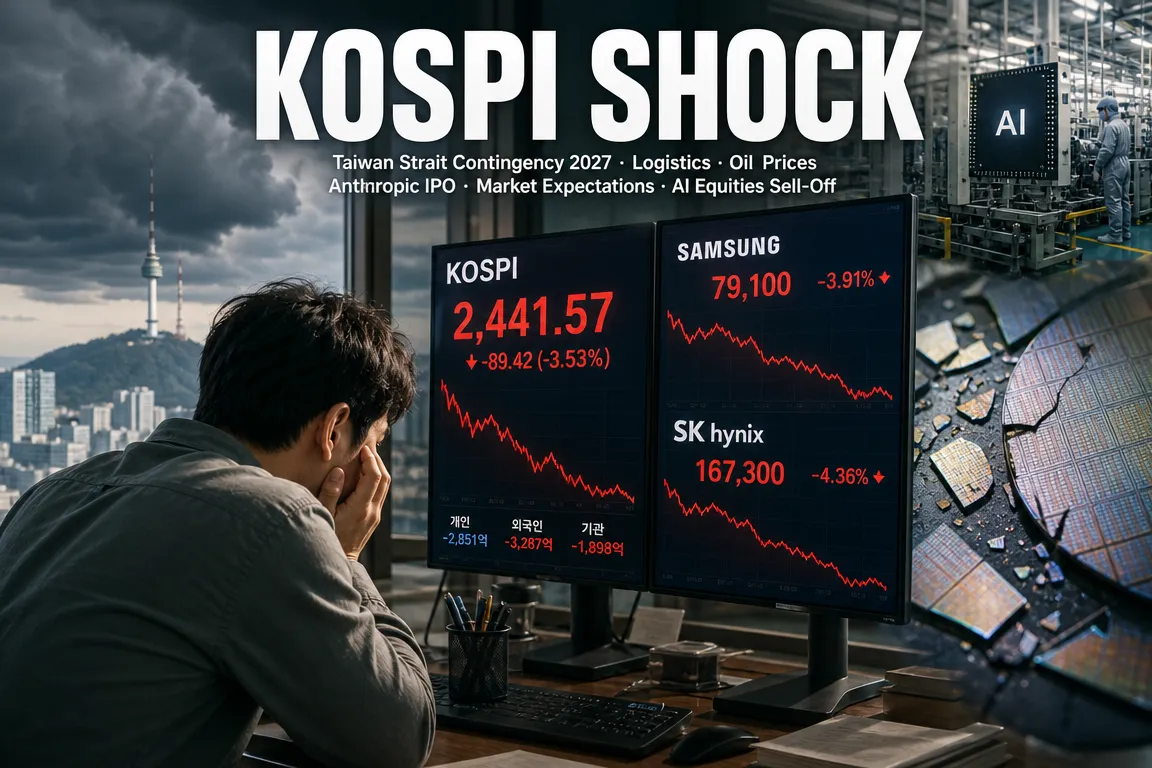
Although the original short video humorously depicts losses in the KOSPI, it highlights several material issues: exit timing, portfolio concentration in semiconductor stocks, loss aversion, and the gap between AI semiconductor expectations and share-price performance.
Investors should not assume that Samsung Electronics and SK Hynix will inevitably recover over time. Their differing business structures, valuation expectations, and investor psychology create distinct risks.
Key Market Message: “Why Reopen an Existing Wound?”
The original content features an investor using self-deprecating humor to describe losses in the KOSPI.
The statement “I once had a dream” reflects the experience of retail investors who entered the market expecting gains but subsequently faced substantial portfolio volatility.
Another notable statement praises investors who know when to exit and can leave the market in a disciplined manner.
The video is therefore less an analysis of a specific stock or market movement than a commentary on loss aversion and regret caused by delayed selling decisions.
Why KOSPI Investors Relate to This Message
The KOSPI is heavily influenced by large semiconductor companies, particularly Samsung Electronics and SK Hynix.
Even when the index declines only modestly, an investor’s realized experience may be substantially worse depending on portfolio holdings and entry prices.
Conversely, a rising KOSPI may not translate into broad investor gains if the advance is concentrated in a limited number of large-cap stocks.
A KOSPI outlook should therefore consider not only index performance but also market breadth, foreign investor flows, exchange rates, and sector-level trends.
Why Samsung Electronics and SK Hynix Should Not Be Evaluated as Identical Semiconductor Stocks
Samsung Electronics and SK Hynix are both leading Korean semiconductor companies, but the market evaluates them using different operating and financial drivers.
Samsung Electronics’ share price reflects memory semiconductors, foundry operations, smartphones, consumer electronics, displays, and other businesses.
Business diversification can provide stability, but it may also reduce the speed at which strength in a specific semiconductor segment affects consolidated earnings and valuation.
SK Hynix’s share price is comparatively more sensitive to memory-sector conditions and demand for high-bandwidth memory, or HBM, used in AI servers.
Expansion in AI data-center investment may strengthen growth expectations. However, if those expectations are already embedded in the valuation, the share price may decline even when reported earnings improve.
A strong company is not always an attractive stock at every valuation, and earnings growth does not necessarily produce short-term share-price gains.
Why AI Semiconductor Growth Does Not Guarantee Share-Price Appreciation
Generative AI and data-center investment are creating additional sources of demand for memory products.
HBM, which is used with AI accelerators, is a high-value product requiring greater technical capability and manufacturing complexity than conventional memory.
However, growth in the AI industry does not mean that all semiconductor companies will appreciate simultaneously.
Investors should evaluate production yields, customer qualification, supply volumes, competitor capacity expansion, average selling prices, and capital expenditure requirements.
Even if the semiconductor cycle improves, price momentum may weaken if supply expands faster than demand.
Because equity markets discount future earnings in advance, positive earnings releases may also trigger profit-taking when expectations have already been priced in.
The Central Message: Knowing When to Exit
The most important issue is not only which stock to buy, but also when to sell.
Many investors establish an entry price but fail to define a target return or maximum acceptable loss.
When prices rise, they delay selling in anticipation of further gains. When prices fall, they postpone selling until the position returns to the original purchase price.
As a result, the basis for the investment decision shifts from enterprise value and earnings prospects to the investor’s entry price.
The market does not recognize an individual investor’s purchase price.
Exit decisions should therefore be based on whether the original investment thesis remains valid, whether earnings expectations have changed, and whether more attractive alternatives are available.
Key Factors Often Underemphasized in Financial Media
First, portfolio concentration can have a greater effect on losses than the index decline itself.
Even during a modest KOSPI correction, a portfolio concentrated in one or two semiconductor stocks may experience substantially greater volatility than the broader index.
Second, AI semiconductor growth and investment returns are separate considerations.
Even in a rapidly expanding industry, share prices may fall if market expectations exceed the actual pace of growth.
Third, foreign investor flows are not determined solely by corporate earnings.
The KRW/USD exchange rate, U.S. interest rates, global risk appetite, China’s economic conditions, and geopolitical risks also affect capital flows.
Fourth, a rising KOSPI does not guarantee gains for individual investors.
Large-cap companies may lift the index while small- and mid-cap stocks or securities favored by retail investors remain weak.
Fifth, investment losses should be reviewed systematically.
Investors should document the original purchase rationale, position size, exit criteria, and expected holding period rather than attributing losses exclusively to market conditions.
Variables to Monitor in the Global Economic Outlook
Because South Korea is highly dependent on exports, the domestic equity market cannot be assessed solely through local economic indicators.
A global economic outlook should incorporate the U.S. interest-rate path, the value of the U.S. dollar, the pace of China’s economic recovery, and capital expenditure by global technology companies.
If U.S. interest rates remain elevated longer than expected, valuation pressure on growth stocks may increase and the Korean won may weaken.
A weaker won can support the translated earnings of exporters but may create currency-loss risks for foreign investors.
Slower growth in China may weigh on Korean intermediate-goods exports, while AI infrastructure spending by major U.S. technology companies remains a key driver of high-performance memory demand.
Practical Criteria for Retail Investors
-
Assess whether any single stock represents an excessive share of total investable assets.
-
Before purchasing, define the conditions that would invalidate the investment thesis rather than focusing only on a target price.
-
Do not pursue index gains without evaluating the sustainability of foreign investor flows and trading value.
-
Determine when themes such as AI and HBM are likely to produce measurable revenue and operating profit.
-
Separate short-term trading from long-term investing, and do not use a long-term classification to justify avoiding losses.
The original content does not provide specific index levels, share prices, or earnings data and should not be interpreted as a time-specific buy or sell signal.
Its primary relevance lies in illustrating loss aversion, portfolio risk, and the importance of disciplined exit criteria.
< Summary >
The video depicts the experience of retail investors who incurred losses in the KOSPI and semiconductor stocks.
Its central focus is not stock selection but the importance of exit criteria, position sizing, and loss management.
Although Samsung Electronics and SK Hynix are both semiconductor companies, they have different business structures and levels of sensitivity to AI-related demand.
AI industry growth alone does not ensure share-price appreciation. Investors should also assess earnings expectations, valuation, exchange rates, interest rates, and foreign investor flows.
Investment decisions should be based on whether the underlying thesis remains valid rather than on recovery to the original purchase price.
[Related Articles…]
*Source: [ 내일은 투자왕 – 김단테 ]
– 왜 또 아픈 상처에 소금을 뿌리십니까? #코스피 #하이닉스 #삼성전자
● War, Shock, Rally
Could a Larger War Begin After the U.S. Midterm Elections? Taiwan, China, North Korea, and the Market Outlook
The central issue is not a simple prediction that war is imminent.
The relevant development is the convergence of U.S. military training for mass-fatality management, 90-day operational self-sufficiency, preparations for a potential Taiwan Strait contingency by 2027, and Chinese exercises aimed at breaking through the First Island Chain.
Other variables include the possibility of U.S. strikes on Iran after the midterm elections, the risk of higher oil prices, expectations for a seasonal U.S. equity rally, and speculation regarding an Anthropic IPO.
However, confirmed facts, military interpretations, market forecasts, and unverified schedules must be assessed separately.
1. Why U.S. Military Training for Large-Scale Temporary Burials Matters
One of the most significant claims concerns a U.S. military exercise reportedly called “Exercise Dragon Covenant,” which included temporary burial procedures for service members killed in action.
Under standard policy, the U.S. military seeks to repatriate remains from overseas theaters to the United States and the service members’ families as quickly as possible.
Immediate repatriation may become impossible if casualties rise sharply within a short period and air or maritime transportation routes are disrupted.
Under such extreme conditions, temporary burial procedures may be required until combat subsides or transportation networks are restored.
- Selection of burial sites and operation of excavation equipment
- Identification and documentation of remains
- Prevention of contamination and physical damage
- Funeral procedures involving military chaplains
- Recovery and repatriation after hostilities end
This exercise should not be interpreted as evidence that the United States has decided to enter a war.
Military organizations routinely prepare for low-probability, high-impact scenarios.
However, the inclusion of mass-casualty scenarios in active training may indicate that the U.S. military expects future conflicts to differ materially from recent wars.
Unlike the wars in Iraq and Afghanistan, where the United States generally maintained air superiority and relatively secure logistics, a conflict involving China or Russia could place transportation networks and casualty evacuation systems under sustained attack.
Claims that this was the first such exercise in approximately 70 years, as well as its exact timing and scale, require confirmation through official U.S. military sources.
2. The U.S. Military’s “90-Day Endurance” Objective Reflects a Logistics Shift, Not a War Prediction
A second signal is the reported objective of enabling U.S. military units to survive and continue operating for up to 90 days without external support.
This requirement extends beyond ammunition.
- Power generation and emergency electricity
- Water supplies and purification systems
- Fuel reserves
- Food and medical supplies
- Satellite, wired, and wireless communications
- Emergency repair of runways and ports
- Cyberattack response capabilities
The Russia-Ukraine war has demonstrated that modern conflicts often target power grids, communications networks, logistics hubs, and rail infrastructure before conventional forces.
In a U.S.-China conflict in the Western Pacific, U.S. bases in Guam, Japan, and the Philippines could face missile and cyberattacks.
Military planners must therefore account for the possibility that supplies departing from the continental United States may not reach forward bases in the Western Pacific.
The central objective of 90-day independent operations is not the construction of fortresses, but the development of logistical resilience that allows distributed bases to withstand supply disruptions.
This shift suggests preparation for a prolonged attritional conflict in which logistics remain under pressure, rather than a short war based on overwhelming force.
3. Why 2027 Is Frequently Cited
2027 is the date most frequently associated with a potential Taiwan Strait contingency.
The year marks the 100th anniversary of the founding of the People’s Liberation Army. U.S. intelligence assessments have repeatedly stated that Chinese President Xi Jinping directed the military to develop the capabilities required for a Taiwan operation by that year.
A critical distinction is necessary.
An instruction to establish military capabilities by 2027 is not equivalent to a decision to invade Taiwan in 2027.
Military capability and political intent are separate variables.
China’s leadership would need to consider Taiwan’s political environment, the probability of U.S. intervention, domestic economic conditions, potential sanctions, and the likelihood of success in an amphibious operation.
A reported statement by a senior U.S. Indo-Pacific commander referred to completing preparations by April 2027.
If accurately reported, the reference to a specific month could attract market attention. However, the commander’s position and the full context of the statement require verification.
A military readiness deadline is more likely to represent an internal target for budgets, force deployment, weapons deliveries, and joint exercises than a forecast of the date on which war will begin.
4. Why the First Island Chain Matters to the Korean Peninsula and U.S. Equities
The First Island Chain is a maritime strategic line extending through the Japanese archipelago, Okinawa, Taiwan, and the Philippines.
From the U.S. perspective, it serves as a defensive structure intended to restrict China’s naval and air access to the broader Western Pacific.
From China’s perspective, it is a strategic barrier that must be overcome to weaken U.S. and allied containment.
Potential Chinese operations in a Taiwan contingency would not necessarily be limited to attacks on Taiwan itself.
- Maritime and air blockades around Taiwan
- Restrictions on access to Okinawa and southwestern Japan
- Control of waters near the northern Philippines
- Missile attacks on U.S. bases and runways
- Disruption of undersea cables and satellite communications
- Interruption of semiconductor and energy transportation routes
The United States is responding by distributing personnel and munitions across multiple smaller bases rather than concentrating them at a few large facilities.
Pre-positioning aircraft, drones, anti-ship missiles, and fuel across the First Island Chain is intended to reduce the risk of losing substantial combat capability during an initial attack.
Reported deployments of advanced fighter aircraft and MQ-9 Reaper drones can be viewed within this broader strategy of distributed and forward-based operations.
5. China’s Objective May Extend Beyond a Taiwan-Only Conflict
A concentrated confrontation in a single theater would allow the United States to direct substantial military resources against China.
China could instead apply simultaneous pressure around Japan, Taiwan, and the Philippines to disperse U.S. forces.
If Russian pressure on Europe and conflicts in the Middle East continue, the United States may be required to manage three strategic theaters: Europe, the Middle East, and East Asia.
This does not imply that wars will begin simultaneously. It means the United States may be unable to allocate sufficient personnel and weapons to every region at the same time.
Air-defense missiles, long-range precision weapons, aircraft carriers, and aerial refueling aircraft are limited assets.
As the number of potential theaters increases, policymakers must decide which regions receive priority.
This allocation constraint is a central component of current geopolitical risk.
6. The Possibility of North Korean Action During a Taiwan Contingency
South Korea must consider the possibility that a Taiwan Strait conflict could become linked to instability on the Korean Peninsula.
If North Korea initiates a localized provocation in the West Sea, along the Demilitarized Zone, or near the Northern Limit Line while China blockades or attacks Taiwan, the ability to redeploy U.S. forces stationed in South Korea could be restricted.
The United States would need to support Taiwan while maintaining the defense of South Korea. Japan would also face pressure to balance domestic defense requirements with support for Taiwan.
However, North Korea should not be assumed to initiate a full-scale war automatically at China’s request.
Regime survival remains Pyongyang’s highest priority, and an uncontrollable conventional war would carry substantial risks.
More plausible scenarios include missile launches, maritime clashes in the West Sea, cyberattacks, and GPS interference rather than an immediate full-scale conflict.
Nevertheless, the assumption that the Korean Peninsula is strategically separate from the Taiwan Strait is increasingly difficult to sustain.
7. Do Three-Day Emergency-Supply Recommendations in the United Kingdom and Japan Signal War?
The United Kingdom advises households to maintain enough water, food, lighting, and radio equipment to remain self-sufficient for at least three days.
Japan similarly recommends storing at least three days of water and food, with one week preferred where possible.
These guidelines address a broad range of emergencies, including war, earthquakes, floods, power outages, pandemics, cyberattacks, and supply disruptions.
Japan’s recommendations predate recent geopolitical tensions and should not be interpreted as evidence that war is imminent.
Although the United Kingdom has emphasized military tensions with Russia, its household preparedness guidance also applies to multiple categories of emergencies.
The more relevant trend is that governments are formally acknowledging periods during which immediate public assistance may be unavailable.
Emergency policy is shifting toward an expectation that individuals and households must remain self-sufficient during the first 72 hours of a crisis.
8. Practical 72-Hour Emergency Supplies for South Korean Households
Excessive purchases driven by fear are unnecessary.
Households can prepare supplies that are also useful during earthquakes, typhoons, or prolonged power outages.
- Water: Approximately three liters per adult per day for at least three days
- Food: Canned goods, energy bars, and other food requiring minimal preparation
- Lighting: Flashlights, spare batteries, and portable lanterns
- Communications: Power banks, battery-powered radios, and written family contact information
- Medical supplies: Basic medication, prescription drugs, disinfectant, bandages, and masks
- Household supplies: Wet wipes, toilet paper, hygiene products, and waste bags
- Payment methods: Small amounts of cash in case electronic systems are unavailable
- Family plan: Predetermined meeting points and evacuation routes
- Children and pets: Formula, diapers, pet food, and additional water
This can be treated as preparation for a prolonged power outage rather than solely for war.
The purpose of emergency supplies is to preserve time and decision-making capacity during unexpected disruptions.
9. Potential U.S. Strikes on Iran After the Midterm Elections and the Oil Market
Another scenario is that the United States could conduct short but intensive strikes against Iran after the midterm elections.
This remains a media and market scenario rather than an officially announced military operation.
Any decision would depend on Iran’s nuclear activities, attacks on U.S. bases, Israeli-Iranian escalation, and conditions in the Strait of Hormuz.
For investors, the transmission mechanism to financial markets is more important than the initial military headline.
- Escalation in the Middle East could raise oil prices and maritime freight costs.
- Higher energy prices could renew inflationary pressure in the United States and Europe.
- Persistent inflation could reduce the Federal Reserve’s capacity to lower interest rates.
- Higher Treasury yields could pressure valuations in growth and AI-related equities.
- A stronger U.S. dollar could weaken the South Korean won and increase foreign capital outflow risk.
Investors should monitor the actual risk of disruption in the Strait of Hormuz, tanker insurance costs, Brent crude prices, and the U.S. 10-year Treasury yield.
South Korea’s high dependence on imported energy means that higher oil prices can directly affect its trade balance and corporate costs.
Middle East risk is therefore a material variable for domestic inflation and South Korean equity earnings.
10. Did U.S. Equities Always Rise After Midterm Elections?
One historical analysis claims that investing from November of a U.S. midterm-election year through the following June produced a 100% positive return rate since 1942, with an average gain of approximately 16.6%.
The period from October of a midterm-election year through the following October has also reportedly generated strong returns.
Several factors may explain this historical pattern.
- Capital may return to markets after election uncertainty declines.
- Economic and market-supportive policies have often strengthened during the third year of a presidential term.
- Companies may resume investment and share repurchases after the election outcome becomes clear.
- Year-end consumption and expectations for a seasonal rally may provide additional support.
However, a historical 100% success rate should not be treated as a reliable forward-looking rule.
Results can vary depending on the index, the inclusion of dividends, and the selected start and end dates.
The number of midterm elections since 1942 is also limited, producing a relatively small statistical sample.
Past gains do not ensure that markets will overcome the effects of war, interest rates, fiscal deficits, or elevated AI valuations in 2026.
Seasonality can inform portfolio decisions, but it does not eliminate geopolitical risk.
11. The October Bottom Thesis and a Potential Post-Election Relief Rally
Major U.S. equity market lows have frequently occurred in October.
Sharp market dislocations during the Great Depression and the global financial crisis contributed to the perception of an adverse “October effect.”
However, markets have also frequently rebounded from November through year-end after October declines and position reductions.
A relief rally could occur after the midterm elections if political uncertainty declines.
For such a rally to remain sustainable, several conditions would likely be required.
- No sharp increase in international oil prices
- Stable U.S. Treasury yields
- No further deterioration in corporate earnings forecasts
- No direct military conflict in the Taiwan Strait or Middle East
- Evidence that AI capital expenditure is generating revenue and cash flow
The global economic outlook is likely to depend more on the interaction among oil prices, interest rates, and corporate earnings than on election seasonality alone.
12. Anthropic IPO Speculation and Risks for AI-Related Equities
A potential mid-November Anthropic IPO has been presented as a second major inflection point for AI-related equities.
However, a listing date should not be considered confirmed until the company issues an official announcement, files the required registration documents, receives exchange approval, and establishes a public offering schedule.
Available information is insufficient to conclude that a mid-November Anthropic IPO has been formally confirmed.
Investors should prioritize the following sources and data over dates circulated through social media or online commentary.
- An S-1 registration statement or related filings with the U.S. Securities and Exchange Commission
- Announcements from Anthropic’s official newsroom
- Offering schedules published by underwriters and the relevant exchange
- The proposed price range and implied valuation
- Revenue growth, cash burn, and cloud-computing expenses
If Anthropic proceeds with an IPO, the transaction could establish a new public-market valuation benchmark for the AI industry.
Generative AI companies are valued not only on revenue, but also on model-training costs, inference costs, cloud agreements, customer retention, and access to financing.
A successful offering at a high valuation could support sentiment toward Nvidia, data centers, networking equipment, and power-infrastructure companies.
A delay or downward revision to the offering valuation could renew concerns about elevated valuations across AI-related equities.
13. Key Indicators in Apple and Palantir Earnings
Apple’s results should be assessed beyond iPhone unit sales.
Relevant indicators include revenue from China, growth in services, and evidence that AI functionality is generating device replacement demand.
For Palantir, key variables include U.S. government contracts, commercial revenue growth, AI platform revenue, and free cash flow.
Even strong reported results may trigger volatility if valuations already reflect aggressive expectations and forward guidance falls short.
Revenue guidance for the next quarter and management commentary on AI demand may be more important than headline results.
14. The Most Important Implications Often Missed in Other Coverage
First, military exercises indicate vulnerabilities rather than providing a date for war.
Temporary burial training is more relevant as evidence that air superiority and secure transportation cannot be assumed than as proof that conflict is imminent.
Second, logistics are more important to the First Island Chain than individual combat aircraft.
Runways, fuel storage, ammunition depots, ports, and undersea cables determine the ability to sustain operations.
Third, China’s primary objective may be to delay U.S. intervention rather than immediately occupy Taiwan.
Restricting access through Japan and the Philippines during the initial phase of a conflict could materially improve China’s strategic position.
Fourth, the most direct risks to South Korean markets are oil prices, exchange rates, and the semiconductor supply chain.
Disruption in the Taiwan Strait could affect semiconductor production and maritime transportation while intensifying depreciation pressure on the South Korean won.
Fifth, emergency-supply guidance in the United Kingdom and Japan should not be interpreted as advance notice of war.
However, it demonstrates that governments increasingly view prolonged power outages and supply-chain disruptions as realistic policy scenarios.
Sixth, post-midterm market strength and elevated geopolitical risk can coexist.
Equities may rise even as oil prices, defense stocks, the U.S. dollar, and gold continue to reflect geopolitical tension.
15. Investor Monitoring Checklist
- Whether Brent and West Texas Intermediate crude prices rise sharply
- Whether commercial shipping through the Strait of Hormuz and Taiwan Strait remains normal
- Whether the U.S. 10-year Treasury yield stabilizes
- Whether the U.S. Dollar Index and the USD/KRW exchange rate rise simultaneously
- Whether the United States deploys additional forces to Japan, Guam, or the Philippines
- Whether Chinese exercises remain short-term demonstrations or evolve into prolonged blockade rehearsals
- Whether North Korean missile launches and West Sea provocations intensify
- Whether Anthropic files official IPO registration documents
- Whether Apple and Palantir maintain their earnings guidance
Investors should avoid liquidating entire portfolios or making aggressive purchases based on isolated headlines.
A diversified allocation across equities, short-duration bonds, and cash equivalents may be more appropriate, with commodities and defense equities used only as measured diversification tools.
Military exercises, government statements, media estimates, and operational orders should be classified as separate levels of information.
< Summary >
U.S. military preparations for mass casualties and 90-day independent operations reflect changes in logistics designed for a potential prolonged conflict between major powers.
2027 is commonly cited as a Chinese military capability target, not as a confirmed date for an invasion of Taiwan.
A Taiwan Strait conflict could affect security on the Korean Peninsula and disrupt semiconductor supply chains through Japan, the Philippines, and North Korea.
Three-day emergency-supply recommendations in the United Kingdom and Japan are broad disaster-preparedness measures rather than war-specific warnings.
U.S. equities may benefit from seasonal strength after the midterm elections, but historical performance does not guarantee future returns.
Investors should monitor oil prices, Treasury yields, the USD/KRW exchange rate, Taiwan Strait logistics, and corporate earnings.
Any Anthropic IPO schedule should remain unconfirmed until supported by official filings and company announcements.
[Related Articles…]
- How Geopolitical Risk Affects Global Equities and Oil Prices
- How Generative AI IPOs Could Reshape AI Equity Valuations
*Source: [ 소수몽키 ]
– 중간선거 이후 더 큰 전쟁이 시작된다? 유례 없는 움직임, 불길한 신호일까