● AI Shock, Nasdaq Slump, Chip Panic
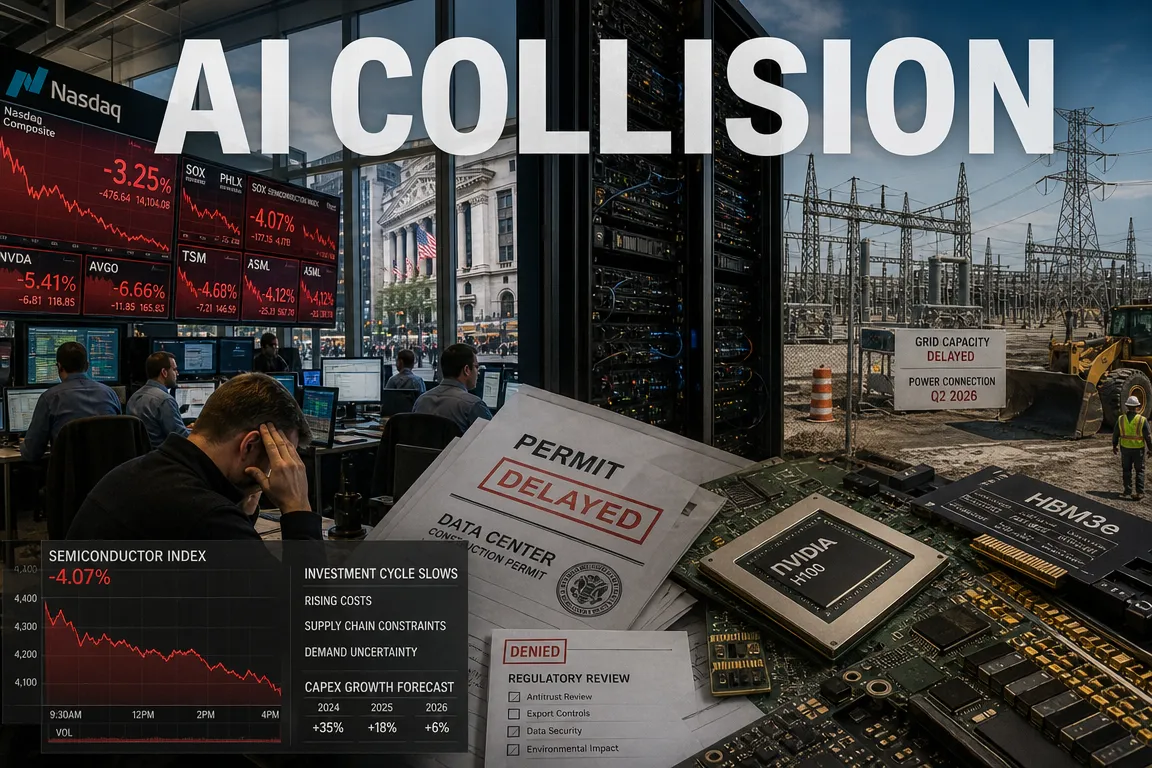
Nasdaq Plunges More Than 5%: AI Data Center Regulation and the Semiconductor Investment Cycle
The central issue is not simply the decline in Nvidia and AMD shares.
Concerns that U.S. midterm election outcomes could intensify restrictions on AI data center grid connections, permitting, and community cost burdens are pressuring market valuations.
ARM and Qualcomm guidance, reports of Apple reducing internal AI spending, and Micron’s Taiwan facility issues have also prompted investors to reassess AI investment returns and the sustainability of semiconductor demand.
The key question is not whether data centers will be canceled, but how long completion schedules may be delayed, who will bear the additional costs, and into which quarters semiconductor orders may be deferred.
However, the reported index movements, internal corporate discussions, and potential policy changes include a mixture of intraday data, media reports, and interpretation. Closing prices and official announcements require separate verification.
1. Nasdaq Selloff and the Drivers of Increased Market Risk
The reported intraday moves were approximately -5.37% for the Nasdaq, -2.38% for the Dow Jones Industrial Average, -3.52% for the S&P 500, and -2.11% for the Russell 2000.
Among major semiconductor stocks, Nvidia reportedly fell approximately 8%, AMD 16%, and Micron 15%.
These figures may represent an intraday snapshot rather than official closing prices. Investors should verify exchange closing data and after-hours trading activity.
Nevertheless, the Nasdaq’s substantially larger decline relative to the Dow and Russell 2000 provides a clear signal.
The market appears to be reducing the valuation premium assigned to highly valued AI and semiconductor growth stocks rather than pricing in a broad collapse of the U.S. economy.
- When losses accelerate without a single identifiable catalyst, investors may assume that undisclosed or underappreciated risks are emerging.
- Concentrated positioning in AI-related stocks can turn relatively limited negative developments into large-scale selling.
- Leveraged liquidations and tighter fund risk limits can generate mechanical selling unrelated to underlying corporate value.
- Options hedging following a volatility increase can accelerate intraday declines.
The selloff is therefore better understood as the combined effect of valuation compression, position unwinding, and policy uncertainty rather than sentiment alone.
2. Why Stocks Plunged Without a Clear Major Shock
The absence of a new systemic shock may itself be significant.
It can indicate that previously recognized risks are being repriced more aggressively.
During a bull market, expectations for AI investment, data center construction, and GPU shortages are reflected in future earnings estimates.
During a correction, investors focus instead on power availability, permitting delays, depreciation expenses, and returns on invested capital.
The market’s central question has shifted from “How large will AI demand become?” to “When will companies generate adequate returns on this investment?”
This narrative shift can pressure companies with strong current results as well as those with weak fundamentals.
3. How U.S. Midterm Elections Could Affect AI Data Centers
The source states that candidates favoring a slower pace of data center development won elections in states including Ohio, Michigan, Texas, and Georgia.
The central concern is not direct federal restrictions on AI.
It is the potential for stronger political opposition related to regional electricity grids, water consumption, land-use approvals, and costs imposed on local communities.
AI data centers require substantially more than server purchases.
- Large-scale power generation and transmission capacity are required.
- Grid connections require substations and long-term electricity agreements.
- Cooling systems may require significant water supplies or additional electricity.
- Projects must obtain local land-use and environmental approvals.
- Developers must address concerns regarding electricity prices and tax incentives.
The effect of U.S. elections on the AI industry may therefore emerge more directly through state governments, local authorities, public utility commissions, electricity providers, and grid operators than through a single federal law.
4. Concerns About Rising Data Center Costs in Texas
The source describes discussions in Texas concerning restrictions on new data center approvals and requirements for developers to bear additional costs associated with protecting residents and the power grid.
The official name, scope, and legislative status of the reported “Texas Resident Protection Act” and any proposed moratorium require confirmation through official legislative records.
Regardless of the policy’s name, the economic implications are relatively clear.
- Data center operators may be required to bear a larger share of transmission and generation infrastructure costs.
- Operators may face requirements for demand-response agreements or on-site power generation.
- Conditions may include residential electricity price protections and local infrastructure investments.
- Construction guarantees, environmental expenses, and reduced tax incentives could weaken project economics.
Higher costs would reduce returns on AI data center investments.
If expected returns fall below internal thresholds, hyperscalers may defer construction or implement projects in phases rather than cancel them outright.
GPU and HBM demand may remain intact, but orders could shift into later quarters.
Equity markets are sensitive not only to demand destruction but also to delayed revenue recognition.
5. How Data Center Delays Affect Semiconductor Stocks
AI infrastructure spending is supported by a sequential supply chain spanning multiple industries.
Permitting delays initially affect construction and power infrastructure schedules, followed by server deployment and semiconductor delivery timelines.
- Grid connections and land-use approvals are delayed.
- Data center completion dates move later.
- Server and networking equipment orders are rescheduled.
- GPU, CPU, HBM, and conventional memory purchases are deferred or distributed over a longer period.
- Quarterly semiconductor revenue growth may slow.
- Price-to-earnings and price-to-sales multiples based on elevated growth assumptions may contract.
AI data center regulation is therefore not limited to Nvidia.
AMD, ARM, memory suppliers, advanced packaging companies, optical networking vendors, and power equipment manufacturers may also be affected.
The principal risk for semiconductor equities is not necessarily the disappearance of long-term demand, but the failure of revenue to materialize at the pace assumed by the market.
6. Why Nvidia, AMD, and Micron Recorded Larger Declines
Nvidia’s valuation reflects substantial expectations for sustained AI accelerator and data center investment growth.
Questions about permitting and hyperscaler capital expenditure can therefore compress its valuation even if current operating results remain strong.
AMD is expected to expand its AI accelerator market share while growing its data center CPU business, making its shares sensitive to changes in the investment cycle.
Micron is viewed as a direct beneficiary of HBM and server memory demand but also operates in the highly cyclical memory market.
If AI server deployment is delayed, investors may price in weaker demand not only for HBM but also for conventional DRAM and NAND.
This can produce greater share-price volatility among memory manufacturers.
7. Why ARM and Qualcomm Guidance Weakened Sentiment
According to the source, ARM reported solid recent results, but its next-quarter revenue guidance fell short of market expectations.
ARM generates licensing and royalty revenue from CPU intellectual property across mobile devices, data centers, automobiles, and AI-enabled hardware.
Weak forward guidance can lead investors to question the pace of AI-related demand growth even when current results remain sound.
Qualcomm’s principal businesses remain smartphone processors and communications semiconductors, although the company also has exposure to on-device AI adoption.
Below-consensus guidance may therefore raise concerns about both smartphone demand and the rate of AI-device adoption.
However, ARM and Qualcomm guidance does not directly establish a downturn in AI data center demand.
The companies have different product portfolios, customer bases, and revenue-recognition schedules, requiring separate analysis of their official earnings materials.
8. Why Amazon and Microsoft Also Declined
Hyperscalers such as Amazon and Microsoft are both major investors in AI infrastructure and businesses that must generate returns from that investment.
Large capital expenditures were initially viewed as supporting cloud market leadership and AI revenue growth.
When market sentiment changes, the same spending can be interpreted as a burden on cash flow.
Investors are assessing three principal factors:
- Whether AI service revenue is growing faster than data center depreciation expense.
- Whether GPU and server utilization rates are sufficiently high.
- Whether lower AI inference costs improve profitability or intensify price competition.
Even rising capital expenditure can pressure valuations if conversion into AI revenue and operating profit is slower than expected.
9. Implications of Reports Concerning Meta and OpenAI
The source cites a Meta representative as stating that building new U.S. data centers has become more difficult, while expanding existing facilities remains comparatively easier.
Existing sites benefit from established power agreements, permitting frameworks, operating histories, and relationships with local communities.
New operators must establish grid connections and obtain public and regulatory support from the beginning.
This structure may provide a relative advantage to companies such as Meta, Amazon, Microsoft, and Google that already control suitable sites.
Data center regulation may therefore create barriers to entry that strengthen incumbent operators rather than affecting all companies equally.
The source also reports that OpenAI executives discussed reassessing the data center capacity required for the following year after reviewing election outcomes.
This may represent internal scenario planning rather than an official reduction in capital expenditure or contracted capacity.
Scenario analysis and an implemented change in investment plans should be treated as separate stages.
10. Has AI Infrastructure Capital Expenditure Peaked?
Citrini Research is cited as warning that AI infrastructure capital expenditure may be approaching a peak, with risks increasingly skewed to the downside.
The firm also reportedly identified higher data center costs and potential stagflation as relevant risks.
By contrast, technology analyst Dan Ives reportedly maintained a constructive long-term outlook on AI while suggesting that the peak in hyperscaler capital expenditure growth could move forward to 2027.
A peak in expenditure growth should be distinguished from a peak in total expenditure.
If investment rises 50% in one year and 20% the next, the growth rate has slowed, but the absolute amount of investment continues to increase.
Analysis of an AI investment peak must therefore specify whether it refers to total spending, growth rates, newly constructed capacity, or GPU shipments.
11. Interpreting Reports of Apple’s AI Cost Reductions
The source reports that Apple reduced engineers’ internal AI token allowance from $300 to $200 and may lower it further to $100.
If accurate, this would indicate that major technology companies are applying closer cost and efficiency controls to generative AI usage.
However, a lower internal usage allowance should not be interpreted as Apple abandoning its AI strategy.
The change could reflect cost optimization, model migration, greater use of internal models, or efforts to eliminate redundant processing.
It may instead indicate that AI is moving from an experimental phase into a commercial phase focused on measurable productivity and returns.
Future evaluation is likely to place greater emphasis on labor savings, revenue generation, and operating efficiency than on raw AI usage volume.
12. Why Apple Was Viewed as a Relative Technology Safe Haven
Apple was reported to have outperformed other large technology companies during the selloff.
Compared with major hyperscalers, Apple has less direct exposure to large-scale AI data center investment and a higher dependence on hardware and services revenue.
If the market begins to treat AI capital expenditure as a risk, companies with lower direct investment exposure may demonstrate defensive characteristics.
Apple nevertheless remains exposed to smartphone replacement cycles, China-related risks, services regulation, and uncertainty regarding its proprietary AI capabilities.
Lower AI infrastructure exposure alone does not make the company a long-term safe asset.
13. Why Healthcare and Walmart Were Relatively Resilient
Healthcare and consumer staples reportedly remained comparatively stable during the technology-led decline.
Companies such as Walmart sell food and essential consumer products that retain demand across economic cycles.
Healthcare earnings also tend to have a lower correlation with economic growth and AI investment cycles.
This relative performance may indicate a rotation from highly valued technology stocks into defensive sectors rather than a system-wide financial crisis.
Sector-level performance dispersion is important when determining whether a decline reflects broad economic deterioration or the repricing of a specific investment theme.
14. Micron’s Taiwan Facility and Labor Dispute
The source states that Micron could suspend construction of a new Taiwan facility because of a labor dispute.
It also reports that workers sought compensation equivalent to approximately 15% of operating profit.
These claims require verification through official company statements, local labor organizations, and facility-specific investment plans.
If construction is delayed, the immediate effects could include higher costs and a slower expansion of production capacity.
Over the longer term, constrained memory supply growth could help limit price declines.
A semiconductor facility delay does not necessarily indicate weaker demand; potential supply restrictions must also be considered.
15. Implications for the KOSPI and South Korean Semiconductor Market
The source reports that KOSPI overnight futures declined approximately 4.6% following a significant fall in the previous session.
South Korea’s equity market is highly sensitive to global AI and memory investment sentiment because Samsung Electronics and SK Hynix represent substantial index weightings.
A sharp decline in U.S. semiconductor stocks can trigger foreign selling of Korean futures, currency weakness, and cash-equity outflows.
When HBM expectations are heavily reflected in valuations, even a delay in data center investment can cause rapid revisions to earnings estimates.
However, the movement in overnight futures does not necessarily correspond directly to the following cash-market close.
Late-session moves in U.S. equities, exchange rates, policy responses, and domestic institutional flows may materially alter the outcome.
16. Comparison With the 2022 Bear Market and the COVID-19 Selloff
The reported Nasdaq decline has been compared with the 2022 bear market and the COVID-19 crash.
However, the primary drivers differ across the three periods.
- The 2020 COVID-19 selloff was driven by the suspension of economic activity and severe financial-market liquidity stress.
- The 2022 bear market reflected inflation and rapid interest-rate increases that compressed growth-stock valuations.
- The current scenario centers on uncertainty regarding AI investment returns and the pace of data center development.
A single day’s decline is insufficient to establish conditions comparable to a financial crisis.
Evidence of credit-market stress, higher interbank funding costs, wider corporate bond spreads, and broad earnings deterioration would be required to indicate systemic risk.
The claim that “Nasdaq multiples have returned to 2022 levels” is also unclear unless it specifies whether the measure is forward price-to-earnings, price-to-sales, or an index-level decline.
Using inconsistent valuation measures can lead to incorrect conclusions about whether the market is expensive or inexpensive.
17. Key Issues Often Overlooked in Market Coverage
First, power infrastructure is becoming a more significant bottleneck than AI demand.
Even with sufficient GPU orders, data centers cannot operate without adequate generation and transmission capacity.
Second, regulation does not affect incumbent hyperscalers and new entrants equally.
Companies with existing sites and power contracts can expand current facilities, while new operators face higher entry costs.
Third, semiconductor stocks can decline even if data center projects are not canceled.
Deferring orders by several quarters can reduce earnings estimates and valuation multiples based on elevated growth assumptions.
Fourth, local politics and utility costs have become central variables in the AI investment cycle.
For local residents, electricity prices, water consumption, and the fairness of tax incentives may be more important than projected job creation.
Fifth, AI cost reductions may represent commercialization rather than industry contraction.
Controls on token budgets and model usage indicate that companies increasingly view AI as an operating expense requiring measurable returns rather than an unlimited experiment.
18. Key Indicators for the Global Economic Outlook
Determining whether the correction is temporary or the beginning of a prolonged decline requires analysis of operating and economic data rather than equity prices alone.
- Annual capital expenditure guidance from Amazon, Microsoft, Alphabet, and Meta.
- Data center revenue growth and order backlogs at Nvidia and AMD.
- HBM contract pricing and capacity plans at Micron, SK Hynix, and Samsung Electronics.
- Grid-connection waiting periods in major U.S. data center markets.
- Actual passage and implementation of data center moratoriums and cost-allocation legislation.
- U.S. Treasury yields, corporate credit spreads, and the U.S. dollar.
- Whether earnings estimate reductions spread beyond selected semiconductor companies to the broader Nasdaq market.
The key issue for the global outlook is not whether AI investment has ended, but how long the industry can sustain elevated capital expenditure growth.
19. Near-Term Scenarios for Investors
Under a bearish scenario, permitting delays and higher electricity costs could lead hyperscalers to reduce capital expenditure.
This could trigger sequential earnings estimate reductions across GPU, HBM, server, and networking equipment suppliers.
Under a neutral scenario, new data center construction would be delayed, while expansions of existing facilities and international investment would offset part of the shortfall.
Long-term AI growth could remain intact, but volatility and company-specific performance dispersion would increase.
Under a bullish scenario, regulatory proposals introduced during election campaigns could be moderated through negotiations over investment and employment.
If hyperscalers agree to bear a larger share of grid costs and local authorities resume permitting, delayed projects could proceed.
Data center regulation is therefore likely to become a negotiation over cost allocation rather than a binary choice between approval and prohibition.
20. Fact-Checking Standards for the Reported Claims
The material combines intraday market data, corporate results, media reports, executive comments, and third-party analysis.
These items should not all be treated as confirmed facts.
- Index and stock movements should be verified against official exchange closing data.
- ARM and Qualcomm guidance should be confirmed through official earnings materials.
- Reports regarding Apple’s internal AI budget should be classified as either official disclosures or anonymously sourced reporting.
- Meta and OpenAI data center discussions should be assessed based on whether they result in actual investment-plan changes.
- Texas legislation should be verified by official title, filing status, legislative approval, scope, and effective date.
- Micron’s Taiwan facility issues should be cross-checked against company disclosures and local labor records.
Unconfirmed reports can influence market sentiment but should be distinguished from finalized developments that materially affect long-term earnings.
< Summary >
The Nasdaq selloff reflects the combined repricing of AI investment returns, data center permitting risk, electricity costs, and potential delays in semiconductor demand rather than a single catalyst.
Stricter data center regulation following U.S. midterm elections could raise construction costs and defer GPU and HBM orders.
ARM and Qualcomm guidance, reports of Apple reducing AI expenses, and discussions involving Meta and OpenAI added pressure to already weak sentiment.
However, data center regulation could also strengthen incumbent hyperscalers that already control sites, power contracts, and permitting frameworks.
Investors should focus less on one-day price movements and more on hyperscaler capital expenditure, grid availability, enacted legislation, semiconductor orders, and changes in earnings expectations.
[Related Articles…]
- AI Data Center Power Infrastructure and Global Investment Outlook
- Semiconductor Investment Cycles and Shifts in AI Demand
*Source: [ 내일은 투자왕 – 김단테 ]
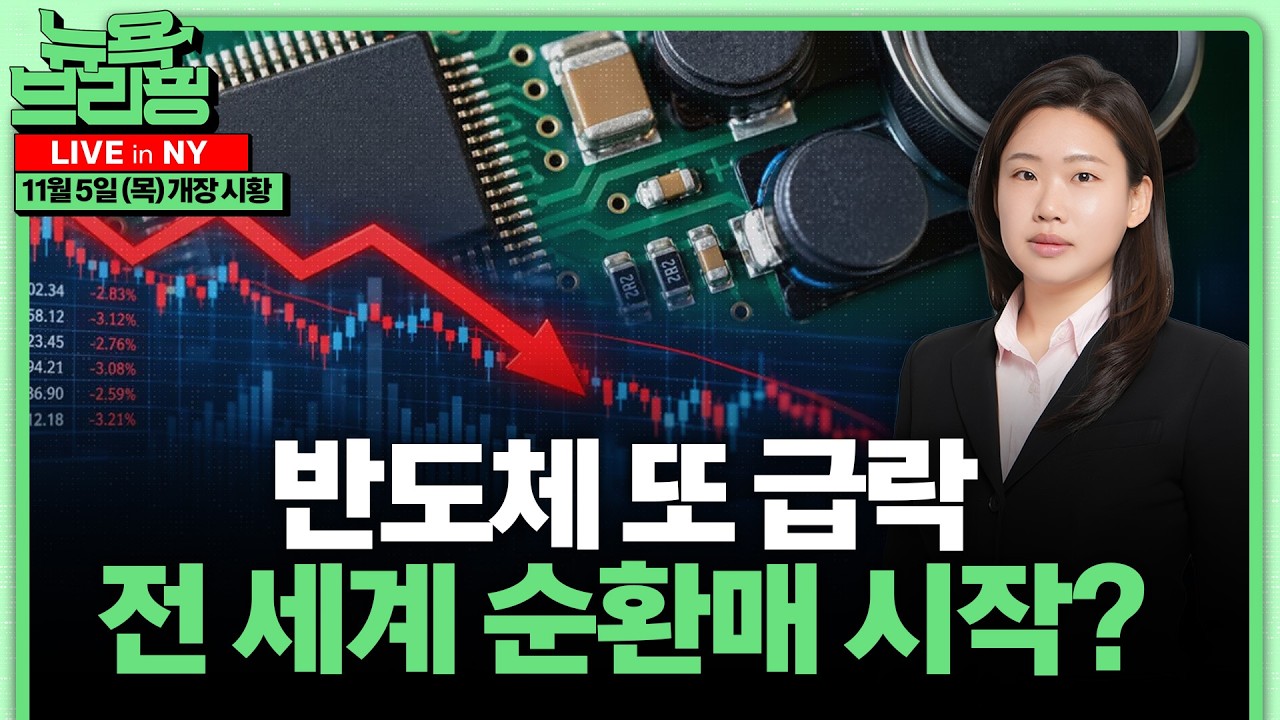
– 나스닥 멸망…
● AI-Selloff, Rotation, Shock
Post-Midterm Market Reversal: AI Semiconductor Selloff and the Implications of Global Sector Rotation
Following the U.S. midterm elections, market leadership is shifting rapidly from AI semiconductors toward financials, consumer companies, healthcare, and platform businesses.
Key issues include how potential U.S. data center restrictions could affect Samsung Electronics and SK Hynix, why semiconductor and Big Tech shares initially diverged, and why the South Korean market experienced disproportionately large losses.
Other major developments include the sharp decline in oil prices, changes in U.S. Treasury yields, the Bank of England’s rate increase, U.S. government shutdown risk, and contrasting earnings trends at Toyota and Qualcomm.
The central market shift is not merely a technology-sector correction. Global capital is increasingly prioritizing current earnings and cash flow over long-term growth expectations.
Note: The figures and political and market conditions below are based on a Maeil Business Newspaper briefing by New York correspondent Hong Hye-jin dated November 5, 2026.
Note: Intraday index and stock-price movements may vary by reference point. Some index, market-capitalization, and point calculations in the source were not fully consistent; the analysis therefore focuses on market direction and transmission mechanisms.
1. U.S. Market Overview: The Dow and Nasdaq Diverged
Following the U.S. midterm election results, performance diverged significantly across major equity indices.
At the beginning of the briefing, Dow futures rose 0.62%, while Nasdaq 100 futures declined by more than 1%.
S&P 500 futures were broadly unchanged, and Russell 2000 futures gained 0.14%.
After the Dow rose more than 3% in the previous session, traditional industrial and financial stocks remained relatively strong, while AI semiconductor and technology shares faced selling pressure.
Risk sentiment deteriorated further after the regular session opened.
The Nasdaq 100 fell as much as 3.18%, the S&P 500 declined 1.45%, and the Dow reversed an early gain to trade 0.47% lower.
The VIX rose approximately 10% intraday, indicating a rapid increase in market volatility.
Semiconductors initially weakened while selected Big Tech shares remained resilient. As risk aversion intensified, however, Alphabet, Amazon, Meta, and Tesla also declined.
The initial sector rotation consequently developed into a broader adjustment in market valuations and leveraged positioning.
- Stage 1: Capital moved from AI semiconductors into financials, consumer stocks, and healthcare.
- Stage 2: Semiconductor weakness triggered sharp declines across Asian markets.
- Stage 3: Selling expanded to Big Tech and growth stocks after the U.S. market opened.
- Stage 4: Falling Treasury yields and a rising VIX signaled a broader risk-off environment.
2. Why AI Semiconductors Declined: Data Center Permitting, Not the End of AI
The correction should not be interpreted as evidence that the AI investment cycle has ended.
The immediate concern was the possibility of tighter U.S. regulations on data center construction.
AI data centers require more than GPUs and high-bandwidth memory.
They depend on large-scale electricity supply, cooling systems, transmission-grid connections, water, land, and environmental approvals.
Communities in areas with substantial data center development may also oppose projects because of electricity-price increases and grid congestion.
According to the source briefing, the post-election balance of power in Congress raised expectations that environmental and electricity-related restrictions could become more stringent.
If data center construction slows, Microsoft, Amazon, and Alphabet may revise server procurement plans.
Lower server-order expectations would affect demand forecasts for Nvidia GPUs and, in turn, the HBM used in those systems.
U.S. electricity and permitting constraints could therefore affect the share prices of Samsung Electronics and SK Hynix.
Data center restrictions → slower AI capital expenditure → weaker GPU orders → lower HBM demand expectations → foreign selling of South Korean semiconductor stocks
The briefing cited intraday declines of approximately 5.35% for Nvidia, 5.56% for Broadcom, 10% for Micron, and 12% for AMD.
Qualcomm also approached a double-digit decline amid earnings concerns and a weaker smartphone demand outlook.
3. Why Data Center Restrictions Could Benefit Big Tech Relative to Semiconductors
Data center restrictions may appear negative for all technology companies.
However, they could reinforce the competitive position of large cloud providers that have already secured data center capacity and electricity supply.
As new construction becomes more difficult, the scarcity value of existing facilities increases.
Microsoft, Amazon, and Alphabet have established infrastructure, cloud customers, and substantial cash flow, giving them greater capacity to absorb regulatory costs than smaller AI companies.
New entrants face higher electricity and permitting costs, while incumbent operators can use existing infrastructure.
A slower AI capital-expenditure cycle could also reduce spending pressure on Big Tech.
Investors have questioned whether unprecedented AI investment will generate adequate returns.
More disciplined investment could improve near-term free cash flow and reduce the risk of excess capacity.
Apple, Alphabet, and Amazon therefore initially outperformed semiconductor stocks.
As broader selling intensified, however, Big Tech shares also moved lower.
This suggests that the market reflected the shock in Big Tech later than in semiconductors, rather than treating Big Tech as a safe haven.
4. Why South Korea Declined More Than Taiwan and the United States
According to the briefing, the KOSPI fell 5.28%, the KOSDAQ declined 5.1%, and a sell-side program-trading curb was activated.
Samsung Electronics declined 7.57%, while SK Hynix fell 9.46%.
Foreign investors sold approximately KRW 3.4 trillion of KOSPI-listed shares.
Net selling of Samsung Electronics and SK Hynix totaled approximately KRW 2.7 trillion, representing about 80% of total foreign net selling.
The larger decline in South Korea reflected concentrated index composition.
In the United States, financials, consumer stocks, healthcare, and industrials can partially offset semiconductor weakness.
The KOSPI is more sensitive to Samsung Electronics and SK Hynix, making declines in these companies more consequential for the broader index.
The source’s claim that the two companies represented 50%–60% of the KOSPI may differ from their actual market-capitalization weight at specific points in time.
The more relevant conclusion is that the South Korean market is highly sensitive to the memory and HBM cycles.
The AI semiconductor correction did not indicate an abrupt deterioration in long-term technological competitiveness.
It was amplified by concentrated foreign-investor positioning in a small number of large-cap stocks. The concentration that supported the index during the rally increased volatility during the decline.
5. Why South Korea Declined While Hong Kong Advanced
Asian markets moved in opposite directions because of differences in sector composition.
According to the briefing, the Hang Seng Index rose 3.67%, while Tencent and Alibaba gained more than 7%–8%.
South Korea has significant exposure to semiconductor manufacturing and the HBM supply chain.
Major Hong Kong-listed companies generate revenue primarily from advertising, gaming, e-commerce, platforms, and cloud services.
Tighter U.S. data center restrictions would have a more limited direct effect on the core revenue of Alibaba and Tencent.
The increasing separation between U.S. and Chinese AI infrastructure ecosystems also influenced capital flows.
A slowdown in U.S. infrastructure investment could redirect capital toward previously underperforming Chinese platforms and other non-U.S. assets.
The divergence demonstrates that Asian equity markets should not be treated as a uniform asset class.
Investors should assess each market’s sector and index composition before making country-level allocations.
6. Structural Reasons for Europe’s Relative Resilience
European equities initially approached record levels despite the decline in South Korea.
At the start of the briefing, the Euro Stoxx 50 rose 0.64%, while Germany’s DAX gained 0.72%.
Most of those gains were later reversed as risk aversion spread from the U.S. market.
Europe’s relative resilience reflected its lower technology-sector weighting.
The source placed the information technology weighting of the S&P 500 at approximately 37%, compared with about 9% for the STOXX 600.
European indices have greater exposure to financials, industrials, pharmaceuticals, food producers, and consumer companies.
Semiconductor-equipment companies such as ASML declined, but banks, pharmaceuticals, steel producers, and consumer staples helped absorb the impact.
ArcelorMittal was cited as gaining approximately 6% after stronger-than-expected results.
A key change in the global economic outlook is the weakening of the structure in which U.S. technology shares unilaterally lead global markets.
Financials, industrials, healthcare, consumer staples, and non-U.S. markets such as Europe and Hong Kong are emerging as potential alternatives.
7. U.S. Treasury Yields: Fiscal Restraint Versus Strong Employment
U.S. Treasury yields changed direction several times during the session.
Investors initially anticipated that divided government could limit fiscal expansion and reduce the supply burden for long-term Treasuries.
The previous session’s 8%–9% decline in oil prices also reduced inflation expectations and bond yields.
Short-term yields then increased as oil rebounded and employment data remained strong.
Initial U.S. jobless claims were reported at 189,000, described as the lowest level since 1969.
Strong employment can sustain Federal Reserve tightening expectations and therefore place upward pressure on short-term yields.
As U.S. equities declined, safe-haven demand strengthened and Treasury yields reversed lower.
The 10-year U.S. Treasury yield was cited at approximately 4.867% intraday.
The current interest-rate outlook reflects two opposing forces:
- Downward pressure: fiscal restraint, reduced long-term Treasury issuance, lower oil prices, and risk aversion
- Upward pressure: strong employment, wage and service inflation, a rebound in oil prices, and persistent inflation
Falling Treasury yields should not automatically be interpreted as positive for equities.
If yields decline alongside a sharp equity selloff, the move may reflect risk aversion rather than expectations of supportive monetary easing.
8. U.S. Labor Market: A “Low Hire, Low Fire” Environment
The decline in initial jobless claims to 189,000 indicates that U.S. employers are not aggressively reducing existing workforces.
However, new hiring also remains limited.
According to the source, job openings totaled 7.52 million in September, while actual hires were approximately 5.4 million.
Companies are retaining employees because current operating conditions remain manageable.
At the same time, uncertainty over growth and costs is limiting aggressive recruitment.
The environment remains relatively stable for existing employees but more difficult for job seekers and workers seeking to change positions.
Wall Street describes this structure as a “Low Hire, Low Fire” labor market.
If sustained, unemployment could remain low while labor mobility, wage progression, and consumer momentum gradually weaken.
9. Oil Price Decline and Rebound: Geopolitical Premium Versus Inventory Constraints
Brent crude declined 8.7% and WTI fell 8% in the previous session.
The source attributed the move primarily to expectations that the U.S. midterm results and the domestic political cost of conflict with Iran could reduce the probability of further military escalation.
After President Trump and Vice President Vance identified war and inflation concerns as factors in the election defeat, markets assessed that additional military action had become less likely.
A lower probability of escalation reduces the geopolitical risk premium embedded in crude oil prices.
UBS estimated that Brent crude at approximately $95 per barrel could still contain a risk premium of $10–$15 per barrel.
Positive developments in U.S.-Iran negotiations could therefore create additional downside risk for oil prices.
However, structural inventory constraints may limit the decline.
According to the source, global crude inventories fell by approximately 700 million barrels during the conflict and could decline by an additional 40 million–50 million barrels per month if hostilities continue.
Rebuilding inventories could require 18–24 months, providing underlying support for oil prices.
WTI and Brent subsequently rebounded by approximately 2% after reports that a tanker north of Qatar had been struck by two projectiles.
Oil remains in a high-volatility range as a declining war premium competes with supply-disruption and inventory risks.
10. Bank of England Rate Increase: Lower Oil Prices Do Not Immediately Reduce Inflation
The Bank of England raised its policy rate by 0.25 percentage points, from 3.75% to 4.00%.
According to the source, this was its first rate increase in approximately three years and three months.
U.K. consumer-price inflation was 3.5% in September, substantially above the Bank of England’s 2% target.
The possibility that inflation could reach 5% by the following summer was also cited as a factor behind the decision.
The rate increase despite lower oil prices reflected the delayed transmission of input costs into consumer prices.
Companies had already absorbed higher electricity, transportation, and raw-material costs, which may subsequently be passed on through goods and service prices.
A decline in current oil prices does not immediately translate into lower consumer inflation.
Bank of England Governor Andrew Bailey stated that the decision did not necessarily indicate a continuous series of rate increases.
Future policy would depend on developments in geopolitical conditions, energy prices, wages, and service-sector inflation.
11. U.S. Shutdown and Debt Ceiling: Risks of Divided Government
Divided government can support bond markets by limiting fiscal spending, Treasury issuance, and long-term yields.
However, political conflict can create separate risks if it obstructs budget and debt-ceiling negotiations.
The source stated that a federal government shutdown could begin if lawmakers failed to reach a budget agreement by December 11.
A shutdown would suspend some federal operations and could delay the publication of major economic indicators.
The debt ceiling represents a longer-term risk.
Citing a Reuters analysis, the source indicated that the U.S. government could approach the ceiling near the end of 2027.
Prolonged conflict between the White House and Congress could increase negotiation risk, short-term funding-market volatility, and concerns about a sovereign credit-rating downgrade.
An actual U.S. default remains unlikely.
Markets may nevertheless react in advance to potential liquidity stress and deterioration in institutional confidence during negotiations.
12. Toyota’s Largest Gain in 39 Years: Reassessment of the Hybrid Strategy
Toyota shares rose approximately 17%, reportedly their largest gain since 1987.
The increase reflected a reassessment of the company’s hybrid-vehicle strategy.
Higher oil prices increased the operating costs of internal-combustion vehicles, while electric vehicles continued to face affordability and charging-infrastructure constraints.
Hybrid vehicles benefited by offering improved fuel efficiency without the same infrastructure requirements as battery-electric vehicles.
Toyota’s operating profit for the July-September period increased 34%, while its annual profit forecast was reportedly raised by 15%.
A weaker yen, cost reductions, and shareholder-return policies also supported the share price.
Toyota’s performance illustrates the market’s increasing emphasis on current profitability rather than the scale of spending on future technologies.
The trend resembles the relative revaluation of cash-generative companies compared with semiconductor businesses dependent on continued AI capital expenditure.
13. Qualcomm’s Decline: Another Consequence of the AI Memory Boom
Qualcomm’s smartphone semiconductor revenue declined 26% year over year to $5.14 billion.
The shares fell approximately 9%–12% following the earnings announcement.
Large-scale memory purchases by data center operators increased memory prices and raised production costs for smartphone manufacturers.
Higher smartphone prices may lead consumers to extend replacement cycles from two years to three years or longer.
Slower smartphone sales would reduce demand for Qualcomm’s mobile processors and communications chips.
Apple’s transition to internally developed modem chips represents an additional risk.
Orders from Samsung Electronics and other smartphone manufacturers may not immediately offset lower demand from a major customer.
Strong AI data center demand benefits memory producers but can increase input costs for smartphones, PCs, and other industries.
The AI investment boom does not benefit all semiconductor companies equally.
14. Key Conclusions Often Overlooked in Market Coverage
First, the semiconductor correction reflects electricity and permitting constraints more than the disappearance of AI demand.
Investors should monitor U.S. electricity prices, transmission-grid investment, data center permits, and power-purchase agreements in addition to GPU shipments.
Second, data center restrictions could strengthen the market power of incumbent Big Tech companies.
When new infrastructure becomes more difficult to build, the value of existing electricity access and data center capacity increases.
Regulation could reduce industry growth while improving the competitive position and profitability of established operators.
Third, the KOSPI decline was more consistent with the unwinding of concentrated semiconductor positions than with a broad reassessment of the South Korean economy.
The concentration of foreign selling in Samsung Electronics and SK Hynix indicates that sector risk was more significant than country risk.
Fourth, lower oil prices are beneficial in the short term, but inventory constraints may prevent a prolonged period of low prices.
Even if the war premium declines, demand to rebuild inventories could support the lower end of the oil-price range.
Fifth, investors are placing greater emphasis on capital efficiency than on headline growth.
Companies with demonstrable cash flow, dividends, share repurchases, and operating profits are receiving stronger valuations than companies focused primarily on investment expansion.
The relative strength of Toyota, financials, healthcare, and consumer staples supports this interpretation.
Sixth, lower Treasury yields are not always positive for equities.
A decline driven by fiscal stability can be constructive, while a decline caused by growth concerns and risk aversion can represent a warning signal.
15. Investor Monitoring Checklist
- Changes in U.S. data center permits and power-grid regulations
- AI capital-expenditure guidance from Microsoft, Amazon, Alphabet, and Meta
- Nvidia GPU orders and HBM shipment forecasts for Samsung Electronics and SK Hynix
- Whether foreign investors resume net buying of South Korean semiconductor stocks
- The degree of correlation between the Philadelphia Semiconductor Index and the KOSPI
- Concurrent movements in the U.S. 10-year Treasury yield and the VIX
- U.S. employment reports and the Federal Reserve’s projected interest-rate path
- U.S. government shutdown and debt-ceiling negotiation schedules
- U.S.-Iran negotiations and reports of disruptions involving tankers or oil facilities
- Whether capital rotation into financials, industrials, healthcare, and consumer staples continues
The central issue for the U.S. equity outlook is not simply whether the Nasdaq rebounds, but where capital leaving semiconductor stocks is ultimately reallocated.
A short-term recovery should not be treated as confirmation that former market leaders have regained control. Sector allocation should remain focused on earnings visibility and cash-flow quality.
< Summary >
- Following the U.S. midterm elections, capital began rotating from AI semiconductors toward financials, consumer stocks, healthcare, and platform companies.
- Concerns over U.S. data center restrictions weakened expectations for GPU and HBM demand, contributing to sharp declines in Samsung Electronics and SK Hynix.
- Big Tech companies with established data center capacity may benefit from lower capital-expenditure pressure and higher barriers to entry, although selling ultimately spread across the technology sector.
- South Korea experienced a larger correction than the United States, Taiwan, Hong Kong, and Europe because of its concentrated semiconductor exposure.
- Oil prices declined as the geopolitical risk premium contracted, but low inventories and supply-disruption risks continue to provide support.
- U.S. Treasury yields declined on expectations of fiscal restraint and increased risk aversion, while strong employment and persistent inflation exerted opposing pressure.
- Market valuation criteria are shifting from investment scale toward realized earnings, cash flow, and capital efficiency.
[Related Articles…]
*Source: [ Maeil Business Newspaper ]
– 美 중간선거가 바꾼 증시 흐름|반도체 팔고 어디로?|글로벌 대순환매 본격화하나|홍혜진의 뉴욕브리핑