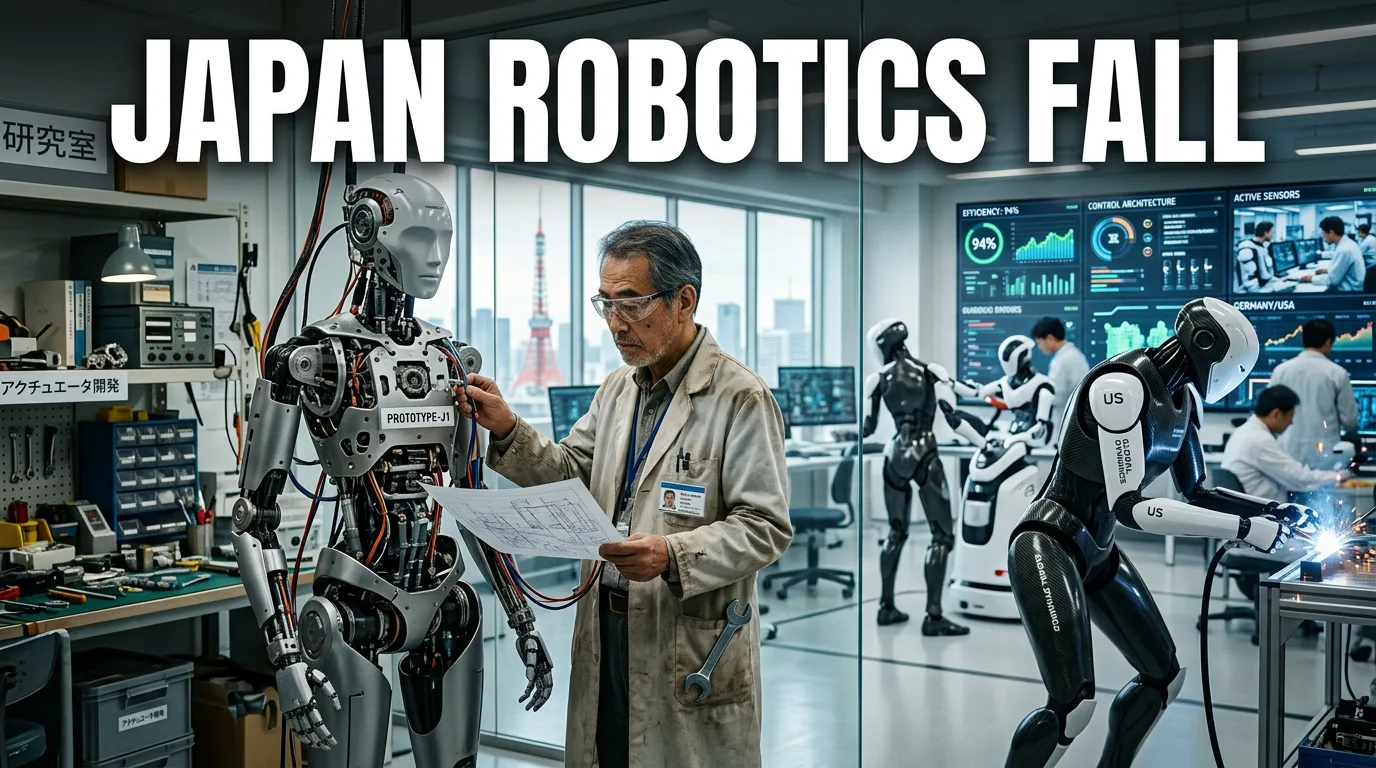
● Japan Loses Robotics Edge to Korea
In the Era of Physical AI, Why Japan, the Robotics Powerhouse, Fell Behind and the Real Opportunity for Korea’s Robotics Industry
The most important point in this piece is not simply “when humanoid robots will arrive.”
The real key takeaway is that the center of gravity in the robotics industry is likely shifting from Japan to the United States, and now toward Korea’s manufacturing sector and the physical AI ecosystem.
In particular, we need to look at why Japan, despite seeming like the birthplace of robot culture, actually fell behind in the next-generation robotics race, how Korea used Japan’s 2019 export restrictions as a turning point to pursue independence in materials, parts, and equipment, and where AI investment and manufacturing innovation will emerge next.
Another thing that should not be overlooked is that “people who are good at studying” are becoming less important than “people who can make AI and robots work for them.”
1. Why Did Japan, the Robot Culture Powerhouse, Lose Its Robotics Lead?
Japan has long been known as the country of robots.
That is because works like Astro Boy, Mazinger Z, Tetsujin 28, Evangelion, and Ghost in the Shell stimulated the imagination of engineers around the world.
In fact, robotics technology is influenced by culture more than people might think.
Some generations saw robots as friends who help humans, some saw them as rescuers deployed to disaster sites, and others saw them as dangerous beings that could threaten humanity like the Terminator.
- The Astro Boy generation imagined robots as human friends.
- The Mazinger Z generation saw robots as saviors that solve crisis situations.
- The Terminator generation viewed robots and AI as risks that must be controlled.
- The Baymax generation accepted robots as beings of care, medicine, rehabilitation, and companionship.
The problem is that while Japan was ahead in robot culture, it did not adapt quickly to the technological paradigm shift of robots in the AI era.
In the past, the core of industrial robots was to perform fixed motions accurately and repeatedly.
Japan excelled in precise position control, repetitive tasks, and industrial actuator technology.
But robots in the era of Physical AI are not just machines that place things accurately.
They must move in spaces shared with people, respond to unpredictable environments, softly control force, and connect AI judgment with physical motion.
In other words, the center of robot control has shifted from “accurate repetition” to “soft force control and situational response.”
This shift is the decisive reason Japan’s robotics industry has found it difficult to rely on its former strengths alone.
2. The Fukushima Nuclear Accident Changed the Leadership of the Robotics Industry
The symbolic turning point for Japanese robotics was the Fukushima nuclear accident.
The world looked at Japan at the time and expected, “If Japan is a robotics powerhouse, shouldn’t it be able to deploy robots in a radioactive environment and solve the problem?”
But reality was different.
The robots deployed to the site were unable to demonstrate sufficient performance in radiation, complex debris, communication failures, and extreme conditions.
At that moment, the United States moved quickly.
DARPA, the U.S. Defense Advanced Research Projects Agency, designed a robotics challenge modeled on disaster scenarios similar to Fukushima.
Through competitions for disaster-response robots that had to open doors, close valves, climb stairs, and overcome obstacles, it presented a new direction for robotics technology.
From that point on, the global branding and technological leadership of the robotics industry began shifting from Japan toward the United States.
The rise of public recognition for companies like Boston Dynamics is connected to this trend as well.
What matters is not simply that the U.S. held a competition.
It is that the U.S. seized the agenda of disaster response, military applications, logistics, humanoid robots, and Physical AI.
3. Is the Claim That Japan Still Dominates Materials and Parts Still Valid?
Many people still think, “Japan makes all the key components for robots.”
Of course, Japan still has strong competitiveness in precision parts, gear reducers, sensors, industrial equipment, and materials.
But the belief that “Japan has absolute control over the key components of robotics” is now closer to an outdated view.
For Korea, a particularly important turning point was the 2019 Japanese export restrictions.
At the time, Japan applied supply-chain pressure centered on semiconductor materials, and Korea strongly felt the need for self-reliance in materials, parts, and equipment.
In this process, not only semiconductors but also robotics parts, actuators, and precision control components began to be localized more quickly.
Angel Robotics also began in earnest to internalize actuators during this period.
Although localization at the time was something they had little choice but to pursue, it ultimately became an opportunity to change the foundation of Korea’s robotics industry.
They directly wound the coils inside the actuator and moved toward independently solving core components except for certain materials that were difficult to source from outside.
This is quite important from a global economic outlook perspective as well.
As the Physical AI and humanoid robot markets grow, companies with core components and control architectures are likely to become more valuable than simple finished-product companies.
Just as Nvidia secured platform status through GPUs and the CUDA ecosystem in the AI era, actuators and control platforms could occupy a similarly strategic position in robotics.
4. The Core of Physical AI Is Not Humanoids but Actuators and Control Architecture
Put simply, Physical AI is technology that allows AI to move beyond the digital screen and operate in the real physical world.
It goes beyond chatbots or AI agents creating documents and writing code, into stages where robotic arms pick up objects, wearable robots assist human movement, and mobile robots make decisions and move in the field.
The most important component here is the actuator.
An actuator is the equivalent of a robot’s joints and muscles.
Every movement a robot makes—walking, lifting, pushing, holding, balancing—is ultimately implemented through actuators.
But the actuators of the future must do more than simply be strong or precise.
They must safely and naturally convert AI-generated commands into physical motion.
In the real world, friction, impact, vibration, unpredictable contact, and sensor noise constantly occur.
These physical nonlinearities must be organized at the lower level so that AI can judge and move more stably.
That is why actuators and control architecture become the core infrastructure of the Physical AI era.
While finished robots attract attention, the actual profitability and entry barriers of the industrial ecosystem are likely to be created in components, control, and data collection platforms.
5. The Robotics Market Will Become as Diverse as the Smartphone App Ecosystem
If you look at the robotics market only through humanoids, your perspective becomes narrow.
The robots of the future do not only mean human-shaped robots.
A microphone that moves closer to the user on its own, a chair that adjusts the user’s posture, agricultural equipment that moves automatically based on crop conditions, and factory equipment that autonomously collects and adjusts data can all be Physical AI in a broad sense.
All technologies eventually evolve in a direction that becomes less visible.
Smartphones first drew attention for their hardware, but what ultimately exploded the industry was the app ecosystem.
Likewise, Physical AI will not be sufficiently driven just because a few major companies produce humanoid products.
The market will grow only when countless startups and small and medium-sized companies create robot services that solve different field problems.
- In manufacturing, robots are needed for assembly, inspection, transportation, and safety management.
- In agriculture, robots are needed for harvesting, pest detection, and crop management.
- In healthcare, robots are needed for rehabilitation, walking assistance, and patient transport.
- In logistics, robots are needed for picking, packaging, sorting, and last-mile delivery.
- At home, robots are needed for care, cleaning, monitoring, and daily assistance.
Ultimately, the key takeaway in the Physical AI market is diversity.
Rather than one giant robot solving everything, the structure is more likely to be one in which countless robots and AI agents solve their own field-specific problems.
6. In the 2027 AI Agent Era, Corporate Organizations Will Also Split into Three Types
The 2027 AI agent trend mentioned in the original text is also very important.
In the future, companies will move beyond merely using chatbots and enter a stage where they assign real work to AI agents.
At that point, companies can largely be divided into three types.
- Organizations where AI agents work alongside people.
- Organizations where people use chatbots or AI tools only as support.
- Organizations where people still work only with other people.
The productivity gap is likely to widen significantly here.
Companies that properly use AI agents can greatly increase speed in planning, research, customer service, data analysis, coding, marketing automation, and operational optimization.
By contrast, companies that use AI only as a search tool or a document summarization tool may see the gap with competitors grow wider and wider.
However, simply using a lot of AI agents is not enough.
If multiple AI agents move independently, it is like strong lights scattering in all directions, creating diffuse reflection.
What matters is the ability to make the agents point in the same direction.
In other words, the ability to define goals, explain context, give appropriate prompts, and verify results becomes even more important.
7. In the AI Era, Talent Shifts from “People Who Get the Right Answer” to “People Who Ask Good Questions”
The work that AI and robots are good at is likely to be automated quickly in the future.
Calculations, memorization, simple analysis, repetitive work, standardized document creation, and rule-based tasks can be handled faster and more cheaply by AI and robots.
So what work should people do?
The key is the ability to ask the question mark.
If AI and robots put the period at the end, people must ask what problem should be solved.
They need to go to the field, see what actually makes people uncomfortable, identify what data is needed, and design the AI or robotics service to solve that problem.
That is why empathy and communication become extremely important in the Physical AI era.
This does not simply mean that humanities-oriented talent will be more advantageous.
It means hybrid talent who understand technology while also understanding people and the field will become stronger.
- Observation that discovers discomfort in the field.
- Empathy that reads users’ real needs.
- Communication skills that clearly instruct AI and robots.
- Teamwork that collaborates across different roles.
- The ability to define problems by designing how data should be collected.
Conversely, talent who are only good at studying but cannot communicate with people or understand field problems may become increasingly disadvantaged.
A good university, high grades, and fast calculation skills alone do not guarantee competitiveness in the AI era.
8. Is the Physical AI Investment Frenzy a Bubble or an Opportunity?
At present, the investment boom in Physical AI and robotics clearly has bubble-like characteristics.
But a bubble is not necessarily a bad thing.
Historically, most major industries have grown by passing through bubbles.
After the 1997 IMF crisis, Korea concentrated on the IT industry, and numerous internet companies and venture firms emerged at the time.
Many of them disappeared, but the ones that survived became core pillars of Korea’s digital economy.
After the 2008 global financial crisis, investment in medical devices and biotech expanded.
The biotech bubble was also large, but in the long run it became an opportunity to lay the foundation for Korea’s biotech industry.
The strategy Korea has chosen now can be seen in three major directions.
- Maintaining a semiconductor super-gap.
- Expanding AI data center infrastructure.
- Rising as a global powerhouse in Physical AI.
When national funds and private capital flow in at the same time, bubbles are bound to form.
What matters is not avoiding the bubble itself, but distinguishing the technologies and companies that will remain even after the bubble bursts.
From an investor’s perspective, rather than short-term theme-driven stock gains, one should look at real technological capability, the level of component internalization, control architecture, data acquisition capabilities, and long-term business vision.
In particular, when evaluating robotics companies, the question is not “how many humanoids can they produce?” but “what key bottleneck in the robotics ecosystem is this company solving?”
9. The Real Key Takeaway Rarely Mentioned in Other News and on YouTube
Much content focuses on when humanoid robots will become commercialized, which company will produce how many units, and how many actuators will be included.
But what is more important is that the value of the robotics industry is shifting from finished-product assembly to platforms and supply chains.
First, the winner in Physical AI may not be only the robotics finished-product companies.
Just as Nvidia became the center of the ecosystem through GPUs and CUDA in the AI era, companies with actuators, control architectures, data platforms, and simulation environments may wield greater power in the robotics era.
Second, the reason Japan fell behind is not simply that its technology became weak.
It is because the paradigm shifted from industrial robots centered on precise repetitive control to a Physical AI paradigm centered on AI-based force control and environmental adaptation.
Third, Korea’s opportunity lies not in humanoid hype but in its manufacturing DNA.
Korea has strong capabilities in semiconductors, batteries, automobiles, shipbuilding, displays, and precision manufacturing.
Since Physical AI is ultimately technology that moves in the real world, countries with manufacturing competitiveness may find bigger opportunities.
Fourth, the robotics industry is likely to become a war not of a few large corporations but of a startup ecosystem.
The market will grow only when robot services that solve diverse field problems, like smartphone apps, are poured into the market.
Fifth, future talent competitiveness may be determined more by problem-definition ability than by technical knowledge.
In an era where AI produces answers quickly, who asks better questions creates economic value.
10. The Meaning of Physical AI from the Perspective of the Korean Economy
Physical AI is directly linked to the next productivity cycle of the Korean economy.
Amid low birth rates, aging, labor shortages in manufacturing, supply chain restructuring, and intensifying global competition, robotics and AI automation are becoming necessities rather than choices.
If Korean companies make good use of Physical AI, they can raise productivity in manufacturing sites, reduce high-risk work, lessen the labor burden on older workers, and increase the automation level of small and medium-sized manufacturers.
This is not just a technology trend; it is a macroeconomic variable that can change Korea’s industrial structure.
However, not every robotics company will succeed.
Within the AI investment boom, many companies may place expectations ahead of substance.
In the end, the companies that survive are likely to be those that secure field data, solve real problems, and differentiate themselves in components and control technology.
< Summary >
Japan was strong in robot culture and industrial robot technology, but it lost some leadership in the AI-era shift toward soft force control and environment-adaptive robotics.
The Fukushima nuclear accident and the DARPA Robotics Challenge were symbolic events that moved robotics industry leadership from Japan to the United States.
Korea strengthened self-reliance in materials, parts, and equipment in response to Japan’s 2019 export restrictions, and is creating new opportunities in core robotics technologies such as actuators and control architecture.
The core of the Physical AI era is not humanoid finished products, but actuators, control platforms, data, and the ability to solve field problems.
In the AI era, talent are not people who simply get the right answer, but people who ask good questions, understand people and the field, and can direct AI agents and robots.
The robotics and Physical AI investment frenzy has bubble characteristics, but in the long run it is likely to become an important growth pillar for Korea’s manufacturing innovation and global economic outlook.
[Related Articles…]
- How Physical AI Is Transforming the Robotics Industry and the Future of Manufacturing
- Semiconductor Super-Gap and AI Data Center Investment Strategy
*Source: [ 티타임즈TV ]
– “공부만 잘하는 친구는 앞으로 좀 힘들 겁니다” (공경철 카이스트 기계공학과 교수)