● Bluewave Shock, Stocks Bottom
Post-Blue Wave Market Bottom Outlook | Implications of the U.S. Midterm Elections for the KOSPI, Semiconductors, and AI Data Centers
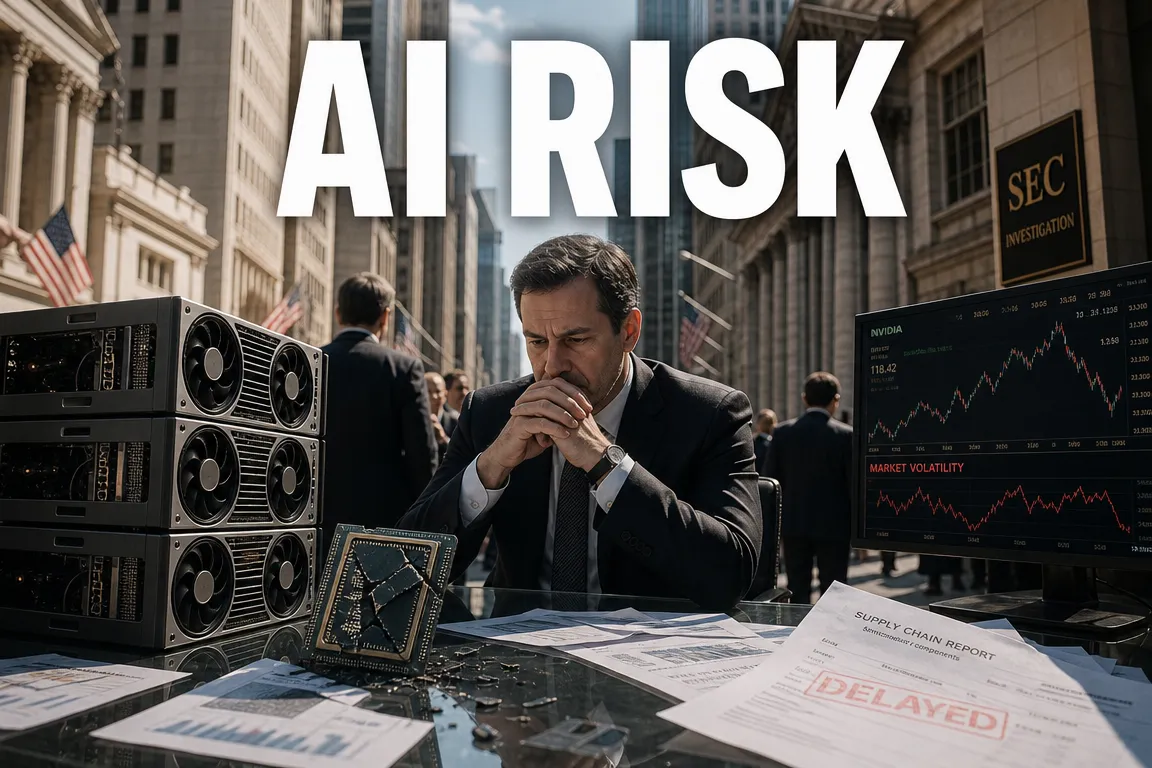
The key market issue is not the Democratic victory itself, but that policy-related concerns are being priced in before any measures are implemented.
Whether the midterm-election shock ends as a short-term correction lasting approximately one week is separate from whether slowing AI data center investment will affect earnings at Samsung Electronics and SK Hynix.
The market outlook also depends on potential stabilization in U.S. Treasury yields, a post-election relief rally, CPI and PPI releases, Japanese rate hikes, and yen carry-trade risks.
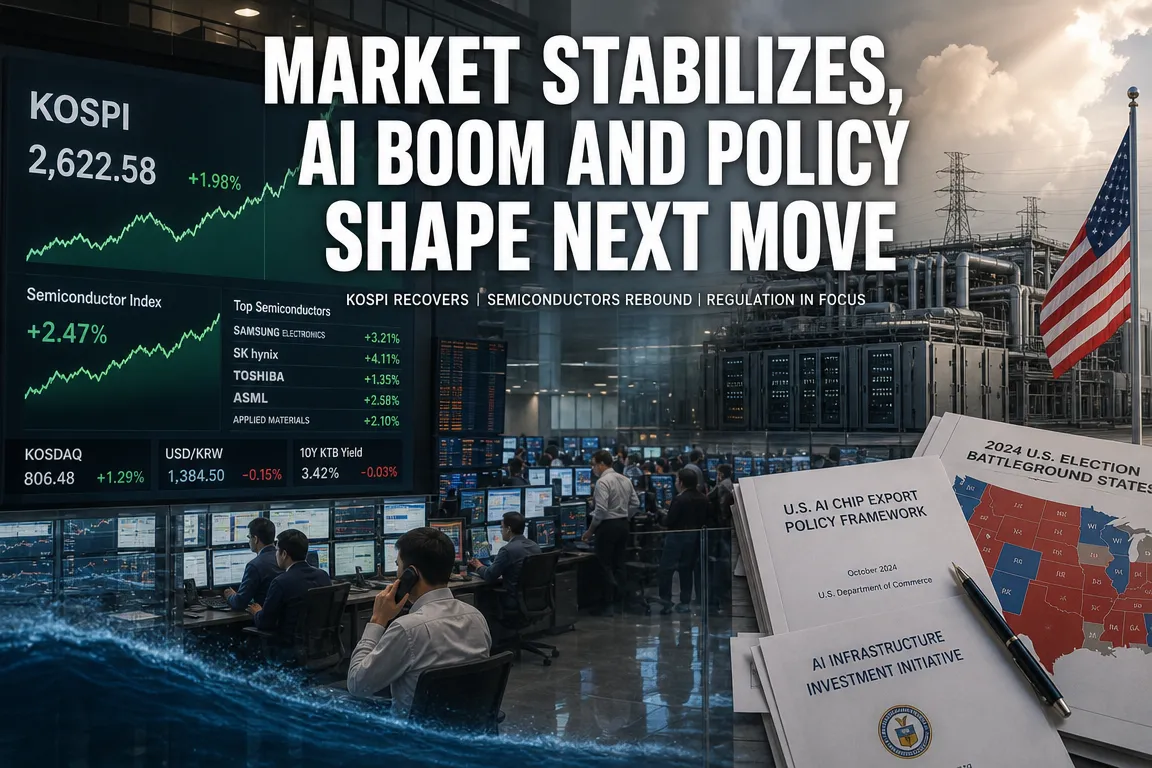
The analysis assigns greater probability to the market approaching a bottom but emphasizes distinguishing the cause and duration of the correction rather than identifying a precise bottom date.
1. Why the Blue Wave Disrupted Markets
A Blue Wave refers to a political environment in which the U.S. Democratic Party secures strong control of both the Senate and the House of Representatives.
The analysis characterizes the U.S. midterm-election result as Democratic control of Congress, described as a Blue Wave or Blue Tsunami.
Markets rapidly priced in expectations that a Democratic Congress would constrain the Trump administration’s fiscal expansion, tariff policy, war-related measures, and AI data center development.
A slowdown in AI data center construction could weaken demand for servers, memory semiconductors, power equipment, cooling systems, and transmission infrastructure.
These concerns have weighed on U.S. technology stocks, Samsung Electronics, SK Hynix, and the broader KOSPI outlook.
2. Critical Distinction | The Real Economy and Capital Markets Operate on Different Timelines
The central analytical concept is the timing gap between capital markets and the real economy.
Capital markets do not wait for policies to be implemented. They react as soon as the probability of implementation increases.
The real economy is affected only after legislation passes, regulations take effect, and companies reduce capital expenditure.
Even if the Democratic-led Congress convenes on January 3, 2027, data center regulations and power-cost allocation measures would not take effect immediately.
Any material slowdown in AI data center CAPEX and resulting impact on South Korean semiconductor exports would likely emerge only after the legislation and implementation schedule become clear.
Equity markets, however, are already discounting the possibility of slower data center investment.
3. Historical Evidence of Fear Being Priced In
The analysis uses tariff conflicts and Middle East wars to illustrate the forward-looking nature of capital markets.
-
Reciprocal Tariff Case
Equities priced in fears of a tariff conflict immediately after reciprocal tariffs were announced, before they took effect.
Although the real-economy impact appeared after implementation, equity prices underwent a sharp correction for approximately one week following the announcement.
-
Middle East War Case
Although a prolonged conflict increases the economic impact, equity markets typically decline most sharply when fear is concentrated immediately after the outbreak.
As the conflict continues, markets may begin treating the risk as already priced in rather than as a new negative catalyst.
-
Rate-Hike Risk Case
Central-bank communications and forecasts can move Treasury yields and equity prices significantly before policy rates are raised.
Unexpected changes and uncertainty generally have a greater market impact than the rate level itself.
Under this framework, the Blue Wave shock could be most pronounced immediately after the election result rather than after Congress convenes.
The analysis assesses the political shock as closer to the short-term fear generated by reciprocal tariff announcements than to a systemic financial crisis.
4. Three Factors Supporting the Market-Bottom Thesis
The first factor is the duration of the correction.
If the fear generated by the midterm result resembles the tariff-announcement shock, the correction could peak within approximately one week.
Based on this scenario, the analysis identifies November 6, 9, 10, or around November 11 as possible short-term bottom dates.
These dates are scenario-based estimates derived from previous shock durations, not definitive forecasts.
The second factor is the reduction in uncertainty after the midterm elections.
Before an election, uncertainty over the outcome weighs on markets. Once the result is known, investors can assess the likely policy direction.
The analysis cites historical post-midterm gains of 8.8% over three months, 15.9% over six months, and 20.1% over nine months in U.S. equities.
These figures may vary by index, sample period, and methodology and should be verified against the original data before being used in investment decisions.
The third factor is the scale of the decline relative to previous crises.
According to the analysis, the KOSPI declined approximately 52% from its peak during the dot-com crash and approximately 54% during the global financial crisis.
If the current correction has reached the high-40% range from its peak, investors must assess whether the Blue Wave represents a shock comparable to the dot-com collapse or the global financial crisis.
The analysis concludes that a political shift is not equivalent to a financial-system breakdown and that the remaining downside may therefore be more limited than during previous systemic crises.
Actual index levels and drawdowns may vary depending on the calculation 기준 and should be confirmed using current market data.
5. Samsung Electronics and SK Hynix | Separating Share-Price Corrections from Earnings Deterioration
A decline in semiconductor stocks does not necessarily indicate that the semiconductor supercycle has ended.
The analysis maintains a relatively constructive earnings outlook for Samsung Electronics and SK Hynix through 2027.
The structural drivers include AI server deployment, high-bandwidth memory demand, and rising data-processing requirements.
The immediate concern is not a collapse in earnings but a possible slowdown in the growth rate of AI data center CAPEX.
Equity prices reflect changes in future earnings growth and market expectations, not only the absolute level of profits.
Even if earnings continue to grow, valuations can contract when growth falls below prior expectations.
The current correction is therefore more consistent with a reset in elevated expectations and valuations than with an industry collapse.
6. Probability of AI Data Center Regulation
Potential Democratic efforts to moderate data center construction are not limited to technology regulation.
Data centers require substantial electricity, cooling water, transmission capacity, and generation infrastructure.
Regional concentration can result in power shortages, higher electricity prices, water-use conflicts, and local opposition to transmission projects.
A survey cited in the analysis indicates that more than 70% of residents in the relevant region opposed data center development.
Because the survey organization, sample, and questionnaire were not disclosed, the figure should not be generalized to the entire U.S. population.
Policymakers must nevertheless balance national AI competitiveness against local concerns regarding electricity costs and environmental conditions.
Even as the United States competes with China for AI leadership, data center development near residential areas may face substantial opposition.
7. Cost Allocation May Be More Likely Than a Comprehensive Data Center Ban
A more plausible policy outcome than a broad prohibition is a requirement for large technology companies to bear a greater share of infrastructure costs.
Data center operators could be required to fund transmission upgrades and new generation capacity rather than shifting those costs to residential customers.
Construction could continue under this framework, but project returns and investment growth could decline.
Slower CAPEX growth among major technology companies would reduce order expectations for semiconductors, servers, power equipment, cooling systems, and optical communications equipment.
The critical variables are therefore power-cost allocation, permitting timelines, and regional regulatory intensity rather than the number of data center projects alone.
8. Renewable Energy Requires Separate Analysis Within the Power Sector
Stronger data center regulation would not affect all power-sector companies equally.
Democrats may criticize high data center electricity consumption while remaining supportive of renewable energy and grid modernization.
Investors should distinguish among solar, wind, energy storage, smart-grid systems, and renewable-energy transmission infrastructure.
AI-related electricity demand may not disappear but instead shift toward clean-energy procurement and improved energy efficiency.
Data center regulation could therefore accelerate investment in renewable energy.
9. Could Lower Treasury Yields and a Trump Lame-Duck Period Support Equities?
If a Democratic Congress limits the Trump administration’s fiscal expansion, the pace of U.S. Treasury issuance could moderate.
Lower supply pressure could stabilize long-term Treasury yields and reduce discount-rate pressure on growth stocks.
Congressional constraints on tariffs, war-related policies, and fiscal expansion could also reduce policy uncertainty.
This structure could pressure AI-related equities in the short term while lowering the broader market risk premium over the medium to long term.
The Blue Wave should therefore not be interpreted as uniformly negative for equities.
10. Key Near-Term Variables | CPI and PPI
Even if the midterm-election shock subsides, higher-than-expected inflation could trigger another correction.
The analysis identifies the CPI release scheduled for November 10 and the PPI release scheduled for November 13 as key events.
An above-consensus CPI reading could revive expectations of additional rate hikes and push Treasury yields higher.
If another correction occurs around November 11, its cause should be attributed to inflation and monetary-policy concerns rather than the Blue Wave.
Corrections with different causes can have different durations and require different investment responses.
11. Japanese Rate Hikes and Yen Carry-Trade Risk
Additional Bank of Japan rate hikes could renew concerns about the unwinding of yen-funded carry trades.
However, the analysis notes that the current environment may differ from previous periods when U.S. rates were falling while Japanese rates were rising.
If both the United States and Japan maintain a tightening bias, the U.S.-Japan interest-rate differential may narrow more gradually.
Yen carry-trade unwinding remains a risk but should not necessarily be treated as the primary cause of the current market correction.
12. FOMO and JOMO Risks for Investors
FOMO refers to buying into a rising market because of concern about missing further gains.
JOMO can describe the relief of having avoided market exposure, which may also encourage investors to sell existing holdings during periods of fear.
Retail investors frequently buy near market peaks under FOMO and sell near market lows under JOMO.
Deleting a brokerage application or liquidating all assets solely because prices have fallen sharply reflects an emotional response rather than a disciplined investment process.
Conversely, committing all available capital based on expectations of a short-term bottom also carries substantial risk.
Market bottoms generally develop through repeated periods of volatility, making phased investment and liquidity management more practical approaches.
13. Key Issues Often Overlooked in Other Coverage
First, data center regulation would change the AI industry’s cost structure rather than end the industry.
Projects may continue, but requiring major technology companies to fund more power-grid and generation infrastructure could reduce investment returns and CAPEX growth.
Second, semiconductor earnings and semiconductor share prices do not move at the same pace.
Samsung Electronics and SK Hynix shares can decline even while earnings improve if market expectations were higher.
Third, a Blue Wave may be negative for selected industries while reducing uncertainty for the broader market.
It may weigh on AI infrastructure but support lower yields by constraining fiscal spending and Treasury issuance.
Fourth, the critical assessment period begins after January 2027 rather than immediately after the election.
The real-economy impact can be evaluated only after Congress specifies regulatory scope, regional application, and cost-allocation requirements.
Fifth, AI data center regulation may create beneficiaries.
Energy-efficient semiconductors, immersion cooling, optical communications, renewable energy, energy storage, and smart-grid industries could gain new demand from regulatory compliance investment.
14. Final Market Assessment
The central conclusion is that the midterm-election shock should not be treated as equivalent to a deterioration in the real economy.
If Blue Wave concerns were concentrated over a short period, equities may be approaching a bottoming range.
However, higher CPI or PPI readings, additional rate hikes, an escalation in the Middle East, or restrictive data center legislation could produce new lows.
Investors should therefore assess whether existing risks have been priced in and whether new risks are emerging rather than relying on a specific bottom date.
The long-term AI and semiconductor supercycle may remain intact, but near-term volatility associated with valuations and policy risks is likely to remain elevated.
This material does not constitute investment advice. Decisions should be based on current economic indicators, corporate earnings, official policy documents, and individual risk tolerance.
< Summary >
-
The Blue Wave shock has brought forward market concerns over data center regulation and slower semiconductor demand.
-
The real-economy impact cannot be assessed until legislation and corporate CAPEX changes become visible after Congress convenes in 2027.
-
Based on historical shock durations and the scale of the decline, the analysis identifies a possible short-term bottom in early to mid-November.
-
The earnings outlook for Samsung Electronics and SK Hynix should be distinguished from short-term share-price corrections.
-
CPI, PPI, U.S. Treasury yields, and the probability of further rate hikes are key determinants of the next market direction.
-
Data center regulation could create opportunities in renewable energy, energy efficiency, cooling systems, optical communications, and grid infrastructure.
[Related Articles…]
*Source: [ 경제 읽어주는 남자(김광석TV) ]
– [생방송] 블루 웨이브, 증시 바닥인가? 지하실 가는가? [즉시분석]