● Tesla Cybertruck to Cybercab, 40kWh Battery Shock
What If Tesla Converts the Cybertruck Line to Cybercab Production? Why a 40 kWh Battery Matters for Tesla Stock
The central issue is not whether the Cybertruck is selling well.
The key question is whether Tesla intends to prioritize limited battery supply and manufacturing resources for long-term robotaxi revenue rather than vehicle sales.
Evaluating the proposed 40 kWh battery, a potential Cybertruck production-line conversion, and robotaxi service-area expansion together provides a clearer view of Tesla’s strategic direction.
However, Cybertruck order volumes, production termination dates, Cybercab battery specifications, and fully autonomous operating status include information that has not been officially confirmed.
This report therefore distinguishes verified facts from estimates while assessing the claims and figures presented in the source.
Key Developments
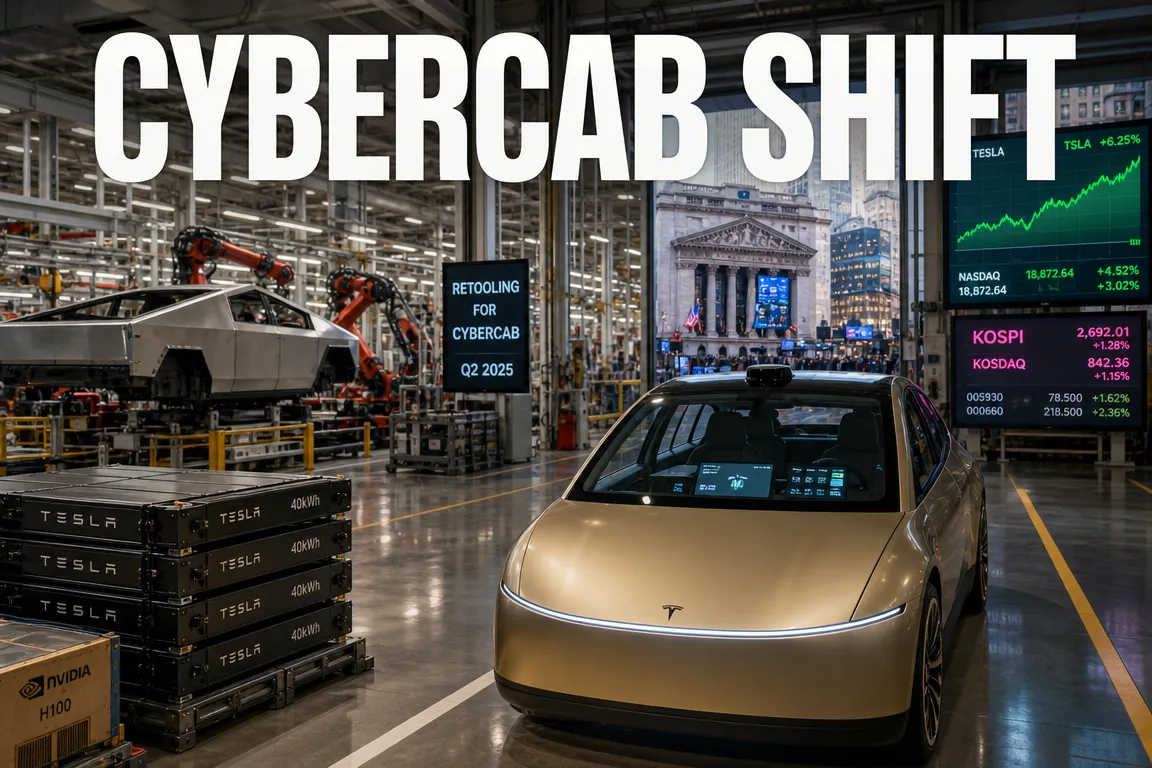
- Cybertruck production line: The source reported that Elon Musk discussed the possibility of using the Cybertruck production line for future Cybercab production.
- Cybertruck orders: Orders were reportedly arriving faster than production, but the actual backlog has not been disclosed.
- Cybercab battery: Reducing the proposed battery capacity from approximately 47.6 kWh to 40 kWh would lower battery requirements per vehicle by about 16%.
- Production impact: With the same battery supply, Tesla could theoretically produce approximately 19% more Cybercabs.
- Tesla’s strategic choice: The shift may indicate a preference for recurring robotaxi revenue from company-owned vehicles over one-time vehicle sales.
- Primary risk: Regulation, safety, utilization, and authorization for fully autonomous operation may become more significant constraints than manufacturing capacity.
Tesla at $378.05: What Supported the Share-Price Increase?
According to the source, Tesla shares closed 5.54% higher at $378.05.
During the same session, the Dow Jones Industrial Average rose 2.15%, the S&P 500 gained 2.34%, and the Nasdaq advanced 2.74%.
Lower oil prices and stabilization in the U.S. 10-year Treasury yield were cited as factors supporting growth-stock sentiment.
For companies such as Tesla, whose valuation depends heavily on expected future earnings from autonomous driving, artificial intelligence, and robotaxi services, lower interest rates increase the present value of projected cash flows.
Conversely, another increase in long-term yields could place pressure on Tesla’s elevated valuation.
Tesla’s share-price increase should therefore be viewed as the combined effect of interest rates, broader technology-sector sentiment, and robotaxi expectations rather than a reaction to a single Cybertruck or Cybercab development.
Market-index levels, oil prices, Treasury yields, and implied interest-rate probabilities can change quickly. Investors should verify the relevant trading date and primary data before making decisions.
Is the Cybertruck Actually Being Discontinued?
The source reported that Elon Musk suggested the Cybertruck production line could be dismantled or converted around June or July of the following year.
This should not be interpreted as an official Cybertruck discontinuation announcement.
A definitive conclusion would require confirmation through Tesla’s formal production plans, regulatory filings, shareholder letters, or earnings disclosures.
The debate can be divided into two scenarios.
Scenario 1. Tesla Ends Cybertruck Production Because of Weak Demand
If weak sales are the reason for ending production, concerns could increase regarding Tesla’s brand strength and demand for new models.
Estimates cited in the source placed U.S. Cybertruck sales at 3,519 units in the first quarter, approximately 3,700 in the second quarter, and 4,323 in the third quarter.
Although quarterly sales increased modestly, estimated deliveries from January through September were approximately 28% lower than in the same period a year earlier.
If accurate, these figures would make it difficult to explain a production shutdown solely as the result of orders exceeding capacity.
Demand constraints involving price, insurance costs, charging access, vehicle size, and design preferences would also require consideration.
Scenario 2. Resource Allocation Matters More Than Current Demand
If orders exceed production capacity but Tesla still converts the line, the strategic implications would be materially different.
Tesla may have concluded that allocating the same factory space, batteries, and engineering resources to Cybercab offers greater long-term returns than producing additional Cybertrucks.
This would be unusual from a traditional automotive manufacturing perspective but consistent with a platform-business model.
A Cybertruck generates revenue primarily when it is sold.
A company-owned Cybercab could generate recurring service revenue each time it operates.
The decision may therefore prioritize return on capital and long-term cash flow over near-term vehicle sales.
The Most Important Undisclosed Figure: Order Backlog
The most important undisclosed figure is the number of valid Cybertruck orders.
A claim that orders are arriving faster than production does not independently demonstrate strong demand.
If production is low, a limited number of orders could still exceed the manufacturing rate.
Orders may also have increased temporarily after reports of a possible production termination created expectations of scarcity.
The following data would be necessary to assess underlying demand:
- Current valid Cybertruck orders
- Deposit refunds and cancellation rates
- Monthly production and delivery volumes
- Timing and production impact of additional shifts
- Units deliverable before the production-line conversion
- Regional inventory and average delivery wait times
Without these data, it remains difficult to determine whether Cybertruck demand exceeds supply or whether weak demand is driving the potential production shutdown.
Why a 40 kWh Cybercab Battery Matters
The most significant figure in the source is the proposed 40 kWh Cybercab battery.
The source cited U.S. Environmental Protection Agency-related documentation indicating an estimated existing battery capacity of approximately 47.6 kWh.
Reducing capacity from 47.6 kWh to 40 kWh would lower battery use per vehicle by approximately 16%.
The calculation is as follows:
(47.6 kWh – 40 kWh) / 47.6 kWh × 100 = approximately 16%
With the same total battery supply, theoretical vehicle output would increase by approximately 19%.
47.6 kWh / 40 kWh = 1.19
For example, 47,600 kWh of battery cells would support 1,000 vehicles equipped with 47.6 kWh packs.
The same battery supply could support approximately 1,190 vehicles equipped with 40 kWh packs.
If battery availability is the primary manufacturing constraint, the 7.6 kWh reduction would affect not only cost but also total vehicle output.
Would 40 kWh Provide Sufficient Range?
The source assumed Cybercab energy efficiency of approximately 6.1 miles per kWh.
Under that assumption, a 40 kWh battery would provide a theoretical range of approximately 244 miles.
This is equivalent to approximately 393 kilometers.
40 kWh × 6.1 miles = 244 miles, or approximately 393 kilometers
This range could be sufficient for a robotaxi operating repeated short-distance urban trips.
However, commercial operations must account for climate control, highway driving, passenger wait times, battery thermal management, empty repositioning, and travel to charging facilities.
Operators would also be unlikely to use the battery’s full 0% to 100% capacity during normal service.
Paid operating hours, empty-mile ratios, charging time, and passenger occupancy would therefore be more relevant than official range alone.
How a Smaller Battery Could Improve Robotaxi Economics
A smaller Cybercab battery could reduce both vehicle price and manufacturing cost.
Lower vehicle weight could also improve energy efficiency and tire life.
Producing more vehicles from the same battery supply could accelerate robotaxi network expansion.
The potential economic structure is as follows:
- Lower battery use per vehicle
- Higher vehicle output from the same battery supply
- Lower vehicle cost and depreciation expense
- Greater vehicle density within each service area
- Shorter passenger wait times
- Higher ride-fulfillment and paid-utilization rates
- Increased recurring platform revenue
Robotaxi success depends on more than individual vehicle performance.
The number of vehicles operating simultaneously within a defined area can determine service quality and profitability.
The 40 kWh specification should therefore be viewed as a network-economics variable rather than only a battery specification.
Why Cybercab Could Generate More Value Than Cybertruck
The source assumed that Tesla earns approximately $9,000 in profit from the sale of one Model Y.
It also cited an external estimate that a Cybercab could generate approximately $420,000 in cumulative revenue over ten years of robotaxi operation.
However, this figure is not official guidance and depends on multiple assumptions.
Fares, mileage, utilization, insurance, maintenance, charging costs, accident rates, platform fees, and vehicle replacement cycles would all materially affect the result.
A vehicle may be technically available for 20 hours per day, while the time spent carrying paying passengers could be substantially lower.
Expanding a service area does not automatically translate into higher revenue.
The more relevant metrics are annual operating cash flow per vehicle and the payback period on invested capital.
Commercial Deployment May Be More Difficult Than Production
The source stated that Tesla management indicated Cybercab production could grow faster than deployment into active service.
If accurate, the primary constraint may be public-road authorization rather than factory capacity.
Vehicles cannot enter paid robotaxi service until regulatory and safety requirements are satisfied.
A Cybercab designed without a steering wheel or pedals may require regulatory treatment different from that applied to conventional vehicles.
In the United States, manufacturers generally self-certify compliance with the Federal Motor Vehicle Safety Standards. The National Highway Traffic Safety Administration does not provide conventional premarket approval for every vehicle.
However, a design that does not meet existing standards may require an exemption, regulatory amendment, or additional review.
The process should not be simplified as merely waiting for NHTSA approval.
Federal safety standards, state-level autonomous-operation permits, insurance requirements, and accident-liability rules must each be evaluated.
Implications of Robotaxi Service-Area Expansion in San Antonio and Austin
The source reported that Tesla presented an operating area of approximately 274 square miles in San Antonio.
Austin’s service area reportedly expanded from approximately 272 square miles to 443 square miles.
Operating hours were also reported to have increased to 21 hours per day, from 5:00 a.m. to 2:00 a.m. the following day.
The mapped areas indicate rapid geographic expansion.
However, the full area displayed in an application may not be continuously available for ride requests and passenger pickups.
Availability may vary by road type, weather, construction, airport access, highway use, and time of day.
The source cited an external estimate that only approximately 60% of the displayed map may be practically accessible.
Investors should focus on the number of active paid vehicles and completed rides rather than mapped area alone.
A Larger Service Area Than Waymo Does Not Necessarily Indicate Technological Leadership
The source compared Tesla’s displayed San Antonio area with Waymo’s approximately 59-square-mile area, making Tesla’s map more than four times larger.
Service-area size alone is not an adequate measure of autonomous-driving capability.
Comparisons should include fully driverless operation, remote-assistance frequency, ride-fulfillment rates, accident and intervention rates, fleet size, and paid-ride volume.
Limited operation across a broad area differs from high-density commercial service within a smaller area.
Tesla’s advantages include large-scale driving data collected from consumer vehicles and its manufacturing capacity.
Waymo’s advantage is its experience operating fully autonomous commercial services in defined markets.
The competitive outcome is likely to depend more on safety and unit economics than on map size.
Conditions Required for a Successful Cybertruck-Line Conversion
A strategy to convert Cybertruck production capacity to Cybercab would require the following conditions:
- A 40 kWh battery must provide sufficient real-world operating range.
- Cybercab mass-production costs must decline to the targeted level.
- Paid driverless operation must be authorized in major cities.
- Accident and remote-intervention rates must remain commercially manageable.
- Passenger demand must grow at least as quickly as vehicle supply.
- Charging, cleaning, maintenance, and incident-response infrastructure must be established.
- Per-vehicle returns must exceed the economics of producing and selling Cybertrucks.
If any of these conditions are not met, Tesla could lose Cybertruck production capacity without achieving sufficient Cybercab utilization.
This could negatively affect factory utilization, cash flow, and depreciation costs.
Key Issues Often Overlooked in Other Coverage
First, battery constraints and factory constraints are fundamentally different.
Available factory space does not enable production if battery supply is insufficient.
The potential line conversion may therefore reflect a decision about which vehicle should receive priority access to battery supply.
Second, 40 kWh is more significant as a network-density variable than as a cost-reduction measure.
If the same battery supply can support approximately 19% more vehicles, Tesla could reduce passenger wait times and improve ride-fulfillment rates.
This could affect platform competitiveness more than the margin on an individual vehicle.
Third, Tesla’s primary risk is idle production capacity.
If Cybercab production expands before regulatory and safety approvals permit deployment, finished-vehicle inventory and fixed-asset costs could rise simultaneously.
Fourth, a larger service map is a leading indicator, not a financial result.
Paid rides, fleet utilization, revenue per mile, and accident rates are more relevant than geographic coverage.
Fifth, claims of strong Cybertruck orders may reflect a denominator effect.
If production is low, limited order volume can still exceed the manufacturing rate.
Demand recovery cannot be confirmed until Tesla discloses backlog and cancellation data.
Implications of Nvidia Developments for Tesla
The source reported that Nvidia shares declined more than 4% amid speculation about a potential investigation involving management.
Any specific allegations require verification through official disclosures and corroboration by reliable media sources.
Tesla uses Nvidia GPUs for artificial-intelligence model training, so prolonged supply-chain or management uncertainty could have an impact.
However, Tesla vehicles use internally designed autonomous-driving computers, and the company continues to develop next-generation AI chips.
Tesla’s expansion of proprietary AI semiconductor capabilities is intended to reduce costs and lower dependence on external suppliers.
Short-term management issues at Nvidia would not necessarily result in an immediate interruption to Tesla’s supply of AI training chips.
The Relevance of Starship Testing to Tesla Shareholders Is Limited
The source discussed a potential Starship test involving the recovery of both the upper-stage spacecraft and booster at the launch tower.
Successful full reusability could reduce launch costs and improve the economics of SpaceX and Starlink.
However, claims regarding Tesla’s SpaceX holdings and a potential combination of the two companies require separate verification through official disclosures.
SpaceX is privately held and does not have an official public-market closing price.
Any SpaceX valuation cited in the source likely reflects a private secondary-market estimate or internal valuation and should not be interpreted as a public-market closing price.
A Tesla-SpaceX combination should not form the basis of an investment thesis unless formally confirmed.
Upcoming Indicators for Tesla Investors
- An official Tesla announcement regarding conversion of the Cybertruck production line
- Cybertruck order backlog and deposit refunds
- Additional production shifts and monthly output
- Official 40 kWh Cybercab battery specifications and range
- Cybercab production volume and the number of vehicles in active service
- Paid-ride volumes in Austin and San Antonio
- The actual scope of fully autonomous operation without onboard safety personnel
- Progress in federal and state regulatory procedures
- Daily revenue and paid-utilization rates per vehicle
- Battery production capacity and changes in cell-supply agreements
- Robotaxi insurance costs and accident-liability structures
The most important monitoring period is June through July of the following year, as referenced in the source.
Investors should determine whether the Cybertruck line is converted and whether Cybercab production and active deployment increase simultaneously.
Higher production without a corresponding increase in active service vehicles would not constitute a positive operating signal.
Petition Concerning Capital-Gains Tax on Overseas Shares
The source also discussed a National Assembly petition requesting that capital-gains tax arising from exchanges of overseas shares be deferred until the exchanged shares are sold.
The issue concerns mergers or share exchanges in which a tax liability may arise even though the investor receives no cash proceeds.
Petition participation and deadlines can change and should be verified through the official National Assembly website.
Final Investment Assessment
This development cannot be reduced to either Cybertruck failure or Cybercab success.
Tesla may be pursuing more than a manufacturing-line adjustment. The company may be attempting to transition from a vehicle seller to an AI-based transportation platform.
The 40 kWh battery is a central variable affecting the cost and production scale required to execute that strategy.
If successful, Tesla could shift from one-time vehicle sales toward recurring transportation-service revenue.
If unsuccessful, Tesla could lose Cybertruck production opportunities while failing to achieve sufficient utilization of Cybercab capacity.
Tesla’s next valuation phase will therefore depend less on how many Cybercabs it can manufacture and more on how safely, frequently, and profitably those vehicles can operate.
< Summary >
- The Cybertruck-line conversion may represent a strategic reallocation of batteries and labor rather than a direct response to weak sales.
- Reducing battery capacity from 47.6 kWh to 40 kWh would lower battery use per vehicle by approximately 16%.
- The same battery supply could theoretically support approximately 19% more Cybercabs.
- A 40 kWh battery could provide an estimated 393 kilometers of range under simplified assumptions, although practical commercial range would be lower.
- The primary Cybercab constraints are regulation, safety, paid utilization, and service demand rather than production alone.
- Robotaxi performance should not be assessed solely by service-map expansion.
- Cybertruck demand remains difficult to verify without order-backlog and cancellation data.
- Investors should prioritize paid-ride volume and per-vehicle cash flow over production figures.
[Related Articles…]
*Source: [ 오늘의 테슬라 뉴스 ]
– 사이버트럭 주문 밀렸는데 라인은 사이버캡에 — 일론 머스크가 꺼낸 배터리 숫자 40kWh, $378 테슬라 주주는?
● Jensen-Huang Scandal Spurs KOSPI Rebound, Nvidia-GPU Shakeup, Oil Drop, AI Rally
Did the Jensen Huang Controversy Drive the KOSPI Rally? The Real Link Between Nvidia, Oil Prices, and the AI Semiconductor Rebound
Attributing the latest KOSPI surge solely to an overnight rise in the Nasdaq overlooks several important market drivers.
The primary factors were lower oil prices following an easing of Middle East risks, bargain buying after steep declines, expectations surrounding a potential Anthropic initial public offering, and Nvidia GPU export restrictions.
However, the claim that a “Jensen Huang scandal” caused the KOSPI to rise is an overly simplified interpretation.
The underlying argument is that GPUs Nvidia cannot sell overseas could be redirected to the US market, increasing supply, lowering prices, and benefiting data center operators. Actual market dynamics are likely to be more complex.
This report separates the drivers of the KOSPI rally from those behind the US equity rebound and examines the links among GPU pricing, data center profitability, and foreign investor flows.
1. Direct Drivers of the KOSPI Rally
The KOSPI rebounded sharply as major Korean technology stocks, including Samsung Electronics and SK Hynix, advanced together.
The most immediate catalyst was the prior-session recovery in the Nasdaq and AI semiconductor stocks.
Korean semiconductor equities often respond strongly to movements in US technology stocks and the Philadelphia Semiconductor Index.
SK Hynix is directly exposed to global AI infrastructure investment through high-bandwidth memory, or HBM.
For Samsung Electronics, a recovery in the memory semiconductor cycle and the potential expansion of HBM supply remain important valuation factors.
Even a modest easing of concerns about US AI infrastructure investment can therefore trigger a relatively strong rebound in Korean semiconductor leaders.
Because Samsung Electronics and SK Hynix account for a substantial share of domestic market capitalization, simultaneous gains in both companies can quickly lift the KOSPI.
2. First Driver of the Nasdaq Rebound: Easing Middle East Tensions and Lower Oil Prices
Expectations that the United States was less likely to attack Iran, together with prospects for US-Iran negotiations, supported market sentiment.
Such developments can reduce geopolitical risk and ease concerns about disruptions to crude oil supplies.
Lower supply-risk premiums generally place downward pressure on international oil prices.
Falling oil prices can reduce transportation, electricity, and raw-material costs, making them broadly supportive of corporate earnings.
Lower energy prices can also ease US consumer inflationary pressure.
This may reduce the Federal Reserve’s policy burden and revive expectations for interest-rate cuts.
Technology and growth stocks, which are particularly sensitive to interest rates, can benefit disproportionately from this environment.
However, lower oil prices are not automatically positive for equities.
A decline caused by easing geopolitical risk is generally constructive, while a decline driven by recession concerns or weaker demand may intensify earnings risks.
The reason for the decline in oil prices is therefore more important than the direction alone.
3. Second Driver: Bargain Buying After Steep Declines
Following a substantial correction in the Nasdaq and semiconductor stocks, investors may view lower prices as a valuation opportunity rather than evidence of fundamental deterioration.
This is the basis of the “discount period” interpretation.
When prices fall rapidly without a corresponding escalation in negative developments, sidelined capital and short-term buying can enter the market simultaneously.
Short covering may further amplify the rebound.
However, a rebound driven by bargain buying should be distinguished from the resumption of a long-term uptrend.
If share prices rise without an improvement in earnings expectations, the move may remain a technical rebound.
Assessing the KOSPI outlook therefore requires monitoring the persistence of foreign net buying and changes in semiconductor earnings forecasts rather than focusing on a single session’s gain.
4. Third Driver: Did Anthropic IPO Expectations Improve AI Sentiment?
Reports that generative AI company Anthropic was proceeding with an initial public offering may have helped ease market concerns.
Anthropic, the developer of Claude, has received investment from major technology companies including Amazon and Google.
A listing by a major AI company would allow public markets to test AI-sector valuations.
A successful offering could improve exit prospects for venture capital investors and privately held AI companies.
It could also support sentiment toward cloud computing, data centers, networking equipment, power infrastructure, and AI semiconductor companies.
Conversely, a delay or a lower-than-expected valuation could renew concerns about elevated AI-sector valuations.
However, no specific listing schedule or official source for Anthropic’s potential IPO has been provided.
Investors should verify any development through company statements, regulatory filings, and major financial news organizations.
5. Fourth Driver: Why the “Jensen Huang Controversy” Could Be Interpreted as Positive
The central argument is that restrictions on Nvidia’s overseas GPU sales could increase supply in the US market.
If inventory is redirected to the United States, GPU purchase prices and rental costs could decline, reducing expenses for data center operators and AI startups.
Limited availability of high-performance GPUs and elevated cloud-computing costs have been major barriers to entry in the AI infrastructure market.
Lower GPU prices could allow less-capitalized companies to develop and commercialize AI models.
Improved profitability among AI service providers could subsequently support investment in cloud infrastructure, servers, memory, and networking equipment.
Under this scenario, an event that is negative for Nvidia could reduce costs for other participants in the AI ecosystem.
6. Why GPUs May Not Automatically Be Redirected to the US Market
Restrictions on Nvidia’s overseas sales would not necessarily result in all affected GPUs being sold cheaply in the United States.
First, products designed for restricted export markets may differ in performance and specifications from the highest-end products demanded by US customers.
Second, semiconductor production is based on long-term supply agreements and foundry capacity planning.
If sales are restricted, Nvidia may reduce production or reallocate capacity to other products.
Third, AI data center constraints extend beyond GPU availability.
HBM, advanced packaging, networking equipment, power supply, cooling systems, and suitable data center sites must also be secured.
Even if GPU inventories rise, shortages of power or HBM could prevent a meaningful decline in total AI infrastructure costs.
Fourth, Nvidia may actively manage supply to protect pricing and margins.
The view that tighter export restrictions would immediately trigger a collapse in GPU prices therefore remains an unconfirmed scenario.
7. A Frequently Overlooked Issue: Nvidia and the Broader AI Ecosystem Have Different Economic Interests
Negative news for Nvidia’s share price is not necessarily negative for the entire AI industry.
Nvidia benefits from higher GPU prices and sales volumes.
AI model developers and data center operators, by contrast, benefit from lower GPU prices and cloud-computing costs.
For companies operating large-scale data centers, including Microsoft, Amazon, Google, and Meta, lower GPU procurement costs could improve cash flow.
For AI model developers and startups such as Anthropic, lower computing costs could accelerate service expansion and shorten the path to profitability.
A decline in Nvidia’s pricing power could therefore pressure Nvidia while benefiting the wider AI ecosystem.
If other AI semiconductor and infrastructure companies outperformed Nvidia during the US market rebound, the divergence may indicate that investors were pricing in this shift in economic benefits.
8. Why Samsung Electronics and SK Hynix Matter to the Korean Market
An expansion in AI GPU supply could have both positive and negative implications for Korean memory manufacturers.
Higher GPU shipments could increase demand for HBM and high-performance DRAM.
This would support earnings at SK Hynix and Samsung Electronics.
However, if rising GPU inventories reflect weaker AI investment, memory orders could also decline.
Investors must therefore distinguish between GPU price declines caused by increased supply and those caused by weaker demand.
Assessing Korean AI semiconductor equities requires monitoring HBM shipments, average selling prices, advanced packaging capacity, and hyperscaler capital expenditure plans rather than Nvidia’s share price alone.
9. Five Indicators for Determining Whether the Rally Represents a Trend Reversal
-
Foreign investor flows: Monitor whether foreign investors remain net buyers of Samsung Electronics and SK Hynix for several consecutive sessions.
-
KRW-USD exchange rate: Currency stabilization could improve conditions for foreign investment in Korean equities.
-
US Treasury yields: Determine whether lower oil prices reduce inflation expectations and translate into lower market interest rates.
-
Semiconductor earnings forecasts: A credible recovery requires improvements in memory prices and earnings estimates alongside share-price gains.
-
Big Tech capital expenditure: Monitor whether Microsoft, Amazon, Alphabet, and Meta maintain their AI data center investment plans.
10. Why a Sharp One-Day Rally Does Not Eliminate Downside Risk
The latest gain remains limited relative to the scale of the preceding decline.
After a 20% decline, an asset must rise by 25%, not 20%, to return to its original price.
One or two strong sessions following a selloff do not fully recover prior losses.
A sharp rally before key risks have been resolved may reflect short covering and technical buying rather than a durable recovery.
For the rebound to develop into a meaningful trend reversal, oil-price stability, lower US Treasury yields, sustained foreign buying, and improved semiconductor earnings must be confirmed.
Areas Requiring Fact-Checking
No specific trading date, index return, change in oil prices, or official announcement source has been provided.
The term “Jensen Huang controversy” does not clearly identify the relevant event or regulatory measure.
Anthropic’s potential listing also requires confirmation through an official timetable and regulatory documentation.
The analysis should therefore be treated as a set of possible explanations for the market rally rather than as a confirmed breaking-news report.
Key Conclusion for Investors
The primary driver of the KOSPI rally was not a controversy involving Jensen Huang personally.
Easing Middle East risks and lower oil prices reduced inflation and interest-rate concerns, while bargain buying supported technology stocks after substantial declines.
The market also considered the possibility that greater GPU availability could reduce costs for AI data center operators.
The key issue is not the Nvidia-related headline itself, but whether returns on AI investment can improve.
Lower GPU and power costs, combined with rising AI service revenue, could reinforce the AI investment cycle.
Conversely, if increased GPU availability reflects weakening demand, the rebound may not be sustainable.
< Summary >
The KOSPI surge can be interpreted as a transmission of the Nasdaq and semiconductor rebound into Korea’s large-cap technology sector.
Easing Middle East tensions and lower oil prices were supportive by reducing inflation and interest-rate pressures.
Bargain buying after recent declines and expectations surrounding a potential Anthropic IPO may also have improved AI-sector sentiment.
The argument that Nvidia’s overseas GPU sales restrictions could increase US supply and lower prices is plausible but remains unconfirmed.
The sustainability of the rebound should be assessed through foreign investor flows, exchange rates, Treasury yields, HBM demand, and hyperscaler data center investment.
[Related Articles…]
*Source: [ 내일은 투자왕 – 김단테 ]
– 젠슨황 스캔들에 코스피 떡상? #젠슨황 #코스피 #엔비디아