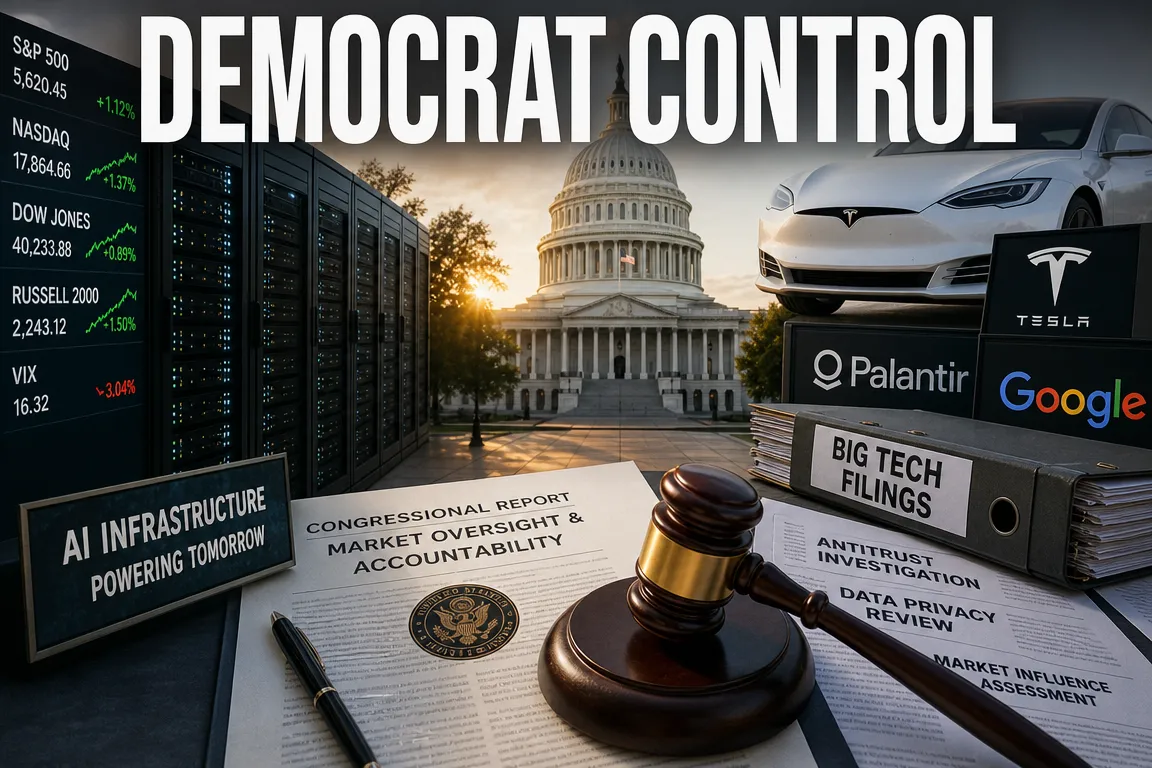
● Democrats Blitz Trump Stocks, Tesla, Big Tech, Palantir, Healthcare Wins
Democrats Signal Broad Scrutiny of Trump-Linked Stocks | Risks for Tesla, Big Tech, and Palantir, and Potential Healthcare Beneficiaries
The central issue for investors is not a Democratic victory itself, but how congressional investigative authority, budget negotiations, and Senate confirmation powers could affect corporate valuations.
Political risks surrounding Tesla and SpaceX, reviews of Big Tech government dealings, and potential scrutiny of contracts involving Palantir and other defense and data companies could increase near-term volatility.
Conversely, efforts to restore Affordable Care Act subsidies and Medicaid funding, reduce tariffs, and limit war-related spending could create policy momentum for healthcare, consumer, payment, and dividend stocks.
However, the source material includes multiple claims requiring independent verification, including election results, the initiation of investigations, and allegations involving specific companies and individuals.
The following analysis therefore does not present those claims as established facts. It assesses how the political scenarios outlined in the source material could affect U.S. equities and the AI industry.
1. Key Facts and Analytical Standards
The source material assumes that Democrats won control of both the Senate and the House in the 2026 U.S. midterm elections.
If confirmed by official election results, Democrats would control committee chairmanships and hearing agendas when the new Congress convenes in January 2027.
Final seat counts should be verified because recounts, runoff elections, and legal disputes may remain unresolved immediately after an election.
Claims that Democrats secured an overwhelming majority should also be distinguished from the actual number of seats required to pass legislation.
A simple majority is important for committee control and most legislative procedures. Overriding a presidential veto, however, requires a two-thirds majority in both the Senate and the House.
Even with control of both chambers, Democrats would not be able to repeal all Trump administration policies unilaterally.
Claims involving impeachment efforts, document-preservation requests directed at Elon Musk, alleged involvement in the Russia-Ukraine war, and investigations into Trump family cryptocurrency ventures would require confirmation through official records and multiple credible news sources.
Investors should distinguish among allegations, formal investigations, subpoenas, indictments, and final convictions.
2. How Democratic Control of Congress Could Change Political Authority
The first major change would be control of congressional committees.
The majority party appoints committee chairs and determines hearing topics, witnesses, schedules, and the scope of document requests.
Committees could summon corporate executives and administration officials while requesting contracts, emails, meeting records, and other relevant documents.
A congressional subpoena does not constitute a criminal conviction.
Noncompliance may lead to contempt proceedings, civil litigation, or referral to the Department of Justice, but enforcement can involve extended legal disputes.
The second change would involve the Senate’s confirmation authority.
The Senate confirms Federal Reserve governors, Cabinet officials, ambassadors, and other senior administration appointees.
A Democratic-controlled Senate could impose stronger scrutiny and demand greater political concessions from nominees selected by President Trump.
This could influence long-term interest-rate expectations and financial-market sentiment.
However, monetary policy is determined by the Federal Open Market Committee based on inflation and employment data, not directly by the president or Congress.
Senate confirmations can affect the Federal Reserve’s long-term composition, but they cannot immediately compel or prevent a specific rate decision.
The third change would be greater leverage in budget and debt-ceiling negotiations.
Federal budgets and spending legislation require congressional approval.
Conflict between the White House and the congressional majority could lead to repeated disputes over continuing resolutions, government shutdowns, defense spending, and social programs.
A renewed debt-ceiling confrontation could create near-term pressure on Treasury yields, the U.S. dollar, and growth-stock valuations.
The fourth change would be increased legislative gridlock.
With Democrats controlling Congress and a Republican president retaining veto authority, neither side may be able to implement its full policy agenda.
Political gridlock, rather than comprehensive policy reversal, could therefore become a defining market theme in 2027.
3. Groups That Could Face Increased Democratic Scrutiny
1) Companies Associated With Elon Musk
The source material identifies Elon Musk and companies including Tesla, SpaceX, xAI, and X as potential targets of heightened congressional scrutiny.
Possible issues include relationships with the Trump administration, federal contracts, space and defense procurement, access to government data, and influence over policymaking.
Government contracts are an important component of SpaceX’s valuation. Investigation-related headlines could therefore affect private-market valuations and sentiment toward Tesla.
Data usage, national-security cooperation, and alleged information sharing involving xAI and its Grok generative AI service could also become political issues.
However, companies linked to the same founder do not automatically share legal liability.
Tesla’s valuation must also be assessed through vehicle deliveries, pricing strategy, energy-storage growth, autonomous-driving commercialization, and cash flow.
2) Big Tech Companies, Including Apple, Nvidia, Google, Amazon, and Meta
Regardless of which party controls Congress, Big Tech remains central to debates over antitrust enforcement, privacy, platform power, and AI regulation.
Expanded congressional investigations could examine dealings with the Trump administration, political-event sponsorships, lobbying activity, and access to government support.
Nvidia faces AI semiconductor export controls and licensing requirements. Apple and Google face scrutiny of app ecosystems and platform fees.
Amazon and Microsoft are exposed to reviews of government cloud contracts, while Meta faces questions regarding social-media operations and generative AI data policies.
Congressional hearings do not necessarily imply lasting damage to corporate growth.
Big Tech executives have appeared before Congress on multiple occasions, while long-term growth in cloud computing, digital advertising, semiconductors, and AI has continued.
3) Defense and Government Data Companies, Including Palantir and Anduril
Palantir and Anduril generate significant business from defense, intelligence, and government systems, making them sensitive to political developments.
Reviews of government contract growth, sole-source procurement, privacy controls, and military AI applications could pressure elevated valuations in the near term.
For Palantir, investors should also monitor U.S. commercial growth, government revenue durability, operating margins, and stock-based compensation.
Contract scrutiny could create negative headlines. However, it could also demonstrate barriers to entry if competitors cannot readily replace the underlying technology.
4) Trump Family Cryptocurrency Ventures
The source material identifies Trump family meme coins and cryptocurrency businesses as potential subjects of conflict-of-interest and preferential-treatment investigations.
If such investigations proceed, uncertainty could extend beyond individual tokens to broader U.S. cryptocurrency policy.
Tokens directly associated with political figures carry particularly high volatility because their cash flows and intrinsic values are more difficult to assess than those of operating companies.
5) Media and Merger-Related Companies
Congressional committees could examine whether political favoritism influenced the approval process for major media mergers.
Investors should distinguish market speculation from formal reviews conducted by the Department of Justice, the Federal Trade Commission, and communications regulators.
4. U.S. Stocks Requiring Additional Caution
Tesla
Tesla is highly exposed to headline risk because Elon Musk’s political activities are closely associated with the company’s valuation and brand.
Repeated reports of investigations or subpoenas could create a valuation discount even without an immediate effect on operating results.
Conversely, the stock could recover if the risks are already priced in or if investigations do not result in material sanctions.
Musk’s “Don’t Panic” message may be intended to reassure shareholders, but it should not be treated as an objective investment signal.
The limited number of comparable posts and inconsistent subsequent price performance provide insufficient statistical evidence.
Palantir
Palantir may face the combined pressure of government-contract scrutiny and a high valuation.
When a share price reflects substantial future growth expectations, contract reviews or congressional hearings can produce significant volatility.
Investment decisions should prioritize remaining deal value, new customer growth, and commercial revenue over political headlines.
Nvidia and AI Infrastructure Companies
Nvidia may be affected less by direct political targeting than by AI export controls and data-center regulation.
Tighter rules governing electricity consumption, local power prices, environmental permits, and semiconductor exports could slow AI data-center development.
Power equipment, cooling systems, servers, and networking companies would share some of these policy risks.
If regulation is diluted or blocked by legislative gridlock, previously pressured AI infrastructure stocks could recover rapidly.
Politically Themed Cryptocurrencies
Tokens directly linked to political figures or election outcomes require a particularly cautious approach.
Regulatory action, investigations, exchange delistings, and declining liquidity could occur simultaneously.
5. Sectors That Could Benefit From Democratic Policy Priorities
1) Health Insurance and Healthcare
Traditional Democratic priorities include Affordable Care Act subsidies, Medicaid funding, and expanded healthcare assistance for lower-income households.
If budget negotiations increase healthcare spending, health insurers, hospital operators, and medical-service providers could benefit from a larger insured population.
For insurers, however, medical-loss ratios and premium regulation may be more important than membership growth alone.
Pharmaceutical and biotechnology companies could benefit from broader coverage, although drug-pricing reforms could create divergent outcomes within the sector.
2) Consumer and Retail Stocks
If Democrats advocate tariff reductions, retailers, apparel companies, household-goods producers, and other import-dependent businesses could attract investor interest.
Tariffs increase import costs and may be passed on to consumers. Their removal or reduction could improve corporate margins.
However, some tariff authority can be exercised by the president, meaning congressional pressure alone may not produce immediate changes.
3) Payment, Card, and Financial Stocks
Higher social spending and improved real household income could support consumer spending and payment volumes.
Lower tariffs and reduced war-related spending could moderate inflation and lower market interest-rate expectations.
Falling rates may reduce bank funding costs but can also compress net interest margins. Financial stocks should therefore not be treated as a uniform group.
4) Dividend and Defensive Stocks
If political gridlock limits new policy initiatives, investors may favor telecommunications, consumer staples, utilities, and other companies with stable cash flows and dividends.
Lower Treasury yields would increase the relative appeal of dividend income.
Conversely, greater government spending and Treasury issuance could raise long-term yields and pressure high-dividend valuations.
6. Why AI Data-Center Regulation Could Become a Critical Variable
If Democrats prioritize AI data-center regulation, the effects would extend beyond semiconductors to power generation, transmission, and infrastructure.
Large data centers consume substantial electricity, creating political concerns regarding household power prices, transmission constraints, water consumption, and carbon emissions.
Regulation may focus less on limiting construction and more on determining who bears the cost of power-grid expansion.
If data-center operators are required to absorb more infrastructure costs instead of passing them to residential customers, cloud companies could face lower returns on capital expenditure.
Even if demand for Nvidia processors remains strong, delays in grid connections and permitting could postpone the point at which installed GPUs begin generating revenue.
Conversely, if regulatory proposals remain under discussion or are combined with bipartisan AI investment incentives, current market concerns may prove excessive.
Investors should therefore monitor not only GPU shipments but also power-purchase agreements, data-center commissioning schedules, and customer returns on investment.
7. Important Issues That May Be Overlooked
First, committee agenda-setting may affect markets more than enacted legislation.
Even without changing the law, hearings and document requests can increase management workload, legal expenses, and reputational risk.
Companies may proactively revise government-contracting practices, lobbying activities, and internal controls.
Second, a document-preservation request is not a search warrant or a finding of guilt.
Such a request instructs recipients not to delete materials that may become relevant to a future investigation or legal proceeding.
Treating it as evidence of a confirmed crime could lead to an excessive market reaction.
Third, Democratic control of both chambers would not guarantee full implementation of the party’s policy agenda.
Presidential veto authority, Senate procedures, judicial review, and budget negotiations would remain significant constraints.
Markets may ultimately assign a higher probability to gridlock than to sweeping policy changes.
Fourth, a government shutdown and a debt-ceiling crisis are separate issues.
A shutdown occurs when funding is not approved and parts of the federal government suspend operations.
A debt-ceiling dispute concerns the government’s authority to borrow funds needed to meet obligations already authorized by Congress.
Their economic and market transmission channels differ and should be assessed separately.
Fifth, political criticism does not necessarily align with lawmakers’ investment portfolios.
Lawmakers may publicly criticize Big Tech while retaining exposure because of the sector’s weight in the U.S. economy and equity indices.
Individual trades should not be treated as direct evidence of policy intent. Disclosure delays and transactions by family members must also be considered.
Sixth, regulation is not uniformly negative for all companies.
Higher compliance costs can strengthen the position of large companies with substantial capital and legal resources.
Strict regulation may increase costs for established technology companies while creating even greater barriers to entry for smaller competitors.
8. Three Market Scenarios for 2027
Scenario A: Aggressive Investigations and Limited Legislation
Congressional hearings and corporate investigations increase, but major legislation fails because of presidential vetoes and political gridlock.
Tesla, Palantir, and Big Tech could experience headline-driven volatility, followed by recovery if no material earnings damage emerges.
Scenario B: Partial Compromise Through Budget Negotiations
Democrats support budget legislation in exchange for expanded healthcare assistance, selective tariff adjustments, and reduced war-related spending.
Healthcare, consumer, and payment stocks could benefit, while defense companies and selected energy stocks could face weaker expectations.
Scenario C: Shutdown and Debt-Ceiling Conflict
Failure to reach an agreement between the White House and Congress results in a government shutdown or heightened debt-ceiling concerns.
Equity volatility would likely increase, while the U.S. dollar, Treasury securities, and gold could move sharply in response to negotiations.
Rising long-term yields would pressure highly valued growth stocks. If economic concerns instead drive yields lower, defensive equities and long-duration bonds could outperform.
9. Investor Checklist
First, verify the final official Senate and House seat counts.
Second, monitor committee-chair appointments and each committee’s priority investigation list.
Third, confirm whether subpoenas, document-preservation requests, or legislative texts have been formally released rather than relying solely on media reports.
Fourth, assess each targeted company’s government-revenue exposure and dependence on individual contracts.
Fifth, determine whether Affordable Care Act and Medicaid funding is included in enacted appropriations legislation.
Sixth, identify whether AI data-center rules target electricity costs, permitting, export controls, or multiple areas.
Seventh, prioritize revenue growth, operating cash flow, and valuation over political headlines.
The U.S. midterm election issue could create a near-term market for politically themed trades, but long-term U.S. equity returns will ultimately depend on corporate earnings and cash flow.
< Summary >
If the source material’s assumption that Democrats secured both the Senate and the House is confirmed, congressional hearings, corporate investigations, nomination reviews, and budget negotiations could intensify in 2027.
Tesla, SpaceX, xAI, Big Tech, Palantir, and politically themed cryptocurrencies may face elevated near-term volatility.
Healthcare, health insurance, consumer, payment, and dividend stocks could benefit from expectations of expanded social spending and tariff reductions.
AI data-center regulation could affect not only semiconductors but also power grids, cooling systems, servers, and cloud investment.
Presidential veto authority and legislative gridlock would limit the probability that the full Democratic policy agenda is implemented.
For the global economic outlook, the key analytical requirement is to distinguish political statements from enacted laws, appropriations, and corporate fundamentals.
This analysis is based on the political scenarios presented in the source material and does not constitute a recommendation to buy or sell any security.
[Related Articles…]
- U.S. Midterm Elections: Market Risks and Sector Implications
- AI Data Centers: Regulatory Risks and Infrastructure Outlook
*Source: [ 소수몽키 ]
– 트럼프 관련주 총공세 예고한 민주당, 조심할 주식과 주목할 주식들● Shockingly Bad Investing Trap
Do Not Follow Other Investors Blindly: A 23-Year Financial Professional on Risk Profiles, Diversification, and Compounding
Before deciding what to buy, investors should determine how they respond to uncertainty.
This report outlines methods for identifying investment behavior, explains why following stock recommendations often produces losses, and presents a three-stage diversification strategy for novice investors.
It also examines why dollar-cost averaging and index investing can serve as foundations for long-term investing, and why time and compounding, rather than exceptional returns alone, were central to Warren Buffett’s wealth accumulation.
Particular attention is given to hidden portfolio overlap and the absence of exit criteria when investing in volatile themes such as AI and semiconductors.
Key Finding: Investment Failures Often Begin with the Strategy, Not the Security
Song Tae-heon, a financial professional with 23 years of industry experience, identifies investor behavior as the first factor to assess before selecting securities.
Many investors ask which stock they should buy but rarely ask what type of investor they are.
Even when investors receive the same recommendation, their actual entry and exit points may differ substantially.
Some act immediately, while others wait until they have reviewed sufficient data and external opinions.
Delays may have limited consequences when purchasing ordinary goods whose prices and characteristics remain relatively stable.
Financial markets, however, continue to move while investors deliberate.
As a result, one investor may already hold a profitable position while another considers buying only after a sharp price increase.
Why Standard Risk-Profiling Tools Are Insufficient
Financial institutions generally classify clients as conservative, moderately conservative, balanced, growth-oriented, or aggressive investors.
These assessments help determine how much volatility an investor can tolerate.
They may indicate whether bond funds, balanced funds, or equity funds are appropriate.
However, these classifications do not determine exactly what to buy or when to enter and exit a position.
A more important consideration is how an investor evaluates and responds to uncertainty.
- Determine whether new information leads to immediate action.
- Assess whether action requires extensive analysis and a high level of conviction.
- Identify whether decisions are made independently or rely on experts and peers.
- Evaluate whether a market decline triggers a planned response or an emotionally driven change in strategy.
Four Investor Behavior Profiles
Song classifies investors into four categories based on decision speed and the degree to which an investment strategy has been internalized.
No category is inherently superior.
The primary risk arises when investors adopt methods that conflict with their actual decision-making behavior.
1. Trend-Setter Expert
- Quickly understands and acts on emerging industries and technologies.
- Maintains relatively clear investment and exit criteria.
- May enter a market before broader investor interest develops.
- May be comparatively well positioned to analyze early-stage sectors such as AI, robotics, semiconductors, and biotechnology.
Rapid decision-making does not guarantee accuracy.
Excessive confidence can result in concentrated exposure to a single company or industry.
2. Fast Follower
- Acts quickly on recommendations from experts or the broader market.
- Rapidly joins established upward trends.
- Enters positions quickly but may lack independent exit criteria.
- Faces an elevated risk of buying thematic or momentum stocks near market peaks.
The primary risk is learning too late that the original source has already exited the position.
When the rationale for buying is borrowed from an external source, the sell decision is also likely to depend on that source.
3. Deliberate Analyst
- Invests after reviewing corporate value and the underlying thesis.
- Prioritizes principles that can be independently understood and supported.
- Focuses on long-term growth and valuation rather than short-term trends.
- May act slowly, but established principles can improve resilience during market volatility.
This profile may be suited to long-term and value investing, but excessive analysis can lead to decision paralysis and missed opportunities.
4. Cautious Observer
- Requires substantial information and external validation before investing.
- Places significant weight on potential losses and repeatedly reviews decisions.
- May become interested only after prices have already risen.
- May be more comfortable with systematic contributions and broadly diversified index investing than with individual stocks.
High-frequency trading and thematic investing may create excessive stress for this investor profile.
If holding equities leads to constant price monitoring or disrupts daily life, the investment amount and risky-asset allocation should be reduced.
Why Following Stock Recommendations Is Structurally Risky
The central problem is not that recommendations are always incorrect.
The problem is that investors rarely know the recommender’s complete strategy.
- The recommender’s actual purchase price may be unknown.
- The position’s weight within the recommender’s total portfolio may be undisclosed.
- Stop-loss and profit-taking criteria may not be provided.
- Investors may not know when the recommender exits.
- The recommender’s investment horizon may differ from the investor’s horizon.
- The same security can present significantly different risk-return profiles at different entry prices.
Investors can quickly follow a buy recommendation, but few sources will manage the exit decision for them.
By the time an investor asks what to do with the position, the original source may already have sold.
The critical distinction is whether the strategy exists in the investor’s own framework or only in the mind of an external expert.
Diversification Is Designed to Improve Survival, Not Maximize Every Return
The objective of diversification is not to generate the highest possible return in every period.
Its purpose is to reduce the probability of an unrecoverable outcome under uncertainty.
A simple analogy is ordering two half-portions instead of committing to one meal.
If one option proves superior, the diversified choice may produce less satisfaction than selecting only the better option.
However, it reduces the risk that the entire choice will be unsuccessful.
The same principle applies to investing.
Concentration can generate exceptional results, but an incorrect thesis may also cause losses that are difficult to recover.
A Three-Stage Diversification Strategy for Novice Investors
First, Diversify Entry Timing
Even if equities are expected to appreciate over the long term, short-term market peaks and troughs are difficult to predict.
Dollar-cost averaging divides entry timing through fixed purchases at regular intervals.
It results in fewer units being purchased at higher prices and more units at lower prices.
This reduces the risk of investing the full amount at an unfavorable price.
Dollar-cost averaging neither prevents losses nor guarantees returns.
However, it can reduce prolonged inaction and discourage large purchases after sharp price increases.
Second, Diversify Securities
It is difficult to determine in advance which company will outperform the broader market.
Novice investors may consider broad-market index investing before selecting individual securities.
Because an index holds multiple companies, weakness in one company has a smaller effect on the overall portfolio.
Returns may be lower than those of the best-performing individual stock, but the risk of concentrating in the worst-performing stock is also reduced.
Third, Diversify Asset Classes
Holding multiple equities does not necessarily create complete diversification.
Equities, bonds, cash equivalents, gold, and other alternative assets may respond differently to market conditions.
Asset allocation combines assets with different characteristics to manage total portfolio volatility.
As investors age or approach the date when capital will be required, loss management and cash flow generally become more important relative to expected returns.
Asset selection and portfolio weights should reflect income stability, debt, emergency reserves, and investment horizon rather than age alone.
Separate the Core Portfolio from Active Investments
Investors do not need to commit their entire portfolio to active equity strategies.
A practical approach is to establish a core portfolio diversified across time, securities, and asset classes, then use a limited allocation to test active strategies.
An active allocation of approximately 20% was cited as an example.
This figure is not universally appropriate; it illustrates the principle that active strategies should be tested within a financially tolerable range.
- The core portfolio targets market-level returns and long-term capital growth.
- The active portfolio tests the investor’s ability to analyze individual companies and industries.
- Returns and volatility for the two portfolios should be recorded separately.
- If active investments consistently underperform the benchmark, the strategy should be reassessed.
- The core portfolio should remain intact as a fallback if active strategies fail.
What to Review When the KOSPI Rises but the Portfolio Declines
If the market index rises while an individual portfolio records a loss, the outcome should not be attributed solely to poor luck.
It may indicate that the selected securities underperformed the broader market.
Performance should be compared over the same period with the KOSPI, KOSPI 200, or another benchmark aligned with the investment universe.
- Confirm that performance periods are identical.
- Include dividends, transaction costs, and taxes.
- Separate the effects of additional contributions and interim withdrawals.
- Measure the volatility incurred to generate returns.
- If underperformance persists over an extended period, consider reducing exposure to individual securities.
The Value of Time: The Primary Driver of Warren Buffett’s Wealth
The time value of money is a fundamental investment principle.
The future value of the same amount of capital varies according to when it is held and how it is deployed.
Compounding occurs when investment gains are added to principal and subsequently generate additional returns.
The key lesson from Warren Buffett is not that he consistently produced the highest short-term returns.
It is that he sustained relatively consistent performance over an exceptionally long period while controlling major losses.
The concentration of his wealth accumulation later in life reflects the accelerating effect of long-term compounding.
Estimates of Buffett’s annualized returns and net worth by age vary according to the measurement period, Berkshire Hathaway’s share price, and valuation methodology.
The relevant principle is that return magnitude and investment duration operate together.
Compounding Requires Investors to Avoid Permanent Market Exit
Compounding benefits investors who remain in the market for extended periods.
If excessive concentration or leverage destroys most of the portfolio, subsequent market gains may provide little benefit.
Long-term capital management therefore depends on limiting losses as well as generating returns.
- Separate living expenses from investment capital.
- Establish an emergency reserve before investing.
- Avoid unaffordable debt and excessive leverage.
- Define position-reduction rules before losses occur.
- Set risky-asset exposure at a level that can be maintained during market declines.
Critical Issues Often Overlooked in Financial News and Online Commentary
1. Diversification Depends on the Number of Risk Factors, Not the Number of Holdings
Holding an AI semiconductor company, a semiconductor equipment manufacturer, and an AI data-center operator does not necessarily provide adequate diversification.
All three may be exposed to the same factors, including interest rates, technology-sector sentiment, semiconductor cycles, and data-center capital expenditure.
The portfolio may contain several securities while remaining concentrated in a single industry and thematic risk profile.
2. Multiple ETFs Can Still Create Overlapping Exposure
A portfolio containing a broad U.S. equity ETF, a Nasdaq ETF, a semiconductor ETF, and an AI ETF may appear diversified.
However, the same large technology companies may be among the largest holdings in each fund.
Investors should review underlying holdings and sector weights rather than relying on the number of ETFs owned.
3. Portfolio Weight Matters More Than the Recommended Security
If an expert allocates only 1% of total assets to a recommended stock, the financial impact of failure is limited.
An individual investor allocating 30% of total assets to the same stock assumes a materially different level of risk.
Copying only the security does not replicate the expert’s strategy and may instead magnify risk.
4. Risk Tolerance Changes with Circumstances
Investors may perceive themselves as aggressive during rising markets.
Actual risk tolerance becomes clearer when portfolio values decline substantially.
Reduced income or the approaching need to fund housing, marriage, or retirement may require a more conservative strategy.
Risk profiles should therefore be reassessed periodically rather than treated as permanent classifications.
5. Investment Records Should Evaluate Decisions, Not Only Returns
A sound decision can produce a short-term loss, while a poor decision can generate a gain by chance.
Recording the purchase rationale, investment horizon, target allocation, and exit conditions before investing helps separate process quality from outcomes.
Over time, this record supports the development of an independent investment framework.
Practical Checklist: Questions to Ask Before Investing
- Can the investment rationale be explained in one sentence?
- Can the position be maintained without continued support from the original recommender?
- Is the position appropriately sized relative to total assets?
- Would a decline of more than 20% affect daily life or cash flow?
- Have the conditions for additional purchases and loss realization been defined?
- Does the investment horizon align with the date when the capital will be needed?
- Does the investment overlap with existing ETFs or securities?
- Has it outperformed the relevant benchmark over the same period?
- Is the pursuit of higher returns creating an unsustainable level of risk?
- Is there a core portfolio to fall back on if the thesis proves incorrect?
< Summary >
- Investors should assess their decision speed and response to uncertainty before selecting securities.
- Following recommendations may provide an entry idea but rarely supplies a complete exit framework.
- The purpose of diversification is to avoid unrecoverable losses rather than maximize every period’s return.
- Novice investors can begin by diversifying entry timing, securities, and asset classes.
- Dollar-cost averaging diversifies entry timing, while index investing reduces company-specific risk.
- Active strategies should be tested with a limited allocation and evaluated against a core portfolio and relevant benchmark.
- Holding multiple AI and semiconductor ETFs may still create overlapping exposure to the same companies and risk factors.
- The central requirement for compounding is avoiding major losses and remaining invested over time.
- Long-term wealth creation depends less on pursuing exceptional short-term returns than on maintaining a disciplined strategy over an extended period.
This report is provided for informational purposes and does not constitute a recommendation to buy or sell any financial product or security.
[Related Articles…]
*Source: [ 경제 읽어주는 남자(김광석TV) ]
– 남이 좋다는 투자 따라하지 마세요…23년 금융인이 말하는 ‘돈 버는 기본’ | 경읽남과 토론합시다 | 송태헌 전문가 [3편]