● Anthropic IPO Shock, SpaceX Revenue Surge, Tesla Booster
Fact-Checking Anthropic’s $1.4 Trillion IPO Valuation and SpaceX Revenue Claims: Key Variables for Tesla Shareholders at $379
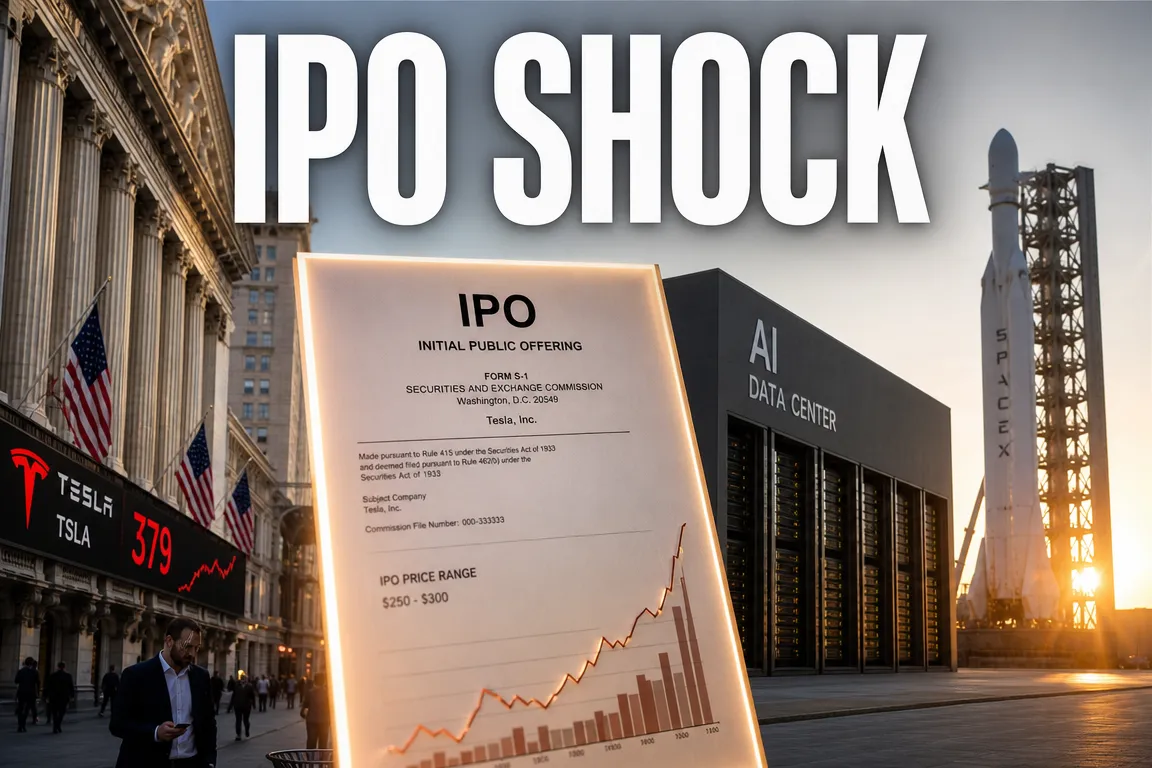
Claims have emerged that Anthropic could go public at a valuation of up to $1.4 trillion and direct the proceeds toward AI computing services provided by SpaceX.
However, calculations based on the figures cited in the source reveal inconsistencies between the projected IPO proceeds and the reported computing contract.
Tesla’s alleged SpaceX stake could represent a valuable asset if confirmed, but it alone would not justify a significant revaluation of Tesla shares near $379.
The critical variables are AI data center customer concentration, the value of SpaceX’s computing business, the equity relationship between Tesla and SpaceX, and the effect of elevated interest rates on growth stocks.
Key Development: Claims That Anthropic’s IPO Proceeds Could Flow to SpaceX
The source states that Anthropic is preparing to sell 825 million shares at between $70 and $78 per share.
At the upper end of $78, Anthropic’s implied valuation could reach approximately $1.4 trillion.
The source expects Anthropic to allocate a substantial portion of the proceeds to computing capacity required for AI model training and inference.
If SpaceX provides large-scale computing infrastructure to Anthropic, a successful capital raise could increase SpaceX revenue.
However, this thesis requires confirmation through Anthropic’s official registration statement, SpaceX customer concentration disclosures, and the underlying computing contract.
The source does not provide official filings or contract documents supporting these claims.
Fact Check 1: The IPO Proceeds Do Not Reconcile
Selling 825 million shares at $70 per share would generate approximately $57.75 billion.
At $78 per share, gross proceeds would total approximately $64.35 billion.
The stated offering terms therefore imply proceeds of approximately $57.8 billion to $64.4 billion.
This is $35.6 billion to $42.2 billion below the separate projection of $100 billion in proceeds.
Overallotment options, secondary sales, convertible securities, or an additional financing round could alter the total.
Without such terms, the $100 billion figure should not be treated as confirmed IPO proceeds.
A $1.4 trillion valuation at $78 per share implies approximately 17.95 billion fully diluted shares.
Under this calculation, the 825 million shares offered would represent approximately 4.6% of total equity.
Investors should therefore assess the primary-secondary share mix, fully diluted share count, and lock-up provisions rather than focusing only on the headline valuation.
Fact Check 2: The SpaceX Computing Contract Contains a Major Numerical Conflict
The source states that Anthropic agreed to spend up to $500 million on SpaceX computing services through 2029.
It also claims that Anthropic would pay approximately $3.1 billion per month once the contracted capacity is fully operational.
A monthly payment of $3.1 billion would equal approximately $37.2 billion annually.
This cannot be reconciled with a maximum contract value of $500 million through 2029.
Possible explanations include a contract value of $50 billion rather than $500 million, or monthly payments of $310 million or $31 million rather than $3.1 billion.
Without the official contract, no figure should be selected as accurate.
The discrepancy may also reflect errors in subtitles, transcription, or unit conversion. Investors should verify the currency units and contract period in primary documents.
Claim That Anthropic Represents 34.5% of SpaceX Revenue
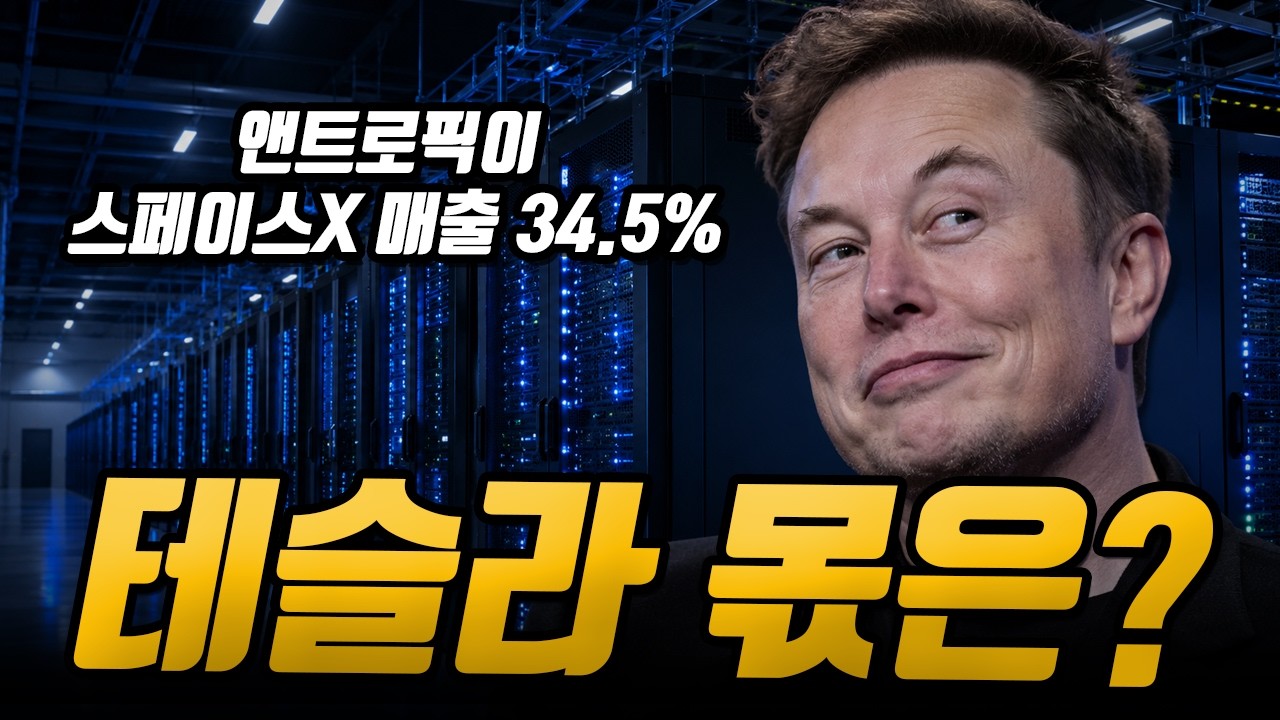
According to the source, SpaceX generated third-quarter revenue of $14.575 billion, with one unidentified customer accounting for 34.5% of the total.
Applying that percentage implies quarterly revenue of approximately $5.03 billion from the customer.
This is close to the reported $5.248 billion in revenue from the communications segment, including Starlink.
If accurate, a single customer would generate revenue comparable to nearly the entire Starlink-related business.
However, the unidentified customer has not been officially confirmed as Anthropic.
Market participants may infer the customer’s identity from its operating profile and contract size, but inference should remain separate from verified fact.
The more material issue is the 34.5% revenue concentration.
If the customer reduces its commitment or shifts workloads to internally owned data centers, SpaceX revenue and operating profit could decline.
Conversely, a long-term agreement with minimum-use commitments could reduce near-term concentration risk.
The Central Investment Issue: Infrastructure Providers May Capture More Durable AI Economics
The principal issue is not the relationship between Elon Musk and Anthropic.
The more relevant business model is whether excess computing capacity can be sold profitably to external customers, including competing AI developers.
Predicting the ultimate winner among AI models remains difficult.
By contrast, suppliers of GPUs, power, networking, cooling systems, and data centers can generate revenue from competition across the AI sector.
If SpaceX is providing large-scale computing services, it could be valued partly as an AI infrastructure company rather than solely as a launch and satellite communications business.
This could shift part of its valuation framework from aerospace revenue multiples toward cloud computing and AI data center multiples.
Such a revaluation would require evidence regarding electricity costs, GPU depreciation, utilization rates, contract duration, and operating margins.
Potential Direct Benefit to Tesla Shareholders
The source claims that Tesla owns 188,919,195 SpaceX shares valued at approximately $2.7 billion.
If the original investment was $2 billion, the implied unrealized gain would be approximately $700 million, representing a return of about 35%.
After rounding, this is broadly consistent with the reported 36% return.
However, an increase in SpaceX’s equity value would not automatically translate into an equivalent increase in Tesla’s cash or operating income.
The accounting treatment depends on whether the stake is private or publicly traded, the applicable valuation method, and any restrictions on sale.
Assuming approximately 3.2 billion diluted Tesla shares, a $2.7 billion stake would equal about $0.84 per Tesla share.
The $700 million increase over the original investment would equal approximately $0.22 per Tesla share.
Relative to an assumed Tesla share price of $379.79, the direct net asset value effect would be limited.
Taxes, illiquidity discounts, transfer restrictions, and accounting treatment could reduce the realizable value further.
SpaceX stake appreciation alone is therefore insufficient to explain Tesla’s share-price direction.
A Tesla-SpaceX Merger Would Be a Separate and More Material Issue
The source claims that Tesla and SpaceX formed a special committee to evaluate a potential merger.
If confirmed, this would be substantially more significant than the value of a minority investment stake.
The exchange ratio, valuation methodology, new share issuance, and dilution of existing Tesla shareholders would become central considerations.
If SpaceX received a high valuation and Tesla issued substantial new equity, existing shareholders could experience material dilution.
Conversely, combining space launch, satellite communications, AI computing, energy storage, and autonomous driving could strengthen the long-term strategic narrative.
However, strategic synergy does not automatically create shareholder value.
An excessive acquisition price or conflicts of interest could impair returns even if the acquired assets are attractive.
No merger-based valuation should be applied until the special committee, negotiations, and exchange terms are confirmed through official disclosures.
Three Scenarios for the Effect of an Anthropic IPO on Tesla
In a bullish scenario, Anthropic prices at the upper end of the range and uses the proceeds to increase external computing consumption.
SpaceX’s AI infrastructure revenue and earnings would rise, potentially increasing the value of any Tesla-held stake.
A higher revenue multiple for the AI data center business could support SpaceX’s overall valuation.
In a neutral scenario, the IPO succeeds, but Anthropic distributes its computing demand across multiple cloud providers.
SpaceX revenue could grow, while customer concentration and high capital expenditure limit the valuation benefit.
In this case, the impact on Tesla would likely remain smaller than the effects of electric vehicles, energy storage, FSD, and robotaxi execution.
In a bearish scenario, IPO demand is weak or Anthropic’s valuation declines rapidly after listing.
Lower AI-sector valuation multiples could also reduce the multiple assigned to SpaceX’s computing operations.
If Anthropic expands its own data centers and reduces external contracts, customer concentration could become a material earnings risk.
Why Anthropic’s Internal Data Center Strategy Is a Long-Term Risk
The source states that Anthropic is expanding an internal infrastructure strategy referred to as “Anthropic Direct.”
Owning data center capacity could reduce long-term dependence on external computing providers.
However, data centers cannot begin operations immediately after securing a site.
Grid connections, substations, cooling systems, semiconductor procurement, environmental approvals, and community acceptance are required.
In the United States, rising power and water consumption has increased local opposition to new data centers.
An internal data center strategy therefore would not necessarily terminate external computing contracts immediately.
Investors should examine minimum-use commitments, early termination penalties, renewal provisions, and contract expiration dates.
Key Issues in the Texas 100 GW Solar Project
The source reports that Tesla is preparing a large-scale Texas facility integrating silicon, wafers, solar cells, and finished panels.
It also claims that SpaceX is developing solar-cell production lines for space-based AI computing satellites, with a long-term target of 100 GW.
Annual capacity of 100 GW would be substantial even by global solar supply-chain standards.
Land-clearing footage or equipment supply agreements alone would not confirm a project of this scale.
Investors should verify phased capacity, total capital expenditure, power supply agreements, tax incentives, environmental approvals, and the production schedule.
If Tesla and SpaceX invest in overlapping supply chains, joint procurement and shared production infrastructure could reduce costs.
However, because the companies are separate legal entities, shared assets would require arm’s-length transactions and conflict-of-interest controls.
Overlapping production requirements alone do not establish a strategic need for a merger.
Texas Political Risk and Data Center Regulation
The source identifies changes in Texas politics and potential data center regulation as risks to Tesla and SpaceX projects.
Statements by a governor or other political official would not immediately halt data center construction.
Material effects would require changes to state policy, local permitting, grid-connection approvals, or environmental regulations.
For projects combining large natural-gas power plants with supercomputing facilities, carbon emissions, water consumption, grid stability, and tax incentives would be key issues.
Project-specific permitting schedules and available power supply are more relevant than general political disputes.
Why U.S. Inflation and Interest Rates Have a More Direct Effect on Tesla
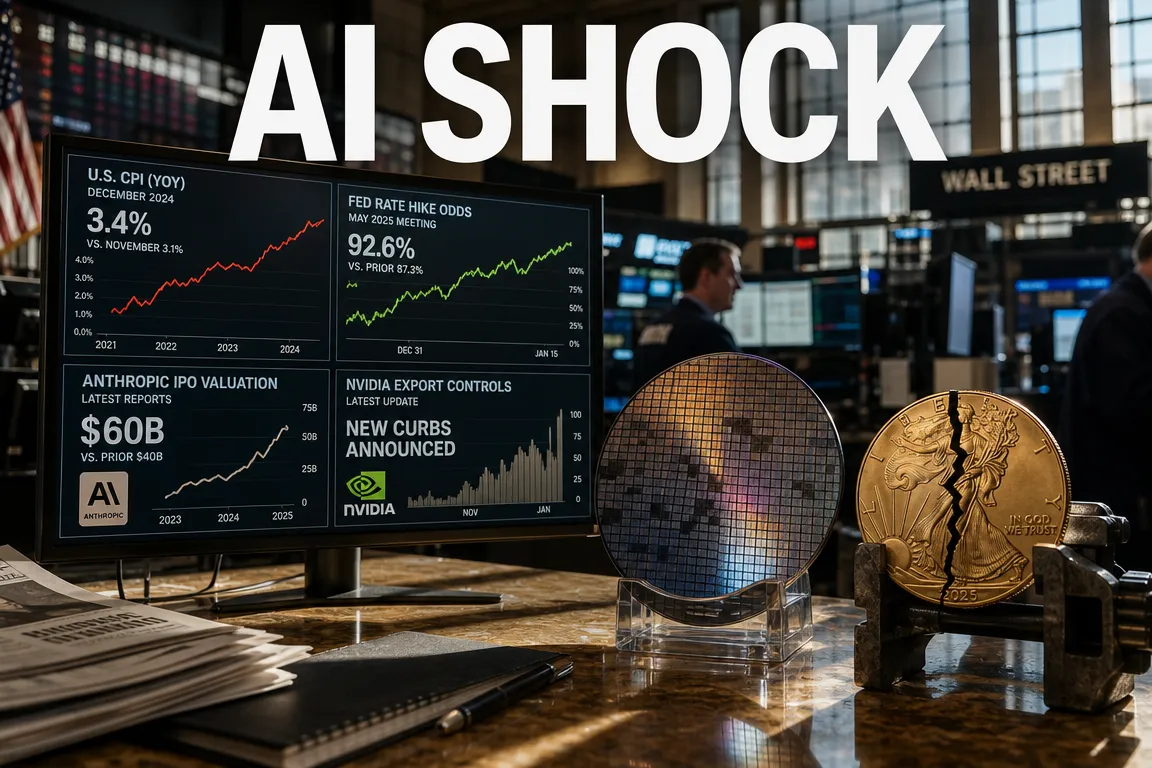
The source states that major U.S. equity indexes declined after consumer inflation exceeded market expectations.
It also cites Federal Reserve commentary suggesting the possibility of a 0.5-percentage-point rate increase.
Comments by individual Federal Reserve officials do not constitute policy decisions; rates are determined through Federal Open Market Committee voting.
Growth companies such as Tesla are sensitive to higher discount rates because future earnings account for a large portion of their valuation.
This sensitivity is greater when the share price reflects distant cash flows from robotaxis, FSD, and humanoid robots.
Higher vehicle financing rates also increase monthly payments and can directly weaken electric-vehicle demand.
Inflation, interest rates, vehicle margins, and deliveries are likely to have a greater near-term effect on Tesla shares than Anthropic’s IPO or the value of a SpaceX stake.
Lower Oil Prices Are Not Automatically Negative for Electric Vehicles
A decline in Brent crude prices can reduce internal-combustion vehicle fuel costs and weaken the relative economic advantage of electric vehicles.
However, vehicle purchasing decisions are not determined by oil prices alone.
Purchase prices, electricity rates, tax credits, insurance costs, residual values, and charging infrastructure also influence demand.
Lower oil prices could reduce inflation and strengthen expectations for interest-rate cuts, potentially supporting growth-stock valuations.
The net effect should be assessed through Tesla’s quarterly deliveries, average selling prices, and automotive gross margin.
Key Issues Often Overlooked
-
The IPO proceeds require arithmetic verification. The stated share count and price range imply approximately $57.8 billion to $64.4 billion.
-
The contract figures contain a direct conflict. A $500 million maximum through 2029 cannot coexist with monthly payments of $3.1 billion.
-
The unidentified customer should not be presented as Anthropic without confirmation. Customer concentration is material, but the customer’s identity remains unverified.
-
The direct per-share value of Tesla’s alleged SpaceX stake may be limited. Without a merger, the effect would likely remain smaller than Tesla’s operating performance.
-
In a merger, the exchange ratio would be more important than headline synergies. Overpaying for an attractive business can still destroy value for existing shareholders.
-
AI infrastructure providers may generate more stable returns than individual model developers. Investors must still assess electricity expenses, GPU depreciation, utilization, and operating profit.
-
Tesla shares near $379 are likely to remain more sensitive to interest rates and automotive performance than to Anthropic’s IPO.
Investor Checklist for Tesla Shareholders
-
Review Anthropic’s official IPO registration statement and confirmed offering size.
-
Separate primary share issuance from secondary sales by existing shareholders.
-
Verify SpaceX’s customer concentration disclosures and the official identity of the major customer.
-
Confirm the computing contract’s total value, monthly minimum usage, expiration date, and early termination provisions.
-
Verify Tesla’s ownership of SpaceX shares and their reported value through official financial statements.
-
Confirm any Tesla-SpaceX merger review or special committee through regulatory filings.
-
Monitor permits and power-supply schedules for the Texas solar and data center projects.
-
Track U.S. inflation, interest-rate expectations, Tesla deliveries, and automotive margins.
< Summary >
If Anthropic completes an IPO at a $1.4 trillion valuation, higher AI infrastructure spending could benefit SpaceX’s computing business.
However, the reported IPO proceeds and computing contract figures contain arithmetic inconsistencies that require verification through official disclosures.
If one customer accounts for 34.5% of SpaceX revenue, that concentration would represent both a near-term growth driver and a long-term risk.
Tesla’s alleged SpaceX stake could be a valuable asset, but its direct effect on Tesla shares near $379 appears limited based on the stated figures.
For Tesla shareholders, merger exchange terms, dilution, U.S. interest rates, vehicle deliveries, and operating margins remain more important variables.
Anthropic’s IPO and a potential Tesla-SpaceX merger should be treated as unverified scenarios until supported by official filings.
[Related Articles…]
*Source: [ 오늘의 테슬라 뉴스 ]
– 앤트로픽 1.4조 달러 상장, 그 돈은 스페이스X로 — 머스크는 “가장 아이러니한 결과”, $379 테슬라 주주는?