● Tesla-SpaceX Merger Bombshell, Tax Trap, Voting Grab
Tesla–SpaceX December Merger Rumors: Exchange Ratios, Taxes, and Voting Rights for Shareholders
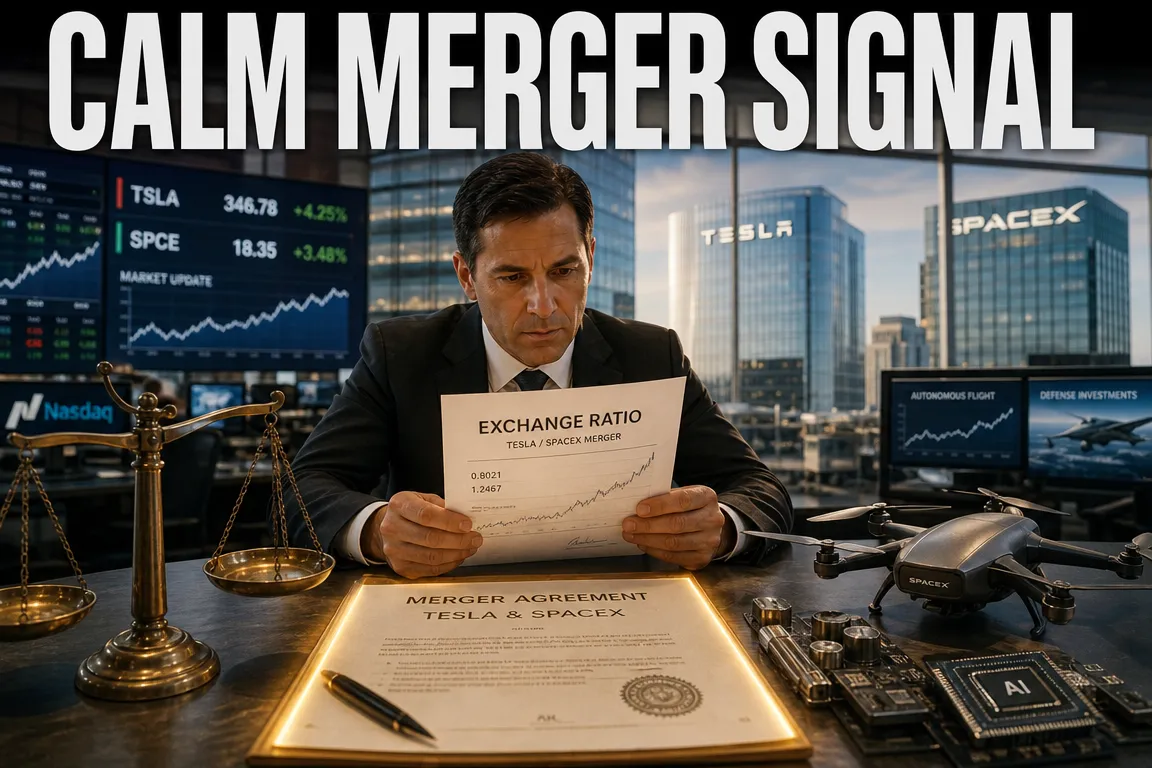
If Tesla and SpaceX merge, the central shareholder question is not the announcement date, but which shares investors receive, in what quantity, and how their rights change.
The source material requires scrutiny of the merger rumors, share exchange ratio, capital gains taxation on foreign shares, Musk’s control, and potential conflicts between Chinese manufacturing operations and U.S. government business.
Robotaxi profitability and AI semiconductor supply chains provide additional investment considerations beyond Tesla’s share-price outlook.
Verification status: The source material contains potentially market-moving claims about a Tesla–SpaceX merger timetable, a SpaceX listing, and a change in Nvidia’s chief executive.
No original article links or regulatory filings were provided, and real-time filings and reporting were not reviewed.
Accordingly, this report is an assessment of unverified claims and potential investment implications, not a verified account of developments as of November 13, 2026.
Unverified allegations concerning private conduct or unlawful activity are not repeated.
1. Core Verification: Reported Does Not Mean Confirmed
The priority is to distinguish levels of evidence, rather than accept or dismiss the merger rumors outright.
| Principal Claim in the Source | Verification Status | Required Evidence |
|---|---|---|
| A Tesla–SpaceX merger could be announced as early as December | Cannot be verified from the supplied material | Original reporting, official company announcements, and relevant filings |
| SpaceX is publicly listed and has a quoted share price | Both listing status and quoted prices require verification | Exchange listing records, SEC registration statements, and filings |
| Nvidia’s founder has stepped down as CEO and director | A material claim unsupported by official documentation | Nvidia investor relations announcements and relevant Form 8-K filings |
| SpaceX’s dual-class share structure and Musk’s voting power are established | The figures in the source cannot be relied upon without verification | Corporate charter, share-class rights, and current ownership disclosures |
| A merger would relax Musk’s compensation conditions or trigger immediate vesting | Compensation agreements and transaction terms require review | Compensation plans, change-of-control provisions, and the merger agreement |
| The December annual meeting schedule and agenda are confirmed | The latest proxy materials require review | Official meeting notice, proxy statement, and brokerage voting instructions |
The source names several media outlets, but naming an outlet does not establish that the cited report exists or accurately reflects its contents.
References to both “168 hours per week” and “108 hours,” alongside inconsistent timing for share-award releases, suggest possible transcription errors.
The material may identify topics for investigation, but it is insufficient for a confirmed news report.
2. A December Announcement Would Not Mean Shares Convert in December
In a major merger, negotiations, signing, shareholder approval, regulatory review, and closing are separate events.
- Review and negotiations: The parties discuss transaction structure, valuations, exchange ratios, and governance.
- Signing and announcement: Following required board approvals and other procedures, the agreement and principal terms are disclosed.
- Shareholder decisions: Required shareholder approvals are obtained under applicable law and the transaction structure.
- Regulatory and contractual review: Competition clearance, government-contract consents, and sector-specific requirements are addressed.
- Closing: Shares are exchanged or consideration is paid once closing conditions are satisfied.
Even if a credible report indicates an announcement as early as December, this should not be interpreted as completion in December.
Whether the merger could be voted on at an already scheduled annual meeting also requires confirmation.
Price renegotiation, approval delays, revised terms, and termination remain possible after an announcement.
3. The First Shareholder Calculation: Exchange Ratio Before Merger Premium
In a stock-funded merger, the first figure to examine is the number of shares received for each Tesla share.
The basic calculation is: Tesla shares held × exchange ratio = shares received.
For example, an investor holding 100 Tesla shares would receive 200 shares if the exchange ratio were 2 shares for each Tesla share.
This is an illustration, not an actual or estimated transaction term.
- Fixed exchange ratio: The number of shares received is fixed, but their value may decline if the consideration shares fall in price.
- Fixed-value structure: The number of shares may adjust to deliver a specified value. Pricing periods, floors, and caps are important.
- Mixed cash and stock: Cash consideration affects liquidity and tax funding, but tax treatment depends on the specific terms.
- Fractional shares: Investors should determine whether fractional entitlements are settled in cash and whether that settlement is taxable.
The source’s prices of $397.45 and $506 imply an increase of approximately 27.3%.
However, arithmetical accuracy does not validate the underlying prices.
A market-capitalization threshold linked to executive compensation is not a guaranteed acquisition price or Tesla price target for ordinary shareholders.
The companies’ relative market capitalizations would not, by themselves, determine the acquirer.
A new holding company, reverse merger, or mixed cash-and-stock structure could produce different outcomes.
4. Capital Gains Tax on Foreign Shares: A Tax Liability Without Cash Proceeds
For South Korean investors, a practical risk is needing cash to pay tax after receiving only replacement shares.
Not all foreign mergers or share exchanges receive identical tax treatment; transaction structure and applicable tax law must be reviewed.
- Taxable event: Determine whether the share exchange constitutes a taxable disposal.
- Disposal proceeds: Confirm the valuation date and pricing method for the shares received.
- Acquisition cost: Establish how the original cost basis of the Tesla shares is treated.
- Exchange rates: Confirm the rates and dates used to calculate gains or losses in South Korean won.
- Tax funding: Assess whether some replacement shares would need to be sold to fund the liability.
- Documentation: Verify that brokerage records and corporate-action statements support the tax filing.
Tax-deferred treatment in the United States does not automatically extend to South Korean tax residents.
Following an announcement, investors should review domestic brokerage guidance and National Tax Service interpretations. Material positions warrant review by a tax professional experienced in international taxation.
The participation count and deadline for the National Assembly petition cited in the source also require verification on the official petition page.
Meeting petition requirements does not guarantee legislative change or tax deferral for a particular merger.
5. Shareholder Voting Power: Share-Class Rights Matter More Than Share Count
Shareholders may retain economic exposure after a merger while losing influence over management.
This is particularly relevant when ordinary and founder-held shares carry different voting rights.
- Economic ownership: Entitlement to appreciation, dividends, and residual assets upon liquidation.
- Voting power: Influence over director elections and other matters submitted to shareholders.
If ordinary shares carry 1 vote each and another class carries 10 votes each, economic ownership and voting power can diverge substantially.
This illustrates the mechanism; it does not verify SpaceX’s actual share classes or voting percentages.
Merger documents should be reviewed for the following provisions.
- The class of shares Tesla investors would receive and the votes attached to each share.
- The duration of enhanced voting rights and conditions for conversion into ordinary shares.
- Requirements for appointing or removing directors and approving major resolutions.
- Minority shareholders’ litigation, arbitration, and information-access rights.
- Procedures for reviewing founder compensation and related-party transactions.
Strong founder control can support sustained long-term research and development.
It can also make management failures or conflicts of interest more difficult to address.
The question is not only whether shareholders trust the founder, but whether effective safeguards exist if that trust deteriorates.
Concentrated voting power does not eliminate directors’ duties or legal liability.
The feasibility of replacing a CEO depends on the corporate charter, board authority, and applicable law—not ownership percentages alone.
6. Chinese Manufacturing and U.S. Government Business: Assessing Integration Costs
Combining Tesla’s Chinese operations with SpaceX’s U.S. government and defense-related business could create issues beyond manufacturing efficiency.
The source’s figures for Shanghai production and shipments require verification. Nevertheless, managing Chinese manufacturing alongside sensitive U.S. technology and government contracts is a material analytical consideration.
- Technology access controls: Access to each business’s technology and data would need to be clearly defined.
- Export controls: Cross-border technology transfers and personnel access may face restrictions.
- Government contracts: Ownership or governance changes may trigger notification, consent, or security-review requirements.
- Legal separation: Separate subsidiaries or operational barriers would need to satisfy applicable regulatory requirements.
- Higher costs: Duplicated systems, separate management functions, audits, and security controls could increase expenses.
A merger would not necessarily require the sale of the Chinese factory.
Separate legal entities, restricted access, and operational restructuring could be considered, subject to regulatory acceptance and contractual requirements.
Investors should focus less on statements that operations are separated and more on the resulting effects on production costs and cash flow.
7. AI Investment: Round-the-Clock Robotaxi Availability Is Not Round-the-Clock Revenue
Operating 24 hours a day, 7 days a week provides 168 hours of potential availability.
Booking availability, vehicle operating time, and revenue-generating passenger time are distinct measures.
The claim that service operates around the clock in every service city requires confirmation through official service information.
Robotaxi profitability depends more on paid utilization and costs than on service availability.
- Demand: Are ride requests sufficient overnight and during off-peak periods?
- Empty mileage: How much time and distance are traveled without paying passengers?
- Downtime: How much capacity is lost to charging, cleaning, maintenance, and incident management?
- Support costs: What are the costs of remote assistance, customer service, and insurance?
- Vehicle economics: How long does it take to recover acquisition or manufacturing costs and depreciation?
A simplified vehicle-level profitability calculation starts with paid operating hours × average revenue per hour, less vehicle operating and support costs.
Longer potential operating hours than those of a human driver do not imply proportionately higher revenue or profit.
If Tesla increasingly operates vehicles rather than selling them, its business model would change.
Recurring service revenue could increase, but upfront investment in vehicles and charging infrastructure would make capital expenditure and payback periods more important.
8. Nvidia and Tesla: Semiconductor Supply Matters More Than Personnel Rumors
The source’s claim about a change in Nvidia’s leadership cannot be treated as established without an official announcement.
Even a confirmed leadership change would not automatically imply disruption to Tesla’s chip supply.
AI semiconductor analysis should distinguish training compute from inference compute.
- Training: Using large datasets to improve AI model performance.
- Inference: Running trained models to make decisions in vehicles, robots, and services.
Developing proprietary automotive chips does not immediately eliminate demand for data-center training GPUs.
Likewise, using one supplier’s GPUs does not establish a permanent supply structure.
Relevant evidence includes product launch schedules, supply agreements, high-bandwidth memory availability, advanced packaging capacity, and power and cooling infrastructure—not brief executive social-media replies.
When and at what cost a company can secure the required compute is more directly relevant to business value than speculation about personnel appointments.
9. Global Economic Variables: Interest Rates and Oil Prices Remain Separate Drivers
The source’s U.S. equity-market movements, Treasury yields, and oil prices lack verified trading dates and sources and should not be presented as current market data.
The channels through which interest rates and energy prices affect Tesla can nevertheless be assessed.
- Higher interest rates: Lower present values of future earnings can pressure growth-stock valuations.
- Vehicle financing costs: Higher loan and lease payments can weaken demand.
- Higher oil prices: Electric vehicles may become more competitive on running costs relative to combustion-engine vehicles.
- Economic slowdown: Higher energy costs and inflation can weaken overall vehicle demand.
Interpreting higher oil prices as unconditionally positive for electric vehicles is therefore incomplete.
Sales effects depend on vehicle prices, financing terms, subsidies, competing models, and charging costs.
Greater macroeconomic uncertainty reinforces the need to assess core sales volumes, margins, and cash flow independently of merger expectations.
10. Further Analysis: Issues That Merger Headlines Can Obscure
The following issues may receive less attention than announcement timing and share-price movements, although they are not necessarily absent from other coverage.
① After-tax economic value matters more than the headline premium.
A higher nominal transaction value may produce a different shareholder outcome after taxes, exchange-rate movements, replacement-share declines, and weaker voting rights.
The acquisition premium and the value ultimately retained should be calculated separately.
② New share issuance and executive compensation should be assessed together.
Compensation shares, options, and convertible securities can change existing shareholders’ effective ownership in addition to shares issued as merger consideration.
Investors should examine the fully diluted share count as well as the exchange ratio.
③ A broader business portfolio does not guarantee a higher valuation.
Combining automotive, robotics, AI, satellite communications, and space operations could generate technological synergies.
However, reduced visibility into segment performance and internal capital transfers could lead to a conglomerate discount.
Post-merger disclosure of segment revenue, earnings, and investment would be an important assessment criterion.
④ Cash generated by one business may fund the risks of another.
Profitable operations could finance businesses that remain unprofitable for extended periods.
Such funding may support long-term growth, but shareholders need clear capital-allocation criteria and investment termination thresholds.
⑤ Political timing is a potential explanatory factor, not evidence of merger motives.
The source’s election results and state-policy claims also require official verification.
Congressional investigations, federal review, state permitting, and court decisions can affect a transaction through different channels.
Announcing a merger before a particular date does not eliminate subsequent regulatory or litigation risk.
⑥ A special committee’s independence matters more than its existence.
Establishing a committee does not itself ensure fair transaction terms.
Investors should determine whether it retained independent advisers, evaluated alternatives, and had authority to reject unfavorable terms.
Where relevant, they should also examine whether separate approval by disinterested shareholders is required.
11. Documents and Actions for Tesla Shareholders
- Start with official announcements.
Compare Tesla, SpaceX, and Nvidia announcements with relevant filings rather than relying solely on videos repeating other reports. - Distinguish the wording in original reporting.
Treat “under discussion,” “agreement signed,” “approved,” and “closed” as separate stages. - Prepare a transaction terms checklist.
Record the exchange ratio, cash consideration, price adjustments, termination provisions, and regulatory approval requirements. - Review changes in shareholder rights.
Compare voting rights, corporate charters, board composition, and dispute-resolution provisions. - Assess taxes and liquidity.
Confirm tax treatment and supporting documentation, and arrange tax funding if necessary. - Check the domestic broker’s voting deadline.
The deadline for submitting voting instructions may precede the overseas shareholder meeting. - Verify any automatic voting arrangements.
Confirm the existence and scope of the arrangement cited in the source, including enrollment, withdrawal, and instruction-change procedures.
The source is best used to prepare a disclosure-review framework, rather than treated as confirmed news.
A successful merger is not defined by an announcement-day share-price gain, but by durable shareholder value after taxes, dilution, and governance changes.
< Summary >
- Core claims about merger timing, a SpaceX listing, and Nvidia leadership changes require official verification.
- An announcement is distinct from completion; exchange ratios and price-adjustment provisions are critical.
- A share exchange may create tax liabilities and liquidity requirements for South Korean investors.
- Dual-class structures can separate economic ownership from influence over management.
- Combining Chinese manufacturing with U.S. government business requires assessment of security, regulation, and operating costs.
- Robotaxi analysis should prioritize paid utilization; AI semiconductor analysis should prioritize supply reliability over personnel rumors.
- The ultimate criteria are after-tax value, dilution, cash flow, and shareholder rights—not the headline merger premium.
[Related Articles…]
*Source: [ 오늘의 테슬라 뉴스 ]
– “테슬라·스페이스X 합병 빠르면 12월” | 젠슨 황 물러난 날, 397달러 테슬라 주주의 한 표는?
● Drone War Profits – Kratos Alert
Kratos as the Leading Drone Stock Pick? Key Considerations for Counter-Drone and AI Autonomous Flight Investment
The U.S. drone stock highlighted at the end of the interview was Kratos, NASDAQ: KTOS.
The broader investment thesis was more significant.
Investors should focus not only on rising drone sales, but also on increasing expenditure on drone defense.
However, treating Kratos as an established leader in interceptor drones, or assuming restrictions on Chinese drones will automatically benefit South Korean companies, could distort investment decisions.
This report examines counter-drone demand, investment considerations for Kratos, Hanwha Aerospace and LIG Nex1, industrial AI drone revenue models, and interview claims requiring verification.
Source recording date: November 5, 2026.
This analysis reconstructs the interview and does not independently verify corporate disclosures, regulations or product launches as of November 2026.
The interviewee’s experience and forecasts should be distinguished from verified facts.
1. Core Interview Thesis: Drone Defense Rather Than Manufacturing Alone
Ahn Jung-hyun, CEO of CNS, stated that the company is developing a construction-site safety inspection platform using drones and AI.
CNS in this interview is a separate company from LG CNS.
Collaboration at Hyundai Engineering & Construction’s Hillstate sites and previous employment at DJI were also reported by the interviewee.
- Civilian drones: Chinese manufacturers’ pricing, component supply chains and product quality were described as substantial barriers to entry.
- Military drones: Expanding reconnaissance and attack-drone deployment is increasing demand for countermeasures.
- Industrial drones: Commercialization depends on flight approvals, safety management, insurance and operating personnel, as well as technical capabilities.
- Investment approach: The interview favored examining companies with established defense and aerospace capabilities alongside dedicated drone stocks.
The sector is influenced by defense spending, supply-chain restructuring, regulatory changes and corporate automation investment.
Impressive demonstrations do not necessarily translate into rapid revenue or earnings growth.
2. DJI’s Competitive Position: What Investors Should Verify
Ahn attributed DJI’s competitiveness to the integration of components, software, mass production and operational experience, rather than pricing or aircraft performance alone.
- Flight controller: The flight controller, or FC, manages aircraft attitude and flight conditions.
- Propulsion and power systems: Motors, batteries and power management affect flight endurance and payload capacity.
- Sensors and perception: Cameras, thermal imaging and lidar support inspection, detection and obstacle avoidance, depending on the platform and payload.
- Operational software: Flight planning, data management, remote supervision and automated return functions support practical deployment.
- Manufacturing ecosystem: Component procurement, production scale, quality control and maintenance infrastructure contribute to cost competitiveness.
The central question is not whether a company can build a drone, but whether it can consistently supply reliable products at competitive prices.
The interview’s claims of a DJI market share above 85%, more than 20,000 patents and a 7–8-year technology gap between South Korea and China require independent verification.
Market share varies by consumer or industrial segment and by unit sales or revenue.
Patent figures require distinctions between applications and grants, as well as checks for duplication across jurisdictions.
The technology gap expressed in years represents the interviewee’s assessment, not an objective measure applicable across military drones, communications, sensors and autonomous flight.
The exact model and specifications of the automated charging station mentioned in the interview cannot be established from the source alone.
Nevertheless, autonomous flight → mission execution → return → charging → data analysis represents an important industry direction.
3. Counter-Drone Systems Require Multiple Defense Methods
Counter-drone systems encompass technologies and operating procedures for detecting, identifying, tracking and responding to hostile drones.
Investors should not reduce the sector to jamming equipment or interceptor drones alone.
| Category | Primary Role | Commercial Assessment Criteria |
|---|---|---|
| Detection and identification | Identify threats using radar, radio-frequency detection, optical imaging and thermal sensors | Small-target detection, false-alarm rates and reliability across environments |
| Command and control | Integrate sensor information and coordinate response systems | Compatibility with existing air defenses, software maintenance and integration capabilities |
| Electronic countermeasures | Disrupt communications and navigation signals | Effectiveness against different threats, interference with surrounding communications and usage restrictions |
| Physical countermeasures | Physically disable targets using interceptors or other means | Engagement cost, success rates, falling debris and collateral damage risks |
| Directed energy | Deploy lasers, high-power microwaves and related technologies | Power and cooling requirements, weather sensitivity, operational performance and production maturity |
Fiber-optic-controlled drones may be difficult to counter through radio-frequency jamming alone.
When control signals travel through fiber-optic cables, conventional jamming of wireless control links may have limited effectiveness.
This does not establish that all electronic countermeasures are ineffective.
Results depend on aircraft configuration, navigation methods and the countermeasures deployed.
From an investment perspective, layered defense integrating multiple technologies deserves greater attention than dominance in a single countermeasure.
As threats diversify, the ability to integrate sensors, software and interception systems may become more valuable.
4. Kratos: What Investors Should Verify Behind the Interview’s Stock Selection
Although the original title included Hanwha Aerospace, Kratos Defense & Security Solutions received the strongest emphasis in the latter part of the interview.
The interviewee cited potential counter-drone market growth when discussing Kratos.
A critical distinction is required.
Kratos is a defense technology company known for unmanned aircraft systems, target drones and defense electronics.
The interview alone does not establish that it leads competitors in small interceptor drones or derives a substantial share of revenue directly from counter-drone systems.
- Products: Identify which systems are actually deployed in counter-drone missions.
- Revenue: Distinguish unmanned aircraft revenue from direct counter-drone revenue.
- Contracts: Research, demonstrations, initial production and full-rate production provide different levels of revenue visibility.
- Orders: Distinguish contract ceilings from funded orders, and backlog from the timing of revenue recognition.
- Cash flow: Production expansion and development spending can strain liquidity despite revenue growth.
- Valuation: Assess how much expected growth is already reflected in the share price.
For U.S. equities, valuation and financing structure are as important as industry growth.
Higher defense budgets may take time to translate into company contracts and earnings.
5. Company Comparison: Drone Exposure Does Not Imply Identical Revenue Models
| Company | Role in the Interview | Investor Due Diligence |
|---|---|---|
| Kratos, KTOS | The interviewee’s most emphasized U.S. company | Distinguish unmanned aircraft from direct counter-drone operations; assess production contracts and cash flow |
| AeroVironment, AVAV | Mentioned by the host as a company previously followed | Current business mix, orders for unmanned aircraft and related systems, and profitability |
| Hanwha Aerospace | Referenced as an established South Korean defense company | Separate operations attributable to the listed entity from those of affiliated companies |
| LIG Nex1 | Identified as a South Korean counter-drone company of interest | Specific program participation, contract value and revenue recognition timing |
| Korean Air | Mentioned as an unmanned aircraft developer | Unmanned aircraft exposure within aerospace operations and contribution to total earnings |
| PABLO AIR | Referenced in connection with drone swarms, defense and drone shows | Current listing status, segment revenue and commercial deployment of technology |
PABLO AIR was described as preparing for a listing. Its current status requires confirmation through exchange notices or company announcements.
The Chinese company referred to as “Lianchuang Guangdian” also requires verification of its exact legal name, stock code and relevant revenue contribution.
EHang appeared in the interviewee’s personal investment experience, not as a counter-drone recommendation.
Skydio was cited as a technology comparison; its current accessibility to investors requires separate verification.
A common error in analyzing South Korean defense stocks is assuming that every group-level business contributes to the earnings of the listed company being purchased.
Investors should separately verify the developer, contracting entity, ownership structure and consolidation treatment.
6. U.S. Restrictions on Chinese Drones: Avoid Treating Them as a Blanket FAA Import Ban
The interview suggested that FAA regulations prohibit all imports of Chinese drones and components and impede connection or activation of new DJI products.
These claims should not be presented as established facts without verifying agency authority and the actual scope of restrictions.
- FAA: Oversees aviation safety, airspace and flight operations.
- FCC: Has responsibilities including communications equipment authorization.
- Customs and import restrictions: Customs holds and import limitations require verification of their specific legal basis and enforcement agency.
- Government procurement restrictions: Restrictions on federal or defense purchases are not equivalent to a general prohibition on civilian use.
Existing product use, new-model authorization, customs clearance, government purchasing and app activation are separate issues.
Election outcomes alone do not establish that restrictions will ease or that particular companies will benefit.
Investors should instead assess which companies convert regulatory-driven demand into contracts, and at what delivery cost.
Replacing Chinese products may increase revenue without materially improving profit if component and manufacturing costs rise significantly.
7. Industrial AI Drones: Inspection Outcomes Matter More Than Flight
Ahn described drone-based safety inspection and management solutions for high-rise exterior walls, tower cranes and other structures.
He also stated that CNS is developing a swarm-operation platform enabling three or more drones to perform AI-guided autonomous missions at a single site.
These are company statements; deployment scope and operating results require independent supporting evidence.
- Imaging and inspection: Drones can help assess exterior-wall conditions and identify signs of equipment abnormalities.
- AI analysis: Image and sensor analysis can prioritize inspection targets.
- Automated reporting: Accumulated inspection records can support maintenance prioritization.
- Recurring operations: Services may generate periodic inspection and site-management contracts.
Aircraft sales may be one-time transactions, while inspection and analysis can generate recurring revenue.
This model illustrates how AI capabilities can translate into workflow automation and repeat business.
Operating several drones simultaneously does not automatically produce substantial cost savings.
Cost assessments must include flight supervision, battery replacement, site control, data review, insurance and maintenance.
The claim that working time can be reduced by more than 50% lacks specified tasks and comparison conditions.
Savings should be measured against conventional methods using equivalent inspection scope, quality and safety standards.
8. Construction Drone Regulation and Safety: Worksites Are Not Automatically Exempt
The interviewee reported that only approximately 4–5 of 27 operating sites did not require flight permission.
This describes one company’s site portfolio, not a representative ratio for all South Korean construction sites.
South Korean operating requirements vary by aircraft weight, flight area, altitude, night or beyond-visual-line-of-sight operations, and business model.
Not every operation requires a Class 1 drone pilot certificate or identical flight and aerial-imaging procedures.
Mandatory insurance, imaging procedures and application processing times also depend on specific operating conditions.
Site requirements should be checked through official resources such as the Drone One-Stop portal.
The approval scope available for repeated flights may vary with operating conditions.
Drones can reduce workers’ exposure to elevated-work risks, but they do not eliminate accident risk.
Operators must also manage crashes, collisions, battery fires and incursions into work areas.
Drone adoption alone does not satisfy obligations under the Serious Accidents Punishment Act or eliminate liability.
The interview’s cross-country fatality figures for work at height lack sources and consistent reporting definitions and should not be used as comparative statistics.
9. Distinguish Technical Potential from Commercial Readiness
First, lifting a heavy payload is not equivalent to transporting a person safely.
An industrial drone’s ability to lift a person’s weight does not establish suitability for passenger transport.
Passenger aircraft must meet separate requirements for reliability, emergency response, certification and operations.
Suspending a person from a conventional industrial drone should not be considered a safe use.
Second, exterior inspection and precision construction involve different technical challenges.
Unlike imaging, inspection or cleaning, bolt fastening and welding require contact-force control, stable positioning and process-quality verification.
Prototypes and demonstrations do not establish economical operation across large construction sites.
Third, AI friend-or-foe identification should not be assumed to approach 100% accuracy.
The interview referenced armed-drone footage and potential AI identification capabilities, but video alone cannot verify autonomous decision-making or battlefield accuracy.
Civilian-combatant distinction, misidentification, human oversight and compliance with international humanitarian law require assessment.
Fourth, VTOL means vertical takeoff and landing; it does not guarantee long-range performance.
Aircraft combining VTOL with fixed-wing cruise may offer endurance advantages, but range depends on propulsion, fuel or batteries, payload and weather.
A total flight distance of 400 km is fundamentally different from a 400 km operational radius that includes mission execution and return.
Drone delivery examples in Shenzhen should also be distinguished between services operating on designated routes and broadly available citywide delivery.
10. Investment Considerations Beyond Individual Stock Selection
① Counter-drone competitiveness may depend on total defense-mission cost rather than equipment price.
Assessments should include sensor installation, control personnel, maintenance, expendable countermeasures and disruption caused by false alarms.
Repeatedly using expensive countermeasures against inexpensive drones can create a long-term economic burden.
Software that accurately detects threats and selects appropriate responses therefore matters alongside low-cost hardware.
② Industrial drone competitiveness depends on accountability as well as AI accuracy.
Investors should examine who reviews missed defects, what records are retained, and how insurance and contracts allocate liability.
Auditable reports and data histories may influence adoption by major customers.
③ Localization requires more than changing component origin.
It also involves security validation, software-update control, supply continuity and long-term maintenance.
Higher-priced products may secure demand by meeting procurement and security requirements, but investors must identify who absorbs the additional cost.
④ A strong technology company is not necessarily an attractive stock.
Excessive growth expectations embedded in valuation can limit returns despite favorable business prospects.
Higher interest rates can reduce the present value of future earnings, while won-dollar exchange-rate movements affect South Korean investors’ returns on U.S. equities.
⑤ Large defense contractors and dedicated drone companies carry different risks.
Larger companies have established operations, but drone activities may contribute only modestly to overall earnings.
Smaller companies may offer greater direct exposure while facing higher customer concentration, cash-burn and equity-dilution risks.
11. Due Diligence Checklist for Drone Investments
- Business exposure: Does the company manufacture drones, sensors, command-and-control systems or interceptors, or provide inspection services?
- Commercial maturity: Is the business in research and development, paid trials or recurring production?
- Contract quality: How much of the announced maximum contract value has actually been ordered?
- Revenue attribution: Does the business contribute to the financial results of the listed entity under consideration?
- Profitability: Are gross margins and operating cash flow improving together?
- Operating economics: Is deployment economical after regulation, certification, insurance and site personnel are included?
- Financial risk: Will the company require additional financing or equity issuance?
- Valuation: What growth and profitability assumptions are embedded in current market capitalization?
The interview is better treated as a starting point for counter-drone research than as an immediate recommendation to buy Kratos.
The central investment questions are which customer problems are being solved, how much customers will pay, and which companies retain that spending as profit.
< Summary >
- Kratos, KTOS, was the U.S. drone-related stock most emphasized in the interview.
- The core thesis is rising counter-drone demand, but Kratos’s direct revenue opportunity and competitive advantage require verification.
- For Hanwha Aerospace, LIG Nex1 and Korean Air, investors should distinguish actual contracts from their contribution to listed-company earnings.
- Industrial AI drones may generate greater recurring value through inspection, analysis and maintenance than through aircraft sales alone.
- DJI market share, technology gaps, U.S. restrictions and working-time savings cannot be confirmed from the interview alone.
- Investment decisions should be based on funded orders, cash flow, valuation and regulatory requirements.
[Related Articles…]
*Source: [ Jun’s economy lab ]
– 드론 전문가가 알려준 드론 주식 단 한가지(ft.안중현 대표)