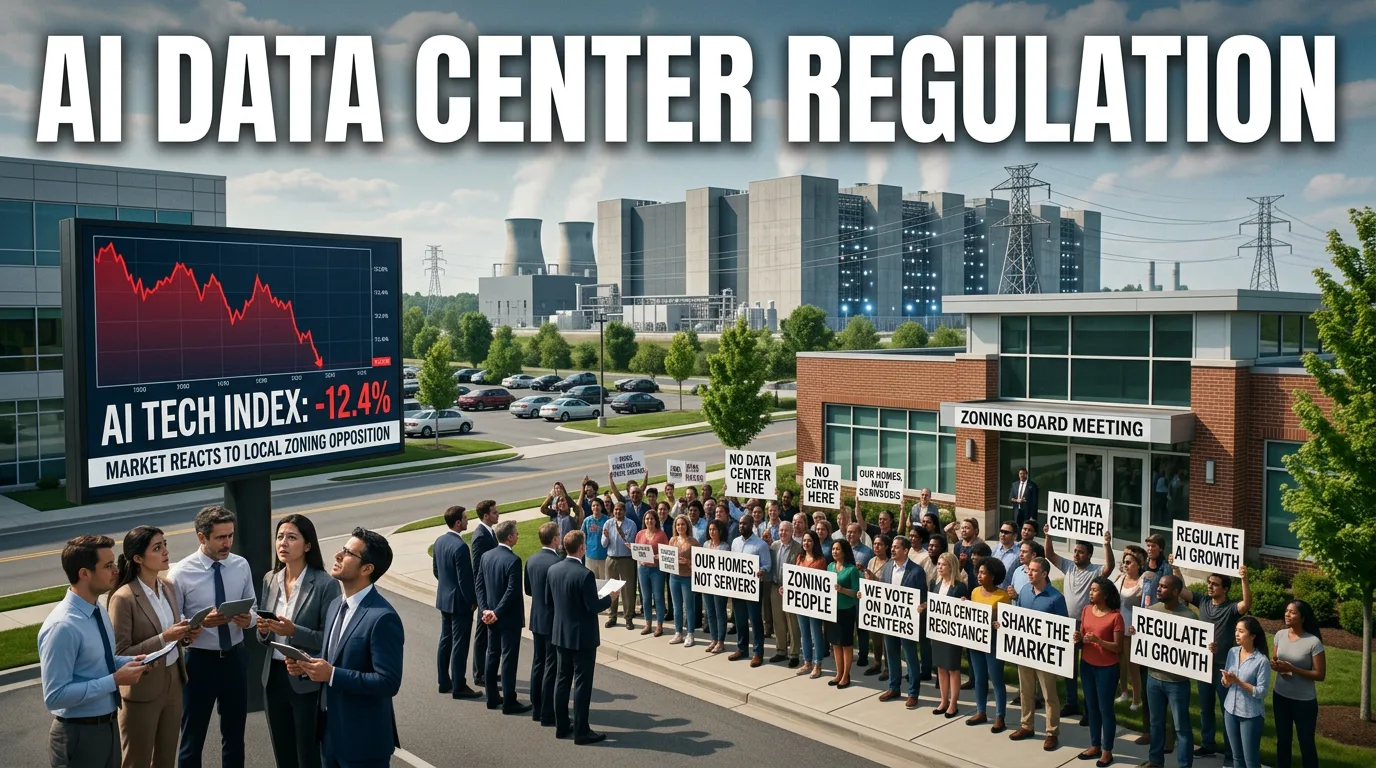
● AI Data Center Backlash
Why Public Backlash Against AI Data Centers Shook Global Markets
The core point of this issue is not simply whether to build data centers or not.
Results unfavorable to AI data centers poured out in U.S. referendums, and this trend is now connecting big tech investment, power infrastructure, the semiconductor market, global stock markets, and even Korea’s KOSPI.
In particular, while many reports only talk about “AI-related stocks falling,” the truly important point is why residents are opposing them so strongly, and how that backlash is shaking Nvidia, neoclouds, and even the HBM supply chain.
Electricity bills are rising, water is becoming scarce, jobs are fewer than expected, and in some cases local residents are being forced to bear costs in advance for data centers that have not even been built yet.
AI data centers are no longer just a tech industry issue; they have become a massive economic issue tied to local politics, energy security, water resources, and global capital markets.
1. Why 40 of 41 U.S. local votes ended against data centers
In data center-related referendums held alongside the U.S. midterm elections, 40 out of 41 outcomes were negative for data center construction.
Specifically, measures opposing construction, strengthening regulations, or blocking proposals that would make construction easier were passed in large numbers.
That said, interpreting this as “the entire United States rejected data centers outright” goes a bit too far.
That is because most of these were not state-level major votes, but small local votes, including village-level votes involving only a few hundred people.
Even so, there is a clear reason the market reacted sensitively.
It confirmed a signal that local sentiment toward data centers, the core infrastructure of the AI industry, is deteriorating rapidly.
As this overlapped with the atmosphere of a Democratic landslide, concern grew that “AI regulations could become even stricter,” and that quickly led to declines in AI-related stocks.
The anti-data center movement that began in the U.S. affected not only Nvidia, cloud companies, and power infrastructure firms, but also the semiconductor market in Korea, including Samsung Electronics and SK hynix.
2. Why opposition to data centers became a political issue
In the United States, Republicans are generally more business-friendly, while Democrats tend to be more active on environmental, community, and regulatory issues.
As a result, Republican-leaning regions have often been relatively favorable toward attracting AI data centers.
By contrast, Democratic-leaning regions have voiced stronger calls for regulation due to environmental concerns, electricity bill issues, and local equity concerns.
With Democrats gaining strength in this election, the market interpreted the result as meaning that “AI regulation could become tighter.”
In particular, some analyses suggest that Republican support fell in areas where data centers were moving in.
For that reason, even inside the Republican camp, a mood is emerging in which unconditional support for attracting data centers is difficult.
For politicians, being on good terms with big tech matters, but if local residents become angry over electricity bills and water shortages, they can lose elections.
3. Even Virginia, the largest concentration of data centers, has seen approval plunge
The region with the most data centers in the U.S. is Virginia.
Virginia has long attracted data centers because of its well-developed internet infrastructure and defense and government networks.
The number of data centers currently operating is said to be about 384, with about 287 under construction, meaning that more than 600 data centers are concentrated there in total.
At that scale, Virginia is often called “Data Center Alley.”
The problem is that sentiment is deteriorating even in the region that has experienced data centers the most.
In the past, support for data centers reportedly reached around 70%, but recent analyses say it has fallen to the 30% range.
In simple terms, the mood has become: “We experienced it first, and it’s not as great as we thought.”
This message is also being strongly conveyed to residents in other regions.
For areas that are considering attracting data centers for the first time, Virginia’s example can only be seen as a warning.
4. Why AI data centers are completely different from past data centers
Old data centers were not as massive as they are today.
Typical data centers were often tens of thousands of pyeong in size, and many did not exceed 100,000 pyeong.
But AI-specific data centers are on another level.
Meta’s project in Louisiana is mentioned as being about 2.7 million pyeong.
SoftBank’s project in Ohio is being discussed at around 3.3 million pyeong.
There are also reports that an ultra-large project in Utah could reach the 50 million pyeong scale.
50 million pyeong is close to the size of an entire district in Korea.
In other words, whereas the past was about “one big server building,” now it is closer to an “AI computing factory city.”
As the scale grows this much, electricity demand, water use, land occupancy, pressure on transmission grids, and local complaints all explode exponentially.
5. The first reason residents are furious: electricity bills
The issue U.S. residents react to most sensitively is electricity bills.
Korea has a relatively unified nationwide electricity rate system.
There are set tariff structures for households, industrial users, and general users, and simply because a data center is built in a certain area does not mean local residents’ electricity bills will suddenly rise sharply.
But in the U.S., regional power market structures differ.
In many cases, regional power purchasing groups secure electricity from power plants, and those costs are passed on to local consumers.
When a data center moves in, local electricity demand surges.
That raises the cost of securing power, and the burden can then flow into local residents’ electricity bills.
From the residents’ perspective, that is understandably unfair.
Whether or not they use AI services heavily, simply living in a region where a data center was built can mean paying higher electricity bills.
In some areas, monthly electricity bills have reportedly risen by tens of thousands of won per household.
A more sensitive problem is that costs may begin to appear even before the data center is completed, as power is secured in advance for future demand.
Residents ask, “Why should we pay first for a data center that hasn’t even been built yet?”
6. The second reason: water shortages and cooling problems
AI data centers generate enormous heat.
Because servers packed with GPUs run 24 hours a day, cooling is essential.
There are several cooling methods, but many data centers use water.
Some use water-cooling systems that circulate coolant around the chips, and others use methods that evaporate water to lower the heat of the entire building.
What is especially problematic is evaporative cooling.
It is a structure that cools by spraying or circulating water to remove heat, but in the process the water evaporates, requiring constant new water input.
In regions with abundant water this may be less burdensome, but in dry regions or places dependent on groundwater, the problem becomes serious.
Many rural areas in the U.S. rely on groundwater or wells.
In such places, if a data center consumes large amounts of water, residents can directly feel shortages in everyday water use.
In some parts of Southeast Asia, there have even been reports of tap water being cut off around data center complexes.
Residents have taken to the streets saying they “can’t even wash rice.”
Companies or authorities may explain it as “a drought issue,” but the anger residents feel does not subside easily.
7. The third reason: far fewer jobs than expected
A phrase often used to justify attracting data centers is “boosting the local economy.”
But in reality, data centers do not create many jobs.
Even ultra-large facilities often have only around 100 operating staff.
That is because they are highly automated and run mainly through server operations and monitoring.
During construction there may be temporary employment, but after completion the effect on sustaining the local economy is limited.
In other words, residents bear the burden of higher electricity bills, water shortages, noise, and concerns over falling home prices, while the job benefits are smaller than expected.
This is the key factor driving opposition to data centers.
The perception is spreading that “big tech makes the money, while local residents pay the costs.”
8. Anti-data center groups and legislative movements spreading across the U.S.
The anti-data center movement is now becoming organized beyond local complaints.
Reports say anti-data center groups have emerged in 49 U.S. states, excluding Hawaii.
Analyses also suggest the number of opposition groups has grown into the hundreds.
Whereas residents used to only protest or issue press releases, the issue is now moving into city councils and state legislatures.
There are also reports of hundreds of bills related to data centers being introduced.
In some areas, there were even attempts to explicitly ban data center construction.
Regardless of whether they pass, this means politicians can no longer ignore the issue.
9. Data center conflicts are growing in Europe, Southeast Asia, and India too
Europe is highly sensitive to environmental issues and has a strong protest culture.
In the Netherlands, protests were held against Microsoft’s data center construction, and some protesters even climbed onto construction sites and cranes.
Slogans like “Stop the dirty data center” even appeared.
In Finland, concerns were raised about forest destruction during Google’s data center site development.
While the European Union says it wants to expand AI data center capacity, it is also issuing guidelines to control power and water usage.
Outwardly it may look complementary, but in reality it is difficult to balance growth and regulation.
In Southeast Asia, water is an even more direct issue.
In regions with distinct dry and rainy seasons, water shortages can worsen during the dry season.
Countries where water itself is scarce, such as Singapore, have no choice but to be cautious about expanding data centers.
In Malaysia, there are concerns that surging electricity demand from data centers could eventually make them account for a significant share of total power usage.
In India, land ownership and resident relocation issues overlap.
When big tech acquires land, farmers may not be sufficiently convinced, or may be pushed out in nontransparent ways.
In developed countries, electricity and water are the issues; in developing countries, land, livelihoods, and administrative transparency can become much bigger flashpoints.
10. Still, there are regions that keep building data centers
Although public opposition to data centers is growing, it is not blocking every region.
China is pushing data centers aggressively as a national strategy.
China is promoting the “East Data, West Computing” strategy.
Eastern mega-cities like Beijing and Shanghai create and consume data, while western regions handle computation and computing capacity.
The plan is to build data center clusters in places like Inner Mongolia, Ningxia, and Guizhou and use a mix of wind, solar, and thermal power.
Because China’s political structure makes it difficult for public opposition to be openly expressed strongly, it can move much faster than the U.S.
This could become an important difference in the AI competition between the U.S. and China.
Australia has also been active in attracting data centers.
It has drawn large-scale investment through 2030 and put in place systems to speed up data center approval processes.
But even in Australia, voices of local opposition are beginning to emerge.
Even within the U.S., Republican-leaning regions remain relatively proactive about attracting data centers.
Analyses suggest that a significant number of data centers currently operating, under construction, or in the planning stage are concentrated in Republican-leaning regions.
Texas, Georgia, and Kentucky remain important candidate locations for big tech and cloud companies.
11. How are companies trying to soothe local opposition?
The most realistic method is ultimately compensation.
The argument is growing that companies should directly compensate residents for electricity bills, water shortages, noise, and deteriorating living conditions.
xAI once announced plans to buy hundreds of homes near its data center in Mississippi.
But the issue is not easy to resolve because some people want to sell while others do not.
In Kansas, there was even a case where a data center company offered to pay nearby households $1,000 per year.
That amounts to a regional compensation package worth hundreds of billions of won over 10 years.
In Maryland, there was also a case where a developer prepared a large compensation package including school remodeling, a community center, and solar projects.
Going forward, AI data centers are likely to become much harder to build through the simple approach of buying land and obtaining permits.
If companies fail to create a structure that shares benefits with the community, they may continue to be blocked in permit approvals and referendums.
12. The company hit hardest: neoclouds
The group most shaken by this data center backlash is the neocloud industry.
Neoclouds refer to GPU-based cloud companies that emerged newly during the AI boom.
CoreWeave, Nebius, and IREN are among the companies commonly mentioned.
These companies grow by purchasing massive amounts of GPUs, building large data centers, and then leasing out that computing capacity.
The problem is that this business model depends heavily on large-scale borrowing.
Data centers take years to build, and during that time enormous amounts of money must be borrowed up front.
But if approvals are delayed by resident opposition and regulation, interest costs keep rising and the timing of revenue generation gets pushed back.
In this structure, the stock price has no choice but to swing sharply.
Some investors are even making extreme forecasts that the neocloud model itself could collapse.
By contrast, established hyperscale cloud companies such as Amazon AWS, Microsoft Azure, and Google Cloud have relatively stronger defenses.
That is because they already operate many data centers, and if new supply is constrained, the value of existing infrastructure could actually rise.
13. The shock spreading to Nvidia and the HBM supply chain
Nvidia occupies a delicate position in this issue.
Nvidia is both a seller of GPUs and, at the same time, an investor in some neocloud companies.
A circular structure has formed in which neoclouds borrow money to build data centers, buy Nvidia GPUs, and then expand AI infrastructure again.
But if data center construction is blocked, that cycle can weaken.
If there is not enough space to install GPUs, and neocloud companies struggle to raise financing, expectations for Nvidia’s sales can also come under pressure.
Korea’s Samsung Electronics and SK hynix are also affected.
In particular, HBM is tightly linked to Nvidia’s AI GPU supply chain.
This is also why the Korean semiconductor market reacts more sensitively when AI-related stocks in the U.S. are shaken.
That said, it is still hard to say HBM demand will suddenly disappear.
Major companies have already signed long-term supply agreements in many cases, and AI computing demand itself has not declined.
The issue is not demand direction, but speed.
If data center approvals are delayed, the timing of revenue recognition and investment cycles can shift back.
That is why the market can react even more sensitively than the actual fundamentals would suggest.
14. Will Korea face the same shock as the U.S.?
In Korea, opposition to data centers is already appearing.
In Gwacheon, Gyeonggi Province, residents strongly opposed the construction of a data center near an apartment complex.
In Geumcheon District, Seoul, complaints related to data centers are continuing.
In Muan, South Jeolla Province, there was also opposition from the county council and residents over a data center near apartments and schools.
Naver previously tried to push a data center project in Yongin but ran into resident opposition, and eventually changed course to Sejong.
The reasons for opposition in Korea differ somewhat from those in the U.S.
In the U.S., residents directly feel costs through higher electricity and water bills.
In Korea, because electricity and water are managed more centrally, the possibility of a direct bill shock to local residents is relatively lower.
Instead, in Korea, concerns about electromagnetic waves, falling home prices, falling land prices, and the perception of a “nuisance facility” are the stronger reasons for opposition.
Transmission grid issues are also important.
To build a large data center, power supply is needed, and to supply that power, transmission networks must be expanded.
But transmission towers themselves face strong opposition because of concerns about electromagnetic waves and reduced property values.
15. Korea also has relative advantages
Korea’s land is small, but that can actually be an advantage for data center operations.
No matter where one builds, the physical distance to major cities is not extremely large.
Administrative and communication networks are also among the best in the world.
Because electricity is centered on Korea Electric Power Corporation and water management is centered on public systems such as the Korea Water Resources Corporation, there is relatively less confusion in local power markets than in the U.S.
Korea also has a strong manufacturing base.
The industrial foundation needed for data center infrastructure, including gas turbines, nuclear power, batteries, semiconductors, cooling technology, and power equipment, is solid.
Therefore, the chance that electricity and water problems will immediately turn into a resident survival issue, as in the U.S., is low.
But the discussion of what to give back to the local community cannot be avoided.
If a data center comes in but job creation remains limited, local governments and residents will likely demand more concrete compensation and local contributions.
16. The real core point that other news does not explain well
Many reports simply explain that “AI stocks fell because of opposition to AI data centers.”
But the most important core point is something else.
First, the AI industry is no longer just a software industry; it is becoming an energy industry.
The competition for AI model performance is ultimately a competition for GPUs, which is a competition for data centers, which is a competition for electricity and water.
Second, the bottleneck in AI data centers is not semiconductors alone.
Even if you have HBM and GPUs, AI infrastructure cannot run without power grids, water, land, transmission lines, and resident consent.
Third, the competitiveness of AI companies going forward may depend more on infrastructure negotiating power than on model performance.
Which company can negotiate better with local communities, secure cheaper and more stable electricity, and have cooling technology that reduces water use may become the key competitive edge.
Fourth, the risk in neoclouds lies not in technology but in their financial structure.
A company building data centers with heavy borrowing can see interest burdens rise and investor confidence weaken if approvals are delayed even by a few months.
Fifth, short-term stock volatility in Korean semiconductor companies may be excessive, but in the long run the pace of data center construction and global power infrastructure investment will be the key variables for HBM demand.
17. What investors should watch next
When looking at AI-related stocks, it is no longer enough to watch only GPU sales volume.
The first thing to watch is the speed of data center approvals.
You need to check how much referendums, regulatory bills, and environmental reviews are being tightened in major U.S. states.
The second is electricity prices.
If the power purchasing costs in regions with many data centers rise, cloud companies’ margins could come under pressure.
The third is cooling technology.
Companies with sealed liquid-cooling systems, immersion cooling, and high-efficiency HVAC technology that reduce water use may attract more attention.
The fourth is the local compensation model.
Companies that design packages well, such as resident compensation, school and community investment, renewable energy linkage, and electricity bill support, may gain an advantage in permit competition.
The fifth is Korea’s semiconductor supply chain.
Samsung Electronics, SK hynix, HBM, advanced packaging, power semiconductors, and server component companies are all likely to move with the data center cycle.
< Summary >
As 40 out of 41 U.S. data center-related referendums ended unfavorably for data centers, AI-related stocks and global markets were shaken.
The key reasons for resident opposition are rising electricity bills, water shortages, noise, fears of falling home prices, and fewer jobs than expected.
In the U.S. especially, because of regional power market structures, data center electricity demand can directly translate into higher costs for local residents.
AI data centers are far larger than older data centers and consume massive amounts of electricity and water, so local conflict is intensifying.
The companies hit hardest are neocloud firms building data centers through heavy borrowing.
Nvidia and Korea’s HBM supply chain are also affected, but since AI demand itself has not disappeared, short-term stock reactions may be excessive.
Opposition to data centers is also growing in Korea, but unlike in the U.S., the key issues are more likely to be electromagnetic waves, real estate value, and local compensation rather than electricity or water bills.
Going forward, the core of AI competition is likely to be not only model performance, but also power infrastructure, water management, resident consent, and the ability to provide local compensation.
[Related Articles…]
AI Data Center Power Shortage and Global Infrastructure Investment Outlook
Analysis of the HBM Semiconductor Market and Changes in Nvidia’s Supply Chain
*Source: [ 티타임즈TV ]
– 물 끊기고, 짓지도 않은 데이터센터 전기요금까지 내야하는 주민들의 고민