● Nvidia AI Frenzy, Wealth Trap, Risk Explosion
Why Greater Wealth Can Increase Risk | NVIDIA, AI Investment, and The 5 Types of Wealth
Rising assets do not necessarily reduce financial anxiety or prevent investors from taking greater risks after reaching their goals.
The central issue is often not the size of wealth, but how quickly the threshold for “enough” rises.
This report examines structural risks in the AI industry, investment behavior as wealth increases, and practical wealth-management principles informed by Sahil Bloom’s The 5 Types of Wealth.
1. Core Assessment | Risk Management Can Change After Financial Success
Greater wealth does not inevitably lead to excessive risk-taking.
However, repeated investment success can cause investors to overestimate their capacity to absorb risk.
Changing peer comparisons and rising living costs can reinforce this tendency.
- Overgeneralizing success: Treating a successful investment as evidence of skill applicable across industries and market conditions.
- Rising comparison benchmarks: Focusing on the gap with wealthier peers rather than personal financial progress.
- Lifestyle costs becoming fixed commitments: Higher housing and consumption costs create pressure to generate returns that sustain an expanded lifestyle.
- Prioritizing targets over loss control: Increasing concentration or leverage while viewing diversification and cash reserves as constraints.
The objective is not to eliminate ambition.
It is to pursue additional returns without jeopardizing an established financial foundation.
2. AI Industry Analysis | NVIDIA’s Competitive Position Extends Beyond GPUs
A useful investment perspective in the source material is that NVIDIA’s competitive advantage combines hardware with an established software ecosystem.
However, claims that customers can never switch platforms or that NVIDIA finances all customer purchases are excessive generalizations.
① CUDA Ecosystem: Switching Costs Reinforce Product Performance
CUDA is a software platform that enables developers to perform parallel computing on NVIDIA GPUs.
As companies accumulate compatible code, libraries, developer expertise, and operating experience, migration to another platform can incur additional costs.
AI semiconductor competition therefore extends beyond chip pricing and performance.
Investors should assess total costs, including development speed, software compatibility, and service reliability.
Alternative accelerators, custom-designed chips, and other software environments remain available; switching is costly, not impossible.
② Investment and Procurement Links: Growth Enablers That Require Scrutiny
Semiconductor suppliers, cloud providers, model developers, and data-center operators can be connected through investments and supply agreements.
These arrangements can ease funding constraints and accelerate infrastructure deployment.
When investment proceeds fund purchases from the investor’s own business, however, investors should assess how much demand exists independently of that financing.
Such transactions do not, by themselves, establish financial weakness or illegality.
Equity investments, loans, purchase commitments, and cloud-service contracts are distinct arrangements that require separate analysis of disclosures and contractual terms.
Key Questions for Investors
- Is AI service revenue from paying end customers increasing?
- How much is operating cash flow improving relative to capital expenditure growth?
- Is revenue excessively concentrated among particular customers or investment-linked counterparties?
- Do GPU and data-center utilization rates support the scale of investment?
- Could long-term purchase commitments and borrowing become burdensome during a downturn?
3. Global Economic Outlook | Cash Flow and Power Availability Shape AI Investment
Reducing U.S. AI policy to “Democrats favor deceleration; Republicans favor acceleration” overlooks important policy differences.
Positions can vary within each party according to national security, technological competition with China, local employment, electricity prices, and environmental concerns.
Export controls also serve multiple objectives, including national security and technological leadership. They should not be characterized solely as an attempt by one party to slow global AI development.
① Interest Rates and Financing Costs
Data centers require substantial upfront investment, with returns realized over subsequent years.
Higher interest rates or tighter credit conditions can weaken project economics even when revenue expectations remain unchanged.
Highly leveraged operators are particularly sensitive to financing costs.
② Power Supply and Permitting
Securing GPUs does not immediately enable AI service deployment.
Grid connections, substations, cooling systems, suitable sites, and permits must also be available.
AI investment therefore affects power equipment and data-center operations as well as semiconductors.
However, rising industry demand does not establish that related equities are undervalued.
③ Export Controls and Market Access
Changes in advanced semiconductor export restrictions can affect eligible products, customers, and regional revenue exposure.
Rules governing semiconductor exports and remote cloud services may differ. Investors should examine the applicable regulatory language and implementation scope.
④ AI Monetization
The key long-term question is not which company purchases the most GPUs, but which generates sustainable profits from AI.
Paid enterprise adoption, productivity improvements, and customer retention must support the investment case for infrastructure spending.
4. The 5 Types of Wealth | Assessing Wealth Beyond Financial Assets
Sahil Bloom’s framework evaluates wealth beyond financial assets alone.
Assessing time, relationships, mental well-being, physical health, and finances can explain why growing wealth does not always improve quality of life.
The following workplace-oriented checklist adapts that framework rather than quoting the book directly.
| Wealth Dimension | Core Question | Assessment Criteria for Working Professionals |
|---|---|---|
| Time Wealth | Can individuals control how they use their time? | Recovery time, time with family, and flexibility to decline work |
| Social Wealth | Are reliable relationships available during difficult periods? | Trust among family and friends, and time invested in relationships |
| Mental Wealth | Is there a clear sense of direction and psychological stability? | Purpose, learning, and independence from social comparison |
| Physical Wealth | Does physical health support the desired lifestyle? | Sleep, exercise, health screenings, and sustainable habits |
| Financial Wealth | Are financial resources sufficient to protect living standards and preserve choices? | Cash flow, debt, emergency reserves, and long-term investments |
The framework does not require equal allocation to all five dimensions at all times.
Periods of intensive income growth may be appropriate, but the associated costs to health and relationships should also be assessed.
Financial assets can increase while overall well-being deteriorates if those costs remain unmanaged.
5. Lagom | Defining “Enough” as a Financial Planning Standard
The Swedish term “Lagom” commonly describes an appropriate balance: neither excessive nor insufficient.
Applied to financial independence, it means defining the resources required for a chosen lifestyle, rather than minimizing spending indiscriminately.
Problems arise when expectations increase faster than assets.
If housing, vehicle, consumption, and retirement targets rise whenever wealth increases, the financial objective continually shifts.
Actual wealth can grow without improving the perceived adequacy of financial resources.
Separate spending into three categories when defining sufficiency.
- Essential spending: Housing, food, healthcare, debt repayments, and other necessary expenses.
- Quality-of-life spending: Hobbies, travel, education, and other expenditures that meaningfully improve personal well-being.
- Comparison-driven spending: Consumption intended primarily to maintain status relative to others.
Identifying the third category can clarify financial goals without requiring across-the-board spending cuts.
Adjustments for inflation, children, caregiving, and health changes remain appropriate.
The objective is to control expectations that rise automatically through social comparison, not to prevent necessary changes.
6. Additional Considerations | Four Structural Connections Behind AI Headlines
Personality-focused coverage can obscure the following structural issues.
① Employment and Investment Assets Can Share the Same Risk Exposure
An AI-sector employee holding employer shares, semiconductor stocks, and technology ETFs may appear diversified.
However, an industry downturn could simultaneously affect salary, bonuses, job security, and investment assets.
Effective diversification requires diversifying underlying sources of financial risk, not merely increasing the number of holdings.
② AI Industry Growth Does Not Guarantee Investor Returns
Strong technology and an attractive investment are not equivalent.
If valuations already incorporate excessive growth expectations, improving business performance may still produce limited investment returns.
AI investments therefore require analysis of entry valuation, profit margins, competition, and potential additional financing needs, alongside market growth.
③ Technological Progress Can Create Costs for Infrastructure Investors
New chips and model optimization can reduce AI service costs.
They can also weaken the competitiveness of existing equipment, requiring earlier replacement and additional capital expenditure.
Investors should assess whether accounting depreciation periods align with equipment’s actual economic life.
④ Defining “Enough” Can Limit Investment Risk
Continually expanding targets can make any achieved return appear insufficient.
Clear living-standard requirements and asset targets reduce the need to pursue greater risk solely for additional returns.
Financial independence depends partly on the ability to reject unnecessary risk, rather than maximize returns.
7. Practical Framework | Five Wealth-Management Principles for Working Professionals
-
Track net worth alongside essential monthly expenses.
Assess liabilities and recurring cash outflows, not just property and equity valuations.
High asset values with insufficient liquidity can force unfavorable sales during market declines.
-
Separate emergency reserves from investment capital.
Required reserves depend on employment stability, dependents, insurance coverage, and debt-service obligations.
Funds needed for near-term essential expenses should generally remain separate from highly volatile assets.
-
Set thematic investment limits before a market rally.
Rapid price gains in high-expectation industries such as AI semiconductors can encourage changes to established investment rules.
Define maximum exposures to individual companies and sectors as a share of financial assets, and review them periodically.
-
Base investment limits on affordable losses rather than expected returns.
Assess whether a substantial decline would compromise housing, education, healthcare, or debt repayments.
Psychological tolerance for losses can differ from financial capacity to absorb them.
-
Document the reasons for changing financial targets.
Distinguish adjustments driven by inflation or family circumstances from those triggered by peers’ investment returns.
A decision record can help identify when excessive risk-taking is being presented as sound planning.
8. Conclusion | Distinguish Personal Motivations from Corporate Growth Strategy
Corporate investment and international expansion cannot be adequately explained solely through a founder’s personal motivations.
Competition, shareholder expectations, technological change, and policy conditions also influence decisions.
Unverified personal allegations should not be equated with unrelated cases involving established legal wrongdoing.
A common assessment applies to both individuals and businesses:
“What risks are being accepted to achieve growth, and what would be lost if the strategy fails?”
The AI industry requires cash flows that support capital expenditure. Individuals require financial priorities that constrain investment risk.
Sustainable wealth management combines the pursuit of additional returns with clear limits on assets and living standards that should not be put at risk.
< Summary >
- Overconfidence, social comparison, and rising living costs can encourage excessive risk-taking; wealth itself is not the determining factor.
- NVIDIA analysis should distinguish CUDA-related switching costs from investment and procurement relationships across the AI ecosystem.
- Key macroeconomic variables for AI investment include interest rates, power availability, export controls, and monetization.
- A comprehensive assessment of wealth includes time, relationships, mental well-being, and physical health alongside finances.
- Lagom provides a standard for rejecting unnecessary risk rather than abandoning growth.
- Unverified allegations involving Jensen Huang and speculative political interpretations should not be treated as established investment evidence.
[Related Articles…]
*Source: [ 경제 읽어주는 남자(김광석TV) ]
– 젠슨 황도 멈추지 못했다…부자가 될수록 더 위험해지는 이유 | 김광석의 북리뷰 | 부자의 5가지 철학 [1편]
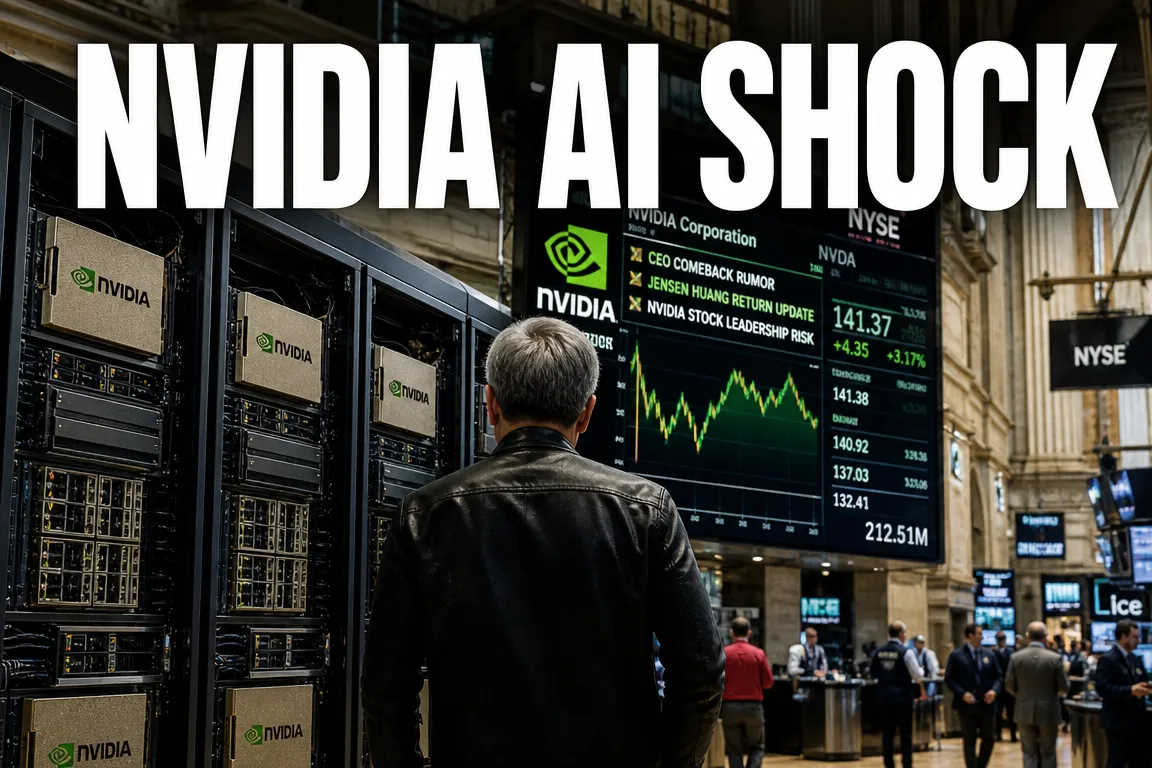
● Nvidia CEO Comeback Bombshell
Jensen Huang CEO Return Rumors: What NVIDIA and AI Semiconductor Investors Should Verify
The central claims in the supplied source—Jensen Huang’s resignation and intention to return as CEO—cannot be verified from the material provided.
The source combines undated social media statements without original links, unsubstantiated reports of a successor appointment, and earnings forecasts with no clearly identified reporting period.
This report separates unverified claims from investment-relevant information, covering financial data verification, leadership risk, and AI data center demand.
The primary issue is not whether return rumors moved the share price, but how to assess the information’s credibility and incorporate it into valuation analysis.
1. Fact Check: Why the Source Cannot Be Treated as Confirmed Breaking News
The reports and regulatory filings have not been cross-checked through a live web search for this report.
Claims concerning a resignation, plans to return, a board investigation, and a search for a successor must therefore be treated as assertions in the supplied material rather than established facts.
- Resignation: Any return narrative first requires official confirmation of an actual resignation or dismissal.
- Social media statements: Verification requires the original post URL, publication date, account authenticity, and full context.
- Board activity: A CEO appointment process cannot be assumed without a company announcement or relevant filing.
- Media citations: Naming a media outlet does not establish that it published the claimed report.
- Share-price response: The magnitude and drivers of a price increase cannot be assessed without trading dates and price data.
The source also includes allegations concerning private conduct and criminal involvement without reliable supporting evidence.
These allegations should not be repeated as facts and should be excluded from investment analysis pending verification.
Unverified means not established as fact; it does not mean this report has determined that every claim is false.
2. Verification Priorities: The Order for Reviewing Official Sources
For breaking news on U.S. equities, a clear hierarchy of sources matters more than speed.
- Official NVIDIA announcements: Check the investor relations website and official newsroom for leadership changes.
- U.S. SEC filings: Review Form 8-K and other relevant filings for CEO changes.
- Original social media posts: Verify account authenticity, timestamps, deletion or revision history, and surrounding context.
- Original news articles: Check the headline, publication date, byline, and reliance on anonymous sources.
- Market data: Compare contemporaneous share-price and trading-volume movements with the semiconductor sector and Nasdaq.
Verification can begin with NVIDIA Investor Relations and the SEC EDGAR search portal.
These links are verification resources, not evidence confirming the source’s claims.
3. Earnings Forecasts: Establish the Period and Methodology Before Using the Numbers
The source identifies earnings per share, revenue, data center revenue, and gross margin as key metrics.
However, it omits the reporting year, fiscal quarter, consensus provider, and estimate date. The figures therefore cannot reliably be cited as current market consensus.
| Metric | Figure Presented in the Source | Required Verification |
|---|---|---|
| Earnings per share (EPS) | $2.47 | Fiscal quarter, GAAP versus non-GAAP basis, and stock-split adjustment |
| Quarterly revenue | $109 billion | Reporting quarter, consensus provider, and numerical units |
| Data center revenue | Approximately $102 billion | Potential transcription errors and the actual segment forecast |
| Gross margin | 74% ±0.5 percentage points | Whether the figure is official guidance and whether it uses GAAP or non-GAAP measures |
| Revenue growth for the following year | An alleged statement of 70% | Original statement, fiscal year, and whether it constitutes official guidance |
These figures reproduce the source’s claims for review; they are not verified results or forecasts.
① EPS comparisons require consistent measurement.
GAAP EPS and non-GAAP EPS, which adjusts for selected items, can differ.
Mixing pre-split and post-split figures can distort growth rates and price-to-earnings ratios.
② Gross margin helps assess the quality of revenue growth.
If quoted accurately, 74% ±0.5 percentage points indicates a range of 73.5–74.5%.
This range should not be used as an earnings benchmark until confirmed as official guidance.
③ “Next-year growth” requires a clearly defined period.
The next calendar year may differ from the company’s next fiscal year. Management’s longer-term expectations must also be distinguished from formal annual guidance.
4. Earnings Release Timing: Korean Time Conversion Requires a Date
The source mentions a social media post at 11:18 a.m. U.S. Eastern Time, an earnings release at 4:20 p.m., and an earnings call at 5:00 p.m.
The time difference between U.S. Eastern Time and Korea depends on daylight saving time.
- Eastern Standard Time (EST): Korea is 14 hours ahead.
- Eastern Daylight Time (EDT): Korea is 13 hours ahead.
For example, 4:20 p.m. corresponds to 6:20 a.m. the following day in Korea under standard time, but 5:20 a.m. under daylight saving time.
The Korean times cited in the source match standard-time conversion. Without a publication date, however, the schedule cannot be confirmed.
References to “today” or “December 1” should not be treated as current dates. Check the official event calendar, including the year.
5. If a CEO Change Is Confirmed: Three Implications for NVIDIA Shares
The following is an analytical framework for a confirmed leadership change, not a statement that such a change has occurred.
① Founder leadership and key-person risk
At founder-led companies, technology strategy, major customer relationships, and decision-making processes can be closely linked to the CEO.
Investors should assess continuity in product strategy and customer relationships rather than focus solely on the executive’s public profile.
② Valuation can move independently of earnings
Share prices reflect both earnings expectations and the valuation multiples investors assign to those earnings.
Greater leadership uncertainty can increase required risk compensation and compress valuation multiples even if earnings forecasts remain unchanged.
③ Execution capabilities matter more than a successor’s name
If succession becomes necessary, priorities include technical-team stability, product launch schedules, and the ability to fulfill customer contracts.
AI semiconductor companies must maintain not only chip design capabilities but also their software ecosystems and system delivery capacity.
6. AI Fundamentals: Separate Leadership News from Business Competitiveness
NVIDIA’s leadership developments and AI infrastructure demand should be assessed as separate dimensions of business value.
- Data center investment: Determine whether major cloud providers’ capital expenditure plans translate into orders and revenue.
- Inference demand: Assess how increased AI service usage affects computing requirements.
- Supply chain: Evaluate whether supplies of high-bandwidth memory, advanced packaging, and networking equipment support system shipments.
- Competition: Identify the workloads for which competing accelerators and customers’ custom-designed chips provide substitutes.
- Software competitiveness: Assess how switching costs for development tools and existing systems influence customer decisions.
- Export restrictions: Review how country-specific sales restrictions and product licensing requirements affect the addressable market.
The global economic outlook also provides important context.
Interest rates, financing costs, power availability, and customers’ returns on investment can affect the pace of AI infrastructure spending.
Rising AI demand does not establish that an individual company’s revenue and earnings will grow at the same rate.
7. Frequently Overlooked Issues: Information Quality Comes Before Price Action
The following analytical considerations can receive insufficient attention in breaking-news coverage.
First, a share-price increase does not validate a news report.
Short-term traders and automated trading systems can respond to unverified information.
Treating a price increase as proof of accuracy creates circular reasoning: market reaction becomes the basis for believing the report.
Second, timing alone does not establish causation.
Even if NVIDIA shares rise after a particular post, sector-wide gains, interest-rate movements, and earnings expectations must also be considered.
Third, precise figures and prominent source names do not replace verification.
Minute-specific timestamps, decimal-point EPS estimates, and executive-search firm names add specificity, but do not establish accuracy without original sources and filings.
Fourth, customers’ deployment capacity can constrain revenue realization despite strong demand.
Data centers require coordinated access to power, cooling, networking, and construction capacity—not GPUs alone.
AI investment analysis should therefore distinguish order volumes from actual installation and commissioning rates.
Fifth, factual verification and investment attractiveness are separate assessments.
Even confirmed positive news may offer limited expected returns if already reflected in the share price.
Conversely, the operational impact of leadership uncertainty should be assessed through subsequent filings and financial results.
8. Final Investor Checklist
- Is there an official announcement or filing confirming a CEO resignation or return?
- Have the original social media post, publication date, and account authenticity been verified?
- Has the cited news article been reviewed directly?
- Are the fiscal quarter and consensus estimate date clearly identified?
- Are EPS and gross margin compared on consistent GAAP or non-GAAP bases?
- Does the analysis avoid overstating causation between news and share-price movements?
- Have leadership risk and AI business competitiveness been evaluated separately?
The available material supports the conclusion that the central claims require verification—not that a return is imminent.
Until the sources are verified, the claims should not be redistributed as confirmed news or used as the sole basis for a trading decision.
< Summary >
- The supplied source does not verify claims concerning Jensen Huang’s resignation, return, or related allegations.
- Official announcements, SEC filings, original social media posts, and original news articles should be reviewed first.
- The financial figures require verification because their reporting periods, sources, and accounting bases are unclear.
- If a leadership change is confirmed, assess strategic continuity, organizational stability, and valuation implications.
- Long-term business analysis should consider AI demand alongside customer returns on investment, power availability, supply chains, and deployment capacity.
[Related Articles…]
*Source: [ Maeil Business Newspaper ]
– [속보] 젠슨황 복귀의사 강력 시사 “엔비디아는 내 평생의 업적…CEO 복귀한다면 영광”