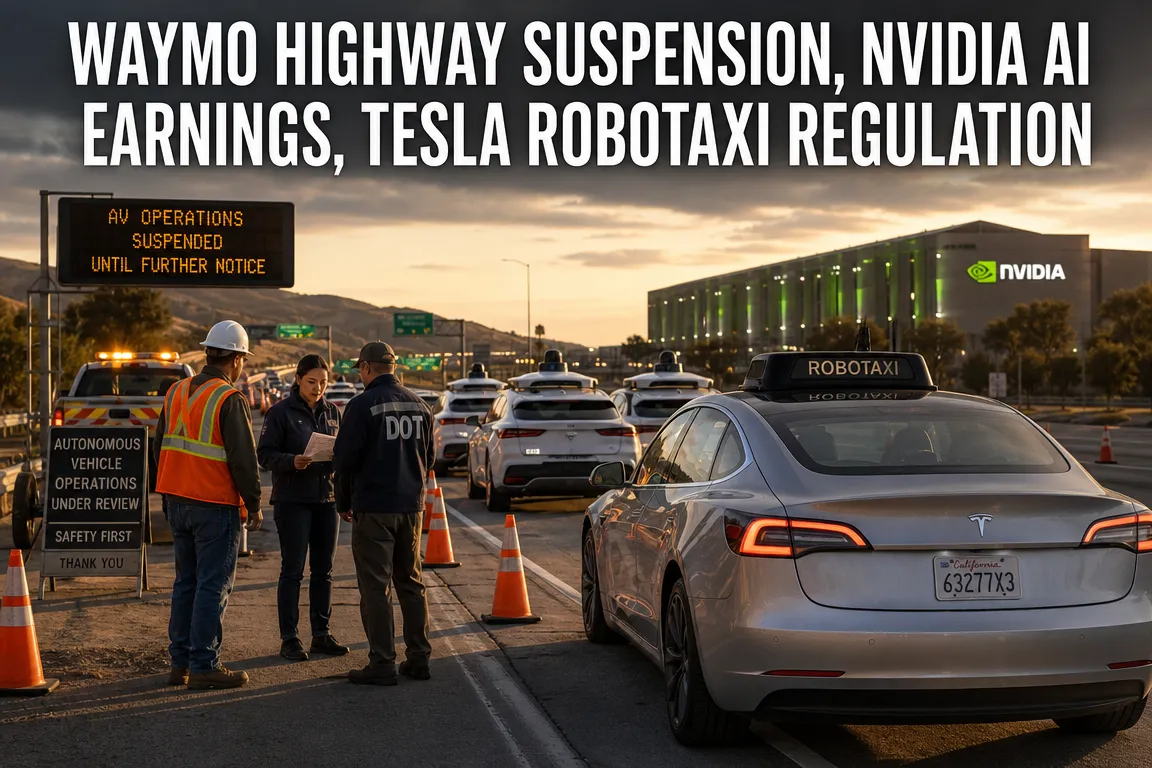
● Waymo Highway Crackdown – Tesla Robotaxi Windfall
Waymo Highway Restrictions: An Opportunity for Tesla? Key Robotaxi Permit and Share-Price Drivers
Restrictions on Waymo’s highway operations would not automatically allow Tesla to capture the affected market.
In California’s robotaxi market, the primary considerations are driverless operating permits, authorization for paid passenger services, and approved service areas, rather than autonomous-driving performance alone.
This report examines the potential operational impact of highway restrictions and the conditions relevant to assessing Tesla’s valuation.
The information provided does not establish whether an official blanket ban on Waymo’s highway operations exists or what its scope would be.
The analysis assumes highway operations are restricted. References to Tesla’s permits reflect the status at the time of the statements discussed.
Confirming permit status as of November 2026 requires the latest records from California regulators.
1. Key Development: A Competitor’s Restrictions Do Not Confer Operating Rights
In conventional markets, competitors may capture customers when a company suspends service.
In autonomous transportation, however, demand alone does not authorize an operator to provide a regulated service.
- Customer demand: Reduced Waymo availability could shift demand toward alternative transportation.
- Service supply: Tesla would need the required local authorizations to serve that demand with driverless robotaxis.
- Revenue conversion: Permits, vehicle deployment, service coverage, and customer support infrastructure must be in place before demand can generate revenue.
Several conditions separate an adverse development for Waymo from an increase in Tesla’s robotaxi revenue.
If Tesla lacks the necessary authorization for paid driverless passenger services, it cannot immediately replace Waymo on affected routes.
2. California’s Permit Framework: Vehicle Operation and Passenger Service Require Distinct Authorizations
California’s robotaxi framework separates the responsibilities of the Department of Motor Vehicles and the Public Utilities Commission.
- California Department of Motor Vehicles (DMV): Oversees autonomous-vehicle testing and deployment permits, distinguishing between operations with a safety driver and driverless operations.
- California Public Utilities Commission (CPUC): Oversees autonomous passenger-service programs and authorization for paid services.
A conventional transportation business permit does not, by itself, authorize commercial driverless robotaxi operations.
Passenger transportation with a human driver and paid transportation in a driverless vehicle are distinct regulatory categories.
The permit reportedly obtained by Tesla, described as comparable to authorization for a limousine operator, should be assessed within this distinction.
The central question is not whether Tesla holds a transportation business permit, but whether it may carry passengers and charge fares without a driver.
3. Four Questions Behind a “Blanket Highway Ban”
Regulatory risk depends on the scope and conditions of an actual measure, not the strength of a headline.
- Official status: Determine whether the measure is a regulatory order, an investigation, a request for restrictions, or a voluntary suspension by the company.
- Geographic scope: Distinguish statewide restrictions from measures affecting specific cities or highway segments.
- Restricted operations: Establish whether the measure applies to paid driverless services, testing, or operations under specific conditions.
- Duration: Determine whether the restriction is temporary, subject to remediation, or a longer-term permit limitation.
These conditions materially affect the implications for Waymo’s business.
Restrictions on selected highway segments should not be interpreted as a suspension of its entire robotaxi service.
4. Waymo’s Economics: Highway Restrictions Affect Travel Time and Vehicle Productivity
Highway access matters beyond enabling higher driving speeds.
For some longer-distance and regional trips, it can shorten travel times and increase the number of trips each vehicle completes.
- Travel time: Diversions onto surface streets may increase journey times on certain routes.
- Vehicle utilization: Longer trips may reduce the number of daily bookings a vehicle can serve.
- Service competitiveness: Customers comparing estimated arrival times and fares may choose alternative transportation.
- Operating efficiency: Longer vehicle repositioning and charging-site access times may affect fleet operations.
The magnitude of the impact depends on local highway dependence, actual trip distribution, and available alternative routes.
Robotaxi economics should be assessed through the efficiency of revenue-generating trips per vehicle, not total mileage alone.
5. Tesla’s Share Price: Expectations and Earnings Improvement Are Distinct
A competitor’s regulatory difficulties could support positive expectations for Tesla.
However, equity-market expectations and operating-profit improvements do not necessarily develop at the same pace.
- Short-term expectations: Slower expansion by a competitor could be interpreted as giving Tesla additional preparation time.
- Medium-term milestones: Monitor whether Tesla secures the required driverless and paid passenger-service authorizations and expands its actual service footprint.
- Long-term validation: Operations must sustain safety and utilization while covering vehicle depreciation, insurance, maintenance, charging, and operational support costs.
Improvements in consumer driver-assistance systems do not automatically confer authorization for paid driverless passenger services.
For AI investors, the stages of “technology demonstration → regulatory approval → commercial operations → profitability validation” should remain distinct.
6. An Overlooked Factor: Alternative Transportation May Capture Demand First
If Waymo cannot serve certain routes, the underlying transportation demand remains.
Customers may shift to services available at the required time and location.
- Conventional ride-hailing: Human-driven vehicles may absorb displaced demand.
- Taxis and prebooked transportation: These services may provide alternatives for longer trips or time-sensitive journeys.
- Private vehicles and public transit: Customers may choose these options based on cost and travel time.
Framing near-term competition solely as Waymo versus Tesla risks overlooking actual shifts in demand.
How regulators classify the underlying issue is also important.
If it is treated as a company-specific operational problem, competitors may gain a relative opportunity.
If it prompts stricter safety validation across driverless operations, later entrants could face higher entry costs and longer preparation periods.
An adverse development for a competitor is not necessarily favorable for Tesla.
7. Investor Checklist
- Official records: Verify permit status, restrictions, and effective dates published by the DMV and CPUC.
- Service conditions: Distinguish driverless authorization, permission to charge fares, geographic coverage, and operating hours.
- Commercial availability: Determine whether the general public can use the service consistently, beyond announcements and demonstrations.
- Operating efficiency: Assess the share of revenue-generating trips, wait times, and trips per vehicle alongside fleet size.
- Profitability: Track insurance, maintenance, and operational support costs alongside revenue growth.
Waymo highway restrictions could create a relative opportunity for Tesla, but would not immediately create a revenue opportunity for driverless robotaxi services in California.
The determining factors are Tesla’s own authorizations and operational readiness, rather than the service gap left by a competitor.
< Summary >
- The existence and scope of any blanket ban on Waymo’s highway operations require official confirmation.
- Conventional transportation business permits differ from authorization for paid driverless robotaxi services.
- Without the required permits, Tesla cannot immediately replace Waymo’s affected services.
- Highway restrictions may affect operating economics through travel times and vehicle productivity.
- Share prices may respond to expectations, while earnings depend on regulatory approval, commercial operations, and demonstrated profitability.
[Related Articles…]
*Source: [ 오늘의 테슬라 뉴스 ]
– 웨이모 고속도로 전면 금지 / 테슬라엔 기회?
● Anthropic IPO Bubble Alert
Anthropic IPO: Six AI Investment Risks Beyond Claude’s Technical Capabilities
Improvements in Claude’s capabilities do not necessarily translate into sustained increases in Anthropic’s valuation.
Assessing Anthropic’s investment appeal requires examining revenue growth sustainability, competition from lower-cost models, enterprise adoption, data center costs, and post-IPO share supply, rather than model performance alone.
A central question is:
“Does rising AI usage translate into higher earnings for model developers?”
1. The Central Anthropic IPO Question: Technical Strength and Investment Value Are Different
Claude’s technical capabilities and the attractiveness of Anthropic’s shares are separate considerations.
Technology supports a company’s growth potential, but investment returns depend substantially on the price paid for that potential.
- Technology: How accurately can Claude complete complex tasks?
- Business: How much will customers consistently pay for those capabilities?
- Investment: How much expected growth is already reflected in the valuation?
A highly valued company’s shares can decline despite strong operating results.
If market expectations exceed actual growth, revenue can rise while the share price falls.
Evaluating an Anthropic IPO therefore requires estimating the operating performance needed to justify its valuation, rather than simply assessing AI’s long-term prospects.
2. Growth Risk: Recent Momentum Matters More Than Headline Annual Growth
Early-stage companies can report exceptionally high year-over-year growth because the prior-year revenue base is small.
Annual comparisons may therefore obscure a slowdown in recent quarterly growth.
Investors should assess the following metrics together.
- Year-over-year growth: Measures business expansion over the preceding year.
- Quarter-over-quarter growth: Indicates whether recent expansion remains on track.
- Existing-customer spending: Shows whether usage and payments continue to increase after adoption.
- New-customer conversion: Indicates whether interest and trials generate paid business.
Annualized revenue must also be distinguished from actual annual revenue.
For example, monthly revenue of $1 billion implies an annualized revenue run rate of $12 billion.
This assumes that the month’s revenue level persists for a full year; it does not mean the company has already generated $12 billion.
Temporary usage spikes or changes in major customers’ spending can create substantial differences between annualized figures and actual annual results.
Third-party data can be useful, but its coverage must be assessed.
Consumer subscriptions or API usage on a specific platform may not adequately capture enterprise contracts and revenue generated through cloud providers.
Official results, management forecasts, and external estimates must remain clearly separated.
3. Pricing Risk: Sufficiently Capable AI May Be Preferred to the Highest-Performing Model
Not every AI coding task requires the most capable model.
Enterprises have limited incentive to pay the same rate for complex system design and routine code changes.
- Complex tasks: Advanced reasoning, large-scale code changes, and tasks with high error costs may favor higher-performing models.
- Routine tasks: Document summarization, format conversion, and repetitive code generation may be adequately served by cheaper models.
- Sensitive tasks: Data-control and security requirements may favor self-hosted models or dedicated enterprise environments.
Enterprises may therefore adopt a multimodel strategy, allocating workloads according to task complexity and cost rather than relying on a single model.
OpenAI’s coding tools and models including DeepSeek, Qwen, GLM, and Kimi expand the available alternatives.
Performance differences and price comparisons vary by version, input and output tokens, caching, and contract terms; no single ratio adequately represents the market.
The relevant benchmark is the total cost of successfully completing a task, not the price per token.
If a cheaper model requires repeated attempts and additional review, a higher-performing model may be more economical.
For simpler tasks, limited performance differences may make price the primary consideration.
Anthropic does not need to capture all AI usage.
Its priority is to secure workloads for which customers will pay a premium and sustain profitability in those segments.
4. Customer Retention Risk: Switching Models Is Not the Same as Switching Enterprise Systems
Customers may find it easier to test competing AI models than to replace some other types of software.
Standardized interfaces and model-routing platforms can reduce the effort required to compare and switch models.
However, enterprise migration typically involves more than changing an API endpoint.
- Output validation: Response formats and accuracy can differ for identical requests.
- Integration changes: Function calling, agent execution, and long-context processing require review.
- Security and legal review: Data retention, processing locations, and contractual terms may require reassessment.
- Operational validation: Latency, incident response, and usage limits must be tested.
Switching may be straightforward for a basic summarization service but substantially more costly for systems embedded in critical workflows.
Anthropic’s long-term competitive position depends on developer tools, workflow integration, security, and operational reliability alongside model performance.
Deeper integration into enterprise workflows can reduce reliance on price-based competition.
5. Enterprise Adoption Risk: Better Models Alone Do Not Guarantee Revenue Growth
Enterprise adoption can progress more slowly than adoption among developers who actively use AI.
Even when employees recognize a model’s capabilities, inadequate organizational infrastructure can limit practical deployment.
Four principal bottlenecks constrain enterprise AI adoption.
- Data access: Required documents and operational data may be fragmented, with poorly defined access permissions.
- Security and compliance: Personal information, trade secrets, and restrictions on external data transfers may limit deployment.
- Accountability: Responsibility for reviewing AI outputs and addressing errors may be unclear.
- Workflow redesign: Organizations may distribute tools without providing training or adapting processes.
Model improvements alone do not resolve these constraints.
Enterprises must also revise access controls, review procedures, and performance criteria.
AI competition is likely to extend beyond model capabilities to enabling effective organizational deployment.
These constraints may limit Anthropic’s growth rate while creating opportunities in security, data integration, and workflow automation.
6. Data Center and IPO Share-Supply Risks: Growth Expectations and Cash Outflows May Diverge
The first risk is the timing gap between infrastructure commitments and realized demand.
AI companies may secure computing capacity in advance to meet expected customer demand.
If revenue grows more slowly than anticipated, that capacity can become a cash-flow burden.
Total contract commitments should not be compared directly with a single year’s revenue.
- Determine the period over which contractual spending occurs.
- Distinguish minimum purchase obligations from usage-based spending.
- Review prepayments, cloud credits, and discounts.
- Assess whether schedules or contractual terms can be adjusted.
- Evaluate affordability using gross profit and available cash, rather than revenue alone.
The central issue is the timing and scale of cash inflows and outflows, not revenue alone.
Even rapid revenue growth may require additional financing if inference costs and research and development spending rise faster.
The second risk is the change in tradable share supply after listing.
A limited initial public float can amplify price movements driven by supply and demand.
Subsequent lockup expirations can increase the number of shares existing shareholders are permitted to sell.
However, a lockup expiration does not necessarily trigger substantial selling or a price decline.
Relevant factors include the shares released, their proportion of the existing float, trading value, and shareholders’ actual selling intentions.
Anthropic’s specific lockup terms cannot be established without official disclosures, and neither an initial price increase nor a subsequent decline should be assumed.
Additional Analysis: Where the Economic Benefits of AI Growth Accrue
① Higher AI usage does not necessarily mean higher revenue for model developers.
Revenue growth can weaken if unit prices fall faster than usage expands.
If usage doubles while the average price halves, revenue remains unchanged, all else equal.
Profitability may nevertheless improve if processing costs decline sufficiently; lower prices alone do not establish business deterioration.
② The allocation of cost savings between customers and suppliers is critical.
Intense competition may force developers to pass inference-cost savings to customers through lower prices.
Distinctive task performance and reliability may instead allow developers to retain those savings as higher margins.
Investors should therefore assess pricing power alongside the pace of technical improvement.
③ Enterprise performance metrics should emphasize business outcomes rather than token consumption.
Higher token usage does not necessarily indicate greater productivity.
Repeated errors and unnecessary retries can increase consumption without creating additional value.
Enterprises should measure AI returns through deployment time, error rates, processing volumes, review time, and customer-service costs.
④ Weakness at an individual model developer does not imply an industry-wide AI downturn.
Customer migration may redistribute computing demand among suppliers rather than eliminate it.
However, slower-than-expected monetization across the industry could affect investment schedules for data centers, semiconductors, and power infrastructure.
Distinguishing company-specific market-share losses from an industry-wide demand slowdown is essential to assessing implications for the global economy and technology equities.
Conditions That Could Reduce Investment Concerns
Anthropic retains growth potential.
However, a positive outlook requires verifiable operating evidence to support an investment case.
- Growth quality: New-customer acquisition should be accompanied by increasing spending from existing customers.
- Profitability: Inference-cost reductions and gross-margin improvement should remain achievable despite pricing pressure.
- Enterprise adoption: Pilot deployments should convert into recurring usage and long-term contracts.
- Cash-flow resilience: Infrastructure spending schedules should remain aligned with financing capacity.
- New-market monetization: Biotechnology, research, and specialized professional applications should generate paid contracts and revenue beyond technical demonstrations.
Biotechnology offers substantial potential, but translating research results into commercial revenue may require validation and regulatory procedures.
Long-term growth opportunities should therefore be distinguished from near-term cash-flow solutions.
The central Anthropic IPO question is not whether AI has a future, but the price and terms at which investors gain exposure to its potential earnings.
< Summary >
- Claude’s technical performance does not guarantee attractive equity returns.
- Assess recent quarterly momentum and actual revenue alongside annual growth rates.
- Lower-cost models and multimodel strategies may pressure pricing power.
- Enterprise adoption requires security, data integration, and organizational change as well as capable models.
- Data center payment schedules and cash-flow implications matter more than headline contract values.
- IPO timing, valuation, financial results, and lockup terms require verification through official disclosures.
- Customer outcomes and sustainable earnings matter more than usage alone.
This analysis addresses industry structure and investment risks and does not recommend buying or selling any security.
*Source: [ 내일은 투자왕 – 김단테 ]
– 앤트로픽 IPO가 걱정되는 이유