● Volatility Surge
AI IPO Disappointment, AMD Short Report, and Falling Oil Prices… The Real Core Point to Watch in the U.S. Stock Market Right Now
Today’s core point is not simply that “the Nasdaq wavered.”
What matters is the supply-demand burden after AI company listings, the short-seller report targeting AMD, the trust risk across the semiconductor market, and the simultaneous drop in oil prices and refining margins.
In particular, this issue is a flow that connects the U.S. stock market, the Nasdaq, the semiconductor market, AI investment, inflation, and interest rate outlook all at once, so investors need to view it quite carefully.
1. Overall Market Flow: From Early Strength to a Sharp Reversal
At first glance, this U.S. market was not in bad shape early in the session.
As expectations around Texas data center approvals revived, the Nasdaq initially opened strong.
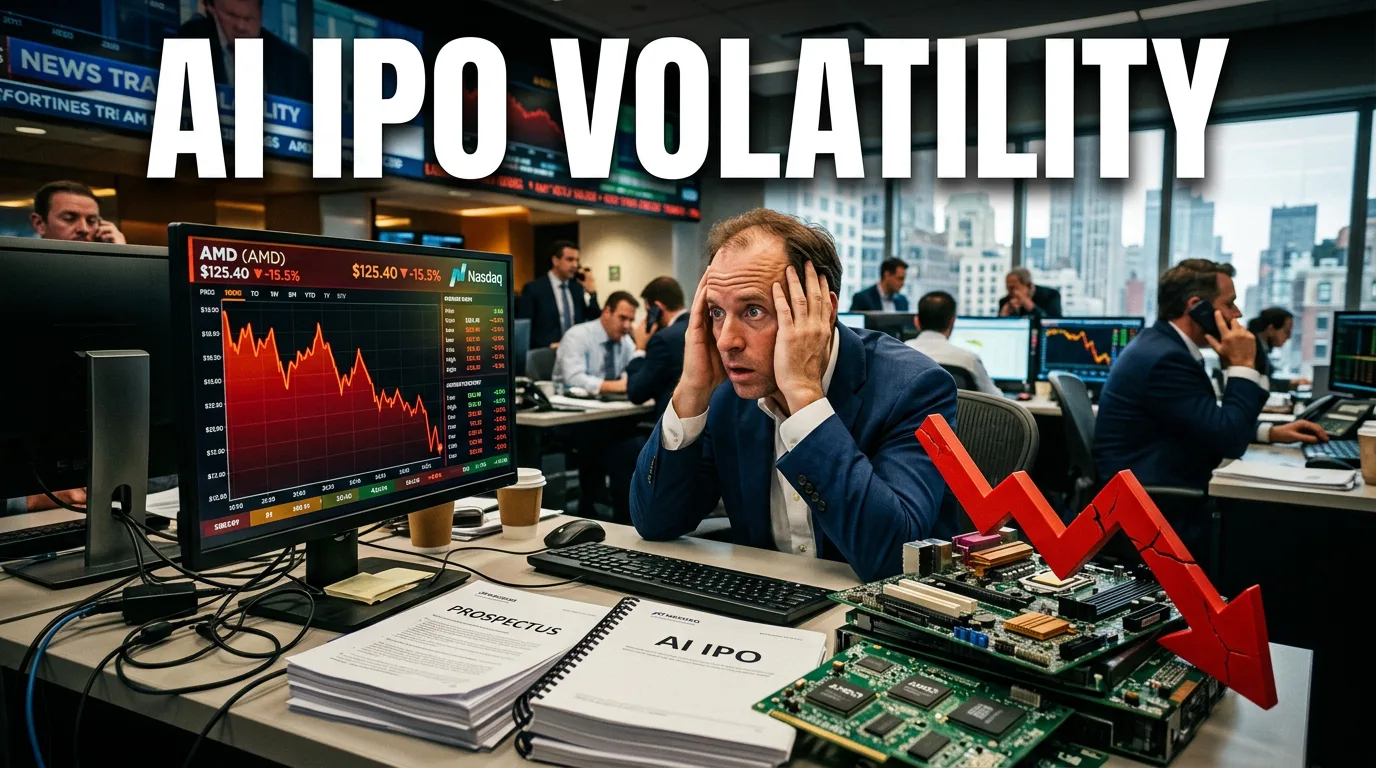
However, disappointment related to AI company listings and the AMD short report quickly soured market sentiment.
- Early session: Technology and AI-related stocks strengthened on expectations of data center approvals
- Intraday reversal: AI IPO supply pressure and an allegation-heavy AMD report worsened investor sentiment
- Result: Increased volatility as the Nasdaq quickly moved from positive territory into negative territory
In this kind of market, short-term supply-demand dynamics and investor sentiment often move stock prices more sharply than fundamentals.
Especially for leveraged investors, even a single day’s price range can significantly increase losses, making risk management more important in this phase.
2. AI IPO Issue: The Problem Is Not Company Value, but the “Shares Flooding In After Listing”
The most important point in this AI listing issue is not the listing price itself, but the number of shares that can be released into the market immediately after listing.
Right after a listing, how many holdings from early investors, employees, and venture capital firms can be sold, and when, has a major impact on price volatility.
Based on the figures mentioned in the original text, the immediately sellable amount was presented at roughly 315 million shares.
At the IPO price of $83, that works out to about $26 billion.
In Korean won, that exceeds 30 trillion won, which is more than enough to weigh on the market.
- Core variable: The number of shares that can be traded immediately after listing
- Investor sentiment: Concerns that early investors may rush to take profits
- Market impact: Even with strong AI enthusiasm, short-term price volatility can increase
Even if an AI company has strong long-term growth potential, its stock does not move purely on company value right after the IPO.
In the short run, “who can sell how much” often matters more.
That is why, in AI IPO investing, it is better to check the lockup release schedule and float size before the growth story.
3. AMD Short Report: Why It Shook the Entire Semiconductor Market
AMD came under strong downside pressure after a short report was released.
The core point of the report was concerns over AMD’s exposure to China-related revenue and parts of its supply chain structure.
However, because short reports can reflect vested interests, investors need to separate claims from facts.
- Claim in the short report: Suspicion that AMD’s revenue share related to China and Singapore may be larger than expected
- Market reaction: AMD’s plunge worsened sentiment across the entire semiconductor space
- AMD’s position: A rebuttal stating that it complied with export control regulations
What matters here is not just one AMD stock, but the trust risk across the entire semiconductor supply chain.
AI semiconductors are a strategic U.S. industry and are directly tied to export restrictions on China.
So even one allegation-heavy report on a specific company can shake Nvidia, AMD, semiconductor equipment stocks, and data center-related stocks together.
Personally, when issues like this arise, I think it is better not to immediately conclude that “the company is in danger,” but instead to examine three things separately.
First, whether there is actual revenue damage.
Second, whether the regulatory risk is likely to expand.
Third, whether institutional investors are reducing positions because of the issue.
4. Nvidia Leadership Issue: The Hidden Risk in the AI Market
The market also discussed uncertainty related to Nvidia’s leadership.
In the AI semiconductor industry, the presence of a key executive is not just symbolic.
That is because it connects to the technology roadmap, customer network, developer ecosystem, and relationships with major cloud companies.
If leadership vacuum or governance uncertainty grows at a leading AI company, the market has no choice but to react sensitively in the short term.
The AI investment market is already being asked to justify high valuations with strong growth and strong execution.
If a leadership issue arises in that environment, stock price volatility can increase further.
- Core asset of AI companies: Not just technology, but founder networks and customer trust
- Market risk: Leadership uncertainty is a valuation discount factor
- Investment point: The higher the dependence on a single individual, the more governance needs to be checked
5. Refining Margins and Oil Prices: A Positive Signal Hidden in Bad News
The relatively positive part of this market is the trend in oil prices and refining margins.
Refining margin is the profit an oil refiner keeps when it buys crude oil and sells it as products like gasoline or diesel.
In simple terms, it is the difference between crude oil prices and petroleum product prices.
The recent sharp drop in refining margins means refinery profit rates are falling.
At the same time, for consumers, it also means gasoline and diesel prices at gas stations may come down further.
- Refining margin decline: Greater downward pressure on gasoline and diesel prices
- Oil price stability: Potential easing of inflation pressure
- Interest rate outlook: If price pressure eases, the Fed’s justification for further tightening weakens
This part matters quite a bit for the stock market.
If oil prices stabilize and inflation pressure eases, the Fed may no longer need to raise rates as aggressively.
Ultimately, that could become a positive factor for the U.S. stock market and growth stock valuations over the long term.
6. The Core Perspective on the Market Right Now: Fear Has Risen, but Prices Have Fallen
It is also important to note that the S&P 500 and Nasdaq have corrected significantly from their highs.
The Nasdaq often experiences a correction of around 10% about once a year.
A 15% decline feels substantial to investors, but historically, markets have eventually found a new equilibrium after major crises.
Of course, this does not mean this is definitely the bottom.
Still, unless we are facing a complete AI bubble collapse or a full-blown recession, the valuations of some high-quality companies can be seen as moving into a more reasonable range.
- Short-term risks: Short reports, IPO supply, policy uncertainty, high interest rate burden
- Mid-term opportunity: AI infrastructure investment, data center expansion, continued semiconductor demand
- Long-term checkpoints: Easing inflation and changes in interest rate outlook
7. The Most Important Detail Easy to Miss in Other News
The real core point of this issue is not whether AMD is right or wrong.
The most important thing is that the market’s trust in AI leader stocks has become much more sensitive than before.
- First, AI companies can no longer be judged by growth alone.
They are now entering a phase where revenue quality, customer structure, regulatory risk, and supply chain transparency are all being scrutinized together. - Second, short reports target the market’s weak points.
Regardless of whether a company actually has a problem, if the report touches on what investors are anxious about, the stock reacts first. - Third, right after an IPO, supply-demand can matter more than company value.
No matter how good the AI company is, if early investor shares can flood the market, short-term stock prices are likely to swing. - Fourth, falling oil prices and refining margins are an unexpected buffer.
Even if the semiconductor market weakens, lower inflation pressure can ease rate expectations and support the market floor. - Fifth, position management matters more than individual stocks right now.
As much as buying good companies matters, it is also necessary to reduce leverage and manage cash allocation.
8. A Checklist Investors Need to Review Right Now
- If you are an AI IPO investor: Check the lockup expiration schedule, the number of shares that can be traded, and the share ratio held by early investors.
- If you are an AMD investor: Look at the China revenue share, export control-related disclosures, and major customer contract status.
- If you are an Nvidia investor: The data center demand and next-generation GPU roadmap matter more than leadership issues.
- If you are a Nasdaq investor: Check the interest rate outlook, U.S. Treasury yields, and inflation indicators together.
- If you are a leveraged investor: In a volatile market like this, you must first set your loss-control rules.
9. Conclusion: The Market Is Unstable, but Opportunity Is Created in Fear
The market right now is clearly not in a normal stable phase.
AI investment enthusiasm is still alive, but valuation pressure and regulatory risks have grown as well.
The semiconductor market has strong long-term growth potential, but in the short term it can still be shaken by short reports and political risk.
That said, oil price stability and the possibility of easing inflation are positive variables for the market.
If interest rate expectations ease, growth stocks and technology stocks may breathe easier again.
In the end, instead of chasing aggressively right now, it is more realistic to select good companies, build positions in stages, and endure volatility.
In particular, key industries such as AI semiconductors, data centers, cloud infrastructure, and power grids are structurally difficult to derail even if short-term corrections occur.
Still, the more unstable the market becomes, the more important it is not to “buy good companies at expensive prices,” but to “buy good companies in stages at prices you can withstand.”
< Summary >
AI IPO disappointment and the AMD short report increased volatility in the U.S. stock market and the Nasdaq.
The burden of post-listing float is a short-term risk for AI company stocks.
The AMD issue spread beyond an individual company to become a regulatory risk across the semiconductor market.
Falling oil prices and refining margins are positive for easing inflation and stabilizing rate expectations.
Right now, cash management matters more than leverage, and staged buying matters more than short-term trading.
[Related Articles…]
- AI Semiconductor Market Volatility and Investment Strategy
- Key Takeaways on Easing Inflation and Interest Rate Outlook
*Source: [ 월텍남 – 월스트리트 테크남 ]
– 앤트로픽 대실망에, AMD 공매도까지 “뭔가 수상합니다”