● Nasdaq Bloodbath, Chip Crash, Fed Fear
Nasdaq Declines and Semiconductor Weakness: Signals to Monitor in Fed Policy and AI Investment
A substantial price decline does not establish a market bottom, and Federal Reserve rate cuts do not necessarily mark the start of a bull market.
During a sharp selloff, the key consideration is the sequence in which inflation, interest rates, and corporate earnings stabilize.
The following examines Nasdaq and semiconductor declines, the rationale for monetary tightening, conditions for a recovery in AI-related equities, and the economic effects of stockpiling.
1. Nasdaq -20%, Semiconductors -44%: Establish the Basis of Comparison
The reference point matters more than the magnitude of the decline alone.
The same percentage decline has different implications depending on whether it refers to the Nasdaq Composite, the Nasdaq-100, a semiconductor index, or an individual stock.
Year-to-date returns must also be distinguished from peak-to-trough drawdowns.
- Benchmark: Determine whether the decline reflects a broad market correction or a shock concentrated in a particular industry or company.
- Measurement period: Comparing declines across different periods can distort assessments of sector risk.
- Underlying cause: Distinguish valuation compression driven by higher interest rates from deterioration in earnings expectations.
Percentage losses and the gains required to recover them are not symmetrical.
An asset that falls 20% requires a 25% gain to recover its original value; a 44% decline requires a gain of approximately 78.6%.
A large drawdown is not sufficient evidence of an investment opportunity. Assess whether earnings can support a recovery.
2. Federal Reserve Tightening: Why Inflation Takes Priority over Equity Prices
The Federal Reserve’s objectives are price stability and maximum employment, not lower equity prices.
However, persistently elevated inflation increases the incentive to maintain restrictive monetary policy despite the risk of an economic slowdown.
- Higher interest rates: Rising borrowing and financing costs restrain consumption and business investment.
- Tighter financial conditions: Falling asset prices and stricter lending standards can constrain spending.
- Inflation expectations: Policy seeks to prevent expectations of persistent inflation from becoming embedded in wage and price setting.
Monetary policy has important limitations.
Higher interest rates do not increase oil supply or immediately resolve logistics bottlenecks.
Because monetary policy works primarily by restraining demand, disinflation may coincide with an economic slowdown when supply shocks are significant.
Assess the breadth and persistence of inflationary pressures rather than relying solely on the tone of Federal Reserve communications.
3. When Could U.S. Equity Market Stress Ease? Four Signals to Monitor
A market bottom is difficult to identify in real time.
Concurrent improvement in the following indicators can help assess the sustainability of a rebound.
- ① Broader disinflation: Look for easing pressure in core and services inflation, rather than lower energy prices alone.
- ② Reduced interest-rate uncertainty: Monitor whether volatility in policy-rate expectations and Treasury yields subsides.
- ③ Stabilizing earnings expectations: Assess whether earnings estimates continue to fall after equity prices decline.
- ④ Credit market stability: Check whether corporate credit spreads and financing conditions are deteriorating.
Equities can rise before all four indicators improve.
Markets may anticipate changes in economic data.
However, declining inflation accompanied by rising corporate default risk does not make lower interest rates unambiguously positive.
Rate cuts enabled by lower inflation have different equity market implications from rate cuts intended to counter a recession.
4. Semiconductors and AI Equities: Industry Growth Does Not Guarantee Share-Price Recovery
AI market growth does not imply uniform improvement in semiconductor companies’ earnings or share prices.
Memory, advanced computing chips, foundries, and semiconductor equipment have different business models and demand exposures.
- Memory: Monitor inventories, supply adjustments, and product-level pricing trends.
- AI computing chips: Customer data center spending and suppliers’ delivery capacity are critical.
- Foundries: Assess process technology competitiveness alongside capacity utilization and capital expenditure requirements.
- Semiconductor equipment: Review customer investment schedules and the effects of export restrictions.
AI investment requires separate assessments of technology demand, supplier profitability, and equity valuation.
Demand growth can coincide with margin pressure from competition. Even strong earnings may produce weak investment returns if valuations already reflect excessive expectations.
If buyers of AI infrastructure fail to generate adequate returns on investment, capital expenditure growth could slow.
5. Crisis Narratives and Stockpiling: Separate Evidence from Sentiment
The supplied title alone does not establish that stockpiling was widespread across the United States.
Verification requires data on the products affected, geographic coverage, and severity of shortages.
Empty shelves at individual stores or sensational videos may not represent broader economic conditions.
- Actual supply disruptions: Identify verifiable causes such as production shutdowns, logistics disruptions, or natural disasters.
- Precautionary purchases: Determine whether consumers buying earlier and in larger quantities caused temporary shortages.
- Unverified claims: Do not use apocalyptic narratives or conspiracy theories as evidence for economic forecasts.
Stockpiling can bring future consumption forward.
This may raise near-term sales but weaken subsequent demand. Companies that mistake the increase for sustained growth may accumulate excess inventory.
Distinguish uncertainty-driven purchases from underlying demand growth.
6. A Key Distinction: Earnings Pressure Can Persist after Discount-Rate Pressure Eases
During a sharp selloff, falling share prices can coincide with declining fundamental value.
Distinguishing these processes is more important than comparing drawdowns alone.
- The first pressure is the discount rate.
Higher interest rates reduce the present value of future earnings, potentially lowering share prices even when earnings forecasts remain unchanged. - The second pressure is declining earnings.
As weaker economic activity affects revenue and margins, equities may face additional pressure even after interest rates stabilize. - The third variable is financing capacity.
Companies with near-term debt maturities and weak cash generation may be more exposed to high interest rates.
For example, if a share price falls 20% while expected earnings per share decline 30%, the forward price-to-earnings ratio rises, all else equal.
The stock becomes cheaper in absolute terms but more expensive relative to expected earnings.
Connecting the global economic outlook to investment decisions therefore requires monitoring earnings estimates, cash flow, and debt maturities, alongside inflation and interest rates.
Rather than attempting to identify the exact market bottom, investors can define their investment horizon and loss tolerance, then evaluate phased purchases and allocation adjustments accordingly.
< Summary >
- The cited Nasdaq and semiconductor declines lack verified dates and reference points and should not be treated as current market figures.
- Federal Reserve efforts to reduce inflation may also weaken economic activity and corporate earnings.
- Assess market stabilization through inflation, interest rates, earnings, and credit conditions together.
- Evaluate AI industry growth, individual company profitability, and equity valuation separately.
- Distinguish stockpiling claims and conspiracy narratives from verified supply and sales data.
- Earnings resilience and cash generation matter more than the size of a share-price decline alone.
[Related Articles…]
*Source: [ 소수몽키 ]
– 나스닥-20% 반도체-44%, 패닉 공포 언제 끝날까/충격 줘서라도 물가 잡는다? 연준발 긴축 공포/종말 대비에 사재기? 음모론에 휩싸인 미국
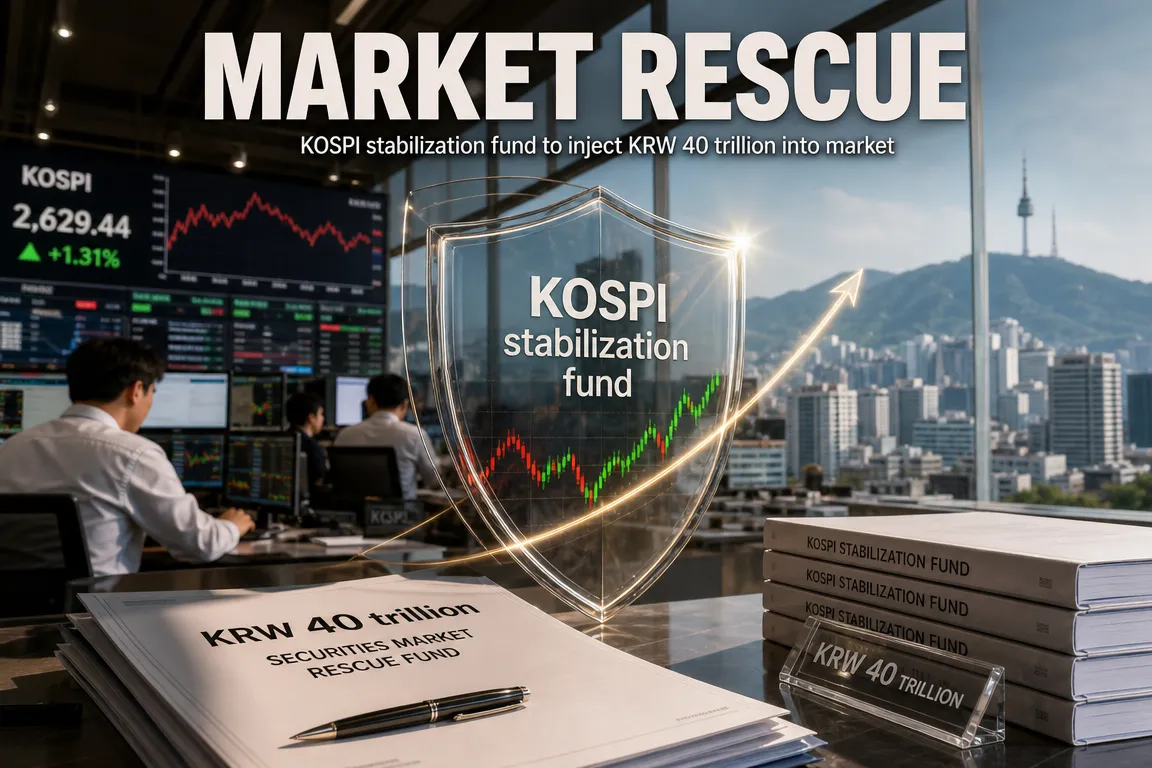
● Kospi Crash Panic – Forty Trillion Won Rescue Fund
Expanding the Securities Market Stabilization Fund to KRW 40 Trillion: What Else Is Needed to Contain a KOSPI Sell-Off?
The effectiveness of a securities market stabilization fund depends less on its announced size than on how quickly and sustainably it can reduce market uncertainty.
The rationale for a KRW 40 trillion fund, the effectiveness of share buybacks, and the relationship between foreign net selling and exchange rates provide a framework for assessing policy outcomes.
The cited 2026 index levels, trading flows, and policy implementation status remain unverified against official sources. Market capitalization and trading amounts used in the calculations below are assumptions, not confirmed current data.
1. A Market Stabilization Fund Is a Buffer Against Disorderly Selling, Not a Price Guarantee
A securities market stabilization fund pools contributions from financial institutions and other participants to support equity purchases during periods of market stress.
Contributors, eligible investments, and execution methods depend on the fund’s structure and operating mandate.
- Primary objective: Mitigate supply-demand imbalances and deteriorating sentiment when buying interest contracts sharply.
- Potential benefit: Interrupt the cycle in which falling prices trigger collateral shortfalls and forced liquidation, leading to further declines.
- Policy limitation: Fund purchases alone cannot resolve deteriorating corporate earnings or sustained global capital outflows.
The fund functions primarily as a shock absorber.
It should not be interpreted as a commitment to defend a specific KOSPI level or guarantee rising share prices.
Policy objectives and perceived support levels are distinct from legal or economic guarantees of principal.
2. Why KRW 40 Trillion? Scaling Intervention Capacity to Market Size
The case for a KRW 40 trillion fund rests on a straightforward premise: stabilization resources should increase as the equity market expands.
| Comparison | Calculation Assumptions | Implication |
|---|---|---|
| Reference market | Market capitalization of KRW 1,000 trillion; fund size of KRW 10 trillion | The fund equals 1% of market capitalization |
| Expanded market | Market capitalization of KRW 4,000 trillion; fund size of KRW 10 trillion | The fund’s relative size falls to 0.25% |
| Maintaining the same ratio | Market capitalization of KRW 4,000 trillion; fund size of KRW 40 trillion | The fund equals 1% of market capitalization |
Under these assumptions, KRW 40 trillion would preserve the fund’s size relative to the market.
If the reference fund were KRW 10.7 trillion rather than KRW 10 trillion, an exact fourfold increase in market capitalization would imply a fund size of KRW 42.8 trillion.
KRW 40 trillion is therefore a benchmark for discussing expansion, not an established optimal amount.
Deploying capital equivalent to 1% of market capitalization does not imply a 1% increase in the index.
Price effects depend on order-book depth, selling pressure, execution timing, and investor sentiment—not a simple ratio between fund purchases and market capitalization.
3. Appropriate Fund Size Depends More on Selling Pressure and Intervention Duration
Market capitalization provides a useful starting point, but operational effectiveness depends on the size and duration of the shortfall in buying demand.
- Selling pressure: Assess whether net selling by foreign and institutional investors is temporary or persistent.
- Other sources of demand: Evaluate the capacity of pension funds, retail investors, and corporate buybacks to absorb selling.
- Execution speed: Examine daily deployment capacity and the conditions for increasing intervention.
- Additional funding capacity: The ability to secure further capital can strengthen policy credibility.
A KRW 10 trillion fund deployed at KRW 1 trillion per day would last 10 trading days.
A KRW 40 trillion fund would last 40 trading days at the same rate.
These assumptions illustrate the pace of fund depletion, not an actual investment schedule.
Daily trading turnover of KRW 20 trillion does not establish that a KRW 10 trillion fund would be insufficient.
Turnover measures the total value of completed transactions; the fund does not need to replace all market activity.
The key is its ability to supplement insufficient buying demand during sharp price dislocations, not to match total trading turnover.
4. Share Buybacks Can Complement Intervention, but Relaxing Limits Does Not Ensure Purchases
Share buybacks use corporate cash to repurchase a company’s own stock.
While a stabilization fund addresses broader market stress, buybacks directly affect individual stocks’ supply-demand conditions and shareholder-return expectations.
Relaxing repurchase limits does not necessarily increase actual buyback activity.
- Financial capacity: Assess cash and cash equivalents alongside debt, working-capital needs, and planned investment expenditure.
- Board approval: Management and directors must evaluate whether repurchases are justified by the share price and business outlook.
- Actual execution: Announced and completed repurchases may differ, requiring disclosure review.
- Subsequent treatment: Cancellation, holding purposes, and potential resale affect the implications for shareholder value.
AI semiconductor companies face capital-allocation trade-offs between shareholder returns and production expansion.
Excessive buybacks could constrain research and development or capital expenditure.
Assessment should therefore consider long-term competitiveness as well as near-term price support.
A share-price decline following a buyback does not automatically establish criminal breach of trust by directors.
Legal assessment depends on the decision-making process, information available at the time, and whether the decision served the company’s interests.
5. Short-Selling Surveillance and Margin Relief: Distinguishing Benefits from Risks
① Enhanced short-selling surveillance is not a short-selling ban.
Monitoring illegal short selling and market abuse can strengthen confidence in market integrity.
It does not eliminate legitimate selling or price declines driven by earnings concerns.
② Relaxing collateral maintenance requirements can delay forced liquidation but does not eliminate losses.
Reducing simultaneous forced sales may ease near-term selling pressure.
If prices continue to fall, however, leveraged investors may incur larger losses and retain outstanding debt even after collateral liquidation.
Where such measures are implemented, investors should verify eligibility, application requirements, and duration through their broker’s official guidance.
Automatic application across all accounts or uniform terms across brokers should not be assumed.
6. Why Foreign Net Selling, USD/KRW, and AI Investment Prospects Must Be Assessed Together
The effectiveness of domestic stabilization measures depends on more than local equity flows.
The global economic outlook, interest-rate expectations, USD/KRW, and perceptions of AI industry profitability also influence outcomes.
First, exchange rates affect foreign investors’ realized returns.
Even if Korean share prices remain unchanged, won depreciation can reduce dollar-denominated returns.
The impact depends partly on currency hedging, but persistent currency instability may sustain foreign selling despite equity-market support.
Second, interest rates affect valuation benchmarks.
Higher expected interest rates reduce the present value of future earnings and can pressure growth stocks.
Rate declines driven by recession concerns may offer limited support if weaker earnings offset valuation benefits.
Third, the causes of AI-related share-price corrections must be distinguished.
Recovery conditions differ depending on whether a decline reflects profit-taking, valuation compression, reduced data-center investment, or weaker semiconductor demand.
AI investment prospects are better assessed through major companies’ capital-expenditure plans, order trends, cash flows, and monetization progress than through share-price declines alone.
A stabilization fund may slow a sell-off, but it does not directly improve AI companies’ earnings prospects.
7. Beyond KRW 40 Trillion: Credible Execution Matters More Than Headline Size
① Announced funding may differ from immediately deployable capital.
Committed contributions, paid-in capital, and funds ready for investment should be assessed separately.
A large announcement offers limited protection during a sell-off if deployment is delayed.
② Policy success depends on the return of private-sector buying, not the volume of fund purchases.
Continued purchases by policy-backed funds alongside private investor withdrawals would indicate growing reliance on intervention.
Conversely, limited deployment could have a substantial stabilizing effect if it restores confidence and attracts private capital.
③ Raising KRW 40 trillion also carries costs.
If financial institutions provide the capital, their liquidity and capital burdens require assessment.
Funding arrangements should not undermine other financial functions.
④ Index stabilization may not translate into comparable support for individual stocks.
A mandate focused on large-cap stocks or major indices may provide uneven benefits to small- and mid-cap companies.
A KOSPI rebound does not remove the need to assess individual holdings’ liquidity and financial risks.
⑤ Exit planning is as important as purchase planning.
Uncertainty about subsequent asset disposals may create an expected selling overhang.
Detailed trade timing need not be disclosed, but clear operating principles and accountability arrangements support credibility.
8. Investor Checklist Following a Policy Announcement
- Policy execution: Distinguish proposals from confirmed measures and verify deployment timing and eligible investments.
- Foreign investor flows: Assess selling intensity across multiple trading sessions alongside futures-market positioning.
- Exchange rates: Monitor whether an equity rebound coincides with easing won depreciation.
- Corporate earnings: Determine whether earnings expectations are stabilizing across major industries, including semiconductors.
- Share buybacks: Prioritize completed purchases and cancellation plans over announced amounts.
- Asset allocation: Review cash allocations and loss tolerance before increasing leverage on policy expectations.
Primary sources include policy announcements from the Financial Services Commission and Financial Supervisory Service, Korea Exchange market statistics, and corporate filings on DART.
The KRW 40 trillion proposal provides a useful basis for assessing intervention capacity, but the headline amount alone cannot explain or ensure a market recovery.
A sustained recovery requires timely implementation, exchange-rate stability, confidence in corporate earnings, and renewed private investment.
< Summary >
- KRW 40 trillion is a market-size benchmark, not a validated optimal fund size.
- Effectiveness depends on deployment speed, net selling pressure, and the return of private-sector buying, as well as total funding.
- Buyback assessment should focus on execution, cancellation plans, and corporate investment capacity.
- Short-selling surveillance and margin relief are complementary measures, not mechanisms for eliminating downside risk.
- A sustained KOSPI recovery should be assessed alongside exchange rates, interest rates, and AI and semiconductor earnings prospects.
[Related Articles…]
*Source: [ Jun’s economy lab ]
– 증안펀드 금액을 40조로 늘려야 하는 이유