● Tesla FSD Fog Gamble
Tesla FSD V15 Fog Video: Is Driving Without LiDAR Safe? Three Criteria Beyond the Display
A clear FSD visualization in fog does not establish that autonomous driving is safe.
The video should be assessed against three criteria.
Whether the display accurately represents actual road conditions, how the vehicle responds when camera visibility deteriorates, and whether the technology can contribute to Tesla’s profitability.
The supplied material identifies the feature as “FSD V15” but does not substantiate its official release status or version-specific specifications.
The assessment therefore distinguishes observable behavior from claims requiring further verification, rather than treating the version designation as evidence of performance.
1. Why the Display Remains Clear When Visibility Outside Is Poor
- Observation: According to the supplied description, dense fog obscures the surroundings, while the in-vehicle display shows roads, lane markings, and nearby vehicles relatively clearly.
- Interpretation: The driver-facing visualization is a graphical representation of the system’s environmental detections and estimates, not a direct video feed of the surroundings.
- Limitation: Display clarity alone does not establish accurate detection of obstacle positions or movement speeds.
Driving perception systems can use motion and temporal information from successive images alongside current camera inputs.
This can support stable representations of road geometry during temporary reductions in visibility.
However, the supplied material does not establish which inputs or processing methods produced the visualization shown.
Visualization quality and comprehensive hazard detection are separate performance measures.
2. Driving Without LiDAR: Responses to System Limitations Matter More Than Sensor Count
Camera-centric driving systems are well suited to interpreting visually meaningful information, including lane markings, traffic signals, and road signs.
A simpler sensor configuration may also offer manufacturing cost and deployment advantages.
However, claims that a vehicle operates with “one camera” require qualification.
A camera-centric architecture does not imply a single-camera system; it may combine inputs from multiple cameras.
- Cameras: Useful for interpreting color and shape, but fog, glare, and contamination can reduce available visual information and impair perception.
- LiDAR: Effective for measuring distance and spatial structure, but fog droplets can scatter light and attenuate signals, reducing performance.
- Radar: Generally offers relative advantages in fog, although its ability to resolve object details and classify objects depends on the equipment and system architecture.
Neither the claim that driving without LiDAR is inherently impossible nor the claim that LiDAR resolves fog-related limitations is justified.
Safety depends on how accurately the system recognizes its sensing limitations and responds through measures such as slowing down or requesting driver control.
3. Autonomous Driving Validation Metrics Beyond Short Demonstration Videos
Competitive assessments should prioritize reproducible validation data over isolated demonstrations.
- Actual visibility: Establish the distance at which objects remain visible rather than relying on descriptions such as “dense fog.”
- Speed and stopping margin: Assess whether the vehicle travels at a speed that allows it to stop after detecting an obstacle.
- Missed obstacles: Examine detection of stationary vehicles, pedestrians, and road debris, not only surrounding traffic.
- Driver intervention: Determine whether a person steered or braked before, during, or after the recorded segment.
- Repeated validation: Evaluate performance across different roads and weather conditions rather than relying on a single successful drive.
- Responses to limitations: Assess whether warnings, deceleration, and control transfers occur appropriately when perception becomes uncertain.
The camera recording the external scene may differ from the vehicle’s cameras in position, exposure settings, and lens condition.
Poor visibility in the recording therefore does not establish that the vehicle’s cameras received identical information.
For features requiring driver supervision, a stable visualization does not remove the driver’s responsibility to remain attentive.
4. Economic Variables Relevant to Tesla’s Equity Valuation
Tesla’s share price reflects expectations for future autonomous driving software revenue as well as electric vehicle sales performance.
A single technology demonstration does not establish faster commercialization or higher enterprise value.
The supplied material cites “a November 20 U.S. closing price of $345.82, down 7.64%,” but provides neither the year nor a market data source. These figures cannot be treated as verified current pricing.
No evidence directly links the cited share price movement to the fog-driving video or a specific FSD version.
- Hardware costs: A simpler sensor configuration may reduce component costs and production complexity.
- AI investment: Addressing limitations in camera inputs may require substantial investment in training data, computing infrastructure, and validation systems.
- Software revenue: Revenue growth depends on purchase rates, subscription retention, and regional availability, as well as feature utility.
- Operating and liability costs: Depending on the business model, profitability must account for incident response, insurance, maintenance, and customer support.
Software revenue may become increasingly important as price competition intensifies in the electric vehicle market.
However, sensor cost reductions do not automatically translate into higher operating profit; development, validation, and operating costs must also be included.
5. Central Consideration: Managing Uncertainty Rather Than Producing Clear Visualizations
The key question is not how clearly the system renders its surroundings, but how safely it behaves when confidence is limited.
- User-facing display: Smooth, stable graphics may encourage confidence without directly reflecting perception accuracy or system confidence.
- Driving decisions: Greater uncertainty should prompt measures such as reduced speed and increased following distance, regardless of display quality.
- Business scalability: Broader safe operating capabilities across adverse weather conditions can increase practical service utility.
For robotaxis and similar services, weather-related downtime can affect vehicle utilization and revenue.
However, minimizing service interruptions is not inherently evidence of superior technology.
Technical competitiveness and commercial viability depend on stopping when safety requires it while expanding the conditions under which safe operation is possible.
AI driving systems should therefore be evaluated on driving accuracy, recognition of limitations, and safety responses rather than visualization quality alone.
< Summary >
- A clear FSD display in fog visualizes detections and estimates; it is not standalone evidence of safe driving.
- Cameras and LiDAR both face adverse-weather limitations, making system responses as important as sensor configuration.
- Key validation measures include visibility, speed, missed obstacles, driver intervention, and repeated driving results.
- Tesla’s commercial prospects depend on AI investment, validation, and operating costs as well as sensor costs.
- The supplied FSD version designation and share price figures require independent verification.
[Related Articles…]
*Source: [ 오늘의 테슬라 뉴스 ]
– 안개 속에서도 또렷한 V15 화면, 라이다 없이 될까?
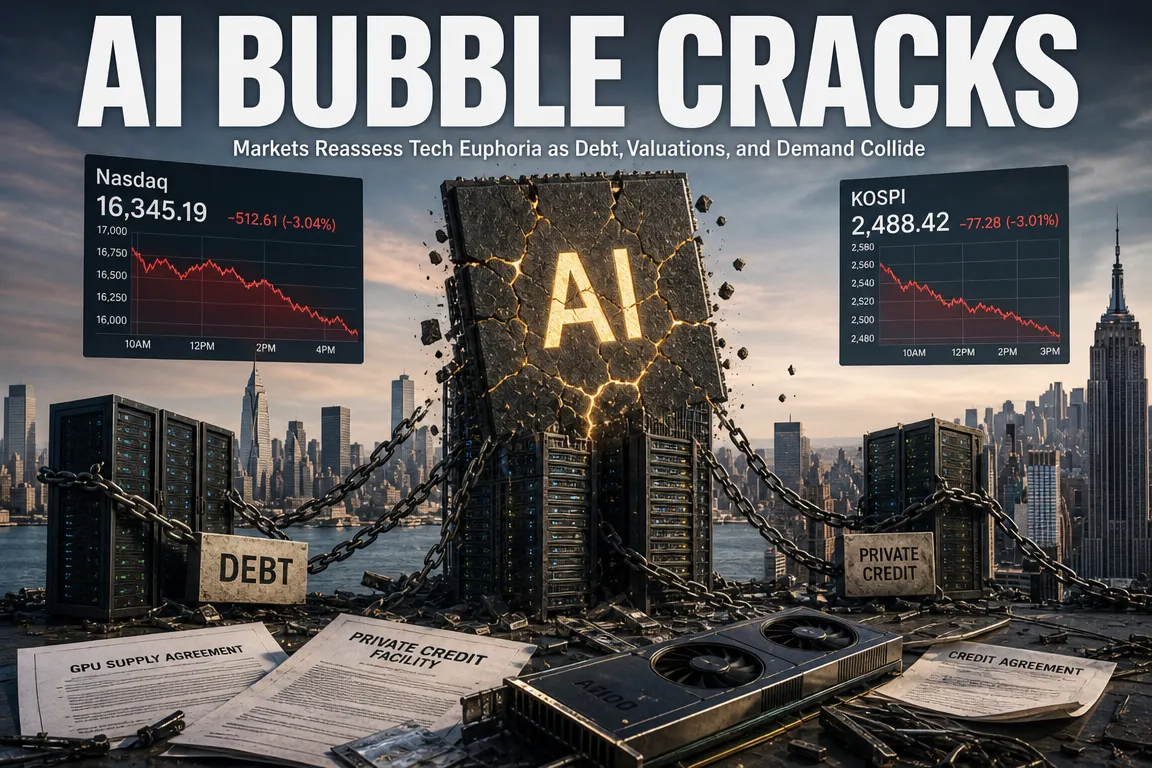
● KOSPI Crash Eases, Nvidia AI Panic, Bailout Hopes
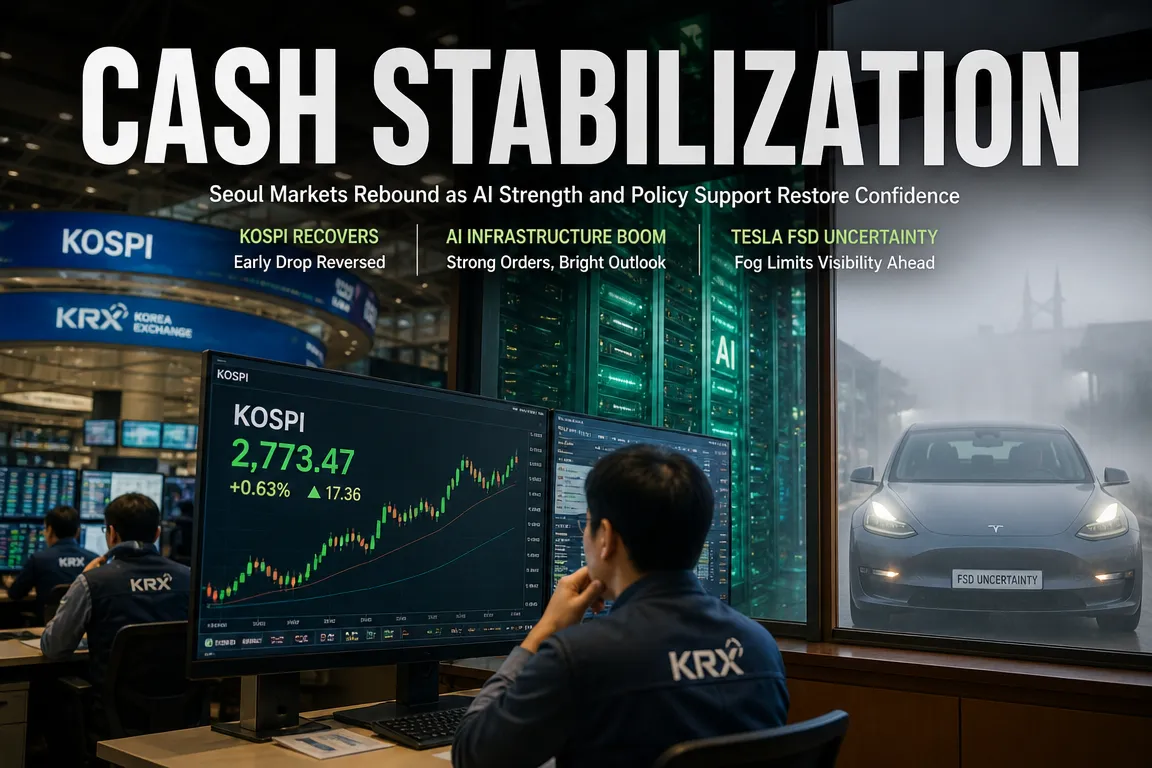
KOSPI Narrows Afternoon Losses: Assessing Trend Reversal Signals, NVIDIA, Anthropic, and Market Stabilization Expectations
A narrowing of afternoon losses in the KOSPI does not necessarily indicate that market uncertainty has subsided.
The key distinction is whether the recovery reflects policy expectations, improving sentiment toward U.S. technology stocks, or underlying financial stress.
AI advances do not benefit all technology stocks equally, and market stabilization funding does not directly improve corporate earnings.
1. KOSPI Afternoon Recovery: Narrower Losses Are Not a Trend Reversal
- Intraday decline: The source describes a KOSPI decline of approximately 3%.
- Afternoon movement: Losses subsequently narrowed, but neither a move into positive territory nor the closing level is established.
- Concurrent developments: Expectations of market stabilization funding and a recovery in U.S. Nasdaq futures.
An index that recovers from its intraday low but remains below its previous close is still down for the session.
The movement is therefore best characterized as an easing of selling pressure following a sharp decline.
A trend reversal would require further evidence, including sustained buying in subsequent sessions, broader market participation, and improving foreign investor flows.
2. Three Potential Drivers of Afternoon Buying
① Market stabilization fund expectations: A potential policy backstop
Reports of government preparations for market support can signal a willingness to contain disorderly declines.
Such expectations may encourage investors to delay selling or initiate purchases at lower prices.
However, preparations and actual fund deployment are distinct stages.
Without confirmation of the fund’s size, funding sources, eligible assets, and deployment conditions, fresh buying cannot be attributed to policy funding.
② Nasdaq futures recovery: Reduced concern over further U.S. technology losses
If the reported increase of approximately 3% in Nasdaq futures was accurate at the relevant time, it may have supported Korean investor sentiment.
Korean equities are sensitive to shifts in U.S. technology sentiment because large semiconductor companies carry substantial index weight.
However, futures fluctuate before the U.S. regular session, and their gains do not necessarily translate into equivalent closing gains.
③ Technical buying after a sell-off: Prices can recover without fundamental improvement
Sharp declines can trigger bargain buying, portfolio rebalancing, and short covering.
Prices may consequently recover even when earnings expectations and economic conditions remain unchanged.
Identifying the drivers of the narrower losses requires time-stamped news and foreign and institutional trading data across cash equities and futures.
3. Jensen Huang and Anthropic: AI Economics Matter More Than Individual Commentary
Unverified causal links should be assessed separately.
Although Anthropic appears in the source headline, the accompanying text does not identify a specific announcement or business development that triggered selling.
It is also unclear whether the term “entropy” refers to Anthropic. The available information is insufficient to attribute the Nasdaq sell-off to a specific company.
Three questions are more relevant to AI investment analysis.
- AI model developers: Can profitability improve as usage and revenue expand, despite computing costs?
- NVIDIA and other AI chipmakers: Is customer data center spending translating into actual orders and revenue?
- Korean semiconductor companies: Is expanding AI demand supporting shipments of higher-value memory products and stronger margins?
The effect of AI efficiency gains on semiconductor demand is not predetermined.
Lower computing requirements per task could weigh on demand. Conversely, lower usage costs could accelerate adoption and increase aggregate computing demand.
AI investment analysis should therefore extend beyond technical progress to assess who reduces costs, who captures revenue growth, and who bears the investment burden.
4. Treasury Secretary Commentary and U.S. Interest Rates: Favorable Remarks Do Not Constitute Policy Support
The precise wording and context of Treasury Secretary Scott Bessent’s reported positive assessment of Jensen Huang have not been verified.
The remarks therefore cannot be treated as official government endorsement of NVIDIA or evidence of new support measures.
Favorable political commentary should be distinguished from concrete policies, including export-control changes, subsidies, and government procurement.
Criticism of the Federal Reserve does not imply an imminent rate cut.
U.S. interest rates reflect Federal Reserve decisions as well as inflation, employment, economic activity, and Treasury supply and demand.
Policy rates and long-term Treasury yields can also move in different directions.
For technology equities, actual changes in Treasury yields and earnings expectations are more informative than the intensity of political rhetoric.
5. Does the Situation Qualify as a Financial Crisis?
A single sharp decline or elevated volatility is insufficient to establish a financial crisis.
An equity correction represents asset repricing. A financial crisis involves disruption to core financial functions, including lending, payments, and funding.
| Area to Monitor | Warning Signals | Interpretation |
|---|---|---|
| Credit markets | Sharp widening of corporate bond spreads over government bonds | Assess whether corporate funding risk is increasing. |
| Short-term funding markets | Rollover failures and surging short-term funding rates | Evaluate whether borrowers can obtain funding when required. |
| Banks and financial institutions | Large deposit outflows and liquidity shortages | Determine whether institution-specific problems are spreading through the financial system. |
| Foreign exchange markets | Rapid won depreciation and deteriorating dollar funding conditions | Monitor external funding pressure on domestic markets. |
The available information does not establish credit or liquidity stress of this kind.
The appropriate assessment is therefore to monitor whether the equity sell-off is spreading to the financial system, rather than classify the situation as a financial crisis.
6. Key Distinction: Policy Can Moderate Selling Pressure but Cannot Substitute for Corporate Value Creation
① Market stabilization and earnings recovery are separate issues.
A market stabilization fund can absorb urgent selling and reduce uncertainty.
It does not directly improve corporate revenue, margins, or cash flow.
KOSPI analysis should distinguish policy expectations as a near-term market flow factor from exports and semiconductor earnings as medium- to long-term drivers.
② AI industry growth and AI equity returns are not equivalent.
Even a rapidly expanding industry can experience equity corrections when valuations already reflect more optimistic expectations.
Conversely, if sentiment is excessively pessimistic, a stabilization in earnings may be sufficient to support a recovery.
The critical variable is the gap between expectations embedded in prices and actual performance, rather than growth alone.
③ Market breadth matters more than the size of the rebound.
Investors should assess whether gains are concentrated in a few large-cap stocks or extend across sectors and individual companies.
A stable USD/KRW exchange rate and foreign net buying of cash equities would provide additional evidence when assessing the recovery’s durability.
A balanced global economic outlook likewise requires joint analysis of interest rates, exchange rates, credit markets, and corporate earnings rather than reliance on a single equity index.
< Summary >
- KOSPI movement: The reported development is a narrowing of afternoon losses, not a confirmed trend reversal.
- Potential recovery drivers: Market stabilization expectations, stronger Nasdaq futures, and technical buying should be evaluated separately.
- AI investment priorities: Computing demand, capital requirements, and profitability matter more than assessments of individual executives.
- Financial crisis assessment: Credit conditions, funding access, and bank liquidity are more relevant than the magnitude of an equity decline.
- Next indicators to monitor: Actual policy deployment, foreign investor flows, exchange rates, and earnings expectations.
[Related Articles…]
*Source: [ 내일은 투자왕 – 김단테 ]
– 코스피 오후에 반등한 이유 #코스피 #젠슨황 #앤트로픽