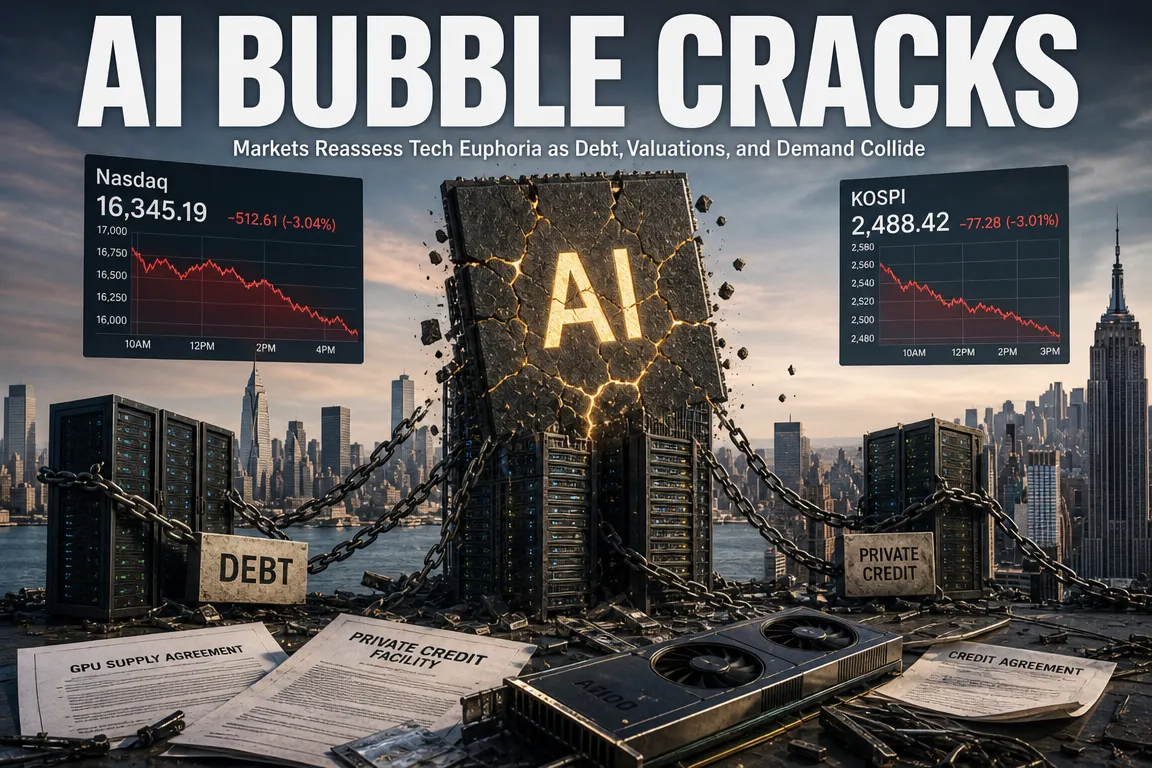
● AI Bubble, Debt Crisis Looms
Could an AI Bubble Collapse Trigger a Financial Crisis? Revenue, Data Centers, and Private Credit Matter More Than the Nasdaq
The central question in AI investing is not how much the technology has improved, but who generates earnings and who repays the investment costs.
This report examines how slowing AI revenue could affect data center debt, the implications for the Nasdaq and South Korean semiconductors, and indicators of potential financial stress.
The distinction between GPU rental rates and data center rents, enforceable payment obligations under long-term contracts, and delayed loss recognition in private credit warrant closer scrutiny than share-price movements alone.
1. Core Assessment: AI Technology Success Does Not Guarantee Investment Returns
AI-driven productivity gains and sustained appreciation in AI-related equities are separate propositions.
Even effective technology can generate investment losses if entry valuations are excessive or supply expands faster than demand.
- Technology: How accurate and useful are AI outputs?
- Business: Will customers pay enough to generate a profit after service delivery costs?
- Investment: Do prospective cash flows justify current valuations and capital expenditure?
- Finance: Can companies meet debt and long-term contractual obligations if cash inflows fall short?
The AI bubble debate centers less on technological validity than on the mismatch between investment scale and the pace of cash recovery.
The internet transformed the economy, but not every investor in internet companies earned a positive return.
2. Why ARR Alone Is Insufficient for Assessing AI Revenue
ARR generally refers to annual recurring revenue and measures the current revenue base of subscription businesses.
However, annualized revenue reported by usage-based AI services may differ materially from contractually secured recurring revenue.
Multiplying monthly revenue by 12 indicates the current run rate; it does not guarantee equivalent revenue over the next 12 months.
Assessing an AI company’s growth requires examining the following factors together.
- Revenue mix: The respective contributions of fixed subscriptions, usage-based APIs, and long-term enterprise contracts.
- Customer retention: Whether existing customers continue using the service and increase spending.
- Gross margin: Revenue remaining after inference computing costs and other costs of service delivery.
- Customer concentration: Exposure to reduced usage by a small number of large customers.
- Cash burn: Growth in research and development expenses and infrastructure-related spending relative to revenue growth.
For example, if API usage rises 30% while the average selling price falls 25%, the associated revenue declines approximately 2.5%, all else equal.
Higher AI usage does not automatically translate into revenue growth or improved profitability for AI providers.
3. Constraints on AI Adoption Extend Beyond Model Performance
Improved AI models do not necessarily accelerate enterprise adoption at the same rate.
Data preparation, security, access controls, and integration with existing systems can present greater implementation barriers.
- Fragmented data: Information dispersed across departmental documents, emails, and internal servers is difficult for AI systems to access and use.
- Security and accountability: Organizations must define permissible access to customer and internal data and assign responsibility for incorrect outputs.
- Workflow redesign: Deploying a tool and changing operating procedures are distinct projects.
- Return validation: Time savings must be measured against actual cost reductions or revenue gains.
Model performance nevertheless remains important.
Many workflows require lower error rates before automation becomes viable. Market expansion therefore depends on improvements in both model reliability and organizational readiness.
Using high-performance models for complex tasks and lower-cost models for routine tasks is another important AI trend.
This multi-model approach reduces customer costs but can intensify pricing pressure on premium model providers.
Open-weight models also incur infrastructure, security, and maintenance costs and are not necessarily less expensive.
4. The Path to Financial Stress: From Slower Revenue to a Credit Contraction
Several transmission channels must operate before slower AI growth can develop into a financial crisis.
- AI service revenue falls short of expectations.
Cash generation becomes insufficient to cover computing costs and research and development expenses. - Equity funding and borrowing become more difficult.
Lower valuations may coincide with higher financing costs. - Companies adjust computing contracts and capital expenditure.
New orders may decline, contracts may be renegotiated, and payments may be delayed. - Infrastructure providers’ cash flows weaken.
Earnings expectations decline for cloud providers, GPU operators, and data center developers. - Credit quality and collateral values deteriorate.
Project loans face greater default risk and less favorable refinancing terms. - Stress spreads to other financial assets.
Loss-driven asset sales, collateral calls, and capital withdrawals may constrain credit supply.
A sharp equity-market decline alone does not constitute a financial crisis.
Risk increases when high leverage, short debt maturities, customer concentration, and weak liquidity management coincide.
5. Three Distinct Business Models Within Data Center Investment
Treating all data center investments as equivalent real estate exposures can distort risk assessments.
| Business Model | Primary Revenue | Key Risks |
|---|---|---|
| Building and power infrastructure leasing | Rent for space and power capacity | Tenant credit quality, vacancy, power availability, lease renewal |
| GPU and computing services | Usage-based and reserved-capacity fees | Utilization, service pricing, equipment obsolescence |
| Data center development and financing | Development profits, interest, project distributions | Construction delays, cost overruns, refinancing, collateral values |
Lower GPU rental rates do not imply an immediate decline in data center building rents.
Long-term leases can support property owners’ cash flows for a period.
Persistent deterioration in tenant profitability, however, may lead to lower rents at renewal or contractual default.
GPU pricing also varies by hardware generation, location, contract duration, and network quality.
A more reliable assessment combines realized rates by equipment type, utilization, and earnings after electricity costs rather than relying on a single price index.
6. How Private Credit Can Amplify Risk—and Where Caution Is Needed
Private credit provides financing to companies and projects outside traditional bank lending and public bond markets.
Data centers may also receive equity investment, bank loans, and corporate bond financing.
The involvement of a major asset manager does not, by itself, establish the investment structure or potential loss exposure.
- Valuation lags: Infrequently traded loans may reflect deteriorating market conditions only after a delay.
- Loan modifications: Maturity extensions or capitalized interest may prevent immediate default while weakening cash recoveries.
- Indirect financial linkages: Losses may spread through fund-level borrowing, bank credit facilities, and insurers’ asset holdings.
- Redemption structures: Closed-end funds face relatively limited immediate redemption pressure, while some open-end and semi-liquid vehicles are more sensitive to withdrawal requests.
Pension fund or insurer participation does not automatically imply systemic risk.
Exposure relative to total assets, leverage, loss-absorbing capacity, and funding maturities determine the potential impact.
7. Implications for the Nasdaq and South Korean Semiconductors
Many Nasdaq-listed companies derive a substantial portion of their valuations from expected future growth. Concerns about AI investment returns can therefore trigger repricing before earnings weaken.
When the interest-rate outlook implies higher discount rates, the present value of distant earnings declines.
South Korean semiconductor investors should distinguish the following transmission channels.
- Demand: Adjustments to AI capital expenditure may affect HBM, server memory, advanced packaging, and equipment orders.
- Capital flows: Global risk aversion may increase volatility in foreign investor flows and the won-dollar exchange rate.
- Earnings: Firm orders and long-term contracts can create a timing gap between share-price declines and weaker operating results.
Falling share prices alongside rising forward earnings per share are not necessarily inconsistent.
Markets may anticipate a demand slowdown not yet reflected in earnings estimates or assign a lower price-to-earnings multiple to the same earnings.
Daily 3x leveraged ETFs such as SOXL do not deliver long-term cumulative returns equal to three times their underlying index’s cumulative return.
Daily resets and compounding can generate losses even in volatile, range-bound markets. Product structure therefore requires assessment independently of the directional outlook.
8. A Critical Distinction: Risk Lies in Contract Terms, Not Just Investment Totals
① Announced contract values differ from binding payment obligations.
Long-term contracts may include phased commitments, demand contingencies, termination provisions, prepayments, and minimum purchase obligations.
Treating a headline contract value as immediately repayable debt can overstate risk.
Conversely, payment obligations that apply regardless of usage can amplify the impact of weaker demand.
② The same company may be both investor and supplier.
When a cloud provider invests in an AI company that then spends the proceeds on that provider’s services, revenue from independent end customers requires separate examination.
This structure is not inherently improper, but distinguishing investment-funded spending from self-sustaining customer demand is essential to evaluating business durability.
③ Asset lives must be assessed against debt maturities.
Buildings and power infrastructure can remain useful for extended periods, while technological progress can erode GPUs’ economic value more rapidly.
If equipment cash flows decline while substantial debt remains outstanding, refinancing and collateral risks may emerge simultaneously.
④ Lower-cost AI may pressure providers while benefiting the broader economy.
Falling model prices can compress developers’ margins while lowering costs for AI users and enabling new services.
Global economic assessments should therefore allow for declining AI supplier valuations alongside broader productivity gains.
9. A Practical Checklist for Assessing Crisis Risk
| Area | Indicators | Warning Combination |
|---|---|---|
| AI service demand | Actual revenue, customer retention, usage, average selling price | Rising usage alongside weaker revenue growth and margins |
| Computing economics | GPU utilization, realized rental rates, electricity costs, equipment costs | Simultaneous declines in pricing and utilization |
| Infrastructure investment | Capital expenditure plans, new orders, contract terminations and amendments | Increasing order cancellations and payment delays |
| Funding | Cash balances, free cash flow, maturities, borrowing costs | Cash depletion alongside rising refinancing costs |
| Financial contagion | Credit spreads, delinquencies, fund valuation losses, redemption restrictions | Project-specific stress spreading across multiple financial institutions |
Equity declines alone may represent a valuation adjustment. Concurrent revenue weakness, contractual disruption, and deteriorating credit quality warrant greater caution.
Conversely, expanding customer demand, lower service delivery costs, and orderly capital expenditure adjustments could allow excess investment to unwind without a financial crisis.
The decisive factors are how quickly demand converts into cash and whether that cash is sufficient to meet financial obligations, rather than optimism or pessimism about AI.
< Summary >
- AI technology advances and AI investment returns are distinct outcomes.
- ARR should be assessed alongside customer retention, gross margins, and cash burn.
- Financial crisis risk increases when weaker revenue leads to contractual defaults and credit losses.
- Data center leasing and GPU services have different cash-flow and risk profiles.
- Contractual payment obligations, customer concentration, and debt maturities matter more than headline investment totals.
- Concurrent deterioration in revenue, utilization, and credit indicators is more informative than Nasdaq movements alone.
[Related Articles…]
*Source: [ 내일은 투자왕 – 김단테 ]
– AI 버블 붕괴가 금융위기로 이어진다???
● AI Bubble Shock, Nasdaq KOSPI Chip Warning
AI Bubble Collapse or Equity Market Correction? Key Variables for KOSPI, Nasdaq, and AI Semiconductor Investors
AI industry growth does not preclude declining equity prices.
The critical issue is not the magnitude of the decline, but the distinction between AI companies’ cash flow, the sustainability of data center investment, U.S. interest rates, and actual changes in orders at Samsung Electronics and SK hynix.
This report examines valuation criteria for AI service providers such as Anthropic, risks arising from interconnected financing arrangements involving Nvidia, and the distribution of benefits from lower AI costs.
1. The AI Bubble Debate: Technological Success and Investment Returns Are Different
Key assessment: Widespread AI adoption does not imply sustained share price appreciation for every AI company.
Rising adoption can increase demand for semiconductors, data centers, cloud infrastructure, and enterprise software.
Investment returns, however, depend on the purchase price and realized earnings, not solely on industry growth.
- Industry growth: Assess growth in enterprise adoption and usage.
- Corporate profitability: Determine whether incremental revenue generates profit after computing, personnel, and other costs.
- Equity valuation: Evaluate how much expected future earnings are already reflected in the share price.
If investors expect 100% revenue growth but actual growth reaches 70%, the share price may decline despite strong business expansion.
A strong business is not necessarily an attractive investment at its current price.
Assessing a potential AI bubble collapse requires distinguishing three stages rather than focusing solely on price declines.
- Expectations reset: Business growth continues, but elevated valuation multiples compress.
- Earnings deterioration: Reduced customer investment leads to downward revisions in revenue and earnings forecasts.
- Credit stress: Financing constraints impair debt repayment or business continuity.
These stages differ in severity and the time required for recovery.
2. AI Companies Such as Anthropic Require Cash Generation Analysis, Not Revenue Analysis Alone
Key assessment: AI company valuations should incorporate growth, profitability, and financial resilience.
Even if usage of services such as Claude increases, rising inference and infrastructure costs may delay cash flow improvement.
Listing status and IPO demand are less important than the amount of customer revenue retained after operating costs.
| Assessment Area | Key Metrics | Interpretation Considerations |
|---|---|---|
| Growth | Revenue growth, paying customer growth, revenue per customer | Distinguish sustainable demand from growth driven by discounts and free usage incentives. |
| Profitability | Gross margin, operating margin, inference costs | Determine whether higher usage increases losses. |
| Cash flow | Operating cash flow, capital expenditure, free cash flow | Accounting earnings may differ from actual cash generation. |
| Financial resilience | Cash balances, debt maturities, contractual spending commitments | Assess whether operations can continue if additional financing is delayed. |
Reliance on external financing does not, by itself, establish that a company is financially vulnerable.
Equity financing differs fundamentally from debt that requires interest payments and repayment.
However, rapid cash consumption combined with substantial long-term cloud purchase commitments makes future financing terms an important valuation variable.
Two misconceptions should also be avoided when evaluating IPOs.
- An IPO facilitates capital raising and potentially sales by existing shareholders; it does not inherently indicate overvaluation.
- A large offering may temporarily redirect demand from other stocks, but it does not permanently remove money from the equity market.
The potential price impact of employee shareholdings depends on sale eligibility, lockup provisions, and trading volume.
3. Nvidia and AI Data Centers: Separate Technological Strength from Financing Interdependence
Key assessment: Even companies with strong technological advantages remain exposed to deterioration in customers’ financial conditions.
① CUDA and total operating costs are central to technological competitiveness.
Nvidia’s competitive position reflects an ecosystem combining GPU performance, CUDA, development tools, libraries, and developer experience.
Lower-priced competing chips may not induce switching if software migration and optimization costs remain high.
Competition could intensify if proprietary AI chips or alternative software deliver sufficient performance and cost efficiency for specific workloads.
② Financial analysis should trace the relationship between investment funding and purchase payments.
Where supplier investments, cloud contracts, and equipment purchases are interconnected, ultimate demand from external customers requires separate assessment.
Such arrangements do not, by themselves, establish misconduct or accounting irregularities.
The central question is: “Can end-customer spending sustain the business without another round of investment funding?”
- Accounts receivable: Assess whether unpaid balances are growing disproportionately relative to revenue.
- Customer concentration: Determine whether financing difficulties at a small number of customers could materially affect overall results.
- Contract quality: Review cancellation and deferral provisions in orders and purchase commitments.
- Actual utilization: Assess whether installed computing capacity is sufficiently utilized to deliver paid services.
4. U.S. Interest Rates and Middle East Risks: Transmission Channels to Growth Stocks
Key assessment: Higher discount rates can pressure Nasdaq valuations even when AI companies report strong operating performance.
Equity valuation reflects the present value of expected future cash flows.
Higher interest rates can disproportionately affect growth stocks whose valuations depend heavily on distant earnings.
Inflation analysis should emphasize trends rather than a single year-over-year reading.
- Core PCE: Assess the persistence of inflation excluding food and energy.
- Month-over-month changes: Determine whether inflation is reaccelerating.
- Services inflation and wages: Assess whether temporary shocks are developing into persistent inflation.
- Deviation from market expectations: Consider whether elevated inflation was already priced in.
Higher PPI does not necessarily translate into higher CPI after a fixed lag.
Companies may pass costs through to customers or absorb them through lower margins when demand is weak.
Policy rate probabilities derived from interest rate futures are market-price-based estimates, not investor voting results.
For Middle East geopolitical risks, actual supply disruption is the key variable.
Escalation risk can increase oil prices, transportation costs, and insurance premiums.
The implications for inflation and monetary policy depend on whether disruptions are temporary or persistent.
“Higher oil prices → substantial interest rate increases → an equity market collapse” should not be treated as a predetermined sequence.
5. Data Center Regulation May Reshape Competition Rather Than Halt AI Development
Key assessment: The scope of regulation and allocation of compliance costs matter more than the existence of regulation itself.
Data center policy encompasses grid connections, electricity cost allocation, water consumption, environmental permitting, and semiconductor export controls.
Different measures may delay projects, increase costs, or restrict sales to specific countries.
- Grid connection delays: Data center commissioning and equipment installation may be postponed.
- Higher infrastructure cost contributions: Financially constrained operators may reduce investment.
- Stricter energy efficiency standards: Efficient semiconductors and cooling technologies may gain a competitive advantage.
- Tighter export controls: Addressable markets and product portfolios may change.
These developments may increase the market share of larger companies.
However, greater market share does not automatically translate into higher earnings.
Lower industry-wide investment or higher compliance costs can also burden leading firms.
Political statements, proposed legislation, enacted laws, and implementation should be assessed separately.
6. KOSPI Outlook: How Should Investors Assess Samsung Electronics and SK hynix?
Key assessment: Separate the financial transmission of U.S. technology stock weakness from business effects on actual semiconductor orders.
Capital flows are important in the short term.
Declines in U.S. technology stocks may prompt foreign investors to reduce exposure to Korean semiconductor equities.
The USD/KRW exchange rate, foreign cash-equity and futures trading, margin positions, and derivatives exposure can amplify KOSPI volatility.
Semiconductor earnings prospects are more important over the medium term.
- HBM demand: Assess whether customer orders and product-specific supply plans remain intact.
- Customer qualification and volume production: Determine whether expanded supply of high-value products translates into revenue.
- Memory pricing: Monitor DRAM and NAND prices alongside inventory trends.
- Customer capital expenditure: Verify whether major technology companies are executing their data center investment plans.
- Earnings estimates: Distinguish share price declines from concurrent downward revisions to operating profit forecasts.
If share prices decline while orders, pricing, and earnings expectations remain stable, valuation compression may be the primary explanation.
If order deferrals, lower prices, and earnings downgrades occur together, a change in the earnings cycle warrants closer attention.
Share prices are not determined by sentiment alone.
Sentiment can amplify short-term volatility, but expected cash flows, interest rates, and risk premiums remain fundamental valuation drivers.
7. An Overlooked Variable: Lower AI Prices Have Different Implications for Suppliers and Users
The central question is not simply how large the AI market becomes, but which participants capture its economic gains.
① Lower token prices can pressure AI service providers’ margins.
Competitive pricing may prevent revenue and earnings from meeting expectations even as usage increases.
A model’s share of token usage on a particular platform should not be interpreted as its share of global AI revenue.
Lower-priced models may generate substantial usage but a relatively small share of revenue.
② The same price decline can improve productivity economics for AI adopters.
Lower AI costs in customer support, document processing, development, and analytics can enable broader automation at reduced expense.
Over time, some economic benefits may shift from AI suppliers to companies deploying AI.
③ Efficiency gains do not automatically reduce semiconductor demand.
Even if computing requirements per task decline, lower prices may attract more users and increase usage frequency, raising aggregate computing demand.
If incremental demand is insufficient, infrastructure investment growth may slow.
Computing costs per task and total task volume should therefore be assessed together.
④ Total task completion cost matters more than a simple choice between superior performance and low prices.
Enterprises consider accuracy, error correction costs, security, response times, and operational reliability alongside token prices.
A more expensive model that reduces rework may be more economical than a cheaper, less reliable alternative.
AI deployment may increasingly involve combining models suited to specific tasks rather than selecting a single highest-performing model.
8. Three Scenarios for Assessing Market Conditions
| Scenario | Conditions to Monitor | Market Interpretation |
|---|---|---|
| Stabilization following an expectations reset | Easing inflation, sustained investment plans, improving AI profitability | Potential for earnings-driven differentiation after valuation excesses recede |
| Prolonged elevated volatility | Continued growth alongside persistent interest rate, regulatory, and cost pressures | Greater importance of financial resilience amid repeated rallies and corrections |
| Earnings deterioration and credit contraction | Concurrent investment cancellations, declining orders, and worsening financing conditions | Potential for an industry-wide reassessment beyond a conventional equity correction |
Assessing the prevailing scenario requires monitoring the cumulative direction of corporate disclosures and economic indicators rather than a single day’s market decline.
Primary sources include the U.S. BEA and BLS for inflation data and release schedules, the Federal Reserve for monetary policy, the Korea Exchange for domestic market data, and corporate filings and investor relations materials for earnings and contracts.
When incorporating global economic forecasts into investment decisions, defining the conditions that would invalidate an investment thesis is more practical than predicting a rebound on a specific date.
This report provides general market analysis and does not identify entry or exit points for individual securities.
< Summary >
- AI industry growth and equity appreciation are distinct. Evaluate expectations alongside current valuations.
- AI company analysis should extend beyond revenue to cash flow. Computing costs and financing dependence are central considerations.
- Interest rates and regulation operate through different channels. Distinguish discount rate changes from actual business contraction.
- Assess KOSPI and semiconductor exposure through orders, pricing, and earnings forecasts. U.S. equity weakness alone does not establish deteriorating fundamentals.
- Lower AI prices may redistribute economic benefits. Consider AI adopters as well as suppliers.
[Related Articles…]
*Source: [ 경제 읽어주는 남자(김광석TV) ]
– [🔴생방송] 코스피 -45%, ‘AI 거품 붕괴’ 시작인가? 끝인가? [즉시분석]