● SpaceX Space Data Centers Push HBM Boom
If SpaceX’s Space Data Center Becomes Reality, Samsung Electronics and SK Hynix HBM Semiconductors Will Go to Space
If you see the space industry as nothing more than rocket launches or satellite images, it is easy to miss the trend.
The core point is that space is changing from an ‘exploration space’ into an ‘economic activity space’.
In particular, if SpaceX pushes ahead with a space data center, AI data centers, HBM semiconductors, low-Earth orbit satellites, orbital transport, and space maintenance industries will all be connected at once.
This change is quite important for South Korea as well.
That is because HBM semiconductors, in which Samsung Electronics and SK Hynix are strong, could become key components of space AI infrastructure.
- We organized why SpaceX’s space data center is connected to the AI infrastructure investment trend.
- We explained in simple terms what technologies are needed to operate a data center in space.
- We explained why Samsung Electronics and SK Hynix are direct beneficiaries in this market.
- We tied low-Earth orbit satellites, orbital transport, satellite maintenance, and lunar base competition into one industrial structure.
- We separately organized the ‘securing the standard for space semiconductors’ issue, which is not obvious on the surface but is the most important.
1. Why the space industry’s landscape is changing: now, what you do in space matters more than rockets
In the past, the core of the space industry was the ability to launch rockets.
But now launch costs are falling rapidly, and the question is changing.
More important than “how well you launch” is “what economic activity you carry out after placing something in space.”
As launch costs fall, even small companies can send satellites into orbit.
Ultra-small satellites equipped with smartphone-level sensors, cameras, communication chips, and processors also become commercially viable.
When that happens, the low-Earth orbit satellite market expands into communications, observation, defense, manufacturing, and data processing.
In the end, the space industry must be viewed as a single value chain.
Rockets, satellites, communications, orbital movement, maintenance, refueling, data centers, and semiconductor supply chains are all connected.
2. Small launch vehicle market: even in space, there will be separate ‘buses’ and ‘taxis’
Large rockets are similar to buses that carry many satellites at once.
They can reduce costs, but it is difficult to reach the exact time and exact orbit you want.
By contrast, small launch vehicles are closer to space taxis.
Even if they are more expensive, they can place the satellite you want, when you want, into the orbit you want.
This market will not disappear even if large rockets continue to advance.
On the contrary, as satellite services diversify, demand for customized launches is likely to increase.
Rocket Lab in the United States has already established itself in the small launch vehicle market, and in South Korea, companies such as Innospace are preparing test launches and commercialization.
This trend signals that New Space companies are entering an industry once dominated by governments and large corporations.
3. In-orbit services: even in space, you need gas stations, tow trucks, and repair shops
In many cases, satellites used to reach the end of their life once their fuel ran out.
But if fuel can be replenished in space, the story changes.
Just like aerial refueling for aircraft, satellites could also have in-orbit refueling services.
If a satellite worth hundreds of billions or even trillions of won can be kept alive for a few tens of billions of won, the economics are sufficient.
The important industry here is in-orbit services.
It includes repairing damaged satellites, refueling them, changing their orbit, and recovering or disposing of satellites whose missions are complete.
As the number of satellites in space increases, these services become not optional but essential.
It is the same as how more cars on the road require repair shops, tow trucks, gas stations, and traffic control.
4. Orbital Transfer Vehicle, OTV: the ‘truck’ market that moves things within space is opening up
If rockets are responsible for lifting cargo from Earth into space, orbital transfer vehicles are responsible for moving cargo within space.
This is called an OTV, or Orbital Transfer Vehicle.
For example, a satellite operating at a 500 km orbit may need to move down to 300 km for a specific mission.
At a lower orbit, it can observe Earth in greater detail.
But moving directly requires a lot of fuel and also shortens the satellite’s life.
In such cases, an OTV can act as a space taxi or space truck.
It can carry satellites to another orbit, transport experimental equipment, or recover items manufactured at a space manufacturing facility.
As space data centers grow, this orbital logistics business is also likely to grow.
That is because data center modules must be launched, replacement parts sent, and faulty equipment recovered.
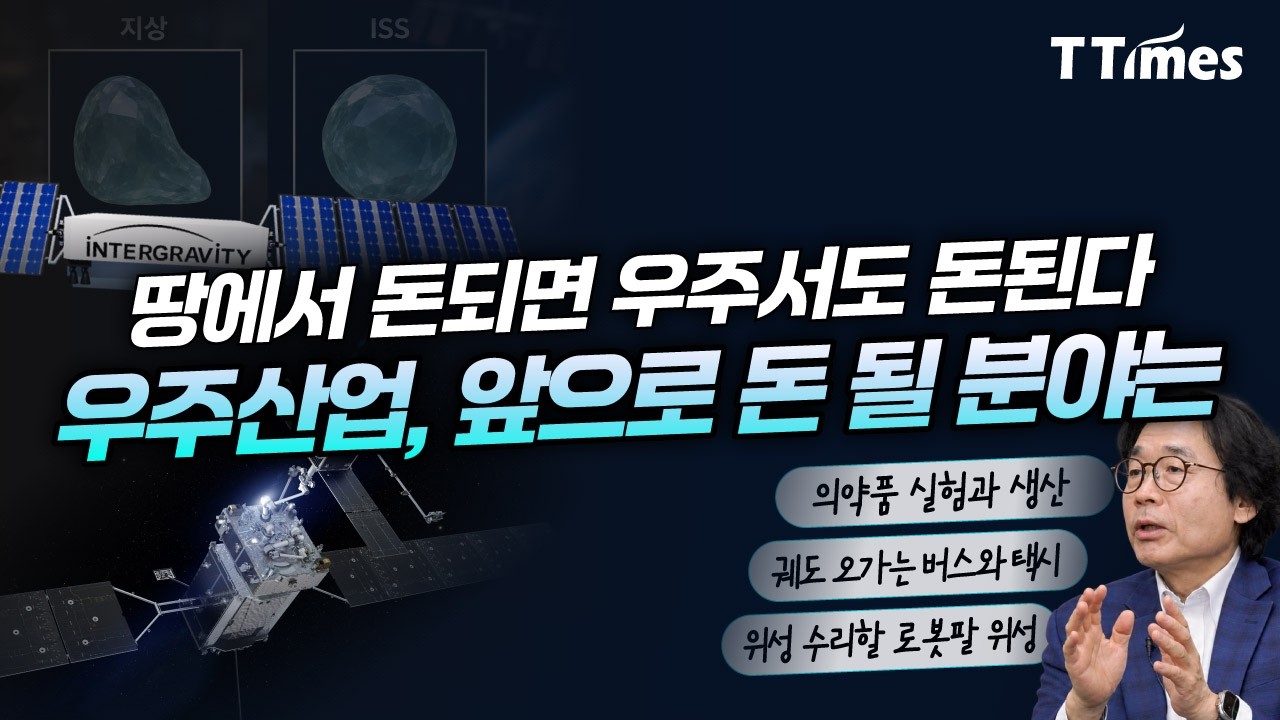
5. Space manufacturing: microgravity could become a new production environment for the pharmaceutical and biotech industries
Space orbit is not complete zero gravity, but it provides a microgravity environment.
In this environment, materials crystallize differently from on Earth.
In particular, the advantages of microgravity manufacturing are being discussed for high-value bioproducts such as protein drugs and anticancer drugs.
On Earth, gravity causes crystal structures to sag downward, but in space, more uniform and rounded crystal structures can be produced.
In theory, even drugs with the same ingredients may differ in absorption rate, effectiveness, and formulation possibilities.
If a drug that was only possible as an intravenous injection can be changed into a subcutaneous injection, the market value is substantial.
In the United States, companies manufacturing space pharmaceuticals are already conducting experiments, and in South Korea, related startups are also taking on the challenge.
This is why the space industry is connected not only to aerospace technology but also to biotech, pharmaceuticals, and materials industries.
6. Starlink and DTC: the biggest variable for telecom companies is direct satellite reception
Starlink has already proven the commercial viability of low-Earth orbit satellite communications.
As subscribers increase, the structure in which revenue grows more than additional costs is becoming clearer.
The more important change is DTC.
DTC stands for Direct to Cell, meaning a mobile phone connects directly to a satellite.
At present, Starlink requires a separate antenna, but if smartphones begin to receive satellite signals directly in the future, that will pose a major threat to existing telecom companies.
Of course, national backbone communication networks are difficult to replace all at once because regulation and sovereignty issues are strong.
However, satellite communications have strong potential in enterprise data communications, maritime, aviation, and remote-area communications, disaster networks, and military communications.
From the perspective of the global economic outlook, this trend is a variable that could change the direction of infrastructure investment in telecommunications.
7. Low Earth orbit is the new real estate: the side that secures the good orbit first has the advantage
As the number of low-Earth orbit satellites increases, space also becomes more crowded.
In particular, low Earth orbit around 500 km is a preferred zone when considering communication latency, satellite lifespan, radiation risk, and launch cost.
The problem is that there is still not enough strong international governance over the use of space.
There is a system to manage radio interference, but the rules for how orbital space itself should be allocated are still incomplete.
In the end, the companies and countries that launch satellites first and accumulate operational records gain the advantage.
Even in space, good locations are limited, and costs rise if you enter late.
From this perspective, low-Earth orbit satellites are not just equipment but also a means of securing space real estate first.
8. The moon also has premium land: competition for polar bases is beginning
The competition for lunar bases follows the same logic.
The moon is not a place where you can land anywhere.
There is a possibility of ice at the lunar poles, and those regions are favorable in terms of securing sunlight and shielding against radiation.
If a permanent base is built, water, energy, radiation protection, and coping with temperature changes all become important.
That is why major countries such as the United States, China, and South Korea are carefully reviewing candidate landing sites on the moon.
Once a base is established, de facto possession follows, so securing a good location first is strategically important.
Korea’s Danuri orbiter, which maps the lunar orbit and accumulates data, is also connected to this competition.
Lunar exploration is both a scientific project and a competition for future resources and base locations.
9. The U.S. Space Force and Golden Dome: space is already a defense and security market
Space is no longer an area driven only by scientists’ curiosity.
The United States operates the Space Force as an official military branch and is investing massive budgets into space-based defense systems.
The Golden Dome project is a plan to protect the U.S. mainland with a space-based surveillance and defense system.
It is close to the concept of extending Israel’s Iron Dome into space.
Such defense demand is also a big opportunity for space startups.
In the past, large defense contractors such as Boeing, Lockheed Martin, and Northrop Grumman took most of the contracts, but now startups with technological capability are also entering the government procurement market.
This is the core of New Space.
It is shifting away from a structure in which the government covers all costs, toward one in which private companies win contracts if they can build things faster and more cheaply.
10. Space data centers: why could AI data centers move outside Earth?
The biggest bottlenecks in AI infrastructure investment are power, cooling, land, transmission networks, and water usage.
Large-scale AI data centers consume enormous amounts of electricity, must remove heat, and must also handle local resident opposition and environmental regulations.
In particular, as AI shifts from training to inference, data center demand is likely to grow further.
That is because inference services continue to require computation as the number of users increases.
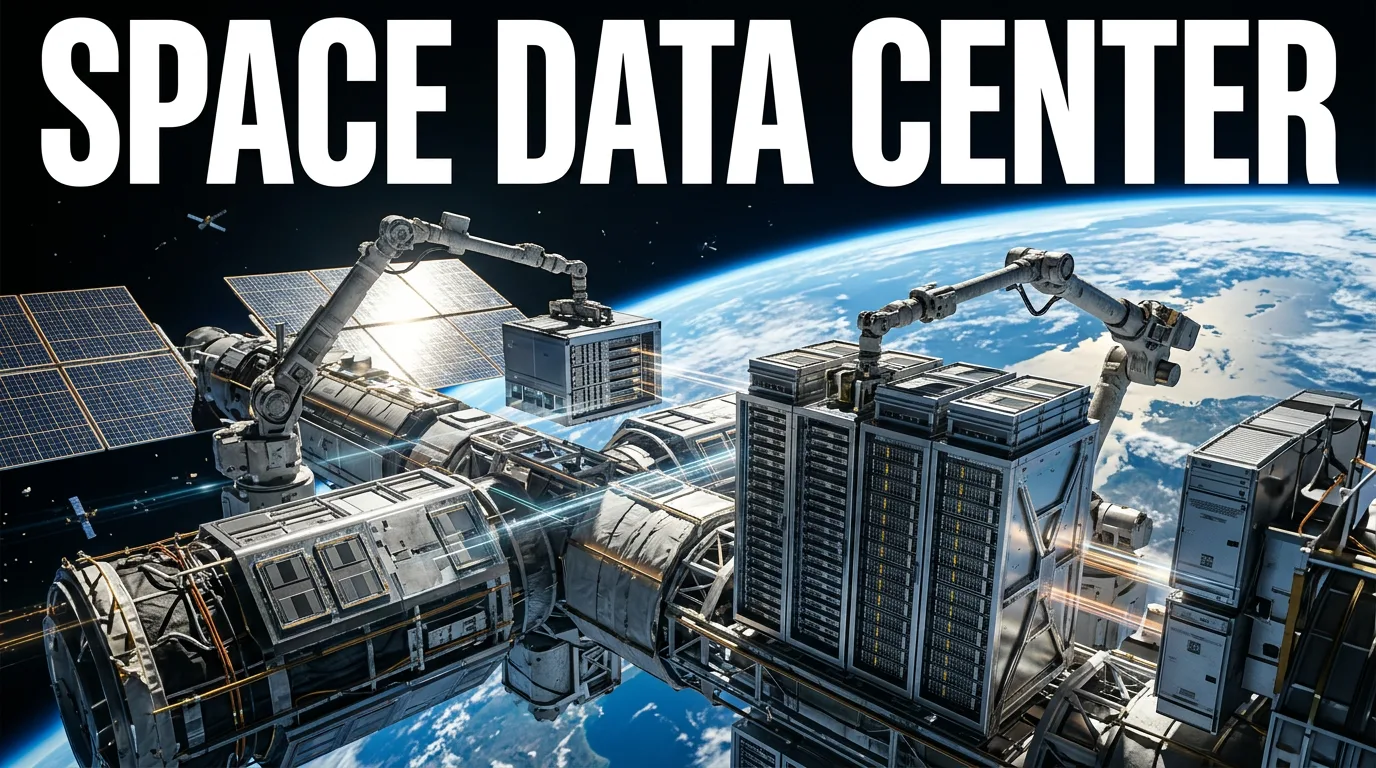
In this situation, space data centers are being discussed as one alternative.
They can make continuous use of solar power, avoid land constraints on Earth, and expand into a global data-processing infrastructure by combining with satellite communication networks.
Of course, this is not an easy business.
In space, there is no air, so you cannot cool systems with fans like on Earth.
Radiators and radiative cooling design become key.
Semiconductors must be protected from radiation, and repair and replacement are also difficult when faults occur.
But this is less a technically impossible area than a matter of economics and scale.
If a company like SpaceX lowers launch costs and has mass deployment capability, the concept becomes more realistic.
11. Why Samsung Electronics and SK Hynix matter: space AI data centers also need HBM
If a space data center performs AI computations, it needs GPUs, AI accelerators, memory, communication chips, and power semiconductors.
Among these, the core of high-performance AI servers is HBM semiconductors.
HBM is high-bandwidth memory attached next to GPUs to process large amounts of data quickly.
It currently accounts for a very important share of the cost structure of AI data centers.
Samsung Electronics and SK Hynix are key players in the global HBM market.
If SpaceX or global big tech companies build space AI data centers, they are likely to require HBM specifications suited to the space environment.
This creates an opportunity for Korea’s semiconductor supply chain.
Companies that secure data on radiation resistance, thermal stability, power efficiency, packaging durability, and long-term reliability will have the advantage in the space AI semiconductor market.
In other words, space data centers are not only a story for space companies.
They also connect to Korean HBM semiconductors, advanced packaging, power semiconductors, cooling materials, and satellite communication component companies.
12. The real opportunity Korean companies should watch is ‘certification data for space semiconductors’
The most important point is not simply selling a lot of HBM.
The true core point is who secures verified semiconductor data and standards in the space environment first.
In space, temperature changes, radiation, vibration, launch shock, and vacuum conditions are all variables.
Even chips that work well in ground data centers may face different problems in space.
That is why the process of launching semiconductors into orbit for testing and accumulating data is important.
Once this data accumulates, a company can tell global customers, “Our product has been verified to this level of performance and stability in the space environment.”
This becomes the barrier to entry in the future market for AI semiconductors for space.
Practical demonstration data and certification experience can become a greater asset than simple manufacturing capability.
13. What is less noticed in the market right now but most important
The essence of a space data center is not ‘building a data center in space.’
The essence is that the location of computing infrastructure is changing in order to solve the physical limitations of AI infrastructure.
Until now, competition in AI data centers has been a race to secure as many GPUs as possible.
Going forward, it becomes a competition across the entire infrastructure, including power, cooling, land, transmission networks, communication networks, and semiconductor reliability.
In this context, a space data center is one extreme solution.
Regardless of whether it succeeds or fails, this attempt also pressures the ground-based data center industry.
Data centers with low power efficiency, high cooling costs, and severe location regulations may become increasingly disadvantaged.
Another important aspect is standard-setting first-mover advantage.
If SpaceX requires a certain AI server specification for space, and Samsung Electronics or SK Hynix supplies HBM tailored to that specification, that itself can become an industry standard.
In early markets, the company that sets the standard gains pricing power and supply chain leadership.
That is why South Korea needs to move quickly into this trend.
14. Checkpoints to consider from an investment perspective
- Speed of launch cost decline
The economics of space data centers ultimately depend on how much launch cost per kg falls.
- Space power and thermal control technology
Companies that can generate power and remove heat reliably in space can become core infrastructure companies.
- Space demonstration of HBM semiconductors
It is important how much environmental test data Samsung Electronics and SK Hynix can secure for space conditions.
- In-orbit maintenance and OTV
As space data centers grow, demand for repair, replacement, transport, and recovery services will increase.
- Expansion of low-Earth orbit communication networks
Even if the data center is in space, it must be connected quickly and reliably to Earth for the business to work.
15. Conclusion for Korean industry
Space data centers may seem like science fiction from the distant future.
But as AI data center power shortages, HBM semiconductor demand, low-Earth orbit satellite communications, and New Space procurement innovation all converge at once, they are becoming a realistic industrial agenda.
Korea may seem behind the United States if you look only at rocket launch vehicles.
However, if you look at semiconductors, memory, advanced manufacturing, satellite technology, and deep-space communication experience together, the opportunity is quite large.
In particular, Samsung Electronics and SK Hynix are highly likely to enter the core supply chain if space AI data centers emerge.
This market can become not just a market for space startups but a new expansion stage for Korea’s semiconductor industry.
What matters going forward is who first accumulates verified data in the space environment and participates in global standards.
If South Korea gets ahead in that competition, it can capture both AI infrastructure investment and the space industry at the same time.
< Summary >
The space industry is shifting from rocket launches to space economic activity.
Low-Earth orbit satellites, orbital transport, satellite maintenance, space manufacturing, and lunar base competition are being connected into one industrial ecosystem.
If SpaceX’s space data center becomes reality, it could become a new option for solving the power shortages and land issues of AI data centers.
In this process, HBM semiconductors from Samsung Electronics and SK Hynix are highly likely to become key components of space AI infrastructure.
The real opportunity for Korean companies lies in securing standards and demonstration data for space semiconductors first.
[Related Articles…]
- AI Data Center Power Shortage and Infrastructure Investment Outlook
- HBM Semiconductor Supply Chain and Growth Opportunities for Korean Companies
*Source: [ 티타임즈TV ]
– 스페이스X 우주데이터센터가 되면 삼전닉스도 간다 (이강수 컴퍼니케이 대표)