● Nvidia Shock Rally, AI Profit Reckoning
Reported NVIDIA Surge and Nasdaq Rally: Assessing AI Investment Returns and Data Center Profitability
Three factors matter more than the reported share-price gains.
Whether NVIDIA’s management uncertainty has been resolved, whether AI data center investment is generating cash flow, and whether AI agents are reshaping competition in shopping and payments.
Additional considerations include short-covering effects, GPU rental profitability, and the risks of leveraged inverse products.
1. Reported NVIDIA and Nasdaq Gains: Figures Requiring Verification
- NVIDIA shares: Verify whether the reported 32% gain reflects the regular-session close, an intraday peak, or after-hours trading.
- Nasdaq index: Identify whether the figure refers to the Nasdaq Composite or Nasdaq-100 and whether it covers the same trading session.
- Management changes: CEO departures and returns require confirmation through investor relations announcements and relevant SEC filings.
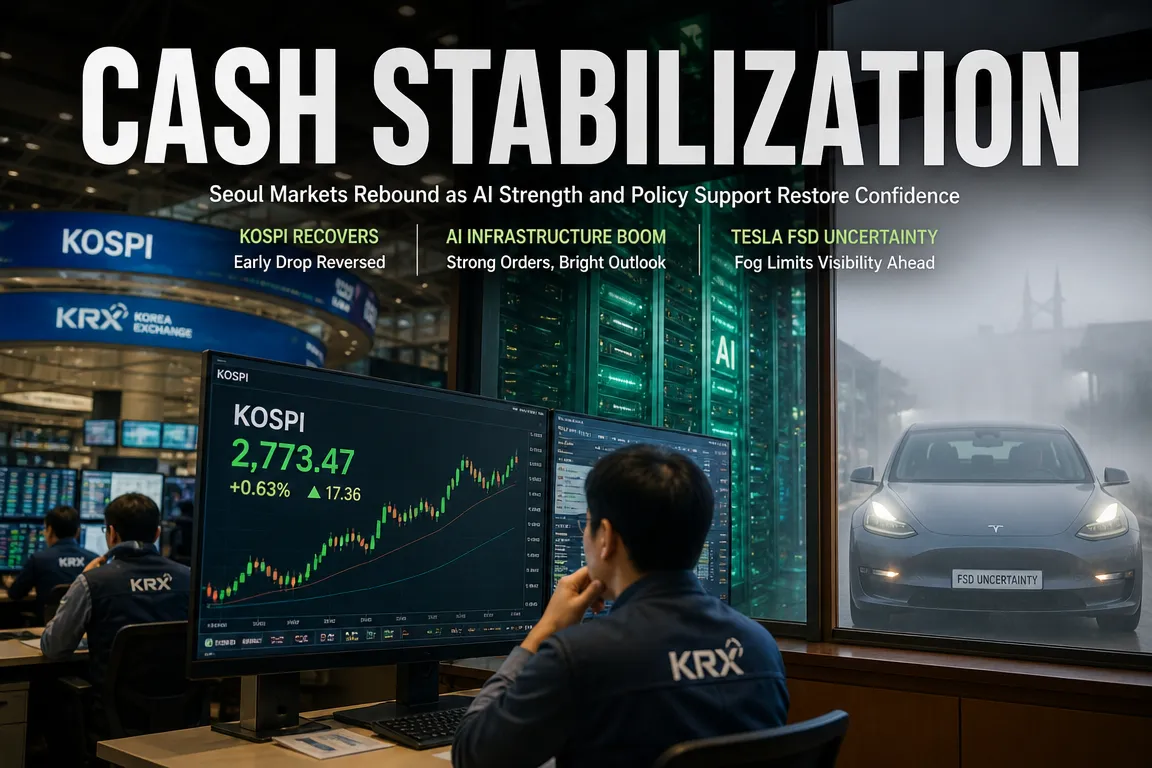
- South Korean futures market: “KOSPI overnight futures” is insufficiently specific. Verify the product, trading date, and applicable price limits.
An increase in market capitalization from $3 trillion to $4 trillion represents approximately 33.3% growth.
Although broadly consistent with the reported share-price gain, calculations based on rounded market capitalizations do not validate market data.
A U.S. equity rally may support sentiment toward South Korean semiconductor stocks, but it does not guarantee the magnitude of the following day’s KOSPI gains.
The USD/KRW exchange rate, foreign investor flows, and domestic earnings expectations also influence market performance.
2. How Reduced Management Uncertainty Can Support Share Prices
Greater leadership stability can reduce the risk discount applied to a company, independently of changes in earnings.
For NVIDIA, management continuity matters because product road maps, the software ecosystem, and major customer relationships are central to enterprise value.
- Product strategy: Assess the likelihood that next-generation GPU launches and system delivery schedules remain on track.
- Customer investment: Monitor whether cloud providers and AI developers proceed with planned purchases.
- Regulatory compliance: Evaluate the operational effects of export controls and compliance requirements.
- Valuation: Lower uncertainty can support a higher price-to-earnings multiple for the same expected earnings.
However, reduced management risk and improved operating performance are distinct catalysts.
Resolving leadership issues does not automatically increase GPU orders or improve gross margins.
Semiconductor investment assessments should therefore track revenue guidance, delivery schedules, and major customers’ capital expenditure separately from management announcements.
3. Does a Nasdaq Surge Signal a New Bull Market?
A sharp one-day rally can reflect either stronger optimism or a reversal of excessive pessimism.
Assessing the U.S. equity outlook requires distinguishing the drivers of a rally rather than focusing solely on its size.
- Improved earnings expectations: Share prices rise as revenue and profit forecasts increase.
- Lower risk premiums: Valuations recover as regulatory or management uncertainty declines.
- Short covering: Investors betting on price declines repurchase shares to limit losses.
- Derivatives hedging: Trading linked to options positions amplifies short-term buying pressure.
These drivers can occur simultaneously, but they have different implications for the sustainability of gains.
If positioning changes without an improvement in earnings expectations, substantial volatility may persist after the rally.
Market breadth also matters: determine whether gains are concentrated in a few megacap technology stocks or extend to equal-weighted indexes and smaller companies.
4. AI Infrastructure Beneficiaries Have Different Earnings Models
Stronger expectations for NVIDIA can attract interest in GPU cloud providers, HBM manufacturers, and data center businesses.
However, a shared AI theme does not justify applying the same investment thesis to every company.
① GPU Suppliers: Shipments and Margins
For suppliers such as NVIDIA, assess GPU sales volumes alongside networking and system revenue, product transition costs, and export market access.
Even when customers increase capital expenditure, earnings effects depend on revenue recognition timing and product mix.
② GPU Cloud Providers: Utilization and Financing Costs
GPU cloud providers such as CoreWeave acquire hardware and sell computing services.
Revenue growth may not translate into expected shareholder returns if interest expense, depreciation, and electricity costs rise faster.
Long-term contract cancellation provisions, customer concentration, and cash collection schedules also require scrutiny.
③ Memory Manufacturers: HBM Demand and Supply Competitiveness
AI server expansion can support HBM demand, but benefits will vary across memory manufacturers.
Micron, SK hynix, and Samsung Electronics should be assessed individually on customer qualification, production yields, shipment volumes, and product-level profitability.
5. Expanding GPU Rentals: Evidence of an AI Boom or a Strategic Shift?
Renting out GPUs originally intended for internal AI model development has two possible interpretations.
Strong external demand may have improved infrastructure returns, or weaker expected returns from internal model development may have prompted a change in asset utilization.
The cited monthly contract values of $3.1 billion and $800 million remain unverified.
Together, they total $3.9 billion per month, equivalent to $46.8 billion annually if maintained for 12 months.
Claims of this magnitude should not be incorporated directly into valuations without verifying contract duration, minimum usage commitments, electricity cost treatment, and revenue recognition terms.
The contracting entities must also be distinguished.
Grok is developed by xAI. Attributing related data centers or rental agreements to SpaceX requires separate verification of ownership, operating responsibilities, and contractual relationships.
Companies associated with the same individual should not have their revenue and assets combined without establishing the relevant legal and economic relationships.
The central question for data center investment is straightforward.
Investment recovery before equipment replacement matters more than the number of GPUs owned.
6. AI Agent Payments: Transaction Quality Matters More Than User Counts
AI agents that search for products, compare options, and complete payments could change the basis of competition in e-commerce.
Purchases may occur without consumers visiting retailers’ websites directly.
Claims of 10 million daily active users, an 80-fold increase in agent spending, and retailer-specific access or blocking policies require verification against official announcements and measurement definitions.
Spending growth and request-volume growth are different metrics.
A small number of high-value transactions can increase payment volumes, while extensive browsing or search activity may generate few completed purchases.
- Absolute transaction value: An 80-fold increase from a small base may still represent a limited share of the overall market.
- Actual purchase share: Distinguish test transactions from genuine consumer purchases.
- Repeat usage: Determine whether adoption leads to recurring purchases rather than one-time trials.
- Cancellation and refund rates: Order errors and refunds can increase operating costs despite higher transaction volumes.
- Revenue allocation: Identify how economic value is distributed among merchants, agent platforms, and payment providers.
AI competition may extend beyond response quality to control over purchasing authorization and trust in payments.
Retailers may increasingly depend on accurate price and inventory data integration, while payment providers may place greater emphasis on user authorization and fraud prevention.
7. A Critical Distinction: AI Ecosystem Revenue Versus End-Market Cash Flow
The first issue is the flow of capital among AI companies.
Investments by chip suppliers, GPU purchases by cloud providers, and computing commitments by AI developers can generate growth indicators across several companies simultaneously.
This structure is not inherently problematic, but treating every company’s revenue as independent end-market demand can overstate market size.
Ultimately, external revenue from businesses and consumers paying for AI services must support investment recovery.
The second issue is the mismatch between contract duration and technological life.
Data centers and power infrastructure have long operating lives, while new product launches can erode GPUs’ relative competitiveness more quickly.
Debt repayment and facility costs may persist after customer contracts expire.
The third issue is financing conditions, which can change ahead of operating results.
Higher share prices may improve access to funding through equity issuance or borrowing.
However, easier financing does not establish investment profitability.
Interest rates and credit market conditions therefore influence the pace of AI infrastructure expansion.
8. Leveraged and Inverse Products Require Particular Caution During Sharp Rallies
Products targeting -3 times an underlying asset’s daily return are highly vulnerable to sharp one-day gains.
A simple calculation implies approximately -96% for a -3 times product if the underlying asset rises 32% in one day.
Actual outcomes may differ because of intraday rebalancing, early termination provisions, expenses, and tracking error.
Claims that a specific product was liquidated or delisted require confirmation through issuer and exchange notices.
Risks also vary depending on whether the instrument is an ETF, an ETN, or another type of ETP.
Even if an investor’s directional view eventually proves correct, an earlier one-day surge can eliminate most of the invested capital.
9. Investment Monitoring Checklist
- Official announcements: Verify management changes and regulatory developments through company announcements and filings.
- Earnings estimates: Monitor whether revenue and profit forecasts rise alongside share prices.
- AI capital expenditure: Determine whether customer investment plans translate into orders and payments.
- Power availability: Assess whether grid connections and operating schedules support data center construction plans.
- Cash flow: Track whether revenue growth is accompanied by stronger operating cash flow and an improved cash position after capital expenditure.
- Agent commercialization: Monitor recurring payments and fee revenue, not just user growth.
Verification sources include NVIDIA Investor Relations and the SEC EDGAR filing search.
The central task is to distinguish reduced uncertainty from newly generated earnings, rather than focus solely on share-price gains.
< Summary >
- Claims about Jensen Huang’s return and sharp NVIDIA and Nasdaq gains should not be treated as confirmed news without official verification.
- Reduced management uncertainty can support valuations but is distinct from improved operating performance.
- AI infrastructure returns depend on utilization, financing costs, and investment recovery rather than GPU ownership alone.
- AI agents should be assessed on actual payment volumes, repeat usage, and revenue allocation rather than user counts alone.
- During sharp rallies, distinguish short covering from earnings improvement and assess the loss exposure of leveraged inverse products.
[Related Articles…]
*Source: [ 내일은 투자왕 – 김단테 ]
– 젠슨황 복귀 비하인드와 역대급 폭등해버린 나스닥 ㄷㄷㄷ
● AI Stock Bloodbath
Nasdaq Down 20%, Nvidia Down 48%: Does Extreme Fear Present a US Equity Investment Opportunity?
During a sharp sell-off, the priority is not the size of the discount, but whether fundamentals have deteriorated or remain intact.
This report examines the Nasdaq correction, AI semiconductor declines, sentiment indicators, credit-market signals, and phased investment strategies for long-term investors.
It also addresses AI data center financing structures and currency risk for Korean investors.
The headline declines are figures from the supplied material; their reference dates and current market prices have not been independently verified. This analysis assumes those declines rather than reporting confirmed current market conditions. Claims requiring official confirmation, including corporate investigations, management changes, political statements, and regulatory schedules, are not treated as established facts.
1. A 20% Nasdaq Decline: Fear Is Not the Same as Undervaluation
The key distinction is between a valuation adjustment and a deterioration in earnings expectations.
- Approximately 10% below the peak: Generally described as a market correction.
- Approximately 20% or more below the peak: Typically classified as a bear market.
- A 40–50% decline in an individual semiconductor stock: Requires an assessment of company-specific earnings and regulatory risks, alongside sector volatility.
These classifications describe market conditions; they do not identify a bottom.
A 20% Nasdaq decline does not limit further downside to 5–10%.
The Nasdaq Composite and Nasdaq-100 have different constituents. Comparisons should use the same index and reference date.
A stock trading at half its previous price is not necessarily undervalued.
If its price falls 40% while forecast earnings per share fall 50%, its forward earnings multiple can rise.
For US equity investors, price relative to prospective earnings matters more than the drawdown alone.
Losses and recovery gains are asymmetric.
- An asset that declines 20% must rise 25% to recover its previous value.
- An asset that declines 48% must rise approximately 92.3% to recover its previous value.
A substantial decline therefore does not imply that a modest rebound will restore the original investment value.
2. Nvidia and AI Semiconductors: Separate Three Risk Categories
AI-related stocks may decline together, but the transmission channels to earnings differ by company.
Treating Nvidia, AMD, Broadcom, and memory manufacturers as a single investment theme can obscure material differences.
① Export Controls: End Use Matters More Than the Reported Sales Location
Tighter controls on advanced semiconductors can affect direct sales to specific countries, end-user verification, third-country transactions, and cloud access conditions.
A Singapore billing address alone does not establish that revenue represents indirect exports to China.
Billing locations, shipping destinations, and end-use locations can differ.
Investors should prioritize corporate disclosures and regulatory documents to assess eligible products, licensing requirements, and restrictions reflected in revenue guidance.
② AI Investment Returns: Does Capital Spending Generate Cash?
AI data center investment creates revenue opportunities for GPU, high-bandwidth memory, networking equipment, and power infrastructure suppliers.
The central issue is whether data center operators can earn adequate returns on that investment.
- Semiconductor suppliers: Monitor order growth, delivery schedules, and gross margins.
- Cloud providers: Assess AI service revenue, capital expenditure, depreciation, and free cash flow together.
- Data center operators: Review utilization, power availability, customer contracts, and borrowing terms.
Long-term AI industry growth does not guarantee investment returns across all AI-related equities.
③ Company-Specific Competitiveness: Outcomes Will Differ Within the Sector
For GPU companies, software ecosystems and customer switching costs matter alongside computing performance.
For custom semiconductor suppliers, major customer design wins and customer concentration are key considerations.
For memory manufacturers, product-specific supply growth, pricing power, and customer qualification progress are critical.
A sector-wide sell-off does not imply a uniform recovery across companies.
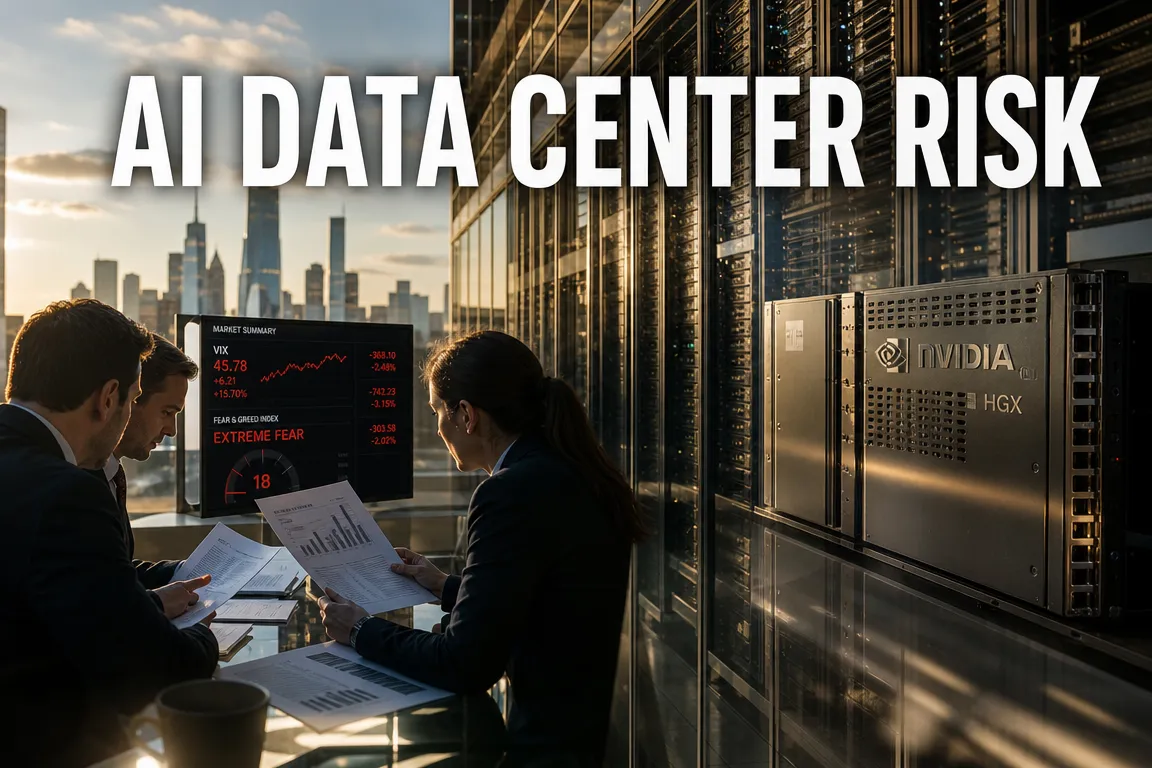
3. The Fear & Greed Index and VIX: Risk Indicators, Not Buy Signals
Extreme fear can create investment opportunities, but it does not confirm a market bottom.
Fear & Greed Index: Measuring Investor Risk Aversion
The widely followed CNN Fear & Greed Index combines several market indicators to assess investor sentiment.
Low readings indicate elevated risk aversion, not the timing of an earnings recovery.
Extreme fear can persist for weeks rather than days.
Buying at a particular reading does not guarantee positive returns over the following 6 months or 1 year.
VIX: Expected Volatility Over Approximately 30 Days
The VIX measures annualized implied volatility derived from S&P 500 option prices.
Elevated readings, such as 30 or 40, indicate that markets are pricing in substantial price fluctuations.
However, a high VIX does not directly quantify the probability of further declines.
Volatility can remain elevated during a strong rebound following a sell-off.
Assess Multiple Signals Rather Than a Single Index Level
- When equities retest their lows, assess whether the VIX also reaches a new high.
- Check whether credit markets stabilize alongside a short-term equity rebound.
- Determine whether gains extend beyond a small group of large-cap stocks.
- Monitor whether earnings forecasts continue to decline.
A falling VIX alone is insufficient.
A recovery has stronger support when sentiment, financing conditions, and earnings expectations stabilize together.
4. Before Assessing a Rebound, Examine Credit Markets
If market stress disrupts corporate financing, a valuation correction can develop into a deeper and more prolonged downturn.
US equity analysis should therefore incorporate credit-market indicators alongside stock prices.
| Indicator | What to Monitor | Investment Implication |
|---|---|---|
| High-yield credit spreads | The yield differential between lower-rated corporate bonds and US Treasuries | Rapid widening may indicate rising default risk and financing pressure. |
| Corporate bond issuance conditions | Issuance completion and required yields | More difficult borrowing and refinancing conditions can lead companies to reduce investment. |
| US Treasury real yields | Yields adjusted for expected inflation | Rising real yields can pressure valuations of growth stocks whose earnings are concentrated further in the future. |
| Corporate earnings estimates | Changes in revenue and earnings-per-share forecasts | A slowdown in earnings downgrades can help support price stabilization. |
If equities rebound while credit spreads continue widening, financing risks may remain unresolved.
Stable credit conditions and slower earnings downgrades may indicate that markets are absorbing adverse developments.
No single indicator reliably anticipates every crisis.
5. AI Financing Costs Can Affect Equity Prices Before Long-Term Technology Prospects
AI-related equities can decline despite continued technological progress if infrastructure financing conditions deteriorate.
The cost of capital is a critical link between technological potential and equity returns.
① Data Centers Are Capital-Intensive Businesses
Data centers require land, power, cooling, networking, and construction spending, in addition to semiconductors.
Higher interest rates or tighter lending terms can reduce project returns even when service demand remains stable.
Project delays and equipment order adjustments can subsequently affect the semiconductor supply chain.
② Long-Term Contracts Depend on Payment Capacity and Guarantees
A substantial long-term contract backlog does not, by itself, establish revenue security.
Investors should assess customer finances, cancellation provisions, minimum purchase obligations, and guarantees.
Companies with concentrated exposure to a particular AI customer require additional scrutiny of that customer’s financing position.
③ Distinguish Debt From Contractual Commitments
Beyond recognized borrowings, leases, purchase commitments, guarantees, and joint-venture funding obligations can create future cash requirements.
Classifying all such obligations as hidden debt or accounting misconduct would be inaccurate.
The key questions are when cash payments become due and whether obligations persist if revenue declines.
④ AI Usage Growth Does Not Necessarily Translate Into Equivalent Infrastructure Revenue Growth
More efficient inference and smaller models can lower service costs and broaden AI adoption.
They can also reduce computing requirements per task, moderating demand growth for certain equipment.
AI investment analysis should therefore consider usage growth, service pricing, and computing efficiency together.
6. Recovery Scenarios: Define Conditions Rather Than Assume a V-Shaped Rebound
Scenario-based decision rules are more practical than attempting to identify an exact month or price for the market bottom.
Scenario A. Rapid Rebound
- Regulatory scope becomes clearer, with a smaller-than-expected earnings impact.
- Major customers maintain AI investment plans and orders.
- Interest rates and credit spreads stabilize.
Lower risk premiums could support a rapid recovery in equity prices.
Initial gains may include short covering, so the durability of the rebound requires separate assessment.
Scenario B. Prolonged Range-Bound Trading
- Business operations remain intact, but growth expectations decline.
- Regulatory and investment-return uncertainties remain unresolved.
- Earnings need time to support prevailing valuations.
A recovery could take considerable time even without a substantial additional decline.
Scenario C. Further Declines
- Order cancellations and investment cuts begin to affect reported results.
- Borrowing costs rise and refinancing becomes more difficult.
- Earnings forecasts continue declining over several quarters.
Previous highs and long-term moving averages would provide insufficient evidence of undervaluation.
The 200-week moving average is a reference indicator, not a guaranteed support level.
7. Long-Term Investors: Phased Buying Requires Suspension Criteria
Long-term investment portfolios and short-term trading accounts require different responses to a sell-off.
Long-Term Investors Making Regular Contributions
- Separate living expenses and near-term funding needs from investment capital.
- Set an appropriate equity allocation and limits for individual holdings.
- Phase purchases according to a schedule or target portfolio weights.
- Suspend additional purchases and reassess if the investment thesis deteriorates.
Phased buying diversifies entry timing; it does not eliminate losses.
Individual companies may fail to recover for an extended period or cause permanent capital losses.
Short-Term Traders
- Define maximum acceptable losses and exit conditions before entering a trade.
- Reduce position sizes during periods of sharp market fluctuations.
- Account for the possibility that margin borrowing and excessive leverage may trigger forced selling.
Leveraged ETFs target daily returns, so longer-term performance can differ from a simple multiple of the underlying index, particularly in volatile markets.
Investors With Limited Available Cash
Before borrowing to purchase more shares, review investment theses, portfolio concentration, and the timing of future cash needs.
Assess whether the portfolio remains sustainable if recovery is delayed, rather than relying on an eventual price rebound.
8. Additional Considerations for Korean Investors: ETF Overlap and the USD/KRW Exchange Rate
① Multiple ETFs Can Still Concentrate Exposure to the Same Risks
Holding S&P 500, Nasdaq-100, and semiconductor ETFs alongside Nvidia shares can create substantial overlapping exposure to large technology companies.
Aggregate underlying holdings and sector weights matter more than the number of investment products.
Broad-market index ETFs can reduce company-specific risk, while semiconductor ETFs remain concentrated in a single sector.
② US Dollar Returns Do Not Translate Directly Into Korean Won Returns
For unhedged US assets, returns measured in Korean won reflect both asset-price movements and changes in the USD/KRW exchange rate.
If US equities rise 10% while the USD/KRW exchange rate falls 8%, the return in Korean won is approximately 1.2%, excluding costs.
Conversely, US dollar appreciation during an equity decline can partially cushion losses measured in Korean won.
Investment plans should therefore account for currency conversion timing and total foreign-exchange exposure.
Conclusion: Establish Risk Capacity Before Investing During Extreme Fear
Extreme fear can create opportunities to acquire quality assets at reasonable valuations.
However, elevated fear and the preservation of fundamental value require separate verification.
A structured assessment should follow this sequence: earnings deterioration → financing stability → regulatory impact → valuation appeal → purchase size.
Reversing this sequence risks taking exposure based solely on the magnitude of the decline.
Maintaining liquidity and risk limits is more important than identifying the exact bottom, particularly when an investment assessment proves incorrect.
< Summary >
- A drawdown does not establish undervaluation. Assess changes in earnings expectations before focusing on price declines.
- AI investment depends on profitability and the cost of capital. Technological growth alone does not guarantee investment returns.
- Sentiment indicators do not confirm market bottoms. Evaluate the VIX alongside credit spreads and corporate earnings.
- Phased buying requires limits. Define the investment horizon and conditions for suspending purchases in advance.
- Korean investors should review ETF overlap and currency exposure. US dollar returns can differ materially from returns in Korean won.
This report provides general market analysis, not a recommendation to buy or sell specific securities or a guarantee of recovery within a particular period.
*Source: [ 소수몽키 ]
– 나스닥-20%, 엔비디아 -48% 극단적 공포 구간에 진입한 증시, 기회일까