● Tesla AI Merger Frenzy – 507 Dollar Shock
Tesla at $385: Why Did Its Gains Diverge from SpaceX? AI Expectations, Merger Premiums, and the $507 Scenario
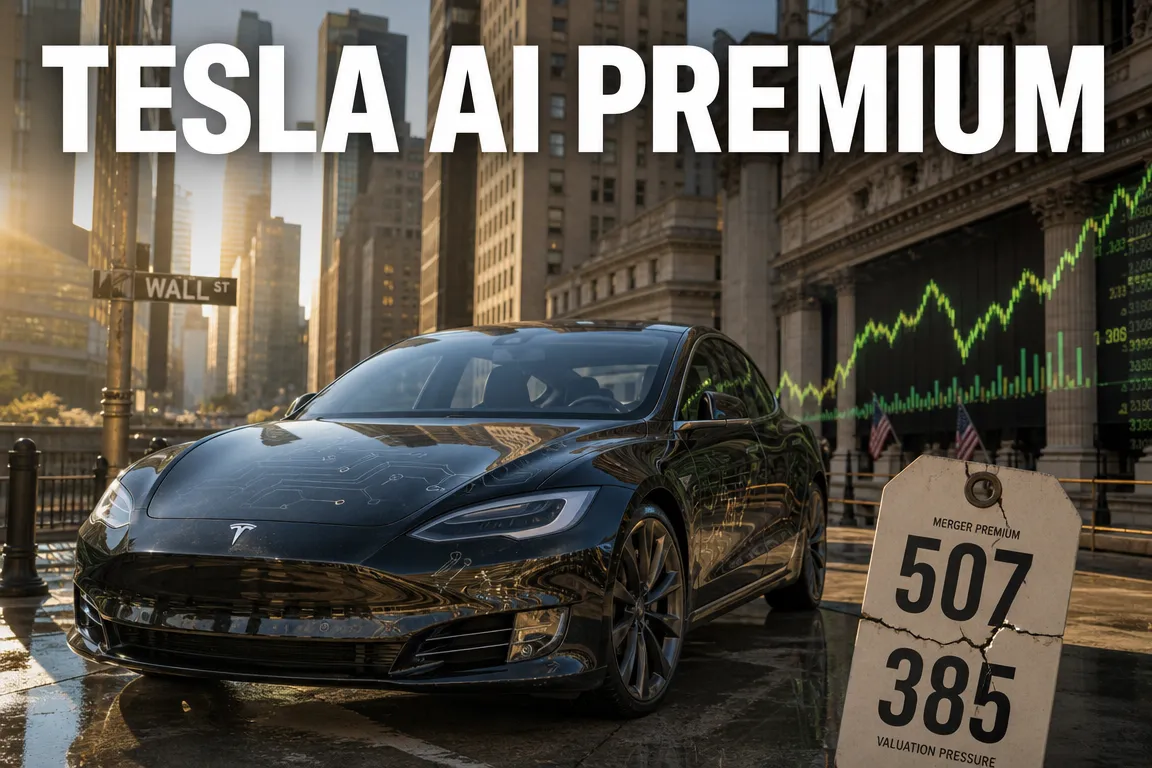
The primary question for Tesla investors is not how much upside remains to $507, but under what conditions that valuation would be justified.
This report examines the divergence in reported share-price gains, the economic value of autonomous driving, the risks of stock-swap mergers, and the funding requirements associated with expanding AI investment.
1. What Do the Reported Gains of 11.46% for Tesla and 4.35% for SpaceX Indicate?
Assuming the reported returns and closing prices are accurate and refer to the same trading day, Tesla significantly outperformed the comparison security.
| Category | Reported Figures | Conditional Interpretation |
|---|---|---|
| Tesla | $385.46, up 11.46% | Company-specific expectations may have reinforced the broader market rebound |
| Security identified as SpaceX | $133.35, up 4.35% | The listed security and price source require verification |
| Nasdaq | Up 6.51% | Assumes a broad recovery in technology-sector risk appetite |
| Return differential | 7.11 percentage points | A simple performance gap that does not establish causation |
Outperformance must be distinguished from its underlying causes.
Tesla’s reported return was approximately 1.76 times the Nasdaq’s return, but a single day’s ratio cannot establish Tesla’s beta, a measure of market sensitivity.
Prior losses, short covering, options activity, trading volume, and company-specific news can all affect daily performance.
- Market factors: Assess whether sentiment improved across U.S. equities.
- Company factors: Identify official announcements that materially changed autonomous-driving commercialization or earnings expectations.
- Trading factors: Determine whether short covering and options hedging amplified the move.
The return differential alone does not justify attributing the move to merger expectations or concluding that FSD accounted for most of the gains.
2. The $507, $359, and $212 Figures Reflect Different Assumptions
The three prices cited in the material are not equivalent types of price targets.
Even if the underlying brokerage report and valuation methodology are verified, the figures must be interpreted separately.
| Price | Stated Interpretation | Difference from $385.46 |
|---|---|---|
| $507 | Transaction scenario incorporating an assumed acquisition premium | Approximately +31.5% |
| $359 | Valuation described as reflecting multiple scenarios | Approximately -6.9% |
| $212 | Assumed standalone valuation | Approximately -45.0% |
$507 is neither a confirmed acquisition price nor a guaranteed payment to shareholders.
Similarly, $212 is not an inevitable share price if a merger fails to proceed.
Valuation changes with assumptions about vehicle sales, profitability, autonomous-driving revenue, and discount rates.
The numerical discrepancy also requires review.
An equal weighting of $212 and $507 produces $359.50. The original report is therefore needed to verify the calculation and rounding methodology behind the stated $359 figure.
An acquisition premium over a historical average price differs from the expected return at the current market price.
A 33% premium to a historical average does not imply a 33% return for investors purchasing after the stock has appreciated.
3. Why Might an Acquisition Target and Its Acquirer Perform Differently?
In a conventional acquisition, the target may command a control premium.
The acquirer must fund that premium, exposing its shareholders to transaction costs and potential dilution.
- Target company: Shareholders may anticipate a transaction price above the prevailing market price.
- Acquirer: Investors assess cash outflows, additional borrowing, and new-share issuance.
- Both shareholder groups: Expected integration benefits must be weighed against transaction costs.
These are general transaction principles, not evidence that merger negotiations between the two companies are underway.
The formation of a special committee, the exclusion of executives from negotiations, and plans for shareholder votes require confirmation through official disclosures.
In a stock-swap transaction, the exchange ratio and contractual structure matter more than the announced transaction value.
Under a fixed exchange ratio, one Tesla share would be exchanged for a specified number of shares in the other company. A decline in the receiving shares’ price would reduce the market value of the consideration.
Under a fixed-value structure, the number of shares delivered may adjust. Contracts may also include collars limiting those adjustments.
Dividing $385.46 by $133.35 produces approximately 2.89, but this is only an arithmetic price ratio.
It does not establish an actual exchange ratio or Tesla shareholders’ negotiating leverage.
4. Tesla’s AI Valuation Depends on Monetization, Not FSD Version Numbers
Autonomous driving, robotaxis, and Optimus are important variables in Tesla’s long-term valuation.
However, classification as an AI company does not independently justify a high valuation.
The technology must operate safely, attract paying customers, and generate profits after operating costs.
① FSD: Software updates and driverless-operation authorization are separate matters.
Even a verified software release does not establish that operation without driver supervision is permitted.
Actual capabilities, driver responsibilities, operating conditions, and regional regulations require separate assessment.
② Robotaxis: Per-vehicle economics matter more than fleet size.
Relevant metrics include paid-service coverage, utilization, the proportion of revenue-generating mileage, insurance, cleaning and maintenance expenses, and remote-support costs.
If operating expenses increase faster than fleet deployment, revenue growth may not translate into earnings growth.
③ Optimus: Demonstrated capabilities must be distinguished from operational productivity.
Key indicators include repetitive-task success rates, the frequency of human intervention, maintenance costs, and customer payback periods.
For long-term equity investors, repeatable revenue and cash flow matter more than product demonstrations.
5. The AI Investment Paradox: Rising Demand Can Coincide with Funding Shortfalls
AI data centers do not generate revenue immediately upon purchasing semiconductors.
Facility construction, grid connections, cooling systems, networking, and customer-service deployment must be completed first.
A major risk is the mismatch between expenditure timing and revenue generation.
If equipment is paid for before power connections are available, capital remains committed while revenue is delayed.
The relevant issue is not simply the strength of AI demand, but the ability to finance that delay.
Accounting distinctions also matter.
Server and building purchases generally constitute capital expenditure. Describing the entire associated funding requirement as working capital is inaccurate.
Analysis should distinguish capital expenditure, working capital, interest expense, and free cash flow.
If U.S. interest rates remain elevated, financial pressure may increase through two channels.
- Debt-financed businesses may face higher funding costs.
- Growth stocks whose valuations depend heavily on distant earnings may be more sensitive to higher discount rates.
A sharp one-day rebound in AI-related shares does not establish that data-center investment recovery risks have been resolved.
6. Technical and Commercial Issues in Memory Specifications and Starlink Integration
① Higher aggregate memory capacity does not produce a proportional improvement in autonomous-driving performance.
The cited AI computer specifications and production schedule require official verification.
Under the stated assumptions, reducing planned capacity from 64GB to 48GB represents a 25% reduction from the original plan.
If the existing product has 32GB, the same 48GB configuration represents a 50% increase in physical capacity.
Combined memory across two chips may not equal the memory freely available to a single AI model.
Usable capacity depends on whether the architecture employs safety redundancy or shared memory.
Performance also depends on memory bandwidth, computing capacity, power consumption, thermal constraints, and software optimization.
② Satellite internet may supplement robotaxi connectivity, but it does not replace autonomous-driving capability.
Vehicle integration and service-launch schedules for Starlink require confirmation through official product information.
Technical assessment should include terminal costs, power consumption, antenna placement, national telecommunications approvals, and obstructed-sky conditions.
Satellite internet does not guarantee continuous connectivity in underground parking facilities, tunnels, or similar environments.
Safe autonomous driving must respond appropriately when communications become unreliable.
Passenger internet access, fleet monitoring, and driving decisions should be evaluated separately.
7. An Often-Overlooked Issue: The Economic Benefits Accruing to Tesla Shareholders
First, commercial cooperation does not automatically translate into value for Tesla shareholders.
Even when Tesla combines services with another company, shareholder value depends on which entity recognizes revenue and which bears the costs.
If the same individual exercises influence over both companies, transaction fairness and board oversight become particularly important.
Second, market prices differ from acquisition prices, and acquisition prices differ from after-tax returns.
For South Korean residents investing in overseas equities, tax and reporting obligations may vary with the transaction structure.
A stock swap should not be assumed to qualify automatically for tax deferral. Investors should determine whether taxes could become payable without receiving cash consideration.
Specific treatment depends on the final contract, applicable law, and individual tax basis.
Third, combining merger expectations and AI growth expectations can double-count value.
If standalone valuation already incorporates future autonomous-driving profits, those same benefits should not be added again as merger synergies.
Automatically combining an AI valuation premium with an additional merger premium risks overstating value.
Fourth, precise calculations based on unverified information can create false confidence.
Detailed price targets and upside calculations have limited investment relevance if the underlying listing status or transaction terms are incorrect.
Priority sources include official investor communications, exchange records, SEC filings, and original brokerage reports.
8. A Review Sequence for Tesla Investors Around $385
- Verify the facts: Confirm the price reference date, official announcements, listed security, and report publication date.
- Assess the core business: Review automotive profitability, cash holdings, capital expenditure, and free cash flow.
- Verify AI monetization: Assess paid FSD adoption, robotaxi operating economics, and customer revenue from robotics.
- Review transaction terms: If an actual merger proposal is disclosed, examine the exchange ratio, share issuance, approval conditions, and termination provisions.
- Manage portfolio exposure: Determine whether the position remains manageable if no merger occurs or AI commercialization is delayed.
A purchase price of $385 does not, by itself, determine whether to hold or sell.
The more important questions are whether the current valuation is supportable without a merger and when AI business performance will translate into cash flow.
< Summary >
- Key claims concerning a SpaceX listing, merger negotiations, and leadership changes should not be treated as confirmed news without official verification.
- The reported return differential is 7.11 percentage points, but it does not establish the cause of the price moves.
- $507 is a conditional transaction assumption, while $212 is not a definitive downside target.
- Tesla’s long-term valuation requires evidence of monetization in autonomous driving, robotaxis, and robotics.
- Stock-swap transactions require analysis of exchange ratios, the counterparty’s share price, dilution, and taxation.
- Power availability, financing capacity, and cash-recovery timing are as important to AI investment as technological competitiveness.
[Related Articles…]
*Source: [ 오늘의 테슬라 뉴스 ]
– 스페이스X는 4%, 테슬라는 11% — 같은 반등에서 왜 갈라졌나, $385 테슬라 주주는?
● Nvidia Santa Rally Trap
Does Nvidia’s Rebound Signal a Santa Claus Rally? Three Variables Shaping the KOSPI and Semiconductor Stocks
When semiconductor stocks surge, the priority is not the size of the gain but whether earnings and capital flows can sustain it.
The market outlook warrants assessment across three variables: U.S. AI policy and export controls, corporate disclosures and governance, and U.S. inflation and interest rates.
Examining the earnings implications for Samsung Electronics and SK hynix, alongside cash flow across the AI investment cycle, helps distinguish a short-term rebound from a sustained trend reversal.
1. First Variable | Actual U.S. AI Regulations Matter More Than Policy Expectations
The central question is not which political party benefits, but how policy changes AI companies’ revenue and investment costs.
AI can support national competitiveness and productivity, while increasing electricity demand and pressure on local infrastructure.
A binary view of U.S. AI policy as either accelerating or restraining development can obscure investment opportunities.
- Advanced semiconductor export controls: Changes to eligible destinations and product performance thresholds can affect Nvidia’s market access and product mix.
- Data center permitting: Delays in construction approvals and grid connections can postpone the conversion of announced investment plans into equipment orders.
- Power infrastructure cost allocation: Higher transmission and distribution infrastructure charges and electricity tariffs for data center operators can affect AI service profitability.
Nvidia’s competitive position rests on GPU performance and the development tools and software ecosystem built around CUDA.
Competing GPUs and custom accelerators also support AI workloads. Claims that the entire AI industry depends on a single company are therefore overstated.
Investors should examine regulatory scope, implementation dates, and exemptions rather than the intensity of political rhetoric.
2. Second Variable | Verify Disclosures and Business Continuity Before Acting on Management News
Confidence in key executives can materially influence valuations at founder-led technology companies.
Concentration of product strategy, customer relationships, and decision-making around one individual can amplify share-price volatility when leadership becomes uncertain.
However, executive departures or allegations of misconduct should not serve as factual investment premises without official documentation.
Relevant reports should be assessed in the following order.
- Official confirmation: Review the company’s investor relations website and U.S. Securities and Exchange Commission filings for confirmed leadership changes or material events.
- Nature of the proceedings: Distinguish congressional inquiries, investigations, indictments, and court rulings; their implications differ.
- Business impact: Check for actual changes to product launches, customer contracts, export licenses, and revenue guidance.
- Organizational resilience: Assess delegation, succession arrangements, and the continuity of critical operations.
A hearing or investigation does not establish wrongdoing.
Conversely, reduced leadership uncertainty does not automatically improve earnings prospects.
A recovery driven by reduced uncertainty should be distinguished from a valuation re-rating supported by stronger earnings.
3. Third Variable | U.S. Inflation and Interest Rates Affect Semiconductor Valuations
Even if company-specific developments lift Nvidia and the Nasdaq, higher-than-expected inflation can change market conditions.
The Personal Consumption Expenditures price index, or PCE inflation, is an important indicator for assessing the Federal Reserve’s policy outlook.
A single inflation release, however, does not determine whether interest rates will rise or fall.
- Headline PCE: Measures broad price trends in consumer expenditure, including energy and food.
- Core PCE: Excludes volatile energy and food prices to help assess underlying inflation pressures.
- Month-over-month changes: Indicate whether the recent pace of inflation is accelerating.
- Deviation from market expectations: An upside surprise can have a larger market impact than an already anticipated elevated reading.
Higher-than-expected inflation can weaken expectations for rate cuts or increase concerns about monetary tightening.
A resulting rise in U.S. Treasury yields can pressure price-to-earnings multiples, or P/E ratios, for growth stocks whose valuations depend heavily on future earnings.
Effects can reach Korean equities through dollar strength, movements in the won-dollar exchange rate, and foreign capital flows.
The global economic outlook therefore requires consideration of both AI industry growth and the interest rates used to value that growth.
4. Samsung Electronics and SK hynix | Nvidia Gains Do Not Imply Identical Earnings Improvements
Improving expectations for Nvidia can support sentiment toward Korean semiconductor stocks.
However, Samsung Electronics and SK hynix have different earnings drivers, reflecting their product portfolios and customer supply arrangements.
- HBM supply competitiveness: Converting demand growth for high-bandwidth memory into revenue requires customer qualification and reliable volume production.
- Manufacturing yields and production costs: Higher sales volumes may not deliver the expected profit growth if manufacturing costs rise.
- Product profitability: Prices and inventories for conventional DRAM and NAND flash affect overall earnings alongside HBM.
- Capital expenditure and supply expansion: Aggressive capacity additions can support growth but may later create oversupply and higher depreciation expenses.
An industry forecast that AI will grow is distinct from a company-level forecast that earnings per share will increase.
Sustained share-price gains require support from customer orders, shipments, selling prices, and operating margins.
5. A Checklist for Distinguishing a Santa Claus Rally from a Temporary Rebound
The Santa Claus rally typically refers to the seasonal tendency for equities to rise during the final five trading days of the year and the first two trading days of the new year.
A single sharp year-end gain does not establish the start of this rally or confirm a trend reversal.
| Indicator | Signals Supporting Sustained Gains | Warning Signs of a Weakening Rebound |
|---|---|---|
| Corporate earnings | Improving revenue and earnings forecasts accompanied by order growth | Rising share prices without improving earnings forecasts |
| AI policy | Reduced uncertainty over export and permitting regulations | Broader sales restrictions and delayed investment execution |
| Interest-rate environment | Easing inflation pressures and stable Treasury yields | Upside inflation surprises and rising market interest rates |
| Market breadth | Gains spreading across multiple sectors | Gains concentrated in a few large-cap stocks |
| Korean market flows | Sustained foreign buying in the cash equity market | A return to selling after a brief period of buying |
A buy-side sidecar temporarily suspends the effectiveness of program-trading buy orders in response to sharp market movements.
Its activation signals strong price movements but does not guarantee further gains.
6. Additional Focus | Who Ultimately Pays Matters More Than the Scale of AI Investment
An often-overlooked question in AI investment analysis is not how much equipment has been purchased, but how much end customers pay for services.
Supplier equity investments, customer financing, and long-term purchase agreements can be interconnected within the AI investment ecosystem.
These structures are not inherently problematic, but announced investment totals alone do not establish sufficient independent end demand.
- End-customer revenue: Assess whether actual enterprise and consumer spending on AI services is increasing.
- Cash collection: Examine whether equipment suppliers’ revenue growth translates into higher operating cash flow.
- Customer financing: Distinguish purchases funded by internally generated cash from those heavily dependent on additional borrowing or external investment.
- Infrastructure readiness: Even after GPUs are secured, inadequate power, cooling, or networking can delay revenue generation.
Improvements in AI model efficiency have two-sided implications.
They can reduce computing requirements per task, while lower usage costs may drive faster growth in overall demand.
A more robust long-term AI outlook considers usage, service pricing, customer retention, and cash flow alongside equipment sales.
< Summary >
- Unverified management reports and share-price figures should not be treated as established investment evidence.
- Key market variables are U.S. AI policy, official disclosures and business continuity, and PCE inflation and interest rates.
- Samsung Electronics and SK hynix require separate assessments of HBM competitiveness and memory profitability.
- Earnings expectations and sustained capital flows provide a stronger basis for assessing a year-end rally than a single sharp gain.
- End-customer spending and cash collection are central to the sustainability of AI investment.
[Related Articles…]
*Source: [ 경제 읽어주는 남자(김광석TV) ]
– [속보] ‘향후 증시의 3가지 쟁점’ 젠슨황의 복귀는 산타랠리 신호인가? 일시적 반등인가? [즉시분석]