● Semiconductor Meltdown
Semiconductor Crash in the Tariff War Season 2: Are Samsung Electronics and SK Hynix Really in Danger?
The core point of this sharp semiconductor decline is not simply that “stock prices have fallen a lot.”
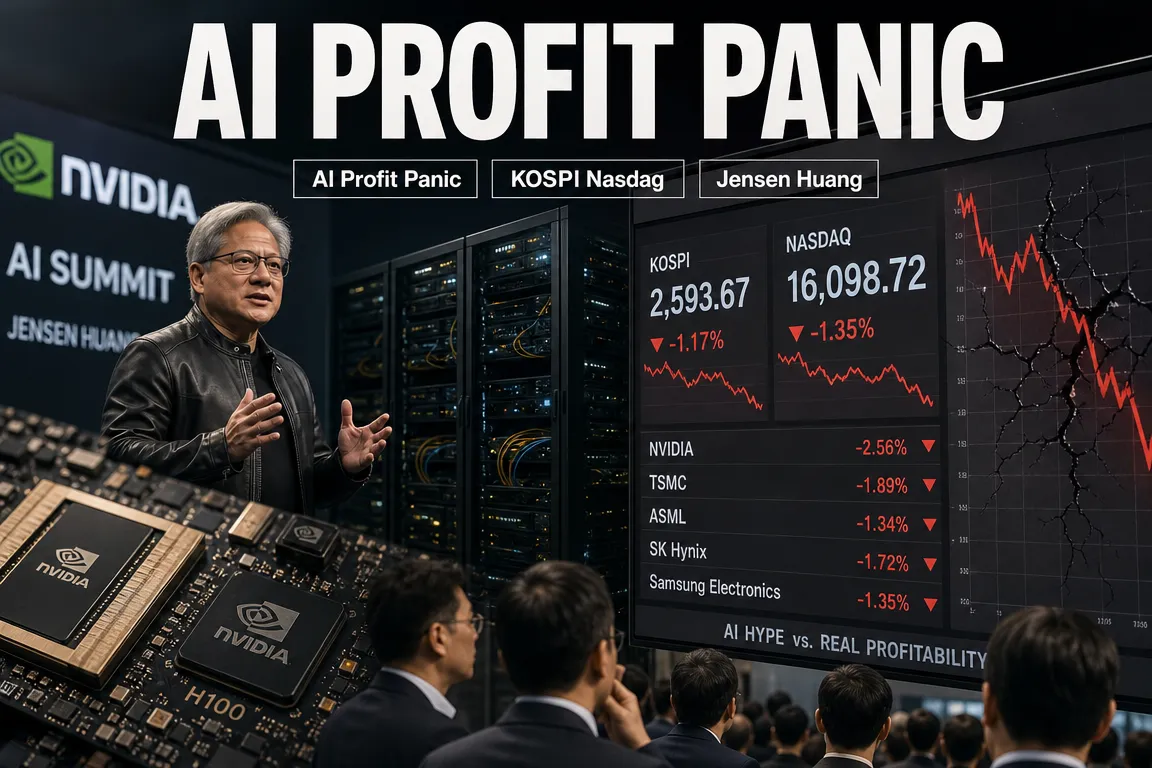
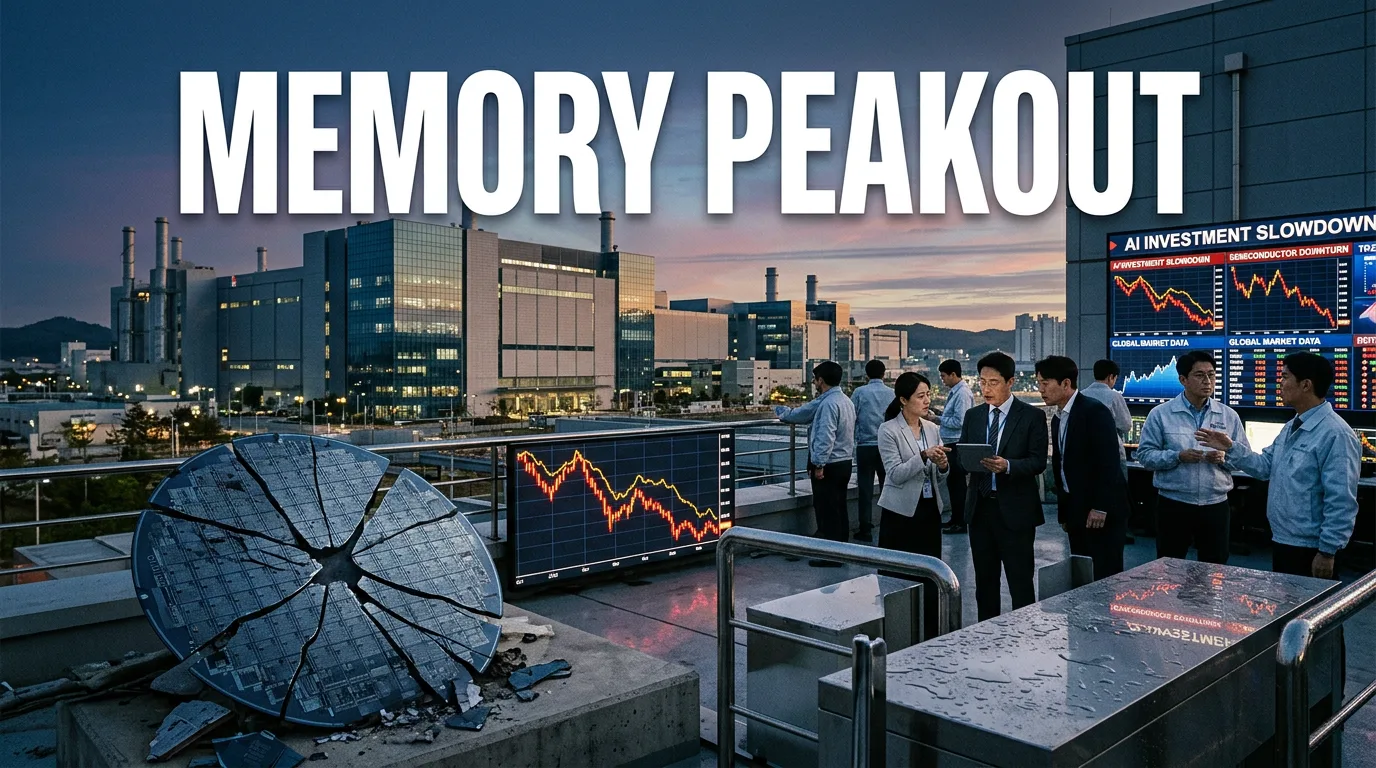
What matters is that the U.S. tariff war has reignited, the Nasdaq has corrected, there are fears of a memory semiconductor peak-out, AI data center investment is slowing, and DRAM and HBM price outlooks are all overlapping at once, with the market already pricing in the worst-case scenario first.
In particular, judging by how much Samsung Electronics and SK Hynix have already fallen, the market appears to have priced in not just a simple slowdown in earnings, but even the possibility of a worsening memory industry cycle in 2028.
So the point to watch right now is not “Will it fall more?” but “How much bad news has already been reflected in the stock price?”
1. Direct Cause of the Semiconductor Drop: Tariff War and Fear of Memory Peak-Out
The biggest area of turbulence in the market recently has been semiconductor stocks.
While the Nasdaq has been weak, the semiconductor index has fallen by a much larger margin, causing investor sentiment to freeze rapidly.
There are three broad reasons on the surface.
- The possibility of renewed U.S. tariff wars
- Fears that memory semiconductor prices have peaked
- The possibility of slowing AI data center investment
As news emerged that the U.S. might once again revive tariff hikes targeting multiple countries, the market has been recalling the shock of the 2018 U.S.-China trade war.
Tariffs are a significant burden for the stock market because they raise corporate costs, fuel consumer inflation, and can destabilize global supply chains.
Semiconductors, in particular, are more sensitive to tariff-war issues because the industry depends heavily on global supply chains.
That said, this tariff pressure appears to be more of a bargaining chip to encourage greater investment in the U.S. than a sign of imminent implementation.
With oil and inflation already under pressure, raising tariffs too aggressively could also weigh on the U.S. economy.
2. The Real Issue the Market Fears Most: The Possibility of Excess Memory Supply in 2028
The most important substance behind this decline is not tariffs, but the outlook for the memory semiconductor cycle.
The market is now worrying more about a deterioration in memory supply and demand after 2028 than about earnings in 2026 or 2027.
In particular, expectations that HBM demand in the AI semiconductor market will keep surging explosively are being adjusted somewhat downward.
As forecasts emerge that the amount of HBM installed in Nvidia’s next-generation GPU platform may be lower than expected, concerns are growing that “HBM demand may have already peaked.”
HBM is a core growth driver for Samsung Electronics and SK Hynix.
That is why even a slight reduction in HBM demand expectations can create significant pressure on major domestic semiconductor stocks.
However, the important thing here is that this does not mean oversupply is happening immediately.
When various forecasts are combined, DRAM supply shortages are likely to continue through 2027.
The problem is 2028.
The market fears that if AI data center investment growth slows and production capacity expansions by Chinese firms such as CXMT overlap, memory supply and demand could loosen in 2028.
3. DRAM Price Outlook: Shortage Until 2027, Slowdown From 2028
The scenario currently being priced in by the market is quite conservative.
In 2026, memory supply is likely to remain below demand.
In 2027, this shortage could become even more pronounced.
That is because AI data center construction and equipment investment already underway are not easy to cancel.
In the semiconductor supply chain, once an investment plan is made, it is difficult to reverse course in the short term.
So through 2027, tight supply is more likely than a sharp collapse in DRAM prices.
That said, conditions could change in 2028.
If AI investment growth is lower than expected and new production capacity enters the market, DRAM prices could fall.
Some forecasts even suggest that general DRAM prices could decline by double digits in 2028.
Even so, this would be closer to a narrowing shortage than a full-blown oversupply situation.
In other words, the market is pricing in not a true oversupply, but a very strong slowdown in growth.
4. Have Samsung Electronics and SK Hynix Already Priced in the Worst?
The current share prices of Samsung Electronics and SK Hynix appear to have already reflected a great deal of bad news.
Memory price declines, slower HBM growth, delays in AI data center investment, and tariff risks have all been priced in at once, driving valuations much lower.
In particular, the forward P/E for the semiconductor sector is now in a historically low range.
The Nasdaq’s overall forward P/E has also fallen to levels seen during major past corrections, and the semiconductor sector is valued even more cheaply than that.
The problem is that earnings expectations for these companies have not completely collapsed yet, while stock prices and valuations have already fallen sharply.
This is often described as a situation where the gap between earnings and stock prices has widened significantly.
In the long run, stock prices tend to converge with corporate earnings and cash flow.
So during periods like this, when EPS and free cash flow forecasts are still holding up but stock prices are falling rapidly, it becomes an important observation period for long-term investors.
5. The Core Point the Market Is Missing: Spot Prices and Long-Term Contract Prices Are Different
There is one part of this semiconductor selloff that many investors may easily overlook.
That is the difference between memory spot prices and long-term contract prices.
Spot prices are the prices at which goods are bought and sold in the market right now.
By contrast, large cloud companies and AI data center customers often procure memory through long-term supply contracts.
Memory companies such as Samsung Electronics and SK Hynix have signed long-term contracts with some customers that include a price floor.
This means that even if spot prices fluctuate in the short term, the contract prices actually reflected in corporate earnings can remain relatively stable.
Of course, if spot prices fall much further, the risk of renegotiation or cancellation of long-term contracts could rise.
But some analysis suggests that such risks would not really materialize unless prices fell by nearly another 50% from current levels.
Unless servers suddenly need almost no memory at all, such an extreme decline does not seem likely.
6. NAND Is a Bit More Cautious, but AI SSD Demand Is Still Alive
The NAND market is showing a somewhat weaker trend than DRAM.
NAND spot prices are already falling, and some forecasts have shifted next-quarter price changes from positive to negative.
This could also weigh on Samsung Electronics’ earnings.
That said, not all demand in the NAND market is collapsing.
Demand for SSDs used in AI data centers is still growing rapidly.
Major storage companies are securing long-term supply contracts and prepayments to lock in future demand in advance.
In other words, while general-purpose NAND prices may weaken, demand for high-performance SSDs for AI servers and data centers is still strong, and that distinction matters.
This is an area where the market may be interpreting things too negatively.
7. Semiconductor Valuations: Cheaper, but That Does Not Mean They Will Rise Immediately
By valuation alone, semiconductor stocks are now in a historically cheap range.
But stocks do not move on valuation alone.
In the short term, sentiment, supply and demand, fear, and macro news have a much larger impact.
Especially when tariff wars, U.S. interest rate expectations, a stronger dollar, and recession fears appear at the same time, even undervalued stocks can get cheaper.
So the more realistic view right now is not “It’s cheap, so it will surge immediately,” but rather “It has become cheap, but a bottoming process is still needed.”
Semiconductor stocks often make their highs when earnings look best and their lows when fear becomes extreme.
We are clearly in a period where fear has become quite intense.
That said, historically, semiconductor downcycles often spent six months to a year consolidating after finding a bottom.
Therefore, a medium- to long-term phased approach appears more suitable than chasing a short-term rebound.
8. Resemblance to 2018: Tariff Wars, Interest Rates, and Nasdaq Correction
The current market atmosphere has some similarities to 2018.
Back then, trade wars also shook the market significantly, and the Nasdaq underwent a major correction.
In addition, the Federal Reserve’s tightening stance pressured investor sentiment.
Afterward, the market rebounded strongly as expectations grew that the rate hike cycle was ending.
This time as well, the U.S. interest rate outlook is likely to be an important variable.
If the market begins to judge that “further tightening is limited and future easing is possible,” a more favorable environment could return for growth stocks and semiconductor stocks.
On the other hand, if inflation rises strongly again, tariffs expand in reality, and rate burdens increase, the rebound could be delayed further.
Ultimately, the key in semiconductor investing right now is not to look only at the memory cycle, but also at the Nasdaq outlook, the U.S. rate outlook, and tariff-war risks together.
9. Five Things Investors in Samsung Electronics and SK Hynix Should Check Now
For investors looking at Samsung Electronics and SK Hynix right now, it is more important to check the following five points than to focus on daily stock swings.
① Whether the HBM demand outlook is actually weakening
Rather than only watching news about HBM stack adjustments, you should also look at overall AI GPU shipments and data center investment 규모.
Even if the amount of HBM installed per unit falls, overall demand can be maintained if AI server shipments rise sharply.
② How well DRAM contract prices hold up
More important than spot price declines are the long-term contract prices with major customers.
If contract prices remain stable, the earnings impact may be smaller than the market fears.
③ Whether AI data center investment delays turn into cancellations
Investment delays and investment cancellations are completely different.
Delays caused by power, site, or permitting issues are not the same as a long-term erosion of demand.
But if actual cancellations increase, the memory demand outlook could weaken again.
④ The pace of capacity expansion by Chinese memory makers
Capacity expansion by Chinese companies such as CXMT is an important variable for memory supply and demand after 2028.
It could become a supply burden in the general DRAM market, but for cutting-edge HBM and high-performance server memory, the technology gap also needs to be considered.
⑤ Cash flow rather than valuation
The market these days cares more about free cash flow than P/E ratios.
You need to check whether these companies still generate cash after massive capital expenditures.
Both Samsung Electronics and SK Hynix need to assess CapEx burden and cash generation capacity while competing in the AI semiconductor investment race.
10. The Most Important Point Other News Often Misses
Right now, the market is pricing in much more fear about “growth slowing” than about “memory prices falling.”
That difference is very important.
Slower growth does not necessarily mean corporate earnings will deteriorate; it can simply mean improvement is happening more slowly.
Yet stock prices are reacting as if earnings are collapsing abruptly.
In particular, a scenario in which AI data center investment falls by 20% does not necessarily mean total investment is declining; it is closer to saying the increase is lower than previously expected.
If you confuse that point, you will become overly pessimistic about the market.
Another important point is that semiconductor cycle bottoms have always formed when the news was at its worst.
By the time good news was confirmed, stock prices were often already much higher.
So instead of being swept away by short-term fear, it is better to calmly distinguish between actual demand destruction and mere expectation adjustments.
11. Conclusion: Are Samsung Electronics and SK Hynix Okay?
It is hard to say that Samsung Electronics and SK Hynix have no issues at all.
Slower memory prices, lower HBM expectations, delays in AI data center investment, and tariff war risks are all real burdens.
However, current stock prices already appear to reflect a great deal of bad news.
In particular, because the market has even priced in the possibility of a slowdown in the memory cycle in 2028, this is now a phase where investors should consider the medium- to long-term recovery potential alongside the downside.
In the short term, volatility may continue.
But in the long term, if investment in AI infrastructure, server DRAM demand, HBM competitiveness, and data center SSD growth remain intact, the current range could instead become an important observation zone for phased semiconductor stock buying.
The core point is not to try to catch the exact bottom all at once.
The semiconductor cycle always swings between fear and greed to extremes.
That is why, in a period like this, a strategy of steadily tracking supply and demand, contract prices, cash flow, and AI investment trends is more important than watching the stock price alone.
< Summary >
The semiconductor crash is the result of overlapping fears of a tariff war, debate over a memory peak-out, and the possibility of slowing AI data center investment.
Samsung Electronics and SK Hynix stock prices appear to have already priced in a substantial part of the possibility of a downturn in the 2028 cycle.
Through 2027, DRAM supply shortages are likely to continue, and the key risk from 2028 onward is easing supply and demand conditions.
Rather than watching only spot price declines, investors should also look at long-term contract prices and AI server demand.
Short-term volatility remains, but from a long-term investment perspective, this is the time to check whether semiconductor stocks are entering an undervalued zone.
[Related Articles…]
- AI Data Center Investment Slowdown and Semiconductor Cycle Outlook
- U.S. Interest Rate Outlook and Nasdaq Valuation Strategy
*Source: [ 월텍남 – 월스트리트 테크남 ]
– 관세전쟁 시즌2에 반도체 대폭락. 삼전닉스는 괜찮을까?