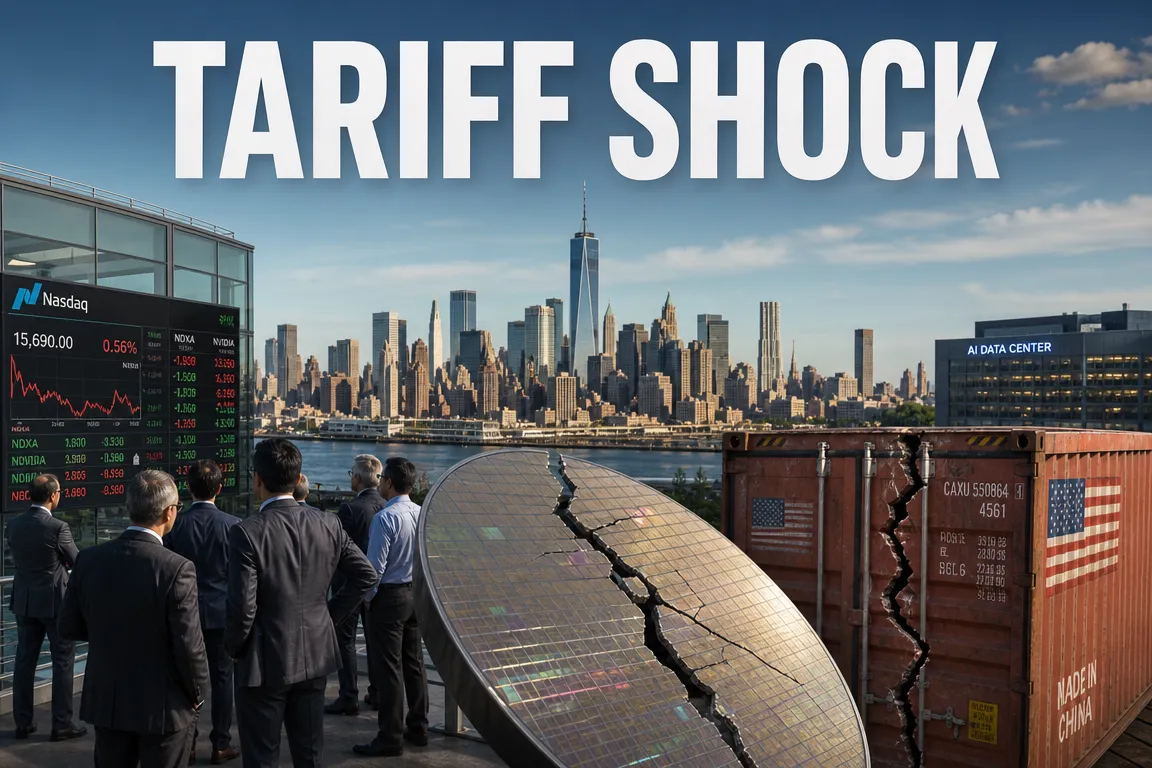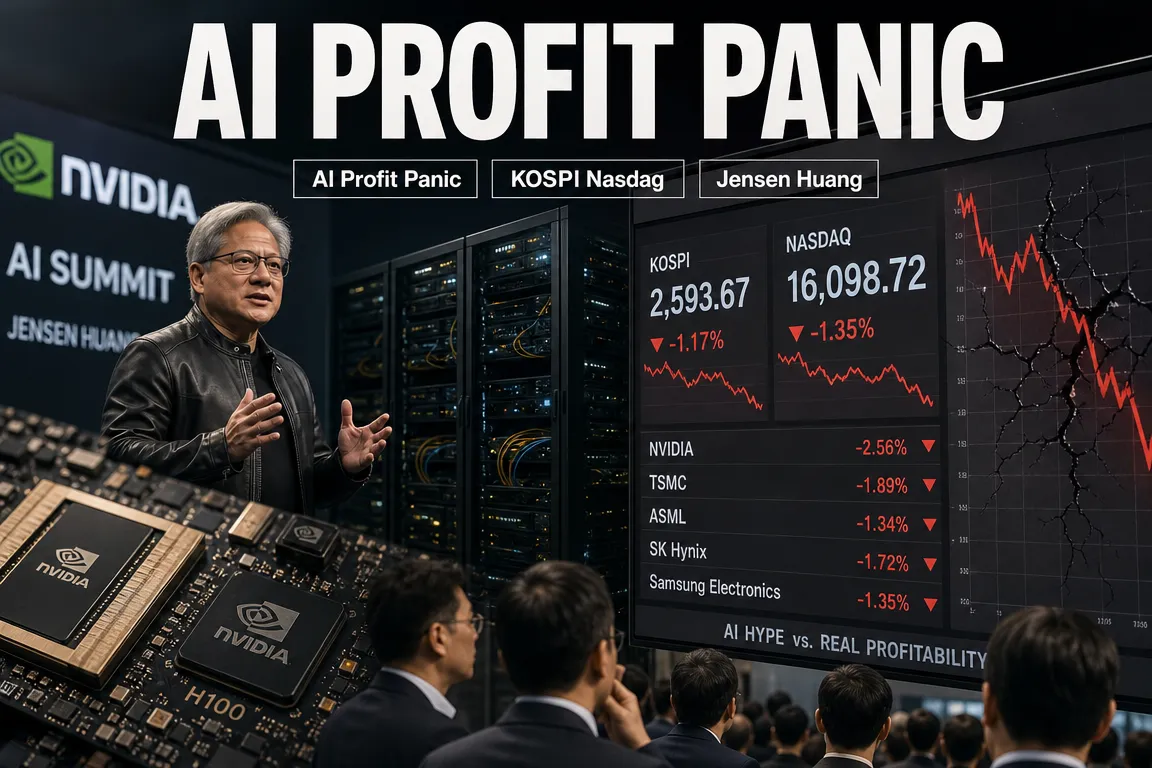
● AI Profit Panic Rocks Nasdaq, Kospi
Why Jensen Huang’s Presence Does Not Stabilize Markets: AI Profitability and Semiconductor Risks Driving the KOSPI and Nasdaq
Growth in the AI industry does not necessarily translate into sustained gains in AI-related stocks.
Understanding the direction of the KOSPI and Nasdaq requires examining AI profitability, data center power constraints and regulation, investment funding flows, and the durability of memory demand rather than high-profile executive appearances.
The central question is not simply the scale of AI investment, but who ultimately pays for it.
1. Market Focus Shifts from AI Expectations to Earnings Validation
Executives such as Jensen Huang can raise the industry’s visibility, but their appearances alone do not change corporate earnings prospects.
Equity prices respond less to positive announcements themselves than to how far results exceed expectations already reflected in valuations.
- When expectations are low: New investments or product announcements may improve growth expectations.
- When expectations are high: Even substantial announcements may have limited impact if revenue conversion and earnings contributions remain uncertain.
- When risk aversion increases: Interest rates, exchange rates, foreign investor flows, and profit-taking can outweigh company-specific developments.
A decline in the Nasdaq or KOSPI does not establish that the AI industry is failing.
Distinguishing actual industry growth from the growth implied by equity valuations is essential to assessing the global economic outlook and investment opportunities.
2. AI Profitability: Growth After Costs Matters More Than Revenue Alone
High spending does not, by itself, indicate financial weakness at an AI company.
Early-stage markets require upfront investment in infrastructure and technology.
The key issue is whether customer revenue and cash flow improve alongside rising investment.
- Paying customer retention: Assess whether enterprise customers renew contracts and expand adoption beyond pilot programs.
- Service delivery costs: If inference costs rise proportionately with customer growth, revenue expansion alone may not improve profitability.
- Investment payback period: Evaluate whether the useful lives of GPUs and data centers support recovery of the capital invested.
- Dependence on external financing: Distinguish operating cash generation from continued reliance on fundraising and borrowing.
For AI model developers such as Anthropic, enterprise contract durability and service delivery costs are more informative than user counts or valuations alone.
Private companies disclose limited financial information, so estimates should not be treated as definitive evidence of profitability or cash burn.
The central question is not whether AI is useful, but whether customers pay enough for that utility to cover its costs.
3. Data Center Regulation: Operating Delays Can Affect Earnings Before Construction Restrictions
Data center investment depends on federal policy, local permitting, grid connections, water availability, and environmental requirements.
Reports of regulatory discussions in the U.S. Congress are distinct from enacted legislation restricting construction.
Investors should examine geographic scope, implementation dates, and differences in treatment between existing and new facilities.
- Grid connection delays: Completed facilities with installed equipment may remain unable to operate without adequate power.
- Permitting delays: Deferred commissioning can alter semiconductor and server delivery schedules.
- Higher operating costs: Rising electricity and cooling costs may slow improvements in AI service profitability.
Operational capacity with secured power can be more informative than announced investment commitments.
However, commissioning delays do not necessarily indicate lost demand.
Distinguishing temporary rescheduling from cancellations caused by deteriorating project economics is essential to a balanced semiconductor outlook.
4. Circular Investment Structures: Independent Customer Demand Is the Key Test
When a semiconductor supplier invests in an AI company that then uses the funding to purchase the supplier’s products, the transactions create linked financial interests.
Such arrangements do not inherently constitute improper transactions or fictitious revenue.
Supplier investment can support customer development during an ecosystem’s early stages.
The following factors warrant scrutiny.
- End-customer revenue: Are external businesses and consumers generating sufficient service revenue?
- Transaction terms: How are investment and purchasing commitments linked, and are the arrangements transparently disclosed?
- Cash collection: Is revenue growth accompanied by cash receipts, or primarily by expanding receivables?
- Funding interruption risk: Can customers fulfill purchasing commitments if access to new financing deteriorates?
The key question is straightforward.
“Can the ecosystem sustain itself through end-customer payments without additional investment funding?”
The less certain the answer, the more financing conditions may influence share prices relative to the scale of AI investment.
5. How Micron Concerns Can Affect Samsung Electronics and SK hynix
As a major global memory supplier, Micron can influence sentiment toward Korean semiconductor equities through changes in its earnings outlook or analyst assessments.
Claims of a substantial price-target reduction and a projected demand decline in 2028 remain unverified without the underlying research report and publication date.
A price target reflects an analyst’s assumptions; it does not establish future demand as a certainty.
Potential effects on Korean semiconductor companies fall into three channels.
- Sentiment channel: Concerns about an overseas memory supplier can create selling pressure across domestic peers.
- Industry fundamentals channel: Confirmed order reductions or inventory increases may lead to lower memory price and earnings forecasts.
- Index channel: Declines in heavily weighted semiconductor stocks can weigh on the broader KOSPI.
However, Samsung Electronics, SK hynix, and Micron will not necessarily experience the same earnings changes.
Outcomes depend on HBM competitiveness, exposure to conventional DRAM and NAND, customer mix, production yields, and capital investment requirements.
Strong HBM demand can coexist with weakness in conventional memory, while recovery timing may vary by product category.
Semiconductor demand should therefore be assessed by segment rather than treated as a single market.
6. An Overlooked Issue: One AI Investment Can Support Multiple Corporate Growth Narratives
A single AI investment program can feature in the growth outlooks of model developers, cloud providers, server manufacturers, and semiconductor suppliers.
Although genuine transactions may occur at each stage, adding them together as independent sources of final demand can overstate market size.
A model developer’s infrastructure spending can become a cloud provider’s revenue, while the cloud provider’s capital expenditure generates revenue for server and semiconductor suppliers.
These are connected activities within a value chain, not necessarily separate sources of incremental final demand.
Investors should therefore prioritize external customer spending on AI services and its growth rate over aggregate investment announcements.
Supply lead times also matter.
Capacity added in response to current equipment shortages may come online after customers have changed their investment pace.
Current shortages can coexist with the risk of excess supply several years later.
However, predicting a demand collapse in a specific year requires additional evidence on capacity, orders, and inventories.
7. Indicators to Monitor: Cash Flow and Utilization Over Headline Announcements
- AI demand: Track paid enterprise contract renewals and growth in actual usage.
- Cloud investment: Assess whether higher capital expenditure is accompanied by improving AI-related revenue and cash flow.
- Data centers: Prioritize secured power, commissioning schedules, and utilization over project announcements.
- Memory market conditions: Monitor prices, inventories, and orders separately for HBM, conventional DRAM, and NAND.
- Financial markets: Evaluate how U.S. interest rates, the dollar–won exchange rate, and foreign investor flows interact with earnings expectations.
Continued infrastructure investment supported by improving AI revenue and cash flow would strengthen the case for sustainable growth.
If external funding and debt instead expand faster than end-customer revenue, equity market volatility could increase.
A balanced assessment requires examining both the cost of growth and the ability to collect payment, rather than adopting unconditional optimism or pessimism toward AI.
< Summary >
- Equity prices respond to earnings and cash flow relative to expectations, not merely to prominent executive appearances.
- AI profitability depends on whether end-customer revenue can cover service costs and investment requirements.
- Power availability and commissioning delays are significant data center risks alongside regulation.
- Circular investment structures require scrutiny of transaction transparency and external customer demand.
- Korean semiconductor prospects should be assessed through product-level demand and company-specific competitiveness, not a single overseas analyst opinion.
- Investment flowing through multiple stages of a value chain should not be counted as independent final demand at every stage.
[Related Articles…]
*Source: [ 내일은 투자왕 – 김단테 ]
– 젠슨황 컴백에도 망한 증시? #코스피 #젠슨황 #앤트로픽
● US Panic Buying, AI Security, Inflation Warning
U.S. Essential-Goods Panic Buying: Assessing Economic Signals Across AI Security, Inflation, and Defensive Equities
The key issue is not stockpiling itself, but the risks consumers perceive and how those concerns redirect spending and capital.
This report examines emergency-supply purchases in the United States alongside AI cybersecurity, power infrastructure investment, inflation, and defensive equity strategies.
A central distinction is that higher sales volumes do not necessarily translate into sustained earnings growth.
This analysis has not been cross-checked against real-time news or corporate filings. Company-specific sales increases, nationwide shortages, causes of successive outages, and details of annual outlook publications are not treated as verified current facts. The discussion focuses on economic mechanisms and conditional scenarios.
1. U.S. Essential-Goods Stockpiling: Distinguishing Preparedness from Panic Buying
Purchases of bottled water and emergency food supplies are not necessarily indicators of an economic crisis.
In the United States, exposure to hurricanes, snowstorms, wildfires, and local power outages makes household emergency preparedness a routine risk-management measure.
The concern arises when planned preparation shifts toward competitive purchasing driven by anticipated shortages.
- Planned stockpiling: Purchases based on household size, the intended coverage period, storage capacity, and shelf life.
- Precautionary advance purchasing: Bringing forward planned consumption in anticipation of price increases or temporary supply disruptions.
- Panic buying: Purchases driven primarily by fear of shortages rather than actual requirements, concentrating demand within a short period.
Empty shelves at selected stores or online videos are insufficient evidence of nationwide stockpiling.
Assessing the scale requires regional sales volumes, stockout duration, inventory turnover, and official retailer statements.
Revenue growth must also be separated into volume and price effects.
2. Infrastructure Interdependence Is Increasing Perceived Risk
Concerns extend beyond food availability.
The interconnection of electricity, telecommunications, payments, transport, and cloud services increases the potential for a single disruption to affect multiple essential services.
- Power outages: Can disrupt refrigeration, heating and cooling, telecommunications equipment, and electronic payments.
- Cloud outages: Can simultaneously interrupt operations and customer services at businesses using the same provider.
- Payment network outages: Can prevent transactions even when products remain available.
- Logistics disruptions: Can cause temporary local shortages through delivery delays despite adequate production.
Successive outages do not, by themselves, establish coordinated cyberattacks or an undisclosed systemic crisis.
Configuration errors, software updates, equipment failures, and external attacks have different causes and require different responses.
Government personnel changes and ambiguous political statements are not reliable evidence of technical incident causes.
3. AI Trends: Operational Resilience Matters Alongside Model Performance
AI competitiveness increasingly depends on reliable service delivery as well as model capabilities.
As AI becomes embedded in business processes, outages and data breaches can generate greater losses.
① AI Can Lower Attack Costs
Generative AI can be misused to produce convincing phishing messages, support multilingual impersonation, and assist parts of attack-code development.
AI involvement does not necessarily make an attack sophisticated or likely to succeed.
② AI Can Improve Defensive Efficiency
Security teams can use AI to detect anomalous behavior, classify alerts, and summarize information for incident investigations.
Relevant metrics include detection accuracy, false-positive rates, response times, and operating costs—not the number of AI features.
③ Investment Analysis Should Include Recovery Capabilities
- Identity and access management: Reduces account compromise and excessive access privileges.
- Cloud and data security: Protects enterprise information and data used by AI systems.
- Backup and disaster recovery: Determines how quickly operations can resume after attacks or outages.
- Power infrastructure: Uninterruptible power supplies, backup power, power management, and cooling systems support service continuity.
Assessing AI investment solely through semiconductor demand overlooks security and recovery costs.
4. When Essential-Goods Purchasing Can Contribute to Inflation
A temporary increase in essential-goods sales does not necessarily produce persistent inflation.
The impact depends partly on the speed of the supply response.
| Scenario | Economic Impact | Indicators to Monitor |
|---|---|---|
| Consumers bring forward planned purchases | A short-term sales increase may be followed by weaker demand | Weekly sales volumes and subsequent repeat purchases |
| Logistics disruptions delay replenishment | Potential local shortages and higher delivery costs | Inventories, lead times, and freight rates |
| Energy supply shocks persist | Potential inflationary pressure through transport and production costs | Oil prices, natural gas prices, and transport costs |
| Household income and employment deteriorate | Spending may shift toward essentials as discretionary consumption weakens | Real income, employment, and delinquency rates |
For example, purchasing two months of bottled water in one month may reduce purchases the following month.
The resulting sales increase primarily reflects demand brought forward rather than additional demand.
The inflationary impact may be greater if energy prices and transport costs rise together while supply disruptions persist.
5. Global Economic Outlooks Should Be Read as Conditional Scenarios
Publication covers and symbolic illustrations are editorial presentations of risk, not evidence of an event’s timing or probability.
A more useful investment approach identifies the conditions under which specific economic shocks could occur.
- U.S. political and policy uncertainty: Assess how changes in tariffs, immigration, fiscal spending, and regulation affect business costs and investment plans.
- Middle East geopolitical risk: Monitor actual production disruptions, maritime transport restrictions, insurance premiums, and freight rates.
- Taiwan Strait tensions: Avoid treating any particular year as a confirmed conflict date. Monitor military activity, export controls, and semiconductor supply-chain changes.
- European fiscal pressures: Track sovereign bond spreads, interest costs, and the prospects for political agreement.
- Climate and electricity supply: Heatwaves, droughts, and floods can affect agricultural prices, insurance premiums, and electricity demand. Claims about record temperatures or a strong El Nino in a particular year require separate meteorological verification.
- AI investment and bond markets: Evaluate returns on large-scale capital expenditure alongside corporate financing costs and long-term interest rates.
Political, energy, and climate risks can interact, but simultaneous deterioration should not be assumed.
Separating baseline and adverse scenarios provides a more practical framework for using global economic forecasts.
6. U.S. Equities: Valuation Matters for Defensive and Cybersecurity Stocks
① Costco and Walmart: Assess Earnings Durability and Profitability, Not Revenue Alone
Large retailers may demonstrate relative resilience during uncertain periods through essential-goods demand and purchasing scale.
However, business models differ, as does the contribution of emergency-supply sales to overall results.
- Distinguish comparable-sales growth driven by customer traffic from growth driven by higher prices.
- Assess whether stronger essential-goods sales coincide with weaker sales of higher-margin products.
- Monitor whether transport and labor costs pressure gross and operating margins.
- For Costco, membership renewals and fee income are also important. Special dividends should not be included in expected returns without an official announcement.
A defensive business model does not eliminate share-price downside.
Returns may be limited despite strong operating results if valuations already reflect high expectations.
② Cybersecurity: Focus on Contracts and Cash Flow Rather Than Incident Size
Major security incidents can increase corporate interest, but converting that interest into contracts takes time.
- Monitor sustained growth in recurring revenue and contracted backlog.
- Assess whether existing customers expand usage or move to competing products.
- Evaluate free cash flow alongside shareholder dilution from stock-based compensation.
- Distinguish AI features that generate incremental revenue from those incorporated into standard offerings.
③ Power and Recovery Infrastructure: Household Emergency Supplies and Enterprise Capital Expenditure Are Separate Markets
Higher household generator purchases do not automatically benefit all data-center power equipment suppliers.
Differences in customers, technical specifications, and contract duration require company-level analysis of orders and revenue recognition.
7. Key Implication: Greater Risk Awareness Raises Resilience Costs
First, improving resilience can increase business costs.
Additional inventory, backup power, redundant systems, and supplier diversification can reduce losses during disruptions.
They also increase ongoing maintenance expenses and capital requirements.
Profitability may diverge between companies able to pass these costs to customers and those required to absorb them.
Second, advance purchasing can distort supply-chain demand signals.
Retailers and wholesalers may interpret a temporary purchasing increase as sustained demand growth and expand orders excessively.
When consumption normalizes, excess inventory and discounting can follow—a pattern known as the bullwhip effect.
A surge in emergency-supply sales may therefore precede an inventory correction.
Third, vulnerabilities may reside in shared dependencies rather than individual businesses.
Reliance on common cloud platforms, authentication services, or telecommunications networks can allow a single outage to spread widely.
Backup systems connected to the same power grid or authentication infrastructure may offer less independence than expected.
The relevant question is not simply whether backup exists, but whether it can remain operational when the primary system fails.
Fourth, uncertainty may change the composition of consumption rather than increase total spending.
Additional spending on emergency food and batteries may reduce household budgets for restaurants, travel, and appliance replacement.
Strong sales at selected retailers should not be treated as evidence of broad strength in U.S. consumption.
8. Household Preparedness and Investor Due Diligence
For households, systematic preparation is preferable to excessive stockpiling.
- Review drinking water, shelf-stable food, prescription medications, flashlights, and power banks in line with local official emergency guidance.
- Establish family communication arrangements, retain copies of important documents, and identify alternatives during telecommunications outages.
- Check expiration dates and rotate emergency supplies through regular consumption.
- Never operate fuel-powered generators indoors, in garages, or in enclosed spaces. Outdoor units must remain well away from doors and windows.
For investors, apply four sequential checks.
- Verify the facts: Use corporate filings and official incident reports to establish an event’s scope and cause.
- Assess durability: Distinguish temporary purchasing spikes from demand likely to persist across multiple quarters.
- Evaluate profitability: Determine whether revenue growth translates into earnings and cash flow after costs.
- Assess valuation: Examine how much of the expected benefit is already reflected in share prices.
During periods of heightened uncertainty, disciplined separation of facts from interpretation is more valuable than faster trading.
< Summary >
- Selected shortages or sales increases do not establish nationwide panic buying in the United States.
- Successive outages warrant investigation but do not prove a common cause or coordinated attack.
- AI adoption increases the importance of cybersecurity, power reliability, backup, and recovery capabilities.
- Advance purchasing may bring forward future demand, making subsequent inventory trends important.
- Defensive equity analysis must include profitability, cash flow, and valuation.
- A key economic implication is the rising cost of resilience for businesses and households.
[Related Articles…]
*Source: [ 소수몽키 ]
– 갑자기 생필품 패닉 바잉에 들어간 미국인들? 음모론일까 경고 신호일까