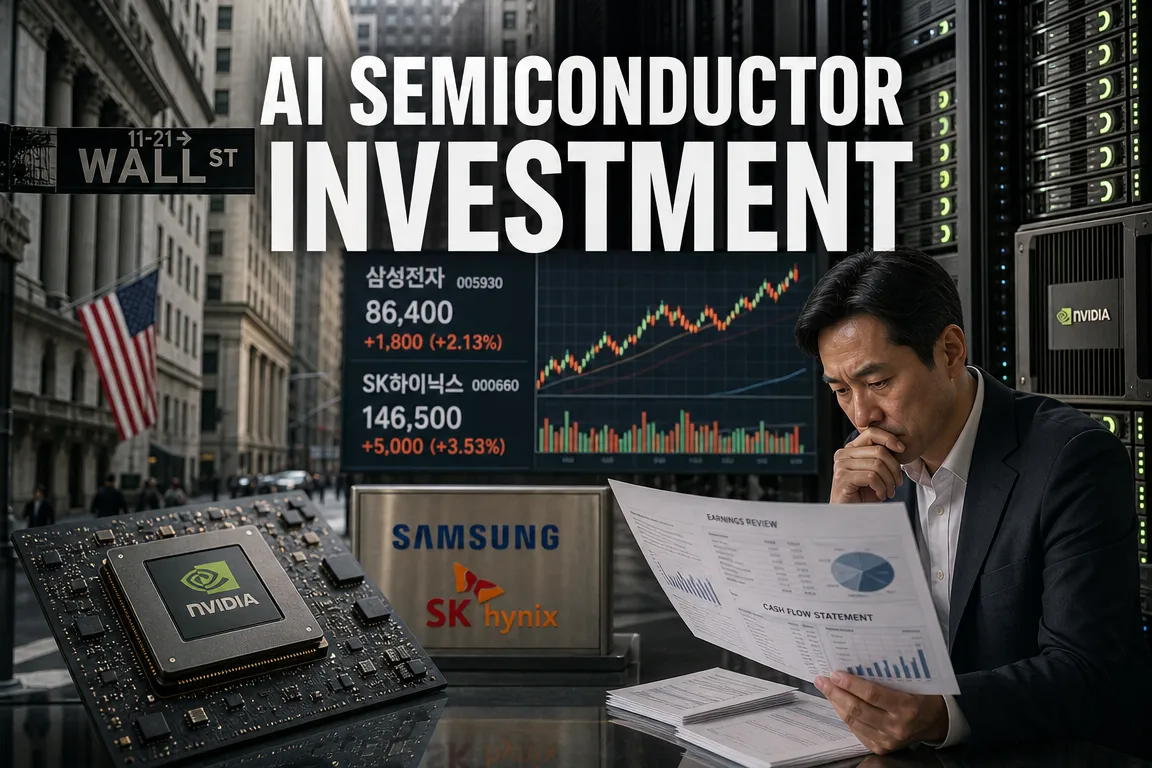
● Tariff War, Nasdaq Turmoil, AI Chip Reckoning
Trump’s Tariff Disputes and Nasdaq Volatility: Key Variables for Nvidia, Semiconductor, and AI Investors
Nasdaq volatility reflects more than tariff headlines: trade policy uncertainty, AI investment returns, and expanding semiconductor supply could converge.
Key considerations include how tariffs affect corporate earnings and interest rates, why NAND and HBM require separate analysis, and how AI safety requirements influence investment payback periods.
Daily share prices, tariff reports and rulings, corporate listing status, and brokerage forecasts cited in the source materials have not been independently verified against current information.
The analysis below distinguishes unverified claims from economic interpretation rather than presenting confirmed breaking news.
1. Nasdaq Volatility: Corporate Earnings and Discount Rates Come First
Technology stocks are sensitive to both growth expectations and interest rates because their valuations depend heavily on future earnings.
A news-driven rally may reverse if earnings expectations or financing conditions do not improve.
- Growth expectations: The pace of AI service revenue growth and data center demand remains critical.
- Capital requirements: GPU purchases, power procurement, and data center construction can pressure cash flow.
- Interest rates: Persistently high market rates reduce the present value of future earnings, weighing on growth-stock valuations.
- Policy uncertainty: Tariffs and export controls can alter addressable markets, production costs, and investment schedules.
Assessing the U.S. equity market outlook requires monitoring earnings estimates, Treasury yields, and credit conditions rather than focusing on prominent individuals or a single-day rebound.
A muted bond-market response does not, by itself, establish that an equity rally lacks fundamental support.
Equities can rise sharply when corporate growth expectations improve without materially changing inflation or policy-rate expectations.
CDS premiums reflect credit risk but are not direct measures of corporate default probability.
Liquidity, contract maturity, assumed recovery rates, and broader risk aversion also affect pricing. Interpretation requires historical data and appropriate benchmarks.
2. Trump’s Tariff Disputes: Policy Details Matter More Than Links to Jensen Huang
The available materials do not establish that tariff policy was driven by Jensen Huang personally or by controversies involving a specific company.
Allegations of corporate misconduct or political motives should not be treated as facts without independent evidence.
Investment analysis should prioritize the legal basis, product coverage, and implementation dates of tariff measures.
Section 301 of the U.S. Trade Act provides a mechanism for responding to unfair foreign trade practices and may support tariff measures following an investigation and determination.
However, measures addressing subsidies do not automatically fall under Section 301. Countervailing duties and other trade remedies involve separate procedures.
- Policy stage: Determine whether a measure represents an investigation, a proposal, or a final decision.
- Scope: Assess whether it applies broadly to a country or narrowly to specific industries and products.
- Tariff stacking: Corporate exposure depends on whether new duties supplement or replace existing tariffs.
- Exemptions and delays: Product exclusions, implementation deferrals, and rules of origin determine the actual impact.
- Legal durability: Litigation risk and review procedures are relevant to long-term implications.
Specific tariff rates, scheduled announcements, and descriptions of a 2026 Supreme Court ruling in the source materials should not be treated as established facts without checking official announcements and the ruling itself.
Section 301 measures should not be characterized as tariffs that necessarily remain unchanged for four years. Continuation requests and statutory review procedures require examination.
3. How Tariffs Affect Inflation, Interest Rates, and Corporate Margins
Tariffs are imposed at the border, but their economic costs are distributed among importers, consumers, and foreign producers.
Although U.S. importers pay the duties, the ultimate burden depends on pricing power and access to alternative suppliers.
- Price increases: Passing costs to consumers creates upward pressure on inflation.
- Margin compression: Importers or suppliers may absorb costs when price increases are not feasible.
- Investment delays: Policy uncertainty can postpone factory and data center orders.
- Supply-chain restructuring: Production relocation and supplier diversification can generate additional costs over time.
Higher inflation pressure may weaken expectations for rate cuts. Conversely, a substantial contraction in consumption and investment could increase growth concerns and push interest rates lower.
The effect of tariffs on interest rates is therefore not unidirectional.
The global economic outlook depends on tariff rates, cost pass-through, consumption weakness, and the scale of retaliatory measures.
4. Semiconductor Markets: Why NAND, DRAM, and HBM Require Separate Analysis
Memory products differ substantially in end-market exposure and supply constraints.
Weaker NAND demand does not imply that HBM conditions will deteriorate at the same pace.
- NAND: Used in SSDs and smartphone storage. Key variables include storage-capacity demand, inventories, and bit-supply growth.
- Conventional DRAM: Influenced by PC, smartphone, and server demand, customer inventories, process transitions, and production volumes.
- HBM: High-bandwidth memory used in AI accelerators. Customer qualification, manufacturing yields, packaging capacity, and accelerator architecture are critical.
Micron’s share price can influence sentiment toward Samsung Electronics and SK hynix, but their product mixes and customer bases differ.
Analysis of the semiconductor outlook should distinguish each company’s HBM revenue exposure, NAND profitability, and capital expenditure plans rather than relying on competitors’ share-price movements.
Whether weaker Chinese enterprise SSD demand offsets North American growth must be assessed using comparable periods and market definitions.
A decline in order value is also distinct from a decline in demand measured by storage capacity.
Figures for 2027 supply growth, NAND pricing forecasts, earnings estimates, and target-price revisions should not be cited without checking the original research reports.
Potential oversupply from 2028 onward is a scenario contingent on capacity expansion and demand assumptions, not an established outcome.
5. AI Investment Returns: Semiconductor Revenue and AI Service Profits Are Distinct
Whether AI generates profits is a different question for semiconductor suppliers than for AI service operators.
GPU vendors can earn profits from equipment sales, while buyers must recover their investment through service revenue.
- Infrastructure suppliers: Key metrics include orders, gross margins, customer concentration, and payment terms.
- Cloud providers: Data center utilization, AI revenue, depreciation, and electricity costs require joint assessment.
- Model developers: Paid-customer retention, inference costs, research and development spending, and access to financing are important.
- AI adopters: Labor savings and incremental revenue must be measured against implementation costs.
Sustained AI investment requires evidence of economic benefits for end customers as well as strong supplier results.
Losses at individual AI services do not, however, establish that the entire ecosystem is commercially unviable.
Claims about Anthropic’s listing price and subsequent share-price decline should be excluded from the analysis unless the exchange, ticker, and regulatory filings are verified.
Private-share transaction prices, publicly traded share prices, and fundraising valuations are distinct metrics.
6. AI Safety Risks and Profitability Concerns Can Coexist
An AI system with potentially dangerous capabilities in specific tasks may still struggle to generate sustainable commercial returns.
Strong cyberattack capabilities do not necessarily translate into practical enterprise deployment if error rates, operating costs, and legal liability remain high.
Deceptive behavior observed in safety evaluations should not be interpreted as evidence that AI experiences human-like anger or dislikes oversight.
Assessment should focus on the evaluation environment, instructions, incentive structure, and specific behavior observed.
- Launch delays: Extended safety testing can postpone revenue generation.
- Higher operating costs: Monitoring, access controls, and security validation require additional spending.
- Changes in revenue models: Restricted enterprise services or deployment in secure environments may be more viable than open-access services.
- Liability costs: Damages and regulatory responses following incidents can erode profitability.
Reports about unreleased model capabilities and internal employee concerns require further verification. The effect of safety requirements on commercialization costs nevertheless remains relevant.
7. Overseas M&A by Samsung Financial Affiliates: Verify Funding Channels First
Higher cash generation in the semiconductor business does not give financial affiliates unrestricted access to those funds.
Ownership relationships, dividend resolutions, actual distributions, capital requirements, and acquisition approval procedures must be examined.
Reports of an overseas investment task force and specific acquisition plans require official confirmation.
If transactions proceed, acquisition pricing, potential return-on-equity improvements, integration costs, and foreign-exchange risk should take priority over headline deal size.
8. The Underlying Issue: A Mismatch Between Investment Outlays and Payback
The central question is not simply whether AI demand will disappear, but whether investment recovery will take longer.
① Costs are incurred upfront, while revenue follows later.
GPUs and data centers require substantial initial investment, while enterprise adoption and paid-revenue growth take time.
Tariffs and safety testing can delay deployment and weaken cash flow even when demand remains intact.
② Greater AI efficiency does not necessarily reduce memory demand.
Total demand can increase if user numbers and workloads grow faster than memory requirements per task decline.
However, supplier growth expectations may weaken if efficiency gains outpace usage growth.
③ Long-term contracts do not eliminate all risks.
Contracts may permit volume adjustments, price renegotiation, or delivery changes.
Claims that next year’s capacity is fully committed require scrutiny of contractual enforceability and revenue recognition schedules.
④ Supply-chain restructuring can create excess capacity without increasing demand.
Duplicated investment across regions can increase near-term equipment demand while reducing long-term utilization and investment returns.
Analysis of Nvidia and memory suppliers should therefore include customer cash flow, actual equipment utilization, and investment payback periods alongside order volumes.
9. Investor Checklist
- Tariffs: Check official USTR documents and the Federal Register for covered products, rates, implementation dates, and exemptions.
- Interest rates: Monitor long-term Treasury yields and corporate credit spreads alongside policy-rate expectations.
- Semiconductors: Track NAND, DRAM, and HBM prices, inventories, and capacity expansion separately.
- AI: Compare capital expenditure growth, AI revenue growth, and free cash flow.
- Corporate developments: Verify listing status, target-price revisions, and M&A plans through filings and original sources.
- Trading discipline: Base decisions on changes to the investment thesis rather than daily price fluctuations.
< Summary >
- Nasdaq volatility requires a combined assessment of tariffs, interest rates, AI profitability, and semiconductor supply.
- A direct causal connection between tariff policy and Jensen Huang has not been established.
- NAND, DRAM, and HBM require separate analysis because their demand structures differ.
- Advanced AI capabilities, safety risks, and weak profitability can coexist.
- Investment payback periods and customer cash flow are critical variables alongside AI demand.
[Related Articles…]
- Tariffs: U.S. Trade Policy and the Global Economy
- Semiconductors: AI Memory Demand and Investment Outlook
*Source: [ 내일은 투자왕 – 김단테 ]
– 나스닥 뒤흔든 트럼프 관세전쟁은 젠슨황 때문?
● Tariff Shock, AI Profit Panic, SP500 9000 Gamble
Trump’s Additional Tariffs and AI Profitability Risks: Assessing the S&P 500’s 9000 Target
Potential additional tariffs on South Korea, Nvidia’s pullback after a sharp rally, AI profitability concerns, and an S&P 500 target of 9000 for 2027.
The central question is not simply how quickly AI grows, but who finances that growth and who ultimately captures the profits.
This report examines how tariffs, interest rates, and AI investment affect corporate cash flow and shareholder returns.
The analysis is based on the November 24, 2026 briefing supplied. Market prices and official announcements have not been independently verified. Tariff, IPO, M&A, and export-control details require confirmation from official sources.
Reported price changes reflect premarket or intraday figures, not confirmed closing prices.
1. U.S. Equity Outlook: Market Breadth and Durability Matter More Than a Sharp Rebound
The key distinction is whether index gains reflect broad market improvement or a rebound concentrated in large-cap stocks.
The briefing reports prior-session gains of 4.7% for the S&P 500, 6.5% for the Nasdaq, and 31.5% for Nvidia, followed by technology-led selling in the next session.
A sharp rally followed by a pullback is insufficient to establish either a renewed uptrend or the resumption of a bear market.
- Short covering: Investors repurchasing shares to reduce losses on short positions can accelerate gains without any change in fundamentals.
- Mechanical buying: Leveraged ETF rebalancing and derivatives-related trading can amplify short-term price movements.
- Large-cap concentration: Gains in a few heavily weighted stocks can make benchmark indices appear stronger than the broader market.
The briefing reports a 4.7% gain for the capitalization-weighted S&P 500 versus 2.6% for its equal-weight counterpart.
The equal-weight advance indicates that the rebound extended beyond a single stock, although gains were more concentrated in large-cap companies.
Investors should monitor advancing stocks, equal-weight indices, trading volume, and earnings revisions alongside headline index levels.
2. Trump’s Tariffs: Application Matters More Than the Headline Rate for South Korea
The briefing suggests that the United States may pursue additional tariffs on several economies, including South Korea, citing overcapacity and government subsidies.
An investigation, a proposed tariff, public consultation, and final implementation are distinct stages.
Discussion of additional tariffs does not establish South Korea’s final applicable tariff rate.
Four Issues for South Korean Companies
- Interaction with existing tariffs: Determine whether new duties supplement or replace existing rates.
- Scope of trade agreements: Assess whether any negotiated tariff ceiling covers the new measures and individual product categories.
- Product-specific treatment: Country-level rates may not capture separate measures affecting automobiles, steel, or semiconductors.
- Economic incidence: Importers generally remit tariffs, but exporters and consumers may share the burden through lower export prices or higher retail prices.
The briefing provides figures for existing tariffs and negotiated rates, but these do not justify concluding that total tariffs cannot exceed 15% under any circumstances.
The final legal authority and operative provisions require verification.
Tariffs also have broader macroeconomic implications.
They can simultaneously affect import prices, corporate margins, consumption, and monetary policy.
3. Nvidia and AI Semiconductors: Resolving Management Uncertainty Does Not Eliminate Business Risks
The briefing attributes part of Nvidia’s rally to Jensen Huang’s return, although the circumstances and official announcement require verification.
The investment distinction remains important.
Resolving a management issue does not eliminate export restrictions, customer financing constraints, or uncertainty over semiconductor demand.
Transmission Channels for AI Semiconductor Export Restrictions
- Direct revenue: Restrictions on customers or regions can reduce the addressable market.
- Transaction costs: More complex end-user checks and licensing procedures can delay contracts and deliveries.
- Demand substitution: Customers elsewhere may or may not replace restricted orders.
- Product mix: A shift toward compliant products can alter average selling prices and profitability.
The status and scope of restrictions involving Southeast Asian companies require verification against official U.S. Bureau of Industry and Security lists and regulations.
A company’s inclusion on a restricted-party list should not be interpreted as a nationwide export ban.
Nvidia’s outlook depends on order replacement and gross-margin trends, not regulatory headlines alone.
4. AI Investment Risks: Cash Flow and Margins Matter More Than Revenue Growth Alone
Long-term AI industry growth does not guarantee strong returns across all AI-related equities.
Semiconductor suppliers, server manufacturers, cloud providers, and AI model developers have different cost structures and bargaining power.
The same investment cycle can generate profits for some companies while increasing funding pressure on others.
| Company Type | Key Metrics | Central Question |
|---|---|---|
| AI semiconductors | Gross margin, customer concentration, export restrictions | Can premium pricing and order growth be sustained? |
| AI servers | Operating margin, inventory, working capital | Do higher server sales generate additional cash? |
| Cloud and data centers | Capital expenditure, utilization, borrowing costs | Is utilization sufficient to recover infrastructure investment? |
| AI models and services | Inference costs, customer retention, cash burn | Does user growth translate into sustainable profits? |
HPE: Higher server sales do not necessarily produce higher profits.
Servers equipped with expensive GPUs can generate substantial revenue while component costs and pricing competition constrain margins.
Order growth should therefore be assessed alongside customer advances, inventory requirements, and collection periods.
Analog Devices: Forward expectations may matter more than current results.
Shares can decline despite better-than-expected results if the earnings outlook falls short of expectations.
A sequential decline in projected EPS alone does not establish weak guidance.
Seasonality and consensus estimates must also be considered.
AMD: Resale registration, immediate selling, and dilution are different issues.
The registered resale shares described in the briefing represent potential supply, not an immediate sale of the entire amount.
Dilution depends on whether the registration covers existing shares or new shares issuable upon the exercise of conditional rights.
Using the briefing’s figures, allocations of 160 million shares to each of two counterparties total 320 million shares, approximately 95% of the 336.9 million shares registered.
The registration documents must be reviewed for issuance conditions and resale eligibility dates.
5. Anthropic IPO Claims: Offering Demand and Post-Listing Value Are Distinct
The briefing includes claims concerning Anthropic’s listing, trading below its offer price, lockup expiration, and index inclusion.
These facts and dates have not been independently verified and should not be treated as confirmed investment information.
AI IPOs can nevertheless be assessed using the following criteria.
- Subscription demand versus sustained buying: Strong offering demand does not guarantee comparable demand at the same price after listing.
- Limits of price stabilization: Overallotment options and related transactions do not guarantee the offer price.
- Lockup expiration: The number of shares eligible for sale may increase, but actual selling depends on shareholder decisions.
- Index inclusion: Potential passive inflows can coincide with anticipatory buying and profit-taking.
- Long-term spending commitments: Exposure depends on contract duration, minimum purchase obligations, and termination provisions.
Cumulative revenue, annualized revenue, and long-term investment commitments measure different things.
Comparing them without consistent periods and accounting definitions can distort estimates of funding needs.
6. Federal Reserve Outlook: Combined Pressure From Tariffs and AI Investment
The briefing identifies expectations for a December rate increase and PCE inflation data as key variables.
Specific probabilities and release dates require verification against current interest-rate futures and official economic calendars.
A one-day equity rally does not establish that the Federal Reserve has greater scope to raise rates.
Policy decisions reflect inflation, employment, demand, and broader financial conditions.
Three Ways Higher Rates Affect AI Companies
- Higher borrowing costs: New financing and refinancing become more expensive for data center construction and equipment purchases.
- Lower discounted valuations: Higher discount rates reduce the present value of distant earnings, potentially compressing growth-stock multiples.
- Customer investment adjustments: Enterprise buyers may raise required returns and slow AI adoption.
Tariffs complicate the policy outlook when they raise prices while weakening real demand.
Falling U.S. Treasury yields should be assessed for whether they reflect improving inflation expectations or concerns about slower growth.
The implications for equities differ.
7. S&P 500 at 9000: Evaluate the Assumptions Behind the Target
The briefing states that Deutsche Bank set an end-2027 S&P 500 target of 9000 and projected EPS of $430.
The report requires independent verification, but the cited figures allow an assessment of the target’s underlying assumptions.
- Implied upside: A rise from 7237 to 9000 represents approximately 24.4%.
- Implied valuation: Dividing 9000 by EPS of $430 produces a price-to-earnings ratio of approximately 20.9 times.
- Core assumption: Earnings must grow while investors continue to assign a relatively high valuation multiple.
Even if earnings meet expectations, higher interest rates and multiple compression could prevent the index from reaching the target.
At the same EPS of $430, an 18-times multiple implies an index level of 7740.
This is a sensitivity calculation, not a separate forecast. It illustrates the target’s dependence on both earnings and valuation.
Long-term optimism remains compatible with further near-term declines.
8. Commodities, Defensive Sectors, and M&A: Assessing Capital Flows
Simultaneous declines in gold and copper need not have the same cause.
Gold is sensitive to real interest rates, the dollar, and liquidity needs. Copper is more closely linked to Chinese activity, manufacturing demand, and supply conditions.
AI-related power infrastructure expectations may influence copper, but a one-day decline does not establish a reduction in AI investment.
Relative strength in defensive sectors does not necessarily indicate broad risk aversion.
If healthcare and consumer staples remain resilient while technology declines, investors should assess whether capital is rotating between sectors rather than leaving equities altogether.
Energy should be evaluated separately from defensive sectors because of its exposure to oil prices and supply conditions.
Large acquisitions require scrutiny of both strategic rationale and purchase price.
The briefing’s claims concerning Sanofi’s acquisition of Insmed and major cybersecurity transactions should not be cited as confirmed without official announcements.
Pharmaceutical acquisitions may address patent expirations, while cybersecurity transactions may expand technology capabilities and customer bases.
Transaction size alone does not establish value creation for the acquirer’s shareholders.
Relevant factors include acquisition premiums, financing costs, integration risks, and incremental cash flow.
9. Key Issue: How AI Growth Costs Are Passed to Shareholders
① Customer acquisition costs may extend beyond the income statement.
When AI semiconductor companies provide customers with shares or warrants, revenue growth may be accompanied by dilution of existing shareholders’ interests.
Investors should assess the economic cost of equity incentives and fully diluted share counts alongside revenue growth.
② Funding within the AI ecosystem differs from spending by external customers.
When supplier investments, customer equipment purchases, and cloud contracts are interconnected, reported revenue growth alone may not establish the strength of end demand.
Such arrangements are not inherently problematic, but cash inflows from independent end customers require scrutiny.
③ Infrastructure providers may not capture the largest long-term benefits.
If infrastructure competition lowers AI service prices, companies using AI to reduce costs may benefit more than those making substantial equipment investments.
Productivity gains in financial, industrial, and service-sector companies therefore warrant attention.
④ Tariffs, high interest rates, and dilution converge in cash flow per share.
Tariffs increase costs, higher rates raise financing expenses, and new equity issuance increases the share count over which earnings are distributed.
Corporate revenue growth may therefore fail to produce a proportionate increase in value attributable to each share.
The central investment question should shift from the scale of AI growth to the improvement in cash flow per share.
10. Market Monitoring Checklist
- Tariffs: Official proposals, covered products, interaction with existing duties, and implementation dates.
- Inflation and rates: PCE components, Federal Reserve communications, interest-rate futures, and U.S. Treasury yields.
- AI earnings: Operating margins, free cash flow, and customers’ capacity to sustain investment—not revenue growth alone.
- Share supply: Issuance terms, warrant exercises, lockup expirations, and disclosed sales.
- Market breadth: Equal-weight indices, advancing stocks, trading volume, and sector earnings forecasts.
- Holiday trading: Distinguish low-liquidity price swings from changes in the underlying trend.
< Summary >
- South Korea’s additional tariff exposure depends on existing agreements and product-specific implementation, not headline rates alone.
- Nvidia’s rebound does not resolve AI export restrictions or investment-recovery risks.
- AI equities should be evaluated using margins, cash flow, and dilution alongside revenue.
- The S&P 500’s 9000 scenario requires both earnings growth and sustained valuation multiples.
- The central investment metric is company-level improvement in cash flow per share, rather than the size of the AI industry.
[Related Articles…]
*Source: [ Maeil Business Newspaper ]
– 🔴[LIVE] 트럼프 이번 주 새 관세 예고? 한국 관세 또 오르나?ㅣ젠슨 황 랠리 하루 만에 급제동ㅣ도이체방크 “내년 S&P500 9000 간다”ㅣ홍혜진의 뉴욕 브리핑