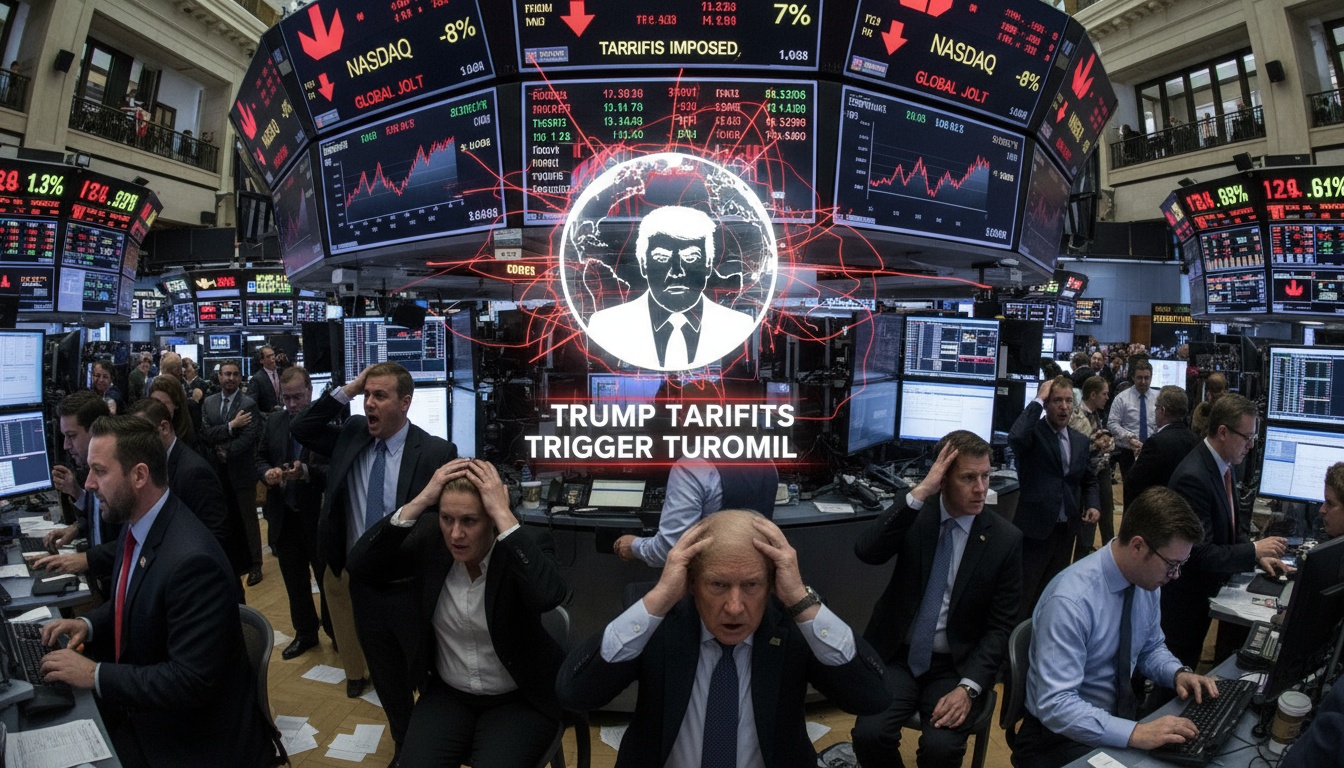
● Trump Tariff Shock, China Rare Earth Squeeze, Nasdaq Tumbles
Trump Risk Again Shakes the Market: The Real Cause of the Nasdaq Plunge and Response Strategies
Key Points in This Article
Today’s article contains: 1) A three-line summary explaining why the Nasdaq fell by 1-2%, 2) A detailed structure of the ‘policy risk’ that the market truly fears, 3) The specific effects of rare earths and tariff issues on the supply chain for AI servers, semiconductors, and EVs, 4) Scenario-based response strategies and a checklist, 5) Points to monitor on a 2-8 week timeline.
In particular, it connects the global economic perspective from the rarely discussed ‘magnet (permanent magnet) processing bottleneck’ to the ‘tariff → inflation → interest rate pathway’.
Market News Summary for Today
The intensification of export control on rare earths and related equipment by China, combined with former President Trump’s hints at re-imposing large-scale tariffs on Chinese goods, has rapidly increased risk-aversion.
Growth stocks centered on the Nasdaq experienced relatively larger fluctuations, while semiconductors, automotive electronics, and industrial goods were also pressured.
The key issues are the ‘surge in policy uncertainty’ and the ‘potential for renewed supply chain shocks,’ where timelines and negotiation frameworks are more important than the numbers.
What Happened: Timeline and Fact Check
China’s reinforced export control on rare earths and related equipment has been brought to the forefront of the market, and Trump has hinted at the possibility of massive tariffs on Chinese goods along with strengthening U.S. control over core technologies.
Rare earths are widely used in smartphones, electric vehicle motors, defense, wind power, and industrial robots, with China holding significant dominance in refining and processing.
Current reports are mixed, so it is essential to verify the detailed clauses and effective dates through official notifications.
The important point is whether the typical pattern of ‘strong rhetoric → used as a negotiation card → exceptions, grace periods, and partial applications’ will be reproduced.
Market Reaction: Which Assets Are Sensitive
Stocks: AI, semiconductor equipment, automotive electronics, and industrial goods showed a simultaneous decline, while some rare earth and resource stocks experienced theme-based strength.
Commodities: Although a psychological premium is attached to rare earths, actual prices are more influenced by long-term contracts and processing bottlenecks.
Bonds/Interest Rates: Tariff concerns can trigger the ‘import price → inflation’ pathway, adding noise to the direction of both short- and long-term interest rates.
Exchange Rates: A reemergence of a stronger dollar could increase volatility in emerging markets.
Why This Issue Is Important: The Intersection of Supply Chains and Policy
From a supply chain perspective, the bottleneck lies not in the rare earth oxides themselves, but in the processing stages of refining, alloying, and magnet processing.
From a policy perspective, tariffs can trigger inflation in the short term, which in turn affects the interest rate path and financial conditions.
Given the demand structure for AI servers, robots, and EVs, a blockage in a specific component can delay entire shipments.
Often Overlooked Key Points (Points Other Media Rarely Mention)
The real bottleneck in rare earths is the ‘NdFeB permanent magnet processing’.
Even if there is an inventory of oxides, if the magnet processing capability is blocked, motors, robots, and wind power projects will be delayed.
AI hardware has a low dependency on rare earths, but if China extends its control over ‘strategic materials,’ there can be ripple effects to GaN power semiconductors, optical modules, and packaging equipment.
Tariffs tend to form a temporary upward pressure on headlines and import prices rather than changing the overall inflation trend, and this indirectly impacts valuations through the Federal Reserve’s interest rate pathway.
Policies typically follow a pattern of ‘strong announcement → grace period/exceptions.’
Thus, the effective date, product codes, license exceptions, and the presence of 30-90 day grace periods determine 80% of the actual impact.
Companies can build buffers through proactive inventory accumulation and diversification of suppliers, although cash flows and inventory turnover may temporarily worsen.
Scenario-Based Response Strategies (Including Checklist)
Scenario A: Strong rhetoric followed by negotiation progress (with a medium to high probability).
– Checklist: Look for exceptions or grace periods in official notifications, normalization in diplomatic schedules, and a softened tone in statements from the U.S. administration and Congress.
– Positioning Ideas: Maintain quality and cash flow-strong big tech and AI infrastructure core assets, and identify beneficiaries of supply chain reshoring (resources from North America and Australia, non-China magnet processing).
Scenario B: Partial controls and selective tariffs (the most likely middle ground).
– Checklist: Restrictions on only specific products or equipment, with gradual expansion of tariff rates and applicable scope.
– Positioning Ideas: Companies that can substitute supply chains outside China, brands and software with strong cost pass-through capabilities, and sectors like defense and energy transition.
Scenario C: Full-blown escalation (low probability but high impact).
– Checklist: Mutual retaliation, expanded regulations across semiconductor equipment, EDA, and cloud computing.
– Risk Management: Increase hedge ratios (index put options, volatility strategies), raise proportions of cash and short-term bonds, and reduce exposure to cyclically sensitive stocks.
Sector and Theme Perspectives: What Will Shake and What Will Withstand
AI/Semiconductors: HBM3E, CoWoS/packaging, 800G optical modules, and power semiconductors are the key bottlenecks.
Although direct dependence on rare earths is low, indirect risks could increase if regulations extend to equipment and materials in the event of a policy escalation.
Electric Vehicles/Robots/Wind Power: NdFeB magnets and motors are critical.
The timing of capacity expansion outside China (in Japan, Europe, Australia, and the U.S.) will dictate stock movements.
Defense: As policy uncertainty rises, the neutral-to-defensive nature of this sector is likely to be enhanced.
Industrial/Energy Transition: In the event of a supply chain disruption, the simultaneous effects of delayed CAPEX and rising costs will interact.
Macro Checkpoints: Global Economy, Interest Rates, and Inflation
Global Economic Cycle: Monitor indicators such as ISM/PMI new orders, export leading indicators from Korea and Taiwan, and whether global manufacturing is resuming.
Interest Rates/Bonds: Tariff issues could stimulate break-even inflation.
It is critical to check whether the direction of headline inflation is changing and to what extent the Fed’s forward guidance is undoing expectations of an interest rate cut.
Exchange Rates/US Dollar: A resurgence of a stronger dollar could increase the volatility of emerging market risk assets.
Commodities: Verify whether the news flow in the copper, nickel, and rare earth chains is being priced in.
AI Trend Updater: ‘AI Capex 2.0’ and Material Risks
Data center design is evolving with increased HBM capacity, the transition from 800G to 1.6T optical conversion, and the adoption of liquid immersion/direct cooling.
As policy risks increase, the localization of packaging, optical modules, and power semiconductor equipment will accelerate.
In the medium to long term, enhancing domestic production of materials and equipment in the U.S., Europe, and Japan can contribute to multi-ple stability.
Practical Checklist: Timeline for the Next 2-8 Weeks
1) Confirm the ‘final notification’ along with product codes, effective dates, and grace period clauses reported by China’s Ministry of Commerce and state-owned outlets.
2) Check for announcements on detailed tariff and export control items and exceptions made by the U.S. Trade Representative (USTR) and the Ministry of Commerce.
3) Monitor the calendar of diplomatic meetings, negotiation events, and changes in briefing tones.
4) Review company guidance: updates on inventory and lead times from semiconductor, automotive electronics, and robotics companies.
5) Analyze market microstructure: changes in the volatility index (VIX), credit spreads, and the inflows/outflows of large growth stocks (ETFs and options).
Risk Management Guide (General Principles)
Position Sizing: It is advantageous to reduce bets around policy events and increase positions after confirmation.
Hedging: Defend against periods of high volatility with index puts, call spreads, and sector pair trades.
Cash Flow: As inventories and sales cycles may extend, prefer companies with strong cash reserves.
Diversification: Evaluate exposure to China and the ability to diversify procurement across sectors and regions.
< Summary >
The essence of this decline is the overlapping of ‘China’s intensified export controls on rare earths and related equipment’ and ‘Trump’s hints at tariffs/technology controls,’ which have led to a surge in policy uncertainty.
The actual impact is determined by the exceptions, grace periods, and the scope of the items, with official notifications and effective dates proving to be key rather than mere rhetoric.
While AI and semiconductors exhibit low direct dependence on rare earths, the risks indirectly increase if regulations extend to equipment and materials.
Tariffs can trigger inflation and influence interest rate pathways, thereby placing pressure on valuations.
The strategy centers on a gradual, scenario-based response guided by a checklist, maintaining high-quality assets, identifying beneficiaries of supply chains outside China, and managing risks around key events.
Keywords: Global Economy, Nasdaq, Supply Chain, Interest Rates, Inflation
[Related Articles…]
Trump Tariff Issues at a Glance
Winners in the Rethinking of Rare Earth Export Controls and Supply Chain Restructuring
*Source: [ 내일은 투자왕 – 김단테 ]
– 또다시 증시를 침몰시킨 트럼프? 대책은?