● AI Dividend Over Taxes
Capitalism Is Shaking in the AI Era: Why an “AI Infrastructure Stake” Matters More Than Taxes
The core point of this article is not simply the story that “AI takes jobs away.”
The really important point is what the state should give back to the public when AI becomes essential infrastructure, just like electricity.
Based on the perspective of Hashed CEO Kim Seo-jun, this news-style piece organizes wealth redistribution in the AI era, AI token dividends, the state’s stake in AI infrastructure, AI competitiveness in Korea and Japan, and even the somewhat shocking outlook that “everyone can become a god.”
In particular, the core point often not covered in other news or YouTube content is not “let’s tax the money earned by AI,” but rather “we need to build a structure in which the public is directly allocated value the moment AI is produced.”
1. Wealth Redistribution in the AI Era: Why the Existing Tax System Is Not Enough
When AI fully enters industry, the first question that comes up is this.
“If only a small number of AI companies make money, how are the rest of us supposed to live?”
So far, when people talked about wealth redistribution, taxes were the most familiar method.
Corporations pay corporate tax, high-income earners pay income tax, and that revenue is then redistributed through welfare and subsidies.
But CEO Kim Seo-jun believes this approach has major limitations in the AI era.
The reason is that it is extremely difficult to accurately measure the productivity of AI agents and automation systems.
- It is hard to calculate how many people one robot replaces.
- It is difficult to compare the productivity difference between 100 AI agents and 1,000 AI agents simply by count.
- Some agents create great value with little computation, while others perform poorly even with heavy computation.
- Global big tech companies also have plenty of room to avoid taxes through tax havens, corporate structures, and intellectual property transfers.
So while a robot tax or AI tax may be necessary, those measures alone cannot solve the economic imbalance of the AI era.
The important alternative here is a “way of sharing the means of production itself.”
2. What Matters More Than Taxes: A Structure That Distributes Value the Moment AI Is Created
In traditional capitalism, taxes are collected after economic activity ends and the remaining money is redistributed.
But in the AI era, a different view emerges: the distribution structure must be designed from the moment value is created.
Put simply, it works like this.
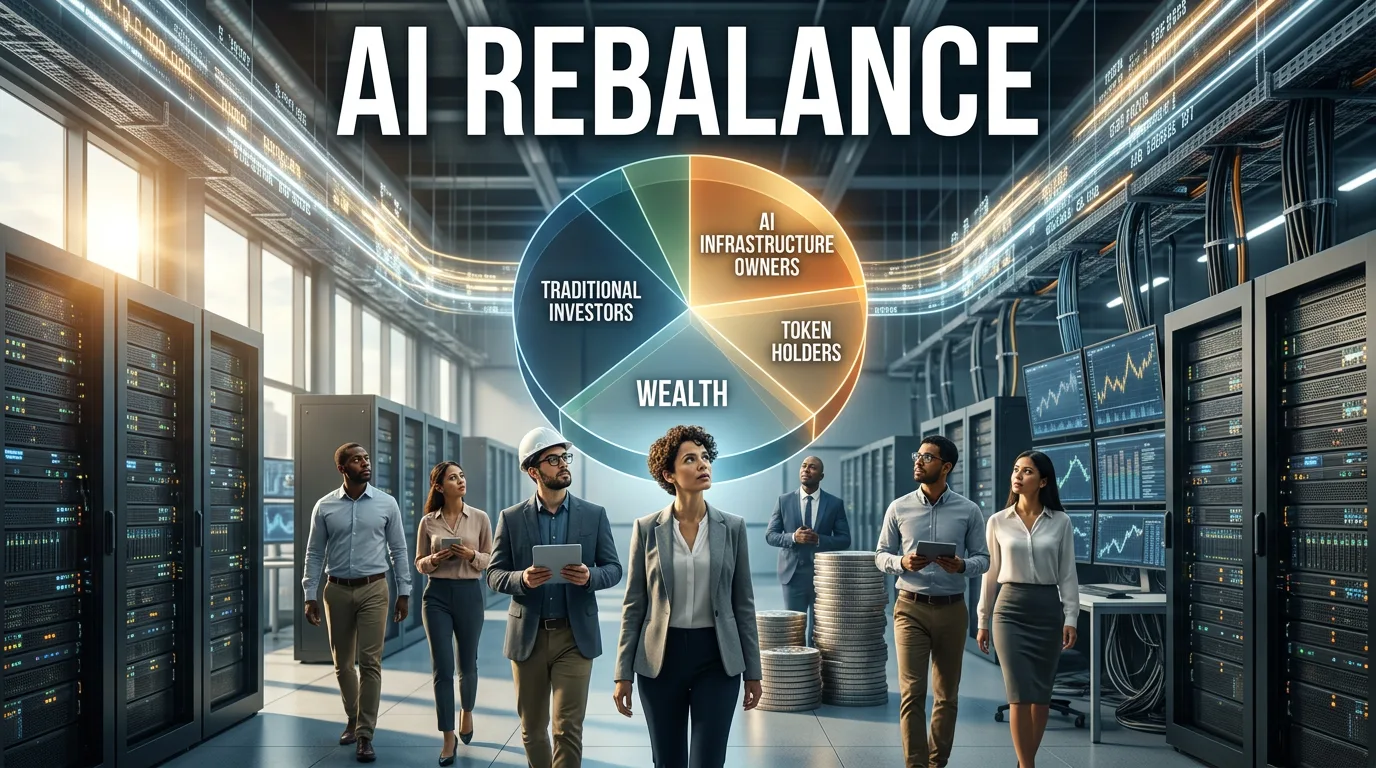
Rather than making an AI company earn huge amounts of money and then collecting part of it as tax, the structure would distribute some of the computation, tokens, and output produced by AI infrastructure directly to the public from the very beginning.
CEO Kim Seo-jun compares this to electricity, water, and telecommunications.
Just as modern people cannot live without electricity, in the future it may become difficult to live a productive life without AI.
The productivity gap between someone who can only use Google Search and someone who can freely use high-performance AI could widen by 100 times or even 1,000 times.
From that perspective, the logic emerges that the state should provide citizens with a certain level of AI usage rights, just as it provides compulsory education.
The AI tokens mentioned here are not cryptocurrency tokens, but computational units needed to use AI models like ChatGPT or Claude.
3. Why the State Must Hold a Stake in AI Infrastructure
The most core structure emphasized by CEO Kim Seo-jun is that “the state must hold a stake in AI infrastructure.”
This is different from communist nationalization.
It is closer to a model in which the government invests according to capitalist rules and then provides a long-term dividend of the stake or a portion of the output to the public.
There are already similar examples in several countries.
- Oil-producing countries in the Middle East provide citizens with cash, land, and welfare benefits based on oil money.
- Alaska operates a structure that distributes part of natural resource income to residents.
- Norway manages oil asset returns through a sovereign wealth fund and uses them as resources for future generations.
If this perspective is applied to AI, citizens born in AI powerhouse countries could receive more AI tokens and digital infrastructure benefits.
On the other hand, countries lacking AI infrastructure may leave their citizens unable to use AI sufficiently, causing them to fall behind in productivity and creativity.
This is not just a welfare debate; it is likely to become a core issue in the global economic outlook.
In the future, national competitiveness could depend heavily on how much semiconductor capacity, data centers, power grids, AI models, and cloud infrastructure a country secures.
4. A Society That Distributes AI Tokens Instead of Money Is Coming
AI token dividends may look similar to existing basic income, but in essence they are a little different.
Cash basic income gives people money.
AI token dividends give people production capacity itself.
For example, let’s assume citizens receive a fixed amount of AI computation tokens every month.
With those tokens, they could write, code, compose music, make videos, draft business plans, and operate their own personal AI agents.
In other words, this is not just consumption support, but a structure that directly increases an individual’s productivity and creative capacity.
That is what makes this fundamentally different from existing welfare policy.
If you are born in an AI powerhouse country, you may receive enough AI tokens every day, while if you are born in an AI weak country, you may not be able to use AI properly unless you are wealthy.
There is even a forecast that the benefits attached to a birth certificate could expand in the future beyond cash, healthcare, and education to include AI usage rights, communication costs, and automated food distribution rights.
5. A Society That Directly Shares the Products of Automation with Citizens
AI token dividends are only the easiest example to understand.
CEO Kim Seo-jun believes that a distribution structure for products is needed in broader areas as well.
A representative example is agriculture.
In 10 or 20 years, fields and farmland could become fully autonomous.
It may become possible to see robots and AI producing, harvesting, and distributing crops in rural areas with almost no people.
If the state has invested appropriately in that infrastructure, it can directly distribute some of the rice or food produced there to the public.
This is not simply collecting taxes and spending them on welfare budgets, but designing the system so that the moment automated products are produced, they go back to the public.
This concept could expand beyond food to communications, energy, water, healthcare, education, and even AI computing resources.
As digital transformation deepens, the resources needed for everyday life are increasingly likely to be produced by automated systems.
6. AI Becomes Like Electricity: Magic at First, Essential Later
CEO Kim Seo-jun compares AI to electricity.
When electricity first appeared, people were deeply shocked and inspired just by seeing lights come on at night.
But now electricity is an obvious piece of infrastructure.
The same goes for phones, the internet, and smartphones.
At first they were innovations and miracles, but now they are essential goods without which life is impossible.
AI is likely to follow the same path.
At first it is a fascinating tool, but soon it could become essential infrastructure for working, learning, creating, and communicating.
From this perspective, AI infrastructure is not just industrial policy.
It is a core foundation that changes capital markets, national finance, industrial competitiveness, individual productivity, and educational gaps.
7. AI Infrastructure Competition Could Become a New Arms Race
In the Cold War era, nuclear weapons, military bases, and the defense industry were the core of national security.
One reason a significant share of GDP was spent on defense was to protect the nation.
But in the AI era, a new kind of arms race is beginning.
Now the central axis of national competitiveness may become how powerful an AI infrastructure the state can provide to its citizens.
If AI semiconductors are not secured, high-performance models are hard to run.
If there is not enough power for data centers, AI services are hard to scale.
If there is no domestic AI model, a country may become dependent on foreign platforms.
Ultimately, AI infrastructure investment is both industrial policy and security policy.
This is also why Korea needs to strategically grow AI semiconductors, data centers, cloud, robots, batteries, and telecommunications networks.
8. AI Competitiveness in Korea and Japan: Why Opportunities for Korean Companies Are Growing
CEO Kim Seo-jun sees the Japanese market as a “near but distant country” and a market with very large opportunities for Korean companies.
Japan’s economy is much larger than Korea’s, and in many industrial sectors it is five to ten times bigger.
Recently, interest in Korean startups has been growing among Japanese venture capital firms.
That is because services that are difficult to launch quickly in Japan are appearing first in Korea and then performing well in the Japanese market too.
For example, platforms like Gangnam Unni in healthcare and services like the character chat platform Zeta are being praised for strong performance in Japan.
Japanese investors have begun to think, “Companies like this don’t emerge quickly in Japan, but Korean companies come here and do well.”
This shift has become even clearer over the past year.
In the past, Japan often viewed Korea as a small market, but now, in the AI era, there is a growing atmosphere of seeing Korea as a more equal partner.
9. Why Is Japan Slower at AI Experimentation?
Japan’s interest in AI is also very high.
The fact that a large portion of taxi ads in Japan are B2B enterprise AI ads shows how strong that interest is.
In particular, because hiring is difficult in Japan, demand is strong for using AI to replace insufficient labor and improve work efficiency.
But high interest does not mean fast experimentation.
CEO Kim Seo-jun believes Japanese corporate culture and national character affect the speed of AI experimentation.
- Japan has a strong culture of “doing one’s own part.”
- At the same time, it also has a strong culture of “not causing trouble for others.”
- This culture improves stability and completeness, but it can be a disadvantage for rapid failure and experimentation.
AI requires a culture of quickly testing, failing, and changing again.
Korean companies have relatively strong energy for quick attempts and execution, which means they are likely to find opportunities in Japan’s AI transition market.
10. Why Korea Must Export No Matter What
The reason Korean startups and companies must expand into overseas markets, including Japan, is clear.
It is because Korea’s population is shrinking.
In education in particular, the impact of low birthrates is already being felt in revenue.
The reality that the number of students and classes in each elementary school grade is shrinking directly leads to a smaller domestic market.
Korean companies can no longer grow by focusing only on the domestic market.
AI, healthcare, education, content, SaaS, robotics, and fintech companies all need to design their businesses with the global market in mind.
Japan is geographically close, large in market size, and becoming more receptive to Korean technology and services.
In that sense, Korea-Japan economic cooperation could go beyond simple exchange and expand into a single massive economic zone.
11. An AI Era That Is Hard to Predict Even Three Weeks Ahead
One striking point CEO Kim Seo-jun mentioned is that “it is now difficult to make plans longer than three weeks.”
Referring to Anthropic’s similar sentiment, he sees AI’s pace of development as having entered a stage that exceeds human planning ability.
In the past, investors or founders could imagine the future three or five years ahead to some degree.
But now new AI research, models, services, and automation cases are coming out every day.
It is also important that AI is moving beyond simply answering questions and is heading toward a stage where it independently finds and solves hard problems that humans do not even know they need to solve.
AI is no longer just a tool for finding answers to human-defined problems; it is evolving into an entity that discovers and solves the problems themselves.
12. The Meaning of Money May Fade, and the Standard of Success Could Collapse
In the past, the measure of success was relatively clear.
As students, there were rankings, grades, and college entrance exam scores.
Once in society, salary, assets, jobs, and titles were seen as the standards of success.
In a capitalist society, “let’s make a lot of money” became the purpose function for many people.
That was because people believed that more money meant more options and more freedom.
But if AI dramatically boosts productivity and the basic resources for human life become automated and cheap, the meaning of money itself could weaken.
This connects to Elon Musk’s view that we may enter an era in which currency loses its meaning.
Of course, this does not mean money disappears completely.
Rather, the era in which money was the sole standard of success may weaken, and questions like “What do I want to create?”, “What experience do I want to make?”, and “What kind of god do I want to become?” may become more important.
13. A Future Where Everyone Can Become a God
The most symbolic phrase CEO Kim Seo-jun used was that “everyone can become a god.”
This is less a religious statement and more about how AI dramatically expands the range of what an individual can create.
For example, a developer used a fruit fly brain map to create a digital life form and made it fly around inside Minecraft.
Things that once required a major research lab and enormous capital can now be realized overnight by an individual using AI and computing resources.
In such an era, there is not just one correct answer.
If everyone has sufficient access to AI, each person can build their own world, create their own works, and solve their own problems.
So the important question is not “Will I succeed?” but “What kind of god will I become?”
In other words, the core issue becomes what kind of world one wants to create, what problems one wants to solve, and how one wants to inspire others.
14. The Most Important Point Rarely Discussed in Other News and YouTube Content
Many media outlets cover the AI era in terms of job loss, big tech monopolies, robot taxes, and basic income debates.
But there is another truly important point in this discussion.
First, welfare in the AI era may shift from cash support to support for production capacity.
Providing AI tokens, computing resources, automated products, and communications infrastructure may become more important welfare than simply giving money.
Second, the state may need to do more than tax AI companies; it may need to hold a stake in AI infrastructure.
If the government invests public tax money in the AI industry, it should design a long-term citizen dividend structure rather than only seeking short-term returns.
Third, AI access rights could create a new class system.
In the future, the gap between those who can use a lot of AI and those who cannot may become as large as the gap between rich and poor.
Fourth, national competitiveness may be judged not just by defense spending but by the ability to distribute AI infrastructure dividends.
A country that secures AI semiconductors, data centers, power, cloud, and models can distribute more production capacity to its citizens.
Fifth, when the standard of success collapses, individuals face even harder questions.
When money, rankings, jobs, and assets are no longer absolute standards, each person must ultimately choose: “What kind of person do I want to be?”
15. What Investors and Office Workers Should Be Watching Now
The economic transformation in the AI era is not just a future theory.
There are practical points that investors and office workers should watch from now on.
- AI infrastructure companies are highly likely to become long-term strategic national assets.
- Semiconductors, power grids, data centers, cloud, and cooling technologies are the foundation of the AI economy.
- AI tokens and computing resources may become a new form of digital asset in the future.
- Korean startups should make expansion into Japan and global markets their basic strategy.
- For individuals, the ability to use AI itself is likely to become a major career advantage.
Especially for office workers, the only question should not be “Will AI replace my job?”
The more important question is “How well can I use AI to multiply my productivity?”
Individuals and companies that use AI well can do more with fewer people.
Conversely, individuals with weak AI access and limited usage ability may see their productivity gap widen even if they work the same number of hours.
16. The Core Issue Ahead: Will AI Basic Rights Emerge?
Extending this discussion, there is a possibility that the concept of “AI basic rights” will emerge in the future.
Just as internet access is now considered a basic right in modern society, a certain level of AI access may also be discussed as a basic right for citizens.
AI access rights are especially important in education.
If one student studies every day with a high-performance AI tutor while another can barely use AI at all, the education gap could become far larger than it is now.
The same applies to creation and entrepreneurship.
Someone who receives enough AI tokens can create apps, music, videos, papers, services, and games on their own.
On the other hand, someone with restricted AI usage rights may fall behind in implementation ability even if they have ideas.
Ultimately, AI basic rights could become welfare policy, education policy, industrial policy, and national strategy all at once.
< Summary >
Wealth redistribution in the AI era is hard to solve by simply collecting more taxes.
That is because AI agents and automated productivity are difficult to measure, and global companies have significant opportunities to avoid taxes.
The core alternative is for the state to secure a stake in AI infrastructure and directly distribute AI tokens or automated products to the public.
AI is likely to become essential infrastructure like electricity, and AI access rights could become a new basic right.
Citizens of AI powerhouse countries may receive more AI tokens and production capacity, while citizens of AI weaker countries may fall behind in productivity and creativity.
Korea may have major opportunities in the Japanese market in terms of the speed and execution of its AI transition.
In the future, the standard of success is likely to shift from money and rankings to “What will I create?”
Ultimately, the question of the AI era is changing from “How much will I earn?” to “What kind of god will I become?”
[Related Articles…]
- How AI Infrastructure Is Changing the Global Economic Outlook
- The AI Token Economy and the Future Basic Income Scenario
*Source: [ 티타임즈TV ]
– “어떤 신이 될 것인가는 내 선택에 달렸다” (김서준 해시드 대표)