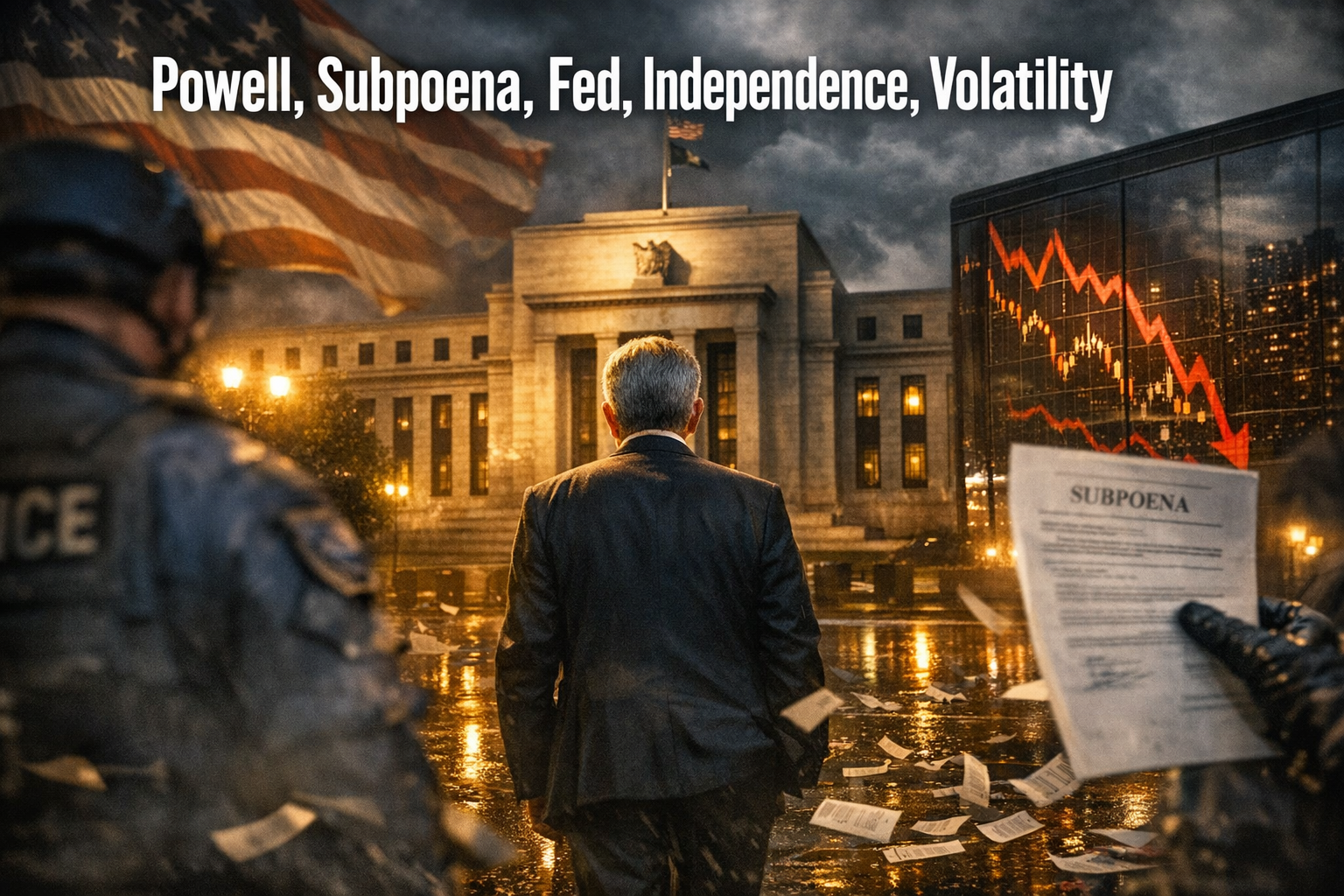
● Powell Subpoena Shock Fed Independence Crisis Hits Stocks Dollar Yields
Powell “Going to Prison?” Rumors: The Real Market Driver—Fed Independence, Rates, the Dollar, and Equity Scenarios in One Brief
This note consolidates (1) why claims such as “Powell arrested/indicted/jailed” emerged, (2) what the relevant legal step actually implies, and (3) how the issue can transmit into U.S. equities, the U.S. dollar, Treasury yields, inflation expectations, and rate-cut pricing. It also highlights key points often omitted in mainstream coverage.
1) Issue Summary: Not “Powell Arrested,” but a “Grand Jury Subpoena” Narrative
The central claim is that Federal Reserve Chair Jerome Powell received a grand jury subpoena in connection with a Department of Justice-related investigation. The primary source of confusion is the tendency to equate a subpoena with immediate arrest or indictment.
2) Legal Process: A Grand Jury Subpoena Is Not an Immediate Indictment or Arrest
The sequence is best framed as follows:
1) Investigation
Authorities are reported to be reviewing testimony and facts related to the Federal Reserve headquarters renovation project.
2) Grand Jury Subpoena
A grand jury (typically 16–23 members) evaluates whether sufficient basis exists to pursue charges and may compel appearance and/or document production. This is not a trial and does not determine guilt or innocence; it is a screening mechanism for potential charges.
3) Indictment
A formal charging decision that advances the matter into the judicial process.
4) Trial → Guilty/Not Guilty
Criminal penalties become possible only after a conviction.
Accordingly, while a subpoena can be a material signal, extrapolating directly to “arrest” or “prison” is not supported by the procedural sequence.
3) Allegation Focus: Perjury/False Statements Typically Require High Evidentiary Burden
The reported focal point is whether Powell made false statements or committed perjury in Senate testimony regarding the headquarters renovation. The referenced testimony (June 2024, Senate Banking Committee) is described as asserting that there were no luxury features and that cost increases were driven by factors outside direct control.
In perjury/false-statement matters, the central evidentiary issue is typically not whether a statement was inaccurate, but whether it was knowingly and intentionally false. Mistake, imperfect recollection, or interpretive disagreement generally complicate proof of intent and raise the burden for prosecutors.
4) Powell vs. Trump Framing: Markets React More to Monetary-Policy Conflict Than Legal Mechanics
The public narrative has been framed as a political-monetary conflict: Powell’s position is characterized as “perjury as pretext,” with the underlying dispute tied to rate decisions not aligning with Trump’s preferences, while Trump has publicly stated he was unaware of the subpoena and denies a rate-related motive.
For markets, the dominant risk channel is whether the episode signals erosion of Federal Reserve independence. If perceived political interference rises, rate-path expectations can become less stable, with spillovers to inflation expectations, Treasury yields, and the U.S. dollar.
5) Market Reaction (As Reported): Nasdaq Futures Decline and a Higher Uncertainty Premium
The reported immediate reaction included Nasdaq futures down approximately 0.8%, consistent with a short-term increase in volatility.
The typical transmission mechanism:
– Heightened Fed–political conflict → reduced predictability of monetary policy
– Reduced predictability → reduced risk appetite for equities
– Near-term equity drawdowns and/or volatility spikes
Growth-oriented U.S. equities are particularly sensitive to rate expectations; therefore, Nasdaq-linked assets often react first.
6) “Prison Risk?” Most Plausible Outcome: Independence Risk Matters More Than Incarceration Scenarios
Even if the matter progressed to indictment, a conviction leading to incarceration would face multiple hurdles:
– Intent is difficult to prove in perjury/false-statement contexts
– White-collar/public-official cases often do not involve immediate arrest dynamics
– If non-violent, administrative-adjacent, and involving no prior record, penalties such as fines or suspended sentences are generally viewed as more plausible than imprisonment
From an investor perspective, the principal risk is not an incarceration outcome but the perceived impairment of Fed independence and the resulting volatility in the expected policy path.
7) Investor Checklist: Four Signals Across Rates, USD, Treasuries, and Equities
To assess whether this remains a one-off headline or becomes a persistent market factor, monitor:
1) Changes in Fed communication
Whether official messaging amplifies a “political pressure” framing or moves quickly to de-escalate.
2) U.S. Treasury yields (especially the 2-year)
Short-end yields typically move first when confidence in the policy path deteriorates.
3) U.S. dollar direction
Two competing forces may dominate: safe-haven demand versus concerns around policy credibility. Price action should be interpreted contextually.
4) Equity style leadership
Relative performance of growth (notably mega-cap tech/AI) versus value/dividend can indicate how aggressively the market is repricing rate risk.
8) Under-Discussed Key Points
Point A) Although framed as a personal issue, markets price it as a systemic Fed risk
Institutional investors typically focus on whether policy credibility and the “independence premium” are impaired. If independence is questioned, inflation expectations can reawaken, increasing valuation sensitivity in equities.
Point B) As the end of term approaches (reported: May 15), signaling effects become more important
Late-term dynamics can shift attention from legal outcomes to implications for the next chair and the future policy reaction function. Markets tend to discount not the endpoint of the episode, but the probability of recurring conflict.
Point C) The primary risk is not a one-day selloff but persistent volatility
If political–monetary conflict becomes a recurring theme, volatility measures such as the VIX may remain elevated, reducing the durability of equity rebounds.
9) Bottom Line: More Likely a Short-Term Volatility Catalyst Than a Structural Trend Reversal
The event is more consistent with a near-term volatility catalyst than a primary driver of long-horizon market direction. However, in a market highly sensitive to marginal changes in inflation and rate-cut expectations—particularly within U.S. technology equities—headline veracity is often less influential than whether the “Fed independence at risk” narrative strengthens.
< Summary >
– “Powell arrested/jailed” is an exaggerated interpretation; the central reported step is a grand jury subpoena.
– Perjury/false-statement cases hinge on intent; the evidentiary hurdle to conviction is material.
– The key market risk is not Powell personally but potential impairment of Fed independence, increasing uncertainty around the rate path.
– Near-term volatility in risk assets (including Nasdaq-linked equities) may rise, but this is not necessarily a regime-changing driver.
– Key indicators: Fed messaging, U.S. 2-year yields, USD behavior, and equity style rotation.
[Related]
- How markets behave when Federal Reserve independence is questioned
- When rate-cut expectations roll over: the sequencing of moves in equities and the U.S. dollar
*Source: [ 내일은 투자왕 – 김단테 ]
– 파월 감옥간다고?? 증시는 어떻게 되나?
● Trump Unleashes Multi-Front Chaos, Greenland-Iran-Mexico Flashpoints, Defense Spending Surge, Markets on Edge, Cash Floods into Drones-Space-Naval Arms
Trump in “Multi-Front Strike” Mode: Why Equities Have Become More Exposed (and Where Capital Is Concentrating)
This report is best read with three focal points:1) Why Trump is pressuring multiple countries simultaneously, how this reshapes negotiation dynamics, and how the next targets are narrowing2) Why the “50% defense spending increase” should be interpreted as a budget reallocation signal toward space, drones, and naval capabilities—not merely rhetoric3) Why the market is elevated despite rising risk, and how to manage risk during short-term overheating (including inflation, rates, and USD dynamics)
1) Key global developments this week (summary): Trump’s approach of expanding the playing field is driving market volatility
The core issue is not a single geopolitical flashpoint, but a strategy that opens multiple fronts simultaneously, increasing fatigue and uncertainty for both markets and counterparties.
The regions referenced span Cuba, Mexico, Colombia, Greenland, and Iran. The market impact is less about short-term fear and more about structural upward pressure on defense outlays, commodities, and reshoring-related supply-chain costs. If inflation re-accelerates, the interest-rate path may become more constrained.
2) Reframing the “next targets” by region (investor-relevant angles)
2-1. Greenland: Not a rhetorical issue—an integrated security + resources + shipping-lane package
Greenland should not be viewed only through a territorial narrative. The main drivers are:
- Arctic routes (logistics/military): directly linked to Russia deterrence
- Rare earths and critical minerals: aligned with reducing China-dependent supply chains
- Space/radar/surveillance infrastructure: modern warfare increasingly depends on persistent ISR capability
An additional market-relevant point is that an acquisition-by-payment concept is not treated as entirely implausible in the US political narrative due to historical precedents, making it a viable negotiation lever.
2-2. Iran: Beyond domestic unrest—explicit mention of an air-strike option is the key signal
With expanding domestic instability and internet controls, the notable signal is the administration’s reference to reviewing air-strike options.
From an investor perspective, the focus is less on spot oil price moves and more on the potential return of a risk premium. Effects can transmit to crude, freight, insurance, and defense demand.
2-3. Mexico and cartels: “Ground-strike” language links to US domestic politics and security framing
Explicitly discussing cartels as military targets is outside typical market baseline expectations. As it intersects with US domestic priorities (border, crime, narcotics), the issue may persist longer and sustain volatility.
2-4. Cuba and Colombia: The “pressure → invitation → deal” Trump pattern
Colombia reflects a recurring sequence: aggressive pressure followed shortly by rapid de-escalation such as a White House invitation. This pattern tends to raise volatility while targeting negotiated “numbers” and concessions.
3) Defense spending +50%: The key issue is not the headline total, but where incremental funding is allocated
Whether a full 50% increase is enacted is separate from the market signal. The actionable information is the direction of budget priorities.
Funding is indicated to concentrate in three pillars:
- Space
- Drones
- Navy (fleet)
This aligns with broader defense planning frameworks responding to the pace of China’s military modernization.
4) Sector market reaction (news-style): Defense leads early-2026 performance rankings
4-1. Defense and drones: Short-term overheating risk increases alongside the structural thesis
Drones have become a core platform in modern conflict, with ongoing validation and iteration since the Ukraine war.
However, when ETFs and single names rise sharply early, subsequent volatility typically increases. This environment favors planning for pullback scenarios rather than aggressive chasing.
4-2. DoD “Gauntlet” (competitive down-select) project: Early-February announcements as a volatility trigger
This is material. If the DoD runs a competitive process that selects a small group and concentrates orders, selection/removal becomes a government-created catalyst.
In such phases, events can dominate fundamentals. Around the early-February announcement window, large upside and downside moves are plausible.
4-3. Space: The Defense Secretary’s visit to Rocket Lab as a procurement-direction signal
The symbolism is significant. Highlighting next-generation launch/space firms rather than only legacy prime contractors suggests procurement priorities are shifting.
Space should be framed as operational infrastructure for surveillance, communications, precision strike, and information warfare—not merely a thematic trade.
4-4. Navy and fleet: Demand expands beyond shipbuilding into onboard systems and sustainment
Fleet expansion drives not only hull construction, but also radar, battle-management systems, propulsion, weapons integration, and maintenance infrastructure across the supply chain. Secondary momentum may extend to South Korean shipbuilding and defense suppliers.
5) Commodities and energy: The second-order effects of geopolitics tend to converge here
5-1. Rare earths and metals: Supply-chain restructuring aligned with the Greenland frame
In rare earths, control of the supply chain is often more important than near-term pricing. Policy-driven efforts to reduce China dependence are likely to remain multi-year.
5-2. Nuclear power and nuclear fuel: Budget signals confirm de-risking from Russia-linked supply
Large-scale support from the US Department of Energy for nuclear fuel manufacturing indicates nuclear is now treated as a strategic industry beyond decarbonization. AI data-center power demand could reinforce the trend.
5-3. Venezuela: “Corporate persuasion” to stabilize energy prices (and political outcomes)
Engagement with major energy companies indicates an intent to raise supply, reduce inflation pressure, and generate visible political outcomes.
Corporate participation may remain cautious due to policy-reversal risk. Near-term optimism can build, but uncertainty may persist until terms are defined.
6) Next-week checklist: Earnings season may drive another leadership rotation
While geopolitical themes can lift parts of the market, earnings season often redirects flows toward large-cap companies with demonstrable fundamentals.
Key items to monitor:
- Financials earnings (high sensitivity to market sentiment)
- Airlines/industrial bellwethers (real-economy read-through)
- Mega-cap tech later in the cycle (validation of AI capex durability and margin trajectories)
- Options expiration (potential short-term volatility)
- Tariff-related rulings/timelines (market impact depends on whether uncertainty is reduced)
7) Three under-emphasized points (most decision-relevant)
1) The defense theme is driven less by the top-line budget figure and more by procurement structure changes. Capital appears to be shifting from legacy primes toward innovation-led players (space/drones).
2) The drone “Gauntlet” down-select makes the announcement date a volatility event. This is not analogous to earnings; selection can trigger valuation re-rating, while exclusion can remove theme premia.
3) Geopolitics is increasingly a structural inflation input. Rising defense and commodities can feed into rates, USD dynamics, and risk-asset valuations. Portfolio construction should pair thematic exposure with cash allocation and diversification.
< Summary >
Trump is expanding negotiation leverage by pressuring multiple fronts simultaneously, including Greenland, Iran, and Mexico.
The defense spending debate’s investable signal is the direction of allocation toward space, drones, and naval capabilities.
The drone Gauntlet project (February announcement) may generate sharp short-term dispersion.
Geopolitics transmits into commodities, energy, and nuclear supply-chain restructuring, with implications for inflation and the rate path.
As earnings season progresses, capital may rotate back from overheated themes into large-cap companies with confirmed fundamentals.
[Related Articles…]
- https://NextGenInsight.net?s=Greenland
- https://NextGenInsight.net?s=Drones
*Source: [ 소수몽키 ]
– 트럼프 다음 타겟은 어디? 동시다발적 공격에 증시 혼란 찾아올까
● CES 2026 AI Power Grab-Physical AI-Ambient AI-Autonomy-XR-Compute War
CES Update to the “Future Industry Map”: Physical AI, Ambient AI, Autonomous-Driving Platforms, XR, and the Real Battleground in the Computing-Power Race
This report consolidates five themes:1) Why the next wave after generative AI—Physical AI—is likely to reshape sector leadership
2) How Ambient AI is shifting the smart home from “appliances” to a “household operating system”
3) Why NVIDIA can influence the market via an autonomous-driving platform (AlphaMayo) without building cars
4) What it means for XR / Spatial Computing to move from headsets to everyday glasses
5) The underlying conclusion: Computing power and its economic spillovers across data centers, GPUs, power, cooling, and networks
1) News Briefing: CES Signals the Core Keywords for 2026
One-line summary
If 2025 was defined by “generative AI + infrastructure build-out,” 2026 is positioned as a year in which AI expands into the physical world, interacts with real environments, and reorganizes industries around computing capacity.
-
Physical AI
AI expands beyond smartphones/PCs into robots, appliances, vehicles, factories, and logistics. A shift from “perception AI” to “action AI.” -
Ambient AI & Smart Home
Home devices move beyond connectivity toward context-aware, autonomous execution. -
XR & Spatial Computing
The market emphasis shifts from bulky hardware toward everyday wearables; form factor and comfort become primary adoption constraints. -
AI Autonomous Vehicles & SDV
Vehicles are redefined as software/computing devices (SDV), not primarily mechanical products. -
The Era of Computing Power
National and corporate competitiveness increasingly depends on computing capacity, data-center scaling, and cost efficiency.
2) Three Key Takeaways from Jensen Huang’s Keynote: Physical AI as the Primary Narrative
2-1. Physical AI: From On-Screen AI to Real-World AI
Historically, AI has primarily generated outputs within apps and screens. CES messaging indicates a transition toward AI systems that observe, decide, and act in real environments.
This is economically meaningful because physical environments contain high variance and frequent edge cases where rule-based systems fail. Physical AI targets systems that adapt to new situations rather than halting under exceptions.
2-2. AlphaMayo: NVIDIA Sells an Autonomous-Driving Platform, Not Vehicles
The strategic objective is to control the autonomous-driving “brain” (OS/platform) rather than manufacturing vehicles.
- Legacy autonomy: sensor processing + deterministic logic; typically positioned as driver-assistance
- Next-generation autonomy: AI-driven reasoning and planning; differentiated decision quality and action execution
If commercialized at scale, value shifts from body/engine attributes toward compute modules, software updates, and data flywheels. In SDV markets, platform control tends to drive ecosystem revenue (licensing, toolchains, developer environments, chipsets).
2-3. Vera Rubin: When Inference Cost Falls, AI Usage Expands Rapidly
Signals around mass production of the next GPU architecture (Vera Rubin) matter because monetization scales through inference. Industry adoption accelerates when “cost per token” declines.
- Higher inference performance → more real-time AI services become viable
- Lower operating cost (per-token economics) → improved ROI for enterprise deployment
- Power/efficiency gains → partial relief of data-center bottlenecks (power, cooling, site constraints)
AI infrastructure scaling depends not only on technology but also on interest rates, liquidity, and the enterprise CAPEX cycle. Data-center expansion is capital-intensive and sensitive to risk appetite.
3) XR & Spatial Computing: Why the Competitive Front Is “Glasses,” Not “Headsets”
XR adoption has remained limited due to weight, bulk, price, and limited endurance. CES trends indicate an attempt to create an inflection point by moving toward everyday eyewear form factors. Spatial computing adoption is constrained by the user burden of wearing dedicated hardware; reducing friction increases usage frequency.
- Work: remote collaboration, design/simulation, field-manual overlays
- Manufacturing/logistics: workflow optimization, safety alerts, real-time inspection
- Consumer: travel/education/entertainment shift from apps to spatial experiences
4) Ambient AI & Smart Home: From “Connected Homes” to “Autonomously Operated Homes”
Ambient AI implies AI embedded in the environment. The differentiator is context, not connectivity.
Example trajectory: a refrigerator tracks inventory and automatically selects and purchases items based on price, delivery time, and expiry considerations. This shifts competition from appliance sales toward household platforms integrating commerce, energy, security, and health.
- Commerce restructuring: “users search” → “AI procures”
- Data control: competitive advantage shifts to who can learn from lifestyle data and manage it securely
- Subscription economics: accelerated automation of replenishment (filters, consumables, groceries)
5) AI Autonomous Vehicles & the Samsung Electronics (Harman) Lens: Automotive as a Second Semiconductor Battlefield
As autonomy advances, semiconductor content per vehicle increases in both unit count and value. The transition from ICE to EV to autonomous EV structurally increases compute, sensing, connectivity, and high-value electronics.
For players such as Samsung (Harman), the strategy is to treat vehicles as mobile consumer electronics, targeting ADAS, infotainment, and connected experiences as an integrated stack.
As autonomy improves, driving time increasingly becomes time allocated to content, work, and commerce, expanding downstream opportunities across displays, audio, networks, and application ecosystems.
6) Why the “Computing-Power Era” Has Structural Impact: Data Centers Become Real Estate + Power + Finance
The computing-power race is not limited to GPU specifications. Data-center expansion ties together:
- Power infrastructure: supply, grid interconnection, substations, renewable PPAs
- Cooling technology: air-cooling limits → liquid cooling and thermal-management solutions
- Networks: performance depends on high-bandwidth, low-latency connectivity
- Land/real estate: site competition driven by electricity, water, and regulation
- Capital markets: only firms with sufficient balance-sheet capacity can sustain the CAPEX race; liquidity conditions are material
At the macro level, AI investment can raise cost pressures (power, construction, chip supply) while also contributing to productivity gains. Market outcomes depend on the balance between these forces.
7) Under-Discussed Points Considered Most Material
7-1. Physical AI Winners May Be Defined by Exception Handling, Not Robot Hardware
Monetization in operational settings is driven by reducing stoppages, failures, and edge-case breakdowns. Differentiation increasingly depends on real-world data learning, safety certification, and maintenance systems, not only sensors or actuators.
7-2. Autonomous Driving Revenue Is Constrained by Insurance, Regulation, and Liability
As autonomy approaches higher levels, the binding constraints shift toward accident liability, regulatory readiness, and risk modeling. Platform scale increases the importance of compliance and insurance structures.
7-3. The Core of Vera Rubin Is Economics: Lower Inference Unit Cost Drives Volume Expansion
AI usage tends to scale non-linearly when unit cost declines. The critical variable is not only smarter models but cheaper inference enabling broader deployment.
7-4. Ambient AI Extends into Competition Over Personal Data Vaults
As home systems assume decision authority, data depth increases. User adoption becomes increasingly dependent on trust: security, privacy, and permission management. Competitive advantage may accrue to firms that design durable data governance.
8) Investor Checklist: Post-CES Signals to Monitor
- In data-center announcements, whether power procurement and cooling architecture are specified together
- In autonomous-driving releases, whether commercial geographies, regulatory pathways, and liability structures are explicit
- In XR products, whether wear time (fatigue), pricing, and battery life improve more than feature expansion
- In smart-home strategies, whether agentic automation is paired with credible security architecture
- Macro linkage: whether the CAPEX race remains sustainable under prevailing interest-rate conditions
< Summary >
CES indicates an inflection beyond generative AI. Physical AI and Ambient AI extend AI into real environments, while autonomy, XR, and smart homes converge into a single contest over computing platforms. The primary determinant is likely to be computing capacity and inference unit economics, with spillovers across data centers, GPUs, power, cooling, and networks.
[Related Articles…]
- https://NextGenInsight.net?s=CES
- https://NextGenInsight.net?s=autonomous-driving
*Source: [ 경제 읽어주는 남자(김광석TV) ]
– CES가 보여준 미래 : 피지컬 AI, 충격적 변화 [경읽남 227화]