● AI CAPEX Boom, Cloud War, Memory Shock, Power Crunch
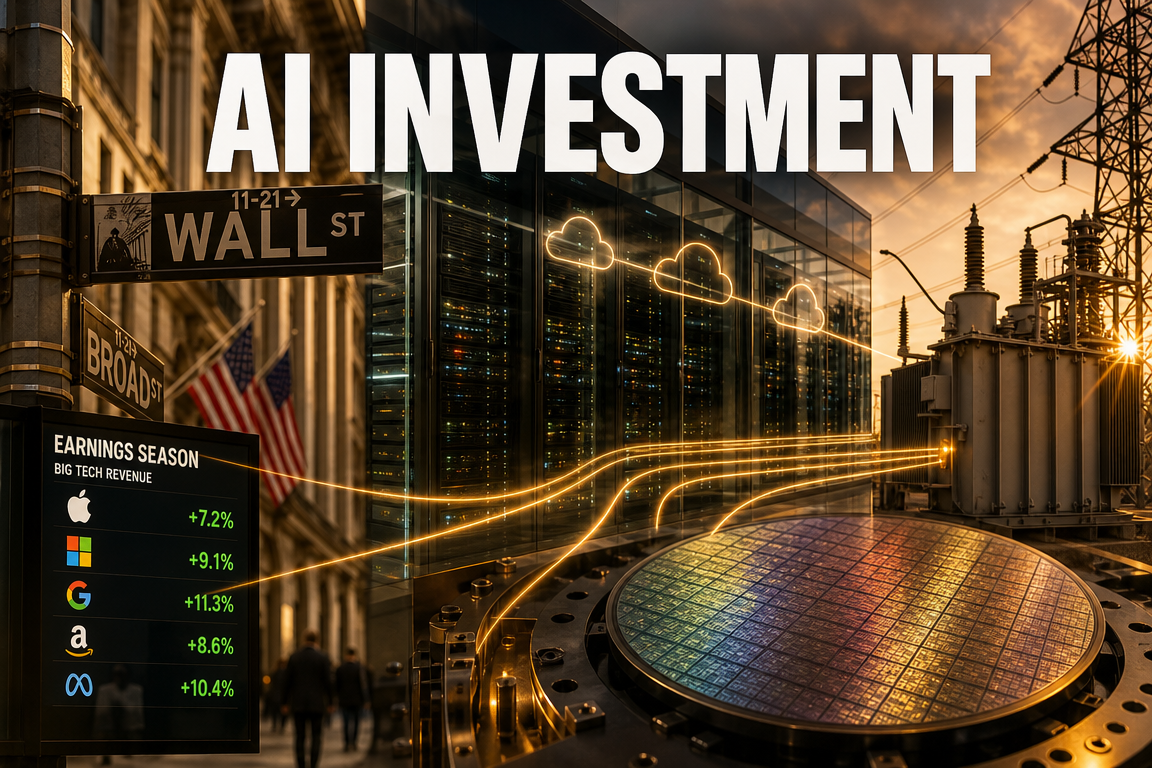
Big Tech Earnings Signal the Next Phase of AI Investment: CAPEX, Memory, Power, and Cloud Matter Most
The key takeaway from the latest Big Tech earnings is not headline outperformance, but confirmation of where AI infrastructure spend is expanding, where cloud growth is concentrating, and where new bottlenecks are emerging across semiconductors and data centers.
This report consolidates:
- Why Alphabet, Microsoft, Meta, and Amazon raising CAPEX guidance is strategically important
- Why Google Cloud appeared to be the practical winner this quarter
- Why Anthropic has become a pivotal AI company between Google and AWS
- Which infrastructure constraints to prioritize next: memory, power, optical networking, and CPU
- How investment structures are increasingly tied to infrastructure usage
- Practical indicators to monitor real AI demand
1. Core conclusion: The AI investment cycle has not rolled over
The market focus was whether AI infrastructure spending would decelerate. Across Microsoft, Alphabet, Meta, and Amazon, the direction remained intact: higher data center-centric CAPEX.
A key risk signal would be explicit guidance that data center investment will slow. No such signal appeared. Management commentary instead implied continued constraints and the need for additional capacity.
2. Earnings-driven shifts observed this quarter
2-1. CAPEX revised upward across the board
All four companies reiterated expanding AI-related infrastructure spend. This reflects:
- Sustained AI service demand
- Incremental requirements for servers, memory, power delivery, and networking equipment
2-2. Google Cloud stood out as the quarter’s momentum leader
Google Cloud delivered high growth and improved mindshare, supported by three drivers:1) A large AI customer base including Anthropic
2) Expansion of Google’s internal AI services (Gemini)
3) A differentiated accelerator stack: Nvidia GPUs plus Google TPUs
TPUs provide a structural differentiation versus other hyperscalers.
2-3. AWS remained solid, but Google’s growth optics were stronger
AWS performance was resilient, but Google’s growth rate appeared more impactful partly due to scale effects (a smaller revenue base can produce higher percentage growth).
The more material point is that AI workloads appear to be migrating meaningfully toward Google Cloud.
3. Why Anthropic was a central strategic variable
Anthropic is not only a frontier-model developer; it functions as a cloud and accelerator “reference customer” that can validate alternative AI compute stacks.
3-1. Anthropic as both model company and infrastructure reference
Both Google and Amazon are incentivized to reduce Nvidia dependency through proprietary accelerators and training/inference stacks. Market adoption depends on credible proof points: which top-tier AI developers run real workloads on these platforms.
If a frontier model is trained and served effectively on TPUs or AWS in-house silicon, it strengthens the competitiveness of those platforms.
3-2. Google’s Anthropic investment: the key is TPU consumption, not equity
A critical feature is that incremental funding appears linked to Anthropic’s usage of Google TPU infrastructure. This is closer to a commercial flywheel than a passive financial investment:
- Google invests in Anthropic
- Anthropic deploys capital into TPU-driven compute usage
- Increased usage supports further investment capacity and cloud revenue expansion
3-3. AWS is pursuing a similar usage-linked structure
Amazon has also made large investments in Anthropic, reportedly linking follow-on funding to AWS usage. This indicates that hyperscalers are competing not only on model quality, but on anchoring the infrastructure layer for leading model builders.
4. Why Google Cloud differentiated: TPU + Gemini + Anthropic
In an AI-centric cloud market, accelerator capacity and platform integration matter more than legacy CPU-centric differentiation. Google’s current positioning reflects three reinforcing levers:
- External demand: Anthropic
- Internal demand: Gemini scaling
- Proprietary silicon: TPU as a non-Nvidia alternative
If TPU adoption continues to broaden among major AI developers, Google’s role increasingly resembles an AI infrastructure platform rather than a conventional cloud provider.
5. Four major AI infrastructure bottlenecks highlighted by earnings
Current constraints extend beyond GPUs. The primary bottlenecks were signaled across:
- Memory
- Power
- Optical networking
- CPU
5-1. Memory: the most explicitly confirmed constraint
Multiple companies directly referenced higher memory and storage costs and/or supply pressure. This matters because memory is not a marginal component; it is a key determinant of AI performance and scalability.
Drivers of structurally rising memory demand include:
- Longer context windows and higher per-request state
- Higher concurrent usage volumes
- Agentic workflows that persist broader state (files, task progress, user context, prior commands, multimodal artifacts)
Earnings commentary highlights:
- Microsoft linked data center spend increases partly to component inflation, specifically memory
- Meta raised infrastructure CAPEX guidance citing component cost increases, notably memory
- Amazon referenced supply pressure in memory and storage components
- Alphabet did not emphasize memory directly but indicated compute constraints and higher future spend
Overall, memory demand does not show clear near-term reasons to soften.
5-2. Power: the binding real-world constraint
Microsoft reiterated power availability as a primary constraint. GPU supply improvements alone are insufficient without:
- Power generation access
- Grid interconnection capacity
- Cooling, transformers, and transmission/distribution readiness
AI data centers have materially higher power density than traditional server farms. Power infrastructure can therefore cap deployed compute even if chips are available.
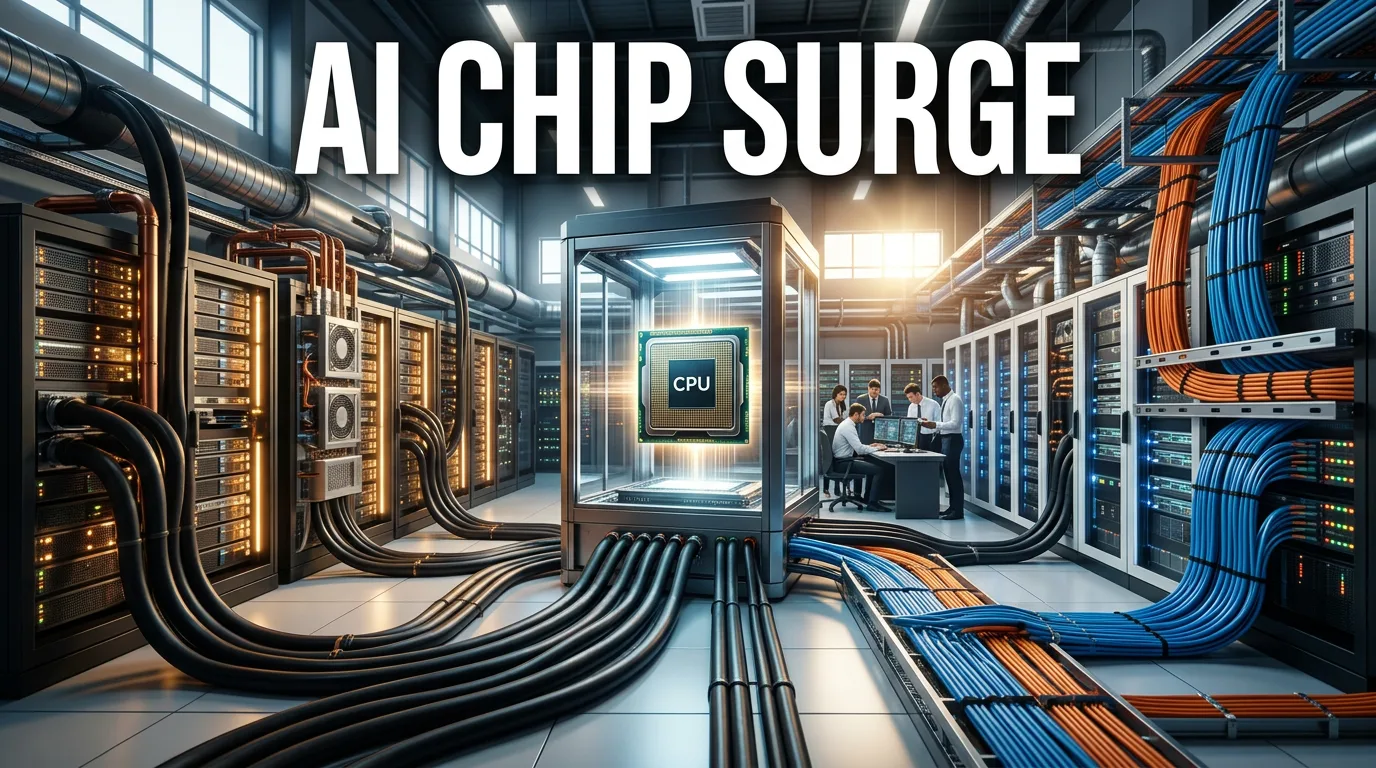
5-3. CPU: less visible, increasingly critical
While GPUs dominate attention, earnings commentary reinforced CPU importance:
- Amazon emphasized CPUs as a core asset
- Microsoft indicated CAPEX will be deployed across both CPU and GPU capacity
AI infrastructure depends on CPUs for orchestration, preprocessing, scheduling, networking control, and storage management. CPU supply expansion is also constrained by advanced-node capacity and manufacturing lead times, creating potential bottleneck risk.
5-4. Optical networking: essential for scaling, often under-discussed
Optical connectivity is a prerequisite for scaling GPU clusters and data center interconnect. As accelerator counts rise, the networking requirement increases sharply, pushing adoption toward optical solutions for bandwidth and efficiency.
This supports ongoing demand for optical transceivers, laser components, and related photonics supply chains as second-order beneficiaries of AI infrastructure buildouts.
6. Under-covered but decision-relevant points
6-1. Bottleneck location matters more than generic “AI demand”
Many narratives stop at “AI demand is strong.” The more actionable insight is where demand is constrained. Earnings suggest bottlenecks are moving into adjacent layers: memory, power, CPU, and optical networking.
This supports a shift from “best model” framing toward identifying suppliers and platforms that relieve binding constraints.
6-2. Anthropic is an infrastructure competition fulcrum
Anthropic’s training and inference venue is not merely vendor preference; it influences accelerator standards and cloud platform competitiveness.
6-3. Higher CAPEX is not uniform: composition matters
CAPEX expansion can be driven by volume growth and/or unit cost inflation. Memory price increases can raise CAPEX without proportional increases in deployed capacity. Investors should evaluate spend drivers, not only totals.
6-4. AI equities may be driven by sentiment volatility despite solid indicators
Operational metrics may remain resilient while valuation multiples fluctuate due to rates, inflation, and macro/geopolitical shocks. Distinguishing temporary risk-off behavior from structural demand deterioration remains important.
7. Two practical indicators to monitor AI demand
No single leading indicator is sufficient, but two useful proxies include:
7-1. OpenRouter token consumption
Token volume approximates real usage intensity across models. Monitoring aggregate token growth and model mix provides insight into whether AI adoption is expanding in production.
7-2. GPU utilization research
GPU utilization trends signal the pace of training and inference activity. Recurring monthly datasets can be more informative than short-term market noise.
8. Investment-oriented interpretation
8-1. Primary checkpoint remains Big Tech data center CAPEX
As long as hyperscaler CAPEX remains elevated, broad AI infrastructure demand is less likely to contract materially.
8-2. The next bottlenecks are increasingly outside GPUs
Memory, power, CPU, and optical networking are positioned to influence deployment velocity and economics.
8-3. Alphabet may be re-rated as an AI infrastructure platform
The combination of Gemini demand, TPU differentiation, cloud distribution, and a strategic anchor customer base supports this framing, contingent on continued TPU adoption.
8-4. AWS retains scale advantages
Google’s growth rates were more visible this quarter, but AWS remains the largest cloud platform with deep ties to Anthropic. Competitive intensity between Google and AWS is likely to remain elevated.
9. Key risks to monitor
9-1. Inflation and interest rates
Higher rates can compress valuation multiples even with stable AI fundamentals.
9-2. Power infrastructure buildout speed
Compute deployment is constrained if grid access and electrical equipment availability lag.
9-3. Rapid memory price increases
Sharp memory inflation can pressure margins and distort CAPEX-to-capacity translation.
9-4. Sentiment-driven volatility
Short-term risk-off moves can dominate price action independent of usage trends.
10. Conclusion: AI is expanding through tightening infrastructure constraints
This earnings cycle indicates AI is not in a demand rollover; it is in an expansion phase where bottlenecks intensify. Data center CAPEX is rising, cloud competition is tightening, and constraints in memory and power are becoming more binding, with CPU and optical networking rising in importance.
The competitive question is increasingly shifting from “which model is best” to “which platform can deliver scalable AI at the infrastructure level.” The latest earnings provided clearer signals on that transition.
< Summary >
Big Tech earnings indicate the AI investment cycle remains intact, with continued upward pressure on data center CAPEX. Google Cloud showed strong momentum driven by Anthropic, Gemini expansion, and TPU differentiation, while AWS remains structurally advantaged by scale and deep Anthropic alignment. The primary infrastructure bottlenecks are memory, power, optical networking, and CPU, with memory and power most explicitly confirmed in earnings commentary. Competition is evolving toward integrated structures linking model ecosystems, cloud platforms, and accelerator usage. Practical demand proxies include OpenRouter token consumption and recurring GPU utilization research.
[Related Posts…]
- https://NextGenInsight.net?s=AI
- https://NextGenInsight.net?s=cloud
*Source: [ 내일은 투자왕 – 김단테 ]
– 빅테크가 찍어준 AI투자의 정답지?
● May Shock, Selloff, Inflation, War, Korea Crunch
Is “Sell in May” the Start of a Real Correction? Key Variables Driving May Markets: KOSPI, U.S. Treasury Yields, and Samsung Electronics’ Labor Dispute
This note goes beyond the seasonal “Sell in May” adage and consolidates the core variables that can shift market direction in May, including KOSPI drivers, renewed volatility risks in U.S. Treasury yields, potential policy uncertainty tied to Fed leadership dynamics and inflation persistence, and why the Samsung Electronics union issue can extend beyond a single-company event to Korea’s semiconductor complex and macro outlook.
1. Bottom line: May seasonality matters less than the combination of concurrent risk factors
“Sell in May and go away” is frequently cited based on historical seasonality (stronger returns from November–April than May–October). However, the current setup is multi-factor: geopolitical conflict, inflation, monetary policy, U.S.–China diplomacy, and Korea’s semiconductor supply chain risks are overlapping.
May should be viewed less as a mechanical “sell” period and more as a regime in which direction is determined by which variables materialize first and whether mitigating factors offset them.
2. News-driven overview: Six variables shaping May risk assets
2-1. Middle East conflict and the Strait of Hormuz: “new fear” matters more than persistence
Markets appear to have partially priced in the ongoing conflict. Over time, market sensitivity typically shifts from conflict duration to changes in escalation probability or de-escalation signals.
Large market moves are more likely when:
- The conflict expands beyond expectations, introducing incremental tail risk
- Ceasefire/de-escalation or easing of transport constraints becomes credible
Signals of reduced shipping disruption in the Strait of Hormuz can matter beyond oil prices, potentially easing inflation pressure, stabilizing sovereign yields, and improving risk appetite.
2-2. U.S.–China leaders’ meeting: May’s largest diplomatic catalyst
A planned U.S.–China leaders’ meeting is a significant market event due to linkages to tariffs, supply chains, export controls, global manufacturing expectations, and inflation narratives.
Potentially constructive channels:
- Reduced probability of further deterioration in bilateral relations supports risk assets
- Any discussion of tariff easing can lift global trade expectations
- Greater inflow of lower-cost Chinese consumer goods could reinforce U.S. disinflation narratives
For Korea, China-linked demand remains important; marginal improvement in U.S.–China tone can support exporters across semiconductors, chemicals, logistics, and industrials. A delay or breakdown would likely be interpreted as renewed uncertainty.
2-3. U.S. inflation releases: the practical inflection point
The dominant variable is U.S. inflation. Rate-cut expectations have not disappeared, but they require inflation not to re-accelerate. Recent conditions increase upside inflation risk.
Oil-price shocks may initially be confined to energy, but can transmit with lags into freight, inputs, dining-out prices, services, and wage bargaining. May CPI and PCE therefore function as tests of:
- Whether the Fed can credibly signal eventual easing
- Whether U.S. Treasury yields face renewed upside volatility
Upside inflation surprises typically reprice yields first, then pressure growth stocks, high-duration equities, the Nasdaq complex, and EM risk assets. Under this framing, “Sell in May” is secondary; inflation persistence is the primary driver.
2-4. Fed leadership dynamics and policy coherence: markets price “division” more than rates
The key issue is less the identity of leadership and more the risk that internal disagreement becomes visible. Markets are sensitive to uncertainty around:
- Which inflation metric will anchor policy decisions
- The mix of balance-sheet reduction (QT) and rate cuts
- The degree to which AI-driven productivity is incorporated into the disinflation narrative
A high-volatility scenario would involve:
- A leadership push to justify rate cuts
- Pushback from officials emphasizing sticky inflation
- Inconsistent messaging that increases policy uncertainty
In such conditions, markets may price policy credibility risk via higher volatility, higher yields, and equity drawdowns.
2-5. Bank of Korea: rate-hike risk is low, but “delayed easing” risk persists
Domestic investors often focus primarily on the U.S. If energy and import-price pressures lift local inflation prints, the Bank of Korea may shift toward a more restrictive communication stance.
For Korea, the market impact often stems less from the level of the policy rate and more from signals that cuts are harder to deliver. This can affect equities, real estate sensitivity, KRW dynamics, and long-end yields, given elevated household debt and housing beta.
2-6. Samsung Electronics union action: a KOSPI-level risk factor, not a single-stock headline
This should not be treated as routine wage bargaining. Samsung Electronics and SK Hynix represent core pillars of KOSPI market cap, exports, capex, employment, the semiconductor supply chain, and foreign investor positioning.
Key risk channels:
- Production disruption risk translating into supply-chain instability
- Downside revisions to export expectations
- Direct deterioration in large-cap sentiment
- Higher perceived Korea equity risk premium for global allocators
This dynamic can evolve from company-level labor issues into a broader valuation discount on Korea.
3. Why Kevin Warsh’s “three-miracle” framework could increase market unease
A framework intended to justify rate cuts by redefining policy anchors may appear supportive at first glance, but can amplify debate and credibility risk.
3-1. Changing the inflation yardstick: from Core PCE to Trimmed Mean PCE
Using a measure that excludes more volatile components can make inflation appear less severe. However, changing metrics during periods of elevated inflation can be interpreted as outcome-driven, raising questions about the stability of the reaction function. The principal risk is loss of credibility rather than the mechanical effect of a lower print.
3-2. Combining balance-sheet reduction with rate cuts
The concept is to offset easier rates with tighter liquidity conditions. Markets, however, tend to respond more strongly to the rate signal than to incremental balance-sheet adjustments. The combination could be perceived as politically motivated easing, even if intended as balance.
3-3. AI productivity as a disinflation anchor
Over the medium term, AI can improve productivity and reduce unit costs, supporting supply-side disinflation. The key issue is timing: AI-driven efficiency gains may not materially lower near-term CPI prints. Using long-horizon arguments to justify near-term cuts can intensify internal and external skepticism.
4. Why Samsung’s labor dispute should be viewed beyond “bonus allocation”
Samsung Electronics and SK Hynix are central to Korea’s growth model, with semiconductors comprising a large share of exports and influencing headline growth and equity performance.
Designing compensation frameworks around peak-cycle profitability can create larger conflicts when the memory pricing cycle turns. Current results reflect not only firm execution but also external drivers including AI server capex, memory price upcycles, data-center expansion, and U.S. hyperscaler investment. The strategic issue is whether Korea can maintain semiconductor competitiveness across cycles.
5. Core points often underemphasized in mainstream coverage
5-1. May’s primary issue is not seasonality, but whether re-inflation fears re-ignite
If CPI/PCE surprise to the upside, “Sell in May” becomes a narrative overlay; the fundamental driver is inflation persistence and the resulting yield repricing.
5-2. Reframing the policy framework can be a credibility risk, not a net positive
New arguments for easing can support risk assets short term, but if markets perceive rule-changing, the required risk premium can rise.
5-3. Samsung’s labor risk highlights Korea’s concentration risk
The episode underscores the degree to which Korea’s macro and equity performance are concentrated in semiconductors, allowing idiosyncratic shocks to propagate into macro pricing.
5-4. The U.S.–China leaders’ meeting is a Korea export-direction variable
Outcomes can influence export expectations, supply-chain sentiment, China-demand assumptions, and semiconductor capex confidence.
6. Investor checklist for May
- Do U.S. CPI and PCE print above consensus?
- Do U.S. Treasury yields re-accelerate higher?
- Does the U.S.–China leaders’ meeting occur as scheduled?
- Does Middle East risk shift toward escalation or de-escalation?
- Does Samsung’s labor dispute translate into credible production disruption risk?
- Does the Bank of Korea adopt a more hawkish tone due to inflation?
These variables are likely to drive KOSPI and broader risk-asset direction.
7. One-line view
May should be framed as a high-volatility window where rate-cut expectations and re-inflation risk conflict, with geopolitics, diplomacy, and Korea semiconductor-specific risks acting as amplifiers or offsets. The dominant transmission remains inflation and sovereign yields; other factors primarily modulate that baseline.
< Summary >
- May equity performance is more dependent on the interaction of key variables than on the “Sell in May” adage.
- The main drivers are: Middle East risk, a U.S.–China leaders’ meeting, U.S. CPI/PCE, Fed leadership dynamics, Bank of Korea stance, and Samsung Electronics’ union action.
- The primary market axis is U.S. inflation and U.S. Treasury yield direction.
- A Warsh-style easing rationale may appear supportive but can introduce policy-credibility risk.
- Samsung’s labor dispute should be assessed as a Korea semiconductor and KOSPI-level risk factor.
- Overall, May presents an elevated-volatility regime where re-inflation risk, policy coherence, and supply-chain risks can collide.
[Related Articles…]
- KOSPI direction and flow dynamics: https://NextGenInsight.net?s=KOSPI
- Semiconductor cycle shifts and implications for Korea equities: https://NextGenInsight.net?s=semiconductor
*Source: [ 경제 읽어주는 남자(김광석TV) ]
– [LIVE] 셀인메이? 증시 조정 시작될까? [즉시분석]