● Stablecoin, Treasury, Shock
Stablecoins Supporting US Treasuries? The Real Reason the “Yield Spike” Narrative Is Weakening
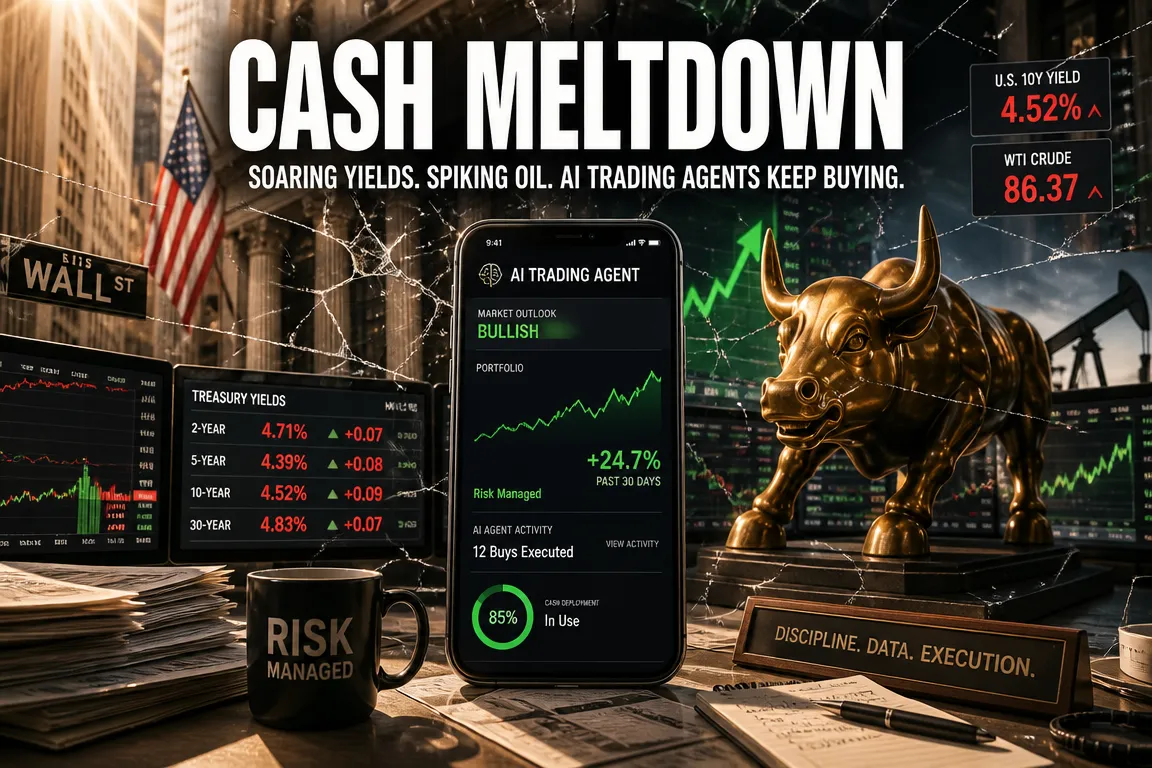
This is not solely a US Treasury story. It links Middle East conflict dynamics, the Strait of Hormuz, global oil prices, potential US-China leadership talks, stablecoins, and the Federal Reserve’s rate path.
The core issue is not generic “Treasury yield instability,” but why yields are unlikely to rise without constraint and how stablecoins can structurally support demand for short-dated US Treasuries (T-bills).
Key points (5):
- Why gold and US Treasuries can sell off simultaneously during conflict
- Why stablecoins can be interpreted as an automated T-bill demand channel
- Why US 10-year yields are politically and financially difficult to allow to surge
- Why US-China talks can affect inflation and rate-cut expectations simultaneously
- How to frame bond investing under the current regime
Recent commentary often reduces the outlook to simplistic chains such as “war → yields surge,” “US debt → Treasury collapse,” or “China sells → endgame.” In practice, market outcomes depend less on who sells and more on who can reabsorb supply—and whether that demand is temporary or structural.
1. Middle East conflict: Treasury selling is better explained by liquidity needs than anti-US sentiment
Post-conflict reports of certain countries selling US Treasuries and gold are frequently framed as “anti-US” or “de-dollarization.” A more plausible macro explanation is liquidity.
In wartime, immediate priorities are funding and cash:
- Financing military and emergency spending
- Managing export disruptions and reduced FX inflows
- Covering wider fiscal gaps
Gold and US Treasuries are among the most liquid assets and can be monetized quickly at scale. As a result, “safe assets” can be sold first by those facing urgent cash needs.
Core interpretation
- Wartime selling of gold and US Treasuries does not necessarily imply loss of confidence in the US.
- It often reflects the need to raise cash using the most liquid assets.
- This is primarily a funding constraint, not a sentiment story.
2. Why the “US Treasury yield must spike” argument is not straightforward
A common narrative claims: widening deficits and war-related spending force heavier Treasury issuance, and yields must therefore surge. The supply-price-yield relationship is valid in isolation, but US Treasuries are not a standard commodity market.
The Treasury market is foundational to the global financial system. A sharp rise in long-term yields transmits broadly:
- Mortgage rates
- Corporate funding costs
- Commercial real estate conditions
- Consumer sentiment
- Equity valuations
- Federal interest expense
The US 10-year yield functions as a system-wide benchmark. This raises the probability of policy, institutional, political, and new-demand responses before yields can spiral.
Why the US cannot easily absorb a sustained long-yield surge
- Higher mortgage rates directly increase the housing burden for middle- and lower-income households.
- Wealth effects supporting consumption can weaken.
- Ahead of elections, policymakers face strong incentives to avoid destabilizing long rates.
- Market-rate spikes can impair financial stability independent of the policy rate.
Conclusion: “More issuance → inevitable long-yield spike” oversimplifies the system-level feedback loops.
3. Stablecoins as a structural demand channel for short-dated US Treasuries
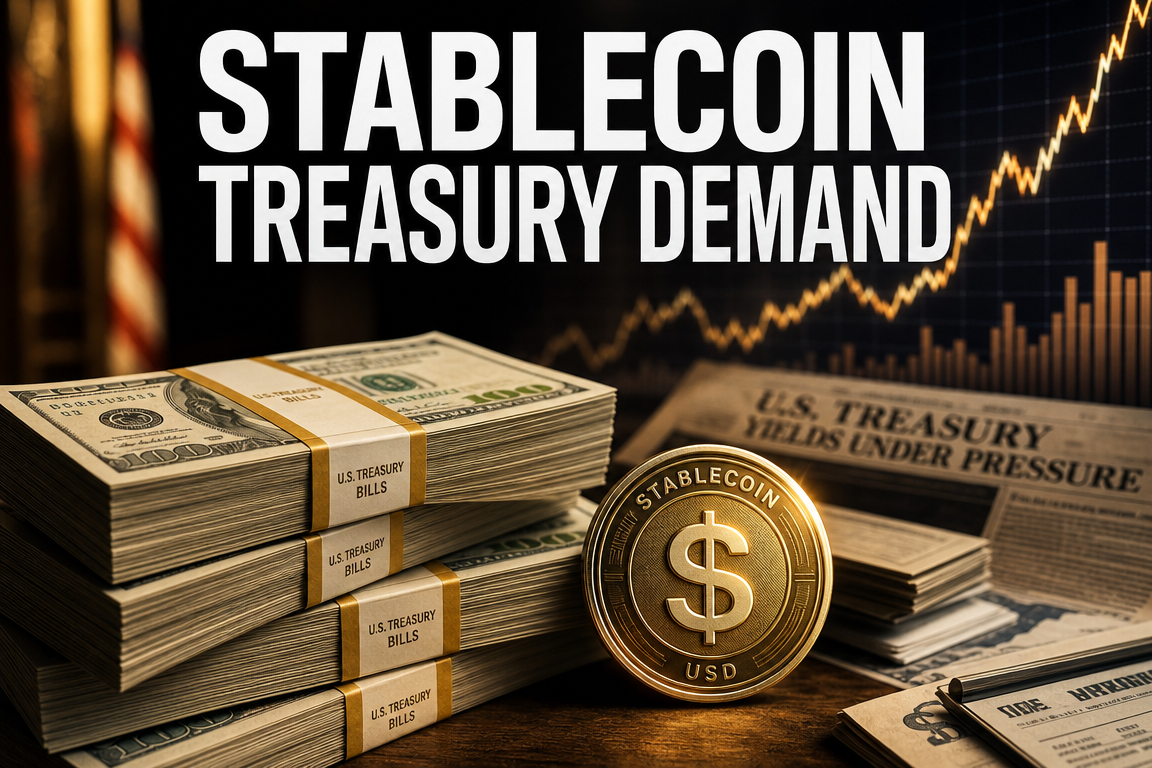
The critical point: stablecoins are not only a crypto payment tool. From a macro perspective, USD-pegged stablecoins can function as a structural absorber of short-term Treasury supply.
USD stablecoin issuers typically hold reserve assets matching outstanding token liabilities. Reserves are heavily concentrated in cash equivalents and short-dated US Treasuries, particularly T-bills.
Implications:
- Stablecoin growth expands the digital USD settlement ecosystem.
- It simultaneously expands a buyer base that must hold T-bills as reserves.
Why this matters
- Historically, Treasury issuance raised questions about marginal buyers.
- If stablecoins are integrated into mainstream financial rails, incremental T-bill demand can scale through private-sector digital finance growth.
- As stablecoin supply increases, reserve demand for T-bills rises in parallel.
This can make Treasury funding more flexible by supporting a greater share of short-term issuance, reducing reliance on long-duration supply.
4. How stablecoins can indirectly stabilize long-term yields
A key question: if stablecoins mainly buy short-dated bills, why discuss long-term yields?
Answer: issuance mix. Even with the same total issuance, shifting the composition between bills and longer-dated notes/bonds changes market impact.
If stablecoin-driven demand absorbs a larger share of T-bill issuance, the Treasury can reduce pressure to issue as much duration. Lower net long-duration supply pressure can reduce upward pressure on benchmark long yields (e.g., 10-year).
Stablecoins may not directly purchase 10-year notes, but they can reshape system-wide supply-demand conditions via the issuance mix.
5. Why potential Strait of Hormuz settlement links to stablecoins are market-sensitive
A scenario discussed is partial settlement of transit fees or oil-related payments via stablecoins. This is not a base case, but markets focus on it due to scale.
Energy and shipping settlement volumes are large. If USD stablecoins are adopted in these flows:
- Stablecoin outstanding supply could expand faster
- Reserve asset demand would scale with issuance
- T-bill demand would increase accordingly
This is not merely “crypto adoption,” but the intersection of:
- digital expansion of USD settlement
- expansion of Treasury demand capacity through stablecoin reserves
News-style summary
- Higher geopolitical risk elevates oil and maritime logistics concerns.
- Digitalization of settlement and potential stablecoin usage can accelerate stablecoin growth.
- Larger stablecoin reserves can become a stabilizing factor for T-bill demand and Treasury market absorption.
6. Potential US-China leadership talks: implications for inflation and rates
These talks are often treated as trade or diplomatic events. The more relevant channel is their potential impact on US inflation, Treasury demand, and Fed policy expectations.
China’s likely priorities:
- Tariff relief and export normalization, especially consumer staples
US political incentives:
- Disinflation mechanisms ahead of elections
If low-cost consumer goods from China re-enter at scale, US consumer inflation could be pressured lower. Base effects and supply normalization can amplify perceived inflation relief.
This functions as a politically relevant inflation-management lever, not only a trade stance.
Second key channelMarkets may also consider the possibility of US requests for renewed Chinese Treasury purchases in non-public discussions. If realized at meaningful scale, this could add downward pressure to long yields and reinforce rate-cut expectations.
This outcome is uncertain and best framed as a negotiation variable rather than a deterministic forecast.
7. China selling US Treasuries: why the shock risk is often overstated
This topic is frequently exaggerated. China has reduced reported Treasury holdings over time, and Japan has been a larger holder. Additionally, some reductions may be offset by custody and routing through third jurisdictions.
Key considerations:
- Headline holdings do not fully capture beneficial ownership structures.
- China is unlikely to fully exit Treasuries because holdings also serve negotiation leverage, reserve management, and influence.
Conclusion: China-related flow risk is better treated as a conditional variable than a singular “collapse catalyst.”
8. US 10-year yields and mortgage rates: political sensitivity
Long-term yields directly affect the housing market through mortgage rates, which are closely linked to the 10-year.
A rise in mortgage rates reduces affordability and disproportionately impacts middle-income and lower-income households relative to wealthy asset holders. This makes long-rate spikes politically costly ahead of elections.
The rate debate is therefore not purely a bond-market issue; it is intertwined with consumption, housing stability, and electoral strategy.
9. Bond investing: prioritize income and defense over short-term price calls
Many retail approaches treat bonds as a directional trade on “rates up or down.” A more robust framework emphasizes:
- defensive properties during risk-off periods
- contractual income (carry)
Equities function as offensive assets; high-quality bonds function as defensive assets. During equity drawdowns, bonds can stabilize portfolios and deliver predictable cash flows through coupon income.
This is relevant amid popularity of monthly-distribution and high-yield structured products, where headline payouts can mask principal erosion and weaker total return. Bond income is generally more predictable because it is tied to contractual cash flows.
For retirement-oriented or cash-flow portfolios, bonds are better evaluated as sustainable income assets rather than short-term price bets.
10. Single-line takeaway: markets are pricing “restructuring,” not “collapse”
This does not imply the Treasury market is risk-free. However, the dominant adjustment path may be rebalancing via new demand sources, political constraints, and funding-mix changes rather than a linear collapse scenario.
Key linkages:
- Middle East conflict can drive short-term liquidation selling for cash.
- US-China talks can affect inflation dynamics and Treasury demand expectations.
- Stablecoins can emerge as a structural support mechanism for short-dated Treasury demand.
The broader transition can be framed as integration of traditional finance with a digital USD settlement layer, reshaping Treasury market absorption.
Underreported points in mainstream coverage
Most commentary stops at “war → oil up → inflation up → rates up.” Additional critical steps:
- In war, safe assets can be sold first to fund expenditures.
- Increased Treasury supply does not mechanically imply long-yield spikes; stablecoin-driven T-bill demand can alter the funding mix.
- US-China talks can operate as a combined political-financial event targeting both inflation optics and Treasury demand.
- China’s reduced reported holdings have symbolic weight, but market impact depends on alternative buyers and indirect holding structures.
- Long-rate dynamics are tied to mortgage affordability and election incentives, not only bond math.
Investor checklist (monitor in sequence)
- Stablecoin regulatory integration pace and issuance growth
- US Treasury issuance mix changes between bills and longer maturities
- Co-movement of the US 10-year yield and mortgage rates
- Whether US-China leadership talks occur and the probability of tariff easing
- Middle East de-escalation signals or changes in Hormuz settlement mechanisms
- Fed policy path and shifts in market-implied rate-cut expectations
- Whether oil and CPI trends re-accelerate in realized data
Tracking these items supports a “restructuring” framework rather than a purely fear-driven framework.
< Summary >
- Post-conflict selling of US Treasuries and gold is more consistent with liquidity needs than with de-dollarization intent.
- The “inevitable Treasury yield spike” view often relies on a simplified supply-only model.
- USD stablecoins can structurally increase demand for short-dated US Treasuries via reserve management.
- This can indirectly reduce pressure on long-duration issuance and contribute to long-yield stability.
- US-China leadership talks can affect tariff policy, goods-price inflation, and potential Treasury-demand negotiation dynamics.
- Bonds are better framed as defensive and income-producing assets than as short-term directional trades.
[Related Articles…]
- Stablecoin expansion and its implications for dollar dominance and the US Treasury market (NextGenInsight.net?s=stablecoin)
- US Treasury yields, global capital flows, and key investment strategy themes for 2026 (NextGenInsight.net?s=ustreasuries)
*Source: [ 경제 읽어주는 남자(김광석TV) ]
– 스테이블코인이 미국 국채를 살린다? 금리 폭등론이 틀린 이유 | 경읽남과 토론합시다 | 마경환 대표 [2편]
● Stock, Psychology, Buying, Valuation
Three Core Drivers of Long-Term Equity Returns for Novice Investors: Psychology, Buying Below Intrinsic Value, and Valuation Discipline
Equity investing outcomes for long-horizon investors are more strongly determined by process and discipline than by tactical chart techniques or short-term trading skills. The primary differentiators are (i) psychological control, (ii) purchasing at a discount to forward-looking value, and (iii) the ability to form an independent view of intrinsic value. These principles are directly applicable across key market variables such as volatility, interest rates, inflation, asset allocation, and U.S. equities.
1. Key Takeaway: Investment Results Are Driven More by Principles Than “Techniques”
Many beginners focus on what to buy, when to buy, and when to sell—often relying on signals or market timing. In long-term investing, the critical questions are:
- Why own the asset
- What constitutes a reasonable price
- Whether the investor can maintain conviction during market stress
Sustained outperformance is frequently associated with fewer unforced errors rather than consistently “being right.”
2. Core Factor #1: Equity Markets Are Primarily Driven by Investor Psychology
2-1. Greed and Fear Reinforce Poor Buy/Sell Decisions
Market prices reflect collective behavior. Typical retail patterns include:
- Buying after price appreciation (greed)
- Selling during sharp declines (fear)
This often results in systematically buying high and selling low, particularly during elevated volatility. Macro catalysts such as rate hikes, growth slowdowns, FX shocks, earnings disappointments, and liquidity cycles amplify these behaviors.
2-2. Stocks Are Easier to Trade Than Real Estate, Which Can Increase Errors
Real estate transaction friction (time, complexity, costs) naturally encourages longer holding periods. Public equities, by contrast, can be traded instantly via mobile platforms, increasing the probability of:
- Excessive trading frequency
- Higher cumulative fees and taxes
- Reduced decision quality under stress
2-3. Long-Term Returns Often Depend on the Ability to Hold Through Drawdowns
A common difficulty is inactivity—holding a high-quality asset without reacting to daily price movements. Market regimes rotate persistently (expansion/recession, tightening/easing, inflation/disinflation). Investors who cannot control behavioral responses may fail to realize returns even with sound security selection.
3. Core Factor #2: Buy “Cheap,” but Define Cheap Relative to Future Value
3-1. The Relevant Discount Is Versus Forward Intrinsic Value, Not Past Price
A price decline from prior highs does not, by itself, indicate undervaluation. The key reference point is future earnings power and cash-flow capacity.
If a company’s fundamentals improve (profitability, competitive position, structural tailwinds such as AI adoption or digital transformation), a superficially “expensive” price can still be attractive relative to forward value.
3-2. Avoid Rigid Target Prices; Update Views as Fundamentals Change
A fixed price threshold can cause missed opportunities when business quality and cash-generation improve. Conversely, buying without a valuation framework increases the likelihood of momentum-driven purchases near local peaks.
Relevant inputs include:
- Earnings trajectory
- Competitive advantage and industry structure
- Interest-rate regime and macro outlook
3-3. “Buy When There Is Capitulation” Requires Selectivity
Buying during panic is not equivalent to purchasing any asset after a sell-off. The intended approach is to accumulate high-quality companies or broad, high-quality index ETFs when risk premia expand due to systemic fear.
Such periods often coincide with:
- Recession risk
- Earnings uncertainty
- Rapid rate increases
- Geopolitical shocks
- Currency volatility
For long-term investors, these environments can improve expected returns, subject to fundamental durability.
4. Core Factor #3: Valuation Discipline Reduces Reactionary Decision-Making
4-1. Without an Intrinsic Value Anchor, Investors Default to External Narratives
If investors cannot judge whether a price is reasonable, they tend to rely on media headlines, social channels, and informal recommendations. This increases inconsistency and promotes reactive trading.
4-2. Valuation Establishes a Reference Point for Risk and Return
Equity valuation parallels income-based assessment in real assets: the focus is the asset’s capacity to generate sustainable cash flows. Common evaluation dimensions include:
- Revenue and operating profit growth
- Cash-flow stability
- Leverage and balance-sheet risk
- Competitive positioning
- Valuation metrics: PER, PBR, EV/EBITDA
- 3–5 year earnings outlook
Full precision is not required initially, but investors should be able to articulate (i) why the company can generate returns on capital and (ii) what expectations are embedded in the current price.
4-3. If Single-Name Valuation Is Not Feasible, Use Index ETFs and Systematic Contributions
For investors lacking resources for company-level analysis, broad index ETFs combined with disciplined periodic investing can reduce idiosyncratic risk and capture aggregate earnings growth.
Large U.S. equity index ETFs typically rebalance toward stronger constituents over time, sustaining exposure to leading firms. Adding asset-allocation rules can further stabilize outcomes.
5. Practical Implementation Framework for Beginners
5-1. Rule 1: Reduce Trading Frequency
Higher activity does not reliably increase returns and often increases errors. Pre-trade checklist:
- What is the investment thesis?
- What is the forward value driver?
- Can the position be held through a 20% drawdown?
- Is this decision based on an internal framework rather than external influence?
5-2. Rule 2: Use Staged Buying and Maintain a Cash Buffer
Bottom timing is unreliable. Staged purchases improve execution under uncertainty. A cash allocation can function as a behavioral stabilizer and provides capacity to add during sharp dislocations.
5-3. Rule 3: Continue Learning, but Keep the System Simple When Necessary
Macro conditions, industry dynamics, and structural themes (including AI adoption) evolve. Complexity is not required to achieve acceptable long-term results. A simplified approach:
- Systematic investing in high-quality index ETFs
- Incremental adds during broad-market drawdowns
- Long holding periods
- Risk control via asset allocation
6. Investor-Report Summary: Priority Points
First. Outcomes are more sensitive to psychological control than to chart-based tactics. Behavior driven by greed and fear increases the probability of buying high and selling low.
Second. “Buy cheap” should be interpreted as buying at a discount to forward intrinsic value, not merely below a prior trading range.
Third. Without valuation discipline, investors are more likely to be influenced by external narratives.
Fourth. If single-name analysis is impractical, diversified U.S. equity index ETFs can be a viable substitute.
Fifth. Long-term compounding is driven less by forecasting accuracy and more by sustained ownership of quality assets.
7. Underemphasized but Material Point: Returns Often Reflect Behavior More Than Information
Portfolio results often diverge due to behavioral mechanics:
- Inability to hold quality assets through volatility
- Panic selling during drawdowns
- Momentum chasing during rallies
- Trading based on headlines without a valuation anchor
In practice, reducing negative behaviors can be more impactful than attempting precise market prediction. Implementable rules include:
- Written entry criteria
- Defined minimum holding period
- Precommitted drawdown-add strategy
- Position-size limits per single name
- Reduced frequency of price monitoring
8. Conclusion: Establish a Framework Before Increasing Complexity
Priority sequencing for beginners:
1) Control behavioral responses
2) Buy at a discount to forward value
3) Build an intrinsic value reference point
Where this is difficult, broad index ETFs with systematic contributions can still provide robust exposure to long-term economic and earnings growth. In periods shaped by shifting rates, inflation dynamics, AI-driven structural change, and elevated volatility, process discipline is a primary determinant of realized outcomes.
< Summary >
The most important driver for novice equity investors is process, not trading technique.
First, equities are heavily influenced by greed and fear; psychological control is essential.
Second, “buy cheap” should be defined as buying below forward intrinsic value, not simply at a lower price than in the past.
Third, valuation discipline is necessary to avoid reliance on external narratives.
If single-name analysis is not feasible, long-term systematic investing in U.S. equity index ETFs is a practical alternative.
In many cases, returns are determined more by investor behavior than by security selection.
[Related Articles…]
AI Era: Why U.S. Equity Investment Strategy Must Be Reassessed
Key Points on the Global Economic Outlook After Rate-Cut Expectations
*Source: [ Jun’s economy lab ]
– 주식 투자 하루만에 끝내기 8탄 주식 투자할 때 중요한 핵심 3가지