● Tesla Cybercab Shock Rollout, April Mass Production Locked, 2027 Delivery Yes
Cybercab “First Mass-Production Unit” Rolled Off the Line: April Production Reaffirmed, “YES” to Deliveries Before 2027; The Key Inflection Point Lies Elsewhere
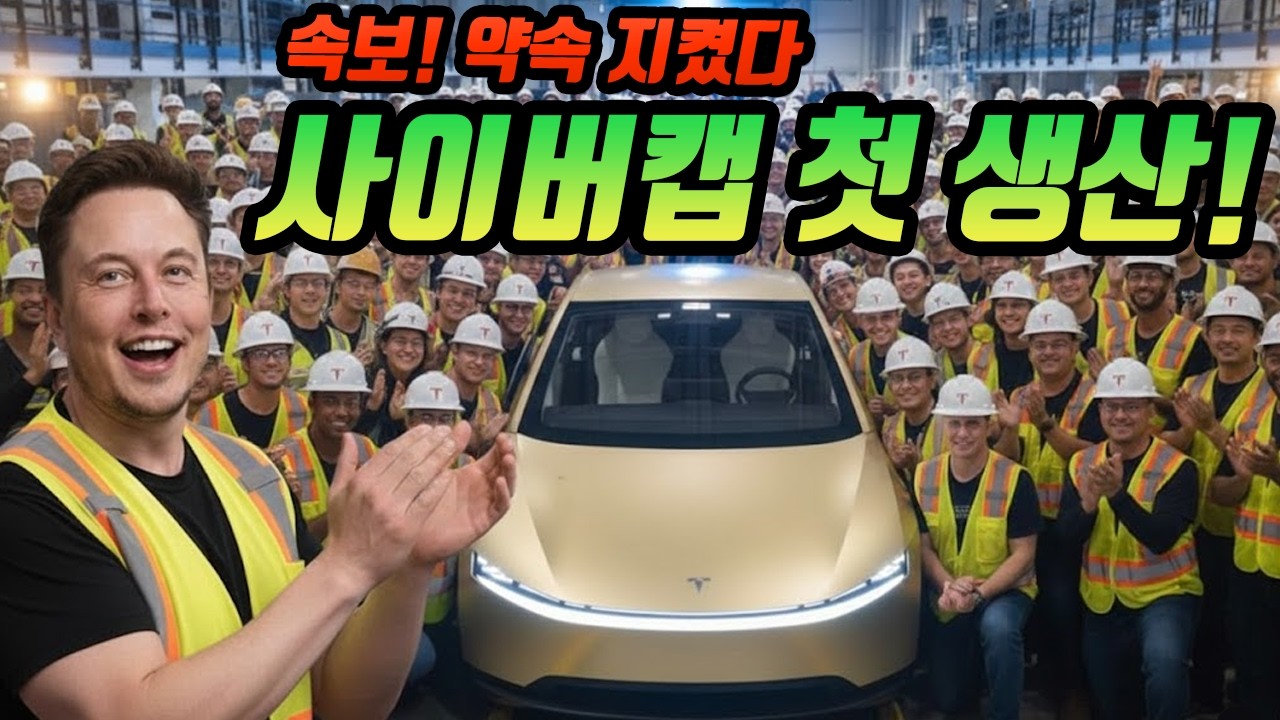
Tesla disclosed the first Cybercab mass-production unit roll-off (completion through the production line) at Gigafactory Texas.
Elon Musk reiterated volume production starting in April and answered YES to whether customer deliveries before 2027 are achievable.
This report focuses on:
- Where the business-model inflection point occurs beyond the symbolism of a first unit.
- What 14 reported Austin robotaxi incidents imply for the direction of regulatory risk.
- How Tesla’s AI-chip talent recruiting in Korea could affect Samsung Foundry and the broader semiconductor supply chain.
- A core framing often missed: Cybercab as an endpoint device for an AI platform, not simply a vehicle.
1) Key Update: What the “First Mass-Production Unit” Signals
1-1. Transition from Prototype to Industrial Production
This is not a hand-built prototype; it is the first output that passed through the actual assembly line at Gigafactory Texas.
The implication is not “one car built,” but that parts, processes, and quality systems are beginning to operate as designed.
1-2. April Start Matters Less Than Ramp Speed
While Musk reaffirmed an April start, the primary investment and industrial variable is how quickly ramp-up accelerates in 2H.
Tesla’s historical pattern is slow initial output for process optimization, followed by rapid scaling after stabilization.
The market focus should be whether the production curve inflects in Q3–Q4, not the April start itself.
2) Product Disruption: No Steering Wheel/Pedals, 48V, Two-Seat Optimization
2-1. Removing Steering, Pedals, Mirrors as a Strategic Signal
Eliminating the steering wheel and pedals is a physical commitment to a Level-5-oriented design intent.
Tesla continues to position camera-plus-neural-network FSD as capable of progressing toward unsupervised autonomy.
2-2. 48V Architecture: Cost-Down Enables Scale
Following Cybertruck’s 48V adoption, Cybercab is expected to extend this approach.
The main impact is not electrical efficiency alone but reduced wiring gauge and copper usage, lowering weight, cost, and assembly complexity.
This supports lower unit cost and shorter cycle time, improving mass-production scalability.
2-3. Two Seats and No Rear Row: Designed for Robotaxi Unit Economics
Based on the premise that most urban trips are 1–2 passengers, removing unused capacity reduces weight and materials.
This directly reduces energy and maintenance costs, lowering cost per mile.
As EV competition intensifies, differentiation may shift from sales margin to operating margin.
3) Manufacturing: Why the Unboxed Process Could Be a Structural Advantage
3-1. Conventional Auto Plants vs. Unboxed
Traditional lines move a large body through sequential stations.
Unboxed assembles multiple modules in parallel on independent lines, then joins them at the end.
3-2. Claimed Outcomes: 40% Less Footprint, Half the Cost, “One Unit per 5 Seconds” Target
Musk referenced an ultimate target of one unit every 5 seconds, which should be treated as aspirational.
The core point is an attempt to remove bottlenecks tied to plant footprint, material flow, and process count.
If achieved, Tesla could pressure competitors primarily through structural cost advantage.
4) Austin Robotaxi Incidents (14): Regulatory Framing Matters More Than the Count
4-1. Reported Data Summary
Media reporting cited 14 incidents over 8 months of Austin service.
Many were described as low-speed, minor contacts (parking/reversing, ~4 mph).
Based on approximately 800,000 miles, this implies roughly one incident per ~57,000 miles; the tone suggested this remains higher than human baselines.
4-2. Both Tailwinds and Headwinds for Tesla
Potential tailwind: the narrative that Tesla reports even minor events, supporting a transparency frame.
Potential headwind: regulators may escalate scrutiny based on incident characteristics (e.g., bus contact) rather than the raw rate.
4-3. Core Watch Item: The Constraint May Be Legal Capacity, Not Technology
Discussion has referenced increasing allowed autonomous-vehicle deployments from 2,500 per year to 90,000.
The binding constraint may be how many vehicles are legally permitted to operate, not only technical performance.
Cybercab scale depends on the pace at which regulation, insurance, and liability frameworks evolve.
5) Sub-$30,000 Price Point and “YES” to Deliveries Before 2027: Why the Market Reacts
5-1. Not a Low-Price Car, but a Cash-Flow Asset Narrative
The messaging implies a shift from “affordable EV” to a structure where an owner’s Cybercab generates revenue in a robotaxi network and can pay back its purchase cost through utilization.
If realized, the vehicle can be perceived as an income-generating asset rather than a pure cost item.
5-2. EV Competition Shifts: Hardware Margin to Software/Network Margin
With intensified price competition in EVs, Tesla’s desired positioning is an AI platform, not a conventional automaker.
Cybercab serves as an endpoint expanding platform reach, with monetization emphasized at the network level.
This can influence how the market frames Tesla’s long-term valuation.
6) Tesla AI-Chip Talent Recruiting in Korea: Semiconductor Supply-Chain Signal
6-1. Why Korea: Samsung Foundry and the SK Hynix Ecosystem
This aligns with commentary that next-generation autonomous-driving silicon (AI5) is expected to be produced at Samsung Foundry.
Tesla’s objective is to reduce gaps between design and manufacturing, where Korea has strong execution capability.
6-2. Beyond Hiring: Competition for Chip Control
Tesla’s direction suggests in-house silicon extending beyond vehicles to Optimus and data-center workloads.
This highlights that AI competition increasingly depends on AI semiconductors, not only models.
Despite macro volatility, AI infrastructure investment continues at national and enterprise scale due to strategic importance.
6-3. Domestic Risk: Talent Outflow and Industrial Hollowing
Positively, it signals global recognition of Korean engineering capability.
Negatively, it can contribute to structural outflow of key talent.
7) Core Point: Cybercab as an “AI Cash-Flow OS,” Not Simply a Vehicle
Most coverage emphasizes “no steering wheel,” “sub-$30,000,” or “Unboxed.”
The central frame is Cybercab as a standardized endpoint for a city-scale autonomous revenue network.
Three structural shifts:1) Ownership and usage: value moves from “driving” to operating an asset.
2) Meaning of production: factory output becomes the number of nodes deployed in cities, compounding network value.
3) Regulation as the primary KPI: even high technical performance cannot scale without legal allowances and liability clarity.
Under this lens, competition extends beyond legacy OEMs to mobility platforms, autonomous operators, and regulators.
8) Near-Term Watchlist (Investment and Industry)
- Post-April: whether Gigafactory Texas discloses weekly/monthly production metrics.
- Austin robotaxi: whether incident types improve from low-speed contacts toward better handling of complex traffic scenarios.
- US autonomy policy: direction on legislation, allowed deployment volumes, and liability allocation.
- Sub-$30,000 pricing: sensitivity to incentives, options, and service inclusions affecting effective customer pricing.
- Samsung Foundry AI5 roadmap: execution risk in yield and mass-production timing, which could become a hidden schedule variable.
< Summary >
- The first Cybercab mass-production unit indicates industrial readiness beyond a prototype milestone.
- April production and deliveries before 2027 were reiterated; outcomes depend on ramp speed and regulatory/insurance framing.
- Unboxed manufacturing and 48V architecture target cost and throughput, supporting robotaxi unit economics.
- The 14 Austin incidents matter primarily through the lens of allowable deployment volumes and liability frameworks.
- Tesla’s Korea-based AI-chip recruiting signals increased vertical control over AI silicon and may intensify domestic talent outflow concerns.
- Cybercab is best analyzed as an endpoint for an autonomous network platform rather than a standalone vehicle.
[Related…]
- Tesla robotaxi expansion: why regulation and insurance are emerging as the binding constraints (NextGenInsight.net?s=Tesla)
- AI semiconductor supply-chain reshaping: Samsung Foundry and the next phase of the global chip competition (NextGenInsight.net?s=Semiconductor)
*Source: [ 오늘의 테슬라 뉴스 ]
– 속보! 사이버캡 양산 유닛 최초 공개! 일론 머스크 “2027년 전 인도 가능” 확답 과연 결과는?