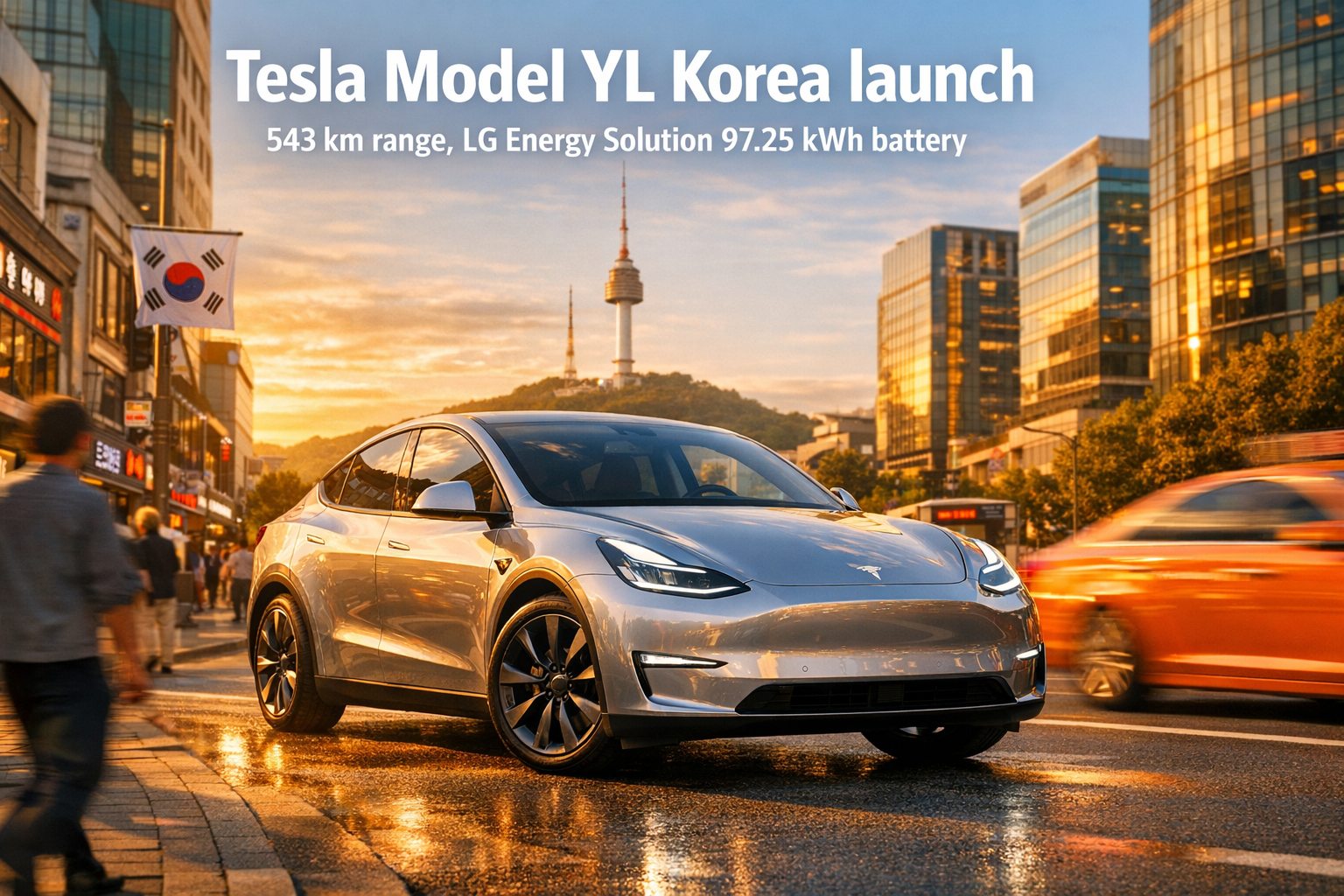
● Tesla Model YL Korea Launch Shock, 543km Range, LG Battery, 3-Row SUV Play
Tesla Model YL Signals Imminent Korea Launch: 543 km Certification, LG 97 kWh Battery, and 3-Row SUV Strategy
This development centers on four key points.
First, the Tesla Model YL, previously viewed as China-specific, has entered domestic certification procedures, making a Korea launch a realistic possibility.
Second, the confirmed combination of 543 km driving range and an LG Energy Solution 97.25 kWh battery suggests stronger-than-expected product competitiveness.
Third, Tesla appears to be doing more than launching a new vehicle; it may be repositioning the broader electric vehicle market around the family SUV segment.
Fourth, when viewed alongside supply chain strategy, manufacturing innovation, and FSD deployment, the Model YL should be understood not as a simple derivative model, but as a product linked to broader themes in the global economy, the battery supply chain, AI trends, and autonomous driving investment.
This report focuses not only on specifications, but also on why the Korean market has become strategically important, why Korea and Australia may be more likely launch markets than North America, and how Tesla’s underlying profit structure may be evolving.
1. Key News at a Glance
The Tesla Model YL has been spotted on Korean roads, and key specifications have effectively been disclosed through Korea Energy Agency certification data.
The certification confirms a large-capacity LG battery, 543 km driving range, increased body size and wheelbase, and a design oriented toward third-row packaging.
In practical terms, this indicates that a larger, more family-oriented, and longer-range electric SUV than the current Model Y may be entering the Korean market.
Tesla has also continued to post strong performance in the imported vehicle market.
This matters because the Model YL is not merely a launch candidate; it is a vehicle with a credible probability of commercial success in Korea.
2. What Has Changed in the Model YL
2-1. Larger Body Than the Existing Model Y
Based on certification data, the Model YL appears to be approximately 22.5 cm longer than the current Model Y, with a wheelbase extended by more than 15 cm.
This is more than a simple length increase.
The central objective is second- and third-row space.
In electric SUVs, adding a third row is less difficult than making it genuinely usable.
The wheelbase extension suggests Tesla designed the vehicle around real-world usability rather than simply adding a 7-seat option.
2-2. Implications of Increased Height
Vehicle height also appears to have increased by approximately 4.4 cm.
This is more significant than it may appear.
One of the most common complaints in 3-row SUVs is limited headroom; the higher roofline suggests an effort to improve third-row head clearance and seating posture.
As a result, the Model YL is better understood not as a larger Model Y, but as a structurally revised vehicle aligned with family-car requirements.
2-3. Core Point: Practical 6-Seat or 7-Seat Usability
Market interest is likely because Korean consumers are not simply seeking larger vehicles; they are looking for electric family SUVs suitable for households with children.
In the domestic EV market, many 3-row SUV options are either expensive or limited in real-world packaging efficiency.
If the Model YL addresses this gap, market response could be meaningful.
3. 543 km Certified Range: More Than a Headline Figure
3-1. 543 km Under Korean Testing Is Commercially Competitive
The most notable figure in the certification is the 543 km single-charge driving range.
While this is lower than the 751 km CLTC figure cited in China, Korean certification standards are materially more conservative.
Accordingly, 543 km under Korean testing is not merely adequate; it is potentially a top-tier figure within the large or upper-mid-size electric SUV category.
For 3-row family SUVs, efficiency typically declines due to higher curb weight and larger body dimensions.
Surpassing 500 km suggests not only increased battery capacity, but also a sufficiently optimized combination of efficiency, aerodynamics, and powertrain calibration.
3-2. Alignment With Korea’s Long-Distance Usage Patterns
Korea is a market characterized not only by urban commuting, but also by significant weekend and holiday long-distance travel demand.
Holiday travel, camping, and family-oriented suburban and intercity trips mean driving range remains a primary purchase consideration for electric SUVs.
A 543 km range can reduce charging anxiety and may offer greater practical utility when combined with Tesla’s Supercharger network.
4. LG Energy Solution 97.25 kWh Battery: Why It Matters
4-1. Significance From a Supplier Perspective
The Model YL is reported to use an LG Energy Solution 97.25 kWh NCM battery.
This is more than a component detail.
It may indicate that Tesla is actively incorporating Korean battery suppliers into vehicles intended for the Korean market and potentially selected global markets.
At a time when battery sourcing is strategically critical, supplier selection affects cost, certification, reliability, and policy compliance.
In an environment where the battery supply chain is increasingly tied to global regulation, the use of an LG battery also offers a clear advantage in terms of consumer confidence.
4-2. Implications of NCM Chemistry
NCM batteries generally offer advantages in energy density.
This makes them a rational choice for mid- to large-size SUVs where long-range capability is important.
While LFP offers advantages in cost competitiveness and durability, the high energy-density characteristics of NCM can be more suitable in 3-row SUVs with greater space and weight constraints.
4-3. Psychological Assurance for Korean Consumers
For domestic consumers, the use of an LG Energy Solution battery may itself be a positive factor.
Brand recognition, perceived quality, and after-sales service expectations all contribute to this effect.
5. How Important Is Pricing?
The commercial outcome for the Model YL is likely to depend more on pricing than on specifications.
The China-market price has been discussed at around CNY 339,000, implying a starting point of roughly KRW 70 million.
The final Korean launch price may differ depending on certification costs, logistics, option structure, and exchange rates.
The key issue is the competitive set.
In both domestic and global 3-row electric SUV markets, options remain limited while price points are generally high.
If Tesla launches the Model YL at an aggressive price, it could capture a broader demand base than incumbent competitors.
6. Why the Korean Market Has Become Especially Important
6-1. It Is Already a Strong Market for Tesla
According to Korea Automobile Importers & Distributors Association data, Tesla recently ranked first in the imported passenger vehicle market.
Model Y sales were also dominant.
This indicates not only strong monthly performance, but also that Korean consumers are already familiar with the Tesla brand and software experience.
As a result, the Model YL is likely to be received not as a new-brand entrant, but as an expanded version of an already validated platform.
6-2. Korea Has Clear Family-Car Replacement Demand
The shift from internal combustion sedans to electric SUVs is evident in Korea.
Households with children typically evaluate space, safety, operating cost, and charging infrastructure together, and Tesla remains a strong candidate under those criteria.
Tesla’s OTA updates, Supercharger network, and software-centric UX also remain differentiating factors versus traditional OEMs.
7. Giga Shanghai Production: Cost Competitiveness Is the Core Advantage
7-1. Advantages of China-Based Production
The Model YL is likely to be produced at Giga Shanghai.
This plant has already served as a core Tesla export hub and is widely regarded as highly competitive in annual output and process efficiency.
The most important point is production cost.
Giga Shanghai is understood to operate with lower per-unit manufacturing costs than several other Tesla facilities.
This suggests Tesla may be able to offer lower pricing while preserving profitability.
7-2. Korea Also Benefits From Logistics Proximity
Korea is a logistically favorable market relative to China.
Compared with North America or parts of Europe, transport efficiency may be superior.
For Tesla, this supports faster supply, lower logistics costs, and more efficient inventory management.
8. Tesla’s No. 1 Supply Chain Ranking: Why It Matters for the Model YL
8-1. Supply Chain Strength Is Now a Cost Advantage, Not Just an ESG Message
In Lead the Charge’s 2026 automotive supply chain leaderboard, Tesla ranked first globally for the second consecutive year.
Its battery supply chain score also improved materially.
This has significance beyond ESG branding.
The ability to manage sourcing and standards for lithium, nickel, cobalt, graphite, and carbon emissions implies a structural cost advantage as regulation tightens.
8-2. Hidden Margin Support in a Carbon-Regulated Era
Europe and North America are progressively strengthening carbon border and battery-related regulations.
In this environment, companies with stronger supply-chain transparency and low-carbon material sourcing capabilities may incur lower incremental compliance costs.
Thus, while competition may appear to center on retail pricing, the actual margin advantage may already be determined at the supply-chain level.
The Model YL is built on Tesla’s broader supply-chain architecture, which may support stronger long-term resilience in pricing and profitability.
9. Key Point Often Overlooked in Other Coverage
9-1. The Model YL May Be Filling the Model X Gap, Not Simply Expanding the Lineup
Many reports describe the vehicle as a long-wheelbase version of the Model Y.
The more important issue is positioning.
If the Model X gradually loses strategic relevance or production allocation shifts, Tesla will need another vehicle to capture higher-end family SUV demand.
The Model YL may be the most realistic candidate for that role.
In this context, the Model YL may be less a derivative and more a central component of a broader Tesla SUV lineup restructuring.
9-2. No North America Launch Does Not Necessarily Signal Weakness
The absence of a North American launch should not necessarily be interpreted as a sign of low strategic importance.
It may indicate the opposite.
Tesla may increasingly differentiate regional product strategy based on demand structure, regulation, price competition, and the FSD roadmap.
North America may be prioritized for robotaxi and autonomous driving ecosystem development, while Korea, Australia, and New Zealand may be more suitable for direct vehicle sales and cash-flow generation.
9-3. The Core of the YL Is ASP Defense More Than Cabin Space
This point is particularly important from an investment perspective.
As Tesla expands into more affordable segments, maintaining average selling price, or ASP, becomes increasingly important.
The Model YL leverages the existing Model Y platform while supporting a higher price point.
In other words, Tesla may be able to raise revenue per unit without developing a fully new vehicle architecture.
This is an efficient strategy from a profitability standpoint.
10. Why the Roadster Monolithic Seat Story Also Matters
10-1. Manufacturing Innovation Typically Starts in Premium Programs and Moves Downmarket
Another Tesla development attracting attention is the potential use of a monolithic integrated seat structure in the new Roadster.
This would combine the seatback, cushion, headrest, and side bolsters into one continuous structure.
On the surface, this appears to be a supercar-specific technology, but the more relevant issue is manufacturing philosophy.
Just as gigacasting reduced body-part count, Tesla appears to be pursuing fewer parts and simpler processes in the interior as well.
10-2. Potential to Diffuse Into Model Y-Class Vehicles
Tesla does not typically confine new manufacturing technologies to premium vehicles.
After validation in Roadster or other higher-end programs, such technologies may expand into Model 3 and Model Y derivatives.
If this approach is ultimately applied to vehicles such as the Model YL, it could enable simultaneous reductions in weight, assembly complexity, cost, and packaging constraints.
Tesla’s competitive advantage is therefore not limited to batteries; it increasingly lies in changes to the broader manufacturing system.
11. Why the Model YL Should Also Be Viewed Through an AI Trend Lens
11-1. Software Revenue Is Becoming More Important Than Hardware Revenue
Tesla is increasingly viewed not only as an automaker, but also as an AI company.
FSD, vehicle data, OTA, and energy-management software are all interconnected.
The Model YL is therefore not a hardware-only product.
After the initial sale, software options, subscription services, and data-driven functional upgrades may become relevant.
For this reason, the current development should be interpreted not only as a new vehicle launch, but also within broader AI trends.
11-2. Musk’s North America Logic Appears Tied to Robotaxi Economics
Elon Musk’s linking of North American launch decisions to FSD maturity is notable.
The logic is straightforward.
If fully driverless autonomous driving becomes viable, owning an expensive large personal vehicle may become less economical than using on-demand mobility services.
This implies Tesla may increasingly segment the future market into vehicle sales and mobility services.
12. Expected Competitive Dynamics in Korea
12-1. Direct Competitive Set
If launched in Korea, the Model YL would likely be compared first with the Kia EV9, Volvo EX90 variants, selected imported electric SUVs, and higher-priced hybrid large SUVs.
Tesla’s competitive edge is not based on traditional options packaging alone.
Its charging network, software execution, brand recognition, expected used-car value retention, and OTA experience are interconnected advantages.
12-2. If Pricing Is Competitive, the Market Structure Could Shift
Because most competing vehicles occupy relatively high price bands, an aggressively priced Model YL could have a significant impact on the market.
It could reset the benchmark for mass-market electric family SUVs.
13. Practical Considerations for Consumers
13-1. Immediate Buyers Do Not Necessarily Need to Wait
Although the Model YL is strategically interesting, launch timing, pricing, seating configuration, and subsidy eligibility remain unconfirmed.
For consumers needing to replace a vehicle immediately, waiting may not be the optimal decision.
13-2. However, Larger Families May Find It Worth Waiting
For consumers who find the current Model Y slightly constrained in space but view EV9-level pricing as burdensome, the Model YL could become a viable alternative.
This is especially true for buyers evaluating driving range, charging infrastructure, and brand preference together.
14. Key Investor Takeaways
14-1. Product Mix Improvement May Matter More Than Unit Volume
From an investment perspective, product mix may be more important than headline sales volume.
If the Model YL succeeds, Tesla can increase the share of higher-priced vehicles while leveraging the existing Model Y platform.
This would support margin preservation.
14-2. Supply Chain Scores and Manufacturing Innovation Support Long-Term Margin
Current market attention is concentrated on discounting, but over the longer term, lower carbon costs, more efficient production, and more stable battery sourcing structures will matter more.
In that context, Tesla should be viewed not only as an automaker, but also as a manufacturing systems innovator.
15. Final Assessment: Can the Model YL Succeed in Korea?
The probability appears meaningful.
The rationale is straightforward.
Korea is already a proven demand market for Tesla, and demand for electric family SUVs is clearly present.
Combined with a 543 km driving range, LG 97.25 kWh battery, expanded body dimensions, and the cost competitiveness of Shanghai-based production, overall product competitiveness appears strong.
The remaining variables are pricing and launch timing.
If these are managed effectively, the Model YL could become more than a headline vehicle and potentially establish a new benchmark in the domestic electric vehicle market.
More broadly, the Model YL illustrates how Tesla is integrating supply chain strategy, manufacturing, software, and AI into a single product proposition.
For that reason, this development should be viewed as more than a conventional new-vehicle launch.
News Summary
Model: Tesla Model YL
Domestic status: Spotted on Korean roads and undergoing Korean certification
Battery: LG Energy Solution 97.25 kWh NCM
Driving range: 543 km certified under Korean standards
Body characteristics: Increased length, wheelbase, and height; improved third-row usability
Production base: Likely Giga Shanghai, China
Core competitive strengths: Pricing competitiveness, charging infrastructure, software, and supply-chain efficiency
Key variables to monitor: Korean pricing, seating configuration, launch timing, and subsidy eligibility
Most Important Points Rarely Addressed by Other YouTube Channels or News Outlets
1. The Model YL may be less a simple long-wheelbase derivative and more a strategy to fill the Model X gap with a lower-cost structure.
2. The lack of a North America launch may not indicate weakness, but rather a strategy in which North America focuses on robotaxi and FSD, while Korea and Australia focus on vehicle sales.
3. The YL can raise ASP using an existing platform, making it relevant as a profitability defense mechanism.
4. The use of an LG battery is not merely a domestic sourcing issue; it should also be viewed in the context of future regulatory compliance and supply-chain stability.
5. The central issue is not one vehicle, but Tesla’s broader effort to redesign the market by integrating supply chain, manufacturing innovation, and AI software.
< Summary >
The Tesla Model YL has moved through domestic certification, materially increasing the likelihood of a Korea launch.
Its core competitive attributes are a 543 km driving range, LG Energy Solution 97.25 kWh battery, expanded dimensions, and third-row packaging.
If supported by the pricing competitiveness of Giga Shanghai production, it could have significant impact on the Korean electric family SUV market.
This development should be viewed not merely as a vehicle launch, but as a case study in Tesla’s integrated strategy across supply chain, manufacturing innovation, autonomous driving, and AI trends.
[Related Articles…]
What Tesla’s No. 1 Supply Chain Ranking Really Means for the Electric Vehicle Market
In the Autonomous Driving Era, How Robotaxis Could Change Vehicle Consumption
*Source: [ 오늘의 테슬라 뉴스 ]
– 모델 YL 국내 도로 포착, 드디어 출시하나? 543km 주행거리 인증 완료! LG 97kWh 배터리 탑재!
● Walmart hits 1 trillion, retail titan transforms into AI fueled platform powerhouse
Walmart Surpasses $1 Trillion: Why the Market Is Beginning to Value It Not as a Retailer, but as a Platform and AI Company
The key point is straightforward.Walmart’s market capitalization surpassing $1 trillion is not simply a story of a major U.S. discount retailer performing well.The core issue is that Walmart is overcoming the structural limits of low-margin retail through AI, automation, advertising, and data platforms.
This report addresses five main questions.First, why Walmart’s move above $1 trillion matters for the global economy and U.S. equities.Second, how Walmart has been re-rated from a traditional retailer to an AI-enabled platform company.Third, which operating metrics investors should monitor now.Fourth, how Walmart’s strategy differs from Costco, Target, and Trader Joe’s.Fifth, the most important points that are relatively underemphasized in other media coverage and video commentary.
In conclusion, Walmart is evolving from a company that sells goods at low prices into one that is reshaping its profit model by combining consumer data, advertising revenue, logistics automation, and generative AI shopping experiences.This transition is not merely a single-company success story; it is a representative example of how the Fourth Industrial Revolution and AI trends are reshaping offline retail.
1. One-line summary of the issue
Walmart is no longer simply a large-scale discount retailer.The market is increasingly pricing Walmart as a platform company with AI-based operating efficiency, data analytics, advertising capabilities, and e-commerce expansion potential.
In other words, a traditional retail company that previously accepted structurally low margins is now being valued on expectations that technology-driven innovation can raise margins.This is highly significant in the context of the U.S. equity market.
2. Why Walmart’s move above $1 trillion is significant
2-1. The $1 trillion club has historically been dominated by Big Tech
Until now, the $1 trillion market capitalization threshold has largely been associated with Big Tech names such as Apple, Microsoft, Alphabet, Amazon, and Nvidia.These companies typically combine technological leadership, high profitability, and network effects.
Walmart’s entry into this group signals that the market is changing the way it classifies industries.Where investors once viewed retail and technology as separate categories, retail businesses are now being revalued as technology-enabled enterprises when they successfully leverage data and AI.
2-2. The core issue is not revenue scale, but a changing earnings structure
Walmart was already a very large company.Revenue scale alone does not explain the current re-rating.The market’s focus is not simply on how much Walmart sells, but on how effectively it converts revenue into higher profit.
Traditional retail typically operates with low margins due to logistics costs, labor expense, and inventory burdens.Walmart is changing that structure by using AI and automation to reduce costs while adding higher-margin revenue streams through advertising and data-driven services.That is the central investment case.
3. Four core strategies Walmart is using to overcome the limits of low-margin retail
3-1. AI-driven inventory forecasting: stocking shelves based on data rather than intuition
The first pillar of Walmart’s strategy is inventory forecasting.Historically, retailers often relied on store manager experience, local market intuition, and prior sales trends to determine inventory allocation.That approach created structural inefficiencies, including both stockouts and excess inventory.
Walmart uses AI to forecast demand by incorporating regional consumption patterns, seasonality, weather, event calendars, and shifts in customer behavior.For example, during heat waves it can increase beverages and frozen foods in advance, while automatically promoting seasonally relevant categories.
The benefits are clear.Fewer stockouts reduce lost sales.Lower excess inventory reduces markdown pressure.The result is better inventory turnover, higher operating efficiency, and stronger cash flow.
This may appear to be a routine operating improvement, but it is a material shift.In retail, even small margin improvements can have an outsized effect on enterprise value.
3-2. Logistics automation and robotics: the real driver of e-commerce profitability
The second pillar is distribution center automation.As online order volumes increase, picking, sorting, packing, and delivery-route management become critical competitive capabilities.If execution is weak, higher sales can still lead to weaker profitability.
Walmart is expanding a structure in which AI optimizes item placement and movement, while robots perform repetitive tasks.Where workers previously moved through warehouses to locate and transport goods, algorithms now determine optimal routes and automated systems handle execution.
This approach offers three advantages.First, order processing becomes faster.Second, labor costs decline.Third, the system can respond more reliably to rising order volumes.
In e-commerce, controlling delivery cost is often more important than top-line growth.Walmart is building an advantage by integrating its nationwide physical footprint with logistics automation.This is not simply a convenience improvement; it is directly tied to improving e-commerce margins.
3-3. AI-based pricing strategy: not simply low prices, but strategically managed prices
The third pillar is pricing.Many consumers assume Walmart’s advantage is simply that it is inexpensive.A more accurate description is that Walmart uses data to determine where, what, and by how much prices should be adjusted.
Walmart analyzes competitor pricing, inventory levels, demand shifts, and local competitive intensity to adjust prices dynamically.In highly competitive markets it can price more aggressively, while in stronger-demand categories it can preserve margin more selectively.
This is not a traditional volume-driven low-price model.It is a framework designed to manage market share and profitability simultaneously.AI is not merely lowering prices; it is helping defend enterprise-wide margin structure while preserving customer-perceived price competitiveness.
In practice, this customer perception is evident across categories such as donuts, pies, patties, steak, TVs, and supplements, where consumers often view pricing as materially more attractive than expected.That perception can drive traffic and repeat purchases.
3-4. Generative AI shopping assistant: moving beyond search to building the basket
The fourth pillar is the most directly aligned with current AI trends.Walmart is using a generative AI shopping assistant to shift customers from product-based search toward intent-based shopping.
For example, if a customer inputs “prepare for a barbecue party this week,” the system can recommend not only meat and sausages, but also sauces, beverages, desserts, paper cups, and plates, helping assemble a complete basket.
The value of this feature goes beyond convenience.Customers spend less time searching, Walmart improves conversion, and average order value can increase.When recommendations are effective, customers make decisions faster and often purchase more.
In addition, repeated usage generates purchase-history and preference data.That data improves recommendation quality and supports more precise merchandising and marketing.This is a classic platform reinforcement loop.
4. Why Walmart’s real strength lies in its data accumulation structure, not retail alone
4-1. Physical stores have become data collection and fulfillment nodes rather than cost burdens
Large physical stores were once viewed primarily as a source of fixed costs due to rent, maintenance, and labor.Walmart is transforming its store network into a system of data collection points and delivery nodes rather than treating stores solely as sales locations.
Physical stores generate actual purchase data.Online channels generate search and clickstream data.When combined with pickup behavior, last-mile delivery activity, and local demand preferences, Walmart gains a multidimensional view of consumer behavior.
As a result, offline retail is no longer the opposite of online retail.It has become a foundation of platform competitiveness.This is a differentiated response to Amazon and a core strategic advantage for Walmart.
4-2. Advertising materially changes the profitability profile
One of the most overlooked factors is advertising.Retail traditionally generates limited profit from product sales alone.However, once a retailer can monetize its platform through advertising, the margin structure changes materially.
Walmart can sell advertising placements across its app, search results, recommendation areas, and digital channels.For brands, these placements are attractive because they reach consumers with high purchase intent.
For Walmart, the economics are favorable.Advertising carries substantially higher margins than retail sales.In other words, the profit generated from monetizing data through advertising can ultimately contribute more to enterprise value than merchandise sales alone.
This is one of the decisive factors leading investors to view Walmart not merely as a retailer, but as a platform company.
5. News-style summary: what is actually changing at Walmart
Key development 1. Walmart enters the $1 trillion club with symbolic significance as a traditional retailer
Walmart’s move above $1 trillion is not merely a market-cap milestone.It signals that global capital markets may assign Big Tech-like premiums to traditional industries when they execute technological transformation successfully.
Key development 2. AI-driven forecasting reduces both stockouts and inventory burdens
By incorporating weather, seasonality, and regional demand patterns into forecasting, Walmart is reducing lost sales opportunities and managing excess inventory more effectively, improving profit structure.
Key development 3. Logistics automation is becoming central to e-commerce profitability improvement
Robotics and algorithm-based logistics are improving order speed, lowering cost, and helping offset the margin pressure associated with online sales expansion.
Key development 4. Generative AI shopping tools are increasing basket size and conversion
By shifting customers away from item-by-item search toward goal-based shopping, Walmart is increasing basket expansion potential.
Key development 5. Advertising revenue is a hidden engine behind Walmart’s valuation re-rating
Consumer data-driven advertising is emerging as a core lever for transforming the structurally low-margin profile of traditional retail.
6. Three key points investors should monitor
6-1. Can advertising and e-commerce growth continue?
The most important factors in Walmart’s valuation going forward are the scalability of advertising and online operations.Offline sales alone are unlikely to justify a sustained premium over traditional retail valuation ranges.If advertising revenue expands and online mix increases, the valuation framework changes significantly.
Investors should monitor advertising growth, online sales growth, and platform traffic indicators in upcoming earnings releases.
6-2. Will AI and automation investment effects be confirmed in the numbers?
Any company can present a technology narrative.What matters is whether logistics costs, labor expense, and inventory-related costs are actually declining.
For Walmart’s AI strategy to sustain market confidence, it must be validated not by narrative but by measurable outcomes.Operating margin improvement, e-commerce profitability, and inventory turnover are key indicators.
6-3. Can the online-offline integration strategy translate into customer lock-in?
Walmart’s core advantage is the integration of its national store base with digital channels.Stores serve as pickup points, online becomes the ordering interface, and data connects both.
If this structure lowers delivery cost, increases customer loyalty, and drives repeat purchases, Walmart may increasingly be viewed not only as a defensive retail name but also as a long-term growth company.
7. Why Walmart differs from Costco, Target, and Trader Joe’s
7-1. Costco is strong in membership; Walmart is increasingly strong in data-driven operations
Costco benefits from a powerful membership model, bulk merchandise strategy, and loyal customer base.Walmart differentiates itself through broader customer reach, a larger store network, and increasingly sophisticated AI-based operating optimization.
In other words, Costco’s strength lies primarily in its customer model, while Walmart is becoming more differentiated through its operating model.
7-2. Target focuses on brand experience; Walmart is converting scale into data advantage
Target has strengths in brand experience and selected categories.Walmart is leveraging its substantially larger transaction volume and store footprint through AI, turning scale itself into a competitive asset.
7-3. Trader Joe’s is fan-based; Walmart is platform-based
Trader Joe’s has a strong following built around differentiated assortment and private-label appeal.Walmart, by contrast, is building a platform model that combines data, advertising, automation, and pricing strategy across a much broader mass-market base.
8. The most important point that is relatively underdiscussed in other media and video coverage
8-1. The core issue is not that Walmart uses AI well, but that AI is changing its profit structure
Much of the discussion focuses on Walmart’s AI adoption itself.The more important point is not the presence of AI, but the fact that AI is linking inventory, logistics, pricing, advertising, and basket construction in ways that change the economics of a traditionally low-margin business.
Understanding this distinction is necessary to view Walmart not as a thematic AI trade, but as a company undergoing structural transformation.
8-2. Physical stores are not obsolete assets; they are real-world data infrastructure in the AI era
It is easy to assume that only online-native companies benefit in the AI era.However, Walmart’s physical stores allow it to collect more granular data on local consumption, immediate delivery, pickup behavior, and daily life patterns.
A large store footprint is therefore not merely a legacy structure.It can serve as real-world infrastructure for AI training and execution.This is a practical strategic asset that enables traditional retailers to compete with large technology platforms.
8-3. Walmart’s case has direct implications for Korean retail and platform companies
This is not only a U.S. story.Domestic retailers, e-commerce firms, and platform companies in Korea are likely to face the same question:Do they merely sell products, or can they convert data into profit?
Over time, valuation gaps are likely to be driven less by revenue scale and more by the ability to monetize data assets, generate advertising revenue, and improve operating efficiency through AI.This is likely to be a central dimension of digital transformation competitiveness.
9. What Walmart’s strategy implies for the global economy and the Fourth Industrial Revolution
9-1. Traditional industries can now be re-rated through AI
AI beneficiaries were previously discussed mainly in semiconductors, cloud infrastructure, and software.Walmart shows that traditional sectors such as retail, logistics, and consumer goods can also receive higher market valuations if AI materially improves productivity and profitability.
9-2. In an inflationary environment, the efficiency premium matters more
In a macro environment shaped by elevated rates and inflation pressures, cost efficiency and cash generation become more important than growth alone.Walmart is well positioned in this context.AI and automation can function as practical tools for margin protection in inflationary conditions.
9-3. Companies with consumer data will ultimately hold the advantage
Going forward, the key issue is likely to be not who sells the most, but who can accumulate consumer behavior data more precisely and connect it to recommendations, advertising, and operational improvement.Walmart is one of the clearest examples of this shift within retail.
10. Risks to monitor going forward
10-1. Returns on AI investment may take longer than expected
Automation and AI require substantial upfront investment.If cost-reduction benefits emerge more slowly than the market expects, valuation pressure could increase.
10-2. Competition in advertising remains intense
Amazon already has a strong position in retail media.Even if Walmart’s advertising business expands, competitive intensity is likely to remain high.
10-3. A consumer slowdown could pressure the broader retail sector
If economic growth weakens materially, price competition may intensify further and consumers may shift more aggressively toward lower-cost products.This could create both opportunity and margin pressure for Walmart.
11. Conclusion at a glance
Walmart’s move above $1 trillion is not a victory for retail alone.It is a case of a company being rewarded for successfully transforming retail into a technology-enabled business model.
At Walmart, AI is not a branding tool.It is a practical monetization engine that reduces inventory inefficiencies, accelerates logistics, sharpens pricing strategy, expands basket size, and supports advertising revenue growth.
Accordingly, the appropriate question is not, “Why is a retailer valued so highly?”It is, “How far can this company platformize its retail data and operating infrastructure?”
Viewed through that lens, Walmart is no longer only a defensive consumer stock.It is also a leading example of how AI and digital transformation can re-rate traditional industries as growth assets.
< Summary >
Walmart’s move above $1 trillion is not simply a retail growth story.The company is being re-rated as a platform business by using AI demand forecasting, logistics automation, data-based pricing, generative AI shopping assistance, and advertising expansion to overcome structurally low margins.
The core issue is not AI adoption itself, but the fact that AI is changing the company’s profit structure.Key indicators to monitor include advertising revenue growth, e-commerce profitability, automation-driven cost reduction, and the effectiveness of online-offline integration.
Walmart’s case is a representative example of how traditional industries can be revalued across the global economy, U.S. equities, digital transformation, technological innovation, and the broader AI ecosystem.
[Related Articles…]
Why Traditional Companies Are Being Re-rated as Platform Businesses in the AI Era
Key Variables for U.S. Equities Next Week: Consumption, Rates, and Big Tech Earnings
*Source: [ Maeil Business Newspaper ]
– [어바웃 뉴욕] 저마진 유통의 한계, 월마트 테크 전략이 깨부쉈다 | 길금희 특파원
● Doosan Enerbility, Nuclear Boom, AI Power Surge, US Policy Catalyst
Doosan Enerbility: Why It Merits Renewed Attention Now — A Focused Review of Nuclear Power Equities, Data Centers, and U.S. Energy Policy
This discussion goes beyond the simple view that “nuclear stocks are rising.”
It examines why Doosan Enerbility sits at the center of the nuclear power cycle,
how U.S. energy policy and global supply chain reconfiguration may reinforce stock momentum,
and which key factors may still be insufficiently reflected in market pricing.
This report also covers the nuclear industry’s 5- to 10-year structural growth profile,
the reasons foreign investor flows are concentrating in Doosan Enerbility,
why data center and AI infrastructure expansion creates new opportunities across the nuclear value chain,
and where the relative investment appeal of nuclear stocks stands versus biopharma and shipbuilding.
In a volatile market environment, sector structure matters more than short-term themes.
From that perspective, Doosan Enerbility can be interpreted not as a short-term momentum trade,
but as a representative Korean equity exposure to both the energy transition and AI infrastructure expansion.
1. Key News Point: Why Doosan Enerbility Deserves Renewed Attention
The core message is clear.
The nuclear industry should not be approached as a short-duration sector, but as a long-term capacity expansion cycle spanning at least five years and potentially up to ten.
Accordingly, investors should focus less on near-term share price fluctuations and more on the relationship between global power demand and capital investment cycles.
Among domestic nuclear-related names, Doosan Enerbility stands out due to the combination of investor flows, earnings expectations, and strategic positioning within the industry.
This explains why it is often cited as the primary equity exposure for investors seeking nuclear upside.
The case is based not only on sentiment but also on meaningful foreign capital inflows in absolute terms.
2. Structural Drivers Behind the Reacceleration of Nuclear Stocks
2-1. Nuclear Power Now Serves Both Decarbonization and Industrial Security
While nuclear power was previously subject to polarized debate, the global market is now responding more pragmatically.
Power demand continues to rise,
and renewable energy alone is increasingly viewed as insufficient to fully support stable baseload generation.
As a result, major economies in North America, Europe, and Asia are again treating nuclear power as a strategic industry.
The key point is that nuclear power is no longer viewed merely as a generation source.
It is increasingly regarded as a tool that supports grid stability, manufacturing competitiveness, national energy security, and decarbonization objectives simultaneously.
This shift could drive a broader market re-rating of the sector.
2-2. The U.S. Nuclear Policy Push Is Stronger Than Commonly Assumed
As noted, the United States continues to build nuclear-related momentum.
This is a critical factor.
Global investors do not buy Korean nuclear equities based only on domestic considerations,
but in reference to U.S. policy direction and broader global electricity market trends.
U.S. power demand is rising structurally due to AI expansion, semiconductor fabrication capacity growth, manufacturing reshoring, and data center build-out.
In this context, there is a growing view that natural gas, renewables, and transmission expansion alone may not be sufficient,
leading nuclear power to re-emerge as a practical solution.
In other words, nuclear stocks are not merely policy beneficiaries,
but are linked to a broader framework involving the U.S. economy, inflation management, power infrastructure investment, and AI adoption.
2-3. In the AI Era, the Primary Beneficiary Is Electricity
AI discussions are typically centered on semiconductors, GPUs, and large technology platforms.
However, the more important issue is that AI requires significant electrical power.
This point is widely mentioned,
but often not examined at a deeper level.
As AI model training and inference,
cloud infrastructure,
hyperscale data centers,
and eventually robotics, autonomous mobility, and industrial AI continue to expand, power demand is likely to rise materially from current levels.
As a result, the argument that electricity, rather than compute chips, could become the primary bottleneck for AI is gaining credibility.
In this context, nuclear power may emerge as a less visible but essential beneficiary of AI infrastructure expansion.
This explains the view that capital tied to data center infrastructure could increasingly extend into nuclear-related investments.
3. Why Doosan Enerbility Stands Out Within the Nuclear Segment
3-1. Strong Symbolic and Strategic Position in the Nuclear Value Chain
Doosan Enerbility is widely recognized as a core supplier of key equipment and components within Korea’s nuclear ecosystem.
As the nuclear industry expands, it naturally becomes one of the first names investors consider.
This is significant from a market perspective.
Representative sector leaders tend to attract concentrated investor flows,
and often price in industry expectations more quickly than peers.
3-2. Why Foreign Investor Flows Are Concentrating
Foreign buying is a particularly important point.
The fact that foreign investors are accumulating Doosan Enerbility in meaningful size should be viewed as more than a simple flow-related headline.
Foreign capital typically evaluates three elements:
First, whether the company is linked to a global industry trend.
Second, whether it has representative positioning within that industry.
Third, whether there is room for future earnings growth and valuation re-rating.
Doosan Enerbility aligns relatively well with all three criteria.
Its exposure to global nuclear expansion,
its status as a leading domestic nuclear value chain company,
and expectations for long-cycle project awards have supported sustained market attention.
3-3. A Stock Better Evaluated Through a Long-Term Lens
A common mistake is to assess this stock primarily through short-term chart movements.
However, the central message is clear.
Investors should focus on at least five years, and potentially ten years, of capacity expansion and structural industry change.
The nuclear industry involves long lead times across order intake, design, manufacturing, permitting, construction, and maintenance.
As a result, a focus on the next quarter’s earnings alone can obscure the broader investment case.
Instead, investors should assess policy direction, order backlog, the global award environment, and future capacity expansion plans together.
4. Scenario-Based Market View on Doosan Enerbility
4-1. Bullish Scenario
If global electricity demand continues to rise,
if U.S.-led nuclear investment expansion becomes more tangible,
and if AI data center growth further increases the need for nuclear generation,
Doosan Enerbility could be re-rated not as a thematic stock but as a structural growth name.
In that case, the investment logic would be as follows:
More nuclear project awards → greater visibility for leading value chain names → foreign inflows → higher earnings expectations → valuation re-rating.
4-2. Base Scenario
Even if the industry direction remains favorable,
delays in actual order timing and earnings recognition could keep the stock range-bound.
In this case, investors would need to absorb the time lag between expectations and realized fundamentals.
4-3. Risk Scenario
Policy shifts,
global rate volatility,
project delays,
raw material cost pressure,
and broader market corrections could increase short-term volatility.
However, the broader view remains that long-term structure matters more than short-term risk factors.
5. Why Nuclear Stocks Stand Out Relative to Biopharma and Shipbuilding
Biopharma and shipbuilding are also mentioned for comparison.
This is not a superficial comparison,
but a framework for assessing which industries currently offer more durable medium- to long-term opportunities in the equity market.
5-1. Difference Versus Biopharma
Biopharma can generate substantial returns when successful,
but it is highly dependent on company-specific events such as clinical data, approvals, licensing, and pipeline outcomes.
By contrast, nuclear investing can be approached more through structural industry dynamics than binary single-asset events.
This may allow for a clearer top-down investment framework.
5-2. Difference Versus Shipbuilding
In shipbuilding, recovery in industry conditions and improved order trends have already been reflected to a meaningful degree in several names.
By contrast, the full long-term growth potential of nuclear power may not yet be fully reflected in valuations.
In particular, nuclear benefits simultaneously from two major trends: the energy transition and AI infrastructure expansion.
6. The Most Important Point Often Missed in Other Coverage
This is the key issue.
Much of the discussion stops at “nuclear is positive” or “Doosan Enerbility is positive,”
but the more important point is that nuclear is being redefined not simply as a power generation industry, but as an essential infrastructure asset in the AI era.
This represents a materially different analytical framework.
As the AI market expands,
the value of power generation and power equipment companies may rise alongside semiconductor companies.
Viewed this way, assessing Doosan Enerbility only as a nuclear stock captures only part of the investment case.
More precisely,
Doosan Enerbility sits at the intersection of the energy transition, power infrastructure investment, global supply chain restructuring, and AI data center expansion within the Korean equity market.
Because this point may not yet be fully reflected in broad market understanding,
there may be additional room for long-term re-rating.
7. Key Investment Considerations
7-1. Direction Matters More Than Short-Term Numbers
For this type of stock, industry direction matters more than a single quarter’s results.
Key indicators include U.S. nuclear policy,
global project award news,
data center-driven power demand growth,
and changes in domestic and international energy policy.
7-2. Investors Should First Assess Whether They Can Hold Long Term
Nuclear-related stocks often experience sharp rallies followed by corrections.
Accordingly, investors who are not prepared for interim volatility should reconsider their approach.
The central emphasis remains a long-term capacity expansion framework.
This implies a more suitable setup for investors with a five- to ten-year horizon.
7-3. Rates and Broader Market Volatility Also Matter
Even in a favorable industry, stocks can weaken during broader market corrections.
In particular, expectations for rate cuts, inflation trends, and the risk of a U.S. slowdown can all affect nuclear equities.
A combined view of macro conditions and industry fundamentals is therefore important.
8. One-Line Summary
Doosan Enerbility should be viewed not as a short-term thematic trade,
but as a representative equity reflecting both long-term nuclear industry growth and rising electricity infrastructure demand in the AI era.
If nuclear enters a structural five- to ten-year cycle,
Doosan Enerbility is likely to remain one of the first names cited at the center of that trend.
9. Key Points for Blog Use
- Doosan Enerbility is a leading domestic nuclear stock with strong foreign investor participation.
- The nuclear industry should be evaluated as a long-term growth sector over at least five to ten years.
- U.S. nuclear expansion policy is supportive for the Korean nuclear value chain.
- AI data center expansion is driving power demand higher, increasing the strategic value of nuclear generation.
- Doosan Enerbility can be interpreted not only as a nuclear stock, but also as a beneficiary of power infrastructure investment, the energy transition, and global supply chain restructuring.
< Summary >
Doosan Enerbility is not merely a nuclear theme stock,
but can be viewed as a representative name exposed to both the long-term energy transition and AI infrastructure expansion.
With support from U.S. nuclear policy expansion,
rising data center power demand,
and concentrated foreign inflows, medium- to long-term re-rating potential is increasing.
The central point is to focus not on short-term price movements, but on structural industry change over a five- to ten-year horizon.
[Related Articles…]
Key Takeaways on Nuclear Industry Restructuring and Korean Equity Beneficiaries
How AI Data Center Expansion Is Affecting the Power Infrastructure Market
*Source: [ 달란트투자 ]
– 두산에너빌리티와 ‘이 주식’ 얼마나 오를지 감도 안옵니다 고민말고 무식하게 사놓으세요 | 이창대 대표 3부