● AMD Shocks AI Market, Nvidia Moat Cracks
Why AMD Signed Massive 6GW-Scale Deals with Meta and OpenAI: I’ve Organized Only the Real Points Where Nvidia’s Monopoly Could Truly Start to Shake
This issue is not simply at the level of “AMD made one good GPU.”
There are three key takeaways.
First, competition in AI data centers has now moved beyond the chip level to the rack level and data center level.
Second, Nvidia’s moat was less about GPU performance and more about its software and interconnect ecosystem centered on CUDA and NVLink, and AMD has now begun to challenge that structure head-on.
Third, the trend linking Meta and OpenAI to ultra-large projects, each discussed at the 6GW scale, is a signal that could reshape the landscape of the global economy, semiconductor investment, and AI infrastructure.
In this article, I will systematically organize in a news-style format why AMD’s Helios and MI400-series strategy matters,where Nvidia’s 90% market-share structure could begin to weaken,and what the market is truly expecting versus what should not yet be overinterpreted.
1. One-line summary of this news: AMD is rising from a “GPU company” to a “data center systems company”
Until now, the market viewed AMD as little more than “a GPU company that could become a challenger to Nvidia.”
But the tone of this announcement is different.
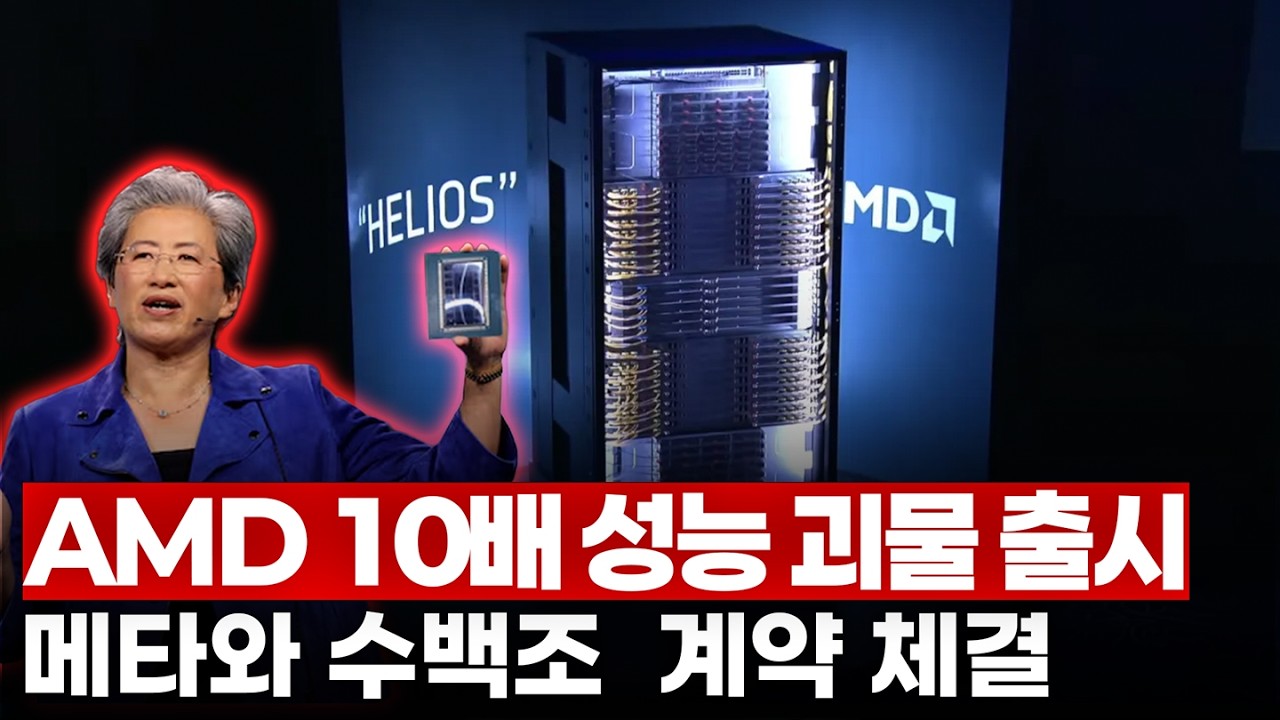
AMD is not simply releasing a single chip.Instead, it is putting forward large-scale system architecture such as Helios, which integrates 72 GPUs and 18 CPUs into a single rack.
This is highly significant.
Because for giant AI models, what matters more than the performance of a single GPU ishow quickly dozens to hundreds of GPUs can communicate with each other and train without bottlenecks.
In other words, the battleground is no longer “who made the better GPU,”but “who can provide the better overall AI data center architecture.”
2. The real reason Nvidia controls over 90%: what is more formidable than performance is ecosystem lock-in
Many people think Nvidia is strong simply because of performance.
Of course, that is not wrong.
But there is a more fundamental reason.
2-1. The software lock-in created by CUDA
Nvidia’s most powerful weapon is CUDA.
Because developers have built AI training code, libraries, and optimization environments around CUDA,moving workloads that already run in Nvidia environments into another GPU ecosystem is far more difficult than it appears.
Put simply,it is not just a matter of changing the GPU, but of changing the entire development culture and operating environment.
2-2. The moat created by NVLink and InfiniBand connectivity technologies
AI model training is a task that runs by grouping multiple GPUs together at the same time.
What matters here is not only the compute performance of individual GPUs.
How fast GPUs can exchange data with one another determines overall training speed.
Nvidia has built a strong advantage here through high-speed connectivity technologies such as NVLink, NVSwitch, and InfiniBand.
Ultimately, Nvidia’s true monopoly power has not been in the “chip” alone, but in a full-stack structure that combines chips, software, and networking.
3. The change AMD showed this time: not just chasing chip performance, but launching a full rack-scale battle
What the market focused on in AMD’s announcement was not just benchmark numbers.
What matters is that AMD is now seriously designing integrated rack-level systems, just as Nvidia has done.
3-1. Why Helios matters
Helios can be understood as a structure that places 72 GPUs and 18 CPUs into a single rack and connects them through ultra-high-speed interconnectsso that they operate like one giant computing unit.
The core point of this method is rack-scale.
In the past, it felt more like GPUs were divided and operated separately by server,but now the direction is shifting toward designing the entire rack as a single AI training machine.
This structure matters because it can significantly reduce network latency and bottlenecks.
When training giant models, communication volume often becomes a bigger problem than raw computation volume.
So rather than simply buying more GPUs,what has become more important is how closely those GPUs are placed together and how fast they are connected.
3-2. MI455X and the next-generation memory strategy
In the original source, the MI455X and large-capacity HBM memory were emphasized.
There may be some confusion in the numerical expressions,but from a market perspective, what matters is that AMD is strongly pushing high-bandwidth memory, or HBM, and large-model processing capability.
HBM is effectively the lifeline of AI semiconductors.
No matter how good the compute units are, if memory bandwidth is lacking, AI training efficiency drops sharply.
The fact that AMD is now presenting system designs in a class similar to Nvidia’s in this area is a fairly major shift from an investor’s perspective.
3-3. Why AMD’s strength in chiplet design is being highlighted again
AMD has always been strong in chiplet design.
Instead of making one giant monolithic chip,it has extensive experience in connecting multiple smaller chips at high speed to deliver one large level of performance.
This strategy has advantages in yield, cost, and scalability.
As chips in the AI accelerator market become larger and more complex,the chiplet approach is likely to become even more important going forward.
In other words, AMD’s move this time can be seen not as simple catch-up,but as a trend of extending the design philosophy it knows best into AI data centers.
4. A full-stack strategy that combines CPU, GPU, and networking: this is what AMD is really targeting
Another area to watch in this announcement is CPU and networking.
AMD is bringing together its next-generation Venice server CPU lineand networking based on Pensando.
In the end, this means it is not saying “we will just sell GPUs,”but rather that it intends to take the entire data center architecture as a whole.
4-1. AMD is also following the Nvidia model
Nvidia is no longer just a GPU company.
It is closer to an AI infrastructure company that integrates CPU, networking, software, and system design.
AMD, judging from this trend, is moving in exactly the same direction.
This matters because, from the perspective of hyperscalers,a validated integrated solution is more attractive than a single component.
Large-scale cloud operators must run tens of thousands of GPUs,so overall operating efficiency, failure response, power management, and developer convenience matter far more than individual chip performance.
4-2. The gigawatt-scale data center era and power infrastructure
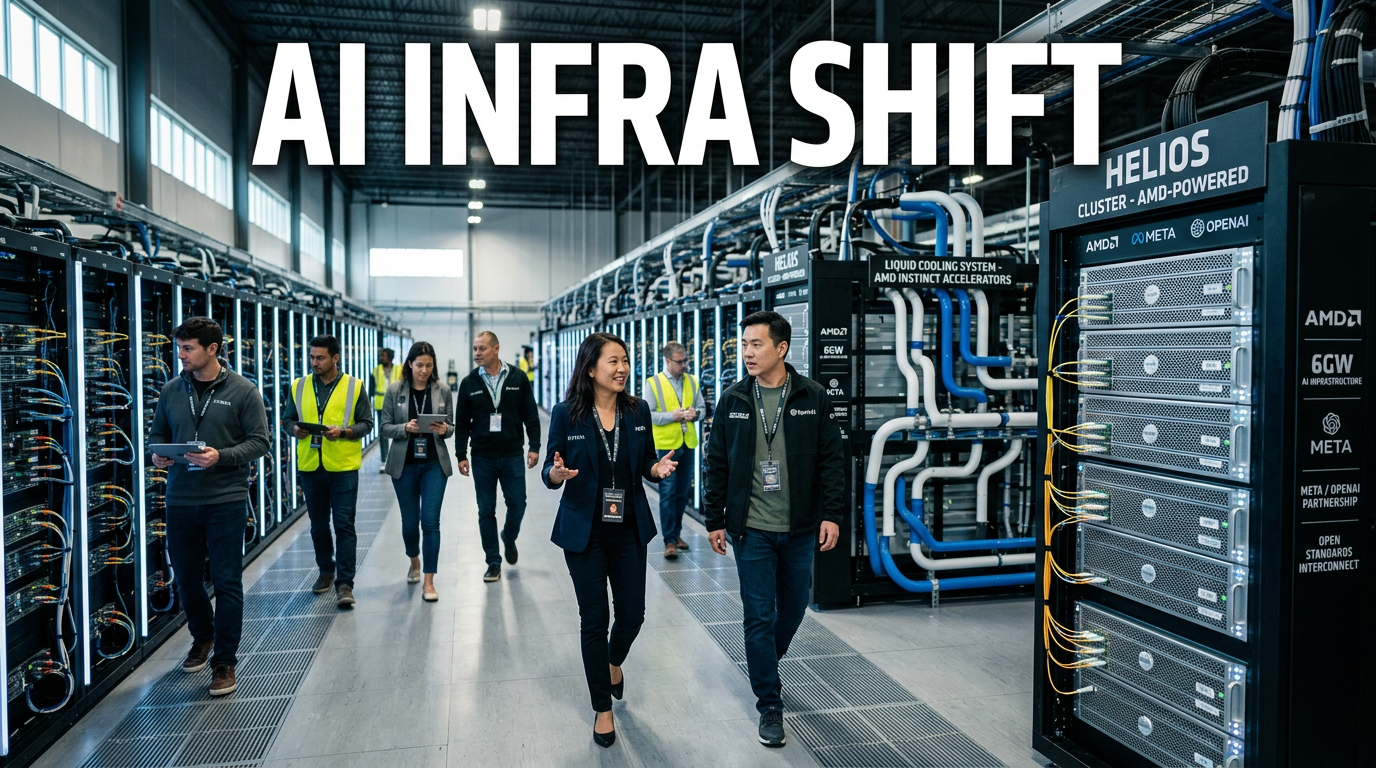
The number 6GW was repeatedly emphasized in this news, and that does not just mean “extremely large.”
It is closer to meaning a data center requiring electricity on the scale of multiple nuclear power plants.
In other words, AI competition is no longer just a semiconductor issue,but has become an economy-wide issue tied to the power grid, cooling, land, transmission and distribution, and power efficiency.
From this point onward, it is no longer just a technology news story,but one that connects to the global economy, infrastructure investment, power policy, and supply-chain restructuring.
5. The 6GW-scale contract issue with Meta and OpenAI: how far should it be interpreted?
The original source interpreted this very strongly, as if Meta and OpenAI had each signed 6GW-scale data center contracts with AMD.
This is certainly a point where market expectations can grow,but the actual confirmed contract structure, supply scope, period, and capex recognition method still require separate verification.
Still, what matters is the atmosphere itself:that ultra-large demand sources such as Meta and OpenAI are viewing AMD as a serious partner candidate.
5-1. Why this reference point could be decisive
In the AI infrastructure market, the first major reference customer is extremely important.
Once one ultra-large customer makes a selection,other hyperscalers also begin to think, “So AMD is now capable of operating at large scale.”
In other words, just as much as technical capability, it is important to cross the threshold of trust.
For AMD, simply being linked with Meta or OpenAI could completely change its sales power and market credibility.
5-2. Why the stock price reacts so sensitively from an investment perspective
The market reacts to narratives before it reacts to numbers.
If expectations emerge that AMD can become not just “the number-two GPU company,”but a key pillar in building ultra-large AI data centers,a valuation re-rating can happen quickly.
Especially at a time like now, when artificial intelligence and semiconductors are the core themes of the stock market,future market-share expectations are often priced in before earnings.
6. The most realistic weapon AMD has to shake Nvidia: open standards
Personally, this is the part I see as most important in this issue.
AMD is not just competing on performance,but aiming to play a central role in an open-standard alliance that stands against Nvidia’s closed ecosystem.
6-1. Why UALink and Ultra Ethernet matter
Hyperscalers do not want to remain permanently dependent on a specific vendor.
Right now, Nvidia is used extensively because it is overwhelmingly strong,but in the long term, they inevitably want open structures in order to secure pricing leverage and system flexibility.
That alternative is open interconnect standards such as UALink and Ultra Ethernet.
If this structure takes hold,AI data centers could move toward an ecosystem where multiple suppliers can participate,rather than one based on equipment dedicated to a specific company.
And expectations are growing that AMD could stand at the center of that structure.
6-2. Hyperscalers have an incentive to support AMD
Companies such as Meta, Microsoft, AWS, and Googlemust control AI infrastructure costs over the long term.
If Nvidia’s monopoly continues, pricing power could become too concentrated on one side.
So from the customer’s point of view, if performance reaches a certain threshold,there is more than enough incentive to cultivate the number-two player.
This is not just a technology competition,but also highly important from the perspective of strategic supply-chain diversification.
7. Still, why Nvidia is not collapsing anytime soon
Balance is also important here.
Even if AMD looks promising, that does not mean Nvidia will immediately be shaken apart.
7-1. The CUDA ecosystem is much stronger than many think
Nvidia’s true core remains CUDA.
Development tools, libraries, optimization, documentation, developer communities, and operational experience have all accumulated around it.
That will not collapse overnight.
Although ROCm is increasingly being evaluated as much improved,many still believe there remains a gap in maturity, compatibility, and on-site operational experience.
7-2. There is a big gap between “announcement” and “field validation” for rack-level integration
AI infrastructure should not be judged by spec sheets alone.
What must be verified in real large-scale operation is failure rate, heat, power efficiency, software stability, and maintenance systems.
Especially in data centers where deployment happens in units of tens of thousands of GPUs,even minor defects can lead to enormous costs.
So the moment AMD is truly evaluated is not the moment of the announcement,but the point when it is deployed in real customer environments and large-model training results are delivered.
8. How the market landscape may change going forward: Nvidia’s monopoly weakens, but the market itself grows larger
In the long run, many believe Nvidia’s market share above 90% will be difficult to maintain indefinitely.
And this is not only because of AMD.
It is also because big tech is strengthening direct chip strategies,including Google TPU, AWS custom chips, Microsoft’s in-house designs, and Meta’s tailored accelerators.
8-1. Market share may fall, but absolute revenue can still rise
This point is quite important in investing.
Even if Nvidia loses some market share,if the market as a whole grows rapidly enough, revenue and profit can continue to increase.
In other words, going forward, what may matter more than “who wins”is “how large the overall market becomes.”
The AI data center market is currently in a phase where high growth is expected,and as cloud and generative AI demand continue to expand,the total industry pie is likely to grow even if the market evolves into a duopoly or a multipolar structure.
8-2. The linkages Korean investors should watch
This trend does not end as just another American big-tech news story.
It connects in a chain to HBM supply chains, advanced packaging, power equipment, cooling solutions, data center construction, and networking equipment.
In other words, in the stock market, investors should not watch only GPU companies,but also memory, power equipment, cables, transformers, cooling, and server component companies.
The AI investment cycle affects far more sectors than many realize.
9. News-style summary: a quick check of only the key points of this issue
9-1. Confirmed trends
– Competition in AI infrastructure is moving from the chip level to the rack and data center level.
– AMD is challenging Nvidia’s stronghold with rack-scale systems such as Helios.
– AMD is strengthening a full-stack strategy integrating CPU, GPU, and networking.
– Open-standard alliances could become a long-term variable that shakes Nvidia’s monopoly structure.
– The possibility of links with major customers such as Meta and OpenAI could greatly enhance AMD’s credibility.
9-2. Areas that still require confirmation
– The exact structure, scope, and revenue-recognition scale of the 6GW-scale contracts require further verification.
– It remains to be seen whether AMD systems can demonstrate Nvidia-level stability in actual field operations.
– It will take more time for the ROCm ecosystem to establish itself as a true alternative to CUDA.
10. The most important point that other news outlets or YouTube channels often miss
What truly matters here is not “whether AMD is faster than Nvidia.”
Rather, the essence of the market is that in the AI era, power is shifting from chip manufacturers to infrastructure standard architects.
Nvidia already holds that power.
With this move, AMD has, for the first time, seriously thrown down a challenge to that power structure.
In other words, the winner in this market going forward may not be “the company that makes the best chip,”but the company that creates standards connecting developers, cloud, networking, power, and data center operations.
This point is far more important than ordinary product performance comparison videos.
Because in the long term, what determines enterprise value is not a single product,but ecosystem dominance and switching costs.
11. Final perspective: AMD is no longer just a “promising contender,” but a “structural variable”
To summarize,AMD is no longer just a simple Nvidia alternative play.
In the AI data center era, it is expanding its presence across multiple axes,including rack-scale systems, chiplet design, CPU-GPU integration, and open networking standards.
Nvidia’s monopoly will not end immediately,but the first scene of a market structure moving from “absolute monopoly” to “competing oligopoly” could certainly be beginning.
And the starting point of that change can be seen precisely in this AMD announcement and the expectations for ultra-large customer references.
Ultimately, there are three things to watch going forward.
Whether AMD can pass not only actual delivery but also operational validation,how well ROCm and open standards settle into the developer ecosystem,and how strategically hyperscalers try to reduce dependence on Nvidia.
If these three factors align,the AI infrastructure market could be reorganized faster than many expect.
< Summary >
AMD’s latest move is not just a GPU product announcement,but a signal that the AI data center market is shifting from chip competition to rack and infrastructure competition.
Nvidia’s real moat was its ecosystem centered on CUDA and NVLink,and AMD has now begun a direct contest through open strategies such as Helios, ROCm, UALink, and Ultra Ethernet.
Expectations around ultra-large projects linked with Meta and OpenAI are variables that could significantly raise AMD’s market credibility.
However, the real contest will be decided not by announcements, but by validation in actual operations.
In the long term, Nvidia’s monopoly may weaken somewhat,but because the AI data center market itself is growing, both companies are likely to continue growing.
[Related Articles…]
After the surge in HBM demand, how far can the memory supercycle continue?
Data center power infrastructure investment: who are the hidden beneficiaries in the AI era?
*Source: [ 월텍남 – 월스트리트 테크남 ]
– OpenAI 이어 메타까지 6GW 대규모 계약..엔비디아급 GPU 출시한 AMD..?