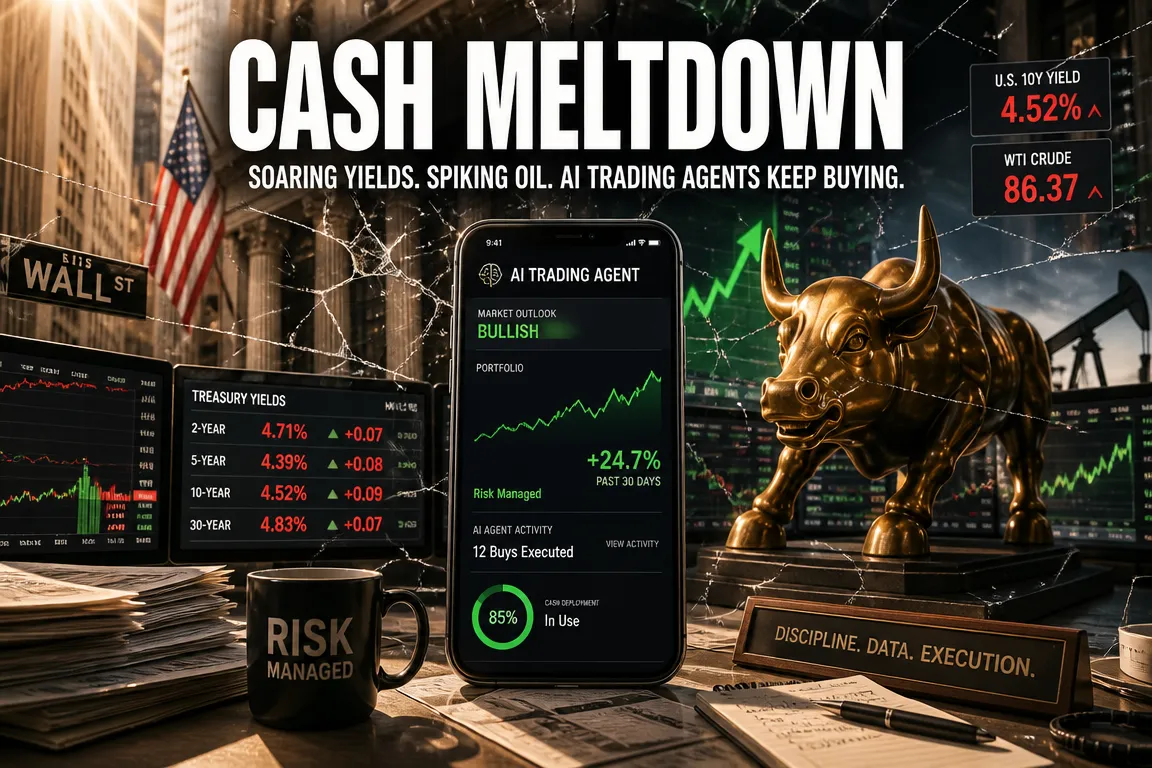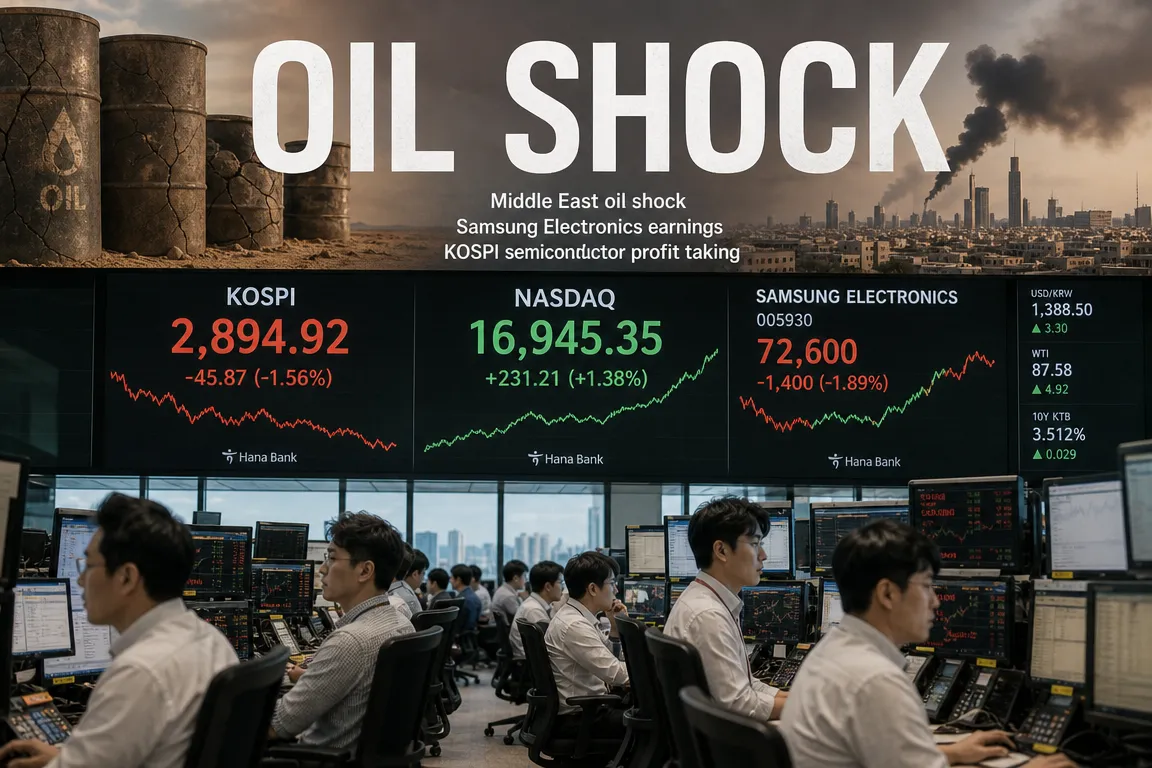
● Oil Shock, War Escalation, Insider Buying Surge
Oil Breaks Above $90, War Risks Prolonged, Equities Under Pressure, and Insider Buying Accelerates A concise summary of the key market signals that matter now
The current backdrop cannot be reduced to a simple rise in oil prices.
Markets are simultaneously contending with a sharp increase in crude oil, expanding geopolitical risk, the possibility of renewed inflation pressure, fading expectations for rate cuts, and a notable rise in insider buying among deeply discounted out-of-favor stocks.
While most coverage focuses on oil and conflict headlines, the more relevant issue for investors is how these shocks alter sector earnings, capital flows, and why insiders are quietly accumulating neglected names.
This report outlines the latest global macro trends, implications for U.S. and Korean equities, investment themes linked to the Fourth Industrial Revolution and AI, and several underappreciated points that are often overlooked in mainstream news and online commentary.
1. Key News Briefing Why Oil Above $90 Matters for the Broader Market
Crude oil moving above $90 is not merely a commodity price event.
It is better understood as a shock to the global cost structure.
When oil rises sharply, transportation costs, production expenses, electricity rates, airfares, and logistics costs tend to increase in sequence.
The result is pressure on corporate margins and renewed upward pressure on consumer prices, which may reaccelerate inflation.
This is the market’s central concern.
Financial markets had been pricing in the view that moderating inflation could bring rate cuts closer. A sharp rise in oil challenges that assumption.
In other words, higher crude prices may support energy equities, but for the broader market they are more likely to increase uncertainty around monetary policy.
2. The Direct Impact of Prolonged War Risk on Equities
When war or geopolitical conflict persists, markets typically respond in three stages.
First, there is a shift toward safe-haven assets.
Capital rotates into the U.S. dollar, government bonds, and gold.
Second, risk assets are repriced lower.
Growth stocks, small caps, and companies with limited earnings visibility tend to come under pressure first.
Third, sector dispersion increases.
Defense, energy, and select commodity-related sectors may outperform, while consumer goods, transportation, parts of semiconductor back-end processing, chemicals, airlines, and retail typically face greater pressure from higher costs.
The key distinction is whether the conflict is a short-term headline event or a structural disruption to supply chains.
Markets are more concerned about prolonged supply-chain realignment and sustained cost inflation than about the headline itself.
If global supply chains weaken again, companies may need to spend more on inventory management and production diversification, raising the risk of downward earnings revisions.
3. Why Equities Are Reacting More Sensitively Than Expected
Markets are unusually sensitive not because of a single negative factor, but because additional risks are emerging while valuations are already elevated.
U.S. equities, in particular, have been supported for an extended period by AI enthusiasm and large-cap technology strength.
However, when markets are already priced at higher levels, new downside risks tend to matter more than new positive catalysts.
Three forces are operating simultaneously.
First, oil-driven inflation concerns are resurfacing.
Second, expectations for rate cuts may be pushed back.
Third, profit-taking pressure is rising after concentrated gains in a narrow set of large technology names.
In this environment, the index may appear relatively stable while individual stocks experience significantly deeper corrections.
Out-of-favor names, small-cap growth stocks, and earnings-turnaround candidates are particularly vulnerable to outsized declines.
4. Why Insiders Are Buying Beaten-Down Neglected Stocks A Meaningful Market Signal
One of the most overlooked signals in the market is insider buying.
Insiders generally include CEOs, CFOs, board members, and other senior executives.
They are often in a better position than external investors to assess cash flow, order trends, cost structure, and progress in new business initiatives.
Insider buying does not guarantee a rebound.
However, when insiders commit personal capital during periods of extreme pessimism, the signal can be meaningful.
When insider buying appears in heavily sold-off neglected stocks, it may indicate a widening gap between market price and intrinsic value.
In practical terms, the external market may be pricing in failure while company insiders may view the stock as materially undervalued.
5. Key Criteria for Interpreting Insider Buying
The signal is less important in isolation than in context.
The following factors should be assessed to improve signal quality.
1) Are multiple insiders buying rather than just one?
Coordinated purchases by several executives are generally more meaningful than a symbolic purchase by a single CEO.
2) Is the purchase size economically meaningful?
Small transactions may be cosmetic. The relevant question is whether the amount is significant relative to personal wealth or compensation.
3) Has the stock already declined materially?
Insider buying after a sharp drawdown tends to be more informative than buying near highs.
4) Is the earnings weakness temporary or structural?
If the shock is temporary, recovery potential may exist. If the industry structure is deteriorating, the interpretation changes.
5) Can the balance sheet withstand continued pressure?
A stock may appear cheap, but liquidity risk remains critical. Cash flow and leverage must be evaluated carefully.
6. Sectors Likely to Benefit or Suffer in a Rising Oil Environment
The sector view can be summarized as follows.
Sectors with relative upside potential
Energy producers, refiners, selected defense names, commodity-related stocks, offshore plant contractors, and sectors with exposure to Middle East project awards.
Higher oil prices can improve earnings expectations for energy-linked companies.
Sectors facing greater pressure
Airlines, transportation, chemicals, consumer goods, retail, manufacturers with limited pricing power, and low-margin platform businesses.
Companies that cannot quickly pass through higher costs are most exposed.
Neutral but highly selective sectors
Semiconductors, cloud, AI infrastructure, software, power equipment, and automation.
These areas may remain volatile in the short term, but the key question is whether their long-term structural growth remains intact.
7. How the AI Trend Connects to the Current Macro Shock
At first glance, rising oil prices and war risk appear to be traditional macro issues, but they also connect directly to the AI investment cycle.
AI depends on power supply, data centers, semiconductor supply chains, cooling infrastructure, networking equipment, and enterprise IT spending.
If oil rises and geopolitical risk intensifies, power costs, equipment investment, and the cost of capital may all be affected.
AI remains a long-term growth theme, but the pace of expansion and the distribution of benefits across companies may diverge depending on macro conditions.
The market is increasingly distinguishing between companies converting AI demand into revenue and those supported primarily by expectations.
In this phase, AI semiconductors, power efficiency, data center infrastructure, industrial automation, robotics, and cybersecurity are likely to matter more because they are tied to actual spending.
8. Themes to Monitor More Closely from a Fourth Industrial Revolution Perspective
In the current market, technologies that deliver measurable productivity gains may receive stronger valuation support than purely narrative-driven themes.
The following areas remain worth monitoring.
AI Infrastructure
GPUs, HBM, servers, cooling systems, power management, and data center construction remain core segments.
Industrial Automation
Rising labor costs and supply-chain uncertainty may accelerate adoption of factory automation, smart manufacturing, and robotics.
Energy Transition
Paradoxically, higher oil prices may reinforce long-term interest in energy efficiency, grid investment, storage systems, nuclear power, and next-generation power infrastructure.
Cybersecurity
As war and geopolitical risk increase, governments, financial institutions, and corporations may need to raise security spending.
Defense Technology
Drones, satellites, surveillance systems, and autonomous defense platforms are increasingly taking on characteristics of both defense and technology equities.
9. U.S. vs. Korean Equities: What Should Be Viewed Differently
U.S. Equities
The U.S. remains the primary destination for global capital.
In periods of dollar strength and rate volatility, large-cap technology may continue to show relative defensiveness.
However, stocks that have already appreciated substantially may react sharply even to modest disappointments, making earnings quality and valuation discipline increasingly important.
Korean Equities
Korea has higher weightings in semiconductors, batteries, autos, shipbuilding, defense, and refining and chemicals, making it more directly sensitive to oil and global growth conditions.
The interaction of commodity prices, exchange rates, and export demand is particularly important.
KRW weakness may provide partial support for exporters, but investors must also account for foreign capital flows and rising input costs.
In Korea, sector selection is likely to matter more than index direction.
10. The Most Important Point Less Emphasized Elsewhere
This is the core issue.
Much commentary stops at “higher oil is negative for equities,” but investment outcomes are more likely to be determined by the following three factors.
First, markets price duration more than headlines
The critical variables are not the conflict itself, but how long it lasts and how persistent the disruptions to energy and logistics become.
Rather than reacting to day-to-day headlines, investors should assess whether supply chains and inflation are facing structural pressure.
Second, insider buying is not a reason to buy immediately, but a starting point for idea generation
Insider purchases should not be treated as a conclusion. They should trigger further work on financials and business quality.
In that sense, insider buying is not the answer but a clue that may point to information the market is underappreciating.
Third, the current correction may reflect sharper capital concentration rather than an outright collapse of the AI theme
The phase in which all AI-related stocks rise together may be ending.
Capital may increasingly favor companies with real orders, real cash flow, and direct exposure to capital spending.
For long-term investors, that may create a healthier environment.
11. Practical Monitoring Points for Investors
In a market like this, checklists matter more than sentiment.
1) Determine whether the rise in oil is temporary or the start of a new trend
It is essential to distinguish between a short-term event and a structural change in supply conditions.
2) Track whether inflation is reaccelerating
Assess how energy prices feed into CPI and PPI.
3) Monitor any shift in the Fed’s policy stance
If rate-cut expectations are delayed, growth-stock volatility may increase.
4) Screen insider-buying names for balance-sheet strength
Cash holdings, leverage, operating cash flow, and the likelihood of earnings recovery should all be reviewed.
5) Reclassify AI names based on earnings conversion
The market is increasingly prioritizing numbers over narrative.
12. Scenario Outlook
Scenario A. Oil stabilizes quickly
Equities may recover after a short-term shock, led again by growth sectors.
AI, semiconductors, and large-cap technology could resume leadership.
Scenario B. Oil remains elevated
Inflation pressure may build, rate-cut expectations may be deferred, and broader equity valuations could face additional compression.
Energy, defense, and value stocks with strong cash flow may show relative resilience.
Scenario C. Prolonged conflict coincides with supply-chain disruption
This scenario warrants the most cautious stance.
Not only equities, but also exchange rates, commodities, logistics, and earnings estimates could come under pressure simultaneously.
Cash management and a more defensive portfolio stance would become increasingly important.
13. Conclusion at a Glance
The market is currently navigating a complex regime in which oil, war risk, inflation, interest rates, the AI theme, and insider buying are all interacting at once.
Although the backdrop appears negative on the surface, periods like this tend to sharpen the distinction between stronger and weaker companies.
Insider buying in heavily sold-off neglected stocks is not just a headline; it may indicate opportunity amid excessive pessimism.
However, this should not be chased indiscriminately. Global macro trends, earnings, cash flow, and structural industry change all need to be assessed together.
The core message of the current market is neither “everything is too risky” nor “a rebound is imminent.”
The key is to identify where capital is seeking shelter and where it is beginning to return.
At the center of that process are crude oil, inflation, interest rates, U.S. equities, and the actual monetization of AI.
< Summary >
Oil above $90 is not just an energy headline; it is a key variable affecting inflation and the path of interest rates.
Prolonged war risk is increasing equity volatility by pressuring supply chains, logistics, and corporate cost structures.
At the same time, insider buying in heavily discounted neglected stocks may signal that the market is undervaluing select companies.
The AI trend remains intact, but leadership is likely to narrow toward businesses with visible earnings and infrastructure exposure rather than pure expectation-driven names.
Going forward, investors should monitor crude oil, inflation, rate-cut expectations, insider buying, and whether AI demand is translating into actual financial performance.
[Related Articles…]
Global equity rotation after the oil surge: the key variables to watch first
Expanding AI infrastructure investment: the next opportunities in semiconductors and data centers
*Source: [ 소수몽키 ]
– 유가 90불 돌파, 전쟁 장기화 우려 커지는 증시/그들은 알고 있다? 폭락한 소외주 사들이는 내부자들
● Middle East War Escalation, Oil Shock, Inflation Comeback, Korea on Edge
Middle East War Escalation, Surge in Global Oil Prices, and the Risk of Renewed Inflation: Key Risks the Korean Economy Must Watch Closely
This issue extends well beyond a single war-related headline.
What matters is how a rise in global oil prices could feed into Korean inflation several weeks later, why expectations for rate cuts could reverse, and how the shock could spread sequentially through the KOSPI, the exchange rate, and the real economy.
This report focuses on the transmission mechanism of energy supply disruptions → import prices → consumer prices → changes in the rate path → slower growth.
It also highlights the significance of the government’s emergency crude procurement measures, how to interpret the surge in retail gasoline prices, and less-discussed risks such as higher marine insurance premiums, rising freight rates, weaker corporate investment sentiment, and stagflation risk.
1. Why the real economy matters more than market volatility in this Middle East conflict
As the Middle East war shows signs of escalation, markets have reacted first.
The fastest-moving variables are global oil prices, gold, exchange rates, and equities.
In this phase, a single headline can trigger sharp swings in the KOSPI, while safe-haven demand tends to strengthen the U.S. dollar and weaken the Korean won.
However, the more important issue is the next stage.
If the conflict ends quickly, the impact may remain confined to financial market volatility.
If it becomes prolonged, the baseline path of the Korean economy could change.
In other words, the expected sequence of “inflation stabilization → rate cuts → economic recovery” could be disrupted.
2. Policy response first: the significance of the emergency import of 6 million barrels of UAE crude
The government has announced emergency imports of more than 6 million barrels of crude from the UAE to reduce energy supply uncertainty.
This volume is broadly comparable to Korea’s daily crude oil consumption, giving the measure meaningful signaling value.
2-1. Why this measure matters
First, it can help stabilize market sentiment.
Even in the absence of major physical supply disruptions, prices can rise in anticipation if market anxiety intensifies.
Securing supply in advance sends a signal that near-term disruption is manageable.
Second, it may slow the pace of import price increases.
Even if global oil prices rise, the actual domestic impact depends on procurement timing and contract structures.
Pre-secured cargoes can serve as a short-term buffer.
Third, it could accelerate discussion on diversification of energy import sources.
This episode underscores Korea’s vulnerability to regional concentration risk.
It also reinforces the need to reassess import structures for crude, gas, naphtha, and other strategic inputs.
2-2. Why the government commented on the surge in retail gasoline prices
At a Cabinet meeting, President Lee Jae-myung stated that retail gasoline prices were rising sharply even though no objectively severe fuel supply disruption had yet occurred, and instructed officials to review concrete enforcement measures.
The key message has two dimensions.
One is direct intervention.
This refers to reducing supply anxiety through actual inventory and procurement measures.
The other is indirect or verbal intervention.
This was a warning against excessive front-loading of price increases in refining and distribution channels before higher global oil prices had been fully reflected domestically.
In effect, the government appears more concerned about price preemption driven by sentiment than about actual physical shortage at this stage.
3. Does higher oil only mean higher fuel costs?
No.
This is the main reason the issue should not be treated narrowly.
Crude oil is not only a transportation fuel; it is a core cost input across the industrial base.
3-1. Transmission into consumer prices
When oil prices rise, transportation costs increase.
Higher transport costs then affect food, manufactured goods, parcel delivery, and restaurant prices.
Oil also enters the cost structure of fertilizer, plastics, chemical materials, textiles, packaging, and household goods.
As a result, higher oil prices feed into producer prices and, with a lag, push up consumer prices.
The issue is not limited to fuel expenses; it can raise broad household living costs.
3-2. Why the lag makes it more dangerous
A rise in global oil prices does not immediately increase all consumer prices.
The impact is typically transmitted with a lag of several weeks to two or three months through import, refining, transport, and distribution channels.
That is why weak near-term pass-through should not be interpreted as safety.
The inflation shock may intensify later.
4. What is similar to, and different from, the Russia-Ukraine war
The 2022 Russia-Ukraine war was a major catalyst for global inflation.
Disruptions in Russian oil, natural gas, and commodity supply spread through global supply chains.
This coincided with post-pandemic liquidity expansion and produced a sharp inflation shock.
4-1. The key driver was not only monetary expansion
Many explanations emphasized post-pandemic liquidity, but the supply shock was also substantial.
Without the surge in energy and raw material prices, inflation would likely have been less severe.
U.S. CPI reached 9.1% in June 2022, while Europe experienced an even stronger energy-driven inflation shock.
Supply chain and energy shocks can materially alter the interest-rate and inflation cycle.
4-2. Korea may be more sensitive this time
Some analysts argue that Korea may face more direct pressure this time than in past episodes.
In an interview with Yonhap News, Kim Kwang-seok, Head of Economic Research at the Korea Economic and Industrial Research Institute, said that if the conflict becomes prolonged, the impact on Korea could exceed that of 2022 and inflation could become difficult to contain within two to three months.
This point is important.
During the Russia-Ukraine war, Europe was hit harder, but the current Middle East risk may affect energy-import-dependent, manufacturing-oriented economies such as Korea more directly.
5. If the Middle East conflict becomes prolonged, the inflation path changes
Until recently, global markets broadly expected a disinflation trend.
Inflation remained elevated, but the pace of increase was slowing, allowing central banks to gradually shift toward rate-cut expectations.
If the Middle East conflict becomes prolonged, that assumption may no longer hold.
5-1. From disinflation to re-inflation
If energy prices rise again, the deceleration in inflation may stall or reverse.
In other words, inflation may reaccelerate after a period of moderation.
This is not merely a statistical change.
It changes the baseline assumptions used by markets.
Once expectations shift, bond yields, exchange rates, equity valuations, and corporate funding costs can all reprice.
5-2. Is the term “hyperinflation” overstated?
Strictly speaking, hyperinflation refers to an extreme collapse scenario and is not an appropriate baseline for Korea at present.
However, in popular usage, “hyperinflation” often refers to a sharp rebound in living costs and household burden.
The key issue is not terminology but direction.
The primary risk is a breakdown in inflation-stabilization expectations.
6. Why rate-cut expectations are suddenly under pressure
If inflation rises again, central banks cannot ease policy quickly.
Markets had expected the Federal Reserve and other major central banks to move gradually toward rate cuts.
If energy-driven inflation reaccelerates, the pace of easing may slow or stop.
6-1. In a downside case, rate hikes could re-enter the discussion
If inflation rises more than expected and remains elevated, some countries may adopt a more restrictive policy stance again.
That would imply not a rate-cut cycle, but “higher for longer” or even renewed discussions of further tightening in some jurisdictions.
This would increase pressure on Korea.
Given already high household debt, a prolonged period of elevated lending rates could delay consumption recovery.
6-2. Why this also affects the exchange rate
If rate cuts are delayed, U.S. dollar strength may persist.
Combined with geopolitical risk, safe-haven demand could push USD/KRW higher.
A weaker won would then increase import prices.
If higher oil prices coincide with a weaker won, Korea’s inflation pressure would intensify further.
7. Real-economy impact: both corporates and households may retrench
The most damaging effect of war is not only direct disruption but heightened uncertainty.
Economic activity is highly sensitive to uncertainty.
7-1. Corporates: more investment delays
Companies tend to delay investment when costs become unstable and demand visibility weakens.
New plants, capital expenditure, R&D, and hiring plans can all become more conservative.
In a manufacturing-heavy economy such as Korea, investment sentiment can deteriorate quickly if energy prices, exchange rates, logistics costs, and global demand all become unstable at once.
7-2. Households: defense takes priority over spending
For households, fuel, food, utility bills, and borrowing costs may all rise simultaneously.
In such an environment, consumption sentiment tends to weaken and cash preservation becomes more important.
Domestic demand may therefore soften.
7-3. Risk of slower growth
Kim Kwang-seok also noted that the government’s 2.0% growth forecast could be revised depending on the intensity of the Middle East escalation.
He added that major economies could partially offset downside growth pressure through expansionary fiscal measures such as supplementary budgets.
In effect, if private-sector activity weakens, governments may again need to provide fiscal support.
8. Why stagflation risk should be taken seriously this time
The most challenging scenario is one in which inflation rises while growth slows.
That is stagflation.
Higher oil prices push inflation upward.
At the same time, a prolonged conflict and greater uncertainty weaken consumption and investment, reducing growth.
Central banks may need tighter policy to contain inflation, but tighter policy can further weaken growth.
Governments may need fiscal expansion to support activity, but that can also add to inflation pressure.
For that reason, stagflation is one of the most difficult macroeconomic environments to manage.
9. A key risk often overlooked: shipping costs and insurance premiums
This is a critical but underappreciated point.
While most commentary focuses on oil prices, the broader transmission may be amplified through marine transport and insurance costs.
9-1. The Strait of Hormuz risk is not just symbolic
If Middle East tensions intensify, tanker and commercial shipping operations may be disrupted.
Transport delays, rerouting, port congestion, and military tensions all increase logistics costs.
9-2. Higher marine insurance premiums affect broad import prices
Insurers raise premiums when war risk increases.
This reflects greater risk of vessel damage, seizure, or route disruption.
Those costs are then passed through to freight rates and ultimately to importers’ cost bases.
As a result, even a moderate increase in oil prices can produce a larger consumer impact if accompanied by higher marine insurance and freight costs.
This effect is often missed in oil-focused reporting.
10. What this means for Korean financial markets
10-1. KOSPI
Near-term volatility is likely to increase.
Energy, defense, and some commodity-linked stocks may outperform relatively, but the broader index is likely to remain vulnerable to risk-off sentiment.
If rate-cut expectations weaken, valuation pressure on growth stocks could rise again.
10-2. Exchange rate
USD/KRW is likely to face upward pressure if geopolitical risk coincides with U.S. dollar strength.
A higher exchange rate affects foreign investor flows and further raises import prices.
10-3. Bond market
If concerns about renewed inflation intensify, bond yields may move higher rather than lower.
That would delay the easier financial conditions previously expected by markets.
11. Why the Trump factor also matters
As noted in the source material, the U.S. political calendar is also a relevant variable.
If the Trump camp has politically leveraged expectations for war resolution, lower inflation, and rate cuts, a prolonged Middle East conflict could complicate that strategy.
A rapid resolution could become a political achievement, while a prolonged conflict could instead reinforce inflation and market instability.
This is why the Middle East situation can intersect with the U.S. election cycle, Fed policy expectations, and the dollar trajectory.
12. Why the reference to Helsinki, Finland matters
The original discussion was prepared from Helsinki, Finland.
This is not merely a geographical detail; it carries symbolic relevance for European energy security and geopolitical risk.
Finland has direct historical experience with Russian tensions, European security issues, and energy dependence.
Since the Russia-Ukraine war, Northern Europe and Europe more broadly have become acutely aware that even distant conflicts can generate immediate economic shocks.
13. Practical points for individual investors and salaried workers
13-1. Focus first on inflation-sensitive sectors
Refining, chemicals, airlines, shipping, retail, food and beverage, and consumer goods are all sensitive to changes in oil prices and freight costs.
Investors should assess not only fuel exposure but also margin structure and pricing power.
13-2. Relying solely on rate-cut expectations is risky
One reason asset markets held up this year was the expectation of lower rates.
If that assumption weakens, market interpretation must also change.
13-3. Review exchange-rate sensitivity
Investors should distinguish among U.S. dollar assets, overseas exposure, won-weakness beneficiaries, and import-dependent sectors.
A weaker won hurts domestic consumption but may provide a short-term cushion for some exporters.
13-4. Managing household inflation exposure becomes more important
For individuals, reviewing living-cost structures may be more important than investment positioning.
When fuel, food, interest costs, and utility expenses all rise together, cash-flow management becomes significantly more important.
14. The most important point often missed by other media
The central risk is not the war itself, but the breakdown of the expected macro path.
Many reports focus on how much oil has risen or how much equities have fallen.
But markets and economies are driven as much by baseline expectations as by the immediate numbers.
Until now, markets broadly expected the following:
Inflation would gradually ease.
Interest rates would decline over time.
Consumption and investment would recover, even if slowly.
If the Middle East conflict becomes prolonged, all three assumptions could weaken simultaneously.
In that case, the larger shock would come not from oil prices alone, but from a shift in the baseline used for policy, asset pricing, and corporate decision-making.
That shift usually arrives later than the headlines, but tends to last longer.
15. Key indicators to monitor going forward
The following indicators should be monitored jointly to assess the trajectory accurately.
First, global oil and LNG prices.
The key question is whether the move is a short-term spike or a sustained uptrend.
Second, USD/KRW.
If energy prices and the exchange rate rise simultaneously, inflation pressure in Korea becomes more severe.
Third, domestic gasoline prices and refining margins.
These provide an early signal of where consumer pressure begins.
Fourth, producer-price and import-price data.
These can be viewed as leading indicators for consumer inflation.
Fifth, shipping-rate indices and war-risk insurance premiums.
This area remains underappreciated but may have substantial macro impact.
Sixth, changes in communication from the Bank of Korea and the U.S. Federal Reserve.
If references to rate cuts diminish and inflation warnings increase, markets are likely to reprice quickly.
16. Final takeaway: this should be viewed as a macro path shift, not just war news
The escalation of the Middle East conflict is not simply a geopolitical headline.
It is a classic macro shock variable with implications for global oil prices, exchange rates, inflation, interest rates, growth, and the KOSPI.
In an economy like Korea’s, with high energy import dependence and a large manufacturing base, shock transmission can be rapid.
The emergency UAE crude procurement measure is meaningful for short-term stabilization, but over the longer term, diversification of energy import sources and supply-chain resilience are more important.
If the conflict ends quickly, the shock may prove temporary.
If it becomes prolonged, inflation-stabilization expectations may break down, the interest-rate path may change, and growth may weaken.
At that point, the focus shifts from market volatility to the economy’s underlying resilience.
< Summary >
An escalation of the Middle East war could alter Korea’s path for inflation, rates, the exchange rate, and growth, not just global oil prices.
The government’s emergency import of 6 million barrels of UAE crude is meaningful for short-term supply stabilization.
However, if the conflict becomes prolonged, import and consumer prices could rise with a lag of two to three months.
In that case, rate-cut expectations may weaken, and concerns over prolonged high rates or renewed tightening could increase.
If corporate investment and household consumption weaken simultaneously, stagflation risk cannot be ruled out.
In particular, rising marine insurance premiums and freight rates are critical risks that many reports overlook.
Ultimately, this issue should be viewed not as war news, but as a signal of a potential shift in the macroeconomic path.
[Related Articles…]
How Surging Global Oil Prices Feed Into Korea’s Inflation and Exchange Rate
How AI Semiconductor Competition and Global Supply-Chain Reconfiguration Affect Equity Markets
*Source: [ 경제 읽어주는 남자(김광석TV) ]
– 중동전쟁 확전과 경제적 파급영향 : 초인플레이션 다시 오나? (feat. 핀란드 헬싱키) [즉시분석]
● China Military Purge, Russia War Turning Point, Taiwan Flashpoint Risk
Why China’s Military Irregularities, a Potential Turning Point in Russia’s War, and Taiwan Risk Must Be Viewed Together
This is not simply another geopolitical news item.Potential power realignment within China’s military, instability within the Xi Jinping system, weakening Russian war sustainability, and the risk of action against Taiwan should not be viewed in isolation.
Rather than summarizing headline-level developments, this report focuses on why Chinese political risk can directly affect the global economy, how Russia’s war fatigue may affect energy markets and supply chains, and which macro signals investors should monitor first.
It also highlights a key point that is often underemphasized in broader media coverage: internal power instability in China may increase incentives for external military action.
1. Key Developments at a Glance
China has recently faced persistent concerns over internal military purges and possible personnel reshuffling.The source material referenced the possibility of resistance from residual factions associated with Zhang Youxia, as well as the possibility that formal political exclusion procedures may not have been fully completed.
This suggests that, although the leadership may appear consolidated on the surface, internal resistance may remain unresolved, increasing the risk of sudden developments.
At the same time, Russia is increasingly assessed as having less economic flexibility than before as the war continues.A significant portion of its accumulated fiscal reserves and strategic resources appears to have been depleted, while battlefield casualties are widely believed to remain elevated.
In parallel, if China’s internal political instability spills outward, Taiwan risk is likely to re-emerge as the first major scenario to watch.This is not only a military issue; it also has direct implications for semiconductor supply chains, global equities, commodity markets, and currency volatility.
2. Why Signs of Instability in China’s Military Matter
2-1. The core issue may be not completed control, but unstable control
China’s political system may appear highly centralized from the outside.In practice, however, the Party, the military, local governments, state-owned enterprises, and intelligence channels are deeply interconnected, making it difficult to conclude that control has been fully secured.
References in the source material to “residual faction resistance” and “incomplete procedures” should not be treated as anecdotal detail; they may indicate that the power base has not been fully locked down.
Under such conditions, the leadership may choose more aggressive purges, intensified loyalty enforcement, or heightened external tensions to strengthen internal control.
2-2. Instability in China’s military is directly linked to economic risk
Viewing instability in China’s military purely as a defense issue captures only part of the picture.The key question is how markets price the risk.
First,if China risk rises, foreign capital may exit mainland China and Hong Kong more rapidly.This could increase volatility across Asian equity markets and weaken broader emerging-market sentiment.
Second,if internal controls intensify, concerns may re-emerge over tighter regulation of private enterprises and restrictions on capital mobility.Combined with slowing Chinese growth, this could further lower global growth expectations.
Third,if China raises external tensions, core supply chains in semiconductors, batteries, rare earths, and shipping logistics could be disrupted.In that case, renewed inflationary pressure cannot be ruled out.
2-3. Talk of a sudden move on Taiwan may sound exaggerated, but markets focus on impact as much as probability
As noted in the source material, internal political stress, leadership insecurity, and unexpected shocks can increase the risk of external military action.A full-scale invasion remains difficult to assume given the substantial military, diplomatic, and economic costs involved.
However, financial markets do not focus only on execution probability.They also assess the magnitude of the potential shock.
Taiwan is central to the global production of leading-edge semiconductors.As a result, even limited escalation could trigger supply-chain concerns, weakness in technology equities, a stronger preference for safe-haven assets, U.S. dollar strength, and Korean won depreciation.
3. Why Discussion of a Turning Point in Russia’s War Continues
3-1. Russia’s economic capacity is becoming more important than military positioning
A recurring assessment in recent commentary on Russia is that it can still endure, but with less room for maneuver than before.
The source material also indicated that Russia has spent a significant portion of the resources it had previously accumulated.This is important.War is ultimately determined not only by ammunition, but by fiscal capacity, industrial output, manpower mobilization, and the cost of social control.
This does not mean Russia is on the verge of collapse.However, as the war extends, the erosion of its economic base may accumulate, increasing the likelihood of more aggressive or less predictable battlefield choices.
3-2. Heavy personnel losses increase regime maintenance costs
The source material used strong language suggesting that troops are being deployed as effectively expendable assets.Such an approach may help sustain the front line in the short term, but over time it can increase social dissatisfaction, widen regional disparities, and deepen fatigue within the military.
Even in a system with strong centralized authority such as Russia’s, a prolonged war continues to generate pressure through local fiscal strain, labor shortages, industrial disruption, and military procurement constraints.
3-3. As Putin’s options narrow, global markets may price in greater uncertainty
A weakening leadership position is not simply a political interpretation.A leader with fewer options may be more inclined toward hardline responses or abrupt decisions rather than negotiation or gradual retreat.
For markets, this is a key risk.Predictable weakness is generally less disruptive than unpredictable escalation.
Accordingly, a turning point in Russia’s war should be understood less as a signal that the war is nearing an end, and more as a sign that the conflict may become increasingly irregular.
4. Implications for Korea and the Global Economy
4-1. Energy and commodity prices are likely to react first
Russia remains a core variable in global energy markets.Changes in the intensity of the war, expanded sanctions, or transport disruptions could quickly affect oil and natural gas prices.
This would feed through to higher manufacturing costs, renewed logistics inflation, and additional consumer price pressure.
In turn, this could affect central bank policy paths and delay expected rate cuts.
4-2. China risk has direct implications for Korean exports and technology industries
Korea remains highly exposed to trade with China and has an export structure centered on semiconductors and intermediate goods.As a result, it is sensitive to both Chinese growth weakness and geopolitical disruption.
If political instability in China depresses both consumption and investment sentiment, Korea’s export recovery could prove weaker than expected.
Conversely, if tensions in the Taiwan Strait rise, Korean semiconductor companies may receive short-term support from substitution expectations, but overall supply-chain disruption and weaker investment activity are likely to dominate.
4-3. Exchange rates and capital flows are likely to react before equities
When geopolitical risk rises, risk-off sentiment tends to strengthen the U.S. dollar.In that environment, USD/KRW may rise, foreign capital may flow out, and volatility in the domestic equity market may increase simultaneously.
This would extend beyond investment implications, affecting import prices, corporate cost structures, and household consumption sentiment.
5. Key Points from an AI Trend and Fourth Industrial Revolution Perspective
5-1. As geopolitical risk rises, AI and semiconductors become more strategic
War-related developments and AI trends are often analyzed separately.In the current environment, they are increasingly intertwined.
A rise in Taiwan risk implies greater risk to advanced semiconductor supply chains, which directly affects generative AI, data centers, cloud computing, autonomous driving, and defense AI.
AI competition is therefore no longer only about technology leadership.It is also about securing resilient chip supply chains and energy infrastructure.
5-2. Defense AI, surveillance technologies, and cyber warfare markets may expand
If tensions related to China and Russia continue to rise, governments are likely to increase investment not only in conventional military assets, but also in AI-based surveillance systems, drones, satellite intelligence analysis, and cybersecurity.
This could create incremental demand across Fourth Industrial Revolution segments including defense technology, security AI, edge computing, and communications infrastructure.
The implication is that investors should look beyond traditional manufacturing and increasingly monitor AI-related value chains tied to national security.
5-3. Supply-chain restructuring may accelerate geographic diversification in AI industries
As China and Taiwan risks increase, the United States, Europe, Korea, and Japan are likely to pursue further diversification of production bases.This process could drive additional demand for advanced manufacturing automation, smart factories, robotics, and industrial AI solutions.
Geopolitical disruption is therefore negative in the short term, but may create structural demand for selected technology sectors over the longer term.
6. Today’s Key Points in News Format
China news points
– Concerns are rising over potential resistance within the military and the possibility that purge-related procedures remain incomplete.
– Internal power instability could lead to tighter domestic control or heightened external tensions.
– Taiwan Strait risk could directly affect semiconductor supply chains and Asian financial markets.
Russia news points
– Russia is increasingly viewed as having weaker economic capacity under prolonged war conditions.
– A war model characterized by heavy personnel losses may increase regime maintenance costs.
– As Putin’s strategic options narrow, markets may price in greater uncertainty.
Global economy news points
– Energy and commodity prices could again become highly sensitive.
– The risk of renewed inflation pressure could affect rate expectations and investor sentiment.
– If Chinese growth weakness and geopolitical disruption intensify simultaneously, global growth forecasts could be revised lower.
Korean market news points
– USD/KRW and foreign capital flows are likely to react first.
– Semiconductors, batteries, shipping, defense, and security AI-related sectors may be directly affected.
– Expectations for export recovery could weaken again due to China-related developments.
7. The Most Important Point Often Underemphasized Elsewhere
The core issue is the link between internal instability in China and incentives for external military action
Many commentators discuss Xi Jinping’s health rumors, military irregularities, and Taiwan invasion scenarios separately.The more important point is that these variables may form a single connected chain.
If internal power instability rises, the leadership may have greater incentive to use external conflict to reinforce regime cohesion.Conversely, if external tensions intensify, the justification for tighter domestic control also becomes stronger.
This structure is risky because even without full-scale war, expanded military exercises, signals of blockade, maritime incidents, economic retaliation, or cyberattacks could generate material market disruption.
The key question is therefore not whether an invasion occurs immediately, but whether internal regime instability increasingly translates into recurring external escalation.That is the more realistic and more market-relevant risk pattern.
8. Key Indicators to Monitor Going Forward
China-related indicators
– Pace of senior military personnel changes
– Intensity of military exercises around Taiwan
– Whether China strengthens capital controls and regulation of private enterprises
– Changes in domestic economic indicators such as youth unemployment, property stress, and local government fiscal deterioration
Russia-related indicators
– Russian fiscal indicators and changes in foreign-currency income
– Sustainability of battlefield logistics and manpower mobilization
– Whether additional Western sanctions or military support are expanded
Market-related indicators
– International oil and natural gas prices
– U.S. dollar index and USD/KRW
– Global semiconductor supply-chain developments
– Whether safe-haven demand is strengthening
9. One-Line Summary
China’s military irregularities and a potential turning point in Russia’s war should be viewed not as separate developments, but as connected signals that geopolitical risk could again disrupt the global economy, supply chains, inflation trends, and the AI industry.
Markets may appear relatively calm on the surface, but if these structural risks re-intensify, exchange rates, commodities, and supply chains are likely to move before equities.
Internal instability in China’s military and risks within the Xi Jinping system may feed into rising tensions in the Taiwan Strait.
Russia’s economic capacity is weakening under prolonged war conditions, potentially increasing the irregularity of the conflict.
These two variables have direct implications for the global economy, inflation, exchange rates, supply chains, semiconductors, and AI trends.
The most important point is that internal power instability in China may function as an incentive for external military action.
From an investment and macroeconomic perspective, priority indicators include energy prices, USD/KRW, military developments related to Taiwan, and signs of tighter internal controls in China.
[Related Articles…]
Semiconductor Supply Chain Restructuring and Key Asian Investment Strategy Themes
Key Global Economic Signals to Monitor During Periods of Elevated Currency Volatility
*Source: [ 달란트투자 ]
– 제정신 아닌 시진핑 상태. 곧 대륙이 발칵 뒤집힌다|조의준 대표 3부