● AI Boosts Solo Output, Crushes Team Performance
Why Has Individual Productivity Risen Because of AI, But Team Performance Fallen: The Real Reason HR, Generative AI, and Organizational Culture Are All Being Shaken at Once
It is easy to assume that adopting generative AI will naturally improve work productivity.
However, the exact opposite is also happening in the field.
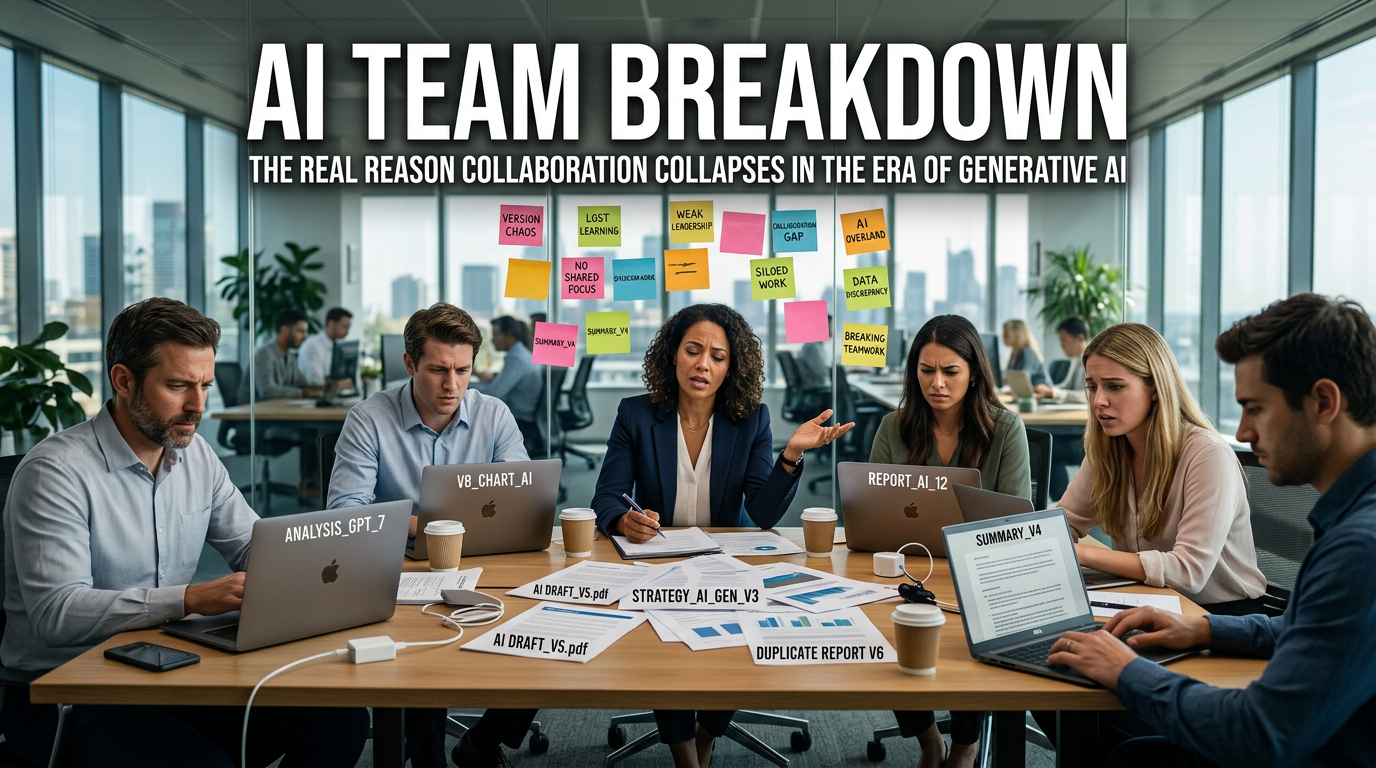
Individuals have become faster, but teams have become slower,communication has decreased,and distrust has actually grown,resulting in declining team performance inside real companies.
In this article, we go beyond the simple idea that “if you use AI well, work gets faster,”and structurally examine why generative AI creates conflict within organizations,why digital transformation can weaken teamwork,and what HR strategy and leadership need to change going forward.
In particular, this article coverswhy individual productivity and team productivity move differently,how AI agents are actually transforming HR work,what “invisible process losses” organizations often overlook,and even the most important point that other news outlets and YouTube channels rarely address.
If you want to understand the real problems of AI collaboration happening in companies right now,this will provide a fairly clear reference point.
1. The Core Point of This Issue: Why Do Individuals Get Faster While Teams Become Weaker?
The most important point explained by Bae Soo-jung of SK Academy RF is simple.
AI can raise individual potential performance, while at the same time increasing process loss within teams.
Team performance can usually be understood like this.
Team performance = potential performance – process loss
Here, potential performance is the sum of the maximum capabilities each team member can produce.If AI is introduced well, this number definitely increases.
The problem is process loss.
Differences in speed,differences in expectations,differences in AI utilization ability,differences in how drafts are interpreted,the collapse of feedback methods,reduced conversation,and psychological intimidation can all accumulate, causing team performance to actually decline.
In other words,a paradox emerges in which individuals become more efficient while organizations become more inefficient.
2. News-Style Summary: The Changes Actually Happening in HR Right Now
2-1. Generative AI Is Changing the Way HR Systems Are Developed
In the past, building a single HR system required around 10 to 15 people.
People analysts,AI specialists,data engineers,UI/UX engineers,frontend and backend developers,and PMs all divided up the work.
The problem in this structure was that reaching even one small agreement could take several weeks.
Projects moved forward without people fully understanding what the others were doing,and development took 3 to 6 months,or more than a year in some cases.
But with the arrival of AI agents, the situation has changed significantly.
Now AI can quickly create role-specific drafts,and teams can discuss much faster whether “this is actually what we are trying to build.”
This change is not just automation,but a change in the very starting point of collaboration.
2-2. AI Agents Are Evolving from “A Chatbot Used Alone” into “A Virtual Team”
One particularly interesting part of this case is the multi-agent structure.
This is no longer just a 1:1 conversation with a single AI,but a way of building a team-like structure in which a PM agent,backend development agent,frontend development agent,report analysis agent,QA agent,and benchmarking agent work simultaneously.
For example, when developing a customized leadership diagnosis system,the AI team works as follows.
- Plan which perspective to use to solve the problem
- Design a diagnosis schema tailored to the leader’s industry, job function, and team composition characteristics
- Develop logic for generating common questions and customized questions
- Design screens for leaders and team members to respond to
- Structure the feedback report
- Check question appropriateness and difficulty through QA
- Conduct a final comparison review to see whether the initial plan and the output actually match
This means that the AI trend is shifting from simple generation functionsto collaborative agent structures.
2-3. The Problem Starts Not with the Output, but from the Moment It Is Inserted into the Organization
The real field-level problem that Soo-jung Bae pointed out is here.
Even if one person uses AI well and creates an excellent draft,if there is no defined way to insert it into the existing organizational process,confusion arises at the team level instead.
Simply put,it is similar to a conveyor belt structure where each person places parts on the line,but someone suddenly places something close to a finished product onto it.
Regardless of whether this output is good or bad,if it does not fit the existing role structure, KPI system,review responsibilities, and approval procedures,the team stops.
This is exactly why many companies’ digital transformation efforts fail to connect to actual performance.
3. Four Invisible Losses That Erode Team Performance
3-1. The Disappearance of the Author: The Target of Feedback Vanishes
In the past, a team leader could review a report or PPT written by a team member and suggest revisions.
But now, when a team member says, “Claude generated this,” the conversation becomes awkward.
Who should receive the feedback?
Should the person be told to send it back to the AI,or should the team member take responsibility and review it again?The criteria become blurred.
The key is that the person’s thinking,judgment,reasoning,and intention that should exist behind the output disappear.
In this state, feedback does not easily lead to learning.
3-2. The Evaporation of Learning: As Trial and Error Disappears, So Does Growth
AI dramatically increases the speed of error resolution and draft creation.
In the past, solving even one SQL error required searching,reading,fixing,failing again,and checking once more.
This was certainly inefficient.
But at the same time, it was also a period of learning in which people understood structure and internalized principles.
Now, if you paste it into AI, it can be solved in 10 seconds.
The problem is that when a similar issue appears three months later,the person may still not know why that error occurred.
In other words,the result was obtained, but the skill did not remain.
In the long run, the structure through which internal organizational expertise is formed may weaken.
3-3. The Disappearance of Conversation: An Organization That Asks AI Before Asking Colleagues
In the past, when a supervisor’s instructions were unclear, colleagues would first start by asking each other, “What does this actually mean?”
Now, each person asks AI,creates a draft,and among themselves it may end with only “What do you think?” and “Looks fine.”
On the surface, this appears efficient.
But teams originally function through conversation among people who interpret the same thing differently.
When that process shrinks,information may remain abundant, but shared interpretation disappears.
This is not just a decline in communication,but a change that weakens the very reason a team exists as a team.
3-4. The Accumulation of Speed Gaps: Distrust Emerges and the Team Splits
One team member may finish the same task in three hours,another in half a day,and another in two to three days.
At that point, whose speed should the team follow?
Someone who uses AI well may already be finished,but release the work little by little to match the schedule.
Others may start thinking, “Is that person just slacking off?”
On the other hand, those who are not good at using AI become intimidated.
And those who are good at using AI may think to themselves:
“If I can do it better and faster by myself, why do I even need to work with others?”
Once it reaches this point, the team is no longer a unit of collaboration, but divided into speed-based tiers.
4. The Meaning of a Draft Has Changed: The Core Point of Collaboration Conflict in the AI Era
One of the sharpest points in the original text is that the meaning of a “draft” has changed.
For those who use AI well, a draft is material.
It is a starting point where multiple versions are generated quickly,and one is selected and developed further.
By contrast, for those who do not use AI well, a draft already feels like a significantly completed intermediate output.
So when someone says, “I brought five drafts,”for an AI user they are exploratory options,but for a non-user it feels like pressure: “They already got that far?”
This is exactly where the rhythm of collaboration goes off.
This is not a difference in document quality,but a collision between different ways of working and different standards of judgment.
5. The Psychological Changes Happening at the Individual Level Are Also Bigger Than Expected
5-1. Threat to Professional Identity
The case of a 10-year planner being shocked by a report made by a new employee in 30 minutes with AI is symbolic.
That is because it is an experience in which an area long believed to be one’s own expertise is suddenly shaken.
This is not just a tool change,but closer to a fracture in professional identity.
5-2. Decline in Sense of Control
If people use AI-generated results as they are,their sense that they are in control of the work may weaken.
It becomes difficult to explain why a certain conclusion was reached,and there are moments when that output must be submitted under one’s own name.
When people lose their sense of control, they also tend to lose enjoyment and immersion in their work.
5-3. Increase in Verification Fatigue
AI can create things very quickly up to 90%.
But the final 10%,that is, quality verification, fact-checking,expression adjustment, and logic review,can actually require even more energy.
So people sometimes feel they have become faster but also more exhausted.
5-4. Confusion Over Ownership of Performance
With outputs created together with AI, it can become unclear how much of it is really one’s own achievement.
If the feeling of “Did I do this, or did AI do it?” accumulates,the sense of accomplishment also becomes blurred.
5-5. Decline in Psychological Safety
In the past, when people did not know something, they asked colleagues.
Now some people reduce asking questions altogether because they fear reactions such as, “You didn’t even ask AI that?”
When questions decrease, learning also decreases,and relationships weaken as well.
6. Why Does AI in Particular Create Greater Team Conflict?
New technologies naturally create gaps.
But AI affects almost every stage of work much more broadly than other technologies.
Planning,research,document writing,analysis,design,development,communication,and even decision-making are all affected.
In other words,it affects not just a few job functions, but almost all job functions at the same time.
That is why small initial differences are likely to widen over time into much larger collaboration gaps.
This is not just a question of adoption rate,but a problem in which the very operating principles of the organization are shaken.
7. What Must Leaders Change?
7-1. They Must Be the Person Who Asks “Is This Right?” Rather Than Just “Let’s Do It Faster”
In the AI era, a leader should become less of a manager who pushes speedand more of a coordinator who organizes standards of judgment and aligns intermediate pace.
If someone is running too fast,that speed needs to be slowed so it can connect with the team.
On the other hand, those who are falling behind need to be translated and helped so they can catch up.
7-2. They Must Create a Common Language
If terms like prompt,persona,context,multi-agent,and codex naturally circulate in team meetings,some will understand immediately while others will miss everything entirely.
Leaders must play the role of translating these terms into language everyone can understand.
7-3. A Sharing Structure Must Come Before Training
Sending people to training is important,but it may be even more important to have time to share how each person is currently using AI within the team.
“Where are you using it?”“How did it help?”“Where did it fail?”Conversations like these actually reduce the gap.
7-4. Ground Rules Are Necessary
For example, rules like these are needed.
- AI-generated drafts must always be reviewed by a person before being shared
- Clearly explain which parts were generated by AI and which parts were judged by a person
- If bringing an AI draft before a meeting, specify whether it is for exploration or a confirmed proposal
- Do not make important decisions based only on AI results
Without these standards, speed may increase, but trust collapses.
8. What Can Team Members Do?
8-1. Transparently Share the Scope of AI Use
Just saying something like “AI created the draft, and I revised this logic myself” helps align the team’s expectations.
8-2. Reconnect AI Answers Back to Colleagues
Instead of treating what AI tells you as the end point,it is important to ask, “AI sees it this way, but what do you think?”
The team’s insight still comes from interaction between people.
8-3. Share Failure Cases
If only successful cases are shared, others become even more intimidated.
By contrast, experiences such as “I tried it this way, but it did not work well” increase psychological safety.
8-4. Look at Team Rhythm, Not Just Speed
It is important to finish quickly on your own,but it is also important to sense where colleagues are and align collaboration timing accordingly.
In the AI era, high performers are likely to be not just fast workers,but people who can handle both speed and relationships together.
9. The Most Important Content That Other YouTube Channels and News Outlets Rarely Address
Many pieces of content focus on how quickly AI can create documents,help with planning,and automate work.
But the truly important issue lies elsewhere.
9-1. The Essential Problem of AI Is Not Productivity, but a Collision with the “Collaboration Operating System”
AI is not just a tool; it changes the sequence of how an organization works.
It changes who makes the first draft,who reviews it,where discussion happens,and what is considered final.
If this is not changed and only AI is introduced, teams are highly likely to clash.
9-2. In AI Gaps, Interpretation Gaps Are More Fatal Than Skill Gaps
Many organizations focus only on who uses it better.
But actual conflict begins when people interpret differently what a “draft” is, what counts as “complete,” and where responsibility ends.
In other words,the problem is closer to a collapse of the collaborative meaning system than to technical proficiency.
9-3. Future Competitiveness May Depend More on the Ability to Design Trust Within Teams Than on the Ability to Use AI
Going forward, corporate competitiveness is likely to depend less on simply using AI a lot,and more on whether a company can build structures in which trust, learning, and conversation are maintained even while using AI.
This is also an important point at the level of economic outlook.
That is because even if productivity statistics appear to improve,if learning and collaboration inside the organization collapse,mid- to long-term innovation capability may weaken.
10. The Implications Raised by HR EXChange 2026
This case goes beyond simple conference promotionand shows quite clearly where HR should focus in the AI era.
Now the role of HR is no longer just to add training programs.
It must redesign the overall structure, including meeting methods,decision-making structures,performance evaluation standards,role definitions,leadership operations,and psychological safety.
In particular, items such as rules for reviewing AI drafts,adjusting collaboration speed,redefining roles,compensating for learning loss,and restoring conversation are likely to become core tasks of HR strategy going forward.
11. In the End, What Must Organizations Redesign?
To summarize, what companies must redesign now includes the following.
- New work processes that reflect AI
- Redefining the standards for drafts, review, and finalization
- Standards for transparency in AI use
- Performance evaluation and contribution measurement methods
- Development systems that compensate for learning loss
- Leadership methods that buffer speed gaps
- Meeting structures that ensure conversation does not disappear
In one sentence,introducing AI is not the addition of a tool, but a change in the organizational operating model.
Companies that recognize this are more likely to grow faster,and for longer.
< Summary >
Generative AI significantly increases individual work productivity,but at the team level it can actually reduce team performance due to speed differences,reduced conversation,the collapse of feedback,learning loss,and accumulated distrust.
The core problem lies less in AI utilization ability itselfand more in the fact that the organization’s operating system has not changed, including the meaning of drafts, standards of responsibility, and the sequence of collaboration.
Going forward, HR and leaders must redesign team ground rules, collaboration structures,performance standards, and psychological safety before focusing on AI training.
In the AI era, true competitiveness is becoming less about the ability to create faster,and more about the ability to help people work together better.
Related Articles…
- The Real Conditions for Corporate Productivity Changed by AI Agents
- Reorganizing HR Strategy: New Standards for Organizational Culture in the Era of Generative AI
*Source: [ 티타임즈TV ]
– AI 때문에 개인생산성 높아졌는데 팀성과 줄어든 이유 (배수정 SK아카데미 RF)