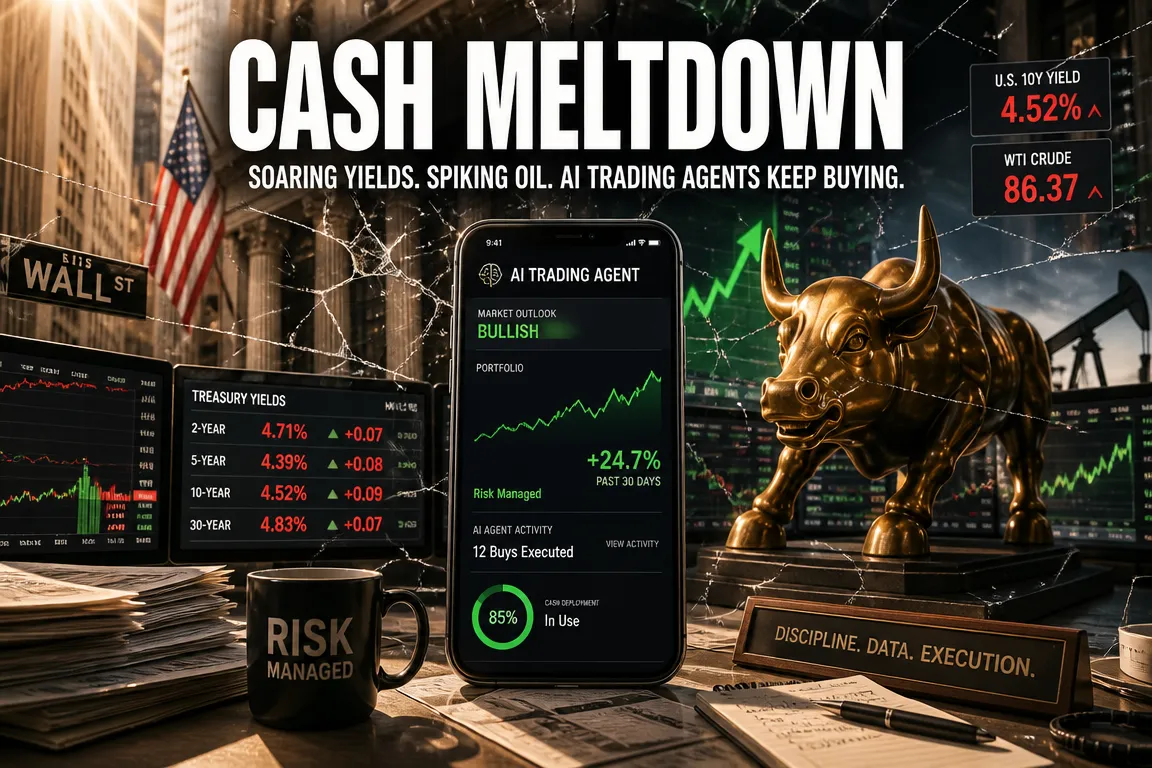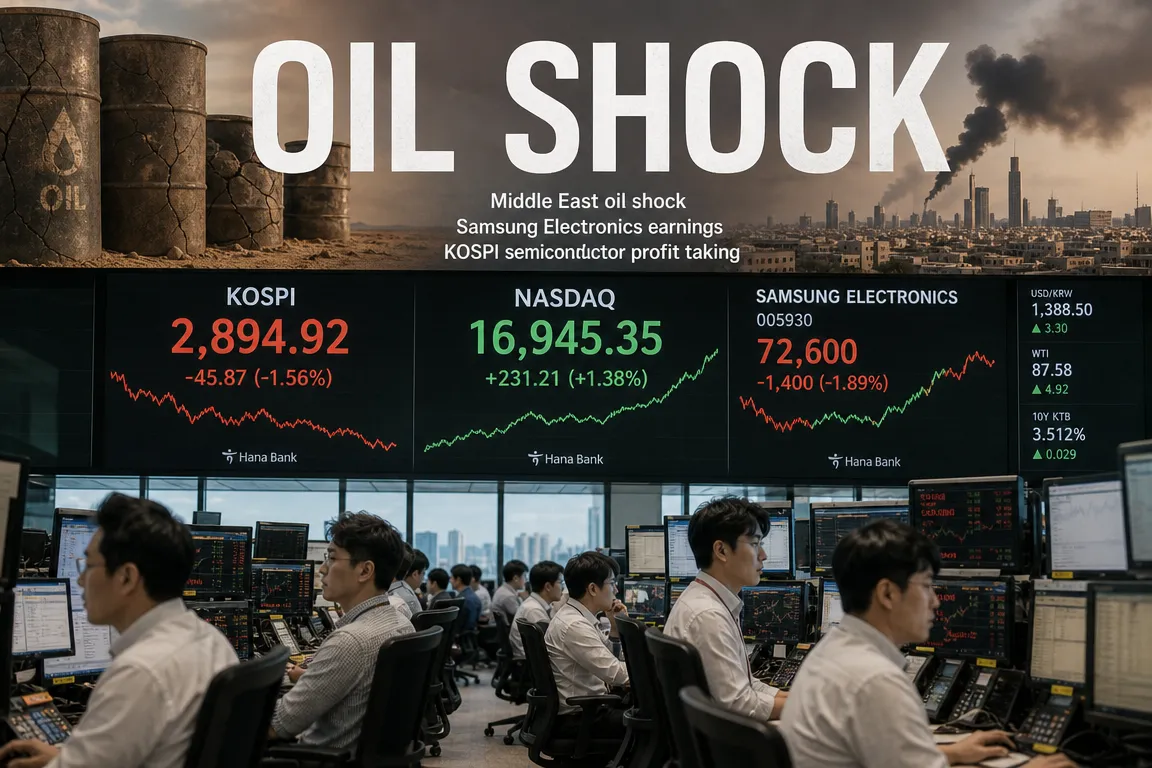
● Oil Shock, Stagflation Panic, Asia Slammed
Oil Up 20%, Potential Entry Into the $110 Era: More Important Than Stagflation Fears Is the Next Scenario
This development should not be viewed simply as “oil has risen.”
Three issues are critical at this stage.
First, whether the oil spike is a temporary supply shock or a structural problem that could persist.
Second, why U.S. equities and Asian equities are reacting differently.
Third, how stagflation risk may affect investment strategy and portfolio construction.
This report reviews the potential for $110 oil, Middle East war risk, renewed inflation pressure, rate outlook, and the implications for the global economy and equity markets.
It also focuses on key areas often overlooked in other news coverage and video commentary: second-order effects that may prove more consequential than oil itself, hidden risks in chemicals, industrials, and Asian equities, and the sectors relevant from a hedging perspective.
1. Key Market News Today: Why the Oil Surge Was So Severe
International oil prices rose nearly 20% in a short period, generating substantial market volatility.
The key issue is not only the price increase itself, but that futures markets reflected strong concern over an immediate disruption to crude supply.
In particular, the sharper move in front-month contracts indicates that the market is more concerned about near-term supply shortages than long-term demand.
This pattern is consistent with the early phase of a classic supply shock.
Such episodes are common when Middle East risk intensifies, but this time the speed of the advance has been unusually steep, increasing investor concern.
2. In a $110 Oil Environment, the Real Issue Is Duration, Not the Number
Whether oil exceeds $100 or reaches $110 is important.
However, the market is more sensitive to how long elevated prices persist.
If oil briefly touches $110 and then retreats quickly, the impact may remain limited.
By contrast, if elevated levels persist for more than four weeks and move beyond the period that strategic reserves and inventories can absorb, high-cost crude will begin to affect the broader industrial economy.
At that point, the issue shifts from a commodity spike to a combination of deteriorating corporate cost structures, weaker consumption, downward earnings revisions, and renewed inflation.
In other words, the essence of the oil shock is duration rather than price alone.
3. Why Stagflation Has Returned to the Center of Market Discussion
One of the terms the market currently views most negatively is stagflation.
Stagflation refers to the combination of slowing growth and rising inflation.
Under normal economic conditions, weaker growth reduces demand and moderates prices.
Conversely, stronger growth tends to increase demand and push prices higher.
However, a major supply shock can produce rising prices even as growth slows.
The most prominent examples are the 1973 and 1980 oil shocks.
During those periods, the surge in oil prices spread across industries, producing inflation, rising unemployment, and slowing growth simultaneously.
If the current oil increase extends beyond a short-term shock, markets may again begin to price in a stagflation scenario.
4. Equities Have Not Yet Priced in Fear to the Same Extent as Oil
One of the most important observations at present is that the decline in U.S. equities has been relatively limited compared with the magnitude of the oil move.
This can be interpreted in two ways.
First, the market may still view the current situation as a temporary supply disruption.
Second, it may indicate that prolonged conflict and broader real-economy damage have not yet been fully priced in.
The most critical phase would begin if equities conclude belatedly that the disruption is lasting longer than expected.
That would likely trigger not only higher volatility, but also valuation compression, downward earnings revisions, and sharper sector differentiation.
In that sense, this may be the beginning of market fear, but not necessarily the end of it.
5. Why Asian Equities Are Under More Pressure Than U.S. Equities
The divergence between the U.S. and Asia in this episode is largely explained by energy structure.
The United States has domestic oil production capacity.
While higher oil prices still burden the U.S. economy, domestic energy production provides relatively greater shock absorption.
By contrast, major Asian economies depend heavily on Middle Eastern crude oil and natural gas.
For Korea, Japan, and China, rising energy import costs directly affect manufacturing, transportation, chemicals, and electricity costs.
As a result, the same oil shock can impose a significantly larger cost burden on Asia than on the United States.
Thus, even if the global macro backdrop appears similar, equity market reactions can differ materially by region.
6. What Rises With Oil: The Broader Problem for Consumer Prices and Industry
Many investors think of higher oil prices mainly in terms of gasoline.
In practice, the effects are much broader.
Crude oil is not only a fuel source but also a raw material across industrial supply chains.
Chemicals are among the sectors most exposed to second-order effects from higher oil prices.
Prices for plastics, rubber, packaging materials, textiles, industrial materials, and a wide range of intermediate goods can rise in sequence.
Korea has a strong refining and petrochemical base, and its naphtha-based industrial structure is closely linked to oil price fluctuations.
If prices for gas-based chemical products, fertilizers, and industrial feedstocks also rise, producer prices increase and consumer prices can follow.
Accordingly, the current oil surge is not only an energy issue but also a potential inflation catalyst across supply chains.
7. Why Natural Gas and Chemical Products Also Require Attention
One area that is easy to overlook in this episode is natural gas.
While the market is focused on crude oil, natural gas-based input costs are also highly important in industrial operations.
The Middle East is influential not only in oil supply but also in natural gas.
Countries such as Qatar occupy a key position in global LNG and gas-chemical supply chains.
If that supply is disrupted, price volatility could spread beyond energy into fertilizers, basic chemicals, and industrial materials.
An investment view based only on crude oil would therefore be incomplete.
In the current environment, the linkage among crude oil, natural gas, chemicals, industrials, and inflation should be assessed together.
8. Where the Current Situation Stands in Historical Context
The 1973 first oil shock and the 1980 second oil shock remain the benchmark cases of stagflation.
In both cases, rising oil prices drove inflation higher, while corporate cost pressure contributed to rising unemployment and slower growth.
Central banks ultimately had little choice but to impose aggressive rate hikes to suppress demand.
During the 2022 Russia-Ukraine war, supply disruption and inflation were also evident, but the economy was not yet in a full contraction phase.
For that reason, it was not a clear-cut case of full stagflation.
Markets are more concerned now because supply shocks are re-emerging while growth concerns are already present.
9. Central Banks and the Rate Outlook: Why Renewed Inflation Is More Problematic
Markets are already balancing rate-cut expectations against concerns over slowing growth.
If the oil surge reaccelerates inflation, central banks face a much more difficult policy environment.
If growth weakens while inflation rises, it becomes difficult both to cut rates and to raise them.
This is why stagflation is especially challenging from a policy perspective.
For the Federal Reserve, even if softer growth and labor conditions argue for easing, renewed energy-driven inflation could constrain policy flexibility.
That would complicate the rate outlook and may weigh further on valuations in growth and technology sectors.
Thus, the current oil shock is not merely a commodity event; it is also a variable that could alter the path of monetary policy.
10. Equity Strategy: The Priority Is Portfolio Construction, Not an All-In View
The most significant mistake in this environment is to commit entirely to a single directional view.
If the conflict ends quickly, oil prices could fall sharply, and investors who sold in panic may be forced to re-enter at higher levels.
If the conflict becomes prolonged, however, cost pressure may intensify and equity downside could deepen.
This is therefore a period in which risk management matters more than prediction.
The core response is portfolio construction.
Possible approaches include maintaining some cash allocation, adding exposure to energy beneficiaries or defensive sectors, or retaining growth positions while incorporating assets more resilient to supply shocks.
The key is not one-way positioning, but building a structure that can withstand uncertainty.
11. Which Sectors to Monitor: Distinguishing Beneficiaries From Exposed Segments
In the current oil shock, sector-level impacts can diverge materially.
11-1. Areas With Potential Relative Benefit
Refiners often attract short-term market attention during periods of rapidly rising crude prices.
Energy-related companies may also see stronger flows as commodity prices advance.
Selected commodities, defense, and supply-chain substitution beneficiaries may also draw interest.
11-2. Areas Facing Higher Pressure
Airlines, transportation, manufacturers with high chemical input costs, and sectors vulnerable to weaker consumption may face pressure.
Companies unable to pass through higher raw material and logistics costs promptly may experience greater earnings stress.
Export-oriented Asian manufacturers could be particularly vulnerable if higher energy costs coincide with softer demand.
12. Why This Issue Also Matters From an AI Trend Perspective
Although the headline focus is oil and geopolitical risk, there are also links to the AI industry.
First, AI infrastructure expansion requires electricity, cooling, servers, semiconductors, and industrial materials.
Higher energy prices can indirectly raise both data center operating costs and infrastructure investment costs.
Second, the more uncertain supply chains become, the more likely companies are to adopt AI for inventory forecasting, logistics optimization, and raw-material risk management.
Third, as cost pressure rises, companies may accelerate AI automation to reduce labor and operating costs.
Thus, while short-term volatility in risk assets may increase, the medium- to long-term backdrop could also support additional AI adoption.
13. Summary in News Format
– International oil prices have surged in the short term, and the possibility of a $110 oil environment is increasingly reflected in markets.
– The current move has the characteristics of a classic supply shock driven more by supply disruption fears than by demand expansion.
– U.S. equities have not yet reflected fear to the same extent as oil, while Asian equities are reacting more sensitively due to higher energy import dependence.
– If the conflict ends quickly, oil may stabilize rapidly, but if it becomes prolonged, stagflation concerns could become more prominent.
– Investors should monitor not only crude oil, but also natural gas and chemical product prices, as these could affect both producer and consumer inflation.
– Central bank rate expectations could become more complicated again, creating an additional headwind for equities, especially growth sectors.
– In this environment, portfolio adjustment and hedging are more important than indiscriminate selling or concentrated positioning.
14. The Most Important Issues Often Missed in Other Coverage
Many commentaries stop at “oil is rising, war risk is high, and equities require caution.”
The more important considerations lie beyond that initial conclusion.
First, markets have not yet fully priced the oil surge as a complete long-duration risk.
That makes the current phase particularly difficult: assets have not fully repriced, but conditions do not justify complacency.
Second, chemicals, materials, and industrial prices often respond more slowly than crude itself, and these may become the core of the second-order shock.
If those effects begin to appear in earnings, markets may shift toward the view that the disruption is lasting longer than expected.
Third, the United States and Asia should not be treated as a single equity market.
Given energy structure, the United States may be relatively more resilient, while Asia may experience greater direct pressure.
Fourth, from the perspective of AI and the broader industrial transition, investors should look beyond short-term corrections and also consider medium-term demand for cost reduction and supply-chain optimization.
Fifth, the key in this environment is not identifying a single correct forecast, but minimizing avoidable errors.
In periods of high uncertainty, portfolio design is more important than directional prediction.
15. Conclusion: This Is a Time for Scenario-Based Responses, Not Emotion-Driven Decisions
More important than the possibility of $110 oil itself is whether the shock remains temporary or evolves into a structural burden on the global economy.
Stagflation is not a predetermined outcome.
However, if the supply shock persists, it is likely to become one of the market’s central downside scenarios.
At this stage, rather than taking an aggressive directional position, investors should consider strategies that can withstand an environment of both inflation pressure and slower growth.
This is a period to reassess portfolios by evaluating equities, commodities, interest rates, foreign exchange, and the broader global macro environment together.
In simple terms, this is neither an indiscriminate buying opportunity nor a case for automatic liquidation.
The priority is to build a portfolio structure that can absorb uncertainty.
< Summary >
The oil surge is not merely an energy issue; it may mark the beginning of a supply shock.
The key variable is not the price level alone, but how long elevated prices persist.
If the conflict becomes prolonged, stagflation risk, renewed inflation, a weaker rate outlook, and higher equity market volatility could emerge simultaneously.
Asian equities are likely to be more vulnerable than U.S. equities, and investors should monitor not only crude oil but also natural gas and chemical products.
This is a period in which portfolio construction and hedging matter more than directional positioning.
[Related Articles…]
Comprehensive Review of How Changes in the Interest Rate Outlook Affect the Equity Market
Analysis of AI Infrastructure Investment Expansion and Beneficiary Sectors in the Global Economy
*Source: [ Jun’s economy lab ]
– 유가 +20% 상승 110달러 시대, 스태그플레이션 대비를 해야 하나
● Oil Shock, Strait Squeeze, Inflation Surge, AI Fallout
Crude Oil Breaks Above $100, Compounded by Trump’s “Sea Lane Control” Strategy: A Consolidated View of Middle East Risk, Inflation, and Implications for the AI Industry
The key issue is not simply that oil prices have risen.
This development links together a sharp increase in global crude prices, risk around the Strait of Hormuz, U.S. strategy to control global logistics routes, pressure on China’s energy access, corrections in equities and Bitcoin, and ultimately the inflation and recession risks relevant to Korean investors.
Most coverage stops at “Middle East tensions,” but the more important factors include a potential U.S. maritime logistics dominance scenario, changes in China’s oil procurement cost structure, and second-order effects on the AI industry and semiconductor supply chains.
This should therefore be viewed not as a routine geopolitical headline, but as an event with the potential to disrupt both the global economy and the trajectory of the Fourth Industrial Revolution.
1. What has happened: key developments
International crude oil prices have moved above $100 per barrel.
As futures markets opened, oil moved sharply higher, with levels around $107 discussed at one point.
The move has revived a level of market tension comparable to the early phase of the Russia-Ukraine war.
At the same time, with a power realignment unfolding around Iran’s supreme leadership structure, markets have begun to price in the possibility that Middle East risk may evolve from a short-term headline into a structural risk factor.
Bitcoin weakened, and U.S. equity futures came under downward pressure.
This indicates that investors are reducing exposure to risk assets.
2. Why oil prices have surged this sharply
2-1. The core issue is instability in Iran and risk around the Strait of Hormuz
The primary driver is that tensions involving Iran are no longer seen as a simple diplomatic dispute, but as a risk to actual oil transport routes.
The Strait of Hormuz is a critical chokepoint in global energy logistics.
A significant share of Middle Eastern crude oil and LNG passes through this corridor.
If military confrontation risk, blockade concerns, surging shipping insurance premiums, and higher maritime freight rates emerge simultaneously, oil prices can rise in advance even without an immediate physical supply disruption.
2-2. Markets price higher transport costs before actual supply shortages
Oil price increases are often understood purely as a function of reduced supply, but that is not how markets operate in practice.
Crude prices are not determined by the underlying commodity alone.
Shipping insurance, rerouting costs, refining margins, and geopolitical risk premiums are also embedded in pricing.
In other words, even if Iranian crude remains discounted, end buyers will still pay more for energy if the cost of moving oil through Hormuz rises sharply.
That is the central point markets are reacting to now.
3. Why a change in Iran’s supreme leadership matters
3-1. The power vacuum appears to be ending
One of the key points emphasized in the source text is that Iran’s internal power vacuum has effectively come to an end.
As momentum appears to shift toward Mojtaba Khamenei, the second son, the U.S. would once again be facing an Iran with a clearly identifiable negotiating counterpart.
The issue is that such a counterpart is widely seen as more hardline.
3-2. The potential for compromise with the U.S. may have declined
If a hardline leadership structure moves to the forefront, room for compromise with Washington may narrow while internal cohesion may strengthen.
If this is reinforced by signals of loyalty from the Islamic Revolutionary Guard Corps, markets are likely to interpret it as a sign that Iran will not easily back down.
That is why the current move in oil is being reassessed not merely as a short-term spike, but as a higher long-term price risk.
4. Trump’s underlying objective may not be Iran, but control over logistics networks
This is the most notable analytical perspective in the current situation.
On the surface, the issue appears to center on Iran, Middle East security, and the possibility of military confrontation.
At a broader level, however, it can also be interpreted as part of a U.S. effort to control global logistics networks and strategic sea lanes.
4-1. The Panama Canal, Arctic routes, and the Strait of Hormuz can be read as one integrated line
Viewed in isolation, strategic actions associated with Trump’s camp may appear unrelated.
When connected, however, they suggest a consistent pattern.
First, stronger influence over the Panama Canal.
Second, sustained focus on Greenland and Arctic shipping routes.
Third, the expansion of risk around the Strait of Hormuz.
Taken together, these point to a strategy aimed at placing the world’s main energy and logistics bottlenecks within the U.S. sphere of influence.
4-2. An energy pressure card aimed at China
China is a central counterpart in this framework.
China can maintain energy cost competitiveness when it has access to relatively cheap Iranian crude.
However, if the cost of moving oil through Hormuz itself rises sharply, part of that pricing advantage is eroded.
In other words, even if the U.S. cannot completely block Iranian oil, it can still achieve strategic effects by worsening the cost structure.
This is not a classic supply denial strategy, but a cost transfer strategy.
4-3. A possible negotiating lever ahead of a U.S.-China summit
If geopolitical tensions intensify at a time when a U.S.-China summit is being discussed this month, Washington could gain additional leverage in energy-related negotiations with Beijing.
If China’s access to discounted Middle Eastern crude becomes less reliable, pressure to increase purchases of U.S. energy could rise.
Accordingly, the current situation may look like a military headline, but in substance it may form part of a broader realignment in energy trade and global supply chains.
5. Implications of the “Greater North America security map” remark
The defense secretary’s remark referenced in the source text is difficult to dismiss as rhetoric alone.
The notion of a strategic map extending from Greenland to the Gulf implies that the U.S. may be attempting to redefine the Arctic-Atlantic-Gulf axis as one integrated security and logistics space.
5-1. No longer regional security, but economic security
In the past, security and economics were viewed separately.
Now shipping routes, energy, data cables, and semiconductor supply chains are increasingly being incorporated into the concept of security.
Control over maritime passages can therefore influence inflation, interest rates, trade balances, and manufacturing competitiveness.
5-2. The U.S. strategy may be closer to that of a global toll-setter than a global policeman
This development suggests that the U.S. may be seeking not only military influence, but also the ability to shape the pricing structure of major global logistics corridors.
Who pays higher insurance costs, who receives shipments later, and who secures more stable energy access may become central to future geopolitical power.
6. Why financial markets reacted immediately
6-1. Bitcoin declined
Bitcoin does not always rise during periods of crisis.
When real geopolitical conflict emerges, investors typically increase cash allocations or shift toward more traditional safe havens such as the U.S. dollar, Treasuries, and gold.
Bitcoin’s decline therefore suggests that markets are interpreting the situation as an actual increase in risk rather than a temporary headline event.
6-2. Equity futures weakened
The decline in U.S. equity futures reflects the same logic.
A sharp rise in oil prices pressures corporate margins.
This is particularly negative for logistics, airlines, chemicals, manufacturing, and consumer goods sectors.
By contrast, energy companies, defense names, and some commodity-related sectors may be relatively more defensive.
6-3. Stagflation concerns are resurfacing
The scenario markets dislike most is slower growth combined with renewed inflation.
If oil remains above $100, central bank rate-cut scenarios could become more complicated.
That would place valuation pressure on growth stocks and may also weaken consumption.
This is why stagflation concerns are re-emerging.
7. Implications for the Korean economy
7-1. Korea is an energy importer and could face a direct impact
The Korean economy is highly sensitive to higher global oil prices.
The country remains heavily dependent on crude oil and LNG imports, while refining, petrochemicals, transport, and power costs move in a linked manner.
A sharp rise in oil prices can therefore simultaneously pressure the trade balance, producer prices, and eventually consumer prices.
7-2. If exchange rates also move, the burden increases further
Heightened geopolitical risk can strengthen the U.S. dollar.
That would add pressure through a weaker Korean won and higher import prices.
In effect, Korea could face a dual burden from both rising oil prices and currency depreciation.
7-3. Sector impacts are likely to diverge
Refiners may benefit from inventory valuation gains, although prolonged oil strength could later weigh on demand.
Airlines and shipping companies could face higher fuel and insurance costs.
Industries such as semiconductors and rechargeable batteries, which are highly sensitive to global supply chains, may need to manage both logistics disruption and cost inflation.
8. Implications for the AI industry and the Fourth Industrial Revolution
8-1. AI is sensitive to electricity and data center cost structures
Many investors assume the AI industry is software-centric and therefore largely disconnected from oil prices.
In practice, that assumption is inaccurate.
AI data centers consume substantial amounts of electricity.
If energy prices rise, power costs, cooling costs, and infrastructure operating expenses also increase.
This can indirectly pressure AI company profitability.
8-2. Semiconductor supply chains also face pressure
Semiconductors are a high-precision manufacturing industry, but they still rely on large-scale global logistics systems.
Raw materials, specialty gases, equipment, wafers, and packaging all move through maritime transport networks.
If Middle East risk pushes up freight rates and insurance premiums, advanced industries will not be exempt.
8-3. Over the long term, demand may rise for energy AI, defense AI, and supply chain AI
Paradoxically, this type of instability does not only reduce AI demand.
It may instead accelerate AI adoption in areas such as energy demand forecasting, maritime logistics optimization, defense surveillance systems, satellite data analysis, and supply chain risk management.
In other words, consumer-facing AI may see valuation compression, while industrial AI may become a relative beneficiary.
9. Key points for investors to monitor
9-1. The first indicators to watch
First, monitor whether Brent and WTI remain above $100.
Second, track whether actual blockade measures or vessel strike headlines emerge around the Strait of Hormuz.
Third, watch for spikes in shipping insurance and freight rate indicators.
Fourth, monitor U.S. 10-year Treasury yields and the U.S. dollar index in parallel.
Fifth, assess whether China responds by diversifying its oil import sources.
9-2. Separate the short term from the medium term
In the short term, fear tends to drive market volatility first.
In the medium term, the more important question is whether the U.S. can push oil prices back down to manageable levels or whether the Middle East conflict broadens instead.
If the oil spike proves temporary, the correction could become an opportunity.
If it becomes prolonged, however, the inflation and rate path may change, altering the broader market framework.
10. The most important point often missed by other coverage
The core issue is not simply that “the U.S. struck Iran.”
More important is the broader trend in which the U.S. may be seeking to secure pricing power over the world’s key maritime logistics corridors.
The Panama Canal, Arctic routes, and the Strait of Hormuz may not be separate issues, but components of an integrated strategy.
And the target of that strategy may not be limited to stabilizing the Middle East; it may also involve undermining China’s access to low-cost energy.
In that sense, the current oil surge may represent not just a war premium, but a repricing process in an energy hegemony conflict.
This helps explain why equities, Bitcoin, exchange rates, inflation, semiconductors, and the AI industry are all moving in connection with the same event.
11. Scenario outlook
11-1. Scenario A: de-escalation
If Iran and the U.S. avoid further escalation and no actual blockade of the Strait of Hormuz occurs, oil could retrace quickly.
In that case, equities may stage a relief rally.
11-2. Scenario B: prolonged limited conflict
This appears to be the most likely scenario.
Even without full-scale war, continued vessel threats, expanded proxy conflicts, and sporadic attacks could keep oil elevated for an extended period.
Under this scenario, inflation pressure could re-emerge and expectations for rate cuts could weaken.
11-3. Scenario C: broadening instability across the Middle East
If attacks expand to Saudi Arabia, the UAE, or U.S. bases, markets could shift into a different regime.
A sharp oil surge, safe-haven demand, equity declines, and supply chain realignment could occur simultaneously.
In that case, recession concerns could intensify rapidly.
12. Conclusion: the market is watching governance and control, not just oil prices
The move above $100 in international crude oil is not merely a commodity story.
Middle East geopolitics, U.S. sea lane control strategy, pressure on China’s energy access, renewed inflation, and the risk of global economic slowdown are moving as a single interconnected theme.
This dynamic could also affect the AI industry and advanced manufacturing supply chains.
Accordingly, the key question for investors is not simply how high oil rises, but who controls pricing power over energy and logistics.
If this framework persists, the global economy may shift toward a structurally higher-cost environment, with energy, defense, supply chain technology, and industrial AI emerging as relative beneficiaries.
< Summary >
The move above $100 in global crude oil prices is not just a Middle East risk event, but a signal of broader economic and supply chain realignment.
The key variables are the Strait of Hormuz, a hardline Iranian leadership structure, U.S. strategy to control maritime logistics, and the possibility of rising energy costs for China.
Financial markets have already shown weakness in Bitcoin and equities, while inflation and stagflation concerns may intensify.
Korea could face a dual burden from higher oil prices and exchange rate pressure, while the AI and semiconductor sectors are also exposed through energy and logistics costs.
The most important point is that this is not merely a war headline, but a competition over pricing power in energy and logistics.
[Related Articles…]
How the surge in global oil prices affects Korean equities and the won
Latest analysis of AI data center power demand and energy investment trends
*Source: [ Maeil Business Newspaper ]
– [속보] 원유100달러 돌파. 헤그세스 국방장관이 공개한 대(大) 북아메리카 안보지도. 이란 최고지도자에 하메네이 차남 I 홍장원의 불앤베어