● Tesla Shock, Robot Revolution, AI Jobquake
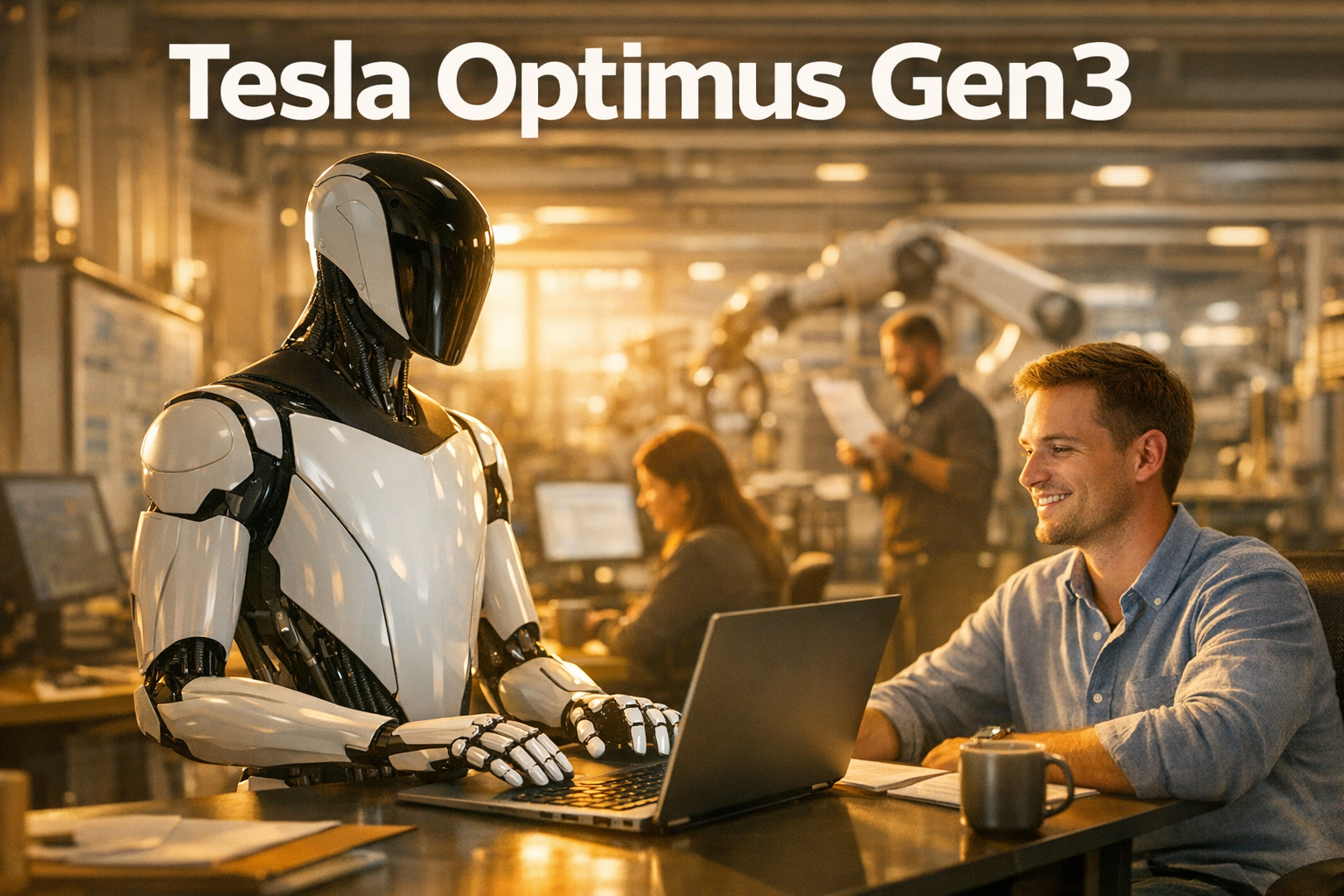
Tesla Optimus Gen 3 Hand Revealed: Why the xAI “Digital Optimus” Integration Matters
This is not merely a Tesla robotics update.
This report summarizes: the technical significance of the Optimus Gen 3 hand; the nature of “Digital Optimus” in conjunction with xAI; how Cybercab could reshape mobility economics; Tesla’s dual push into manufacturing and office automation; and which industries may face the earliest disruption from a global macro perspective.
It also connects potential second-order impacts across the AI industry, the EV market, robotics automation, US equities, and global supply chains.
1. Key Developments (At a Glance)
A single teaser image released by Tesla China drew market attention.
The focal point is a new physical design believed to be the Optimus Gen 3 hand.
The design appears closer to a human-hand form factor, supporting the interpretation that Tesla is advancing from demonstration-grade humanoids toward a general-purpose robot intended for deployment in industrial and everyday human environments.
In parallel, the concept of “Digital Optimus” linked to xAI has gained visibility.
This implies a dual track: physical robots for real-world tasks and software-based agents that operate inside computer systems.
In practice, Tesla’s direction can be read as: physical Optimus for factory-floor execution and Digital Optimus for office-process execution.
2. Why the Optimus Gen 3 Hand Is Material
2-1. Why this is not a cosmetic change
Robotic hands remain one of the most technically challenging subsystems.
Fine manipulation (grasping, twisting, pressing, inserting, assembling) is generally harder than locomotion.
The newly shown hand appears materially different from prior generations, trending toward a smoother, human-like geometry rather than exposed mechanical features.
This supports a strategic objective: deploying robots into human-designed environments without redesigning the environment.
Most interfaces are optimized for human hands, including door handles, keyboards, tools, kitchen implements, wiring, switches, packaging materials, boxes, and parts trays.
For general-purpose labor, hand capability is a gating factor.
2-2. Estimated 22 degrees of freedom: proximity to human dexterity
Optimus Gen 2 hands have been reported at approximately 11 degrees of freedom.
That level already enabled demonstrations requiring delicate force control (e.g., handling fragile objects).
Gen 3 is discussed at roughly 22 degrees of freedom.
Given common estimates of the human hand at approximately 27 degrees of freedom, this would narrow the dexterity gap.
Potential task expansion includes:
- Micro-component assembly
- Wire connection and routing
- Tool and switch actuation
- Packaging and sorting
- Operation of human-oriented equipment interfaces
- Assistance in high-precision inspection
This would reduce the need to redesign entire production lines around robots and instead enable robots to adapt to existing human workflows.
2-3. Human-like hands are primarily an economic choice
The rationale is cost and deployment speed: adapting robots to the existing world is cheaper than rebuilding the world around robots.
This is a productivity-led thesis, not a design preference.
Tesla’s stated ambition to mass-produce Optimus at a sub-USD 20,000 price point aligns with this economics-driven approach.
Compared with annualized costs for skilled labor in North America, a low entry price combined with high utilization (including 24/7 operations) could compress payback periods for adopters.
3. Digital Optimus: Potentially the Primary Disruptor
3-1. Definition and scope
Digital Optimus can be characterized as an AI “employee” operating inside computer environments.
It is positioned to interpret screen-level visual information and perform actions via keyboard and mouse-like control.
This implies workflow execution inside real applications (open, click, input, save, verify), not only conversational output.
Illustrative target domains include repetitive white-collar processes such as:
- Accounting operations support
- HR administration
- Document classification and filing
- Procurement and order management
- Customer support triage and assistance
- Operations dashboard monitoring
3-2. Role split between Grok and Tesla agents
A functional interpretation:
- Grok (xAI): high-level reasoning and prioritization
- Tesla AI agent layer: perception of UI states and execution (click/type/run)
- Combined effect: reasoning + action
This addresses a common enterprise AI constraint: strong suggestions with limited end-to-end execution. Digital Optimus targets the execution layer.
3-3. “Macrohard”: strategic implication
The “Macrohard” framing signals an intent to integrate hardware, models, execution agents, robots, and compute infrastructure into a unified system.
This is positioned less as incremental office automation software and more as a re-architecture of operational workflows.
4. What Changes When Physical and Digital Optimus Converge
4-1. Manufacturing and office automation become coupled
Historically, automation has been deployed in silos:
- Factory automation, or
- Office automation
Tesla’s approach suggests integration across the operating chain:
- Physical Optimus: manufacturing, logistics, assembly, transport, inspection
- Digital Optimus: ordering, settlement, document handling, inventory entry, operations management
A combined system could automate cross-functional loops. Example: a production-side inventory decrease triggers data generation from physical operations, followed by automated procurement actions in enterprise systems, including vendor comparison on delivery and cost.
This is a structural change to organizational speed and overhead, not only headcount reduction.
4-2. A 24/7 operating model becomes more feasible
Human labor is constrained by shifts, rest, training, attrition, and error rates under fatigue.
A combined physical-robot and digital-agent workforce increases feasibility of continuous production, management, and response.
At scale, this can affect unit economics and potentially macro-level productivity measures.
5. Cybercab: Why It Belongs in the Same Thesis
5-1. Not a conventional robotaxi concept
Post-event details indicate a purpose-built autonomous-only vehicle: no steering wheel or pedals, a large display, Braille buttons, and a minimalist interior.
Braille integration signals inclusive design for users typically underserved by mobility systems.
The implied objective is independent mobility for non-drivers, expanding addressable demand beyond traditional driver-eligible populations.
5-2. Interior architecture changes the value proposition
Removing the driver cockpit changes space allocation.
Even as a two-seater, effective cabin utility may exceed conventional sedans.
This supports a shift from “transportation” to a service environment (work, entertainment, rest), moving the product closer to services economics than traditional automotive differentiation.
5-3. LiDAR test sightings: interpretation
Vehicles reportedly observed with LiDAR instrumentation are notable.
Tesla’s production strategy has historically avoided LiDAR, but LiDAR can be used as a ground-truth reference during validation.
This is consistent with raising validation rigor and refining vision-based performance before scale deployment.
6. Model YL: Relevance to Profitability
Sightings of a six-seat Model YL being transported in Australia have been reported.
Strategic value is not limited to additional seating; it includes second-row captain seats, improved third-row access, and an extended wheelbase to broaden the family-vehicle segment.
This may support:
- Higher average selling price potential
- Incremental premium family demand capture
- Expanded SUV segment coverage
- Margin support options in a more competitive EV market
As EV competition intensifies, profitability durability can be more material than unit growth alone.
7. Macro and Global Economic Relevance
7-1. Labor-market implications
If physical Optimus and Digital Optimus scale concurrently, both blue-collar manufacturing roles and repetitive white-collar roles may face automation pressure.
Segments likely to see earlier impact include:
- Warehousing and fulfillment
- Manufacturing processes
- Administrative back-office functions
- Routine accounting operations
- Tier-1 customer support handling
- Inventory and procurement operations
This is not limited to job displacement; it changes hiring demand toward AI supervision, exception handling, and process governance.
7-2. Links to inflation and rates
Broad deployment of robotics and execution-capable agents can lower labor cost intensity for firms.
Over time, this may reduce portions of services inflation pressure via productivity gains.
Such shifts can influence central bank policy paths, corporate capex decisions, and equity valuation frameworks, including the US market.
7-3. Supply-chain reconfiguration potential
If robot costs fall sufficiently and capability rises, the labor-arbitrage rationale for offshoring weakens.
This can accelerate reshoring or nearshoring for selected manufacturing categories.
The US, Mexico, and parts of Europe may gain relevance as automation-centered manufacturing hubs.
8. Underemphasized Points
8-1. Tesla’s objective may be a “labor platform,” not product sales
Tesla is often categorized as an EV company, a robotics company, or an AI company.
A unified view suggests a platform focused on mechanizing labor across domains:
- Vehicles: automation of mobility labor
- Optimus: automation of physical labor
- Digital Optimus: automation of office labor
This implies a roadmap targeting time-intensive human labor categories as the primary economic opportunity set.
8-2. Data advantage may outweigh hand hardware
Dexterous hardware is necessary but not sufficient; performance depends on real-world intelligence.
Tesla’s key advantage may be large-scale real-world data accumulated through FSD development.
Capabilities such as distance estimation, obstacle avoidance, moving-object prediction, and complex scene understanding are transferable to humanoid operation.
This suggests competition may be defined by real-world learning loops rather than hardware aesthetics.
8-3. Digital Optimus could pressure the SaaS layer
Enterprise software has been designed around direct human use.
If AI agents can operate existing software, firms may increase automation without replacing core systems.
Over time, software differentiation may shift toward “agent-operability” and workflow accessibility rather than feature depth alone.
9. Execution Risks and Constraints
9-1. Scaling may be slower than implied by demos
Humanoid mass production is complex.
Key constraints include batteries, actuators, thermal management, durability, safety, serviceability, and software reliability.
Demonstrations should not be extrapolated directly into near-term mass deployment timelines.
9-2. Regulation and social acceptance
Robotaxis, office-automation agents, and humanoid robots face material regulatory and adoption barriers.
Liability, privacy and data handling, labor displacement backlash, and public safety standards can materially affect rollout pace.
9-3. Competitive response
Humanoid robotics competition includes Figure, Agility, Boston Dynamics, and multiple China-based firms.
AI agent competition includes OpenAI, Google, Microsoft, and Anthropic.
Strategic direction does not guarantee durable monopoly outcomes.
10. Monitoring Checklist
- Release of real-world demo video for the Optimus Gen 3 hand
- Verification of the ~22 degrees-of-freedom claim
- Concrete public demonstration of Digital Optimus
- Expansion rate of Cybercab on-road testing
- Vision-system maturity after LiDAR-referenced validation
- Market reception and margin contribution of Model YL
- Depth of integration between xAI and Tesla AI infrastructure
11. One-Line Takeaway
The core development is not a more refined robot hand; it is the increasing specificity of Tesla’s strategy to automate both physical and digital labor.
< Summary >
Tesla’s Optimus Gen 3 hand reveal indicates progress toward general-purpose labor automation, beyond incremental industrial demos.
Digital Optimus, positioned as an execution-capable AI agent in computer environments and linked with xAI, could materially reshape white-collar automation.
The combined physical and digital stack enables a pathway to continuous (24/7) operations across manufacturing and administrative workflows.
Cybercab is relevant as a mobility-services platform, while Model YL is relevant as a profitability and mix-management lever.
The integrated thesis is that Tesla is evolving toward an automation infrastructure platform spanning mobility, manufacturing, and office labor.
[Related]
- Tesla robotics and autonomy updates: https://NextGenInsight.net?s=Tesla
- AI industry and global macro highlights: https://NextGenInsight.net?s=AI
*Source: [ 오늘의 테슬라 뉴스 ]
– 테슬라 옵티머스 3세대 실물 손 공개! xAI와 결합한 ‘디지털 옵티머스’가 가져올 거대한 변화 !● Musk Unleashes Digital Optimus, Tesla-xAI AI Empire Shockwave
Tesla and xAI Unveil “Digital Optimus”: Key Takeaways from Musk’s March 11 Remarks Covering Autonomy, X Money, and Political Risk
This is not a routine update. The March 11 remarks outline an integrated strategy to combine physical-world AI, digital-work AI, a payments network, and a mobility network into a single operating layer.
Key components addressed:
- Tesla AI4 low-cost inference hardware
- Grok positioned as a System 2 reasoning layer
- Digital labor automation at enterprise scale
- Shifts in the Tesla–Uber relationship as autonomy matures
- X Money and financial-network strategy
- AI bias and “truth-seeking” positioning
- Implications for future organizational operating models
1. Primary Development: Tesla–xAI Joint Project “Digital Optimus”
What Digital Optimus is
Based on Musk’s description, Digital Optimus:
- Interprets real-time computer-screen video plus the last ~5 seconds of keyboard/mouse inputs
- Converts understanding into immediate actions
It is positioned as a digital agent capable of observing, deciding, and executing workflows rather than merely generating text.
Grok is framed not as a chatbot but as a higher-level reasoning and decision layer that coordinates Digital Optimus.
System 1 + System 2 framing
- Digital Optimus = System 1 (fast execution layer)
- Grok = System 2 (deliberative reasoning and planning layer)
This separation is intended to improve reliability and usability for end-to-end task automation.
“Macro Hard” reference
Musk used “Macro Hard” as a Microsoft parody. The strategic implication is a move beyond document-centric productivity software toward AI-driven execution of business processes.
2. Strategic Significance: Toward “Company-Function Emulation”
Core claim
Musk stated that, in principle, such a system could emulate the entire function of a company.
If an agent can sequentially perform email, document production, accounting support, customer handling, scheduling, inventory checks, dashboard interpretation, and internal tool operation, the cost structure and staffing model for many firms may change.
Economic implications
Potential impact extends beyond AI software into:
- Productivity growth
- Labor-market reallocation
- Broader adoption vs. traditional RPA due to wider task coverage
3. Tesla AI4 and the Low-Cost Strategy: Why Cost May Matter as Much as Model Quality
Reducing dependence on high-cost Nvidia inference
Musk emphasized pairing the system with Tesla’s low-cost AI4 hardware, contrasting it with xAI’s higher-cost Nvidia-based infrastructure.
Implied architecture:
- High-cost training infrastructure primarily on the xAI side
- Low-cost inference/deployment on Tesla-style hardware
Why this matters
Long-term market outcomes may be driven by inference cost and deployment economics, not only benchmark performance. Musk referenced AI4 hardware at approximately $650, signaling a cost-reduction narrative for scaled deployment.
Investor relevance
This supports framing Tesla less as an EV volume story and more as a low-cost AI deployment platform spanning mobility and robotics.
4. Connecting Digital Optimus to the Optimus Robot: Convergence of Digital and Physical Execution
Division of roles across Musk entities
Musk suggested:
- Tesla focuses on general intelligence in the physical world (vehicles, robots, sensors, actuation)
- xAI focuses on general intelligence in the digital world (reasoning, language, planning)
The strategic intent is a combined stack consistent with “actionable AGI” positioning.
Why the humanoid robot matters
Musk reiterated that Optimus is expected to perform tasks such as assisting humans and handling cleanup-type work. If Digital Optimus automates computer-based workflows while physical Optimus automates on-site work, it implies simultaneous acceleration of:
- White-collar automation
- Blue-collar automation
5. Autonomous Driving: Uber CEO Comments and Tesla’s Network Strategy
Mixed autonomy is likely
Uber’s CEO stated the future city will not be 100% autonomous or 100% human-driven. Musk indicated agreement. This supports a hybrid adoption pathway constrained by regulation, infrastructure, and trust.
Why Uber “welcomes” Tesla
Simplified incentives:
- Tesla: control of vehicles, autonomy stack (FSD), and potentially fleet assets
- Uber: control of demand aggregation and consumer interface
Vehicle ownership and network ownership can diverge, creating multiple equilibrium outcomes.
Underappreciated factors
Autonomy monetization may depend on more than driving performance:
- Fleet operations
- Insurance structure
- Maintenance networks
- Payments and booking flows
- City-by-city regulatory adaptation
This increases the strategic relevance of X platform and X Money as potential integration layers.
6. Grok 4.2 and AI Bias: Product Positioning and Trust Competition
Stated direction
Musk said Grok 4.2 “hallucinates less” and is more fact-based. He highlighted differences versus other major models using comparative examples.
Why it matters
Competition may increasingly focus on:
- Perceived censorship level
- Fact orientation
- Political neutrality claims
- User trust and brand positioning
Musk is positioning Grok as a “truth-seeking” alternative, with implications for adoption and regulatory scrutiny.
7. X Money Early Release: Payments as a Core Super-App Layer
Timing
Musk indicated X Money early access will move toward broader release “next month.”
Strategic relevance
Not a feature add-on; payments can enable platform-level expansion:
- Peer-to-peer transfers and payments inside X
- Integration with creator economy, commerce, and subscriptions
- Potential linkage to mobility booking, robot services, and recurring billing
- Competitive implications in fintech if scaled internationally
Musk referenced a user base in the hundreds of millions, implying ambitions beyond advertising monetization toward transactional infrastructure.
8. X Chat and Privacy/Security: Trust Infrastructure Remains a Constraint
User concerns raised
Critiques included:
- Censorship and surveillance risk perceptions
- Hacking risk
- Account suspension risk (loss of communications access if banned)
Musk’s response
He stated issues are being fixed. For a super-app trajectory, trust in communications, payments, identity, and account stability is a prerequisite.
9. Musk on Software Productivity: Small Teams and Execution Speed
Brooks’ Law endorsement
Musk agreed with the view that adding developers can slow delivery due to coordination overhead.
Organizational implication
AI-era competitiveness may emphasize:
- Talent density
- Decision speedover headcount scale.
10. Political and Social Commentary: Platform Positioning and Risk Transmission
Why political posting matters for investors
Musk engaged on issues including media framing, election integrity, legislative topics, protests/violence, and cultural conflict. This can affect:
- X’s political identity and user segmentation
- Grok brand positioning
- Advertiser willingness
- Regulatory and reputational risk
How markets may interpret it
- Potential upside: stronger engagement among a loyal base
- Potential downside: heightened regulatory and brand risk
Growth may depend on whether user trust can expand within a polarized environment.
11. Korea Mention: Demographics as a Macro Driver for Automation Demand
Statement
Musk expressed hope that Korea’s severe population challenges improve.
Economic relevance
Demographic decline links to:
- Lower potential growth
- Shrinking labor supply
- Changes in consumption and housing dynamics
- Increased pension and defense burdens
- Higher structural demand for robotics and automation
This reinforces the addressable market rationale for humanoid robots and enterprise automation in low-fertility economies.
12. Lifestyle Messaging: Capital Allocation Narrative
Small-house imagery
The message emphasized that wealth is largely tied to equity stakes (e.g., SpaceX, Tesla), not liquid consumption.
Interpretation
This supports a founder narrative focused on reinvestment and long-duration risk-taking, relevant to:
- Investor persuasion
- Talent recruitment
- Public legitimacy
13. News-Style Recap
Key briefing points
- Tesla and xAI disclosed a joint “Digital Optimus” initiative
- Grok described as the System 2 reasoning layer; Digital Optimus as the System 1 execution layer
- Core mechanism: real-time screen video plus recent input context to enable immediate action
- Strategy highlights combining Tesla AI4 low-cost inference with xAI high-performance training infrastructure
- Long-term target: AI that can emulate broad company functions
- Recruiting message: Tesla for physical-world AI; xAI for digital-world AI
- Autonomy adoption expected to be hybrid rather than absolute
- Uber signaled openness to Tesla participation, indicating separation between demand networks and vehicle ownership
- Grok 4.2 positioned as more fact-based, part of the AI bias/trust competition
- X Money broader rollout targeted for next month, strengthening payments-network strategy
- X chat security/account stability issues acknowledged as under active improvement
- Musk commented on Korea’s demographic risk
14. Under-Discussed Core Points
1) The strategic target is enterprise operations automation, not chatbot iteration
Digital Optimus is positioned as an execution agent capable of running workflows across applications, potentially reshaping office productivity markets.
2) Tesla is increasingly framed as a low-cost AI execution platform
The narrative shifts from EV unit economics to scaled AI inference and deployment across devices, vehicles, and robots.
3) Tesla, xAI, X, and X Money form a vertically integrated stack
xAI: cognition and reasoning
Tesla: physical actuation and edge deployment
X: distribution and user interface
X Money: transaction infrastructure
4) Autonomy outcomes may hinge on operations and payments as much as driving capability
Booking, payments, insurance, maintenance, and regulatory execution may determine monetization.
5) Low-fertility economies may be early adopters of automation
Labor scarcity can increase demand for humanoid robots and digital labor automation as economic infrastructure.
15. Monitoring Checklist
Items to track
- Whether a tangible Digital Optimus demo is released
- Technical details on Grok–Tesla AI4 integration
- Whether Optimus robot and digital agents share architecture and training pipelines
- Speed of regulatory approvals for X Money by jurisdiction
- Evolution of Uber–Tesla cooperation vs. competition
- Grok user growth amid bias/trust debates
- Likelihood of direct competition with Microsoft/OpenAI in enterprise automation
One-line outlook
The March 11 remarks clarified an intent to connect vehicles, robots, digital agents, payments, messaging, and distribution into a unified execution platform with potential implications for labor, enterprise operations, fintech, and urban mobility.
< Summary >
Tesla and xAI disclosed “Digital Optimus,” a real-time, execution-oriented AI agent concept. Grok is positioned as the System 2 reasoning layer, while Digital Optimus serves as the System 1 action layer. The cost narrative emphasizes deployment on low-cost Tesla AI4 hardware, with ambitions extending to broad enterprise function emulation. Autonomy, Uber dynamics, X Money, X chat, and humanoid robotics were presented as components of a single integrated platform strategy. Low-fertility economies such as Korea may see increased structural relevance of these automation technologies.
[Related]
- Tesla AI strategy and autonomous-driving monetization model analysis (NextGenInsight.net?s=Tesla)
- AI industry restructuring and global big-tech competition (NextGenInsight.net?s=AI)
*Source: [ 허니잼의 테슬라와 일론 ]
– [전체 공개 일론 머스크 라디오 3월 11일] 일론이 읽어주는 일론 X 게시글 요약 정리
● Oil Shock, Hormuz Flashpoint, 200-Dollar Threat
Surge in Crude Oil Prices: Why Hormuz Strait Risk Matters More Than “$200 per Barrel” Headlines
Market sensitivity is being driven by three factors beyond the price increase itself:
1) Attacks in the Strait of Hormuz have shifted “supply disruption risk” from a hypothetical scenario to an observable operational risk.
2) Even a large-scale IEA strategic stock release has not fully stabilized sentiment.
3) The shock can propagate across inflation, interest rates, global growth, energy pricing, and broader asset markets.
This report summarizes: (i) why the Strait of Hormuz incidents pushed prices higher again, (ii) why the IEA release had limited impact, (iii) how to interpret the “$200 per barrel” warning, and (iv) the key indicators for Korea and investors.
1. What Happened in Markets: The Immediate Catalyst for the Latest Oil Spike
On the NYMEX (US Eastern Time, 11th), WTI for April delivery rose $3.80 (+4.55%) to $87.25/bbl, reaching the high $88 range intraday.
Unlike prior moves that reflected partial expectations of de-escalation, this rise followed reports that three vessels were attacked in the Strait of Hormuz. The Islamic Revolutionary Guard Corps (IRGC) stated it attacked one of them, increasing perceived geopolitical risk.
Oil prices typically react faster to anticipated disruptions than to realized supply losses; this episode followed that pattern.
2. Why the Strait of Hormuz Is Systemically Important
The Strait of Hormuz is a critical maritime chokepoint for global crude flows, commonly estimated at roughly ~20% of seaborne oil transit.
The principal risk is not necessarily a formal, complete closure. Even without legal “blockade” conditions, uncertainty about safe passage can trigger:
- Reduced sailings by shipping companies
- Sharp increases in war-risk insurance premiums
- Delayed cargo scheduling by shippers
These dynamics can produce de facto supply disruption effects absent a full closure.
3. IEA Strategic Release (400 Million Barrels): Why It Did Not Fully Stabilize the Market
The IEA announced that 32 member countries would release a combined 400 million barrels of strategic reserves, more than double the approximately 182.7 million barrels released after Russia’s invasion of Ukraine. Market impact remained limited for three reasons.
3-1. Strategic stocks are constrained by release speed
Total volume matters, but delivery speed into the physical market is often decisive. With potential shortfalls discussed at up to ~16 million barrels per day (per JPMorgan commentary cited), a stock release may damp initial shock but may not resolve a large or prolonged disruption.
3-2. Strategic releases are finite
Markets treat strategic reserves as a temporary buffer rather than a durable solution. If disruption risk persists, the signaling power of additional releases diminishes.
3-3. Uncertainty can dominate volume
Commodity markets often price unquantifiable risk more aggressively than calculable shortages. Key uncertainties include the probability of follow-on attacks, targeting patterns, and the magnitude of insurance and shipping pullbacks.
4. Interpreting Iran’s “Prepare for $200 per Barrel” Warning
The statement should not be taken literally as a base case. The market-relevant signal is the potential weakening of deterrence and maritime security expectations.
4-1. More important than the number: a deterrence signal
Repeated attacks can erode confidence in naval protection, allied deterrence, and diplomatic containment. The pricing impact is driven by perceived deterioration in shipping security.
4-2. Oil reprices before physical shortages materialize
As insurance costs rise, voyages are delayed, and refiners compete for inventory, prices can move ahead of confirmed supply losses. While $200/bbl is a tail scenario, a move back above $100/bbl becomes more plausible if risk persists.
5. Market Narrative: Key Points Being Priced
- Vessel attacks in the Strait of Hormuz -> higher supply-chain risk premium
- IRGC acknowledgment -> geopolitical risk perceived as more credible
- IEA 400 million barrel release -> attempted short-term stabilization
- Renewed Iranian pressure rhetoric -> offsets stock-release calming effect
- Risk of reduced tanker traffic and higher insurance premiums -> higher probability of shipping disruption
- WTI surge -> market repricing of supply risk
- Inflation pressures re-accelerate -> higher rate volatility and asset-market instability risk
6. Where the Shock Transmits First When Oil Rises
6-1. Direct pass-through into consumer prices
Fuel costs (gasoline, diesel, jet fuel, bunker fuel) respond quickly, followed by logistics costs, manufacturing input costs, and broader consumer inflation.
6-2. Central banks face a more complex rate path
Higher energy-driven inflation can delay or reduce the scope of expected rate cuts, particularly for the Federal Reserve, tightening global financial conditions.
6-3. Greater equity dispersion by sector
Energy-linked sectors may benefit, while airlines, portions of shipping, chemicals, consumer sectors, and transport-sensitive businesses may face margin pressure. Index-level moves may be less informative than sector selection.
7. Implications for Korea: Primary Areas of Sensitivity
Korea’s high dependence on energy imports increases exposure.
7-1. Import-price pressure
Higher crude import costs affect the trade balance, producer prices, and corporate cost structures. Earnings volatility can increase in refining, petrochemicals, power generation, logistics, and aviation.
7-2. Potential interaction with FX
Geopolitical stress can strengthen the USD via safe-haven flows. A weaker KRW alongside higher oil prices can create a dual shock to domestic inflation.
7-3. Household cost pressures can lead
Consumers typically feel the impact first via fuel prices, delivery fees, and airfares, potentially weakening sentiment before corporate earnings effects are fully visible.
8. Why US Politics Also Matters
Rapid fuel-price increases are politically sensitive in the US because they are immediately visible to voters. This creates incentives for policymakers and candidates to seek containment rather than prolonged escalation. However, market pricing will likely depend more on tangible shipping security than on rhetoric.
9. Five Indicators to Monitor
9-1. Additional attacks in the Strait of Hormuz
Repeat incidents matter more than a single event; recurrence would likely add to the risk premium.
9-2. Tanker insurance premiums and freight rates
These are operational indicators that can signal de facto closure conditions.
9-3. Actual pace of IEA releases
Execution speed and deliverability matter more than headline volume.
9-4. US escort operations and allied participation
The effectiveness of convoying and route security is a core variable for normalization.
9-5. Whether Iranian rhetoric translates into sustained actions
Markets will differentiate between signaling and durable operational escalation.
10. Underappreciated Core Takeaways
10-1. The key issue is not formal closure, but breakdown of normal shipping operations
If vessels cannot transit reliably, the market will treat conditions as functionally equivalent to a blockade.
10-2. Strategic stocks buy time, not a durable price floor
Releases can smooth the near-term shock but do not resolve ongoing maritime-security risk.
10-3. This is not only a commodity story; it can re-ignite the inflation narrative
If elevated oil prices persist, disinflation trends and rate-cut expectations may be challenged, affecting risk assets and growth assumptions.
11. Practical Implications for Investors
- Treat the move as a volatility regime shift rather than a one-directional call.
- Strategic stock releases may cushion near-term stress but are unlikely to neutralize persistent shipping risk.
- Monitor oil, FX, equities, and sector exposures jointly; shipping security is the central variable.
- Prioritize evidence of operational normalization over policy statements.
- In the near term, the key inflection point is whether additional attacks or escalation signals emerge.
12. One-Sentence Summary
The core driver of the latest oil spike is not immediate scarcity, but the possibility that the world’s most critical oil transit corridor may no longer be reliably safe, limiting the ability of policy measures to stabilize prices and increasing spillovers to inflation, rates, and broader markets.
The IEA’s planned 400 million barrel release can provide short-term cushioning but does not resolve maritime-security concerns, limiting its stabilizing effect.
The key risk is not a formal blockade but disruption of normal tanker operations.
This risk can spill over into inflation, interest rates, FX, equities, and Korea’s import prices.
Key indicators: additional attacks, insurance and freight costs, realized release speed, US escort posture, and whether escalation rhetoric translates into sustained actions.
[Related Links…]
- https://NextGenInsight.net?s=crude%20oil
- https://NextGenInsight.net?s=AI
*Source: [ 경제 읽어주는 남자(김광석TV) ]
– [속보] “국제유가 200달러” 경고. “호르무즈 유조선 격침” Vs “IEA 비축유 대량 방출” [즉시분석]