● Musk Power Shift, Tesla Dethroned, SpaceX xAI Fusion, AI Empire Shock
The Center of Gravity of the Musk Empire Shifts from Tesla to SpaceX and xAI Is the Space-AI Merger Real Innovation or Sophisticated Financial Engineering? Key Points Explained
This is not just a simple corporate merger news.
The Musk Empire, which was centered on electric vehicles, is now signaling its shift to space industry, artificial intelligence, datacenters, and next-generation platform competition.
In this article, we’ll explain why the merger structure of SpaceX and xAI is being hotly debated in the market, whether the concept of ‘space datacenter’ is truly feasible, if SpaceX can become a more important asset than Tesla, and how this move might impact semiconductor, power, and space infrastructure investments from a global economic perspective.
Additionally, we’ll touch upon topics that other news outlets or YouTube might skim over, such as why Musk is pushing for the merger at this particular timing, what to discern when connecting it to SpaceX IPO, and how the competition in the AI era is transitioning from models to capabilities in power, orbit, and capital procurement.
1. What is this merger in one line?
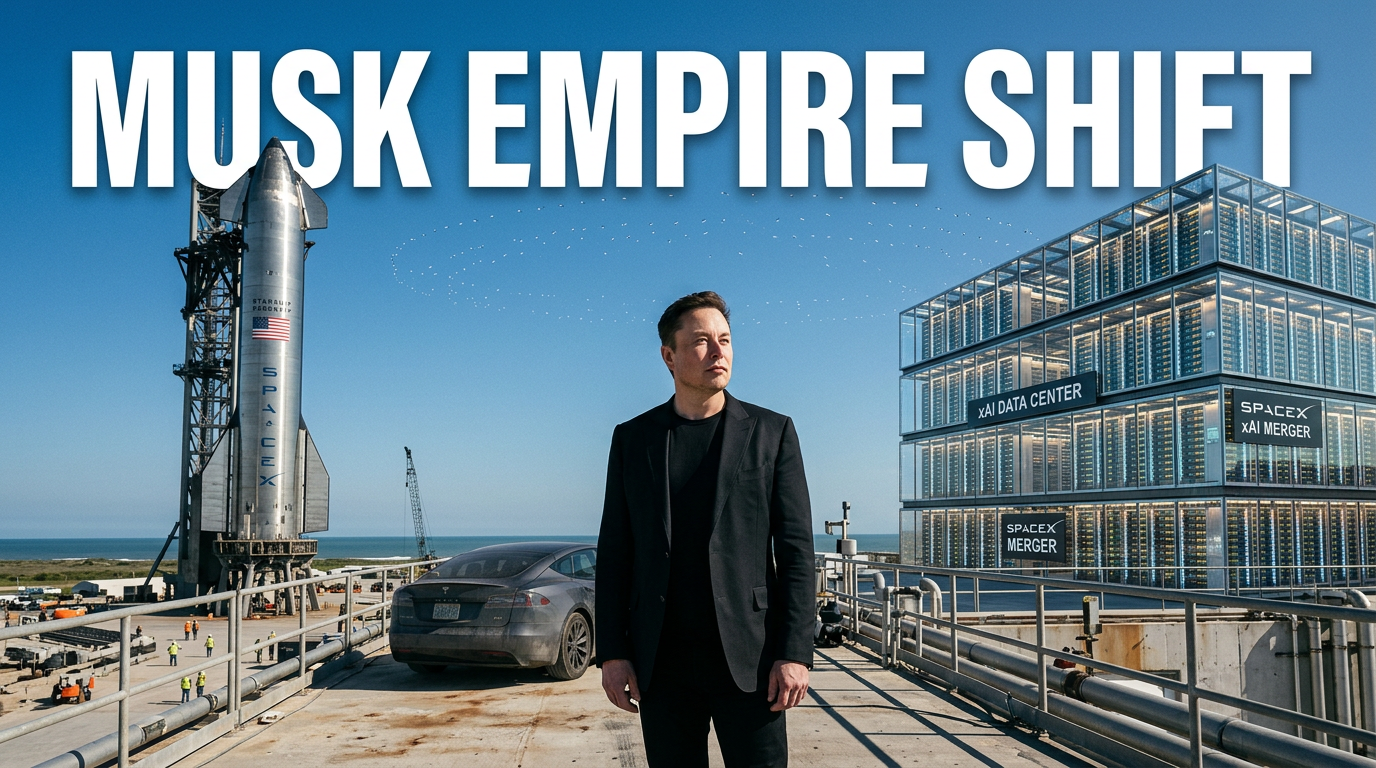
Elon Musk has introduced a larger picture of ‘space-based AI infrastructure’ to the market, beyond the traditional electric vehicle narrative, by combining his space company SpaceX with the AI startup xAI.
On the surface, this is a synergy strategy that combines SpaceX’s launch vehicles, satellites, and communication infrastructure with xAI’s large-scale AI models and computational needs.
However, Wall Street’s perspective is somewhat cooler. There is skepticism that this might be a structure to dilute the deficit burden by adding capital-intensive xAI to cash-flow-rich SpaceX.
Thus, the crux of this issue is the collision between the future story of “the meeting of space industry and artificial intelligence” and the capital market logic of “risk reallocation utilizing favorable assets.”
2. News Summary
2-1. Announcement Details
The merger plan to combine SpaceX and xAI has been formalized, with the valuation of the merged entity cited at around $1.25 trillion.
What the market noted especially was that Musk no longer explains the future solely with Tesla, but is bundling space, AI, and communication infrastructure as a single growth engine.
2-2. Why Now?
The AI competition has transcended model performance competition to a game of who can secure more power, more GPUs, more stable data flow, and greater capital strength.
In this environment, while xAI has strong technological narratives, it needs to handle tremendous capital outflow. Meanwhile, SpaceX, based on Starlink, launch services, and defense and government contracts, shows relatively strong performance and cash generation capability.
2-3. Market Reaction
The supporting argument is clear. If power can be secured from space and AI computation and data transmission can be combined based on low-orbit satellites, it can transcend the power shortage and cooling issues of terrestrial data centers.
However, opposition is strong as well. There’s criticism that due to realistic challenges such as space cooling, radiation, orbital congestion, maintenance costs, and launch frequency, at this stage it is more akin to a corporate valuation defense story rather than technological innovation.
3. Why Is the Center of Musk Empire Shifting from Tesla?
3-1. Tesla is No Longer the Sole Growth Narrative
Previously, Tesla was the symbol of the Musk Empire. Electric vehicles were innovation icons, and Tesla’s stock was seen as an indicator of Musk’s influence.
However, the situation has changed now. Competition in the electric vehicle market has intensified, with the chase of Chinese firms, profitability pressure, price competition, and doubts about the commercialization speed of autonomous driving all existing simultaneously.
Conversely, SpaceX is being evaluated as an asset capable of dominating space infrastructure in the long term, with reusable launch vehicles, Starlink expansion, strategic relations with the U.S. government, and more.
3-2. SpaceX is Viewed as a ‘Future Infrastructure Company’
The core point of SpaceX is that it is not just a rocket company. Rockets are merely the entrance, and its actual essence is closer to a platform company that can lay space infrastructure by lowering launch costs.
Starlink is already serving as a communication and data network. The idea of adding AI computation is essentially interpreted as an attempt to evolve SpaceX into a ‘space-based cloud company.’
4. Why Did xAI Need to Be Bundled with SpaceX?
4-1. The Essence of AI Companies is Ultimately Money and Power
Today’s AI market is not won simply by having good models. Training and operating large language models require all of semiconductors, power, memory, cooling, network, and data acquisition.
In this process, a new AI company like xAI must bear immense capital expenditures and operational costs. The cash burn rate can only be fast.
4-2. Connection with X Platform, and the Next Stage
Musk restructured Twitter into X after acquisition and linked it to xAI. The reason is clear: large-scale real-time data is needed for training AI models.
The next stage is the data processing infrastructure. If X was the data supplier, SpaceX will serve as a computation and network infrastructure supplier.
4-3. Similar ‘Vertical Integration Thinking’ as SolarCity Case
Musk has always seen it as tearing down corporate boundaries and creating one massive value chain.
The combination of Tesla and SolarCity was also a vertical integration strategy connecting energy production-storage-consumption. It’s the same approach this time: combining data acquisition, computation, transmission, and space infrastructure into one structure.
5. How Does Musk’s ‘Space AI’ Operate?
5-1. Core Thought: Turning Space Into a Datacenter
The core of Musk’s concept is surprisingly simple. As terrestrial data centers face limits in power and cooling, the idea is to put AI computation infrastructure in space.
The plan is to massively expand the Starlink satellite network, equipping each satellite with high-performance computing devices to process data in orbit.
5-2. Why Space?
Musk’s logic is as follows: in space, solar power is more reliably utilized, and there’s less tethering to issues like clouds, atmosphere, and regional power grids as on the ground.
Additionally, there’s the advantage of rapidly delivering AI services to dispersed users on Earth through the low-orbit communication network.
In short, it’s a vision to implement a global real-time infrastructure for AI models, not with terrestrial cloud but with a low-orbit network.
5-3. What Changes Industrially?
If this vision is realized, it’s not AI service companies but those owning AI infrastructure that will have market dominance.
Up to now, companies like OpenAI, Google, and Meta have drawn attention with model competition focus, but going forward, who integrates power, data centers, and network will matter more.
6. Wall Street’s Cool View: Is It a ‘Lifeboat Strategy’?
6-1. Major Criticism Points
Critics read this merger not so much as a future vision but more from a financial structure management perspective.
In simpler terms, it’s seen as a strategy to alleviate market shock and appease investor unease by placing cash-burning xAI on profit-making SpaceX.
6-2. Three Reasons Financially Suspects
First is the effect of separating debt and risk. As xAI or X-related burdens grow, independently procuring capital can get challenging, but with SpaceX, it goes under a trustworthy umbrella.
Second is the deficit dilution effect. enquanto as big as xAI, but with SpaceX’s profitability, it stands out relatively less.
Third is the exit strategy for investors. Compared to uncertain valued private AI assets, the structure tying with more marketable SpaceX shares may look far more attractive to investors.
6-3. Why Does This Controversy Grow?
Looking at recent global economic trends, the time when merely adding the word ‘AI’ guaranteed high valuations is gradually behind us.
The market now scrutinizes actual monetization, cash flow, power procurement ability, and facility sustainability more critically.
Thus, this merger is interpreted as a significant case of the gap between future growth expectations and the current financial reality.
7. Are Space Datacenters Technically Feasible?
7-1. The Biggest Challenge is Cooling
Many think space is cold, assuming cooling would be easy, but it’s not the case in practice.
Space is a vacuum with no air, so methods like fan cooling on Earth don’t work. Much more sophisticated designs are needed to dissipate heat outward.
This leads to the need for large radiator-like heat dissipation structures, potentially increasing the weight and size of satellites, thereby pushing launch costs upward again.
7-2. Radiation Issues are Tremendous
In space, exposure to stronger radiation than on Earth occurs. Commercial AI chips could be vulnerable to such environments, increasing chances of errors or malfunctions.
Space-grade semiconductor design, shielding materials, and radiation-resistant systems are required, raising both costs and technical demands.
7-3. Orbital Congestion and Space Debris Risks
Even with just increasing Starlink satellites, the issue of space traffic management is growing in the international community.
If AI computation satellites are added in large numbers, collision risks and space debris issues could become more serious.
This is not just a corporate issue but could evolve into international regulation, military security, and space environmental governance problems.
7-4. Maintenance Costs Could Be Far Larger Than Thought
Satellites are not permanent assets. They have limited lifespans and require constant replacement launches.
In other words, for space datacenters to be truly economical, even with continual launch, replacement, and maintenance costs, they must still be more efficient than terrestrial datacenters.
This remains to be proven as of now.
8. Truly Important Points from a Global Economic Perspective
8-1. The Core Point of AI Competition is Changing
This merger is crucial as it demonstrates that AI competition is shifting from algorithm competition to infrastructure competition.
Whoever makes the better model is less significant than who secures cheaper power, more semiconductors, a broader network, and stronger capital markets.
This means the artificial intelligence industry expands into a massive macro theme encompassing semiconductors, power grids, nuclear power, batteries, communication, and space industries.
8-2. Data Center Investment Flow Could Increase
Recent surges in data center investments in the U.S. and global markets are due to this. AI isn’t just an industry accommodated by adding a few more servers.
Power infrastructure, cooling facilities, real estate, optical communication networks must all be involved simultaneously.
Thus, beneficiaries of AI extend beyond simple software firms to power facilities, semiconductor equipment, cooling solutions, optical communication, and nuclear-related companies.
8-3. The Reevaluation Potential of SpaceX’s Value
If the market starts viewing SpaceX not merely as a launch vehicle company but as a space communication and computation infrastructure firm, it could fundamentally alter the enterprise value assessment.
In such a case, SpaceX could receive premiums more akin to cloud or platform companies than aerospace firms.
8-4. IPO Expectations and Risks Increase Simultaneously
If a SpaceX IPO materializes, the merger story gains much more significance.
This is because pre-listing allows vision-centric valuation, but post-listing, markets will scrutinize quarterly performance, cash flow, CAPEX burdens and regulatory risks much more acutely.
9. Critical Points Not Well Addressed by Other News
9-1. The Real Battle of This Merger is More ‘Funding Structure’ than ‘Technology’
While space AI is the main story on the surface, what matters more is whether xAI can continually secure astronomical investment capital.
The core point of this merger is not the technological announcement but how to secure the financial strength to withstand the AI war.
9-2. Musk is Not Creating ‘Companies’ But Trying to Change ‘Market Rules’
Musk’s approach is consistently the same. He doesn’t aim to be top within existing industries but moves towards changing the standards of the industry itself.
This was the case in electric vehicles and reusable rockets, and now he’s attempting to shift the location of AI data centers from Earth to space.
Regardless of success likelihood, such an approach creates immense framing effects in the market, prompting competitors to ponder, “Where should the next AI infrastructure be deployed?”
9-3. Even if ‘Space AI’ Does Not Work Right Away, the Story Itself Moves Investment and Policy
This is genuinely critical. Even if 100 million units of satellite datacenter aren’t completed, merely the discourse can push governments and companies to act more aggressively towards space communication, defense networks, edge computing, satellite Internet, and power infrastructure investment.
Simply put, Musk has thrown the direction of the next investment theme before realization.
10. Key Observations to Watch Moving Forward
10-1. How Much Will the Actual Launch Cost of Starship Decrease?
The economy of space datacenters ultimately hinges on launch costs. If the reusability and mass launch systems of Starship don’t stabilize, the viability of this concept in terms of costs can fall short.
10-2. Will xAI’s Cash Burn Rate Decrease?
The AI model competition won’t halt. Instead, there’s a high possibility even larger models, more GPUs, and more data will be needed.
As such, it’s crucial to see if xAI’s cost structure improves or if continuous capital infusion remains necessary.
10-3. Will the Regulatory Environment be Favorable?
With orbital usage, radio spectrum resources, defense collaboration, big platform influence, and AI safety issues combined, regulatory variables could become significantly larger than anticipated moving forward.
10-4. When SpaceX IPOs, How Will the Market Value It?
When the listing timing comes, what is crucial is how the market perceives SpaceX among space companies, communication firms, defense companies, platform corporations, or AI infrastructure enterprises.
This valuation approach could significantly alter the global capital market’s interest.
11. Final Interpretation: Leap for Humanity or Strategic Move to Defend the Empire?
Personally, I believe this issue is both.
On the one hand, it truly is a Musk-like concept. The imagination to solve terrestrial datacenter bottlenecks with space is clearly a picture existing companies don’t easily present.
On the other hand, given the current reality xAI faces, interpreting this merger as a strategic decision for capital procurement and value defense is also quite compelling.
Ultimately, execution matters more than words. If space AI is implemented sufficiently to alter the industry structure, this merger will be recorded as a move accelerating the era.
Conversely, if technical challenges and cost issues aren’t solved, this deal could remain a precedent of burden wrapped in splendid narrative.
What’s certain as of now is that the core key of the Musk Empire has shifted from just electric vehicles to a mega infrastructure game involving space industry, artificial intelligence, data centers, and global capital markets simultaneously.
< Summary >
The combination of SpaceX and xAI signals that the core key of Musk’s empire is shifting from Tesla to space AI infrastructure.
The pro argument sees space-based data centers and the Starlink network as the next-generation AI infrastructure.
The con argument criticizes it as financial engineering to dump xAI’s deficit and risks onto SpaceX.
The core point is more about funding, power acquisition, semiconductor supply, launch cost reduction, and future IPO market assessment than technology.
In conclusion, this issue is a symbolic event showing that AI competition is shifting from a model fight to a battle of infrastructure and capital.
[Related Articles…]
Reasons Why SpaceX’s Corporate Value Reassessment and IPO Expectations Are Increasing
Impact of AI Data Center Power Shortage on Semiconductor and Nuclear Power Investment
*Source: [ 티타임즈TV ]
– ‘지상에서 우주로, 테슬라에서 스페이스X로’ 머스크 제국의 중심이 이동한다