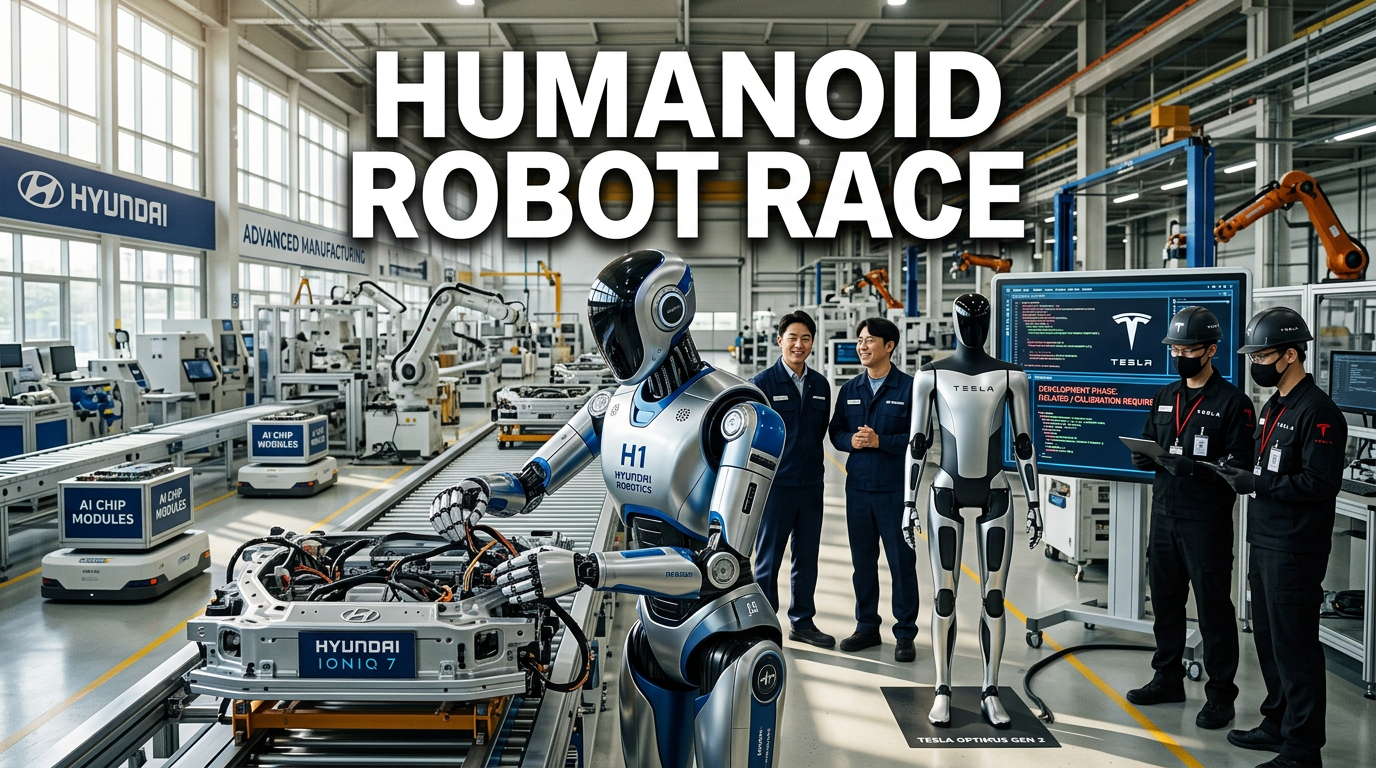
● Humanoid Robot Wars, Atlas Surges, Optimus Stalls, China Charges Ahead
From Hyundai Atlas to Tesla Optimus: How Far Have Humanoid Robots Come?
The humanoid robot market is now at a turning point from being just a thematic stock to the next step in manufacturing innovation and industrial automation.
This article organizes why Hyundai Atlas is noteworthy, why there’s a difference between expectation and reality with Tesla Optimus, how Figure AI, BMW, Benz, Amazon, and Chinese robot companies have tested their capabilities, and how Samsung Electronics, LG, Doosan, and Korean startups are getting on board.
We’ll especially focus on the core takeaway often missed in other articles or YouTube videos, which is, “The ultimate competition in the robot market is not in the robot body but in the hands, data, software, battery, and actual deployment sites.”
Viewing this together with robot-related stocks, global economy, future industry, AI semiconductors, and supply chain changes gives a clearer picture of the flow.
1. A Comprehensive News Summary
– Hyundai has emerged as a leading player in the humanoid robot era, showcasing the commercial Atlas based on Boston Dynamics.
– Tesla has heightened market expectations with Optimus, but the speed of actual commercialization is slower than initially announced.
– BMW, Benz, and Amazon are already conducting demonstration tests of humanoid or semi-humanoid robots in factories and logistics sites.
– China aggressively climbs with subsidies, low-cost mass production, and fast manufacturing capabilities.
– Korea’s ecosystem is rapidly growing with contributions not only from large corporations like Hyundai, Samsung Electronics, LG, and Doosan, but also from startups focusing on robot software and hand technologies.
– While not fully commercialized yet, the term “just before commercialization” accurately describes the current stage of industrial site adoption.
2. Why Are Physical AI and Humanoid Robots Suddenly in the Spotlight?
2-1. Generative AI is Eventually Moving to the Physical World
Following ChatGPT, AI is transitioning from “speaking AI” to “moving AI.”
While AI has shown strengths in digital spaces like document creation, translation, summarization, and image generation, it’s now moving to perform labor in real-world spaces like factories, logistics centers, warehouses, homes, and hospitals.
This is precisely what physical AI is.
Simply put, it’s a structure where AI sees with eyes, picks up with hands, moves with legs, and makes judgments on-site to perform tasks.
2-2. The Reason Humanoids Are Gaining Attention Is Due to the “Human-Centric Infrastructure”
There are many questions about why robots need to look like humans.
The answer is simple.
Almost all offline environments around the world are designed with humans in mind.
Door handles, stairs, conveyor heights, workbenches, tools, vehicles, warehouse shelves, keyboards, doorsteps, elevator buttons—everything is tailored to human hands, height, and movement.
Therefore, to deploy without overhauling existing infrastructure, humanoid robots are the most advantageous choice.
2-3. The Market Potential Is Fundamentally Different from Existing Industries
The reason the humanoid market is highly valued is simple.
This market targets the entire economic value produced by human labor, not just a specific product market.
Factory labor, logistics movement, inspection, packaging, cleaning, simple service tasks, hazardous work, and repetitive tasks all have the potential for robotic substitution.
Thus, investors are looking not at current sales but at how much it can disrupt GDP and the structure of labor income in the long term.
3. The Approaches of the Automotive Industry and Big Tech Are Completely Different
3-1. Automobile Companies Have the Advantage of “Being the Direct User”
The reason automakers like Hyundai, Tesla, Toyota, and Benz are active in humanoids is clear.
Automobile factories are representative industries with a high amount of robot usage.
Processes are standardized, there is a lot of repetitive work, safety standards are high, and productivity improvements are immediately visible in numbers.
Especially automakers can test robots in their factories right after development.
This is a huge advantage.
They can collect data, fix problems, improve hardware, and update software through direct usage without convincing external customers.
3-2. Big Tech Focuses on the “Brains and Development Environment” of Robots More Than the Body
Big tech companies like Nvidia, Google, and Amazon generally focus on AI models, simulation tools, digital twins, sensor recognition, and computing infrastructure for teaching robots rather than on making the robot bodies themselves.
Nvidia, in particular, sees physical AI as the next AI momentum and has a significant influence in providing foundational models and simulation environments for robotics.
Ultimately, the future robot competition is likely more focused on “who dominated the learning data, simulation infrastructure, AI semiconductors, and software ecosystem” than “who built the body.”
4. How Far Has the Actual Adoption of the Humanoid Market Come?
4-1. In Conclusion, It Is “Just Before Commercialization”
It’s not yet at the level where robots run entire factories.
However, testing has certainly moved beyond simple demos and reached the stage of integrating into some actual site processes.
The era of “showcase videos” has passed, and we’ve moved to the phase of “actually entrusting part of the work.”
4-2. BMW is One of the Most Active Demonstration Cases
BMW is often mentioned as a representative case having conducted demonstrations at factories in the US and Germany with Figure AI.
Reportedly, they tested operations 10 hours a day, 5 days a week, and entrusted the tasks of parts movement and placement in some production processes.
Mainly used in transporting sheet metal parts to specific locations or as worker support, these operations form the focus.
However, it’s important to note that this does not immediately mean a successful large-scale commercialization.
Significant potential has been shown in simple tasks, but it’s not yet at a level to change the entire production line.
4-3. Benz is Approaching More Conservatively
Benz, too, is conducting tests at factories in Germany and Hungary, focusing on much more limited roles compared to BMW.
For instance, assigning simple support tasks focused on logistics, like delivering heavy parts to human workers.
This reflects the current industry atmosphere well.
Most companies are still focusing on “partial support” rather than “complete replacement.”
4-4. Amazon and Logistics Companies Are Accelerating Warehouse Automation
Logistics is a sector where humanoid adoption can progress relatively quickly.
This is because the work environment is relatively standardized, highly repetitive, and entails a significant burden of moving heavy items.
In the US, Agility Robotics has conducted meaningful tests in logistics center tasks, and companies like GXO Logistics are also accumulating small-scale practical usage cases.
Warehouses are likely to become the initial market for humanoids as much as factories.
5. Why Tesla Optimus Has a Large Vision But Is Quiet in Reality
5-1. It Is the Company that Raised the Most Expectations
Tesla is the company that has piqued the most imagination in the market with Optimus.
The aggressive portrayal includes mass production at low cost, standardized actuators, the possibility of producing tens of millions in the long term, and an opportunity bigger than the car business.
The direction mentioned by Musk is certainly impressive.
5-2. However, the Schedule Is Continuously Delayed
The problem is that the roadmap hasn’t progressed as announced.
In the past, it was mentioned as if thousands would be working in factories by 2025, but recently, the expression has shifted closer to “researching.”
This doesn’t suggest the market should overly criticize Tesla but indicates how much harder humanoid commercialization is than expected.
5-3. The Bottlenecks Are Ultimately Hands and Software
The primary bottleneck frequently cited for Optimus is hands.
Walking is challenging for robots, but making money in actual industrial sites requires the ability to precisely handle objects with hands.
Gripping too tightly can damage, gripping too loosely lets objects slip, and improper angle and force control can immediately lead to defects or accidents in a production environment.
Moreover, software is also an issue.
While a car essentially functions as long as it runs, a robot loses its reason for existence if it can’t correctly recognize, manipulate, and move.
This industry places far more importance on software completeness than hardware.
5-4. Investment Points to Watch
Tesla remains a significant player, but judging Optimus solely on immediate performance may lead to disappointment.
What is more critical is Tesla’s development of its component system, sensor strategy, battery technology, plant data, and AI learning structure for robots.
Ultimately, before stock prices, the speed at which technological bottlenecks are resolved is key.
6. Why Hyundai Atlas Is Especially Noteworthy
6-1. It’s Shifting from Research to Commercial Directions
Boston Dynamics’ Atlas has long been famous for videos of jumps, parkour, and balancing acts.
But back then, the character was heavily research-oriented.
The recent interest is because now a commercial direction usable in actual industrial sites is beginning to appear.
6-2. Hyundai’s Core Strength Is the ‘Field’
Hyundai’s advantage is not simply due to its robot technology.
The company operates numerous factories worldwide, can run direct deployment tests, and can flexibly design facilities to match new factories.
Especially, the expansion of production bases in the US further strengthens the rationale for humanoid introduction.
The US has high labor costs and pressures for local production due to tariff and supply chain restructuring issues, increasing the economic viability of robot deployment.
6-3. The True Strengths of Atlas Are Hand Dexterity and Electrification
One of the critical focal points drawing attention to Hyundai Atlas is its hand dexterity.
Hand dexterity is a crucial indicator of how delicately a robot can handle objects.
Furthermore, the transition from hydraulic to electric systems carries significant importance.
While hydraulic systems are powerful, they may have limitations in precision, and electric systems are more advantageous for delicate operations and industrial applications.
It signifies a shift from being a “well-running robot” to a “well-working robot.”
6-4. Hyundai’s Weakness Was in AI Brains, but This Can Be Supplemented Through External Collaboration
Hyundai’s traditional strengths lie in machinery and manufacturing.
In contrast, its software brain, like AI foundational models, has been pointed out as a weakness compared to big tech.
However, this is a part where Hyundai can effectively respond practically.
The company can collaborate with global enterprises like Google and Nvidia to leverage the robots’ brains and learning environments.
In the end, Hyundai is likely to pursue a strategy that holds onto hardware and the field while linking AI with global partners.
7. Opportunities Are Growing Beyond Car Factories
7-1. Logistics Centers
Early commercialization is most likely to occur in logistics.
This is due to the repetitive nature, significant movement of heavy loads, and relatively predictable work flows.
7-2. Retail Stores and Retail
Tasks such as arranging displays, labeling, packaging, and inspecting are favorable areas for humanoid or quasi-humanoid robots to enter.
Enterprises like Canada’s Century AI demonstrate this direction.
7-3. Home Robots
Norwegian-based 1x is capturing attention with a model closer to home-use humanoids.
Providing directions on opening doors, simple cleaning, and basic home support indicates potentials, but in this market, price, safety, trust, and emotional acceptance may be more critical than technology.
In other words, the home market is not opened by technology alone.
8. Why Are Chinese Robot Companies a Threat?
8-1. Subsidies, Mass Production, and Price Competitiveness Converge
China applies the formula already shown in electric vehicles, batteries, solar power, and drones to robots.
A structure where government support, large-scale production, low cost, and quick market entry are combined.
Unitree and Ubtech are representative companies.
8-2. Chinese Companies Are Fast in Deployment, Not Just Demos
The strength of Chinese enterprises doesn’t just lie in flashy videos.
It’s in component supply chains, mechanism design, mass production optimization, and price disruption converging at once.
As humanoids become widespread, price competition is inevitable, and in this area, China is already on a favorable starting line.
8-3. Aspects That the US and Korea Need to Be Cautious of
The US is strong in software and AI platforms, Korea in precision manufacturing and components, but China can be overwhelming in the mass market and speed.
In the future, the robot market can be viewed as a collision of American brains, Chinese mass production, and Korean manufacturing precision and industrial application capability.
9. How Are Korean Conglomerates Like Samsung, LG, and Doosan Moving?
9-1. Samsung Electronics: Robots Are Extensions of Semiconductors and Devices
The reason Samsung Electronics views robots as important is not simply because of the finished product business.
A single robot contains semiconductors, sensors, batteries, displays, communications, and mobile technologies.
In other words, robots are a field with great synergy with Samsung’s existing business sectors.
The expansion of shares in Rainbow Robotics should be seen in this context.
For Samsung, humanoids may not be just a new business but also the next generation hardware platform.
9-2. Doosan: Expanding from Collaborative Robots to Humanoids
Having experience with collaborative robots, Doosan understands industrial site robots well.
In a situation where the robot arm-central market is facing intensified competition and price pressure, shifting to humanoids to find new growth engines is natural.
9-3. LG: Opportunities in Household and Lifestyle Robots
LG’s strong point is its high understanding of home appliances and living spaces.
Should the home robot market open in the long term, LG can become a designer of life scenarios, rather than just a simple robot manufacturer.
In other words, greater competitiveness can come from “how robots will work contextually inside the house” than from the robots themselves.
10. Korean Startups, the Real Important Players Are Different
10-1. Real World: Approaching by Making the Robot’s Brain
Among domestic startups, those focusing on the robot foundation model are noteworthy, more than making the robot bodies.
Real World is a representative example.
This company focuses on the brain that allows robots to understand the world and act, rather than making the robot body directly.
The importance of this approach is clear.
In the long term, the value of operating systems and learning models may be greater than hardware.
10-2. Holiday Robotics: The Potential of Simulation-Based Learning
Holiday Robotics is a company with an interesting simulation-centered approach.
If the imitation learning based on real-world data can rapidly enhance performance, simulation allows for infinite repetitive learning to pursue deeper generalization possibilities.
In the future, the AI competition in robots will likely hinge on imitation learning vs simulation, or a combination of both.
10-3. Airobot: An Example Showing That Eventually, the Hand Is Most Important
While many think of legs and walking when it comes to robots, hands are far more crucial in actual industry.
That’s why companies like Airobot, focusing on hands, gain attention.
The true bottleneck of humanoids could be in manipulation rather than mobility.
This perspective is quite important for future investment decisions.
11. The Most Important Parts Often Missed in Other News or YouTube
11-1. The Competition Isn’t Just Among ‘Robot Companies.’
Much content presents it as Hyundai vs Tesla vs Figure AI, but the real competition is much broader.
Batteries, reducers, actuators, tactile sensors, machine vision, AI models, simulation tools, AI semiconductors, factory data, logistics automation systems, and industrial software are all interconnected.
In short, the humanoid market is an ecosystem war, not a single company competition.
11-2. The First Customers of Humanoids Are Not the General Consumers, But Companies
While the public is very interested in home robots, the first paying customers will be companies.
Factories and logistics centers can calculate ROI, with clear repeated work and manpower shortage issues.
Therefore, the early market will most likely center around B2B rather than B2C.
11-3. The Real Core Is Not ‘A Robot That Does Everything at Once’
Many imagine all-encompassing robots like humans, but the market is likely to open before that.
For example, limited tasks such as moving heavy parts, simple sorting, placing in fixed positions, assisting workers, and moving in hazardous areas can be monetized first.
Thus, the market opens with “Is it cheaper and more stable than humans in specific tasks?” rather than with perfect universality.
11-4. The ‘Hand’ of the Robot Is as Important as the LLM of AI
These days, AI discussions focus on software, but in the real industrial world, the precision of the hand is core to profitability.
Works like threading needles, organizing cables, inserting parts, and handling fragile objects are mandatory to move up to high-value-added processes.
Therefore, in robot investment, the focus should be on “how precisely they operate” as much as “what AI they use.”
11-5. Battery Is a Much Larger Variable Than Expected
Humanoids consume significant energy due to movement, balance, perception, calculation, and hand manipulation.
Battery duration, replacement speed, weight, and safety are pivotal conditions for commercialization.
Ultimately, the expansion of the robot market is also connected to the competition for secondary cells and energy density.
12. Future Points of Interest for Investors and Readers
12-1. Is There an Increase in Actual Test Sites?
What’s more important than video demos are actual deployment cases in factories, logistics centers, and retail settings.
Core details include the duration, weeks involved, what tasks were assigned, and how the defect rates and downtimes were.
12-2. The Speed of Hand and Battery Improvement
The tangible variables that will dictate the speed of commercialization are hands and batteries.
Without improvements in these two areas, robots will find it difficult to surpass grand demos.
12-3. The Degree of Integration Between AI Software and Manufacturing
This industry isn’t feasible for AI startups alone, nor for manufacturing firms solo.
The real play is how well software, hardware, and field data integrate.
12-4. Global Supply Chain Restructuring and Local Production Pressures
US tariff policies, supply chain diversification, rising labor costs, and labor shortages all increase the economic feasibility of robotics adoption.
Thus, humanoids are both a tech trend and a beneficiary industry of global economic structure change.
13. Final Conclusion: Where Are the Promising Robot Companies Now?
In terms of short-term attention, Figure AI, Tesla, and Hyundai Atlas are most frequently mentioned.
Looking at applicability and industrial linkage, Hyundai’s position seems quite strong.
In terms of software and infrastructure, Nvidia’s influence is overwhelming.
Price competitiveness and mass production speed make it hard to overlook Chinese companies.
In Korea, large companies like Samsung Electronics, LG, and Doosan, along with startups like Real World, Holiday Robotics, and Airobot, which solve specific bottlenecks, appear much more vital.
Ultimately, this market is more likely defined by “who can create a system that’s reliably employed in fields repeatedly” than “who is the most famous.”
< Summary >
Humanoid robots have moved beyond mere expectations and are entering the commercialization-ready stage, actively tested in real factory and logistics environments.
Hyundai Atlas garners strong attention due to its hand precision, manufacturing settings, and Boston Dynamics technology.
Tesla Optimus, despite having a large vision, is facing delays due to hand and software bottlenecks.
BMW, Benz, Amazon, and Chinese companies have already started demonstrations, while Samsung Electronics, LG, Doosan, and Korean startups are rapidly growing their ecosystems.
The most important aspect is that the competition is within the ecosystem—including hands, battery, AI models, simulation, field data, and supply chains—more than in the robot body itself.
The initial market is likely to open first in B2B centered around factories and logistics rather than home-use.
[Related Posts…]
Robotic Industry Outlook and the Next Opportunity for Korean Manufacturing
The Impact of Changes in AI Trends on the Global Economy
*Source: [ 티타임즈TV ]
– 국내외 로봇회사 어디가 유망할까?