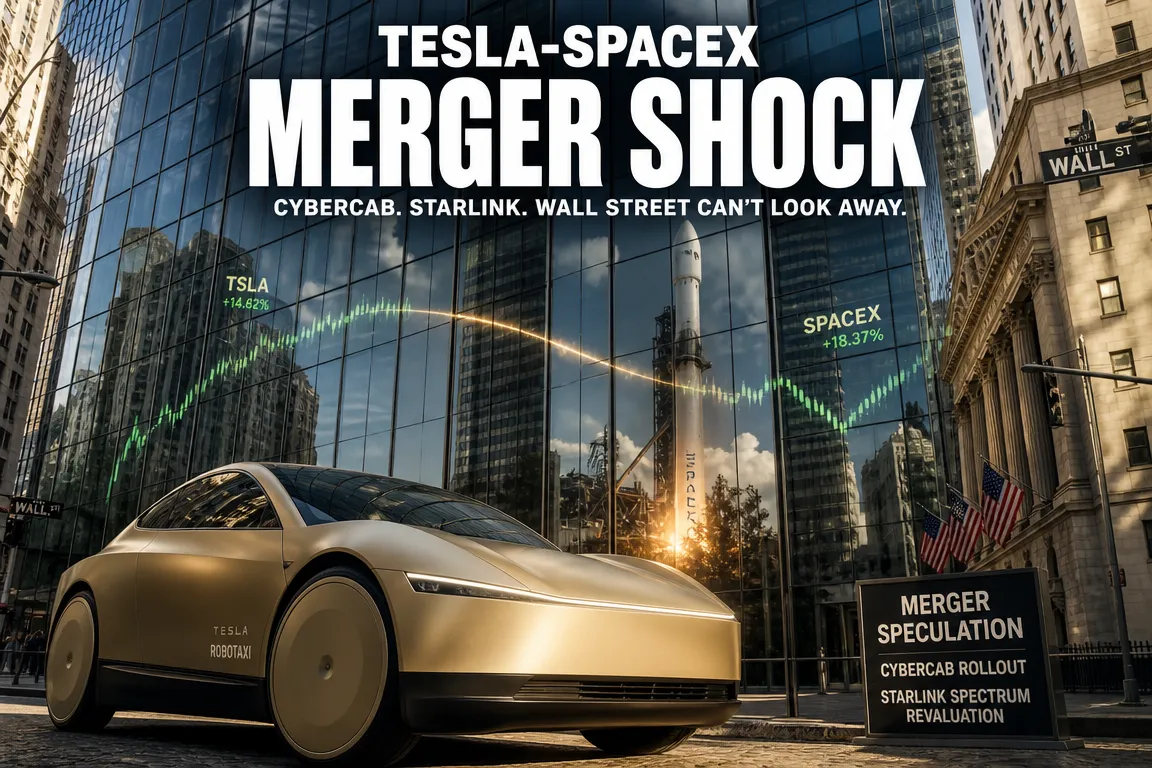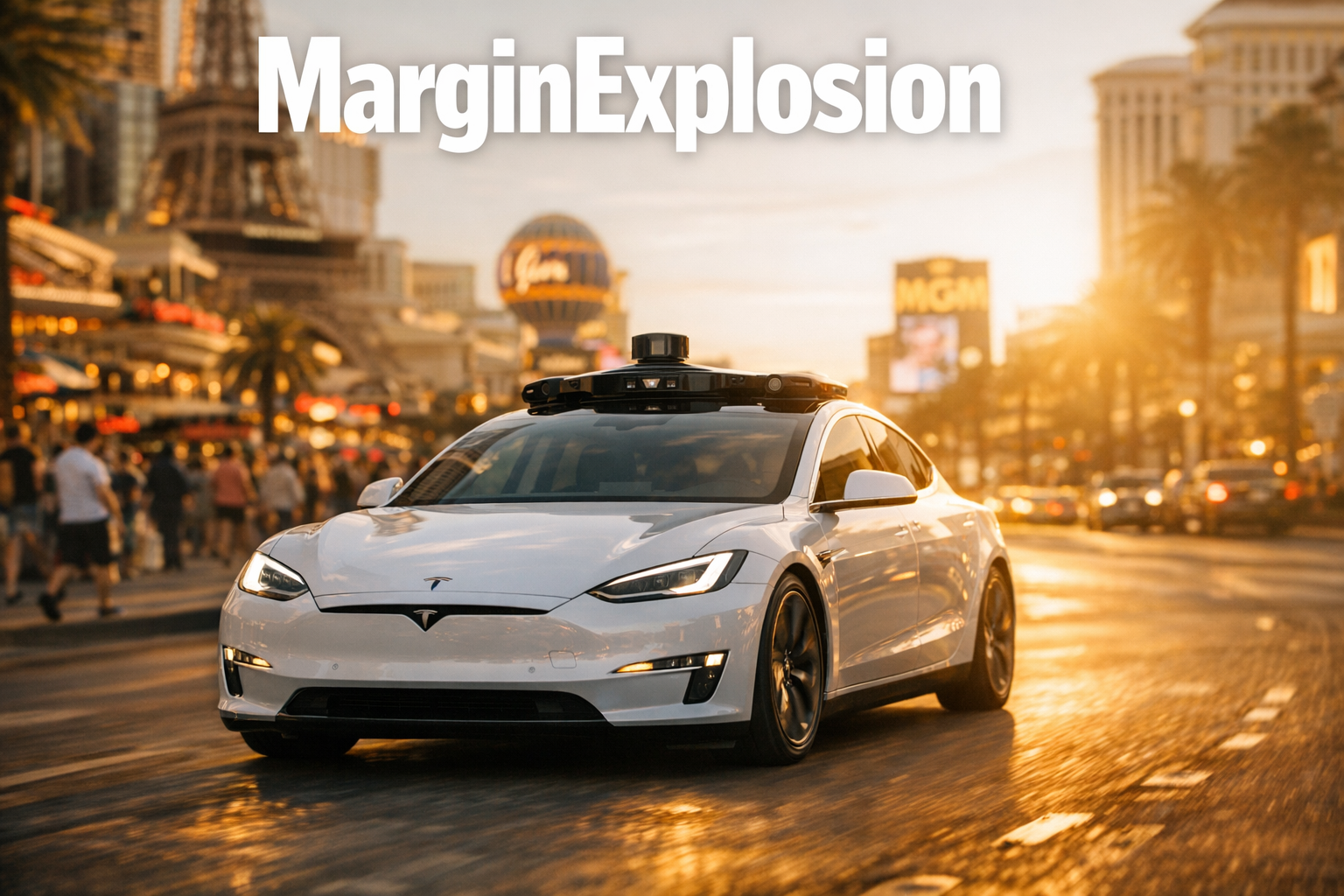
● Tesla Robotaxi Shock, Vegas Launch, 78 Percent Margin Explosion
Tesla Robotaxi: Is a Real Launch Starting in Las Vegas? Implications of a 78% Margin Claim and Key Signals from Vehicles Spotted in Las Vegas and Dallas
The key issues in the current news flow are limited and specific:
- Why Tesla appears to be preparing Robotaxi operations in Las Vegas and Dallas
- Why a Model Y–like vehicle was observed with a camera-lens cleaning nozzle
- Why Robotaxi is not merely an autonomous-driving headline, but a potential catalyst across EVs, AI, semiconductors, energy storage, and platform economics
- Why the market is highly sensitive to the “78% margin” narrative and how it links to equity valuation frameworks and industry structure
This report also connects: (i) a U.S. LFP supply-chain buildout with LG Energy Solution, (ii) the implications of OpenAI’s reported Stargate downsizing for AI infrastructure competition, and (iii) competitive positioning versus Nvidia/Uber/Hyundai-aligned ecosystems.
1. Key Takeaways
Dozens of Tesla vehicles were recently spotted in Las Vegas and Dallas, Texas. While they resemble standard Model Y units, some were observed with a new hardware feature near the rear camera: what appears to be a lens-cleaning nozzle. This has increased market speculation regarding Robotaxi pilots and/or commercialization preparation.
Tesla has indicated intentions to expand Robotaxi services to major metro areas within 1H, with Las Vegas, Phoenix, and Dallas frequently cited as potential early nodes.
In parallel, Tesla’s battery strategy is shifting toward U.S.-based LFP supply, while AI competition is increasingly constrained by physical infrastructure (power, cooling, chips, land, networking) rather than model performance alone.
2. Why the Vehicles Spotted in Las Vegas and Dallas Matter
2-1. Model Y Exterior, Potential Robotaxi Test Configuration
The principal signal is not the overall exterior but the incremental hardware. Vehicles were observed with a nozzle-like device near the rear camera consistent with a lens-cleaning mechanism.
This is unlikely to be a standard “comfort” feature. For fully unmanned autonomy, camera visibility directly impacts operational safety and continuity.
Human drivers can intervene when sensors are obstructed; unmanned vehicles cannot. For Tesla’s camera-forward approach, automated lens-cleaning becomes a practical prerequisite for reliable 24/7 operation.
2-2. Why This Hardware Detail Is Material
Tesla’s autonomy stack is primarily vision-based rather than LiDAR-centric. This can provide cost advantages but increases sensitivity to lens obstruction.
In environments such as Las Vegas—limited rainfall but higher dust and particulate exposure—camera occlusion can become an operational limiter. A cleaning nozzle can therefore be interpreted as an operational-readiness signal rather than a minor cosmetic change.
2-3. Why Dallas Observations Add Weight
Vehicle behavior reported in Dallas—roadside stops, dwell-time patterns consistent with pickup/drop-off, and re-entry into traffic—suggests potential operational workflow testing rather than mapping-only or demonstration driving.
This resembles service-model validation (dispatch, dwell time, throughput) more than technology-only trials.
3. Why Las Vegas Could Be an Advantageous Initial Market
3-1. City Demand Patterns Support Early Deployment
Las Vegas is demand-dense and corridor-concentrated: airport, major hotels, convention venues, and central commercial zones. This supports predictable routing and faster operational learning through repeated trips.
3-2. Potential Integration with The Boring Company Tunnel Network
A distinct factor is the existing tunnel infrastructure in Las Vegas. If Tesla vehicles can operate across both surface roads and tunnel segments, the combined system could create a differentiated operating environment that is difficult for competitors to replicate.
This would shift the competitive unit from “vehicle-only” to “vehicle + dedicated throughput infrastructure.”
3-3. Structural Differences vs Competitors
Waymo, Motional, and Zoox have also tested in major cities, generally using higher-cost sensor suites and constrained geofences.
Tesla’s approach emphasizes a mass-manufacturable vehicle platform, lower bill-of-materials, large-scale real-world data capture, and potential infrastructure adjacency. If execution is successful, this could enable faster scaling and more aggressive unit economics.
4. The “78% Margin” Discussion: Why the Market Reacts
4-1. Robotaxi as a Platform, Not a One-Time Vehicle Sale
The “78% margin” figure is best viewed as a scenario-based estimate rather than a confirmed metric. Market sensitivity stems from the business-model shift: Robotaxi revenue accrues per mile and per hour of utilization, not only at the point of vehicle sale.
Traditional auto economics recognize most profit at delivery; Robotaxi economics recognize recurring cash flows over the vehicle’s operating life.
4-2. Simplified Unit Economics Framework
If pricing is approximately $1.4 per mile and operating costs are materially lower, the model can resemble software-like operating leverage, particularly once driver labor is removed.
This underpins the thesis that network deployment and utilization may be more profit-generative than incremental vehicle sales, subject to regulatory approval and operational reliability.
4-3. Why Austin Price Increases Are Interpreted as a Signal
Reported fare increases in Austin over a short period can be interpreted as demand management and price-elasticity testing. If demand remains resilient after increases and wait times remain elevated, it suggests progression from technical demonstration toward economic validation.
5. Comparison vs Uber and Waymo
5-1. Uber’s Labor-Cost Constraint
Uber remains predominantly human-driver based, structurally tied to labor compensation and incentive dynamics. This limits long-term margin expansion relative to an unmanned model, assuming comparable safety and service quality.
5-2. Waymo’s Cost Structure
Waymo’s multi-sensor approach (including LiDAR) can improve redundancy and precision but carries higher hardware and maintenance costs, which can slow fleet scaling and pressure per-mile economics.
5-3. Scale and Replication Speed as Primary Determinants
The primary competitive axis is not only “best autonomy,” but the ability to scale rapidly at low cost with high utilization. Tesla’s vertical integration across manufacturing, OTA software, in-house compute, and battery supply may increase replication speed, subject to deployment constraints.
6. LG Energy Solution: $4.3B Contract and the Strategic Supply-Chain Angle
6-1. Strategic Significance of Michigan LFP Production
LG Energy Solution’s plan to produce Tesla-oriented LFP prismatic cells in Michigan is material beyond procurement. A scale of ~50 GWh annually supports hundreds of thousands of EVs or substantial energy-storage deployments. With production indicated from 2027, the initiative aligns with medium-term capacity planning for both mobility and energy businesses.
6-2. Reducing Dependence on CATL
Geopolitical, tariff, and U.S. industrial policy pressures (including IRA-aligned incentives) increase the value of local production and diversified sourcing. U.S.-based output can reduce regulatory risk and improve eligibility for domestic-incentive frameworks.
6-3. Linkage to Robotaxi and Energy Storage
LFP supply is relevant to both vehicle cost structure and grid-scale storage (e.g., Megapack). This contract can be interpreted as a cost-control and continuity-of-supply measure supporting broader network expansion and energy margin stability.
7. Implications of OpenAI “Stargate” Downsizing: AI Competition as an Infrastructure Race
7-1. Physical Infrastructure as the Binding Constraint
Reports that OpenAI shifted from self-build to more lease-oriented data-center strategy highlight that AI at scale is capital-intensive and bottlenecked by power availability, cooling, chips, land, networking, and operations.
7-2. Relevance to Tesla and xAI
An approach emphasizing direct infrastructure buildout can increase upfront capex but may improve execution speed and strategic autonomy. The broader implication is that AI industrialization is determined by the ability to deploy large-scale training and inference capacity efficiently, analogous to the scaling problem in Robotaxi operations.
8. Nvidia/Uber/Hyundai-Aligned Ecosystems vs Tesla: Competitive Dynamics
8-1. Timeline Differentiation
Nvidia has promoted autonomy roadmaps with major partners. Many competitive plans reference 2027–2028 horizons, while Tesla signals earlier commercialization expansion around 2026. The gap affects investor perception of near-term execution risk and market-share timing.
8-2. Data Scale as a Regulatory and Safety Advantage
Regulators prioritize real-world performance evidence. Tesla’s large installed base and accumulated driving data may be difficult for newer alliances to match rapidly, even with strong simulation pipelines.
8-3. Dedicated Robotaxi Vehicle Strategy
A purpose-built Robotaxi platform (e.g., a dedicated vehicle architecture) can improve unit economics by removing unnecessary components and optimizing for unmanned operation. This differs from retrofitting autonomy onto existing consumer vehicles and can materially impact cost per mile and fleet uptime.
9. Industry Shift: From Vehicle Sales to Mobility Subscriptions
The primary significance is not a single-company product cycle but a potential change in industry business models: recurring mobility revenue driven by network utilization rather than one-time vehicle delivery volume.
If consumer behavior shifts from ownership to on-demand access with low wait times, the automotive value chain and profit pools could reallocate toward network operators and integrated platform owners.
10. Under-Discussed Points
10-1. The Lens-Cleaning Nozzle as an Operational-Readiness Requirement
For camera-centric autonomy, lens contamination is a practical limitation. Evidence of automated cleaning hardware can be interpreted as progress toward unmanned operational compliance and higher uptime.
10-2. Las Vegas as an “Infrastructure-Integration Testbed”
Beyond tourism demand and road layout, Las Vegas offers potential synergy with tunnel infrastructure. If integrated, Tesla’s offering could resemble a localized urban mobility operating system rather than a standalone Robotaxi fleet.
10-3. The Core Issue in the “78% Margin” Debate: Valuation Regime Shift
The critical factor is less the precision of the percentage and more whether the market begins to underwrite Tesla as a high-margin platform operator. Such a reframing can affect valuation multiples, competitive responses, and regulatory attention.
10-4. Battery Supply-Chain News and Robotaxi Are the Same Cost-Control Narrative
Battery localization and Robotaxi deployment both depend on sustained cost reductions and supply continuity. Network-scale operations require predictable input costs; supply-chain strategy therefore becomes integral to service-platform economics.
11. Investor Watchlist
11-1. Confirmation of Las Vegas Service Launch
Distinguish between internal testing and a commercial rollout via official disclosures and observable operating patterns. Hardware and behavior signals reduce the likelihood of “mapping-only” interpretation but are not definitive.
11-2. Dedicated Robotaxi (Cybercab) Manufacturing Timeline
Production timing, specifications, and target pricing will influence scaling speed and unit economics.
11-3. U.S. Regulatory Developments
Deployment velocity depends on state and federal frameworks, including safety validation standards and liability allocation.
11-4. Competitive Pricing Responses
Assess whether Waymo, Uber, and other ecosystems can reduce per-mile costs sufficiently to compete, given their sensor stacks, operational models, and supply-chain constraints.
12. Integrated Interpretation
This is not solely an autonomy headline. It signals a transition from EV sales competition to operational-network competition.
Automotive manufacturing, AI infrastructure, semiconductors, batteries, energy storage, and platform economics are becoming increasingly interdependent. The observed hardware detail in Las Vegas and Dallas may reflect preparations for unmanned, continuous operation rather than incremental product iteration.
< Summary >
Tesla has increased indications of Robotaxi commercialization preparation in Las Vegas and Dallas. A key signal is the rear-camera lens-cleaning nozzle, which can be interpreted as required hardware for reliable fully unmanned operation. Las Vegas offers concentrated, repeatable demand and potential integration with The Boring Company tunnel infrastructure. Robotaxi economics may drive a platform-style valuation framework due to recurring revenue potential, making margin narratives (e.g., “78%”) market-sensitive even if scenario-based. LG Energy Solution’s U.S. LFP supply-chain buildout supports cost control and policy alignment for future scaling. OpenAI’s reported Stargate downsizing reinforces that AI competition increasingly depends on physical infrastructure and execution capacity. Overall, the competitive landscape is shifting toward integrated control of data, cost, supply chain, and infrastructure.
[Related Links…]
- https://NextGenInsight.net?s=Robotaxi
- https://NextGenInsight.net?s=Battery
*Source: [ 오늘의 테슬라 뉴스 ]
– 마진율 78%?! 베가스에서 로보택시 시작하나? 영상으로 공개된 테슬라 로보택시 비밀은?
● Gold, Silver, Oil, Bitcoin – 2026 Shock Winners and Hidden Risks
Gold, Silver, Crude Oil, and Bitcoin: Where the Opportunities Are in 2026 — Seasonality, Supply Shocks, and Quantum Computing Risk
This report focuses on structural market drivers rather than short-term directional calls.
Key questions addressed:
- Why gold and silver may behave differently from prior spike-and-crash episodes
- Why crude oil can spike tactically but may be structurally constrained as a long-duration holding
- Why industrial commodities such as copper and uranium may be leveraged beneficiaries of electrification, AI, and data-center buildouts
- Why Bitcoin may rebound yet still warrants caution
- Why “quantum computing risk” should be incorporated into long-horizon crypto risk frameworks
The analysis links macro conditions (growth, inflation, rates, FX) with commodity market structure, emphasizing supply constraints and demand durability.
1. Macro framing: Why markets are re-pricing real assets and commodities in 2026
Markets are increasingly differentiating between:
- Assets supported by physical scarcity and constrained supply response, and
- Assets driven primarily by liquidity expectations and positioning flows
Gold and silver are core real assets:
- Silver: rising industrial demand intensity
- Gold: sustained central-bank demand
By contrast:
- Bitcoin: more sensitive to liquidity conditions, ETF flows, risk sentiment, and geopolitics
- Crude oil: can react sharply to geopolitical events, but longer-term upside may be limited by supply responsiveness and demand substitution
Bottom line: pricing power is increasingly accruing to assets with verifiable scarcity and durable demand.
2. Seasonality: Patterns extend beyond equities to metals, crypto, and commodities
2-1. Why seasonality matters
Seasonality reflects repeatable drivers:
- Institutional budgeting and deployment cycles
- Portfolio rebalancing windows
- ETF flow timing
- Recurring shifts in risk appetite
2-2. Why gold seasonality changed after 2004
A structural inflection is attributed to the introduction of gold ETFs, which:
- Reduced friction for institutional access
- Changed flow timing and price behavior
Observed pattern since then:
- Generally stronger from October to April
- Generally weaker from May to October
Implication: long-run price behavior can change when market structure changes.
2-3. Bitcoin is increasingly shaped by institutional flow regimes
As ETF participation and correlation with US growth equities increased, Bitcoin has exhibited a pattern often characterized as:
- Relatively stronger from October to March
- Relatively weaker from April to September
Bitcoin is therefore better analyzed alongside:
- US equity risk conditions (notably Nasdaq)
- Liquidity regime
- ETF flow dynamics
3. Gold: Corrections are possible, but structural support remains
3-1. Why gold strength has persisted
Gold demand is primarily monetary rather than industrial. Since 2022, concerns about:
- asset-freeze risk,
- reserve diversification, and
- fragmentation in the international monetary order
have supported sustained central-bank buying.
This is not solely “safe-haven” demand; it reflects strategic reserve reallocation.
3-2. Why supply is slow to respond
Supply elasticity is limited due to:
- long mine development timelines
- environmental and permitting constraints
- rising exploration and development costs
- scarcity of new large-scale deposits
This supports a higher structural floor versus prior cycles.
3-3. Portfolio implications
Even after sharp rallies, gold can remain structurally supported under:
- elevated macro uncertainty
- renewed inflation risk
- rate-cut expectations combined with growth deceleration
4. Silver: A critical 2026 asset due to industrial demand and supply deficits
4-1. Why the current cycle may differ from 1980 and 2011
Prior peaks were associated with high speculative concentration and subsequent drawdowns. The current cycle places greater weight on industrial demand, driven by:
- AI infrastructure and data centers
- solar deployment
- EVs and power electronics
- advanced circuitry and grid investment
Silver is increasingly positioned as an industrial input rather than primarily a precious-metal proxy.
4-2. The central issue: persistent supply deficits
The key constraint is supply. Multi-year deficits have been reported, with limited near-term relief because:
- new supply requires multi-year to decade-long development cycles
- high-grade reserves are increasingly difficult to secure
This characterizes silver as a structurally imbalanced market rather than a purely sentiment-driven trade.
4-3. Why AI increases silver’s strategic relevance
AI is infrastructure-intensive:
- data-center expansion
- high-performance compute hardware
- grid upgrades and electrification
- solar and EV scaling
Demand is therefore linked to structural capex cycles, not only to the economic cycle.
4-4. Implementation considerations
Preference is often expressed for physical exposure or physically backed vehicles versus futures-based products due to:
- roll costs and tracking drag in futures structures
Practical factors to evaluate:
- taxes
- custody/storage
- FX exposure
- tracking error
- liquidity
5. Crude oil: A tactical event-driven asset, not necessarily a structural compounder
5-1. Why oil can spike
Oil can reprice rapidly on:
- war risk and Middle East instability
- shipping disruptions
- producer cuts
It can serve as a tactical hedge for geopolitical risk.
5-2. Why long-duration attractiveness may be limited
Structural headwinds include:
- repeated technological improvements enabling supply expansion
- broad geographic resource availability (cost and technology are often the binding constraints)
- energy transition, EV adoption, and decarbonization policies moderating long-term demand growth
Conclusion: oil may offer episodic upside without a strong structural case for sustained long-term appreciation.
5-3. The futures-ETF constraint
Futures-based oil ETFs can underperform spot due to:
- roll costs, particularly in contango
Long-horizon holders should not assume spot-price moves translate one-for-one into ETF performance.
6. Adjacent commodities: Copper and uranium as electrification and power-security beneficiaries
6-1. Copper: A core metal for electrification
Key demand drivers:
- grid expansion and upgrades
- EV adoption
- renewable buildout and transmission
- AI-driven data-center power requirements
Supply risks:
- slow mine development (often 10+ years)
- declining productivity at mature assets
Copper shares silver’s “tight supply versus structural demand” profile.
6-2. Uranium: Rising relevance amid nuclear re-rating
As power reliability constraints become more salient, nuclear generation has been re-evaluated, supporting uranium demand.
Supply considerations:
- constrained mine supply
- concentration risk (notably Kazakhstan exposure)
- physical accumulation strategies by certain funds reducing available float
These factors can amplify price sensitivity and volatility.
7. Bitcoin: Rebound potential, but structural risks remain material
7-1. Drivers cited for recent rebounds
Key supports include:
- geopolitical tension and cross-border value transfer demand
- ETF flows
- technical rebounds and liquidity conditions
Bitcoin can function as a transfer mechanism in specific regions under stress.
7-2. Why it may be premature to declare a new uptrend
Historical cycle behavior is often described as:
- post-halving peak formation
- followed by ~12–13 months of drawdown
In downtrends, 30–50% rebounds can occur without a durable regime shift. Trend confirmation therefore warrants caution.
7-3. The pivotal long-horizon variable: quantum computing risk
Quantum advancements introduce a non-trivial strategic risk to legacy cryptographic assumptions.
Core issues:1) Migration to quantum-resistant wallet and signature standards
2) Dormant or abandoned coins could become exploitable, creating potential supply shocks
3) Mitigation requires network-level consensus, which may be difficult given governance and property-rights sensitivities
Bitcoin analysis therefore increasingly requires integration of technology-transition and governance-execution risk.
8. Key takeaway: not “this time is different,” but “demand structure has changed”
Three structural themes:1) Silver and copper as AI-era infrastructure inputs with potentially durable demand
2) Gold as a beneficiary of reserve diversification and monetary-order fragmentation
3) Bitcoin as a maturing asset class where technical-security transition risk and regulatory risk must be modeled alongside price volatility
The primary question for 2026 allocation is less about relative upside and more about durability of demand and supply elasticity.
9. News-style summary
9-1. Gold
- Central-bank buying remains supportive.
- Strategic reserve demand increased following asset-freeze concerns.
- Supply growth is constrained.
- Medium- to long-term bias remains constructive despite potential corrections.
9-2. Silver
- Industrial demand tied to AI data centers, solar, EVs, and electrification.
- Supply deficits have persisted for multiple years.
- The bull case is increasingly industry-led rather than purely speculative.
9-3. Crude Oil
- Highly sensitive to war and geopolitical disruptions.
- Long-term structural upside thesis is weaker due to supply responsiveness and demand transition.
- Futures ETFs require roll-cost awareness for long holding periods.
9-4. Copper
- Beneficiary of grid investment, electrification, and data-center expansion.
- Slow project pipelines elevate supply-tightness risk.
- Increasing relevance as a strategic medium-term commodity.
9-5. Uranium
- Nuclear re-rating supports demand.
- Concentrated supply and physical accumulation dynamics can increase price sensitivity.
- Importance likely rises with power-security priorities.
9-6. Bitcoin
- Tactical rebounds are possible, but trend confirmation should be conservative.
- Regime is influenced by ETF flows, liquidity, and geopolitical demand.
- Quantum computing risk is emerging as a core long-term variable.
10. Under-emphasized points in mainstream coverage
10-1. Silver should be treated as an “AI infrastructure metal,” not only a precious metal
Silver is increasingly linked to electrification, semiconductors, and data-center buildouts rather than serving as a substitute for gold.
10-2. The primary driver of gold is not only inflation hedging, but monetary-order and reserve strategy
Central-bank behavior and geopolitical fragmentation are central to the demand profile.
10-3. Bitcoin’s dominant long-term risk may be system transition execution, not only volatility
Quantum-resilience migration and dormant-coin handling represent potential structural shocks.
10-4. Oil behaves more like an “event asset” than a scarcity asset
It can hedge geopolitical shock risk, but it is less compelling as a structural scarcity trade relative to select industrial metals.
11. Practical allocation framing
A conservative framework:
- Gold: defensive core
- Silver and copper: growth-linked real-asset sleeve tied to electrification and AI infrastructure
- Bitcoin: high-risk optionality sleeve
- Crude oil: tactical/event-driven hedge sleeve
For commodities, evaluation should incorporate:
- time-to-supply response
- substitutability
- durability of demand
- product structure (spot vs futures, roll costs)
- FX impact
< Summary >
The 2026 market framework increasingly separates scarcity-driven real assets from liquidity-driven assets.
- Gold: supported by central-bank demand and geopolitical monetary fragmentation; medium- to long-term constructive.
- Silver: rising AI- and electrification-driven industrial demand amid persistent supply deficits; a key asset to monitor.
- Copper: central to electrification and grid investment; supply constraints may persist.
- Uranium: supported by nuclear reassessment and supply concentration.
- Crude oil: responsive to geopolitical shocks, but structurally limited as a long-duration appreciation thesis; futures-ETF roll costs are material.
- Bitcoin: rebound potential exists, but trend calls should remain conservative; quantum computing risk is a critical long-horizon variable.
Pricing power is more likely to accrue to assets with structural demand and constrained supply response.
[Related Articles…]
- https://NextGenInsight.net?s=gold
- https://NextGenInsight.net?s=bitcoin
*Source: [ Jun’s economy lab ]
– 금, 은, 원유, 비트코인 이때 사야 돈 법니다(ft.강환국 작가 2부)
● EssilorLuxottica, AI Smartglasses Powerhouse, Ray-Ban to Meta, Defensive Growth Play
EssilorLuxottica: Why It Warrants Renewed Attention Now — From Ray-Ban and Oakley to AI Smart Glasses, Healthcare Demand, and Global Investment Considerations
This company is not simply an eyewear manufacturer.
The core investment point is that fashion brands, lens technology, global distribution, AI wearables, and structural healthcare demand are integrated within one platform.
This report summarizes: (i) why the brand equity of Ray-Ban and Oakley remains durable, (ii) how EssilorLuxottica built scale and control across the global eyewear value chain, (iii) why Meta-partnered smart glasses matter from an equity-market and macro perspective, and (iv) why the company is often evaluated as a long-duration compounder amid aging demographics and digital healthcare adoption.
Three under-discussed issues are addressed separately:
- Why an “eyewear company” is being positioned as a candidate for the post-smartphone interface
- Why the company’s moat is increasingly tied to distribution and data, not only brand equity
- Why it can be interpreted as both a relatively defensive consumer exposure and a healthcare asset during economic slowdowns
1. Company Snapshot: What EssilorLuxottica Is Today
EssilorLuxottica is widely viewed as the world’s largest eyewear company.
It holds a strong brand portfolio (including Ray-Ban, Oakley, Persol, and Oliver Peoples) and combines lens technology with a global retail and wholesale footprint under a vertically integrated model.
In practice, it is not solely a brand owner, a manufacturer, or a distributor. It controls product development, lens technology, frame brands, retail execution, and consumer touchpoints—enabling direct capture of demand and behavioral data across the value chain.
The company is often estimated to hold approximately 25% global eyewear market share.
More recently, collaboration with Meta on Ray-Ban smart glasses has extended the business into AI wearables and platform-adjacent areas.
2. Brand Origins: Why Ray-Ban and Oakley Remain Strategically Differentiated
2-1. Ray-Ban: From Functional Product to Cultural Icon
Ray-Ban originated in the 1930s with eyewear designed for US military pilots; the Aviator model addressed glare and visibility challenges at altitude.
It began as a functional solution and later scaled into a lifestyle franchise through film, celebrity adoption, and broader pop culture. The brand’s association with iconic content (e.g., Top Gun) reinforced a durable “classic” positioning, while modern global marketing continues to refresh relevance with younger consumers.
A key investor-relevant attribute is the steady-seller structure: classic core SKUs sustain demand over time without eroding brand identity, while incremental trend-led designs can be layered on.
2-2. Oakley: Performance Heritage Expanded into Lifestyle and Tech Aesthetics
Oakley was founded in California in 1975, initially adjacent to motorcycle components, and scaled rapidly through high-performance sports eyewear.
It built credibility in cycling, baseball, and ski segments through performance and technical positioning, and later expanded into streetwear and tech-forward styling. Design language that was once niche is increasingly aligned with contemporary trends.
Oakley’s performance identity also maps well to functional wearables, including smart-glasses form factors.
3. Formation: A Scale Platform Built Through High-Impact M&A and Integration
The corporate history reflects a consistent ability to acquire and integrate strategically adjacent assets.
Luxottica acquired Ray-Ban in 1999 and Oakley in 2007. In 2018, Luxottica merged with French lens leader Essilor, creating EssilorLuxottica.
This combination is structurally important: brand businesses can lack deep optical technology, while technology-led businesses can lack consumer access and distribution leverage. EssilorLuxottica consolidated frame brands, lens technology, optical expertise, distribution channels, and owned retail.
This diversification across profit pools can improve resilience across cycles, as weakness in one segment can be partially offset by others.
4. Primary Competitive Advantage: Vertical Integration Over Pure Brand Strength
4-1. Not Only a Brand Company
Public perception often centers on Ray-Ban and Oakley; however, the investment thesis is more directly linked to vertical integration.
The company designs products, develops lenses, operates proprietary brands, and runs retail networks. A representative asset is Sunglass Hut.
This structure typically supports:
- Lower leakage of intermediary margins
- Higher pricing control through direct-to-consumer execution
- Faster capture of demand signals and product performance data
This is not merely retail presence; it functions as a data-enabled consumer platform.
4-2. Strategic Value of Direct Sales Channels
Direct-to-consumer capabilities are increasingly important in global consumer strategy. Owned channels can accelerate feedback loops on:
- New product adoption
- Shifts in consumer preference
- Price elasticity and promotional effectiveness
Owned distribution is also a mechanism to standardize and control brand experience, not only to increase revenue.
5. Financial Momentum and Market Attention
Recent performance has been described as resilient.
As referenced, 2025 revenue is cited at approximately EUR 28.4 billion, up about 11% year over year. Q4 2025 revenue is cited as up about 18% year over year, indicating acceleration.
Equity valuation has remained elevated, with smart-glasses expectations contributing to a premium. The market increasingly evaluates the company as more than a stable eyewear business, assigning partial “AI wearables growth” characteristics.
This creates a relatively uncommon mix: defensive demand attributes alongside growth optionality.
6. Dual-Track Strategy: Core Profitability Expansion and Future Technology Entry
6-1. Track One: Strengthening Core Economics and Margins
Core operations include eyewear, sunglasses, lenses, and retail. The strategy is characterized more by pricing power and distribution efficiency than by pure cost cutting.
Eyewear has both discretionary and non-discretionary components: prescription lenses and vision correction are closer to necessity spending, while sunglasses extend into lifestyle consumption.
This combination can support relative stability while preserving exposure to trend-driven demand.
6-2. Track Two: AI Smart Glasses and Platform-Adjacent Expansion
Investor focus has concentrated on smart glasses.
EssilorLuxottica partnered with Meta to launch Ray-Ban smart glasses featuring photo/video capture, audio playback, voice control, Meta AI integration, and live streaming.
A key adoption driver is industrial design: embedding technology within familiar, socially accepted eyewear reduces friction that has historically limited wearable adoption.
7. Why Smart Glasses Matter: Competition for the Post-Smartphone Interface
Smart glasses are often mischaracterized as novelty hardware; the market frames them as a potential candidate for the next major interface after smartphones.
The rationale is behavioral: humans rely continuously on vision and hearing, and an eyewear form factor aligns with natural usage patterns. As AI becomes more context-aware, devices shift from display tools to real-time assistants.
Smart glasses could consolidate functions such as heads-up information, real-time translation, capture, search, navigation, health data, and content consumption.
EssilorLuxottica’s advantage is structural: technology companies may struggle to deliver everyday-wear design and optical credibility, while fashion players often lack optical technology and global distribution. EssilorLuxottica sits at this intersection.
8. Healthcare Expansion: Aging Demographics as a Structural Growth Driver
While smart glasses are a visible catalyst, healthcare exposure provides a more stable long-duration demand underpinning.
The company is expanding into myopia management, digital vision testing, and medical optical equipment.
The primary macro driver is aging: as populations age, demand for vision correction, presbyopia management, and eye-health solutions typically rises structurally. In parallel, increased screen time supports incremental demand for vision management among younger cohorts.
This positions the business as both an aging-demographics beneficiary and a digital-lifestyle beneficiary.
9. Institutional Lens: Three Areas of Focus
9-1. Market Control and Structural Moat
Institutions emphasize the difficulty of replicating a platform that combines brands, lens technology, distribution, and owned retail. In an industry where trust, fit/comfort, optical performance, and point-of-sale execution matter, share displacement tends to be challenging for late entrants.
9-2. AI Wearables Optionality
Meta collaboration is interpreted as more than a single product cycle; it positions EssilorLuxottica as a core partner in a potentially expanding AI hardware category.
As AI features become embedded in daily routines, smart glasses may gain value as a hardware platform.
9-3. Relatively Defensive Consumer Exposure with Healthcare Characteristics
Prescription-related demand is typically less cyclical than discretionary consumer categories. This can support relative resilience during periods of growth deceleration, rate volatility, or risk-off regimes, and may improve portfolio diversification properties.
10. Key Investment Considerations
10-1. European Listing Structure
EssilorLuxottica is listed in Europe rather than on US exchanges; many US investors access exposure via ADRs. In the context of capital rotation and geographic diversification away from US mega-cap concentration, the name can re-enter focus.
10-2. Valuation May Already Reflect Part of the Upside
Rising smart-glasses expectations can be partially priced in. If adoption or monetization lags expectations, equity volatility may increase.
10-3. Dependence on Meta Partnership and Potential Competitive Intensification
The smart-glasses narrative is currently tied to Meta collaboration. Entry by other large technology firms could accelerate competition. However, broader competition may increase the strategic value of a partner with optical expertise, brand portfolios, manufacturing capacity, and distribution scale.
11. Most Material Points Often Under-Emphasized in Coverage
11-1. Not Just Eyewear: A “Real-World Interface” Platform
The critical asset is control of the face—specifically the eye-level interface. Unlike smartphones, eyewear can be continuously worn, which materially changes platform economics and usage time.
11-2. Distribution as a Data Asset in the AI Era
Owned retail (including Sunglass Hut) is not only a sales channel; it functions as a demand-sensing network. It can track which designs, price points, and feature sets perform by region and demographic segment, supporting product development, personalization, and inventory optimization.
11-3. Aging Can Translate into Pricing Power, Not Only Volume Growth
Vision correction and eye health are difficult to defer. In structurally expanding healthcare-adjacent categories, companies with strong trust and technical leadership can sustain pricing and reduce inflation sensitivity.
12. Consolidated View: How to Classify EssilorLuxottica
The company can be viewed through three concurrent lenses:1) A global branded consumer company anchored by Ray-Ban and Oakley
2) A healthcare-adjacent vision and optical solutions provider
3) An AI wearables partner positioned for smart-glasses adoption
It is uncommon for one company to combine all three. This is a core reason the market assigns a higher strategic value than that of a conventional eyewear manufacturer.
In periods of macro volatility, a platform combining consumer brands, healthcare-linked demand, distribution control, and technology optionality can screen as structurally advantaged.
< Summary >
EssilorLuxottica is the world’s largest eyewear company, owning Ray-Ban and Oakley, and operating a vertically integrated model spanning lens technology and global distribution.
Through Meta-partnered Ray-Ban smart glasses, it is emerging as a relevant participant in AI wearables.
Simultaneously, aging demographics and rising digital vision-management needs support a healthcare-linked growth profile.
The company therefore combines consumer, healthcare, and AI-adjacent characteristics in a single equity, supporting sustained investor attention in global markets.
[Related Articles…]
- Smart glasses market: who is positioned to win the next phase of AI wearables (NextGenInsight.net?s=smart%20glasses)
- Healthcare investing in an aging era: global companies to monitor now (NextGenInsight.net?s=aging)
*Source: [ Maeil Business Newspaper ]
– [어바웃 뉴욕] “안경 기업 아니랄까봐” 돈 되는 사업 기가 막히게 알아본다 | 길금희 특파원