● AI Disrupts Global Finance
“Understanding by Reading Only” People… the Key Takeaway Claude Changed with “Simulation Education”
Why You Absolutely Need to See This Now: The Moment Intuition Opens with “One Line”
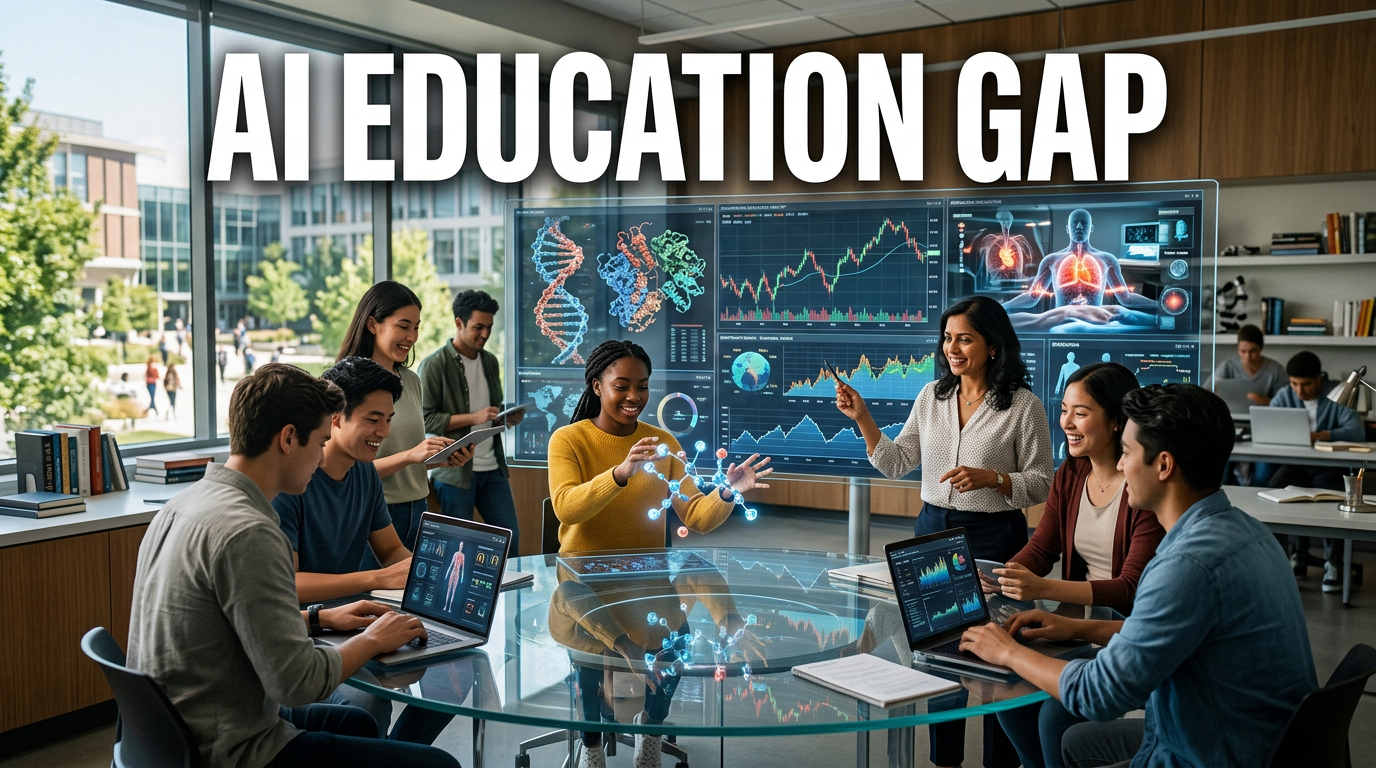
These days, “AI is good” is too common, right? But what Claude showed this time isn’t just at the level of summarizing or organizing—it’s the key takeaway. With a single line like “Show parallel processing (GPU vs CPU)”, it produces a flow that goes from graph → animation → a simulation the user can directly manipulate. For readers, there’s exactly one thing that matters most here. The AI solves the problem where you “pretend to know with your head” from text/explanation, but the actual structure doesn’t stick by making it happen visually as an action. Especially, this kind of education/understanding approach is very likely to create big learning gaps in the future.
1) The Essence of Claude’s Update: Static Explanation → Dynamic Visualization (Simulation)
① A Method That Builds “Intuition,” Not “Explanation”
Most prior AI use looked like this. – “Summarize” – “Compare” – “Explain why that is” That’s not wrong. The issue was that difficult concepts (e.g., GPU/CPU parallel processing, memory bandwidth, core architecture) might seem understandable when you read text, but it’s hard to “lock in” the actual structure in your mind. This is where Claude goes one step further. It shows, in the “moving state” of a picture when the user requests it, and even lets users manipulate it directly.
② Designing an Experience Where Understanding Changes When You Try Manipulating It
The most striking scene in videos/explanations was this. – When the number of tasks is (e.g., 4), the GPU/CPU don’t seem to differ much – When you increase the number of tasks – the GPU finishes quickly with parallel processing – the CPU takes longer due to sequential processing – So the result comes in not as a “number,” but as something you can feel In other words, AI doesn’t convince users—it makes users understand by running experiments themselves.
2) Why It Works Across Any Domain: GPU vs CPU, Math, Science… Without Limits
① Computer Architecture Used to Be Hard Because It’s “Abstract,” but Now It’s Turned into “Movement”
GPU/CPU are among the toughest topics. – GPU: parallel processing (many tasks at the same time) – CPU: sequential processing (one at a time/few parallel tasks) – The differences come from structures like the number of cores, scheduling, memory/bandwidth But in text, you don’t really see this structure. This approach shows “why parallelism gets faster” by changing the workload and displaying it as a simulation, so understanding sticks quickly. That’s the core capability of educational AI interactions.
② In Math, Understanding Improves Faster When the “Proof Method” Itself Is Visualized
Topics with multiple proof methods—like the Pythagorean theorem—are especially like this. – When the slides move – When rearrangement/diagram unfolding looks like a “process” – Then you finally feel, “Ah, so that’s why it holds.” In the past, if you couldn’t catch the proof process in one shot from an image, you’d just end up memorizing it. Now, because AI shows the “process” as animation, the learning structure changes.
③ Earth Science (revolution/rotation/seasons/solar eclipse/lunar phases) is all about showing “change over time”
Earth science is especially weak in text. Because the essence is “change over time.” – revolution/rotation – seasonal changes – solar/lunar eclipses – lunar phases/tidal phenomena If you let the user run a simulation while adjusting the time speed, it becomes far more intuitive than textbooks. So Claude’s strength is not “the picture” itself—it’s reproducing action (change).
④ Engineering (semiconductor processes) has so many steps that “animation” is basically essential
Semiconductor processes include wafer slicing → oxidation → photoresist application → etching → implantation/deposition → wiring → die singulation & packaging, and more. There are too many steps, so if you follow it with text, your head gets exhausted. But animation shows the connections between steps immediately. So you can say it has especially high usefulness in engineering education.
3) Economics/Finance Doesn’t End at “A Calculator”—It Evolves into “Scenario Comparison”
① Loan Calculators: Beyond Numbers, You Feel It Through Graphs
Loan calculators already had many tools, but this trend is even stronger. – equal principal and interest vs equal principal – deferment periods – changing the repayment method – changing the term If you adjust these with sliders and visually show the repayment amount, the principal/interest ratio, and how the balance decreases, users won’t just “understand the calculation results”—they’ll feel the principles behind the change.
② FIRE (Retirement) Calculators: How Assumptions About the Withdrawal Rate Change the Future
FIRE has especially many variables. Based on a withdrawal rate (e.g., 4%), – at what age you can retire – how much funding you need – how the balance moves as time passes If you compare this with graphs and simulations, the problem of “I understood it in words, but I can’t get a feel for it in reality” decreases.
③ Economic Graphs (AD/AS, IS-LM, exchange rates/FX markets) as a “manipulable learning tool”
In studying economics, the point where people get stuck the most is graphs. – interpreting AD/AS curves – the IS-LM relationship – exchange rate/foreign exchange market flows Click them, move them, and change the variables, and learning becomes closer to “experimenting with principles” rather than “memorizing formulas.” This is the direction where AI would practically implement constructivism (where learners interact to construct knowledge) as discussed in education.
4) Shift in the Education Paradigm: AI That Lowers “Experience Cost,” Not “Knowledge Transfer”
① Traditional textbooks had a high “experience cost”
In the past, education focused on “delivery.” It’s a method where the teacher transfers what they know to the students. Even if you try to move toward constructivism, in reality you lacked tools. For example, you can’t always keep turning the Earth model, or actually “watch” and change the semiconductor process from a book.
② AI interactive visualization makes the “experience cost” effectively close to 0
That’s why someone said you can compare it to the printing press of the two Berks. – Printing press: lowers the cost of reproducing knowledge – AI interactive visualization: lowers the cost of experiencing knowledge In the end, what you should learn may become less important than how you should learn.
5) (Important) The “Gap” This Change Creates and the Strategy Ahead
① If you only use it like a search bar, the gap can grow
The key takeaway is this. Many people still use AI like this. – question → answer (text) → done But the direction Claude showed is – question → generate visualization/animation – further, manipulate scenarios/run simulations – fix understanding by comparing results This difference in steps can quickly turn into a difference in capability.
② “Use it right away” from the reader’s perspective (execution tips)
To apply from today, you should change request sentences like this. – Instead of “Explain,” – “Show it through visualization of the concept” – “Simulate how the results change as you adjust variables” – “Compare parallel processing like GPU vs sequential processing like CPU” – “Show how the difference looks when you increase the number of tasks from 4→16→64” With this, the AI won’t be just “talking”—it will make you run understanding experiments.
Main message to convey (a one-line conclusion that isn’t said well elsewhere)
The real turning point for AI isn’t the ability to “summarize/explain,” but lowering the experience cost of learning through interactive visualization (simulation) that makes users understand by directly manipulating it. So in the future, it’s very possible that people who create simulations will understand faster and grow more than people who simply ask better questions.
[Additional Key Emphasis] The “one line” spoken in the video actually changes the entire learning method
Just like requests such as “Tell me how to visualize the process of full elimination,” a one line that specifies the form of the output (visualization/animation/simulation) makes the difference. That’s the biggest message Claude’s update delivered to education.
✅ Points Connected from a Global Economic Outlook Perspective (Why This AI Education Matters)
This trend doesn’t end as a simple education news story. Because similar principles are applied in companies and industries too. – Productivity: calculation/design becomes faster with “visualization + simulation” – Talent gap: difference between those who only have document-based understanding vs those who acquire it quickly through interactive experiments – Tech diffusion: modeling/verification cycles shorten in fields like semiconductors, finance, and logistics If you connect it with economic keywords, then in the future the market may become more sensitive to variables like AI investment expansion, productivity, demand for semiconductors/data centers, AI regulation/compliance, and interest rates and cost of capital. In other words, this kind of AI education/visualization can connect to industrial competitiveness beyond being just a personal study tool.
SEO Keyword Naturally Inserted (Core Themes Embedded in the Article)
The trend covered in this article ultimately intersects with topics like generative AI, AI agents, educational AI, the semiconductor industry, and productivity innovation
< Summary >
– Beyond “explanation,” Claude shows difficult concepts like GPU/CPU as visualization + animation + a manipulative simulation – Because users change variables (like number of tasks) and feel the results, understanding becomes fixed quickly – Broadly applicable to math, earth science, engineering (semiconductors), finance (loans/retirement), and economics (AD/AS, IS-LM, exchange rates) – Education is likely to place more importance on lowering the experience cost than on knowledge transfer – A “search-bar answer” usage pattern can create a gap, and asking questions that specify the output form (visualization/simulation) becomes a competitive advantage
[Related Articles…]
*Source: [ 월텍남 – 월스트리트 테크남 ]
– 안보면 후회할 클로드 꿀팁 영상..”한마디”만 추가하세요