● Humanoid Robot Race
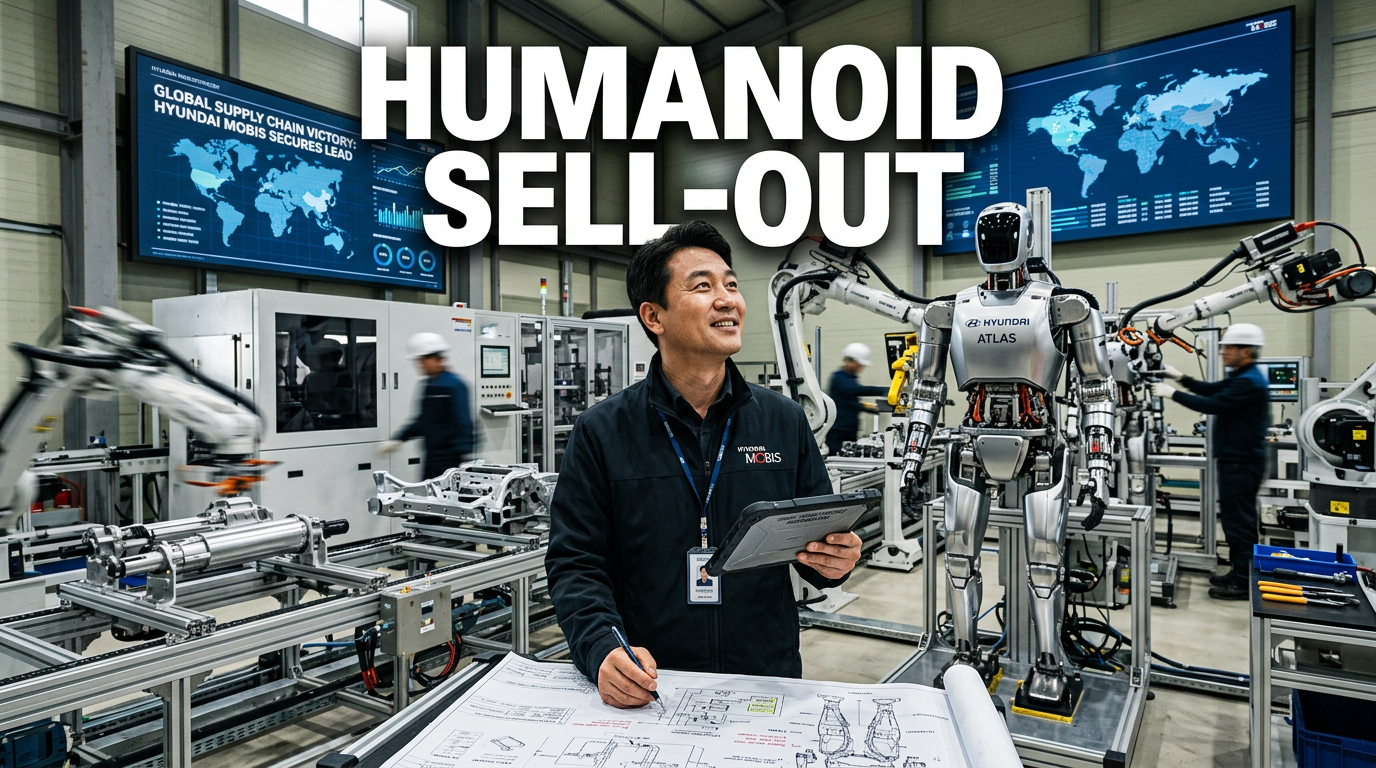
“Humanoid Robot Commercialization Race” — The Real Reason Boston Dynamics Won: 2026 Units ‘Sold Out,’ a Comeback Move Made by Hyundai
3 core points you should see right now (the most important takeaways included in this article)
- The fact that the 2026 Atlas production volume is already ‘sold out’.
- While people’s attention was on “Tesla bots,” the deciding factor was that commercialization was first completed by the ‘automaker’ (Hyundai).
- The key component that separates the cost problem wasn’t AI or cameras; in the end, it came down to the ‘actuator (electric joint drive)’.
If you connect these three, the conclusion becomes clear.
“Robots aren’t driven first by technology; supply chains and factories (manufacturing base) come first.”
Atlas serial production starts in 2026, but why is it ‘already sold out’?
- At the Las Vegas event, Boston Dynamics officially announced entry into serial (Serial) production of the Atlas humanoid.
- Even more surprising is that the 2026 production run wasn’t just a plan but had already been sold (committed).
- Usually it goes “demo → validation → initial adoption → expansion,” but this time the pace is far too fast.
Meaning of the market reaction
- It can be seen as a sign that demand is solidifying for industrial robots—not yet a consumer “home robot,” but robots businesses buy.
- In other words, humanoids are passing the logic of productivity and cost reduction, beyond just “fun video content.”
“Why did people say humanoids would take 10 more years?”: the rules of the game everyone missed
The idea that the humanoid robot market will grow has been around for a long time.
But why did commercialization keep getting delayed? Here, the perspective splits.
- The issue isn’t the form factor (arm/leg shape), but industrial reliability.
- In a lab, you can just redo it if it falls, but in a factory, “downtime” is cost.
- In the end, the contest is decided not by overall robot performance, but by component reliability + maintenance + the structure for mass production.
Why humanoids ‘became necessary’ after Fukushima
The starting point of this article is one event.
- The Great East Japan Earthquake in 2011 → tsunami
- After the Fukushima nuclear power plant accident, access to internal facilities was difficult.
- But the bigger shock was that in an environment where “a person would die,” there simply weren’t enough robots to go in.
DARPA’s conclusion was straightforward.
- Buildings and facilities are ultimately designed around “a structure that people can move through,” so
- you need arms and legs to perform the work.
That’s why programs like DARPA Robotics Challenge accelerated humanoid development.
This is the flow where Boston Dynamics delivered results early on, leading to Atlas.
Where DARPA, Google, and SoftBank got stuck: “We made robots, but we had no manufacturing”
This section is truly important.
Because it wasn’t a lack of technical capability—it was a lack of business/manufacturing capability.
1) Google: you saw the ‘platform,’ but there was no factory
- The background to Boston Dynamics’ acquisition was expectations of expanding the robot market.
- But fundamentally, Google is a software/data-focused company, and it had no factory-based structure to mass-produce physical products.
- In other words, it was hard to solve the bottlenecks for robot commercialization (component supply chain/assembly lines/quality management).
2) SoftBank: ‘investment’ was strong, but ‘production’ was weak
- SoftBank’s structure favored growth stories built on massive funds.
- Ultimately, investors can’t directly build an “expandable manufacturing system.”
- As a result, models like Spot were sold, but Atlas still had a strong research character—this is connected to the same reason.
The decisive move: why Hyundai made commercialization happen (actuators)
Here, the article’s conclusion lands firmly.
“In humanoid robots, the most expensive part isn’t AI—it’s the actuator.”
- According to the perspective shared by Hyundai Mobis, actuators can account for 60% or more of a robot’s material cost.
- Why that matters: actuators aren’t just “parts that make it move”—they determine grip force, resistance sensing, and shock response (not breaking).
- The problem, however, is that making actuators that meet 8–10 hours of durability in industrial environments into mass production is difficult.
Hyundai’s ‘secret weapon’ was a component that was already in their factories
- The actuator structure is similar to an automotive electric power steering system.
- Hyundai Mobis has experience producing electric power steering with global volume.
- That means Hyundai didn’t “invent a brand-new component.”
Instead, it transplanted existing accumulated manufacturing capability into robots.
This single line changes the game board.
It wasn’t a matter of “a company with technology”—it was that a company with parts/supply chains that can produce technology won.
Where the new Atlas specs point: not ‘human copying,’ but ‘industrial suitability’
Boston Dynamics’ Atlas emphasizes that it isn’t a model that simply copies the human body.
- Size: about 1.9 m / Weight: 90 kg
- Working radius: 2.3 m
- Degrees of freedom: 56 joints
- Feature: some joints can rotate 360 degrees
- You can understand the design as prioritizing efficiency by rotating only the joints needed for the task, instead of forcing rotation of the entire body.
Its task capability is also geared toward industrial work, not “video-trick” performance.
- Max payload: 50 kg peak
- Repetitive work standard: 30 kg continuous
- Tactile sensors + palm camera + head-based 360-degree view
- Safe stop when detecting people/obstacles
- IP67-level protection (generally solid against dust/water splashes for an industrial grade)
- Battery replacement after one use: automatic swap in about 3 minutes
The ‘brain’ isn’t “all-in direct development,” but optimized by combining partners
There’s also a point here.
Atlas isn’t portrayed as a brain built by a single company; it’s a structure that completes the system by attaching a strong partner ecosystem to raise overall quality.
- Boston Dynamics: physical control (dynamic balance, joint coordination) focus
- Upper-layer reasoning/robot understanding: Google DeepMind-related, Gemini Robotics, etc.
- VR learning-based technology (linked with the Toyota Research Institute)
- If you demonstrate a task via VR once, the system extracts principles and transfers them to similar tasks
And the most operationally practical connection is the operating system.
- Orbit (fleet management platform)
- Task allocation, performance monitoring
- Connected with existing production systems
- Detects safety issues with a vision model (e.g., spilled products/product debris accumulation)
So it’s not that one unit is smart by itself—
the direction is incremental improvement through shared data accumulated from multiple units.
The moment expensive pricing stops being a wall: how TCO (total cost) changes the calculation
Atlas pricing hasn’t been officially disclosed clearly, but articles/analysis commonly mention the following range.
- About 130k–320k dollars (estimated per unit)
When you look at the competitive landscape too, you get the picture.
- Tesla Optimus: long-term target of 20k dollars mentioned
- Unitree: several thousand dollars (smaller-spec humanoids)
Even so, the reason Atlas is already ‘sold out’ is simple.
Companies look not at sticker prices, but at “total cost of ownership (TCO).”
- Atlas operates on 3 shifts, 24/7
- Reduced variables like vacation/sick leave/fatigue/skill drop
- Calculated over a 10-year usage period, the logic is that “daily cost” becomes favorable compared to labor cost.
This is a point commonly missed in the AI/robot market.
It’s not “how impressive the robot is.”
It’s how long and how reliably it can work—and how that total cost beats labor cost.
Who buys it? Not half of the 2026 volume—mostly Hyundai + Google (DeepMind)
- The 2026 production run is said to be split between two customers.
- 1) Hyundai: Robotics-related facilities in Georgia, USA (R&D/validation/phase for deployment preparation)
- 2) Google DeepMind: a purpose to further advance Gemini robotics in the lab
Here’s another interesting point in this segment.
Hyundai isn’t just planning simple deployment—it’s described as using Atlas first in an R&D stage for validating next-generation process workflows, then gradually expanding into actual production lines (assembly/part handling/machine serving, etc.) as part of a roadmap.
Hyundai built the factory too: a closed-loop of “robot manufacturing → robot deployment” targeting 30,000 units/year
The strongest signal is this.
- Hyundai is building a humanoid robot-dedicated factory in the United States
- Target output: 30,000 units per year
- This isn’t just a strategy as an “adopting company”—it’s interpreted as building a manufacturing ecosystem that produces robots again.
With this, the competitive landscape is likely to shift faster toward “production scaling capability” rather than “technology strength.”
What will change going forward: the humanoid robot market grows first in factories/logistics, not in homes
Humanoid robots taking off with the general public will take time.
But early demand comes from places where it’s relatively predictable.
- Manufacturing/assembly
- Warehouses/logistics
- Repetitive work (sorting/alignment/order processing, etc.)
Overlapping macro factors further reinforce this:
- Aging and intensifying labor shortages
- Increasing pressure to raise the cost of hiring people
- Robot economics improving (operating efficiency + durability + TCO)
- A time when accumulated research-level technology rises to production level
So AI innovation isn’t ending at “videos.”
It’s entering industrial operating models.
There is also a counterargument (but the direction has still changed)
Even if you summarize the skeptics’ view, it’s like this.
- Demos are demos; mass-production factory reliability hasn’t been proven
- Prices are still high, so there’s a chance it remains mainly for large enterprises
- If Tesla reaches its target price (e.g., 20k dollars), the market could change
But the core issue is more about “when.”
There’s a strong view that the direction itself has already changed.
The evidence is the 2026 sold-out production and the factory buildout.
The conclusion of this race: maybe the winner was the one who was smarter—and had the stronger ‘manufacturing base’
The message this article leaves you with is exactly this:
- Google: strong at platform/data, but had no manufacturing base
- SoftBank: strong in capital, but had unfavorable factory operations
- DARPA: created the need, but couldn’t carry the manufacturing structure for commercialization all the way through
- Hyundai: already had key components in mass production (actuators), and execution was faster because it needed to solve real factory problems
So the Atlas story isn’t just a technology saga—
it becomes an example of how technology connects directly to production.
Viewpoints you can use right away in a blog (the ‘real important points’ that people talk less about elsewhere)
1) Humanoids are not a competition of AI—it’s a competition of ‘component supply chains.’
- Joint actuation (actuators) is directly tied to industrial reliability.
- Ultimately, the winner isn’t the “smarter model,” but the one with joints that last longer and can be mass-produced.
2) The moment TCO flips the game beyond sticker price has arrived.
- When numbers like 24/7 operation and 10-year deployment come into play, the comparison versus labor cost changes.
3) The future robot industry goes to a closed loop of ‘factory (robot manufacturing factory) + site (robot deployment factory).’
- Companies that don’t just “deploy” like Hyundai, but also capture “production,” are more likely to succeed.
Main content to convey (one-line summary)
The winner of humanoid commercialization wasn’t “who built demos faster,” but “who acquired factories and the component supply chain faster.”
And the essence of this news is that Atlas is at the starting point, and the decisive partner was Hyundai (actuators/manufacturing capability).
Keywords for SEO (core sentences naturally integrated)
- This momentum is a sign that AI robot commercialization is expanding beyond simple demonstrations into a manufacturing ecosystem.
- Especially important is that the bottleneck in robot automation is not technology, but supply chain/actuators.
- In the end, industrial AI wins not with “models” but with “operating systems” and “TCO.”
< Summary >
- Boston Dynamics’ Atlas entered serial production, and the 2026 allocation is already sold out.
- Humanoids split not in demo competitions, but in manufacturing base (TCO, supply chain, component durability).
- Google/SoftBank had technology/capital, but lacked factory/mass-production structures.
- The key reason Hyundai won was that it could supply actuators (joint drive units) with automotive mass-production capability.
- The new Atlas strengthens industrial suitability with 56 degrees of freedom, some 360-degree rotation, and IP67 protection; it expands via operational systems like Orbit/VR learning.
- Companies judge not by sticker price but by total cost of ownership (TCO), and 24/7 operation reduces the price barrier.
- Ultimately, the contest is shifting from “AI performance” to the ability to manufacture, run, and operate robots longer, more, and more reliably.
[Please check related articles…]
- Atlas robot commercialization: the next step of AI robot automation implied by the 2026 sold-out situation
- Actuator supply chain decides the winner: the essence of the humanoid robot manufacturing competition
*Source: [ AI Revolution ]
– Boston Dynamics Won The AI Robot Race With This One Move