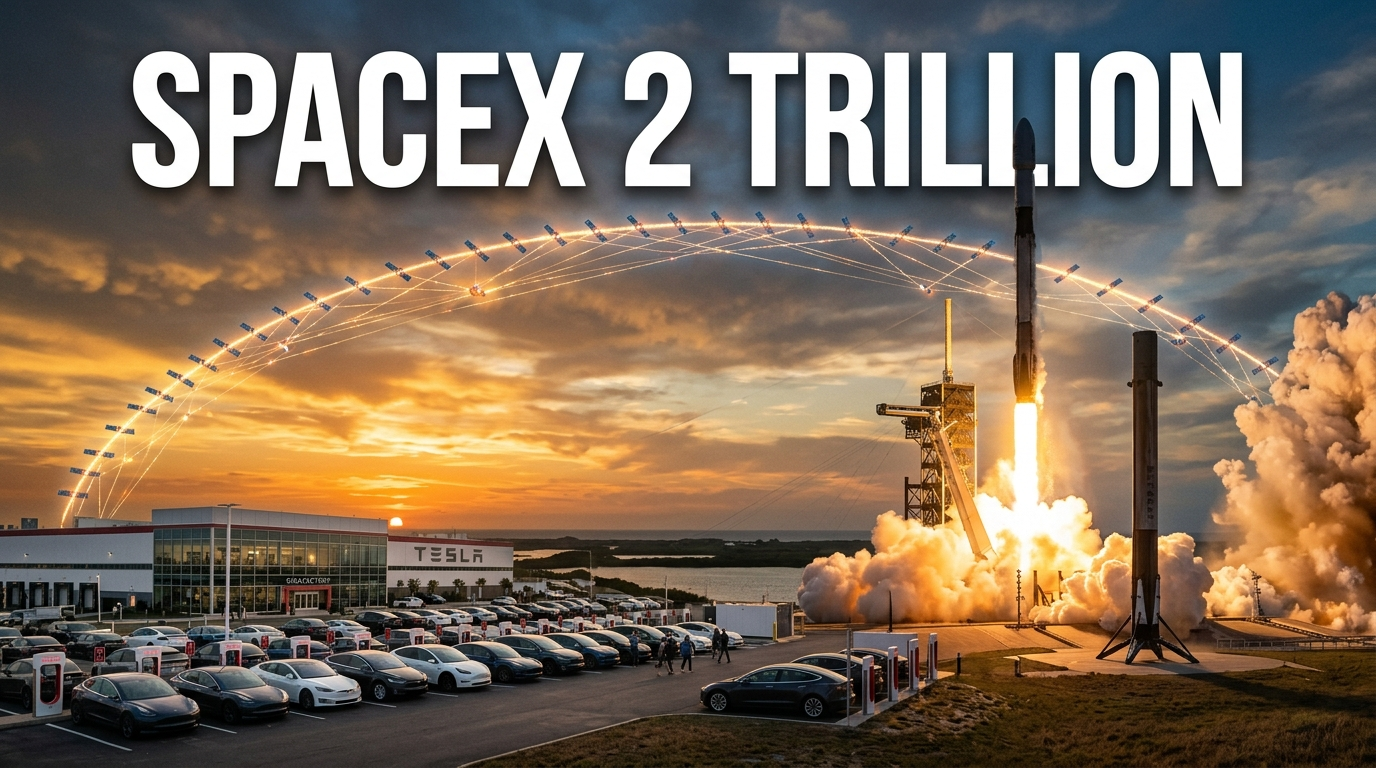
● Starlink Valuation Shock
3 Reasons Why SpaceX Is Valued Higher Than Tesla: Communication-Reuse-Laser Are One Set
Key points you must take away in today’s post (If you don’t miss this, understanding is complete)
1) SpaceX isn’t a “rocket company”;
it’s more like a satellite-based communications platform.
2) The core of the valuation (corporate value) debate is
the structure of creating a virtuous cycle by lowering launch costs through rocket reuse.
3) The laser technology that communicates between satellites isn’t just a simple specification—it effectively works as a moat (competitive advantage).
And as a bonus,
I’ll connect and explain the key keywords of the 6G era (expanded satellite coverage, integration with physical AI/robots/autonomous driving) as well.
1. Why You Should Be Surprised Even at “$2 Trillion+” in Enterprise Value: SpaceX Is a Communications Operator
In recent discussions around SpaceX’s listing (IPO) related valuations, the corporate value mentioned is
around the level of $2 trillion (and more—there are views that it could exceed $2 trillion).
At that level, it’s unavoidable that it looks “more expensive” in the market than manufacturing/automotive companies like Tesla.
The first reason cited is that the revenue structure is “communications.”
As laid out in the original flow of the article,
SpaceX is assessed as a “model close to a communications company,” earning a substantial portion of its total revenue (around 70% level)
from satellite communications.
Why Satellite Communications Make Money? Connecting to the Definition of 6G (Satellite-Earth-Satellite Link)
In general, there’s a view that 5G will build coverage centered on terrestrial base stations,
while 6G will have satellite-based connectivity as the key.
What’s important here isn’t “a satellite far out in space,”
but rather that satellites in orbit over Earth (at hundreds of kilometers altitude)
are used to link satellite-to-satellite communications plus user communications on Earth together as one system.
Then comes the logic that SpaceX’s influence grows as coverage expands through infrastructure like Starlink (satellite internet).
To sum up,
there’s a strong perspective that SpaceX is not a “company that goes to space,”
but a “company that builds a communications network laid over space.”
2. Why SpaceX Lowers “Launch Costs” Through Reuse: The Price per kg Determines Market Dominance
The keyword that always comes up when describing rocket companies is “rocket reuse.”
In the original text, the core argument is exactly this.
If you use and discard a rocket once, the cost structure doesn’t add up,
whereas SpaceX is pushing toward
dramatically lowering the launch unit cost by recovering and reusing rockets.
How Does This Directly Link to a “Higher Valuation”?
From an investor’s viewpoint, the real meaning of reuse is not the “coolness of the technology,” but “economics.”
Based on the original text,
it mentions that launch costs were reduced to about “one-tenth” compared with other companies.
In terms of concrete numbers, compared with roughly $2,700 per kg,
the logic is that SpaceX created stronger cost competitiveness at lower prices.
And like the approach Elon Musk argued in electric vehicles,
it’s interpreted as an attempt to apply the loop of
“mass production (engineering-based) → ecosystem → price decline”
to the space launch industry as well.
Answer to the Question “There Are Already So Many Satellites”: More Launches Are Needed for “Data Center + AI” to Be Profitable
A question naturally arises: “If we already installed enough satellites, are we going to keep launching them in the future?”
The original text answers with two lines of thought.
First, it views that coverage/demand/technology advancement still isn’t sufficient.
Second, it’s not just about launching satellites—
because the goal is a space data center (an infrastructure that processes AI/compute/data in space),
the argument is that more satellite launches and deployments are necessary.
3. Why Laser Communications (Optical Communication Between Satellites) Works as a Moat (Monopoly/Barrier)
When you bundle the three core technologies SpaceX has, the original flow is as follows.
1) The technology to launch satellites
2) The technology to communicate between satellites (laser communications/optical communications)
3) Reuse technology to launch rockets more cheaply
Why Laser Communications Are Difficult: “You Have to Align,” but Satellites Move Fast
The real difficulty here isn’t “using lasers,”
but the precision of aligning each other’s positions.
Keeping the analogy from the original text,
with thousands of satellites moving quickly,
you still have to connect laser links “like lines” between each other.
In other words,
it’s close to the problem of continually adjusting optical communication paths
targeting countless moving points.
Moat Point: SpaceX Develops the Laser Modules Itself and Lowers Costs Too
In the original text, before SpaceX,
laser modules were expensive, so
the unit price burden was significant,
and SpaceX lowered costs by directly developing key components (laser modules),
(about one-tenth level) and as a result, scalability increased.
Ultimately, this affects both “communication quality between satellites” and “expansion costs.”
So laser communications aren’t just a component technology;
they can be evaluated as a structural competitive advantage where
the satellite network becomes stronger as it grows (more favorable as it expands).
4) Why “Space Data Centers” Still Seem Like Distant Talk, Yet the Market Is Paying Attention
Space data centers may look not very realistic in the near term.
In the original text too, questions like “Why not build it on Earth?” come up naturally.
Even so, two reasons to choose space
1) Space is advantageous for cooling (heat treatment)
2) It can receive solar energy more efficiently
On Earth, solar energy efficiency drops due to rain/night/seasons,
but the logic is that in space, you can orient toward the sun, potentially increasing energy efficiency even more.
A Practical Barrier: Eventually Economics Only Works If Launch Costs Drop Even Further
A particularly important number is mentioned in the original text.
To make space data centers economically viable,
the cost to launch satellites must drop dramatically compared with now, and
there’s also mention that it needs to come down to as low as $200 per kg as a benchmark.
In other words, SpaceX’s goal isn’t just “launch a lot of satellites,”
but to change the cost curve of space infrastructure by “launching cheaper and more.”
Starship (Large Rocket) and Payload Expansion: The Key Is Carrying More at Once
Based on the original text, Starship has a much larger volume/payload capability than the existing Falcon series, so
even with the same number of launches, you can carry and send more satellites.
That’s why there’s a picture that cost improvements like “one-tenth” could become possible.
5) The Moment Communications-Launch-Lasers Come Together: It Also Aligns with the 6G/Physical AI Era
In the original text, the need for 6G isn’t just about speed competition;
it’s about the safety of “connected coverage” and “future industries (physical AI).”
Why 6G Becomes More Important from the Perspective of Physical AI (Robots/Autonomous Driving/Drones)
Following the flow of the original text,
in fields like robots, autonomous driving, and UAM (vertical takeoff and landing drones),
it’s not that they only operate in areas where terrestrial networks are laid out like humans;
if coverage drops, “connectivity-based control” can be destabilized.
So in response to the question “Is 5G enough by itself?”
the logic is that in environments like long distances, at sea, in flight operations, and deserts, satellite-based coverage becomes more important.
Here, SpaceX already has an “operating satellite internet” image with Starlink,
so it gains expectations by connecting to future demand (the spread of physical AI).
6) The Competitive Landscape Isn’t Zero% Right Now, but the “Technology + Cost Curve” Becomes the Wall
In the original text, there’s also the question: “A perfect monopoly doesn’t exist, right?”
Other companies like Amazon’s Kuiper and Rocket Lab also have plans for space internet,
but there’s a nuance that SpaceX’s network scale, communications technology, and cost structure could maintain an advantage for a while.
In the end, while competitors may emerge over time,
the perspective is that the deciding factor is “who reduced the cost curve faster in the early stage and scaled it.”
Re-read from an independent reader perspective “in one line”
The logic that makes SpaceX expensive is,
“By lowering launch costs through rocket reuse, we place more satellites;
by upgrading the satellite network with laser communications,
and because that communications infrastructure pulls in demand in the 6G/physical AI era.”
So SpaceX is being re-evaluated not as a “space business,”
but as a “space-type communications infrastructure business.”
The “most important extra summary” that’s easy to miss in other posts
Most people view SpaceX only as a “rocket,”
but the most decisive point in this original text is that
rocket cost reduction (reuse) + laser communications between satellites (moat) + communications revenue (cash flow)
all three must work at the same time for the enterprise value to be justified.
If even one of them is missing, it can end as a “future story,”
but SpaceX is already making money through communications (cash flow),
creating expansion barriers (moat) with network technology, and
having a loop that allows it to keep launching by lowering unit costs through reuse.
That’s why the key point in the IPO valuation is that the market reads it as
a communications platform + network effects premium,
not a “rocket company premium.”
< Summary >
SpaceX’s high enterprise value (observed at $2 trillion+ ) comes from the viewpoint of seeing it as a “satellite communications platform,” rather than a “space rocket company.”
There are three core reasons.
(1) A large portion of revenue comes from satellite communications (like Starlink), creating solid cash flow,
(2) by lowering launch costs (cost per kg) through rocket reuse, it builds a cost structure that allows it to launch more, and
(3) by precisely building links with laser (optical) communication technology between satellites, it strengthens expansion scalability and the moat (competitive advantage).
With this, expectations for future growth are added as 6G satellite coverage expansion and demand integrating with physical AI (robots/autonomous driving/UAM) connect.
[Related Posts…]
Rocket Reuse Innovation and Cost Decline
The Satellite Communications Market and Key Points in the 6G Transition
*Source: [ 월텍남 – 월스트리트 테크남 ]
– 테슬라보다 스페이스X가 비싼 세가지 이유