● Tesla Shock Reversal, Musk Sparks Selloff, AI Boom Delayed
Tesla Post-Earnings Shock: After-Hours Reversal from +4% to -1% Following Musk’s Comments — Key Points Shareholders Should Monitor
This quarter’s results were strong on headline metrics. However, the market focused less on reported figures and more on the timing of monetization and cash-flow realization. This report summarizes (i) why the quarter read as an earnings surprise, (ii) why the stock reversed during the earnings call, and (iii) how to frame the update from a long-term investor perspective.
Key elements include: the primary drivers behind the operating income surge despite weak deliveries; how FSD, insurance, energy, and AI infrastructure can converge into a single monetization model; three earnings-call statements that triggered the strongest market reaction; and the “valuation timing gap” risk that is often underemphasized in mainstream coverage.
1. One-line summary: “Results were solid; expected monetization moved out”
Following the release of Tesla’s 1Q 2026 results, the stock rose nearly 4% in after-hours trading.
The initial move reflected multiple beats versus expectations:
- Operating income: $0.94B
- +136% YoY
- Operating margin: 4.2%
- Revenue: $22.4B, +16% YoY
- Non-GAAP EPS: $0.41, above consensus
Sentiment shifted materially once the earnings call began. Management emphasized accelerated investment, while indicating that meaningful monetization may be more likely in the next year and beyond. The market interpreted this as a delay in near-term growth catalysts.
After-hours price action reversed from approximately +4% to around -1%, underscoring a prevailing market preference for near-term cash-flow visibility over headline earnings strength.
2. Deliveries were weak; why were results stronger?
The most visible negative in the quarter was vehicle deliveries:
- Vehicle deliveries: 385,000
- Down more than 14% vs. prior quarter (418,000)
- Below market expectations
Energy storage was also weaker than anticipated, declining meaningfully versus the prior quarter. On the surface, these metrics did not suggest a particularly strong quarter.
The income statement, however, implies that Tesla’s results are increasingly driven by non-vehicle dynamics, limiting the explanatory power of a pure “EV manufacturer” framework.
3. Three primary drivers behind the operating income surge
3-1. FSD subscription growth and software-margin leverage
A critical driver was expansion in FSD subscriptions:
- Active FSD subscribers: 1.28M
- Up approximately 180,000 vs. prior quarter
Software subscription revenue has materially different economics than incremental vehicle production. Once developed, software scales with relatively limited incremental cost, allowing margins to expand more rapidly as subscribers grow.
The linkage with insurance is strategically relevant: broader FSD usage can support improved safety outcomes and pricing dynamics, potentially enabling a feedback loop of FSD adoption → data accumulation → accident-rate improvement → insurance profitability improvement.
3-2. Battery cost reduction and vertical integration benefits
The second driver was cost reduction.
Tesla continues to strengthen vertical integration across lithium refining, cathode materials, and 4680 battery production. This strategy is not solely a manufacturing expansion; it increases supply-chain control and bargaining power across raw materials and components.
Lower unit costs can lift profitability even in periods of softer volume. This appears to have been a meaningful contributor to margin improvement in the quarter.
In the current macro environment, where commodities, FX, and supply-chain constraints can drive earnings volatility, vertical integration can also function as a structural risk-mitigation approach.
3-3. Foreign-exchange tailwinds
The third driver was FX.
A weaker U.S. dollar typically benefits companies with substantial international revenue. Reported results indicate that FX effects provided incremental support to both revenue and operating income.
Investors should treat this as an external variable rather than a core competitive advantage, and separate it from underlying operational performance.
4. From automaker to AI platform: what this quarter signals
The key takeaway is shifting from “units sold” to “installed platform monetization.”
Services and other revenue increased materially to approximately $3.7B. This category includes more than maintenance, with potential exposure to FSD subscriptions, Supercharging, insurance, and longer-term robotaxi-style operating revenue.
This supports the view that Tesla is transitioning from a hardware-led vehicle business toward a platform model combining software, energy, AI infrastructure, and robotics.
This transition matters for valuation methodology: conventional auto-sector margins and EV peer multiples may be insufficient to capture the evolving earnings mix.
5. Three growth pillars highlighted: Cybercab, Semi, Megapack
Management emphasized three growth vectors:
- Cybercab
- Tesla Semi
- Megapack
Each represents a pathway to incremental revenue beyond consumer vehicle sales.
Cybercab is positioned as a symbolic entry point into a robotaxi ecosystem; Semi targets commercial freight; Megapack expands Tesla’s presence in grid-scale storage.
Energy may be less visible than vehicles but can be positioned for more stable long-duration cash flows, supported by renewable buildout, grid stabilization needs, and rising data-center power demand.
6. Optimus: largest upside narrative and largest uncertainty
Optimus was both the most prominent and most debated topic on the call.
Tesla framed Optimus as a product moving toward scale, with references to production infrastructure, site planning, and longer-term capacity goals.
Market focus, however, remains on timelines. References to Fremont production start, Texas second-generation line timing, and delays around a third version imply that revenue recognition is unlikely to be near term.
Optimus can support a higher long-term narrative value, but near-term valuation is sensitive to execution proof points and timing.
7. AI chips and supercomputing: strategic push for AI infrastructure control
A central strategic theme was internal AI compute and semiconductor capability.
AI5 design completion, internal supercomputer expansion, and semiconductor production planning are not purely technical updates. They indicate a deliberate effort to reduce reliance on external GPU ecosystems and increase end-to-end control from training to inference.
In AI markets, the binding constraints are increasingly compute availability, power, and chip supply. For autonomy and robotics, data, models, chips, power, and manufacturing capacity are interdependent; internal control can be a strategic differentiator.
This theme aligns with broader industrial restructuring where competitive advantage is defined not only by model performance, but by compute and supply-chain control.
8. Three earnings-call statements that drove the reversal
8-1. Higher capex guidance: increased near-term cash outflow
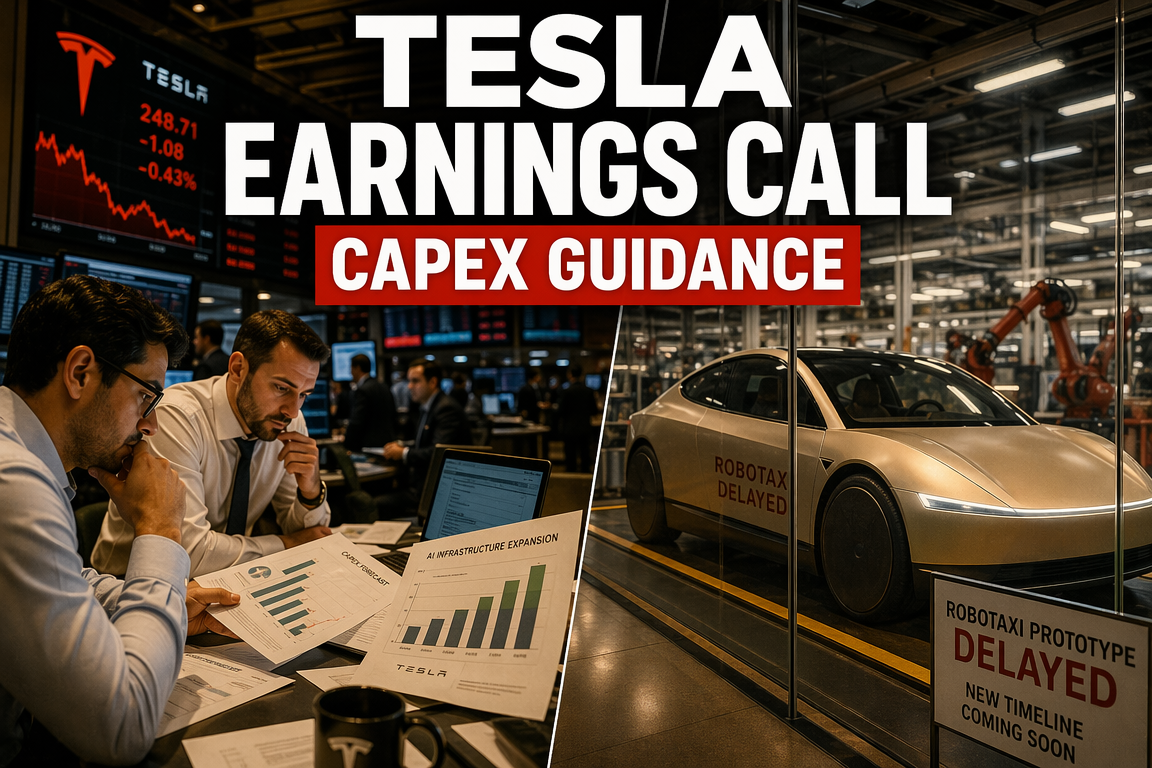
The strongest immediate trigger was higher capex guidance:
- Prior expectation: $20B
- Revised guidance: $25B
An incremental $5B is material. Strategically, it is consistent with investment needs across AI, data centers, robotics, semiconductors, and manufacturing capacity.
From an equity-holder perspective, this implies increased pressure on free cash flow, as spending occurs before monetization.
The current market environment is less tolerant of open-ended pre-investment without near-term cash-flow visibility.
8-2. Unsupervised FSD revenue: not meaningful this year
The second catalyst was timing for unsupervised FSD monetization.
Investors had partially priced in the possibility of material robotaxi or unsupervised FSD revenue beginning this year. Musk indicated it may not be meaningful this year, implying greater importance next year.
Given that a portion of Tesla’s valuation is supported by near-term autonomy monetization expectations, a timing push-out can mechanically reduce near-term momentum demand.
8-3. Optimus timelines: slower than some expectations
The third factor was perceived slippage in Optimus production timing.
While targets remain aggressive in documentation, verbal guidance suggested later deployment and scaling than some market participants expected.
Markets typically price optionality but require periodic validation of revenue timing; absent that, volatility can increase.
9. HW3 vehicle exposure: potentially material cost risk
A critical item was commentary on HW3 vehicles.
Musk effectively confirmed that HW3 vehicles may not be capable of unsupervised FSD. The remediation approach becomes central:
- Incentivize replacement into new vehicles
- Upgrade existing vehicles’ computers and cameras
Both paths carry operational and financial complexity. Upgrade programs, in particular, can impose logistics, labor, parts, and service-center capacity burdens, potentially affecting future margins.
This risk may be underappreciated.
10. SpaceX–Intel–Tesla semiconductor collaboration: implications
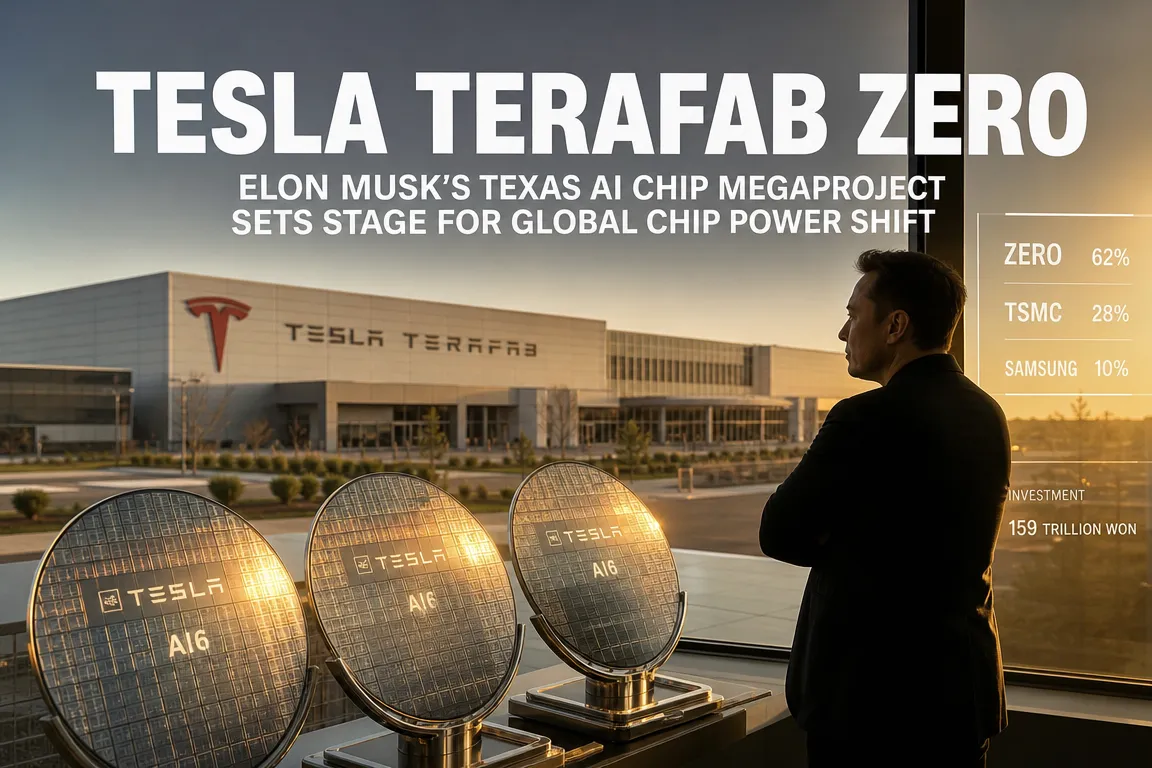
References to joint initiatives with SpaceX, Intel as a potential process partner, and plans for a research fab investment near Giga Texas reinforce the strategic priority of chip internalization.
This is best viewed as an attempt to control long-term AI semiconductor supply chains.
From a macro perspective, this is an aggressive move into a capital-intensive intersection of semiconductors, power, AI, and advanced manufacturing.
For investors, the core trade-off is that the strategic narrative is large, but execution costs are also large.
11. Implications for shareholders with a $387 cost basis
The quarter supports the strategic direction but requires a reassessment of timing.
For investors anchored around $387, two framing questions are central:
- Is the objective a near-term recovery trade?
- Or a 2–3+ year allocation to an AI/robotics/energy transition thesis?
Near-term headwinds are non-trivial: higher capex, delayed FSD monetization, Optimus timing uncertainty, and HW3-related costs were all reinforced.
For long-term investors, the quarter adds evidence of a transition beyond the “automaker ceiling,” but equity prices rarely move linearly. Rates, recession risk, broader U.S. valuation constraints, and sector rotation remain relevant external factors.
12. Key points (news-style summary)
- Tesla’s 1Q results exceeded market expectations
- Despite weak deliveries, operating income and EPS improved
- Drivers included FSD subscription growth, services revenue expansion, cost reductions, and FX tailwinds
- After-hours shares initially rose following the release
- Shares reversed during the call as capex guidance increased and monetization timing shifted out
- Meaningful unsupervised FSD revenue is framed more as next-year potential than current-year
- Optimus and AI chips remain long-term pillars, with limited near-term P&L impact
- HW3 remediation may become a material cost factor
- Market disappointment reflected timing of cash-flow realization, not a rejection of strategic direction
13. Underemphasized but critical issue: the “valuation timing gap” risk
The central question is not whether Tesla is “executing well” in the abstract, but whether the market’s valuation framework is shifting faster than Tesla’s monetization.
Tesla is increasingly valued partly as an AI platform, while reported earnings are still largely driven by vehicles, services, and energy. The wider this gap, the more earnings events can produce outsized volatility.
The key risk is not only technology failure, but timing mismatch.
AI infrastructure, robotaxi, Optimus, internal chips, and grid storage can represent durable long-term opportunities. However, public markets may compress valuation premia if the cash-flow inflection arrives later than implied by forward narratives.
This quarter’s core message: reported results were strong, but the present value of future cash flows was repriced modestly lower due to delayed timelines.
14. Investor checklist (monitoring items)
- Whether services and other revenue can sustain elevated growth next quarter
- FSD subscriber growth rate and insurance business linkage
- Where incremental capex is concentrated by segment
- Regulatory and commercialization progress for robotaxi/unsupervised FSD
- Optimus disclosure cadence and production validation milestones
- Progress on chip internalization and changes in external dependence
- Stability and growth of Megapack and broader energy segment
< Summary >
Tesla’s 1Q results were strong on headline figures. During the earnings call, higher capex, delayed unsupervised FSD monetization, and Optimus timing uncertainty drove an after-hours reversal.
The core framework remains a transition from an automaker toward an AI/robotics/energy platform. The market is primarily focused on monetization timing and cash-flow visibility.
This quarter was less about an earnings surprise and more about a shift in expected monetization timing; long-term narratives remain intact, while near-term volatility risk appears elevated.
[Related]
- Tesla earnings and robotaxi expectations: investment points to reassess now (https://NextGenInsight.net?s=Tesla)
- AI infrastructure competition accelerates: linkages across semiconductors, energy, and robotics (https://NextGenInsight.net?s=AI)
*Source: [ 오늘의 테슬라 뉴스 ]
– 시간외 +4%에서 -1%로 — 머스크가 어닝 콜에서 뱉은 한마디, $387 주주는 어떻게?
● Tesla Earnings Shock, AI Bet, Robotaxi Delay
Core Analysis of Tesla’s Q1 2026 Earnings: Results Held Up, but the Key Inflection Is Robotaxi, FSD, and AI Infrastructure Capex
This Q1 2026 earnings release should not be assessed solely on whether results beat consensus. Key market sensitivities included EPS, operating cash flow, and free cash flow, alongside forward-looking disclosures on robotaxi rollout timing, FSD subscription momentum, in-house AI chip/semiconductor strategy, energy segment implications, and Optimus production planning.
The central question was why forward investment direction mattered more than near-term financial prints, why the stock reaction softened after the call despite solid figures, and whether Tesla is increasingly positioned as an AI, energy, and robotics platform rather than a conventional automaker.
1. One-line takeaway
Headline financials were better than expected: EPS exceeded expectations, operating cash flow was strong, and free cash flow remained positive. Near-term liquidity appeared resilient.
The tone shifted during the earnings call. Tesla formally signaled capex expansion, implied that large-scale robotaxi expansion is more weighted toward next year than this year, and effectively confirmed that Hardware 3 vehicles are unlikely to support unsupervised full autonomy.
In summary: current-quarter execution was resilient, but the market is being asked to underwrite larger long-term investment while adopting a more conservative view on the timing of commercialization.
2. News-style highlights: what to focus on
2-1. Reported metrics were better than expected
- EPS beat expectations
- Strong operating cash flow
- Free cash flow remained positive
- Cash and equivalents increased
- Capex did not spike to the most bearish expectations
Capex was the primary near-term concern. Some expectations had centered on quarterly capex exceeding approximately $4B. The reported level did not reflect that magnitude of acceleration, reducing immediate concerns that Tesla is overextending financially while funding AI infrastructure, robotaxi scaling, semiconductor efforts, batteries, and Optimus.
2-2. Operating cash flow strength was a key signal
Operating cash flow outperformed accounting earnings, indicating stronger cash conversion. This is particularly relevant ahead of an investment upcycle and in a macro environment characterized by rates, supply-chain constraints, and geopolitical risk. Tesla demonstrated both a sizable cash position and ongoing cash generation.
2-3. FSD indicators were stronger than expected
FSD-related usage indicators (including cumulative driving metrics) accelerated meaningfully, suggesting adoption and engagement beyond simple fleet growth.
Implications:
- Higher software revenue potential
- Margin expansion opportunity
- Improved economic validation pathway for robotaxi over time
Given the higher margin profile of software versus hardware, FSD subscription traction is material to long-term cash flow expectations.
3. Why the market hesitated after the call
3-1. Capex expansion guidance was larger than expected
Management referenced the possibility of capex reaching approximately $25B annually, implying a higher quarterly run-rate than many investors had modeled.
This points to accelerated investment across:
- AI data center capacity
- Megapack/Terafactory footprint
- Chip initiatives
- Battery materials and related infrastructure
- Optimus manufacturing capability
Strategically, this can strengthen long-term positioning. Tactically, higher capex may pressure free cash flow and near-term per-share metrics, creating a less supportive setup for short-term price performance.
3-2. Robotaxi scaling timeline was more cautious than the market expected
While progress on unsupervised robotaxi operations was discussed, the tone suggested that meaningful commercial scaling is more likely next year than this year. This does not invalidate the long-term thesis, but it reduces near-term catalyst intensity for investors positioned for rapid scaling.
3-3. Hardware 3 is unlikely to support unsupervised autonomy
Management indicated that Hardware 3 vehicles are effectively not positioned for unsupervised full autonomy, raising potential considerations around:
- Customer remediation and support policy
- Upgrade pathways to newer hardware
- Cost and brand trust implications
- Future FSD packaging and positioning
A more explicit distinction between feasible and non-feasible pathways may improve credibility, but it introduces execution and customer-management complexity.
4. The core point: Tesla should not be framed purely as an “auto earnings” story
4-1. The strategic pivot toward an AI infrastructure platform
The release reinforced Tesla’s positioning as a platform that:
- Collects real-world driving data
- Trains AI models at scale
- Deploys them across autonomy/robotaxi, humanoid robotics, and energy systems
AI training infrastructure is central, linking Colossus, Dojo, AI5, next-generation silicon, and potential deeper vertical integration.
The message increasingly suggests Tesla aims to reduce dependency on external compute supply chains and may pursue expanded in-house design and manufacturing capabilities. This has implications for the broader AI value chain.
4-2. Why higher capex can be strategically consequential
Capex typically signals near-term cash outflows. In an AI-driven competitive landscape, the ability to secure compute, data, deployment experience, and supply stability can be determinative. The call implied that management views this as a time-sensitive capacity build rather than discretionary spend.
This also aligns with broader U.S. industrial themes: AI infrastructure, domestic manufacturing capacity, and energy resilience.
5. Segment-level assessment
5-1. Automotive: results were not exceptional, but the implications were not neutral
Key operating signals included:
- Higher mix of premium trims
- Continued unit cost reduction
- Early demand stabilization signals
- Regional improvement cited across parts of Asia, South America, and segments of Europe
- Continued emphasis on maximizing factory utilization
The focus appears to be on maintaining manufacturing efficiency and cost structure discipline amid intensifying EV competition.
5-2. FSD and robotaxi: the most important leading indicators this quarter
FSD subscription and usage data are not yet fully reflected in financial line items, but appear to be strengthening as leading indicators for future monetization. Software operating leverage can materially alter Tesla’s margin structure relative to vehicle sales alone.
Robotaxi remains the potential business model transition from unit sales to network economics; however, the call emphasized controlled scaling and validation rather than imminent rapid expansion.
5-3. Energy: near-term volatility, intact structural demand
The energy segment showed weaker-than-expected installation volume, contributing to investor uncertainty. Structurally, AI data center expansion increases demand for grid stability and storage, supporting long-duration storage deployments.
Megapack and related storage solutions increasingly function as AI-era power infrastructure, not simply an EV-adjacent business. The quarter’s softness may reflect timing and recognition variability rather than demand erosion.
5-4. Optimus: pre-revenue, but manufacturing preparation is becoming more explicit
Optimus remains in a preparatory stage, but disclosures increasingly emphasized manufacturing readiness:
- Early production preparation underway
- References to production line transitions
- Continued intent to scale manufacturing
- Long-term ambition for high-volume production (up to 1M units annually referenced as a strategic scale target)
As supply chain and line readiness become more visible, the market may begin to incorporate optionality into valuation.
6. Why this matters in a global macro context
6-1. The call highlighted where AI-era bottlenecks are forming
Identified constraints include:
- AI chip supply
- Power infrastructure
- Battery packs
- Advanced packaging
- Data center build-out velocity
- Regulatory approval timelines
Capital allocation is likely to extend beyond software into physical infrastructure: power, storage, semiconductors, robotics manufacturing, and automation.
6-2. Increasing linkage between Tesla and core U.S. industrial themes
Tesla increasingly reflects multiple U.S. structural themes:
- Manufacturing reshoring
- Semiconductor self-reliance
- Energy security
- AI infrastructure investment
- Labor scarcity mitigation via automation
- Industrialization of autonomy and robotics
Higher capex should be interpreted within this broader industrial policy and AI competition framework.
7. Underemphasized but material takeaways
7-1. The key shift is not “delay,” but a change in validation approach
The call suggested a stronger emphasis on safety, operational validation, and jurisdiction-by-jurisdiction experience rather than aggressive timelines. This indicates a shift toward an execution model designed for regulated commercialization.
7-2. Tesla is positioning to remove chip bottlenecks rather than simply procure chips
Unlike peers relying primarily on external vendors, Tesla signaled an intent to control critical constraints across silicon, training systems, and compute infrastructure. This is less about cost reduction and more about ensuring capacity and strategic autonomy in an AI-constrained environment.
7-3. Energy is evolving into AI-era power infrastructure
Energy storage demand is increasingly tied to data center load growth. From this perspective, Megapack functions as an enabling component of AI infrastructure, supporting the strategic relevance of the segment despite quarter-to-quarter variability.
8. Key risks and opportunities for investors
8-1. Risks
- Near-term free cash flow pressure from higher capex
- Potential delays to large-scale robotaxi commercialization
- Potential customer remediation costs and policy complexity related to Hardware 3
- Regulatory and policy uncertainty
- Energy segment quarterly volatility
8-2. Opportunities
- FSD subscription growth translating into revenue and margin expansion
- Long-term competitive advantage from internal AI training infrastructure and silicon strategy
- Structural growth in grid storage
- Valuation re-rating potential if Optimus reaches production and scaling milestones
- Business model transition potential if robotaxi commercialization advances materially
9. Bottom line: the quarter held up; the call required underwriting a larger long-term buildout
Q1 results were resilient: stable financials, solid cash flow, and improving FSD indicators. The earnings call, however, increased the burden of proof by formalizing a larger investment trajectory and by moderating near-term expectations for scaling timelines, while acknowledging Hardware 3 limitations for unsupervised autonomy.
The key framing question for investors is whether Tesla should be valued primarily as a near-term auto business or as a multi-year platform spanning AI, autonomy, energy infrastructure, semiconductors, and robotics.
< Summary >
Tesla’s Q1 2026 results were better than expected on EPS, operating cash flow, and free cash flow. The earnings call introduced near-term headwinds via higher capex expectations, a more cautious posture on large-scale robotaxi commercialization timing, and effective confirmation of Hardware 3 limitations for unsupervised autonomy.
The core takeaway is that Tesla further clarified a long-duration platform strategy spanning FSD, robotaxi, AI infrastructure, grid storage, semiconductor vertical integration, and Optimus manufacturing preparation.
This quarter can be summarized as: resilient execution + formalized acceleration of long-term investment.
[Related Posts…]
- Tesla robotaxi scaling and key AI value-chain shifts: https://NextGenInsight.net?s=Tesla
- FSD subscription growth and autonomy monetization models: https://NextGenInsight.net?s=FSD
*Source: [ 허니잼의 테슬라와 일론 ]
– [테슬라 라이브] 2026년 1분기 실적 발표 & 어닝콜 실시간 분석 중계